Deserts
Deserts: definition
• A region which has an arid climate or where
evaporation exceeds precipitation
• Steppe: region often adjacent to a desert
• Semiarid climate: irregular precipitation,
enough to generate minimal plant growth
Desert and Steppe areas
around the world:
Deserts:
• Cover a fifth of the
earth’s surface
• Can be found at all
altitudes and
latitudes
• Four physical factors
cause deserts : all
are influenced by
prevailing winds
a. Continentality
b. Lee side of
mountains
c. Cold ocean currents
d. Prevailing winds
Prevailing Winds:
• Found 30 n and s latitude due to the
global wind circulation system
• Descending air masses are
compressed, warm and absorb
moisture
Lee Side:
Coastal Location:
Desert Erosion: Water
• Seldom rains in desert regions
• When it does massive DOWNPOUR or it’s
called a FLASHFLOOD
• Dry weathered soil, and minimal vegetation to
anchor the soil causes rapid erosion
• Rainwater carries sediment away and
deposits it on the valley floor
• Within 10 to 20 minutes the rain is gone and
the water has evaporated
Wind erosion processes:
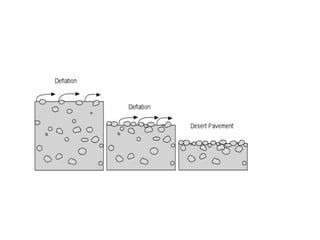
• Deflation ; is the removal of rock waste
from the land by wind
– Blowout or deflation hollow ; depression
caused by deflation due to lack of
vegetation to hold material down
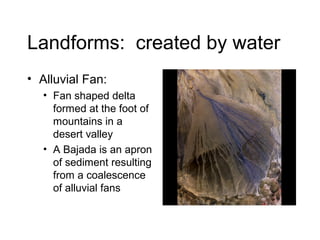
Landforms: created by water
• Alluvial Fan:
• Fan shaped delta
formed at the foot of
mountains in a
desert valley
• A Bajada is an apron
of sediment resulting
from a coalescence
of alluvial fans
Landforms : water
• Playa Lake:
– A temporary shallow
lake formed in the
central basin of a
desert during a rare
downpour
– A Playa is the dry flat
lake bed that
remains
Wind erosion processes:
• Deflation: removal of
rock waste from the
land by the wind
• Abrasion :
“sandblasting” effect
on materials caused
by the impact with
particles carried by
the wind
• Bedload:
– Saltation
– Suspension
– Particles are bounced
along the ground or
suspended in the air;
both these process erode
rock surfaces and carry
material
Sand Dunes:
• Many different types
but learn these:
• Barchan: crescent
shaped with convex
portion facing the
wind
• Formed with a
constant wind and
limited sand supply
• Longitudinal or seif
• Elongated in general
direction of wind
• Formed with slightly
different wind
directions and
limited sand supply
Inactive or stable dune:
• Parabolic Dune:
• Formed along
coastlines or large
lakes
• Winds cause
blowouts in sand
resulting in a
crescent shape with
convex side facing
the wind
Reg Deserts: little sand
Desert
Desert
Desert

Desert

  • 1.
  • 3.
    Deserts: definition • Aregion which has an arid climate or where evaporation exceeds precipitation • Steppe: region often adjacent to a desert • Semiarid climate: irregular precipitation, enough to generate minimal plant growth
  • 5.
    Desert and Steppeareas around the world:
  • 6.
    Deserts: • Cover afifth of the earth’s surface • Can be found at all altitudes and latitudes • Four physical factors cause deserts : all are influenced by prevailing winds a. Continentality b. Lee side of mountains c. Cold ocean currents d. Prevailing winds
  • 7.
    Prevailing Winds: • Found30 n and s latitude due to the global wind circulation system • Descending air masses are compressed, warm and absorb moisture
  • 9.
  • 10.
  • 11.
    Desert Erosion: Water •Seldom rains in desert regions • When it does massive DOWNPOUR or it’s called a FLASHFLOOD • Dry weathered soil, and minimal vegetation to anchor the soil causes rapid erosion • Rainwater carries sediment away and deposits it on the valley floor • Within 10 to 20 minutes the rain is gone and the water has evaporated
  • 14.
    Wind erosion processes: •Deflation ; is the removal of rock waste from the land by wind – Blowout or deflation hollow ; depression caused by deflation due to lack of vegetation to hold material down
  • 15.
    Landforms: created bywater • Alluvial Fan: • Fan shaped delta formed at the foot of mountains in a desert valley • A Bajada is an apron of sediment resulting from a coalescence of alluvial fans
  • 17.
    Landforms : water •Playa Lake: – A temporary shallow lake formed in the central basin of a desert during a rare downpour – A Playa is the dry flat lake bed that remains
  • 19.
    Wind erosion processes: •Deflation: removal of rock waste from the land by the wind • Abrasion : “sandblasting” effect on materials caused by the impact with particles carried by the wind
  • 20.
    • Bedload: – Saltation –Suspension – Particles are bounced along the ground or suspended in the air; both these process erode rock surfaces and carry material
  • 21.
    Sand Dunes: • Manydifferent types but learn these: • Barchan: crescent shaped with convex portion facing the wind • Formed with a constant wind and limited sand supply
  • 22.
    • Longitudinal orseif • Elongated in general direction of wind • Formed with slightly different wind directions and limited sand supply
  • 23.
    Inactive or stabledune: • Parabolic Dune: • Formed along coastlines or large lakes • Winds cause blowouts in sand resulting in a crescent shape with convex side facing the wind
  • 24.