OFFICIAL COMPOUNDS OF IODINE
Presented By
Ms. Monika P. Maske
M. Pharm
(Pharmaceutical Chemistry)
Kamla Nehru College of Pharmacy,
Butibori, Nagpur
IODINE
Introduction
o Iodine (as iodide) is one of essential trace element.
o Iodide with food after absorption reaches blood circulation.
o Play important role in synthesis of two important thyroid
hormones known as thyroxine & triiodothyronine.
o Its essential for the normal growth & development
o Play a important role in energy metabolism
STRUCTURE OF THYROXINE &
TRIIODOTHYRONINE
IODINE
o Thyroxine important function is to increase the metabolic rate
by increasing the oxidative process.
o Deficiency of thyroid causes “hypothyroidism”, Cretinism.
o Metabolic processes are slowed down & gaiter characterised
by swelling of neck.
o Male usual requirement of iodine is about 140 micrograms &
female about 100 microgram daily usually obtained from diet.
IODINE
IODINE
o After internal administered iodide is oxidised to iodine.
o Then converted to an amino acid tyrosine to form monoiodo and
diiodo tyrosine.
o It again converted to triodo and tetraiodo tyrosine by coupling
reactions.
o Using radioactive iodide, iodine is incorporated in thyroid gland only
for forming the thyroid hormones.
IODINE
1. Physical properties:
o Symbol- I2
o Mol. weight- 253.8
o Colour- Bluish-black rhombic prism or plates
o Odour- Irritating odour
o Taste- Pungent tase
o Solubility- Insoluble in water
- soluble in alcohol, freely soluble in chloroform,
ether
IODINE
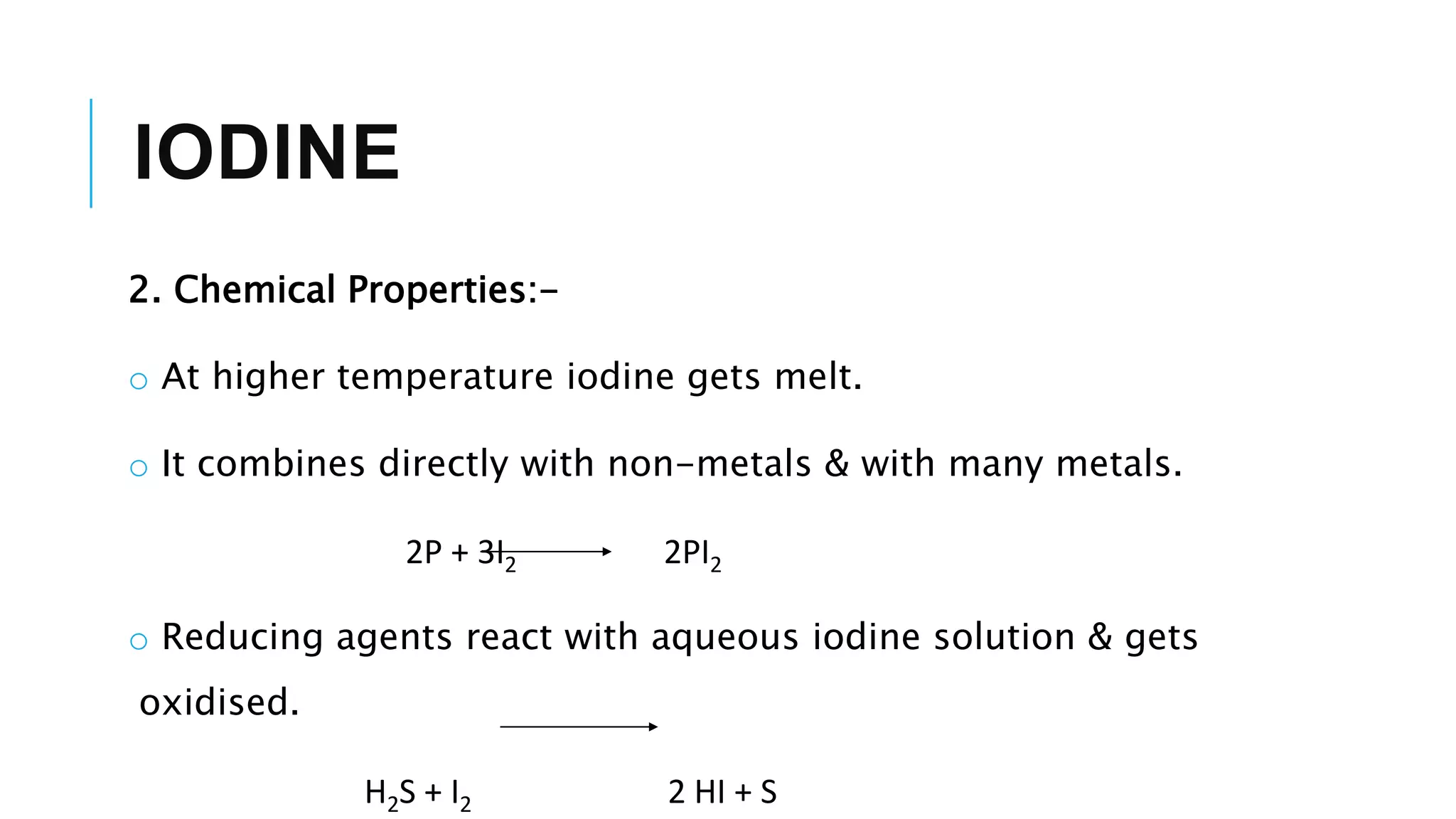
2. Chemical Properties:-
o At higher temperature iodine gets melt.
o It combines directly with non-metals & with many metals.
2P + 3I2 2PI2
o Reducing agents react with aqueous iodine solution & gets
oxidised.
H2S + I2 2 HI + S
IODINE
o Iodine react with alkali to form iodide & iodate especially when
heated.
3I2 + 6NaOH 5NaI + NaIO3 + 3H2O
o Potassium iodine dissolves in iodine because of formation of
ion
KI + I2 KI3
o Iodine add to unsaturated compounds & unsaturated acids
present in oil.
o This principal reaction used in the preparation of non-staining
iodine ointment.
PREPARATION
o Iodine mfg. by extracting kelp (seaweed ash) with water, the
solution is concentrated.
o The sodium and potassium are crystals out.
o leaving freely soluble sodium & potassium iodide in the
mother liquor.
o Sulphuric acid is added to mother liquor & sulphur allowed to
settle.
PREPARATION
2NaI + 3H2SO4 + MnO2 MnSO4 + 2NaHSO4 + 2 NaHSO4 + I2 + 2H2O
o Impurities like ICl, IBr, and ICN are removed by heating crude iodine with
potassium iodide.
ICl + KI KCl + I2
ASSAY
o Iodine is analysed by oxidation-reduction method.
o 0.5 g of iodine + potassium iodide + 5 ml of water +
dissolved +dilute with 50 ml of water.
o Acidify with 1 ml of acetic acid + using starch as indicator.
oTitrated with 0.1 N sodium thiosulphate solution.
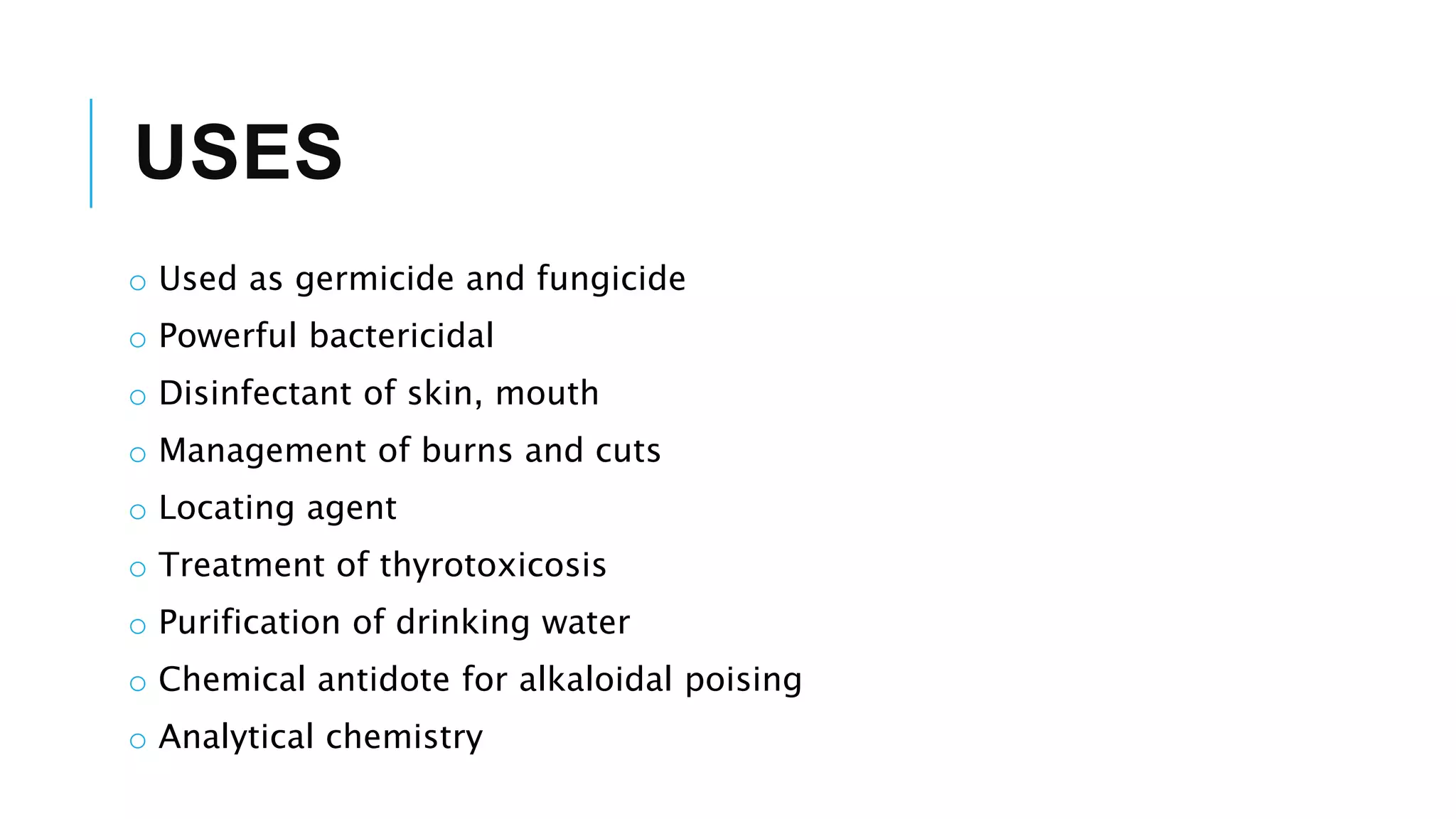
USES
o Used as germicide and fungicide
o Powerful bactericidal
o Disinfectant of skin, mouth
o Management of burns and cuts
o Locating agent
o Treatment of thyrotoxicosis
o Purification of drinking water
o Chemical antidote for alkaloidal poising
o Analytical chemistry
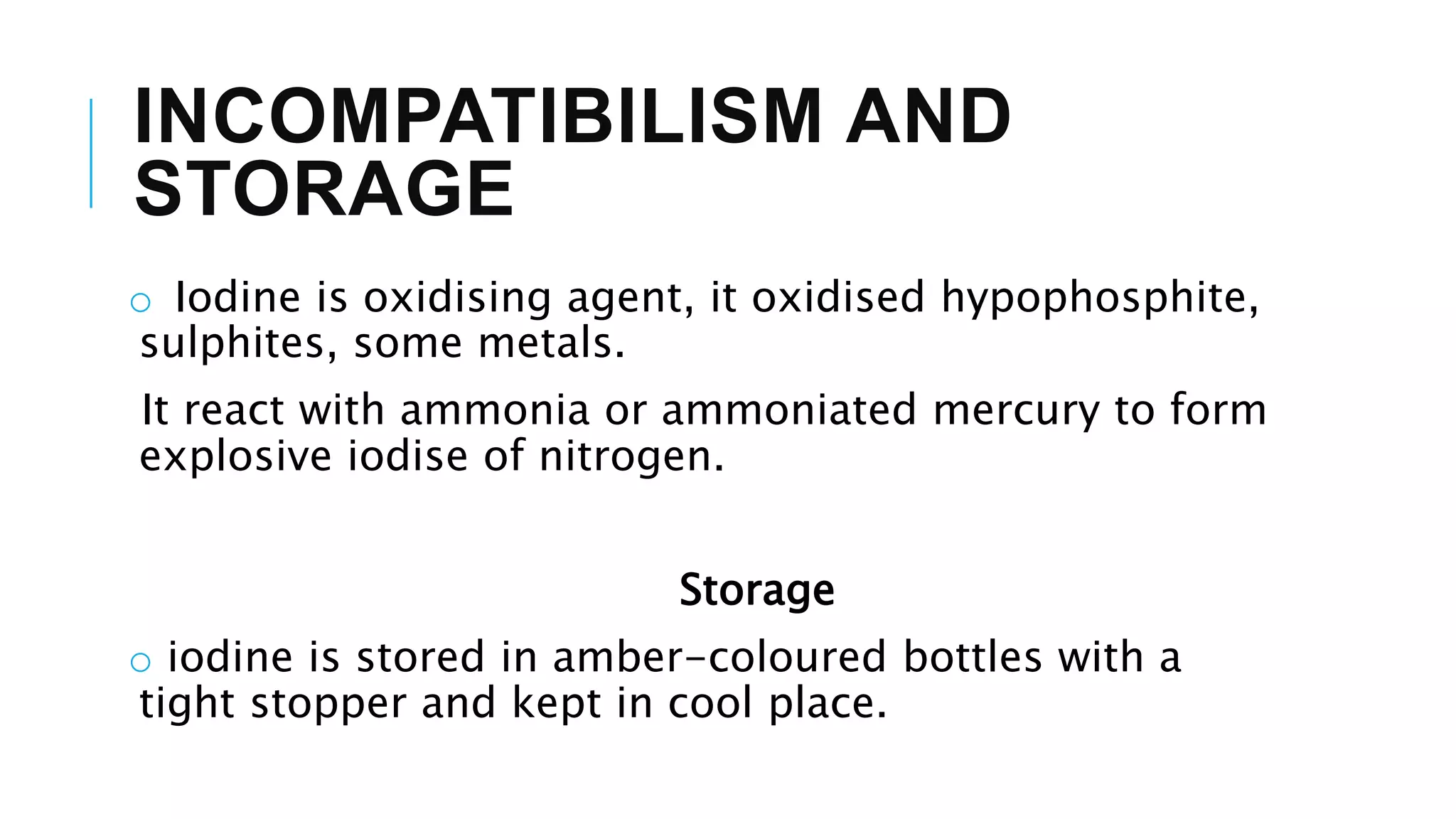
INCOMPATIBILISM AND
STORAGE
o Iodine is oxidising agent, it oxidised hypophosphite,
sulphites, some metals.
It react with ammonia or ammoniated mercury to form
explosive iodise of nitrogen.
Storage
o iodine is stored in amber-coloured bottles with a
tight stopper and kept in cool place.
COMPOUND CONTAINING
IODINE
A. Sodium iodide
1. Physical properties:-
Symbol- NaI
Mol. weight- 149.9
Colour- Colourless crystals or white crystalline powder
Odour- Odourless
Nature- Hygroscopic
Solubility- Soluble in water & alcohol
SODIUM IODIDE
2. Chemical properties:-
o Its stable in dry air but may decompose on storage & develop
brown colour.
o The aqueous solution gives yellow ppt. with sliver nitrate.
NaI + AgNO3 AgI + NaN3
PREPARATION
o Take slightly excess amount of iodine + conc. of sodium
hydroxide.
it gives the mixture of sodium iodate & potassium iodate.
o The reaction mixture evaporate to dryness.
o Residue is treated with carbon to convert sodium iodate into
sodium iodide.
6 NaOH + 3 I2 5 NaI + NaIO3 + 3H2O
NaIO3 + 3C NaI + 3CO
ASSAY
o 1.3 g of sodium iodide + 100 ml of water.
o 20 ml of this solution + 40 ml concentrated HCl mixed
properly.
o Titrated with 0.05 M potassium iodate until colour changes to
yellow.
o 5 ml of chloroform is added with continues stirring.
POTASSIUM IODIDE
Incompatibilities:-
both iodides get decomposed in presence of acid with
liberation of iodine.
Storage:-
sodium and potassium iodide stored in well closed
container and kept in dry place.
USES
o Used in treatment of thyroid gland
o Fibrolytic agent in syphilis and leprosy
o In fungal infection & actinomycosis
o As expectorant
o In asthma and chronic bronchitis
RADIOACTIVE IODINE &
SODIUM IODIDE
Introduction:-
o 131I is obtained by neutron irradiation of tellurium.
o Its used in the form of sodium iodide (131I).
o In 1988 sodium iodide (131I ) official in B.P.
o 131I in the form of sodium iodide and contains sodium thiosulphate or any other
reducing agent and may be suitably buffered.
RADIOACTIVE IODINE &
SODIUM IODIDE
1. Properties:-
o Colour- Clear colourless solution
o 131I having half life of 8.04 days
o It emits beta and gamma radiations
o pH between 7 – 10
ASSAY
o The activity is determined by comparison with a standardised iodine
– 131 solution.
o Using counting instrument.
o Its also tested for radionuclide purity and Radiochemical purity.
USES
o Radioactive iodine is most widely used for diagnosis of thyroid
function for treatment of hyperthyroidism.
o Thyroid cancer
o Diagnosis of hypothyroidism, hyperthyroidism and goitre.
o Grave’s disease
Official compound of Iodine

Official compound of Iodine

  • 1.
    OFFICIAL COMPOUNDS OFIODINE Presented By Ms. Monika P. Maske M. Pharm (Pharmaceutical Chemistry) Kamla Nehru College of Pharmacy, Butibori, Nagpur
  • 2.
    IODINE Introduction o Iodine (asiodide) is one of essential trace element. o Iodide with food after absorption reaches blood circulation. o Play important role in synthesis of two important thyroid hormones known as thyroxine & triiodothyronine. o Its essential for the normal growth & development o Play a important role in energy metabolism
  • 3.
    STRUCTURE OF THYROXINE& TRIIODOTHYRONINE
  • 4.
    IODINE o Thyroxine importantfunction is to increase the metabolic rate by increasing the oxidative process. o Deficiency of thyroid causes “hypothyroidism”, Cretinism. o Metabolic processes are slowed down & gaiter characterised by swelling of neck. o Male usual requirement of iodine is about 140 micrograms & female about 100 microgram daily usually obtained from diet.
  • 5.
  • 6.
    IODINE o After internaladministered iodide is oxidised to iodine. o Then converted to an amino acid tyrosine to form monoiodo and diiodo tyrosine. o It again converted to triodo and tetraiodo tyrosine by coupling reactions. o Using radioactive iodide, iodine is incorporated in thyroid gland only for forming the thyroid hormones.
  • 7.
    IODINE 1. Physical properties: oSymbol- I2 o Mol. weight- 253.8 o Colour- Bluish-black rhombic prism or plates o Odour- Irritating odour o Taste- Pungent tase o Solubility- Insoluble in water - soluble in alcohol, freely soluble in chloroform, ether
  • 8.
    IODINE 2. Chemical Properties:- oAt higher temperature iodine gets melt. o It combines directly with non-metals & with many metals. 2P + 3I2 2PI2 o Reducing agents react with aqueous iodine solution & gets oxidised. H2S + I2 2 HI + S
  • 9.
    IODINE o Iodine reactwith alkali to form iodide & iodate especially when heated. 3I2 + 6NaOH 5NaI + NaIO3 + 3H2O o Potassium iodine dissolves in iodine because of formation of ion KI + I2 KI3 o Iodine add to unsaturated compounds & unsaturated acids present in oil. o This principal reaction used in the preparation of non-staining iodine ointment.
  • 10.
    PREPARATION o Iodine mfg.by extracting kelp (seaweed ash) with water, the solution is concentrated. o The sodium and potassium are crystals out. o leaving freely soluble sodium & potassium iodide in the mother liquor. o Sulphuric acid is added to mother liquor & sulphur allowed to settle.
  • 11.
    PREPARATION 2NaI + 3H2SO4+ MnO2 MnSO4 + 2NaHSO4 + 2 NaHSO4 + I2 + 2H2O o Impurities like ICl, IBr, and ICN are removed by heating crude iodine with potassium iodide. ICl + KI KCl + I2
  • 12.
    ASSAY o Iodine isanalysed by oxidation-reduction method. o 0.5 g of iodine + potassium iodide + 5 ml of water + dissolved +dilute with 50 ml of water. o Acidify with 1 ml of acetic acid + using starch as indicator. oTitrated with 0.1 N sodium thiosulphate solution.
  • 13.
    USES o Used asgermicide and fungicide o Powerful bactericidal o Disinfectant of skin, mouth o Management of burns and cuts o Locating agent o Treatment of thyrotoxicosis o Purification of drinking water o Chemical antidote for alkaloidal poising o Analytical chemistry
  • 14.
    INCOMPATIBILISM AND STORAGE o Iodineis oxidising agent, it oxidised hypophosphite, sulphites, some metals. It react with ammonia or ammoniated mercury to form explosive iodise of nitrogen. Storage o iodine is stored in amber-coloured bottles with a tight stopper and kept in cool place.
  • 15.
    COMPOUND CONTAINING IODINE A. Sodiumiodide 1. Physical properties:- Symbol- NaI Mol. weight- 149.9 Colour- Colourless crystals or white crystalline powder Odour- Odourless Nature- Hygroscopic Solubility- Soluble in water & alcohol
  • 16.
    SODIUM IODIDE 2. Chemicalproperties:- o Its stable in dry air but may decompose on storage & develop brown colour. o The aqueous solution gives yellow ppt. with sliver nitrate. NaI + AgNO3 AgI + NaN3
  • 17.
    PREPARATION o Take slightlyexcess amount of iodine + conc. of sodium hydroxide. it gives the mixture of sodium iodate & potassium iodate. o The reaction mixture evaporate to dryness. o Residue is treated with carbon to convert sodium iodate into sodium iodide. 6 NaOH + 3 I2 5 NaI + NaIO3 + 3H2O NaIO3 + 3C NaI + 3CO
  • 18.
    ASSAY o 1.3 gof sodium iodide + 100 ml of water. o 20 ml of this solution + 40 ml concentrated HCl mixed properly. o Titrated with 0.05 M potassium iodate until colour changes to yellow. o 5 ml of chloroform is added with continues stirring.
  • 19.
    POTASSIUM IODIDE Incompatibilities:- both iodidesget decomposed in presence of acid with liberation of iodine. Storage:- sodium and potassium iodide stored in well closed container and kept in dry place.
  • 20.
    USES o Used intreatment of thyroid gland o Fibrolytic agent in syphilis and leprosy o In fungal infection & actinomycosis o As expectorant o In asthma and chronic bronchitis
  • 21.
    RADIOACTIVE IODINE & SODIUMIODIDE Introduction:- o 131I is obtained by neutron irradiation of tellurium. o Its used in the form of sodium iodide (131I). o In 1988 sodium iodide (131I ) official in B.P. o 131I in the form of sodium iodide and contains sodium thiosulphate or any other reducing agent and may be suitably buffered.
  • 22.
    RADIOACTIVE IODINE & SODIUMIODIDE 1. Properties:- o Colour- Clear colourless solution o 131I having half life of 8.04 days o It emits beta and gamma radiations o pH between 7 – 10
  • 23.
    ASSAY o The activityis determined by comparison with a standardised iodine – 131 solution. o Using counting instrument. o Its also tested for radionuclide purity and Radiochemical purity.
  • 24.
    USES o Radioactive iodineis most widely used for diagnosis of thyroid function for treatment of hyperthyroidism. o Thyroid cancer o Diagnosis of hypothyroidism, hyperthyroidism and goitre. o Grave’s disease