Lessons from a model of public
    participation in environmental
         enforcement in India
LOCAL AREA ENVIRONMENT COMMITTEES

                RAJESH RANGARAJAN
                  Senior Researcher
        Centre for Development Finance, IFMR


            PAC Colloquim on Citizens’ Voices in
                  Environmental Governance
               Bangalore International Centre
                        24-08-2012
Environmental Governance & Enforcement
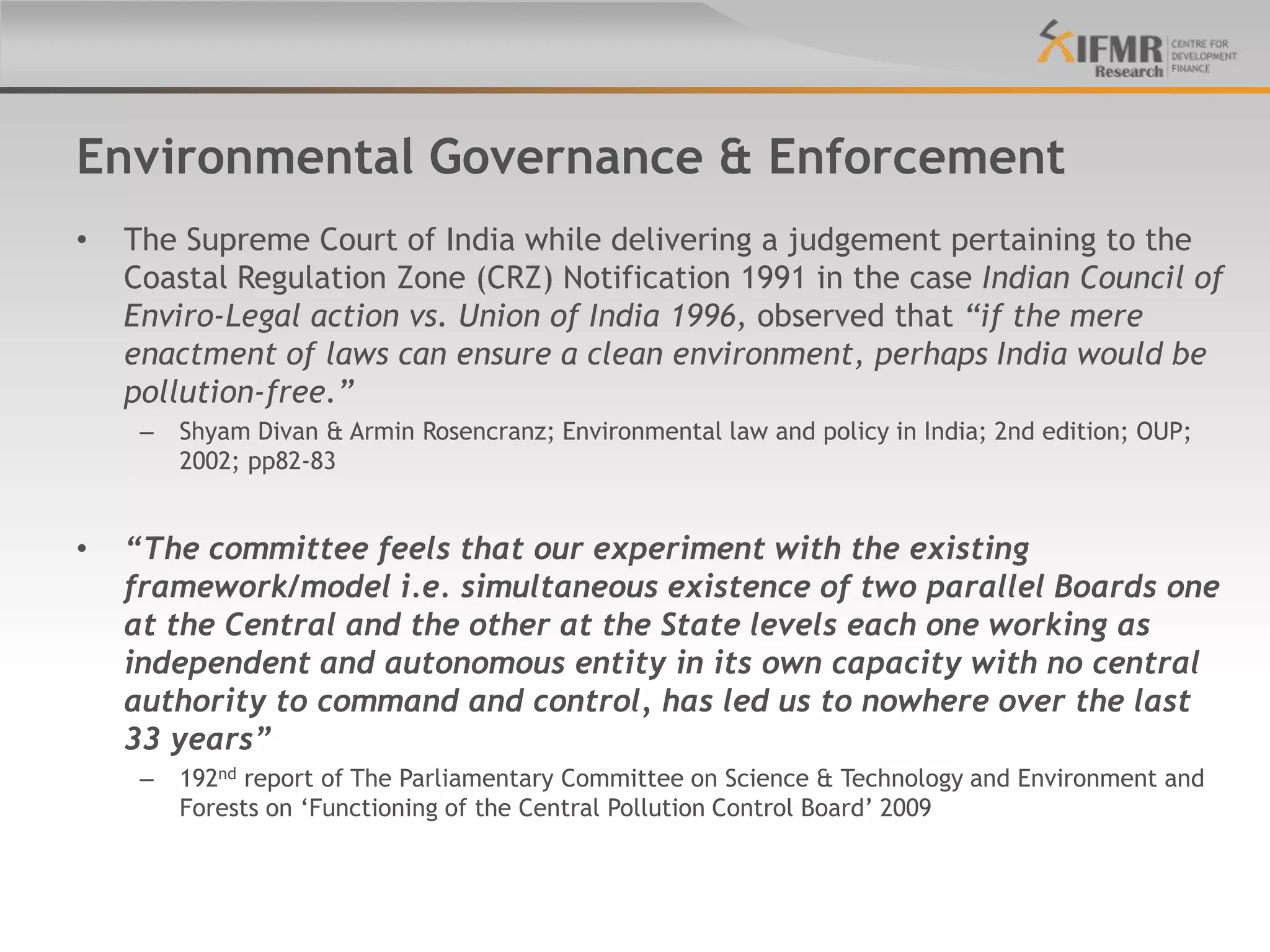
•   The Supreme Court of India while delivering a judgement pertaining to the
    Coastal Regulation Zone (CRZ) Notification 1991 in the case Indian Council of
    Enviro-Legal action vs. Union of India 1996, observed that “if the mere
    enactment of laws can ensure a clean environment, perhaps India would be
    pollution-free.”
     –   Shyam Divan & Armin Rosencranz; Environmental law and policy in India; 2nd edition; OUP;
         2002; pp82-83


•   “The committee feels that our experiment with the existing
    framework/model i.e. simultaneous existence of two parallel Boards one
    at the Central and the other at the State levels each one working as
    independent and autonomous entity in its own capacity with no central
    authority to command and control, has led us to nowhere over the last
    33 years”
     –   192nd report of The Parliamentary Committee on Science & Technology and Environment and
         Forests on „Functioning of the Central Pollution Control Board‟ 2009
Gaps in Environmental Governance

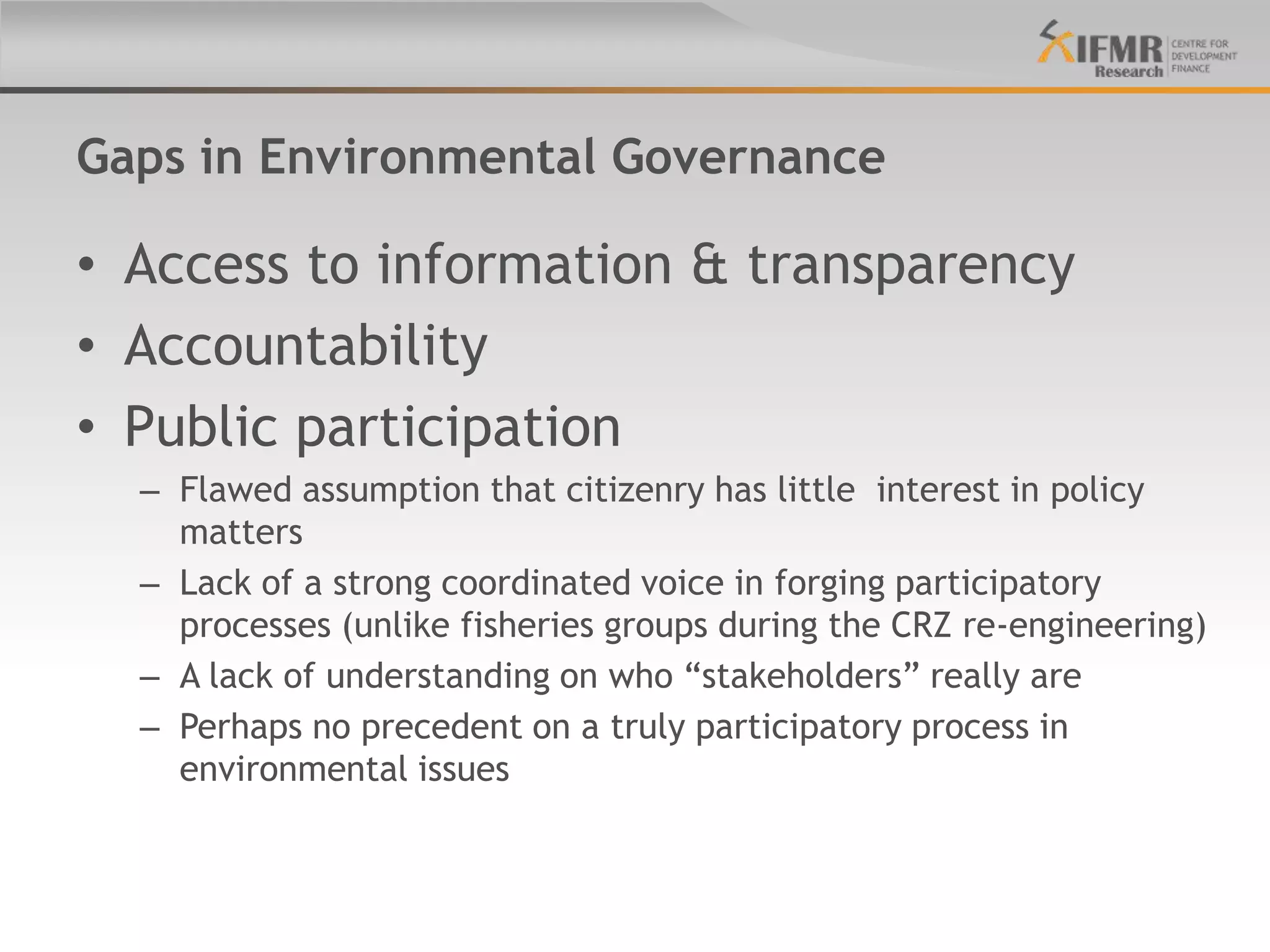
• Access to information & transparency
• Accountability
• Public participation
  – Flawed assumption that citizenry has little interest in policy
    matters
  – Lack of a strong coordinated voice in forging participatory
    processes (unlike fisheries groups during the CRZ re-engineering)
  – A lack of understanding on who “stakeholders” really are
  – Perhaps no precedent on a truly participatory process in
    environmental issues
Case Study: SC, HazWaste, LAEC

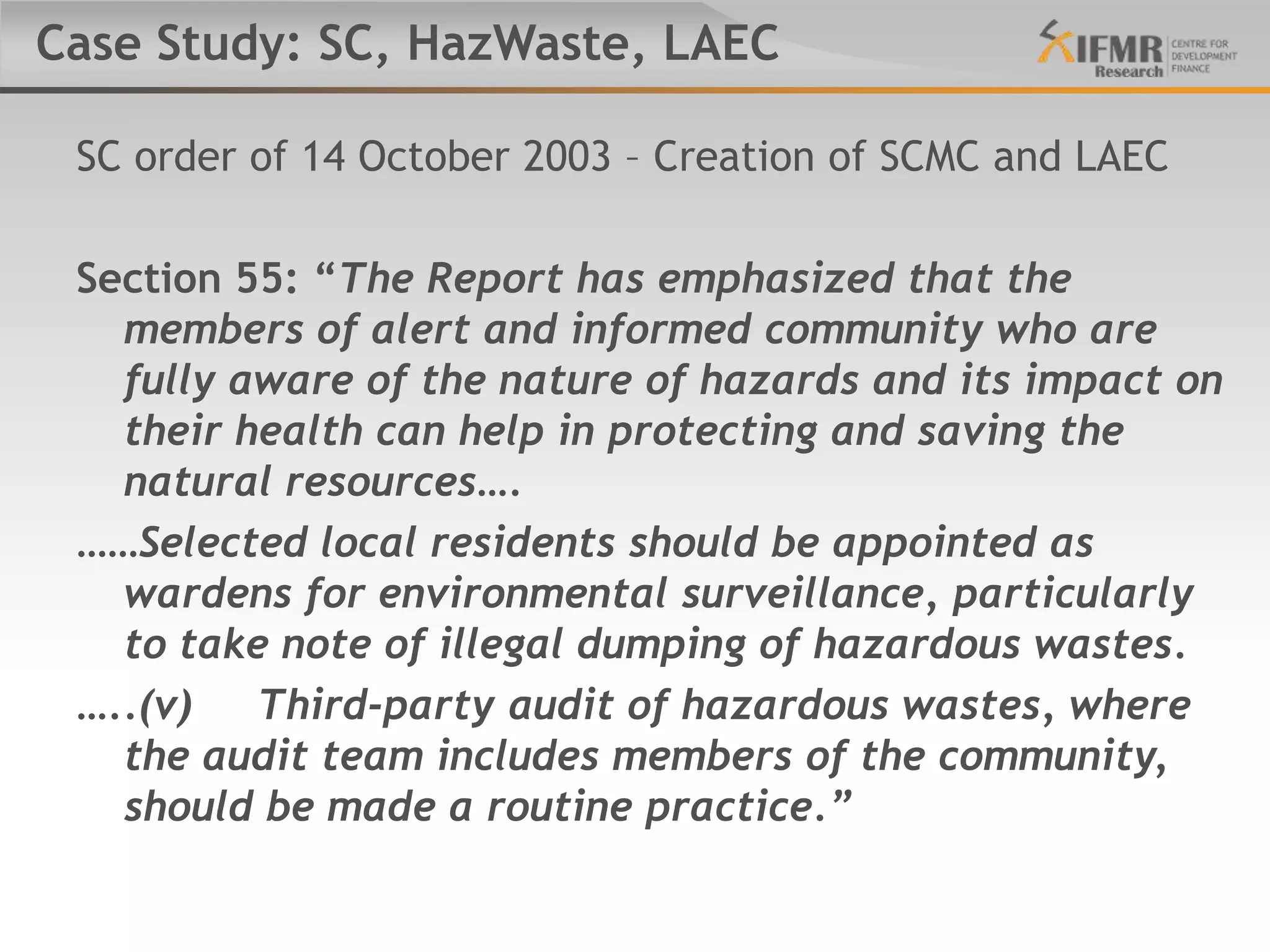
 SC order of 14 October 2003 – Creation of SCMC and LAEC

 Section 55: “The Report has emphasized that the
   members of alert and informed community who are
   fully aware of the nature of hazards and its impact on
   their health can help in protecting and saving the
   natural resources….
 ……Selected local residents should be appointed as
   wardens for environmental surveillance, particularly
   to take note of illegal dumping of hazardous wastes.
 …..(v)   Third-party audit of hazardous wastes, where
   the audit team includes members of the community,
   should be made a routine practice.”
Case Study: SC, HazWaste, LAEC

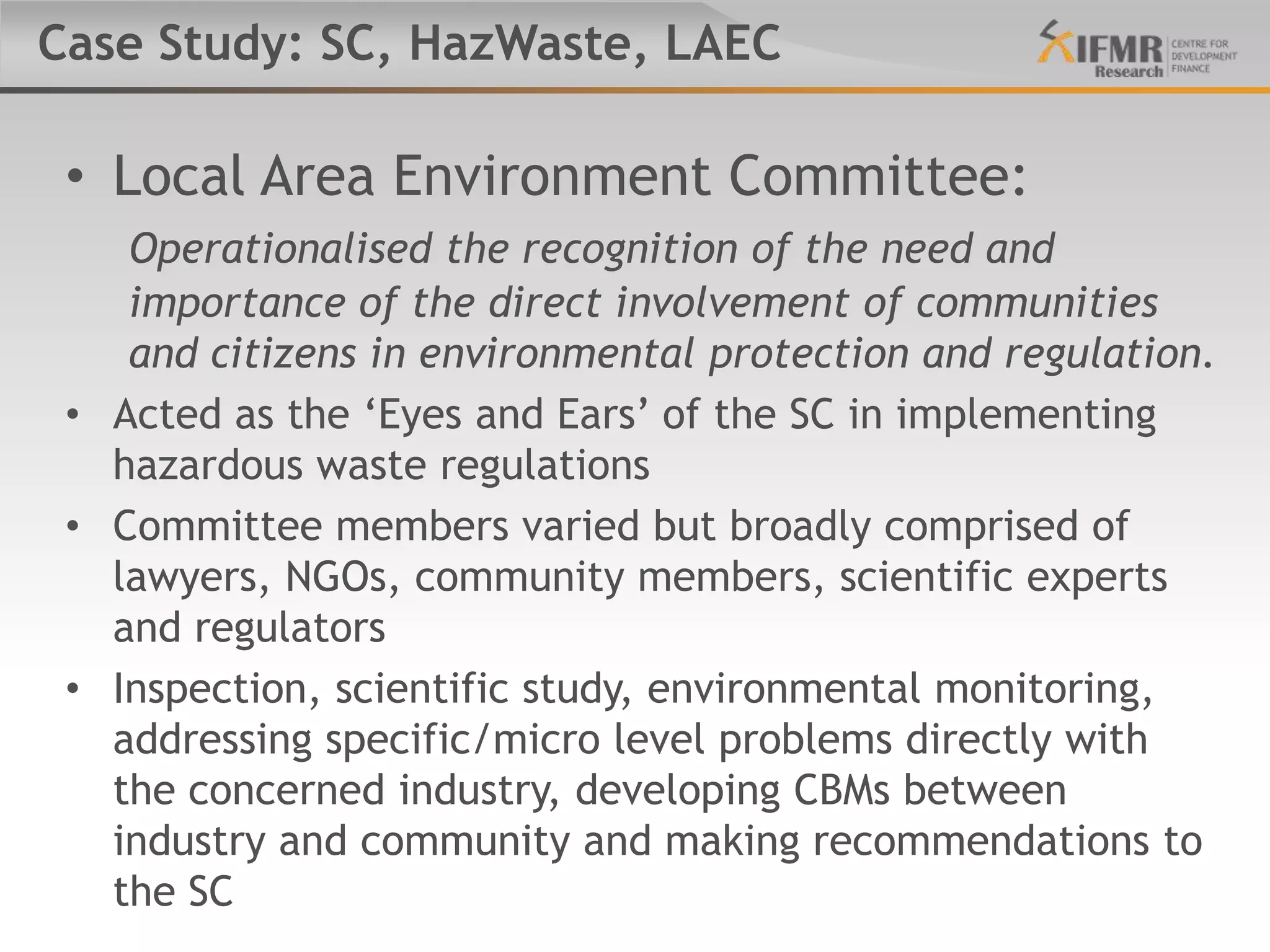
 • Local Area Environment Committee:
    Operationalised the recognition of the need and
    importance of the direct involvement of communities
    and citizens in environmental protection and regulation.
 • Acted as the „Eyes and Ears‟ of the SC in implementing
   hazardous waste regulations
 • Committee members varied but broadly comprised of
   lawyers, NGOs, community members, scientific experts
   and regulators
 • Inspection, scientific study, environmental monitoring,
   addressing specific/micro level problems directly with
   the concerned industry, developing CBMs between
   industry and community and making recommendations to
   the SC
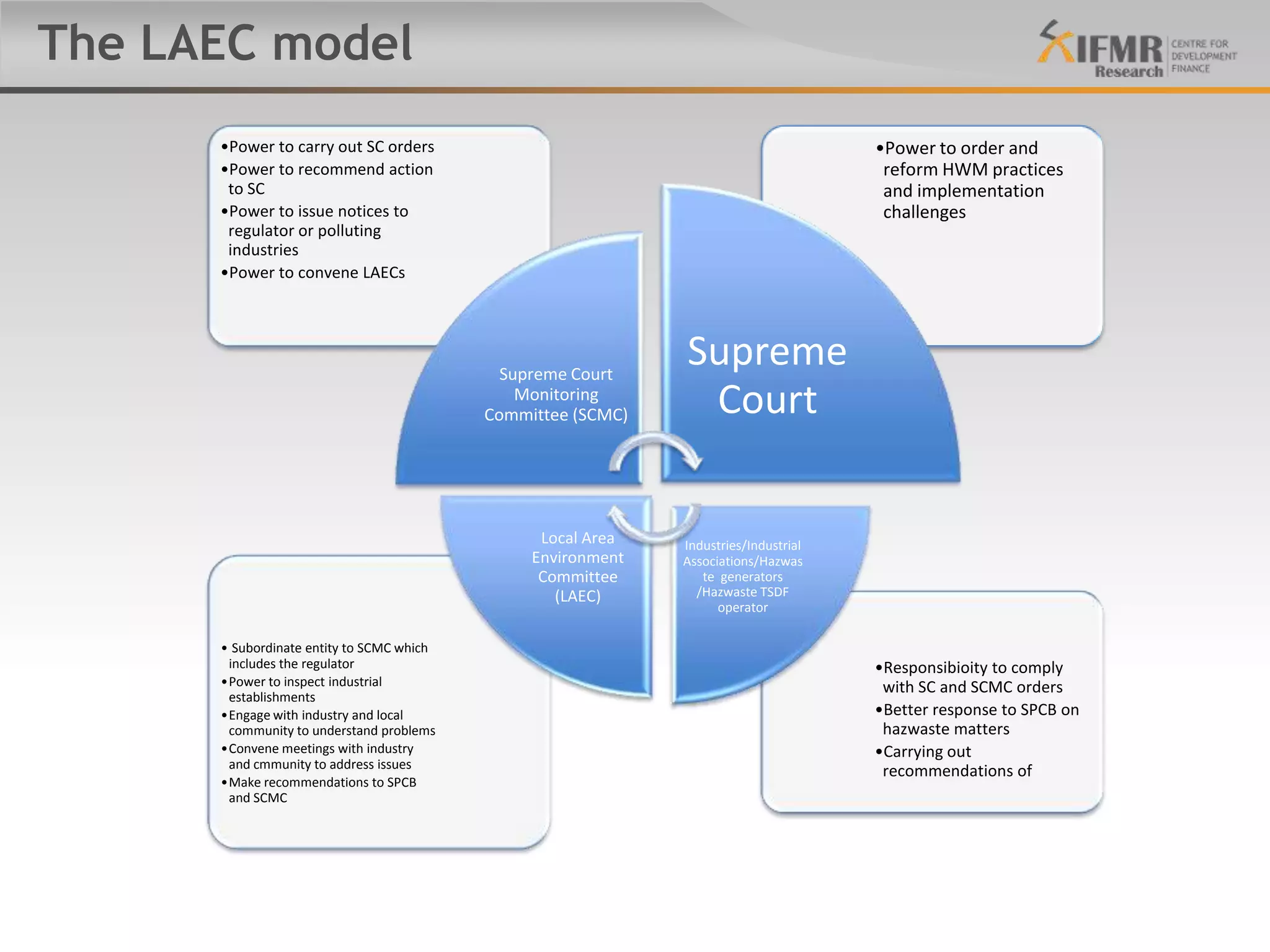
The LAEC model
      •Power to carry out SC orders                                                   •Power to order and
      •Power to recommend action                                                       reform HWM practices
       to SC                                                                           and implementation
      •Power to issue notices to                                                       challenges
       regulator or polluting
       industries
      •Power to convene LAECs


                                             Supreme Court
                                                              Supreme
                                               Monitoring
                                           Committee (SCMC)    Court

                                                 Local Area   Industries/Industrial
                                                Environment   Associations/Hazwas
                                                 Committee       te generators
                                                   (LAEC)       /Hazwaste TSDF
                                                                    operator

      • Subordinate entity to SCMC which
       includes the regulator                                                         •Responsibioity to comply
      •Power to inspect industrial                                                     with SC and SCMC orders
       establishments
      •Engage with industry and local                                                 •Better response to SPCB on
       community to understand problems                                                hazwaste matters
      •Convene meetings with industry                                                 •Carrying out
       and cmmunity to address issues
                                                                                       recommendations of
      •Make recommendations to SPCB
       and SCMC
Trends in Public Participation in Environment

 • 90‟s – Golden era of PILs
 • 2000 – 2010: growing demand for public
   participation in policy formulation and
   decision making
 • Cases/trends:
    – Urban/city master planning (Bangalore & Chennai)
    – EIA & public hearing
    – Consultations/consultative mechanisms (NBSAP, CRZ
      2011)
 • LAEC – A unique and fairly participatory
   model in environmental matters
Lessons/Outcomes of the LAEC model

 • Levels of participation – Generally acknowledged
   as positive. But defining who should be included
   in the LAEC, was it truly democratic and
   representative?
 • Improve implementation/governance – Provided
   temporary solace, resulted in some good
   outcomes (AQ monitoring station, provision of fresh water, in
   some cases even closure of industries). Did it really make
   significant and lasting changes in the way the
   issue was governed (Eg: improvements in the way
   SPCB functioned?
Lessons/outcomes of LAEC contd...

 • Improving resolution of information –
   created a significant body of literature and
   addressed the generally prevailing
   asymmetry in information in court cases.
 • All-round capacity building:
   – Community could understand science
   – Regulators could deal with problems in a more
     targeted way
   – Industries were educated more on the range
     and diversity of environmental problems and
     community needs/demands
Challenges in integrating citizen voices

• The LAEC model may not be the panacea,
  however exploring the elements of this
  model from the lens of :
  – Replicability?
  – Sustainability?
  – Institutionalisation?


• Can the colloquim address this?
Thank you


A1, 10th Floor | IIT Madras Research Park | Kanagam Road | Taramani | Chennai - 600113
                                    www.ifmr-cdf.in

Local Area Environment Committees: Lessons from a model of public participation in environmental enforcement in India

  • 1.
    Lessons from amodel of public participation in environmental enforcement in India LOCAL AREA ENVIRONMENT COMMITTEES RAJESH RANGARAJAN Senior Researcher Centre for Development Finance, IFMR PAC Colloquim on Citizens’ Voices in Environmental Governance Bangalore International Centre 24-08-2012
  • 2.
    Environmental Governance &Enforcement • The Supreme Court of India while delivering a judgement pertaining to the Coastal Regulation Zone (CRZ) Notification 1991 in the case Indian Council of Enviro-Legal action vs. Union of India 1996, observed that “if the mere enactment of laws can ensure a clean environment, perhaps India would be pollution-free.” – Shyam Divan & Armin Rosencranz; Environmental law and policy in India; 2nd edition; OUP; 2002; pp82-83 • “The committee feels that our experiment with the existing framework/model i.e. simultaneous existence of two parallel Boards one at the Central and the other at the State levels each one working as independent and autonomous entity in its own capacity with no central authority to command and control, has led us to nowhere over the last 33 years” – 192nd report of The Parliamentary Committee on Science & Technology and Environment and Forests on „Functioning of the Central Pollution Control Board‟ 2009
  • 3.
    Gaps in EnvironmentalGovernance • Access to information & transparency • Accountability • Public participation – Flawed assumption that citizenry has little interest in policy matters – Lack of a strong coordinated voice in forging participatory processes (unlike fisheries groups during the CRZ re-engineering) – A lack of understanding on who “stakeholders” really are – Perhaps no precedent on a truly participatory process in environmental issues
  • 4.
    Case Study: SC,HazWaste, LAEC SC order of 14 October 2003 – Creation of SCMC and LAEC Section 55: “The Report has emphasized that the members of alert and informed community who are fully aware of the nature of hazards and its impact on their health can help in protecting and saving the natural resources…. ……Selected local residents should be appointed as wardens for environmental surveillance, particularly to take note of illegal dumping of hazardous wastes. …..(v) Third-party audit of hazardous wastes, where the audit team includes members of the community, should be made a routine practice.”
  • 5.
    Case Study: SC,HazWaste, LAEC • Local Area Environment Committee: Operationalised the recognition of the need and importance of the direct involvement of communities and citizens in environmental protection and regulation. • Acted as the „Eyes and Ears‟ of the SC in implementing hazardous waste regulations • Committee members varied but broadly comprised of lawyers, NGOs, community members, scientific experts and regulators • Inspection, scientific study, environmental monitoring, addressing specific/micro level problems directly with the concerned industry, developing CBMs between industry and community and making recommendations to the SC
  • 6.
    The LAEC model •Power to carry out SC orders •Power to order and •Power to recommend action reform HWM practices to SC and implementation •Power to issue notices to challenges regulator or polluting industries •Power to convene LAECs Supreme Court Supreme Monitoring Committee (SCMC) Court Local Area Industries/Industrial Environment Associations/Hazwas Committee te generators (LAEC) /Hazwaste TSDF operator • Subordinate entity to SCMC which includes the regulator •Responsibioity to comply •Power to inspect industrial with SC and SCMC orders establishments •Engage with industry and local •Better response to SPCB on community to understand problems hazwaste matters •Convene meetings with industry •Carrying out and cmmunity to address issues recommendations of •Make recommendations to SPCB and SCMC
  • 7.
    Trends in PublicParticipation in Environment • 90‟s – Golden era of PILs • 2000 – 2010: growing demand for public participation in policy formulation and decision making • Cases/trends: – Urban/city master planning (Bangalore & Chennai) – EIA & public hearing – Consultations/consultative mechanisms (NBSAP, CRZ 2011) • LAEC – A unique and fairly participatory model in environmental matters
  • 8.
    Lessons/Outcomes of theLAEC model • Levels of participation – Generally acknowledged as positive. But defining who should be included in the LAEC, was it truly democratic and representative? • Improve implementation/governance – Provided temporary solace, resulted in some good outcomes (AQ monitoring station, provision of fresh water, in some cases even closure of industries). Did it really make significant and lasting changes in the way the issue was governed (Eg: improvements in the way SPCB functioned?
  • 9.
    Lessons/outcomes of LAECcontd... • Improving resolution of information – created a significant body of literature and addressed the generally prevailing asymmetry in information in court cases. • All-round capacity building: – Community could understand science – Regulators could deal with problems in a more targeted way – Industries were educated more on the range and diversity of environmental problems and community needs/demands
  • 10.
    Challenges in integratingcitizen voices • The LAEC model may not be the panacea, however exploring the elements of this model from the lens of : – Replicability? – Sustainability? – Institutionalisation? • Can the colloquim address this?
  • 11.
    Thank you A1, 10thFloor | IIT Madras Research Park | Kanagam Road | Taramani | Chennai - 600113 www.ifmr-cdf.in