Legal Aspects Of Transboundary River Basin Management
And Policy Guidelines Using Strategic
Environmental Assessment As A Tool For
Chenab River Basin Management
Dr. Bilal Ahmad Zafar Amin, Kinza Irshad
Department of Environmental Sciences, CUI,
Abbottabad
TRANSBOUNDARY RIVER BASIN MANAGEMENT
• Trans-boundary river management is a historical challenge between river basins sharing
countries across the globe.
• Climate change and rapid population growth adds to further hydropolitical conflicts over
distribution of water and river resources, thus has becoming key challenges in South Asia.
• Trans-boundary river conflicts and hydropolitical tensions have been increasing between
India and Pakistan over time
• The cascade of hydropower and damming projects on the Chenab River Basin (CRB)
further increases conflicts between two states.
COMSATS University Islamabad, Abbottabad campus
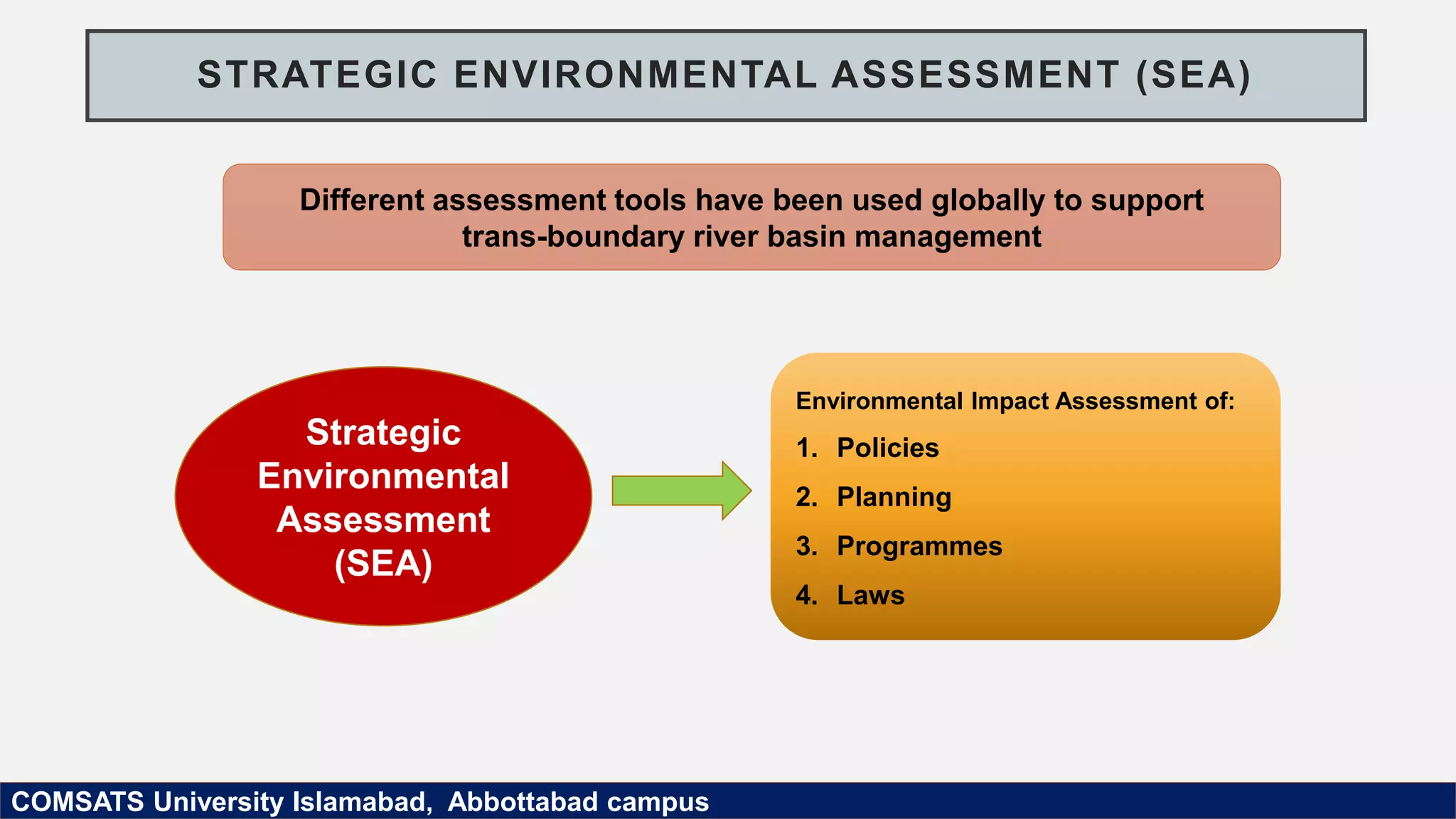
STRATEGIC ENVIRONMENTAL ASSESSMENT (SEA)
COMSATS University Islamabad, Abbottabad campus
Different assessment tools have been used globally to support
trans-boundary river basin management
Strategic
Environmental
Assessment
(SEA)
Environmental Impact Assessment of:
1. Policies
2. Planning
3. Programmes
4. Laws
ADVANTAGES OF STRATEGIC ENVIRONMENTAL ASSESSMENT (SEA)
• Aims to avoid conflicts, and to support socio-environmental integration and
environmental friendly decision making
• Provide an early platform for consultation amongst key stakeholders for river basin
sharing countries
• SEA acts as a planning instrument for trans-boundary river planning globally
CHENAB RIVER BASIN
• Chenab River is one of the natural resource of
Pakistan.
• It starts from Himalaya and its length is 960km.
• It is the significant part of irrigation system of
Pakistan
COMSATS University Islamabad, Abbottabad campus
OBJECTIVE
The study investigates the role of the SEA in the
Mekong and Mara river basins planning and its
compatibility for the Chenab River Basin (CRB)
COMSATS University Islamabad, Abbottabad campus
CHENAB RIVER BASIN
METHODOLOGY
COMSATS University Islamabad, Abbottabad campus
Review of academic literature
• Journals
• Books
• Thesis
• Treaties
• EIA and SEA reports
• Protocols
Structured interviews with two
international SEA experts, involved in SEA
of:
• Mekong River Basin
• Marra River Basin
Summary of factors and conditions of successful SEA of the
Mekong River Basin
S # Factors and conditions of successful SEA for the Mekong river basin
1 The Mekong River agreement of 1995 and Mekong River Commission
2 Obligation of prior consultation and notification on development plans
3 Availability of financial resource to conduct theSEA study
4 Continuous strategic planning cycle and The Initiative of sustainable hydropower programme of Mekong River
Commission
5 Stakeholder participation
6 Public awareness
7 Continuous studies about the impacts of hydropower plans on fisheries, livelihoods, and biodiversity and regional
SEA studies
8 Transboundary EIA/SEA guidelines of 2002 and 2010
Summary of factors and conditions of successful SEA of
the Mara River Basin
S # Factors and conditions of successful SEA for the Mara River Basin
1 The EAC agreement of 1999 and the protocol on environment and natural resource management of 2006.
2 Previous studies, including "Biodiversity policy and action plan and The assessment of Reserve Flows for the Mara
3 Lake Victoria Basin Commission with authority and commitment
4 Transboundary SEA/EIA guidelines of LVBC 2005
5 USAID, WWF and governments of Kenya and Tanzania support
6 Availability of financial resource
7 Political support from government and community
8 Continuous studies about the impacts of development activities on river hydrology, biodiversity and livelihoods
provided baseline information for SEA MRB
Summary of possible factors and conditions of successful
SEA of the Chenab River Basin
S # Success factors for the SEA Chenab River Basin
1 Indus Water Treaty of 1960 provides guidelines for further cooperation and addressing issues between India and
Pakistan.
2 Indus Water Commissions of India and Pakistan could be a vital platform to supervise SEA studies.
3 The SEA experience of India and Pakistan within countries can be replicated in trans-boundary prospective.
4 World Bank's role is important to increase cooperation between two countries for joint management ideas.
5 International development organizations provide support India and Pakistan to improve their environmental
assessment procedures and skills of officials.
6 Academic research, regional SEA/EIA studies and feasibility studies could be a good source of information for SEA of
Chenab River Basin
7 Hydrological and weather monitoring stations already exists on Indus Water System it could provide data for the SEA
study of the CRB
KEY FINDINGS
• The study shows that the major success conditions for the SEA study of
the Mekong River Basin included Mekong River Agreement of 1995.
• Similarly, the key success conditions for the SEA study of the Mara
River Basin included the East African Community agreement of 1999.
• The study documented possible success conditions for the SEA study
of the CRB including the Indus Water Treaty of 1960.
COMSATS University Islamabad, Abbottabad campus
CONCLUSION
• It is concluded that although the SEA as assessment tool provided interesting
contributions for the Mekong and Mara river management, the level of success was
limited because the recommendations were not accepted or partially implemented.
• Although, the CRB complies most of success factors and conditions of successful
SEA study, those which were recorded in the Mekong and Mara case studies except
the level of cooperation between India and Pakistan is limited and Indus Water Treaty
of 1960 is missing environment and joint management.
COMSATS University Islamabad, Abbottabad campus
ACKNOWLEDGMENTS
• literature consisted of academic literature (including journals, books,
and thesis), treaties, EIA/SEA methodology documents, protocol
documents, SEA reports and websites. The factors and conditions of
successful applications in these case studies were documented and
the investigation was based on predefined variables Additionally,
structured interviews were held with two international experts, who
were directly and indirectly involved in the SEA study of the Mekong
River Basin (MRB). The selection criteria for both case studies were
based on economies of countries, conflicts, level of cooperation and
trans-boundary river management agreements.

Strategic Environmental Assessment

  • 1.
    Legal Aspects OfTransboundary River Basin Management And Policy Guidelines Using Strategic Environmental Assessment As A Tool For Chenab River Basin Management Dr. Bilal Ahmad Zafar Amin, Kinza Irshad Department of Environmental Sciences, CUI, Abbottabad
  • 2.
    TRANSBOUNDARY RIVER BASINMANAGEMENT • Trans-boundary river management is a historical challenge between river basins sharing countries across the globe. • Climate change and rapid population growth adds to further hydropolitical conflicts over distribution of water and river resources, thus has becoming key challenges in South Asia. • Trans-boundary river conflicts and hydropolitical tensions have been increasing between India and Pakistan over time • The cascade of hydropower and damming projects on the Chenab River Basin (CRB) further increases conflicts between two states. COMSATS University Islamabad, Abbottabad campus
  • 3.
    STRATEGIC ENVIRONMENTAL ASSESSMENT(SEA) COMSATS University Islamabad, Abbottabad campus Different assessment tools have been used globally to support trans-boundary river basin management Strategic Environmental Assessment (SEA) Environmental Impact Assessment of: 1. Policies 2. Planning 3. Programmes 4. Laws
  • 4.
    ADVANTAGES OF STRATEGICENVIRONMENTAL ASSESSMENT (SEA) • Aims to avoid conflicts, and to support socio-environmental integration and environmental friendly decision making • Provide an early platform for consultation amongst key stakeholders for river basin sharing countries • SEA acts as a planning instrument for trans-boundary river planning globally
  • 5.
    CHENAB RIVER BASIN •Chenab River is one of the natural resource of Pakistan. • It starts from Himalaya and its length is 960km. • It is the significant part of irrigation system of Pakistan COMSATS University Islamabad, Abbottabad campus
  • 6.
    OBJECTIVE The study investigatesthe role of the SEA in the Mekong and Mara river basins planning and its compatibility for the Chenab River Basin (CRB) COMSATS University Islamabad, Abbottabad campus
  • 7.
  • 8.
    METHODOLOGY COMSATS University Islamabad,Abbottabad campus Review of academic literature • Journals • Books • Thesis • Treaties • EIA and SEA reports • Protocols Structured interviews with two international SEA experts, involved in SEA of: • Mekong River Basin • Marra River Basin
  • 9.
    Summary of factorsand conditions of successful SEA of the Mekong River Basin S # Factors and conditions of successful SEA for the Mekong river basin 1 The Mekong River agreement of 1995 and Mekong River Commission 2 Obligation of prior consultation and notification on development plans 3 Availability of financial resource to conduct theSEA study 4 Continuous strategic planning cycle and The Initiative of sustainable hydropower programme of Mekong River Commission 5 Stakeholder participation 6 Public awareness 7 Continuous studies about the impacts of hydropower plans on fisheries, livelihoods, and biodiversity and regional SEA studies 8 Transboundary EIA/SEA guidelines of 2002 and 2010
  • 10.
    Summary of factorsand conditions of successful SEA of the Mara River Basin S # Factors and conditions of successful SEA for the Mara River Basin 1 The EAC agreement of 1999 and the protocol on environment and natural resource management of 2006. 2 Previous studies, including "Biodiversity policy and action plan and The assessment of Reserve Flows for the Mara 3 Lake Victoria Basin Commission with authority and commitment 4 Transboundary SEA/EIA guidelines of LVBC 2005 5 USAID, WWF and governments of Kenya and Tanzania support 6 Availability of financial resource 7 Political support from government and community 8 Continuous studies about the impacts of development activities on river hydrology, biodiversity and livelihoods provided baseline information for SEA MRB
  • 11.
    Summary of possiblefactors and conditions of successful SEA of the Chenab River Basin S # Success factors for the SEA Chenab River Basin 1 Indus Water Treaty of 1960 provides guidelines for further cooperation and addressing issues between India and Pakistan. 2 Indus Water Commissions of India and Pakistan could be a vital platform to supervise SEA studies. 3 The SEA experience of India and Pakistan within countries can be replicated in trans-boundary prospective. 4 World Bank's role is important to increase cooperation between two countries for joint management ideas. 5 International development organizations provide support India and Pakistan to improve their environmental assessment procedures and skills of officials. 6 Academic research, regional SEA/EIA studies and feasibility studies could be a good source of information for SEA of Chenab River Basin 7 Hydrological and weather monitoring stations already exists on Indus Water System it could provide data for the SEA study of the CRB
  • 12.
    KEY FINDINGS • Thestudy shows that the major success conditions for the SEA study of the Mekong River Basin included Mekong River Agreement of 1995. • Similarly, the key success conditions for the SEA study of the Mara River Basin included the East African Community agreement of 1999. • The study documented possible success conditions for the SEA study of the CRB including the Indus Water Treaty of 1960. COMSATS University Islamabad, Abbottabad campus
  • 13.
    CONCLUSION • It isconcluded that although the SEA as assessment tool provided interesting contributions for the Mekong and Mara river management, the level of success was limited because the recommendations were not accepted or partially implemented. • Although, the CRB complies most of success factors and conditions of successful SEA study, those which were recorded in the Mekong and Mara case studies except the level of cooperation between India and Pakistan is limited and Indus Water Treaty of 1960 is missing environment and joint management. COMSATS University Islamabad, Abbottabad campus
  • 14.
  • 15.
    • literature consistedof academic literature (including journals, books, and thesis), treaties, EIA/SEA methodology documents, protocol documents, SEA reports and websites. The factors and conditions of successful applications in these case studies were documented and the investigation was based on predefined variables Additionally, structured interviews were held with two international experts, who were directly and indirectly involved in the SEA study of the Mekong River Basin (MRB). The selection criteria for both case studies were based on economies of countries, conflicts, level of cooperation and trans-boundary river management agreements.