CLEANER
PRODUCTION
TECHNIQUES
Farhan Ahmad
Department of Chemical Engineering
University of Engineering & Technology
Lahore.
Cleaner Production Techniques
- An Overview
By
Farhan Ahmad
farhanahmad@uet.edu.pk
DEPARTMENT OF CHEMICAL ENGINEERING
Course Details:
3
Subject
Subject code
Contact hours
Credit hours
Sessional
Mid term
Final term
Cleaner Production Techniques
Ch.E. - 320
2 + 3
2 + 1
30 % (Quizzes + Attendance + Class participation + Assignments)
30%
40%
Evaluation Procedure:
Course Outline
 Cleaner production and sustainable development; Cleaner production
principles and phases; cleaner production plans and strategies for
implementing cleaner production plans; cleaner production and eco-
efficiencies.
 Environmental management systems; closed loop operations; detailed
chemical/material flow analysis; renewable energy resources; life cycle
design and impact assessment.
 Waste minimization; re-use of waste products; specific examples from
industry where the methods of cleaner production have been applied. 4
5
Cleaner Production
- An Introduction
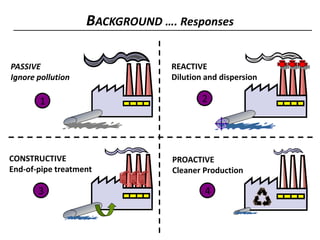
BACKGROUND …. Responses
PASSIVE
Ignore pollution
REACTIVE
Dilution and dispersion
PROACTIVE
Cleaner Production
CONSTRUCTIVE
End-of-pipe treatment
1 2
43
Cleaner Production …… Definition by UNEP
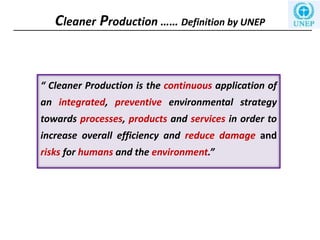
“ Cleaner Production is the continuous application of
an integrated, preventive environmental strategy
towards processes, products and services in order to
increase overall efficiency and reduce damage and
risks for humans and the environment.”
Cleaner Production …… Definition by UNEP
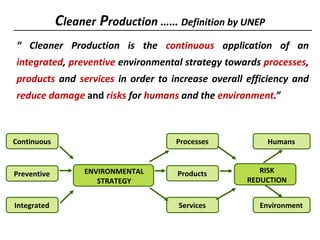
“ Cleaner Production is the continuous application of an
integrated, preventive environmental strategy towards processes,
products and services in order to increase overall efficiency and
reduce damage and risks for humans and the environment.”
Continuous
Preventive
Integrated
ENVIRONMENTAL
STRATEGY
Processes
Products
Services
RISK
REDUCTION
Humans
Environment
Cleaner Production ……
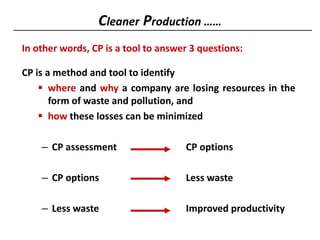
In other words, CP is a tool to answer 3 questions:
CP is a method and tool to identify
 where and why a company are losing resources in the
form of waste and pollution, and
 how these losses can be minimized
– CP assessment CP options
– CP options Less waste
– Less waste Improved productivity
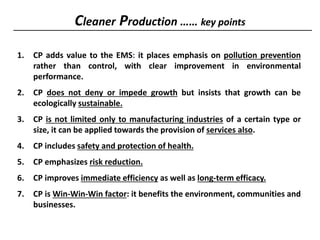
Cleaner Production …… key points
1. CP adds value to the EMS: it places emphasis on pollution prevention
rather than control, with clear improvement in environmental
performance.
2. CP does not deny or impede growth but insists that growth can be
ecologically sustainable.
3. CP is not limited only to manufacturing industries of a certain type or
size, it can be applied towards the provision of services also.
4. CP includes safety and protection of health.
5. CP emphasizes risk reduction.
6. CP improves immediate efficiency as well as long-term efficacy.
7. CP is Win-Win-Win factor: it benefits the environment, communities and
businesses.
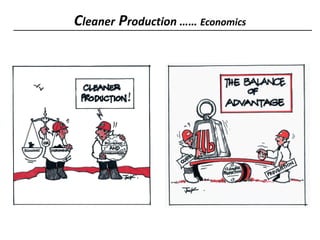
Cleaner Production …… Economics
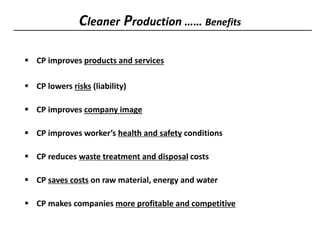
Cleaner Production …… Benefits
 CP improves products and services
 CP lowers risks (liability)
 CP improves company image
 CP improves worker’s health and safety conditions
 CP reduces waste treatment and disposal costs
 CP saves costs on raw material, energy and water
 CP makes companies more profitable and competitive
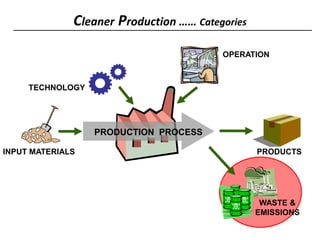
Cleaner Production …… Categories
TECHNOLOGY
INPUT MATERIALS
OPERATION
PRODUCTS
PRODUCTION PROCESS
WASTE &
EMISSIONS
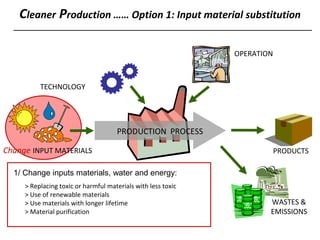
Cleaner Production …… Option 1: Input material substitution
TECHNOLOGY
OPERATION
PRODUCTS
PRODUCTION PROCESS
WASTES &
EMISSIONS
1/ Change inputs materials, water and energy:
> Replacing toxic or harmful materials with less toxic
> Use of renewable materials
> Use materials with longer lifetime
> Material purification
Change INPUT MATERIALS
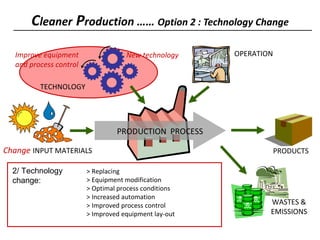
Cleaner Production …… Option 2 : Technology Change
TECHNOLOGY
OPERATION
PRODUCTS
PRODUCTION PROCESS
2/ Technology
change:
> Replacing
> Equipment modification
> Optimal process conditions
> Increased automation
> Improved process control
> Improved equipment lay-out
Improve equipment
and process control
New technology
WASTES &
EMISSIONS
Change INPUT MATERIALS
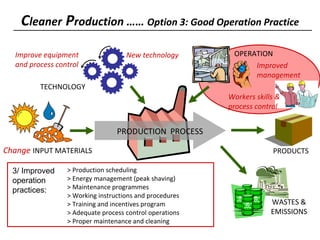
Cleaner Production …… Option 3: Good Operation Practice
TECHNOLOGY
OPERATION
PRODUCTS
PRODUCTION PROCESS
3/ Improved
operation
practices:
> Production scheduling
> Energy management (peak shaving)
> Maintenance programmes
> Working instructions and procedures
> Training and incentives program
> Adequate process control operations
> Proper maintenance and cleaning
Improved
management
WASTES &
EMISSIONS
Workers skills &
process control
Improve equipment
and process control
Change INPUT MATERIALS
New technology
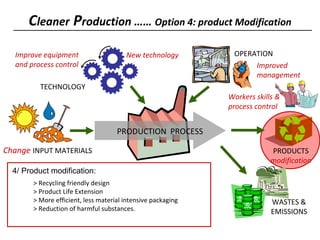
Cleaner Production …… Option 4: product Modification
PRODUCTS
modification
TECHNOLOGY
OPERATION
PRODUCTION PROCESS
4/ Product modification:
> Recycling friendly design
> Product Life Extension
> More efficient, less material intensive packaging
> Reduction of harmful substances.
WASTES &
EMISSIONS
Improve equipment
and process control Improved
management
Workers skills &
process control
Change INPUT MATERIALS
New technology
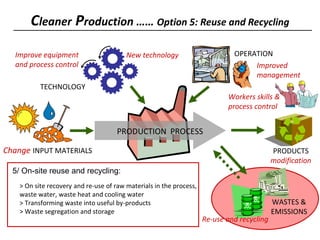
Cleaner Production …… Option 5: Reuse and Recycling
TECHNOLOGY
OPERATION
PRODUCTION PROCESS
5/ On-site reuse and recycling:
> On site recovery and re-use of raw materials in the process,
waste water, waste heat and cooling water
> Transforming waste into useful by-products
> Waste segregation and storage
WASTES &
EMISSIONS
Improve equipment
and process control Improved
management
Workers skills &
process control
PRODUCTS
modification
Re-use and recycling
Change INPUT MATERIALS
New technology
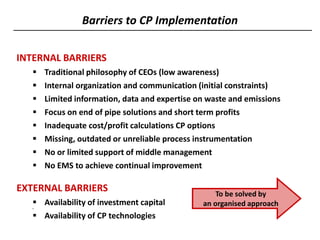
Barriers to CP Implementation
INTERNAL BARRIERS
 Traditional philosophy of CEOs (low awareness)
 Internal organization and communication (initial constraints)
 Limited information, data and expertise on waste and emissions
 Focus on end of pipe solutions and short term profits
 Inadequate cost/profit calculations CP options
 Missing, outdated or unreliable process instrumentation
 No or limited support of middle management
 No EMS to achieve continual improvement
EXTERNAL BARRIERS
 Availability of investment capital
 Availability of CP technologies
To be solved by
an organised approach
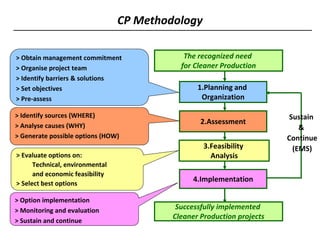
CP Methodology
The recognized need
for Cleaner Production
1.Planning and
Organization
2.Assessment
3.Feasibility
Analysis
4.Implementation
Successfully implemented
Cleaner Production projects
Sustain
&
Continue
(EMS)
> Obtain management commitment
> Organise project team
> Identify barriers & solutions
> Set objectives
> Pre-assess
> Identify sources (WHERE)
> Analyse causes (WHY)
> Generate possible options (HOW)
> Evaluate options on:
Technical, environmental
and economic feasibility
> Select best options
> Option implementation
> Monitoring and evaluation
> Sustain and continue
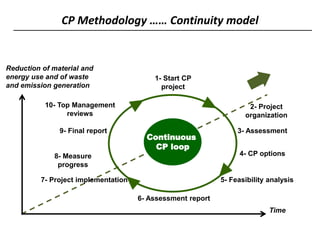
CP Methodology …… Continuity model
Continuous
CP loop
3- Assessment
1- Start CP
project
2- Project
organization
4- CP options
5- Feasibility analysis
6- Assessment report
7- Project implementation
8- Measure
progress
9- Final report
10- Top Management
reviews
Reduction of material and
energy use and of waste
and emission generation
Time
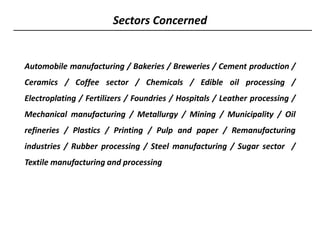
Sectors Concerned
Automobile manufacturing / Bakeries / Breweries / Cement production /
Ceramics / Coffee sector / Chemicals / Edible oil processing /
Electroplating / Fertilizers / Foundries / Hospitals / Leather processing /
Mechanical manufacturing / Metallurgy / Mining / Municipality / Oil
refineries / Plastics / Printing / Pulp and paper / Remanufacturing
industries / Rubber processing / Steel manufacturing / Sugar sector /
Textile manufacturing and processing

Cleaner production techniques

  • 1.
    CLEANER PRODUCTION TECHNIQUES Farhan Ahmad Department ofChemical Engineering University of Engineering & Technology Lahore.
  • 2.
    Cleaner Production Techniques -An Overview By Farhan Ahmad farhanahmad@uet.edu.pk DEPARTMENT OF CHEMICAL ENGINEERING
  • 3.
    Course Details: 3 Subject Subject code Contacthours Credit hours Sessional Mid term Final term Cleaner Production Techniques Ch.E. - 320 2 + 3 2 + 1 30 % (Quizzes + Attendance + Class participation + Assignments) 30% 40% Evaluation Procedure:
  • 4.
    Course Outline  Cleanerproduction and sustainable development; Cleaner production principles and phases; cleaner production plans and strategies for implementing cleaner production plans; cleaner production and eco- efficiencies.  Environmental management systems; closed loop operations; detailed chemical/material flow analysis; renewable energy resources; life cycle design and impact assessment.  Waste minimization; re-use of waste products; specific examples from industry where the methods of cleaner production have been applied. 4
  • 5.
  • 6.
    BACKGROUND …. Responses PASSIVE Ignorepollution REACTIVE Dilution and dispersion PROACTIVE Cleaner Production CONSTRUCTIVE End-of-pipe treatment 1 2 43
  • 7.
    Cleaner Production ……Definition by UNEP “ Cleaner Production is the continuous application of an integrated, preventive environmental strategy towards processes, products and services in order to increase overall efficiency and reduce damage and risks for humans and the environment.”
  • 8.
    Cleaner Production ……Definition by UNEP “ Cleaner Production is the continuous application of an integrated, preventive environmental strategy towards processes, products and services in order to increase overall efficiency and reduce damage and risks for humans and the environment.” Continuous Preventive Integrated ENVIRONMENTAL STRATEGY Processes Products Services RISK REDUCTION Humans Environment
  • 9.
    Cleaner Production …… Inother words, CP is a tool to answer 3 questions: CP is a method and tool to identify  where and why a company are losing resources in the form of waste and pollution, and  how these losses can be minimized – CP assessment CP options – CP options Less waste – Less waste Improved productivity
  • 10.
    Cleaner Production ……key points 1. CP adds value to the EMS: it places emphasis on pollution prevention rather than control, with clear improvement in environmental performance. 2. CP does not deny or impede growth but insists that growth can be ecologically sustainable. 3. CP is not limited only to manufacturing industries of a certain type or size, it can be applied towards the provision of services also. 4. CP includes safety and protection of health. 5. CP emphasizes risk reduction. 6. CP improves immediate efficiency as well as long-term efficacy. 7. CP is Win-Win-Win factor: it benefits the environment, communities and businesses.
  • 11.
  • 12.
    Cleaner Production ……Benefits  CP improves products and services  CP lowers risks (liability)  CP improves company image  CP improves worker’s health and safety conditions  CP reduces waste treatment and disposal costs  CP saves costs on raw material, energy and water  CP makes companies more profitable and competitive
  • 13.
    Cleaner Production ……Categories TECHNOLOGY INPUT MATERIALS OPERATION PRODUCTS PRODUCTION PROCESS WASTE & EMISSIONS
  • 14.
    Cleaner Production ……Option 1: Input material substitution TECHNOLOGY OPERATION PRODUCTS PRODUCTION PROCESS WASTES & EMISSIONS 1/ Change inputs materials, water and energy: > Replacing toxic or harmful materials with less toxic > Use of renewable materials > Use materials with longer lifetime > Material purification Change INPUT MATERIALS
  • 15.
    Cleaner Production ……Option 2 : Technology Change TECHNOLOGY OPERATION PRODUCTS PRODUCTION PROCESS 2/ Technology change: > Replacing > Equipment modification > Optimal process conditions > Increased automation > Improved process control > Improved equipment lay-out Improve equipment and process control New technology WASTES & EMISSIONS Change INPUT MATERIALS
  • 16.
    Cleaner Production ……Option 3: Good Operation Practice TECHNOLOGY OPERATION PRODUCTS PRODUCTION PROCESS 3/ Improved operation practices: > Production scheduling > Energy management (peak shaving) > Maintenance programmes > Working instructions and procedures > Training and incentives program > Adequate process control operations > Proper maintenance and cleaning Improved management WASTES & EMISSIONS Workers skills & process control Improve equipment and process control Change INPUT MATERIALS New technology
  • 17.
    Cleaner Production ……Option 4: product Modification PRODUCTS modification TECHNOLOGY OPERATION PRODUCTION PROCESS 4/ Product modification: > Recycling friendly design > Product Life Extension > More efficient, less material intensive packaging > Reduction of harmful substances. WASTES & EMISSIONS Improve equipment and process control Improved management Workers skills & process control Change INPUT MATERIALS New technology
  • 18.
    Cleaner Production ……Option 5: Reuse and Recycling TECHNOLOGY OPERATION PRODUCTION PROCESS 5/ On-site reuse and recycling: > On site recovery and re-use of raw materials in the process, waste water, waste heat and cooling water > Transforming waste into useful by-products > Waste segregation and storage WASTES & EMISSIONS Improve equipment and process control Improved management Workers skills & process control PRODUCTS modification Re-use and recycling Change INPUT MATERIALS New technology
  • 19.
    Barriers to CPImplementation INTERNAL BARRIERS  Traditional philosophy of CEOs (low awareness)  Internal organization and communication (initial constraints)  Limited information, data and expertise on waste and emissions  Focus on end of pipe solutions and short term profits  Inadequate cost/profit calculations CP options  Missing, outdated or unreliable process instrumentation  No or limited support of middle management  No EMS to achieve continual improvement EXTERNAL BARRIERS  Availability of investment capital  Availability of CP technologies To be solved by an organised approach
  • 20.
    CP Methodology The recognizedneed for Cleaner Production 1.Planning and Organization 2.Assessment 3.Feasibility Analysis 4.Implementation Successfully implemented Cleaner Production projects Sustain & Continue (EMS) > Obtain management commitment > Organise project team > Identify barriers & solutions > Set objectives > Pre-assess > Identify sources (WHERE) > Analyse causes (WHY) > Generate possible options (HOW) > Evaluate options on: Technical, environmental and economic feasibility > Select best options > Option implementation > Monitoring and evaluation > Sustain and continue
  • 21.
    CP Methodology ……Continuity model Continuous CP loop 3- Assessment 1- Start CP project 2- Project organization 4- CP options 5- Feasibility analysis 6- Assessment report 7- Project implementation 8- Measure progress 9- Final report 10- Top Management reviews Reduction of material and energy use and of waste and emission generation Time
  • 22.
    Sectors Concerned Automobile manufacturing/ Bakeries / Breweries / Cement production / Ceramics / Coffee sector / Chemicals / Edible oil processing / Electroplating / Fertilizers / Foundries / Hospitals / Leather processing / Mechanical manufacturing / Metallurgy / Mining / Municipality / Oil refineries / Plastics / Printing / Pulp and paper / Remanufacturing industries / Rubber processing / Steel manufacturing / Sugar sector / Textile manufacturing and processing