Environmental
management
Submitted by:
M.Samyuktha
11011BA022
6th Semester
Concept of Sustainable development
 It is a pattern of resource use, that aims to meet human
needs while preserving the environment so that these
needs can be met not only in the present, but also for
generations to come.
 The development initiatives be initiated in such a way that
the future generations can enjoy the benefits of Nature
without any compromise.
 Sustainable development is development that meets the
needs of the present without compromising the ability of
future generations to meet their own needs
2
3
 At the global scale and in the broadest
sense environmental management involves
the
 Oceans
 Fresh water systems
 Land &
 Atmosphere
But following the sustainability principle of
scale it can be equally applied to any
ecosystem from a tropical rainforest to a
home garden!!!
Environmental management
Concept of Environmental Management
 Its an attempt to control human impact on and interaction with the environment in order to
preserve natural resources
 Environmental management focuses on the improvement of human welfare for present and
future generations.
 Administrative functions that develop, implement, and monitor the environmental policy of an
organization.
 Environment management implies not only a mere management of environment but it is
essentially the management of various activities with intolerable constraints imposed by the
environment itself and with full consideration of ecological factors.
 Thus it involves environmental planning, conservation of resources, environmental status
evaluation and environmental legislation and administration.
4
Characteristics
 It deals with world affected by humans;
 It supports sustainable development
 It demands a multidisciplinary approach;
 It has to integrate different development view points;
 The time-scale involved extends the short term and concern ranges from
local to global;
 It seeks to integrate natural & social science, policy making &
planning.
 This Environmental management implies an element of conscious choice from a variety of
alternative proposals and furthermore that such a choice involves purposeful commitment for
recognized and desired objectives.
5
6 Some other definitions
 “Environmental management is concerned with the man-environment interface, the complex
boundary where bio-physical and socio-cultural systems interact”.
- (Hare, 1970.)
 “An approach which goes beyond natural resources management to encompass the political and
social as well as the natural environment”.
- (Clarke, 1999.)
 “Environmental management – a generic description of a process undertaken by systems
oriented professionals with a natural science, social science or less commonly, an engineering
,law or design background, tackling problem of human altered environment on an interdisciplinary
basis from a quantitative and/or futuristic viewpoint”.
- (Downey, 1989)
7 Some other definitions
 “The process of allocating natural and artificial resources so as to make optimum use of the
environment in satisfying basic human needs, at the minimum, and more, if possible, on a
sustainable basis”. - (Jolly, 1978.)
 Throughout the world, particularly in developing countries, there is an urgent need for the
management of total environment. In the first instance environmental management must do three
things:
 Identify goals
 Establish whether these can be met &
 Develop & implement means to do what it deems possible.
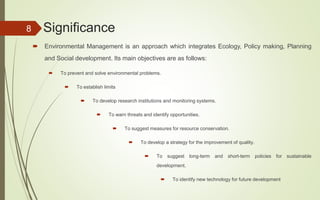
8 Significance
 Environmental Management is an approach which integrates Ecology, Policy making, Planning
and Social development. Its main objectives are as follows:
 To prevent and solve environmental problems.
 To establish limits
 To develop research institutions and monitoring systems.
 To warn threats and identify opportunities.
 To suggest measures for resource conservation.
 To develop a strategy for the improvement of quality.
 To suggest long-term and short-term policies for sustainable
development.
 To identify new technology for future development
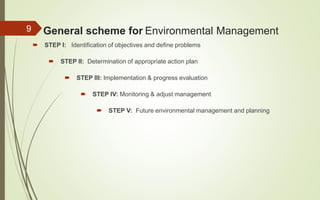
9 General scheme for Environmental Management
 STEP I: Identification of objectives and define problems
 STEP II: Determination of appropriate action plan
 STEP III: Implementation & progress evaluation
 STEP IV: Monitoring & adjust management
 STEP V: Future environmental management and planning
10 Trends in Environmental management
 Impact Assessment and Planning (IAP)
Assessing environmental and social impacts prior to setting up operations and obtaining environmental approval
from the authorities is almost mandatory in most project categories. IAP assessments may be required not only
for newly constructed facilities, but also for new operations that will be housed in an existing building
 Environmental Liability and Clean-up
Foreign investment has resulted in heightened scrutiny of current and historic environmental liabilities associated
with property transactions in India.
 Sustainability and Regulatory Compliance
The increasing desire of Indian companies to meet world class standards has caused established companies in
India to take on sustainability initiatives as a means of improving their global brand and reputation.
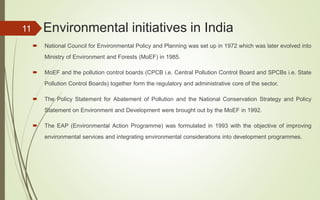
11 Environmental initiatives in India
 National Council for Environmental Policy and Planning was set up in 1972 which was later evolved into
Ministry of Environment and Forests (MoEF) in 1985.
 MoEF and the pollution control boards (CPCB i.e. Central Pollution Control Board and SPCBs i.e. State
Pollution Control Boards) together form the regulatory and administrative core of the sector.
 The Policy Statement for Abatement of Pollution and the National Conservation Strategy and Policy
Statement on Environment and Development were brought out by the MoEF in 1992.
 The EAP (Environmental Action Programme) was formulated in 1993 with the objective of improving
environmental services and integrating environmental considerations into development programmes.
12 Environmental initiatives in India
 For the protection of environment and to control pollution several measures have been
undertaken both by government and NGOs.
 Even before independence, some laws have been enacted for the protection of environment. In
Indian Penal Code of 1860, Articles 268, 290, 291, 426, 430, 431 and 432 are related with
environment. Similarly, Article 277 was related with water pollution and 278 with Air pollution.
 National Environmental policy, 2006
It the first initiative in strategy-formulation for environmental protection in a comprehensive manner. It
undertakes a diagnosis of the causative factors of land degradation with a view to flagging the remedial
measures required in this direction. It recognizes that the relevant fiscal, tariffs and sectoral policies
need to take explicit account of their unintentional impacts on land degradation.
13
As the quality of life improves, demand for better quality services and products also increases.
Customers all over the world and at all times demand that they be assured and satisfied that the
product or services as anticipated. However, inspection is not a satisfactory way of giving assurance
that the product will perform as desired during its life. It is generally agreed that the required level of
quality can be built into the product only through the use of a proper quality management system.
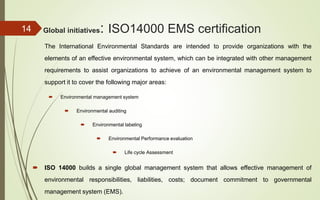
14 Global initiatives: ISO14000 EMS certification
The International Environmental Standards are intended to provide organizations with the
elements of an effective environmental system, which can be integrated with other management
requirements to assist organizations to achieve of an environmental management system to
support it to cover the following major areas:
 Environmental management system
 Environmental auditing
 Environmental labeling
 Environmental Performance evaluation
 Life cycle Assessment
 ISO 14000 builds a single global management system that allows effective management of
environmental responsibilities, liabilities, costs; document commitment to governmental
management system (EMS).
15
 ISO 14000 is a way of empowering businesses to take control of environmental responsibility and
encouraging government departments to approach the challenge with far greater flexibility.
 ISO 14000 does not only relate to massive global companies. The standard states “It has been written to be
applicable to all types and sizes of organizations and to accommodate diverse geographical, cultural and
social conditions.”
 ISO 14001 Certification is an initiative to bring about uniformity in environmental compliance standards to
reduce impediments to trade among countries. If it is accepted and implemented properly, it can bring about
a lot of changes in the present Indian scenario.
 After the increase of environmental standards around the world, ISO assessed the need for International
environmental standards. They formed the Strategic Advisory Group on Environment (SAGE) in 1991, to
consider whether such standards could serve to be effective instruments of pollution control.
Global Initiatives
16
A set of international standards, which bring world-wide focus on the environment, encourage a
cleaner, safer, healthier world for all of us. The existence of these standards allow organizations to
focus their environmental on the basis of internationally accepted criteria. At present many countries
and regional groupings are generating their own requirements for environmental issues, and these
vary between the groups. A single standard will ensure that there are no conflicts between regional
interpretations of good environmental practice.
17 Educational systems:- Awareness
 LEED (Leadership in Energy & Environmental Design) 1994
It is a set of rating systems for the design, construction, operation, and maintenance of green buildings, homes and
neighborhoods, developed by the U.S. Green Building council (USGBC), LEED is intended to help building owners and
operators be environmentally responsible and use resources efficiently.
LEED has evolved since 1998 to more accurately represent and incorporate emerging green building technologies. The
pilot version, LEED New Construction (NC) v1.0, led to LEED NCv2.0, then LEED NCv2.2 in 2005.
LEED was most recently updated in 2009, to LEEDv3. It encompasses nine rating systems for the design, construction
and operation of buildings, homes and neighborhoods. Five overarching categories correspond to the specialties
available under the LEED Accredited Professional program. That suite currently consists of:
 Green Interior design & construction
 Green building operations & Maintenance
 Green Neighborhood development
 Green Building Design & construction
18
 It is an agency of the United nations, that coordinates its environmental activities, assisting developing
countries in implementing environmentally sound policies & practices. It was founded as a result of the
United Nations Conference on the Human Environment in June 1972.
 Its activities cover a wide range of issues regarding the atmosphere, marine and terrestrial ecosystems,
environmental governance and green economy.
 It has played a significant role in developing international environmental conventions,
promoting environmental science and information and illustrating the way those can be implemented in
conjunction with policy, working on the development and implementation of policy with national
governments, regional institutions in conjunction with environmental non-governmental organizations
(NGOs).
 UNEP has also been active in funding and implementing environment related development projects.
United Nations Environmental Programme
19 Indian Green Building Council
 It was formed by confederation of Indian industry in the year 2001 is continuously striving towards wider
adoption of eco – friendly/ Green building concepts in the Indian Industry.
 There are three primary ranking in India GRIHA, IGBC etc promotes a whole building approach to
sustainability based on the principles of 5 elements of the nature. They are:
 Sustainable site development
 Water savings
 Material selection
 Energy efficiency
 Indoor environmental quality
 Green building : “Green or sustainable building is the practice of creating healthier and more resource-
efficient models of construction, renovation, operation, maintenance, and demolition.”
20
 Construction – Reduce the amount of waste generated at a construction site
 Design – Building design details will help to reduce construction materials, and energy/water
requirements when completed
 Material Selection – Careful selection of construction materials will leave less of an environmental
impact
 Goal: Reduce / Reuse / Recycle
 Building design based on standard sizes of materials
 Buy higher quality to reduce rejects
 Recycle (use scraps)
 Train crew
 Renovate an existing building
Green Building

Environmental management

  • 1.
  • 2.
    Concept of Sustainabledevelopment  It is a pattern of resource use, that aims to meet human needs while preserving the environment so that these needs can be met not only in the present, but also for generations to come.  The development initiatives be initiated in such a way that the future generations can enjoy the benefits of Nature without any compromise.  Sustainable development is development that meets the needs of the present without compromising the ability of future generations to meet their own needs 2
  • 3.
    3  At theglobal scale and in the broadest sense environmental management involves the  Oceans  Fresh water systems  Land &  Atmosphere But following the sustainability principle of scale it can be equally applied to any ecosystem from a tropical rainforest to a home garden!!! Environmental management
  • 4.
    Concept of EnvironmentalManagement  Its an attempt to control human impact on and interaction with the environment in order to preserve natural resources  Environmental management focuses on the improvement of human welfare for present and future generations.  Administrative functions that develop, implement, and monitor the environmental policy of an organization.  Environment management implies not only a mere management of environment but it is essentially the management of various activities with intolerable constraints imposed by the environment itself and with full consideration of ecological factors.  Thus it involves environmental planning, conservation of resources, environmental status evaluation and environmental legislation and administration. 4
  • 5.
    Characteristics  It dealswith world affected by humans;  It supports sustainable development  It demands a multidisciplinary approach;  It has to integrate different development view points;  The time-scale involved extends the short term and concern ranges from local to global;  It seeks to integrate natural & social science, policy making & planning.  This Environmental management implies an element of conscious choice from a variety of alternative proposals and furthermore that such a choice involves purposeful commitment for recognized and desired objectives. 5
  • 6.
    6 Some otherdefinitions  “Environmental management is concerned with the man-environment interface, the complex boundary where bio-physical and socio-cultural systems interact”. - (Hare, 1970.)  “An approach which goes beyond natural resources management to encompass the political and social as well as the natural environment”. - (Clarke, 1999.)  “Environmental management – a generic description of a process undertaken by systems oriented professionals with a natural science, social science or less commonly, an engineering ,law or design background, tackling problem of human altered environment on an interdisciplinary basis from a quantitative and/or futuristic viewpoint”. - (Downey, 1989)
  • 7.
    7 Some otherdefinitions  “The process of allocating natural and artificial resources so as to make optimum use of the environment in satisfying basic human needs, at the minimum, and more, if possible, on a sustainable basis”. - (Jolly, 1978.)  Throughout the world, particularly in developing countries, there is an urgent need for the management of total environment. In the first instance environmental management must do three things:  Identify goals  Establish whether these can be met &  Develop & implement means to do what it deems possible.
  • 8.
    8 Significance  EnvironmentalManagement is an approach which integrates Ecology, Policy making, Planning and Social development. Its main objectives are as follows:  To prevent and solve environmental problems.  To establish limits  To develop research institutions and monitoring systems.  To warn threats and identify opportunities.  To suggest measures for resource conservation.  To develop a strategy for the improvement of quality.  To suggest long-term and short-term policies for sustainable development.  To identify new technology for future development
  • 9.
    9 General schemefor Environmental Management  STEP I: Identification of objectives and define problems  STEP II: Determination of appropriate action plan  STEP III: Implementation & progress evaluation  STEP IV: Monitoring & adjust management  STEP V: Future environmental management and planning
  • 10.
    10 Trends inEnvironmental management  Impact Assessment and Planning (IAP) Assessing environmental and social impacts prior to setting up operations and obtaining environmental approval from the authorities is almost mandatory in most project categories. IAP assessments may be required not only for newly constructed facilities, but also for new operations that will be housed in an existing building  Environmental Liability and Clean-up Foreign investment has resulted in heightened scrutiny of current and historic environmental liabilities associated with property transactions in India.  Sustainability and Regulatory Compliance The increasing desire of Indian companies to meet world class standards has caused established companies in India to take on sustainability initiatives as a means of improving their global brand and reputation.
  • 11.
    11 Environmental initiativesin India  National Council for Environmental Policy and Planning was set up in 1972 which was later evolved into Ministry of Environment and Forests (MoEF) in 1985.  MoEF and the pollution control boards (CPCB i.e. Central Pollution Control Board and SPCBs i.e. State Pollution Control Boards) together form the regulatory and administrative core of the sector.  The Policy Statement for Abatement of Pollution and the National Conservation Strategy and Policy Statement on Environment and Development were brought out by the MoEF in 1992.  The EAP (Environmental Action Programme) was formulated in 1993 with the objective of improving environmental services and integrating environmental considerations into development programmes.
  • 12.
    12 Environmental initiativesin India  For the protection of environment and to control pollution several measures have been undertaken both by government and NGOs.  Even before independence, some laws have been enacted for the protection of environment. In Indian Penal Code of 1860, Articles 268, 290, 291, 426, 430, 431 and 432 are related with environment. Similarly, Article 277 was related with water pollution and 278 with Air pollution.  National Environmental policy, 2006 It the first initiative in strategy-formulation for environmental protection in a comprehensive manner. It undertakes a diagnosis of the causative factors of land degradation with a view to flagging the remedial measures required in this direction. It recognizes that the relevant fiscal, tariffs and sectoral policies need to take explicit account of their unintentional impacts on land degradation.
  • 13.
    13 As the qualityof life improves, demand for better quality services and products also increases. Customers all over the world and at all times demand that they be assured and satisfied that the product or services as anticipated. However, inspection is not a satisfactory way of giving assurance that the product will perform as desired during its life. It is generally agreed that the required level of quality can be built into the product only through the use of a proper quality management system.
  • 14.
    14 Global initiatives:ISO14000 EMS certification The International Environmental Standards are intended to provide organizations with the elements of an effective environmental system, which can be integrated with other management requirements to assist organizations to achieve of an environmental management system to support it to cover the following major areas:  Environmental management system  Environmental auditing  Environmental labeling  Environmental Performance evaluation  Life cycle Assessment  ISO 14000 builds a single global management system that allows effective management of environmental responsibilities, liabilities, costs; document commitment to governmental management system (EMS).
  • 15.
    15  ISO 14000is a way of empowering businesses to take control of environmental responsibility and encouraging government departments to approach the challenge with far greater flexibility.  ISO 14000 does not only relate to massive global companies. The standard states “It has been written to be applicable to all types and sizes of organizations and to accommodate diverse geographical, cultural and social conditions.”  ISO 14001 Certification is an initiative to bring about uniformity in environmental compliance standards to reduce impediments to trade among countries. If it is accepted and implemented properly, it can bring about a lot of changes in the present Indian scenario.  After the increase of environmental standards around the world, ISO assessed the need for International environmental standards. They formed the Strategic Advisory Group on Environment (SAGE) in 1991, to consider whether such standards could serve to be effective instruments of pollution control. Global Initiatives
  • 16.
    16 A set ofinternational standards, which bring world-wide focus on the environment, encourage a cleaner, safer, healthier world for all of us. The existence of these standards allow organizations to focus their environmental on the basis of internationally accepted criteria. At present many countries and regional groupings are generating their own requirements for environmental issues, and these vary between the groups. A single standard will ensure that there are no conflicts between regional interpretations of good environmental practice.
  • 17.
    17 Educational systems:-Awareness  LEED (Leadership in Energy & Environmental Design) 1994 It is a set of rating systems for the design, construction, operation, and maintenance of green buildings, homes and neighborhoods, developed by the U.S. Green Building council (USGBC), LEED is intended to help building owners and operators be environmentally responsible and use resources efficiently. LEED has evolved since 1998 to more accurately represent and incorporate emerging green building technologies. The pilot version, LEED New Construction (NC) v1.0, led to LEED NCv2.0, then LEED NCv2.2 in 2005. LEED was most recently updated in 2009, to LEEDv3. It encompasses nine rating systems for the design, construction and operation of buildings, homes and neighborhoods. Five overarching categories correspond to the specialties available under the LEED Accredited Professional program. That suite currently consists of:  Green Interior design & construction  Green building operations & Maintenance  Green Neighborhood development  Green Building Design & construction
  • 18.
    18  It isan agency of the United nations, that coordinates its environmental activities, assisting developing countries in implementing environmentally sound policies & practices. It was founded as a result of the United Nations Conference on the Human Environment in June 1972.  Its activities cover a wide range of issues regarding the atmosphere, marine and terrestrial ecosystems, environmental governance and green economy.  It has played a significant role in developing international environmental conventions, promoting environmental science and information and illustrating the way those can be implemented in conjunction with policy, working on the development and implementation of policy with national governments, regional institutions in conjunction with environmental non-governmental organizations (NGOs).  UNEP has also been active in funding and implementing environment related development projects. United Nations Environmental Programme
  • 19.
    19 Indian GreenBuilding Council  It was formed by confederation of Indian industry in the year 2001 is continuously striving towards wider adoption of eco – friendly/ Green building concepts in the Indian Industry.  There are three primary ranking in India GRIHA, IGBC etc promotes a whole building approach to sustainability based on the principles of 5 elements of the nature. They are:  Sustainable site development  Water savings  Material selection  Energy efficiency  Indoor environmental quality  Green building : “Green or sustainable building is the practice of creating healthier and more resource- efficient models of construction, renovation, operation, maintenance, and demolition.”
  • 20.
    20  Construction –Reduce the amount of waste generated at a construction site  Design – Building design details will help to reduce construction materials, and energy/water requirements when completed  Material Selection – Careful selection of construction materials will leave less of an environmental impact  Goal: Reduce / Reuse / Recycle  Building design based on standard sizes of materials  Buy higher quality to reduce rejects  Recycle (use scraps)  Train crew  Renovate an existing building Green Building