Equilibrium
Name : Atul Saini
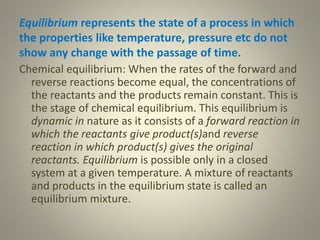
Equilibrium represents the state of a process in which
the properties like temperature, pressure etc do not
show any change with the passage of time.
Chemical equilibrium: When the rates of the forward and
reverse reactions become equal, the concentrations of
the reactants and the products remain constant. This is
the stage of chemical equilibrium. This equilibrium is
dynamic in nature as it consists of a forward reaction in
which the reactants give product(s)and reverse
reaction in which product(s) gives the original
reactants. Equilibrium is possible only in a closed
system at a given temperature. A mixture of reactants
and products in the equilibrium state is called an
equilibrium mixture.
• In a Homogeneous system, all the reactants and
products are in the same phase.
For example, in the gaseous reaction,
N2 (g) + 3H2(g) 2NH3(g), reactants and products are in
the homogeneous phase.
• Equilibrium in a system having more than one phase is
called heterogeneous
equilibrium. The equilibrium between water vapor and
liquid water in a closed
container is an example of heterogeneous equilibrium.
H2O(l) ->H2O(g)
• Law of Chemical Equilibrium: It may be stated
as, at a given temperature the ratio of
product of equilibrium concentration of the
products to that of the reactants with each
concentration terms raised to power equal to
the respective stoichiometric coefficient in the
balanced chemical reaction has a constant
value. This constant value is known as
Equilibrium constant. For a general reaction of
the type aA + bB  cC + dD
Kc = [C]c[D]d /[A]a [B]b This expression is
known as Law Of Chemical Equilibrium.
• Units of Equilibrium Constant: The value of
equilibrium constant Kc can be calculated by
substituting the concentration terms in mol/L
and for Kp partial pressure is substituted in Pa,
kPa, bar or atm. This results in units of
equilibrium constant based on molarity or
pressure, unless the exponents of both the
numerator and denominator are same. For
the reactions (i)H2(g) + I2(g)-> 2HI, Kc and Kp
have no unit.(ii)N2O4(g) ->2NO2 (g), Kc has
unit mol/L and Kp has unit bar
Characteristics Of Equilibrium Constant
• Equilibrium constant is applicable only when concentrations
of the reactants and products have attained their equilibrium
state.
• The value of equilibrium constant is independent of initial
concentrations of the reactants and products.
• Equilibrium constant is temperature dependent having one
unique value for a particular reaction represented by a
balanced equation at a given temperature.
• The equilibrium constant for the reverse reaction is equal to
the inverse of the equilibrium constant for the forward
reaction.
• The equilibrium constant K for a reaction is related to the
equilibrium constant of the corresponding reaction, whose
equation is obtained by multiplying or dividing the equation
for the original reaction by a small integer.
Applications of equilibrium constant :
• Predict the extent of a reaction on the basis
of its magnitude.
• Predict the direction of the reaction, and
• Calculate equilibrium concentrations.
• Le Chatelier’s Principle: It states that if a
system in equilibrium is subjected to a change
of concentration, temperature or pressure,
the equilibrium shifts in a direction that tends
to undo the effect of the change imposed.
Effect of change of concentration: When the
concentration of any of the reactants or products
in a reaction at equilibrium is changed, the
composition of the equilibrium mixture changes
so as to minimize the effect of concentration
change.
For eg:- H2(g) + I2(g)  2HI(g)
If H2 is added to the reaction mixture at
equilibrium, the equilibrium of the reaction is
disturbed. In order to restore it, the reaction
proceeds in a direction whereas H2 is consumed
i.e. more of H2 and I2 react to form HI and finally
the equilibrium shifts in forward direction.
Effect of change of pressure: When the
pressure is increased the equilibrium shifts in
the direction in which the number of moles of
the gas decreases. Consider the reaction, CO
(g) + 3H2 (g)  CH4 (g) + H2O (g) Here, 4 mol
of gaseous reactants (CO + 3H2) become 2
mol of gaseous products (CH4 (g) + H2O). so
by Le Chatelier‘s principle. The increase in
pressure will shift the equilibrium in the
forward direction, a direction in which the
number of moles of the gas or pressure
decreases.
Effect of change of Temperature: When a change in
temperature occurs, the value of equilibrium constant
changes. In general, the temperature dependence of
the equilibrium constant depends on the sign of ΔH for
the reaction. The equilibrium constant for an
exothermic reaction (-ve ΔH) decreases as the
temperature increases. The equilibrium constant for an
endothermic reaction(+ve ΔH) increases as the
temperature increases. When the Temperature is
increased the equilibrium shifts in the direction in of
endothermic reaction.
Consider a reaction N2(g) + 3H2(g)  2NH3(g) ΔH = -
92.38Kj/mol
According to Le Chatelier‘s principle, raising the
temperature shifts the equilibrium to left (backward
direction i.e. direction of endothermic reaction) and
decreases the equilibrium concentration of ammonia.
Effect of Inert Gas Addition: If the volume is
kept constant and an inert gas such as argon
is added which does not take part in the
reaction, the equilibrium remains
undisturbed. It is because the addition of an
inert gas at constant volume does not change
the partial pressures or the molar
concentrations of the substance involved in
the reaction. The reaction quotient changes
only if the added gas is a reactant or product
involved in the reaction.
Effect of a Catalyst: A catalyst increases the rate
of the chemical reaction by making available a
new low energy pathway for the conversion of
reactants to products. It increases the rate of
forward and reverse reactions that pass through
the same transition state and does not affect
equilibrium. Catalyst lowers the activation energy
for the forward and reverse reactions by exactly
the same amount. Catalyst does not affect the
equilibrium composition of a reaction mixture. It
does not appear in the balanced chemical
equation or in the equilibrium constant
expression
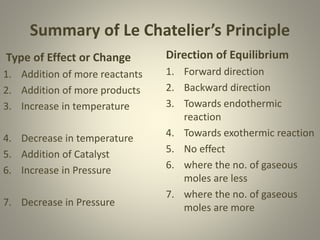
Summary of Le Chatelier’s Principle
Type of Effect or Change
1. Addition of more reactants
2. Addition of more products
3. Increase in temperature
4. Decrease in temperature
5. Addition of Catalyst
6. Increase in Pressure
7. Decrease in Pressure
Direction of Equilibrium
1. Forward direction
2. Backward direction
3. Towards endothermic
reaction
4. Towards exothermic reaction
5. No effect
6. where the no. of gaseous
moles are less
7. where the no. of gaseous
moles are more
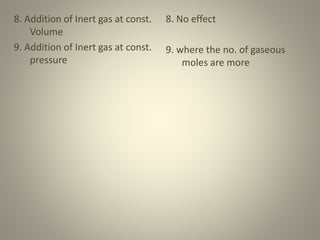
8. Addition of Inert gas at const.
Volume
9. Addition of Inert gas at const.
pressure
8. No effect
9. where the no. of gaseous
moles are more
THANK YOU

Equilibrium

  • 1.
  • 2.
    Equilibrium represents thestate of a process in which the properties like temperature, pressure etc do not show any change with the passage of time. Chemical equilibrium: When the rates of the forward and reverse reactions become equal, the concentrations of the reactants and the products remain constant. This is the stage of chemical equilibrium. This equilibrium is dynamic in nature as it consists of a forward reaction in which the reactants give product(s)and reverse reaction in which product(s) gives the original reactants. Equilibrium is possible only in a closed system at a given temperature. A mixture of reactants and products in the equilibrium state is called an equilibrium mixture.
  • 3.
    • In aHomogeneous system, all the reactants and products are in the same phase. For example, in the gaseous reaction, N2 (g) + 3H2(g) 2NH3(g), reactants and products are in the homogeneous phase. • Equilibrium in a system having more than one phase is called heterogeneous equilibrium. The equilibrium between water vapor and liquid water in a closed container is an example of heterogeneous equilibrium. H2O(l) ->H2O(g)
  • 4.
    • Law ofChemical Equilibrium: It may be stated as, at a given temperature the ratio of product of equilibrium concentration of the products to that of the reactants with each concentration terms raised to power equal to the respective stoichiometric coefficient in the balanced chemical reaction has a constant value. This constant value is known as Equilibrium constant. For a general reaction of the type aA + bB  cC + dD Kc = [C]c[D]d /[A]a [B]b This expression is known as Law Of Chemical Equilibrium.
  • 5.
    • Units ofEquilibrium Constant: The value of equilibrium constant Kc can be calculated by substituting the concentration terms in mol/L and for Kp partial pressure is substituted in Pa, kPa, bar or atm. This results in units of equilibrium constant based on molarity or pressure, unless the exponents of both the numerator and denominator are same. For the reactions (i)H2(g) + I2(g)-> 2HI, Kc and Kp have no unit.(ii)N2O4(g) ->2NO2 (g), Kc has unit mol/L and Kp has unit bar
  • 6.
    Characteristics Of EquilibriumConstant • Equilibrium constant is applicable only when concentrations of the reactants and products have attained their equilibrium state. • The value of equilibrium constant is independent of initial concentrations of the reactants and products. • Equilibrium constant is temperature dependent having one unique value for a particular reaction represented by a balanced equation at a given temperature. • The equilibrium constant for the reverse reaction is equal to the inverse of the equilibrium constant for the forward reaction. • The equilibrium constant K for a reaction is related to the equilibrium constant of the corresponding reaction, whose equation is obtained by multiplying or dividing the equation for the original reaction by a small integer.
  • 7.
    Applications of equilibriumconstant : • Predict the extent of a reaction on the basis of its magnitude. • Predict the direction of the reaction, and • Calculate equilibrium concentrations. • Le Chatelier’s Principle: It states that if a system in equilibrium is subjected to a change of concentration, temperature or pressure, the equilibrium shifts in a direction that tends to undo the effect of the change imposed.
  • 8.
    Effect of changeof concentration: When the concentration of any of the reactants or products in a reaction at equilibrium is changed, the composition of the equilibrium mixture changes so as to minimize the effect of concentration change. For eg:- H2(g) + I2(g)  2HI(g) If H2 is added to the reaction mixture at equilibrium, the equilibrium of the reaction is disturbed. In order to restore it, the reaction proceeds in a direction whereas H2 is consumed i.e. more of H2 and I2 react to form HI and finally the equilibrium shifts in forward direction.
  • 9.
    Effect of changeof pressure: When the pressure is increased the equilibrium shifts in the direction in which the number of moles of the gas decreases. Consider the reaction, CO (g) + 3H2 (g)  CH4 (g) + H2O (g) Here, 4 mol of gaseous reactants (CO + 3H2) become 2 mol of gaseous products (CH4 (g) + H2O). so by Le Chatelier‘s principle. The increase in pressure will shift the equilibrium in the forward direction, a direction in which the number of moles of the gas or pressure decreases.
  • 10.
    Effect of changeof Temperature: When a change in temperature occurs, the value of equilibrium constant changes. In general, the temperature dependence of the equilibrium constant depends on the sign of ΔH for the reaction. The equilibrium constant for an exothermic reaction (-ve ΔH) decreases as the temperature increases. The equilibrium constant for an endothermic reaction(+ve ΔH) increases as the temperature increases. When the Temperature is increased the equilibrium shifts in the direction in of endothermic reaction. Consider a reaction N2(g) + 3H2(g)  2NH3(g) ΔH = - 92.38Kj/mol According to Le Chatelier‘s principle, raising the temperature shifts the equilibrium to left (backward direction i.e. direction of endothermic reaction) and decreases the equilibrium concentration of ammonia.
  • 11.
    Effect of InertGas Addition: If the volume is kept constant and an inert gas such as argon is added which does not take part in the reaction, the equilibrium remains undisturbed. It is because the addition of an inert gas at constant volume does not change the partial pressures or the molar concentrations of the substance involved in the reaction. The reaction quotient changes only if the added gas is a reactant or product involved in the reaction.
  • 12.
    Effect of aCatalyst: A catalyst increases the rate of the chemical reaction by making available a new low energy pathway for the conversion of reactants to products. It increases the rate of forward and reverse reactions that pass through the same transition state and does not affect equilibrium. Catalyst lowers the activation energy for the forward and reverse reactions by exactly the same amount. Catalyst does not affect the equilibrium composition of a reaction mixture. It does not appear in the balanced chemical equation or in the equilibrium constant expression
  • 13.
    Summary of LeChatelier’s Principle Type of Effect or Change 1. Addition of more reactants 2. Addition of more products 3. Increase in temperature 4. Decrease in temperature 5. Addition of Catalyst 6. Increase in Pressure 7. Decrease in Pressure Direction of Equilibrium 1. Forward direction 2. Backward direction 3. Towards endothermic reaction 4. Towards exothermic reaction 5. No effect 6. where the no. of gaseous moles are less 7. where the no. of gaseous moles are more
  • 14.
    8. Addition ofInert gas at const. Volume 9. Addition of Inert gas at const. pressure 8. No effect 9. where the no. of gaseous moles are more
  • 15.