Dr. Pedro Villegas
pjva00@hotmail.com
OBJECTIVES
• To become familiar with Chemical
Thermodynamics concepts;
• To familiarize with Second and Third Law
of Thermodynamics;
• To understand Entropy and Free Energy
terms.
Brown, Lemay & Bursten, Chemistry:
The Central Science, 10th Ed. (Chapter 19)
TEXTBOOK
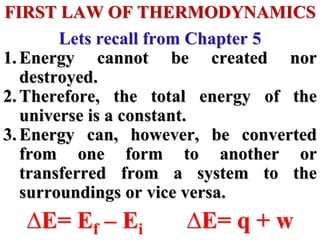
FIRST LAW OF THERMODYNAMICS
Lets recall from Chapter 5
1.Energy cannot be created nor
destroyed.
2.Therefore, the total energy of the
universe is a constant.
3.Energy can, however, be converted
from one form to another or
transferred from a system to the
surroundings or vice versa.
∆E= Ef – Ei ∆E= q + w
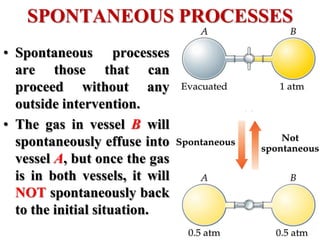
SPONTANEOUS PROCESSES
• Spontaneous processes
are those that can
proceed without any
outside intervention.
• The gas in vessel B will
spontaneously effuse into
vessel A, but once the gas
is in both vessels, it will
NOT spontaneously back
to the initial situation.
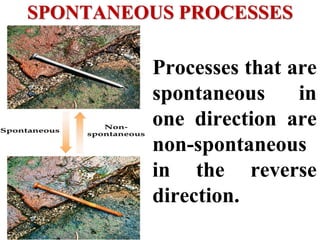
Processes that are
spontaneous in
one direction are
non-spontaneous
in the reverse
direction.
SPONTANEOUS PROCESSES
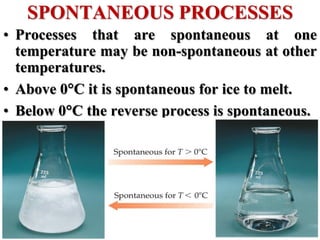
• Processes that are spontaneous at one
temperature may be non-spontaneous at other
temperatures.
• Above 0C it is spontaneous for ice to melt.
• Below 0C the reverse process is spontaneous.
SPONTANEOUS PROCESSES
REVERSIBLE PROCESSES
• In a reversible process
the system changes in
such a way that the
system and
surroundings can be put
back in their original
states by exactly
reversing the process.
• Changes are
infinitesimally SMALL
in a reversible process.
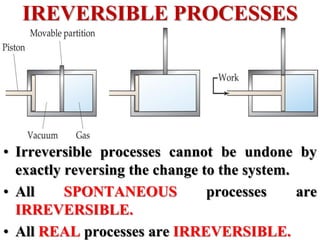
• Irreversible processes cannot be undone by
exactly reversing the change to the system.
• All SPONTANEOUS processes are
IRREVERSIBLE.
• All REAL processes are IRREVERSIBLE.
IREVERSIBLE PROCESSES
SUMMARIZING
• Spontaneous processes: Most chemical
reactions have a natural direction in
which they flow. In one direction they
are spontaneous, while in the other,
they are not.
• Reversible processes: the original state
of the system and surroundings can be
restored by reversing the change.
• Irreversible processes: the system
cannot return to its original state by
reversing the change.
ENTROPY
• Entropy (S) is a term coined by
Rudolph Clausius in the 19th Century.
• Clausius was convinced of the
significance of the ratio of heat
delivered and the temperature at which
it is delivered: q
T
Rudolf Julius Emanuel
Clausius (1822–1888),
was a German
Physicist, considered
one of the central
founders of the science
of Thermodynamics.
He introduced in 1865
the concept of Entropy.
• Entropy can be thought of as a
measure of the randomness of a system.
• It is related to the various modes of
motion in molecules.
• Like Internal Energy (E) and Enthalpy
(H) Entropy (S) is a state function.
• Therefore: S = Sfinal  Sinitial
ENTROPY
• For a process occurring at constant
temperature (an isothermal process):
• qrev = The heat that is transferred when
the process is carried out
REVERSIBLY at a constant
temperature.
• T = Temperature in Kelvin.
ENTROPY
T
q
S rev


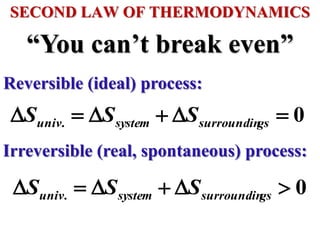
SECOND LAW OF THERMODYNAMICS
The Second Law of Thermodynamics:
The Entropy of the universe does not
change for reversible processes and
increases for spontaneous processes.
Reversible (ideal) process:
Irreversible (real, spontaneous) process:
0
. 




 gs
surroundin
system
univ S
S
S
0
. 




 gs
surroundin
system
univ S
S
S
―You can’t break even‖
SECOND LAW OF THERMODYNAMICS
Reversible (ideal) process:
Irreversible (real, spontaneous) process:
0
. 




 gs
surroundin
system
univ S
S
S
0
. 




 gs
surroundin
system
univ S
S
S
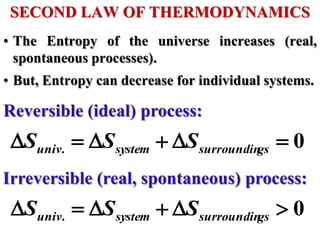
• The Entropy of the universe increases (real,
spontaneous processes).
• But, Entropy can decrease for individual systems.
SECOND LAW OF THERMODYNAMICS
Reversible (ideal) process:
Irreversible (real, spontaneous) process:
0
. 




 gs
surroundin
system
univ S
S
S
0
. 




 gs
surroundin
system
univ S
S
S
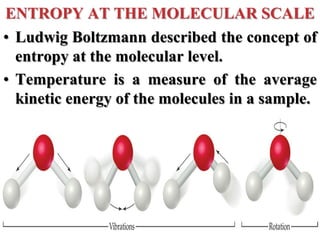
ENTROPY AT THE MOLECULAR SCALE
• Ludwig Boltzmann described the concept of
entropy at the molecular level.
• Temperature is a measure of the average
kinetic energy of the molecules in a sample.
The Austrian
Scientific Ludwig
Eduard Boltzmann
(1844 – 1906) has a
gravestone in Vienna
inscribed with his
famous relationship
between the Entropy
and the number of
available
Microstates:
S = k*lnW
Molecules exhibit several types of motion:
 Translational: Movement of the entire molecule
from one place to another.
 Vibrational: Periodic motion of atoms within a
molecule.
 Rotational: Rotation of the molecule on about an
axis or rotation about  bonds.
ENTROPY AT THE MOLECULAR SCALE
• Boltzmann envisioned the motions of a sample of
molecules at a particular instant in time.
 This would be akin to taking a snapshot of all the
molecules.
• He referred to this sampling as a MICROSTATE of the
thermodynamic system.
ENTROPY AT THE MOLECULAR SCALE
• Each thermodynamic state has a specific number
of microstates (W) associated with it.
• Entropy is: S = k*lnW
where k is the Boltzmann constant: 1.38*1023 J/K.
ENTROPY AT THE MOLECULAR SCALE
Implications:
• More particles:
 more states  more entropy
• Higher T:
 more energy states  more entropy
• Less structure (gas vs solid):
 more states  more entropy
ENTROPY AT THE MOLECULAR SCALE
The number of microstates and,
therefore, the entropy tends to
increase with increases in:
• Temperature.
• Volume (gases).
• The number of independently
moving molecules.
ENTROPY AT THE MOLECULAR SCALE
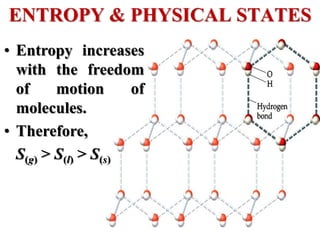
ENTROPY & PHYSICAL STATES
• Entropy increases
with the freedom
of motion of
molecules.
• Therefore,
S(g) > S(l) > S(s)
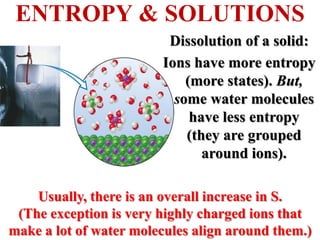
ENTROPY & SOLUTIONS
Usually, there is an overall increase in S.
(The exception is very highly charged ions that
make a lot of water molecules align around them.)
Dissolution of a solid:
Ions have more entropy
(more states). But,
some water molecules
have less entropy
(they are grouped
around ions).
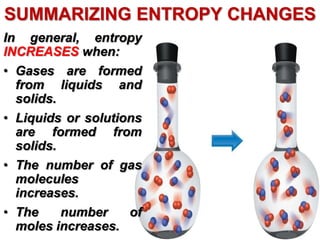
SUMMARIZING ENTROPY CHANGES
In general, entropy
INCREASES when:
• Gases are formed
from liquids and
solids.
• Liquids or solutions
are formed from
solids.
• The number of gas
molecules
increases.
• The number of
moles increases.
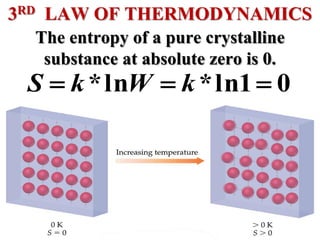
3RD LAW OF THERMODYNAMICS
The entropy of a pure crystalline
substance at absolute zero is 0.
0
1
ln
*
ln
* 

 k
W
k
S
3RD LAW OF THERMODYNAMICS
The entropy of a pure crystalline
substance at absolute zero is 0.
0
1
ln
*
ln
* 

 k
W
k
S
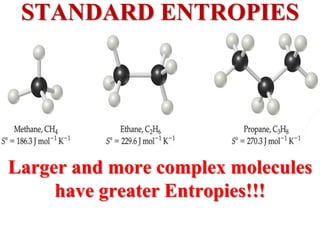
STANDARD ENTROPIES
• These are molar
Entropy values of
substances in their
standard states.
• Standard Entropies
tend to increase with
increasing molar
mass.
Larger and more complex molecules
have greater Entropies!!!
STANDARD ENTROPIES
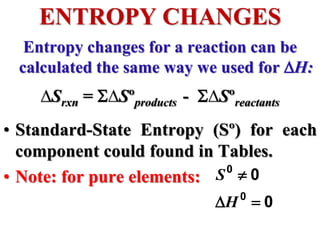
ENTROPY CHANGES
Entropy changes for a reaction can be
calculated the same way we used for H:
∆Srxn = ∆Sºproducts - ∆Sºreactants
• Standard-State Entropy (Sº) for each
component could found in Tables.
• Note: for pure elements:
0
0
0
0



H
S
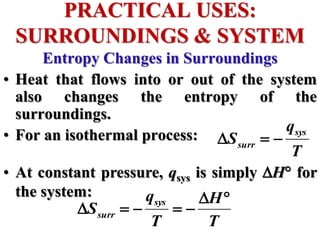
Entropy Changes in Surroundings
• Heat that flows into or out of the system
also changes the entropy of the
surroundings.
• For an isothermal process:
• At constant pressure, qsys is simply H for
the system:
PRACTICAL USES:
SURROUNDINGS & SYSTEM
T
q
S
sys
surr 


T
H
T
q
S
sys
surr







LINKING S AND H: PHASE CHANGES
T
H
T
q
S
sys
surr







A phase change is isothermal (no change in T).
For water:
Hfusion = 6 kJ/mol
Hvap = 41 kJ/mol
If we do this reversibly:
Ssurr = – Ssys
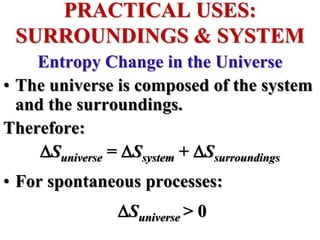
Entropy Change in the Universe
• The universe is composed of the system
and the surroundings.
Therefore:
Suniverse = Ssystem + Ssurroundings
• For spontaneous processes:
Suniverse > 0
PRACTICAL USES:
SURROUNDINGS & SYSTEM
= – Gibbs Free Energy
PRACTICAL USES:
SURROUNDINGS & SYSTEM





 system
system
universe H
S
T
S
T
Starting from the Entropy Change in the Universe:
And considering that:
We get the following expression:
Multiplying by T we get:
gs
surroundin
system
universe S
S
S 




T
H
Ssurr





)
( T
H
system
universe
system
S
S







Make this equation nicer:
PRACTICAL USES:
SURROUNDINGS & SYSTEM
= – Gibbs Free Energy





 system
system
universe H
S
T
S
T
system
system
universe S
T
H
S
T 




 
system
system S
T
H
G 



 
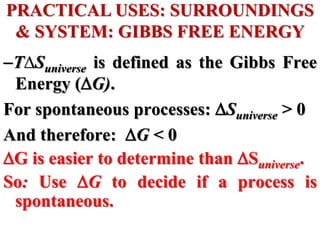
T∆Suniverse is defined as the Gibbs Free
Energy (G).
For spontaneous processes: Suniverse > 0
And therefore: G < 0
G is easier to determine than Suniverse.
So: Use G to decide if a process is
spontaneous.
PRACTICAL USES: SURROUNDINGS
& SYSTEM: GIBBS FREE ENERGY
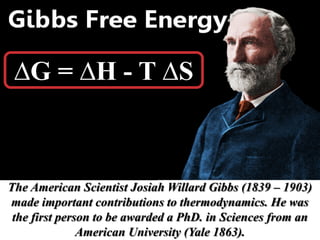
The American Scientist Josiah Willard Gibbs (1839 – 1903)
made important contributions to thermodynamics. He was
the first person to be awarded a PhD. in Sciences from an
American University (Yale 1863).
∆G = ∆H - T ∆S
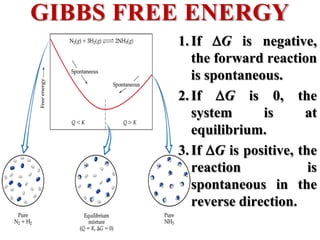
GIBBS FREE ENERGY
1.If G is negative,
the forward reaction
is spontaneous.
2.If G is 0, the
system is at
equilibrium.
3.If G is positive, the
reaction is
spontaneous in the
reverse direction.
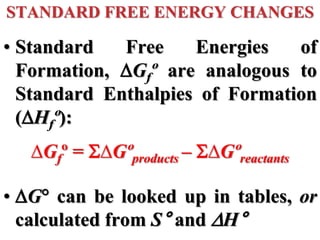
STANDARD FREE ENERGY CHANGES
• Standard Free Energies of
Formation, Gfº are analogous to
Standard Enthalpies of Formation
(Hfº):
∆Gfº = ∆Gºproducts – ∆Gºreactants
• G can be looked up in tables, or
calculated from S° and H°
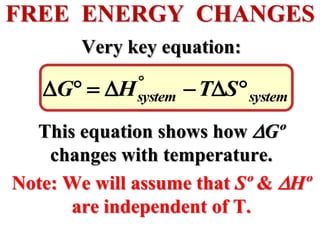
FREE ENERGY CHANGES
Very key equation:
This equation shows how Gº
changes with temperature.
Note: We will assume that Sº & Hº
are independent of T.
system
system S
T
H
G 





 
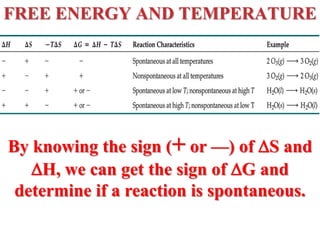
FREE ENERGY AND TEMPERATURE
• There are two parts to the Free
Energy equation:
 H — the Enthalpy term; and
 TS — the Entropy term.
• The temperature dependence of
Free Energy comes from the
Entropy term.
FREE ENERGY AND TEMPERATURE
By knowing the sign (+ or —) of S and
H, we can get the sign of G and
determine if a reaction is spontaneous.
FREE ENERGY AND EQUILIBRIUM
Remember from above:
If ∆G is 0, the system is at equilibrium.
So ∆G must be related to the
equilibrium constant (Keq-Chapter 15).
The Standard Free Energy (∆Gº) is
directly linked to Keq by:
∆Gº = — RT lnKeq or ∆Gº = — RT lnK
Note: for pure elements:
0
0
0
0
0
0





G
H
S
SUMMARIZING FREE ENERGY
1.The Free Energy (∆G) is negative for all
spontaneous processes.
2.The Free Energy (∆G = 0) for any system at
equilibrium.
3.The Free Energy (∆G) is positive for non
spontaneous processes.
• When a system in a given initial state goes
through a number of different changes in
state and finally returns to its initial values,
the system has undergone a cycle.
• Therefore, at the conclusion of a cycle, all
the properties have the same value they had
at the beginning.
• E.g. steam that circulates through a closes
cooling room undergoes a cycle.
CYCLICAL PROCESS
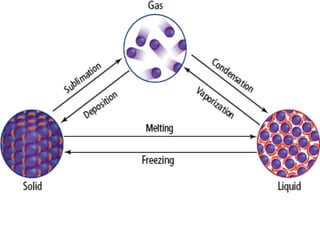
The term PHASE CHANGE indicates that a
substance has changed among the three classical
phases of matter: solid, liquid, gas and plasma:
• Solid to liquid – Melting;
• Liquid to solid – Freezing;
• Liquid to gas – Boiling;
• Gas to liquid – Condensation;
• Solid to gas – Sublimation;
• Gas to solid – Deposition.
PHASE PROCESSES
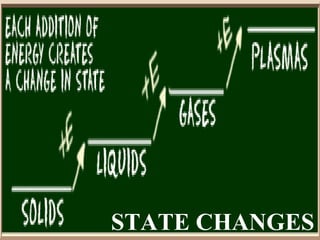
STATE CHANGES
• A Thermodynamic State is a set of values of
properties of a thermodynamic system that
must be specified to reproduce the system.
• The individual parameters are known as state
variables, state parameters or thermodynamic
variables.
• Once a sufficient set of thermodynamic
variables have been specified, values of all
other properties of the system are uniquely
determined. The number of values required to
specify the state depends on the system, and is
not always known.
STATE CHANGES
• An isothermal process occurs at a constant
temperature.
• An example would be to have a system
immersed in a large constant temperature
bath. Any work energy performed by the
system will be lost to the bath, but its
temperature will remain constant. In other
words, the system is thermally connected,
by a thermally conductive boundary to a
constant temperature reservoir.
ISOTHERMAL PROCESS
• An isochoric (or iso-volumetric) process is one in
which the volume is held constant, meaning that the
work done by the system will be zero.
• It follows that, for the simple system of two
dimensions, any heat energy transferred to the
system externally will be absorbed as internal
energy.
• An example would be to place a closed tin can
containing only air into a fire. To a first
approximation, the can will not expand, and the only
change will be that the gas gains internal energy, as
evidenced by its increase in temperature and
pressure. We may say that the system is dynamically
insulated, by a rigid boundary, from the
environment.
ISOCHORIC PROCESS
• An isobaric process is a thermodynamic process
in which the pressure remains constant.
• This is usually obtained by allowing the volume
to expand or contract in such a way to neutralize
any pressure changes that would be caused by
heat transfer.
• In an isobaric process, there are typically
internal energy changes, work is done by the
system, and heat is transferred, so none of the
quantities in the First Law of Thermodynamics
readily reduce to zero.
ISOBARIC PROCESS
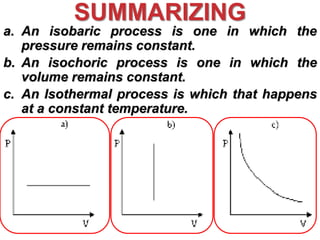
SUMMARIZING
a. An isobaric process is one in which the
pressure remains constant.
b. An isochoric process is one in which the
volume remains constant.
c. An Isothermal process is which that happens
at a constant temperature.
CONCLUSIONS (1)
1. The Second Law of Thermodynamics states
that in any spontaneous process the Entropy
of the universe increases.
2. The Third Law of Thermodynamics states
that the Entropy of a pure crystalline solid at
absolute zero (0 K) is zero.
3. Entropy is an indicative of the randomness of
a system. Entropy is a state function like
Internal Energy and Enthalpy.
4. The Entropy of any system tends to increase
with increases in Temperature, Volume and
the number of moving molecules.
CONCLUSIONS (2)
4.The Gibbs Free Energy is a potential that
measures the maximum or reversible work that
may be performed by a thermodynamic system
at a constant temperature and pressure
(isothermal and isobaric). As such, a reduction
in Free Energy is a necessary condition for the
spontaneity of processes at constant pressure
and temperature.
5.The Gibbs Free Energy of the system is a state
function because it is defined in terms of
thermodynamic properties that are state
functions (Entropy and Enthalpy).

ChemicalThermodynamics.pdf

  • 1.
  • 2.
    OBJECTIVES • To becomefamiliar with Chemical Thermodynamics concepts; • To familiarize with Second and Third Law of Thermodynamics; • To understand Entropy and Free Energy terms. Brown, Lemay & Bursten, Chemistry: The Central Science, 10th Ed. (Chapter 19) TEXTBOOK
  • 3.
    FIRST LAW OFTHERMODYNAMICS Lets recall from Chapter 5 1.Energy cannot be created nor destroyed. 2.Therefore, the total energy of the universe is a constant. 3.Energy can, however, be converted from one form to another or transferred from a system to the surroundings or vice versa. ∆E= Ef – Ei ∆E= q + w
  • 5.
    SPONTANEOUS PROCESSES • Spontaneousprocesses are those that can proceed without any outside intervention. • The gas in vessel B will spontaneously effuse into vessel A, but once the gas is in both vessels, it will NOT spontaneously back to the initial situation.
  • 6.
    Processes that are spontaneousin one direction are non-spontaneous in the reverse direction. SPONTANEOUS PROCESSES
  • 7.
    • Processes thatare spontaneous at one temperature may be non-spontaneous at other temperatures. • Above 0C it is spontaneous for ice to melt. • Below 0C the reverse process is spontaneous. SPONTANEOUS PROCESSES
  • 8.
    REVERSIBLE PROCESSES • Ina reversible process the system changes in such a way that the system and surroundings can be put back in their original states by exactly reversing the process. • Changes are infinitesimally SMALL in a reversible process.
  • 9.
    • Irreversible processescannot be undone by exactly reversing the change to the system. • All SPONTANEOUS processes are IRREVERSIBLE. • All REAL processes are IRREVERSIBLE. IREVERSIBLE PROCESSES
  • 10.
    SUMMARIZING • Spontaneous processes:Most chemical reactions have a natural direction in which they flow. In one direction they are spontaneous, while in the other, they are not. • Reversible processes: the original state of the system and surroundings can be restored by reversing the change. • Irreversible processes: the system cannot return to its original state by reversing the change.
  • 11.
    ENTROPY • Entropy (S)is a term coined by Rudolph Clausius in the 19th Century. • Clausius was convinced of the significance of the ratio of heat delivered and the temperature at which it is delivered: q T
  • 12.
    Rudolf Julius Emanuel Clausius(1822–1888), was a German Physicist, considered one of the central founders of the science of Thermodynamics. He introduced in 1865 the concept of Entropy.
  • 13.
    • Entropy canbe thought of as a measure of the randomness of a system. • It is related to the various modes of motion in molecules. • Like Internal Energy (E) and Enthalpy (H) Entropy (S) is a state function. • Therefore: S = Sfinal  Sinitial ENTROPY
  • 14.
    • For aprocess occurring at constant temperature (an isothermal process): • qrev = The heat that is transferred when the process is carried out REVERSIBLY at a constant temperature. • T = Temperature in Kelvin. ENTROPY T q S rev  
  • 15.
    SECOND LAW OFTHERMODYNAMICS The Second Law of Thermodynamics: The Entropy of the universe does not change for reversible processes and increases for spontaneous processes. Reversible (ideal) process: Irreversible (real, spontaneous) process: 0 .       gs surroundin system univ S S S 0 .       gs surroundin system univ S S S
  • 16.
    ―You can’t breakeven‖ SECOND LAW OF THERMODYNAMICS Reversible (ideal) process: Irreversible (real, spontaneous) process: 0 .       gs surroundin system univ S S S 0 .       gs surroundin system univ S S S
  • 17.
    • The Entropyof the universe increases (real, spontaneous processes). • But, Entropy can decrease for individual systems. SECOND LAW OF THERMODYNAMICS Reversible (ideal) process: Irreversible (real, spontaneous) process: 0 .       gs surroundin system univ S S S 0 .       gs surroundin system univ S S S
  • 18.
    ENTROPY AT THEMOLECULAR SCALE • Ludwig Boltzmann described the concept of entropy at the molecular level. • Temperature is a measure of the average kinetic energy of the molecules in a sample.
  • 19.
    The Austrian Scientific Ludwig EduardBoltzmann (1844 – 1906) has a gravestone in Vienna inscribed with his famous relationship between the Entropy and the number of available Microstates: S = k*lnW
  • 20.
    Molecules exhibit severaltypes of motion:  Translational: Movement of the entire molecule from one place to another.  Vibrational: Periodic motion of atoms within a molecule.  Rotational: Rotation of the molecule on about an axis or rotation about  bonds. ENTROPY AT THE MOLECULAR SCALE
  • 21.
    • Boltzmann envisionedthe motions of a sample of molecules at a particular instant in time.  This would be akin to taking a snapshot of all the molecules. • He referred to this sampling as a MICROSTATE of the thermodynamic system. ENTROPY AT THE MOLECULAR SCALE
  • 22.
    • Each thermodynamicstate has a specific number of microstates (W) associated with it. • Entropy is: S = k*lnW where k is the Boltzmann constant: 1.38*1023 J/K. ENTROPY AT THE MOLECULAR SCALE
  • 23.
    Implications: • More particles: more states  more entropy • Higher T:  more energy states  more entropy • Less structure (gas vs solid):  more states  more entropy ENTROPY AT THE MOLECULAR SCALE
  • 24.
    The number ofmicrostates and, therefore, the entropy tends to increase with increases in: • Temperature. • Volume (gases). • The number of independently moving molecules. ENTROPY AT THE MOLECULAR SCALE
  • 25.
    ENTROPY & PHYSICALSTATES • Entropy increases with the freedom of motion of molecules. • Therefore, S(g) > S(l) > S(s)
  • 26.
    ENTROPY & SOLUTIONS Usually,there is an overall increase in S. (The exception is very highly charged ions that make a lot of water molecules align around them.) Dissolution of a solid: Ions have more entropy (more states). But, some water molecules have less entropy (they are grouped around ions).
  • 27.
    SUMMARIZING ENTROPY CHANGES Ingeneral, entropy INCREASES when: • Gases are formed from liquids and solids. • Liquids or solutions are formed from solids. • The number of gas molecules increases. • The number of moles increases.
  • 28.
    3RD LAW OFTHERMODYNAMICS The entropy of a pure crystalline substance at absolute zero is 0. 0 1 ln * ln *    k W k S
  • 29.
    3RD LAW OFTHERMODYNAMICS The entropy of a pure crystalline substance at absolute zero is 0. 0 1 ln * ln *    k W k S
  • 30.
    STANDARD ENTROPIES • Theseare molar Entropy values of substances in their standard states. • Standard Entropies tend to increase with increasing molar mass.
  • 31.
    Larger and morecomplex molecules have greater Entropies!!! STANDARD ENTROPIES
  • 32.
    ENTROPY CHANGES Entropy changesfor a reaction can be calculated the same way we used for H: ∆Srxn = ∆Sºproducts - ∆Sºreactants • Standard-State Entropy (Sº) for each component could found in Tables. • Note: for pure elements: 0 0 0 0    H S
  • 33.
    Entropy Changes inSurroundings • Heat that flows into or out of the system also changes the entropy of the surroundings. • For an isothermal process: • At constant pressure, qsys is simply H for the system: PRACTICAL USES: SURROUNDINGS & SYSTEM T q S sys surr    T H T q S sys surr       
  • 34.
    LINKING S ANDH: PHASE CHANGES T H T q S sys surr        A phase change is isothermal (no change in T). For water: Hfusion = 6 kJ/mol Hvap = 41 kJ/mol If we do this reversibly: Ssurr = – Ssys
  • 35.
    Entropy Change inthe Universe • The universe is composed of the system and the surroundings. Therefore: Suniverse = Ssystem + Ssurroundings • For spontaneous processes: Suniverse > 0 PRACTICAL USES: SURROUNDINGS & SYSTEM
  • 36.
    = – GibbsFree Energy PRACTICAL USES: SURROUNDINGS & SYSTEM       system system universe H S T S T Starting from the Entropy Change in the Universe: And considering that: We get the following expression: Multiplying by T we get: gs surroundin system universe S S S      T H Ssurr      ) ( T H system universe system S S       
  • 37.
    Make this equationnicer: PRACTICAL USES: SURROUNDINGS & SYSTEM = – Gibbs Free Energy       system system universe H S T S T system system universe S T H S T        system system S T H G      
  • 38.
    T∆Suniverse is definedas the Gibbs Free Energy (G). For spontaneous processes: Suniverse > 0 And therefore: G < 0 G is easier to determine than Suniverse. So: Use G to decide if a process is spontaneous. PRACTICAL USES: SURROUNDINGS & SYSTEM: GIBBS FREE ENERGY
  • 39.
    The American ScientistJosiah Willard Gibbs (1839 – 1903) made important contributions to thermodynamics. He was the first person to be awarded a PhD. in Sciences from an American University (Yale 1863). ∆G = ∆H - T ∆S
  • 40.
    GIBBS FREE ENERGY 1.IfG is negative, the forward reaction is spontaneous. 2.If G is 0, the system is at equilibrium. 3.If G is positive, the reaction is spontaneous in the reverse direction.
  • 41.
    STANDARD FREE ENERGYCHANGES • Standard Free Energies of Formation, Gfº are analogous to Standard Enthalpies of Formation (Hfº): ∆Gfº = ∆Gºproducts – ∆Gºreactants • G can be looked up in tables, or calculated from S° and H°
  • 42.
    FREE ENERGY CHANGES Verykey equation: This equation shows how Gº changes with temperature. Note: We will assume that Sº & Hº are independent of T. system system S T H G        
  • 43.
    FREE ENERGY ANDTEMPERATURE • There are two parts to the Free Energy equation:  H — the Enthalpy term; and  TS — the Entropy term. • The temperature dependence of Free Energy comes from the Entropy term.
  • 44.
    FREE ENERGY ANDTEMPERATURE By knowing the sign (+ or —) of S and H, we can get the sign of G and determine if a reaction is spontaneous.
  • 45.
    FREE ENERGY ANDEQUILIBRIUM Remember from above: If ∆G is 0, the system is at equilibrium. So ∆G must be related to the equilibrium constant (Keq-Chapter 15). The Standard Free Energy (∆Gº) is directly linked to Keq by: ∆Gº = — RT lnKeq or ∆Gº = — RT lnK Note: for pure elements: 0 0 0 0 0 0      G H S
  • 46.
    SUMMARIZING FREE ENERGY 1.TheFree Energy (∆G) is negative for all spontaneous processes. 2.The Free Energy (∆G = 0) for any system at equilibrium. 3.The Free Energy (∆G) is positive for non spontaneous processes.
  • 48.
    • When asystem in a given initial state goes through a number of different changes in state and finally returns to its initial values, the system has undergone a cycle. • Therefore, at the conclusion of a cycle, all the properties have the same value they had at the beginning. • E.g. steam that circulates through a closes cooling room undergoes a cycle. CYCLICAL PROCESS
  • 49.
    The term PHASECHANGE indicates that a substance has changed among the three classical phases of matter: solid, liquid, gas and plasma: • Solid to liquid – Melting; • Liquid to solid – Freezing; • Liquid to gas – Boiling; • Gas to liquid – Condensation; • Solid to gas – Sublimation; • Gas to solid – Deposition. PHASE PROCESSES
  • 50.
  • 52.
    • A ThermodynamicState is a set of values of properties of a thermodynamic system that must be specified to reproduce the system. • The individual parameters are known as state variables, state parameters or thermodynamic variables. • Once a sufficient set of thermodynamic variables have been specified, values of all other properties of the system are uniquely determined. The number of values required to specify the state depends on the system, and is not always known. STATE CHANGES
  • 53.
    • An isothermalprocess occurs at a constant temperature. • An example would be to have a system immersed in a large constant temperature bath. Any work energy performed by the system will be lost to the bath, but its temperature will remain constant. In other words, the system is thermally connected, by a thermally conductive boundary to a constant temperature reservoir. ISOTHERMAL PROCESS
  • 54.
    • An isochoric(or iso-volumetric) process is one in which the volume is held constant, meaning that the work done by the system will be zero. • It follows that, for the simple system of two dimensions, any heat energy transferred to the system externally will be absorbed as internal energy. • An example would be to place a closed tin can containing only air into a fire. To a first approximation, the can will not expand, and the only change will be that the gas gains internal energy, as evidenced by its increase in temperature and pressure. We may say that the system is dynamically insulated, by a rigid boundary, from the environment. ISOCHORIC PROCESS
  • 55.
    • An isobaricprocess is a thermodynamic process in which the pressure remains constant. • This is usually obtained by allowing the volume to expand or contract in such a way to neutralize any pressure changes that would be caused by heat transfer. • In an isobaric process, there are typically internal energy changes, work is done by the system, and heat is transferred, so none of the quantities in the First Law of Thermodynamics readily reduce to zero. ISOBARIC PROCESS
  • 56.
    SUMMARIZING a. An isobaricprocess is one in which the pressure remains constant. b. An isochoric process is one in which the volume remains constant. c. An Isothermal process is which that happens at a constant temperature.
  • 57.
    CONCLUSIONS (1) 1. TheSecond Law of Thermodynamics states that in any spontaneous process the Entropy of the universe increases. 2. The Third Law of Thermodynamics states that the Entropy of a pure crystalline solid at absolute zero (0 K) is zero. 3. Entropy is an indicative of the randomness of a system. Entropy is a state function like Internal Energy and Enthalpy. 4. The Entropy of any system tends to increase with increases in Temperature, Volume and the number of moving molecules.
  • 58.
    CONCLUSIONS (2) 4.The GibbsFree Energy is a potential that measures the maximum or reversible work that may be performed by a thermodynamic system at a constant temperature and pressure (isothermal and isobaric). As such, a reduction in Free Energy is a necessary condition for the spontaneity of processes at constant pressure and temperature. 5.The Gibbs Free Energy of the system is a state function because it is defined in terms of thermodynamic properties that are state functions (Entropy and Enthalpy).