Georgescue Rogen

Prof. Prabha Panth,

Osmania University
Limitations of Economic Theory
 Georgescue-Roegen pointed out some important
defects in Economic Methodology.
 Led to neglect of environmental effects
 Physical Laws have been neglected.

 Therefore, environmental crises that accompany
economic activity are ignored.
 But Natural Resource Depletion and Pollution are

inbuilt with economic activity.
Prabha Panth

22
Main Criticism against Economic
Theory:
 Role of the physical system:
Economic system is a sub-set of the environment.
 Concept of Equilibrium:
Economics gives too much importance to
equilibrium conditions.
But in Nature, there is always disequilibrium, for the
natural state is always in disequilibrium.
• Disequilibrium is based on the physical laws of
thermodynamics.
Prabha Panth
3
The Laws of Thermodynamics:
1. The First Law of Thermodynamics:
 According to the First Law of Thermodynamics,
Matter and Energy can neither be created nor
destroyed.
 Economic ‘production’ only converts one form of

Matter into another, with the help of Labour.
 All economic goods remain temporarily in use,
before being disposed off as wastes.
 Wastes still exist in the environment, but in a
different form.
Prabha Panth
4
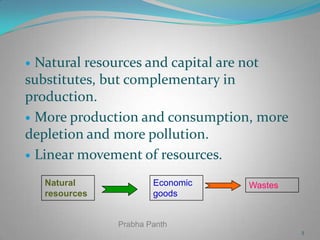
Natural resources and capital are not
substitutes, but complementary in
production.
 More production and consumption, more
depletion and more pollution.
 Linear movement of resources.


Natural
resources

Economic
goods

Wastes

Prabha Panth
5
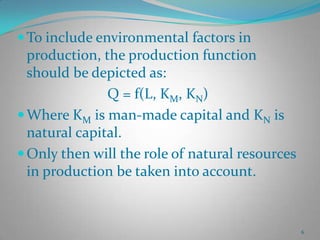
 To include environmental factors in

production, the production function
should be depicted as:
Q = f(L, KM, KN)
 Where KM is man-made capital and KN is
natural capital.
 Only then will the role of natural resources
in production be taken into account.

6
2. Second Law of Thermodynamics:

The Entropy Law:
 Entropy is a measure of disorder in a

thermodynamic system.
 For example, heat moves by itself from a
hotter to a colder body.
 Energy in a piece of coal is low entropy,
more order, available for use.
 If burnt, the energy and all material in the
coal is spread out, high entropy, not
available for use
7
 The Entropy Law states, “In a closed system,

the use of matter energy causes a one-way
flow from low entropy resources to high
entropy resources – from order to disorder.”
 If a piece of coal is burnt, the total amount
of energy and material in the coal is
converted into different forms – heat, light,
ash, CO2, CO, SOx and so on.
 All these materials were inside the coal in an
ordered form. Now they are dissipated in a
disordered form.
8
 When all these were concentrated in the

coal, the energy was available for use –
 it is “bound energy”, and has low entropy or
disorder.
 But once the coal is burnt, all the molecules
are distributed in the environment in
different forms,
 and are unavailable for use.
 This is high entropy or disorder.

Prabha Panth
9
 Economic activity therefore converts low

entropy resources into high entropy
resources;
 It converts natural resources into pollution
and wastes.
 Therefore more the production and
consumption, more natural resources will
be converted into pollutants.
 This is a natural part of economic activity,
not due to inefficiency in production or
consumption.
Prabha Panth
10
 Georgescue-Roegen points out the

following:
 Total energy cannot be recycled to do
work, since the original components are
lost during use.
 If pollutants have to be recycled, more
energy and resources are needed, creating
more environmental problems.

Prabha Panth
11
 Economic activity has converted circular

environmental systems into linear systems, from
natural resources to wastes.
 Pollution and wastes are not due to inefficiency
of production, but inherent in economic activity
due to the laws of thermodynamics.
 The stock of low and available entropy resources
on Earth is limited.
 This is getting converted into unavailable energy
and wastes

Prabha Panth
12
Solution:
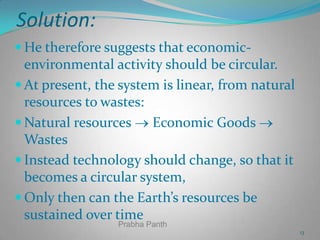
 He therefore suggests that economic-

environmental activity should be circular.
 At present, the system is linear, from natural
resources to wastes:
 Natural resources
Economic Goods
Wastes
 Instead technology should change, so that it
becomes a circular system,
 Only then can the Earth’s resources be
sustained over time
Prabha Panth

13
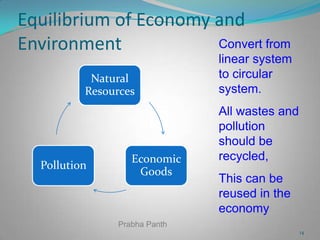
Equilibrium of Economy and
Convert from
Environment
Natural
Resources

Pollution

Economic
Goods

linear system
to circular
system.
All wastes and
pollution
should be
recycled,
This can be
reused in the
economy

Prabha Panth
14
 Change of energy technologies from Non-

renewable resource based to Renewable
resources techniques.
 This will preserve non renewable resources,
 Lower production, so there is lower disorder
and pollution.
 All wastes to be recycled.
 The economic system can then continue
without environmental problems.
Prabha Panth
15

05 the entropy law and economic process

  • 1.
    Georgescue Rogen Prof. PrabhaPanth, Osmania University
  • 2.
    Limitations of EconomicTheory  Georgescue-Roegen pointed out some important defects in Economic Methodology.  Led to neglect of environmental effects  Physical Laws have been neglected.  Therefore, environmental crises that accompany economic activity are ignored.  But Natural Resource Depletion and Pollution are inbuilt with economic activity. Prabha Panth 22
  • 3.
    Main Criticism againstEconomic Theory:  Role of the physical system: Economic system is a sub-set of the environment.  Concept of Equilibrium: Economics gives too much importance to equilibrium conditions. But in Nature, there is always disequilibrium, for the natural state is always in disequilibrium. • Disequilibrium is based on the physical laws of thermodynamics. Prabha Panth 3
  • 4.
    The Laws ofThermodynamics: 1. The First Law of Thermodynamics:  According to the First Law of Thermodynamics, Matter and Energy can neither be created nor destroyed.  Economic ‘production’ only converts one form of Matter into another, with the help of Labour.  All economic goods remain temporarily in use, before being disposed off as wastes.  Wastes still exist in the environment, but in a different form. Prabha Panth 4
  • 5.
    Natural resources andcapital are not substitutes, but complementary in production.  More production and consumption, more depletion and more pollution.  Linear movement of resources.  Natural resources Economic goods Wastes Prabha Panth 5
  • 6.
     To includeenvironmental factors in production, the production function should be depicted as: Q = f(L, KM, KN)  Where KM is man-made capital and KN is natural capital.  Only then will the role of natural resources in production be taken into account. 6
  • 7.
    2. Second Lawof Thermodynamics: The Entropy Law:  Entropy is a measure of disorder in a thermodynamic system.  For example, heat moves by itself from a hotter to a colder body.  Energy in a piece of coal is low entropy, more order, available for use.  If burnt, the energy and all material in the coal is spread out, high entropy, not available for use 7
  • 8.
     The EntropyLaw states, “In a closed system, the use of matter energy causes a one-way flow from low entropy resources to high entropy resources – from order to disorder.”  If a piece of coal is burnt, the total amount of energy and material in the coal is converted into different forms – heat, light, ash, CO2, CO, SOx and so on.  All these materials were inside the coal in an ordered form. Now they are dissipated in a disordered form. 8
  • 9.
     When allthese were concentrated in the coal, the energy was available for use –  it is “bound energy”, and has low entropy or disorder.  But once the coal is burnt, all the molecules are distributed in the environment in different forms,  and are unavailable for use.  This is high entropy or disorder. Prabha Panth 9
  • 10.
     Economic activitytherefore converts low entropy resources into high entropy resources;  It converts natural resources into pollution and wastes.  Therefore more the production and consumption, more natural resources will be converted into pollutants.  This is a natural part of economic activity, not due to inefficiency in production or consumption. Prabha Panth 10
  • 11.
     Georgescue-Roegen pointsout the following:  Total energy cannot be recycled to do work, since the original components are lost during use.  If pollutants have to be recycled, more energy and resources are needed, creating more environmental problems. Prabha Panth 11
  • 12.
     Economic activityhas converted circular environmental systems into linear systems, from natural resources to wastes.  Pollution and wastes are not due to inefficiency of production, but inherent in economic activity due to the laws of thermodynamics.  The stock of low and available entropy resources on Earth is limited.  This is getting converted into unavailable energy and wastes Prabha Panth 12
  • 13.
    Solution:  He thereforesuggests that economic- environmental activity should be circular.  At present, the system is linear, from natural resources to wastes:  Natural resources Economic Goods Wastes  Instead technology should change, so that it becomes a circular system,  Only then can the Earth’s resources be sustained over time Prabha Panth 13
  • 14.
    Equilibrium of Economyand Convert from Environment Natural Resources Pollution Economic Goods linear system to circular system. All wastes and pollution should be recycled, This can be reused in the economy Prabha Panth 14
  • 15.
     Change ofenergy technologies from Non- renewable resource based to Renewable resources techniques.  This will preserve non renewable resources,  Lower production, so there is lower disorder and pollution.  All wastes to be recycled.  The economic system can then continue without environmental problems. Prabha Panth 15