OBJECTIVEApply the second law of thermodynamics to processes.
Define a new property called entropy to quantify the
second-law effects.
Calculate the entropy changes that take place during
processes for pure substances, incompressible substances,
and ideal gases.
Examine a special class of idealized processes, called
isentropic processes, and develop the property relations for
these processes.
Derive the reversible steady-flow work relations
Introduce and apply the entropy balance to various
systems.
2ND LAW OF
THERMODYNAMICS
Involve many inequalities:
Ŋ irrev < ŋrev
COP HP/ R < COP rev
VALID FOR ALL CYCLES
Differential over entire cycle
Sum of all differential
amounts of heat
transfer per T at
boundary
Energy balance on combined system,
Consider the cyclic device
reversible,
Eliminates δQR,
The combine system undergo cycle,
So, we have CLAUSIUS INEQUALITY
If no irreversibilities & cyclic device is reversible,
The combined system is internally reversible
The system considered
in the development of
Clausius Inequality
Violates Kevin-Planck of
2nd Law, so Wc cannot be
work output (Wc≠+ve)
CLAUSIUS INEQUALITY
The EQUALITY for totally or just
internally reversible cycles
The INEQUALITY for the
irreversible ones.
Definition of Entrophy
The net change in a property
(i.e. volume) during a cycle is
always zero
SPECIAL CASE: INTERNALLY REVERSIBLE
ISOTHERMAL HEAT TRANSFER PROCESSES
Property A quantity which its
cyclic integral = 0
The entropy change between two
specified states is the same
whether the process is reversible
or irreversible
ENTROPY
PROPERTY
1. Processes can occur in a certain direction only, not in any
direction. A process must proceed in the direction that complies
with the increase of entropy principle, that is, S gen ≥ 0. A process
that violates this principle is impossible.
2. Entropy is a nonconserved property, and there is no such thing
as the conservation of entropy principle. Entropy is conserved
during the idealized reversible processes only and increases during
all actual processes. (Entropy is generated or created during
irreversible process due to the presence of irreversibilities).
3. The performance of engineering systems is degraded by the
presence of irreversibilities, and entropy generation is a measure
of the magnitudes of the irreversibilities during that process. It is
also used to establish criteria for the performance of engineering
devices.
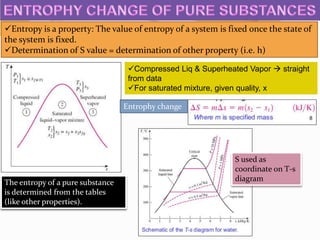
Entropy is a property: The value of entropy of a system is fixed once the state of
the system is fixed.
Determination of S value = determination of other property (i.e. h)
The entropy of a pure substance
is determined from the tables
(like other properties).
Entrophy change
S used as
coordinate on T-s
diagram
Compressed Liq & Superheated Vapor  straight
from data
For saturated mixture, given quality, x
A rigid tank contains 5kg of R-134a initially at 20°C and 140 kPa. The refrigerant
is cooled while being stirred until its pressure drops to 100 kPa. Determine the
entrophy change of R-134a during this process.
SOLUTION:
ASSUMPTIONS: the volume of the tank is constant, so v2 = v1
ANALYSIS:
1. Closed system, no mass crosses the system boundary
2. Change in entrophy = s2-s1, state 1 is fully specified
3. Specific volumes remains constant
State 1: at P1=140 kPa, T1 = 20°C s1 = 1.0624 kJ/kg.K, v1 =
0.16544 m3/kg
State 2: P2 = 100 kPa, v2 = v1 = 0.16544 m3/kg  saturated
mixture since vf<v2<vg
Determine the quality for state 2 x = (v2-vf)/vfg = 0.859
Thus s2=sf+xsfg = 0.8278 kJ/kg.K
Entrophy change, ΔS = m(s2-s1)= -1.173 kJ/K
ISENTROPIC PROCESS  A PROCESS WHICH THE ENTROPHY REMAINS
CONSTANT.
During an internally
reversible, adiabatic
(isentropic) process, the
entropy remains constant.
The isentropic process appears as a vertical
line segment on a T-s diagram.
ISENTROPIC PROCESS:
NO HEAT TRANSFER,
AREA = 0
ENTROPHY  A MEASURE OF MOLECULAR DISORDERS OR
MOLECULAR RANDOMNESS
As a system becomes more disordered, the entrophy will increase.
3RD LAW OF
THERMODYNAMICS
A pure crystalline substance at 0
temperature is in perfect order &
its entrophy is 0
The level of molecular
disorder (entropy) of a
substance increases as it
melts or evaporates.
S is related to the thermodynamic
probability, p (molecular
probability)
Derived from Eq. 7-23 Gibbs equation
Liquids & solids can be
approximated as
incompressible
substances since their
specific volumes remain
nearly constant during a
process
Liquids, solids:
For an isentropic process of an incompressible substance
ISENTROPIC
ISOTHERMAL
IDEAL GAS PROPERTIES
From the first T ds
relation (Eq 7-25)
From the second T ds
relation (Eq 7-26)
Entropy change of an ideal gas on a
unit–mole basis  multiplying by molar
mass
Under the constant-specific-heat assumption,
the specific heat is assumed to be constant at
some average value.
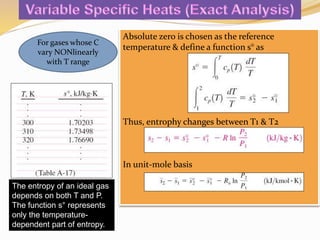
For gases whose
C vary linearly
with T range
Absolute zero is chosen as the reference
temperature & define a function s° as
Thus, entrophy changes between T1 & T2
In unit-mole basis
On a unit–mole basis
The entropy of an ideal gas
depends on both T and P.
The function s° represents
only the temperature-
dependent part of entropy.
For gases whose C
vary NONlinearly
with T range
Air is compressed from an initial state of 100kPa and 17°C to a final state of 600
kPa and 57°C. determine the entrophy change of air during this compression
process by using (a) property values from the air table (b) average specific heats
SOLUTION: Air is compressed between 2 specified states. The entrophy change is
to be determined by both method
ASSUMPTIONS: Air is an ideal gas
ANALYSIS: the initial & final states are fully specified
(a) Property table for s0 (Table A-17) & substituting into eq. for exact analysis [-
0.3844 kJ/kg.K]
(b) Find Cp values to determine the Cpave at Tave of 37°C (Table A-2b) and solve
using approximation analysis [-0.3842 kJ/kg.K]
Constant Specific Heats (Approximate Analysis)
For Isentropic (Δs=0) process, setting the above Eqs. equal to zero to get:
The isentropic relations of ideal
gases are valid for the isentropic
processes of ideal gases only.
Pv=RT
Variable Specific Heats (Exact Analysis)
Relative Pressure & Relative Specific Volume
The use of Pr data
for calculating the
final temperature
during an
isentropic
process
T/Pr is the relative
specific volume vr.
Helium gas is compressed by an adiabatic compressor from an initial state of 100
kPa and 10°C to a final temperature of 160°C in a reversible manner. Determine the
exit pressure of helium.
SOLUTION:
ASSUMPTION: At specified conditions, helium can be treated
as ideal gas.
ANALYSIS:
1. Find the k value for helium (Table A-2)
2. Calculate the final pressure of helium using eq.
Energy balance for a steady-flow device (internally reversible, +ve for Wout)
but
Yield
For work input,
For the steady flow of incompressible liquid (v constant)
through a device that involves no work interactions (such as a
pipe section), the work term is zero.
BERNOULLI
EQUATION
v , W
Energy balance for 2 (irrev & rev) steady-flow devices (+ve for Qin, Wout)
Both operate between the same end states,
however,
Gives,
T is absolute T
Work-producing devices (turbines )deliver
more work, and work-consuming devices
(pumps, compressors ) require less work
when they operate reversibly
A reversible turbine delivers more
work than an irreversible one if
both operate between the same
end states.
Proof that Steady-Flow Devices Deliver the Most and Consume
the Least Work when the Process Is Reversible
IRREVERSIBLE
REVERSIBLE
Entrophy transfer + Entrophy generation = Entrophy change
Entropy Change of a System, ∆S system
When the properties of the system are not
uniform
Energy and entropy
balances for a system
HEAT TRANSFER
Entropy transfer by heat transfer:
Entropy transfer by work:
Heat transfer is always accompanied by
entropy transfer in the amount of Q/T,
where T is the boundary temperature.
No entropy accompanies work as it crosses
the system boundary. But entropy may be
generated within the system as work is
dissipated into a less useful form of energy.
Mechanisms of Entrophy Transfer, Sin & Sout
T ≠ constant
MASS FLOW
Entropy transfer by mass:
When the properties of the mass
change during the process
Mass contains entropy as well as energy,
and thus mass flow into or out of system
is always accompanied by energy and
entropy transfer.
s = specific
entrophy
Mechanisms of Entrophy Transfer, Sin & Sout
Mechanisms of
entropy transfer
for a
general system.
Entropy generation
outside system
boundaries can be
accounted for by
writing an entropy
balance on an
extended system
that includes the
system and its
immediate
surroundings.
Entrophy Generation, Sgen
The entropy change of a closed system during a process is equal to
the sum of the net entropy transferred through the system
boundary by heat transfer and the entropy generated within the
system boundaries.
ADIABATIC CLOSED SYSTEM
SYSTEM + SURROUNDINGS
Closed Systems
STEADY FLOW SINGLE STREAM ADIABATIC
STEADY FLOW
STEADY FLOW SINGLE STREAM
The entropy of a substance always
increases (or remains constant in the
case of a reversible process) as it flows
through a single-stream, adiabatic,
steady-flow device.
The entropy of a control volume
changes as a result of mass flow as
well as heat transfer.
Control Volumes
A horizontal cylinder is separated into two compartments by an adiabatic,
frictionless piston. One side contains 0.2 m3 of nitrogen and the other side
contains 0.1kg of helium.. Both initially at 20°C and 95 kPa. The sides of
the cylinder and the helium end are insulated. Now heat is added to the
nitrogen side from a reservoir at 500°C until the pressure of the helium
rises to 120 kPa. Determine (a) the final temperature of helium, (b) the final
volume of the nitrogen, (c) the heat transferred to the nitrogen and (d) the
entrophy generation during this process.
ANS: (a) 321.7K, (b) 0.2838 m3, (c) 46.6287kJ, (d) 0.057 kJ/K

Week 7 entrophy

  • 2.
    OBJECTIVEApply the secondlaw of thermodynamics to processes. Define a new property called entropy to quantify the second-law effects. Calculate the entropy changes that take place during processes for pure substances, incompressible substances, and ideal gases. Examine a special class of idealized processes, called isentropic processes, and develop the property relations for these processes. Derive the reversible steady-flow work relations Introduce and apply the entropy balance to various systems.
  • 3.
    2ND LAW OF THERMODYNAMICS Involvemany inequalities: Ŋ irrev < ŋrev COP HP/ R < COP rev VALID FOR ALL CYCLES Differential over entire cycle Sum of all differential amounts of heat transfer per T at boundary
  • 4.
    Energy balance oncombined system, Consider the cyclic device reversible, Eliminates δQR, The combine system undergo cycle, So, we have CLAUSIUS INEQUALITY If no irreversibilities & cyclic device is reversible, The combined system is internally reversible The system considered in the development of Clausius Inequality Violates Kevin-Planck of 2nd Law, so Wc cannot be work output (Wc≠+ve) CLAUSIUS INEQUALITY The EQUALITY for totally or just internally reversible cycles The INEQUALITY for the irreversible ones.
  • 5.
    Definition of Entrophy Thenet change in a property (i.e. volume) during a cycle is always zero SPECIAL CASE: INTERNALLY REVERSIBLE ISOTHERMAL HEAT TRANSFER PROCESSES Property A quantity which its cyclic integral = 0 The entropy change between two specified states is the same whether the process is reversible or irreversible ENTROPY PROPERTY
  • 6.
    1. Processes canoccur in a certain direction only, not in any direction. A process must proceed in the direction that complies with the increase of entropy principle, that is, S gen ≥ 0. A process that violates this principle is impossible. 2. Entropy is a nonconserved property, and there is no such thing as the conservation of entropy principle. Entropy is conserved during the idealized reversible processes only and increases during all actual processes. (Entropy is generated or created during irreversible process due to the presence of irreversibilities). 3. The performance of engineering systems is degraded by the presence of irreversibilities, and entropy generation is a measure of the magnitudes of the irreversibilities during that process. It is also used to establish criteria for the performance of engineering devices.
  • 7.
    Entropy is aproperty: The value of entropy of a system is fixed once the state of the system is fixed. Determination of S value = determination of other property (i.e. h) The entropy of a pure substance is determined from the tables (like other properties). Entrophy change S used as coordinate on T-s diagram Compressed Liq & Superheated Vapor  straight from data For saturated mixture, given quality, x
  • 8.
    A rigid tankcontains 5kg of R-134a initially at 20°C and 140 kPa. The refrigerant is cooled while being stirred until its pressure drops to 100 kPa. Determine the entrophy change of R-134a during this process. SOLUTION: ASSUMPTIONS: the volume of the tank is constant, so v2 = v1 ANALYSIS: 1. Closed system, no mass crosses the system boundary 2. Change in entrophy = s2-s1, state 1 is fully specified 3. Specific volumes remains constant State 1: at P1=140 kPa, T1 = 20°C s1 = 1.0624 kJ/kg.K, v1 = 0.16544 m3/kg State 2: P2 = 100 kPa, v2 = v1 = 0.16544 m3/kg  saturated mixture since vf<v2<vg Determine the quality for state 2 x = (v2-vf)/vfg = 0.859 Thus s2=sf+xsfg = 0.8278 kJ/kg.K Entrophy change, ΔS = m(s2-s1)= -1.173 kJ/K
  • 9.
    ISENTROPIC PROCESS A PROCESS WHICH THE ENTROPHY REMAINS CONSTANT. During an internally reversible, adiabatic (isentropic) process, the entropy remains constant. The isentropic process appears as a vertical line segment on a T-s diagram. ISENTROPIC PROCESS: NO HEAT TRANSFER, AREA = 0
  • 10.
    ENTROPHY  AMEASURE OF MOLECULAR DISORDERS OR MOLECULAR RANDOMNESS As a system becomes more disordered, the entrophy will increase. 3RD LAW OF THERMODYNAMICS A pure crystalline substance at 0 temperature is in perfect order & its entrophy is 0 The level of molecular disorder (entropy) of a substance increases as it melts or evaporates. S is related to the thermodynamic probability, p (molecular probability)
  • 11.
    Derived from Eq.7-23 Gibbs equation Liquids & solids can be approximated as incompressible substances since their specific volumes remain nearly constant during a process Liquids, solids: For an isentropic process of an incompressible substance ISENTROPIC ISOTHERMAL
  • 12.
    IDEAL GAS PROPERTIES Fromthe first T ds relation (Eq 7-25) From the second T ds relation (Eq 7-26)
  • 13.
    Entropy change ofan ideal gas on a unit–mole basis  multiplying by molar mass Under the constant-specific-heat assumption, the specific heat is assumed to be constant at some average value. For gases whose C vary linearly with T range
  • 14.
    Absolute zero ischosen as the reference temperature & define a function s° as Thus, entrophy changes between T1 & T2 In unit-mole basis On a unit–mole basis The entropy of an ideal gas depends on both T and P. The function s° represents only the temperature- dependent part of entropy. For gases whose C vary NONlinearly with T range
  • 15.
    Air is compressedfrom an initial state of 100kPa and 17°C to a final state of 600 kPa and 57°C. determine the entrophy change of air during this compression process by using (a) property values from the air table (b) average specific heats SOLUTION: Air is compressed between 2 specified states. The entrophy change is to be determined by both method ASSUMPTIONS: Air is an ideal gas ANALYSIS: the initial & final states are fully specified (a) Property table for s0 (Table A-17) & substituting into eq. for exact analysis [- 0.3844 kJ/kg.K] (b) Find Cp values to determine the Cpave at Tave of 37°C (Table A-2b) and solve using approximation analysis [-0.3842 kJ/kg.K]
  • 16.
    Constant Specific Heats(Approximate Analysis) For Isentropic (Δs=0) process, setting the above Eqs. equal to zero to get: The isentropic relations of ideal gases are valid for the isentropic processes of ideal gases only.
  • 17.
    Pv=RT Variable Specific Heats(Exact Analysis) Relative Pressure & Relative Specific Volume The use of Pr data for calculating the final temperature during an isentropic process T/Pr is the relative specific volume vr.
  • 18.
    Helium gas iscompressed by an adiabatic compressor from an initial state of 100 kPa and 10°C to a final temperature of 160°C in a reversible manner. Determine the exit pressure of helium. SOLUTION: ASSUMPTION: At specified conditions, helium can be treated as ideal gas. ANALYSIS: 1. Find the k value for helium (Table A-2) 2. Calculate the final pressure of helium using eq.
  • 19.
    Energy balance fora steady-flow device (internally reversible, +ve for Wout) but Yield For work input, For the steady flow of incompressible liquid (v constant) through a device that involves no work interactions (such as a pipe section), the work term is zero. BERNOULLI EQUATION v , W
  • 20.
    Energy balance for2 (irrev & rev) steady-flow devices (+ve for Qin, Wout) Both operate between the same end states, however, Gives, T is absolute T Work-producing devices (turbines )deliver more work, and work-consuming devices (pumps, compressors ) require less work when they operate reversibly A reversible turbine delivers more work than an irreversible one if both operate between the same end states. Proof that Steady-Flow Devices Deliver the Most and Consume the Least Work when the Process Is Reversible IRREVERSIBLE REVERSIBLE
  • 21.
    Entrophy transfer +Entrophy generation = Entrophy change Entropy Change of a System, ∆S system When the properties of the system are not uniform Energy and entropy balances for a system
  • 22.
    HEAT TRANSFER Entropy transferby heat transfer: Entropy transfer by work: Heat transfer is always accompanied by entropy transfer in the amount of Q/T, where T is the boundary temperature. No entropy accompanies work as it crosses the system boundary. But entropy may be generated within the system as work is dissipated into a less useful form of energy. Mechanisms of Entrophy Transfer, Sin & Sout T ≠ constant
  • 23.
    MASS FLOW Entropy transferby mass: When the properties of the mass change during the process Mass contains entropy as well as energy, and thus mass flow into or out of system is always accompanied by energy and entropy transfer. s = specific entrophy Mechanisms of Entrophy Transfer, Sin & Sout
  • 24.
    Mechanisms of entropy transfer fora general system. Entropy generation outside system boundaries can be accounted for by writing an entropy balance on an extended system that includes the system and its immediate surroundings. Entrophy Generation, Sgen
  • 25.
    The entropy changeof a closed system during a process is equal to the sum of the net entropy transferred through the system boundary by heat transfer and the entropy generated within the system boundaries. ADIABATIC CLOSED SYSTEM SYSTEM + SURROUNDINGS Closed Systems
  • 26.
    STEADY FLOW SINGLESTREAM ADIABATIC STEADY FLOW STEADY FLOW SINGLE STREAM The entropy of a substance always increases (or remains constant in the case of a reversible process) as it flows through a single-stream, adiabatic, steady-flow device. The entropy of a control volume changes as a result of mass flow as well as heat transfer. Control Volumes
  • 28.
    A horizontal cylinderis separated into two compartments by an adiabatic, frictionless piston. One side contains 0.2 m3 of nitrogen and the other side contains 0.1kg of helium.. Both initially at 20°C and 95 kPa. The sides of the cylinder and the helium end are insulated. Now heat is added to the nitrogen side from a reservoir at 500°C until the pressure of the helium rises to 120 kPa. Determine (a) the final temperature of helium, (b) the final volume of the nitrogen, (c) the heat transferred to the nitrogen and (d) the entrophy generation during this process. ANS: (a) 321.7K, (b) 0.2838 m3, (c) 46.6287kJ, (d) 0.057 kJ/K