Hisrich
Peters
Shepherd
Chapter 7
The Business Plan:
Creating and
Starting the Venture
Copyright © 2010 by The McGraw-Hill Companies, Inc. All rights reserved.McGraw-Hill/Irwin
7-2
Planning as Part of the Business
Operation
 Plans provide guidance and structure in a
rapidly changing market environment.
 Plans get finalized as the entrepreneur has
a better sense of the market, the product
or services, the management team, and the
financial needs of the venture.
 They help meet short-term or long-term
business goals.
7-3
What is the Business Plan?
 A written document describing all relevant
internal and external elements, and
strategies for starting a new venture.
 It is an integration of functional plans;
addresses short-term and long-term
decision making for the first three years of
operation.
7-4
Who Should Write the Plan?
 The plan should be prepared by the
entrepreneur in consultation with other
sources.
 The entrepreneur should make an
objective assessment of his or her own
skills before deciding to hire a consultant.
7-5
Scope and Value of the Business
Plan—Who Reads the Plan?
 Who is expected to read the plan can often
affect its actual content and focus.
 In preparing the plan it is important to
consider the:
 Entrepreneur’s perspective.
 Marketing perspective.
 Investor's perspective.
7-6
Scope and Value of the Business
Plan—Who Reads the Plan? (cont.)
 Depth and detail in the business plan
depend on:
 Size and scope of the proposed new venture.
 Size of the market.
 Competition.
 Potential growth.
7-7
 The business plan is valuable because it:
 Helps determine the viability of the venture in a
designated market.
 Guides the entrepreneur in organizing planning
activities.
 Serves as an important tool in obtaining
financing.
 This process provides a self-assessment by
the entrepreneur.
Scope and Value of the Business
Plan—Who Reads the Plan? (cont.)
7-8
How do Potential Lenders and
Investors Evaluate the Plan?
 The business plan must reflect:
 The strengths of management and personnel.
 The product/service.
 Available resources.
 Lenders are interested in the venture’s
ability to pay back the debt.
 Focus on the four Cs of credit - Character, cash
flow, collateral, and equity contribution.
 Banks want an objective analysis of the
business opportunity and the risks.
7-9
 Investors, particularly venture capitalists,
have different needs:
 Place more emphasis on the entrepreneur’s
character.
 Spend much time conducting background
checks.
 Demand high rates of return.
 Focus on market and financial projections.
How do Potential Lenders and
Investors Evaluate the Plan? (cont.)
7-10
Presenting the Plan
 The entrepreneur is expected to “sell” the
business concept.
 Focus on why this is a good opportunity.
 Provide an overview of the marketing program;
sales and profits.
 Address risks and how to overcome them.
 Audience includes potential investors who
may raise questions.
 Investors describe these presentations as
elevator pitches.
7-11
Information Needs
 Before creating a business plan, the
entrepreneur must undertake a feasibility
study.
 Information for a feasibility study should
focus on marketing, finance, and
production.
 Feasible, well-defined goals and objectives
need to be established.
 Based on this, strategy decisions can be
established.
7-12
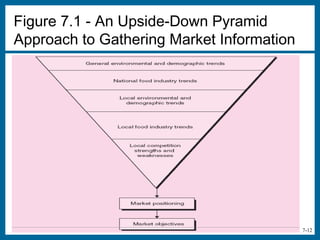
Figure 7.1 - An Upside-Down Pyramid
Approach to Gathering Market Information
7-13
 Operations Information Needs
 Location.
 Manufacturing operations.
 Raw materials.
 Equipment.
 Labor skills.
 Space.
 Overhead.
 Most of the information should be incorporated
directly into the business plan.
Information Needs (cont.)
7-14
Financial Information Needs
 The entrepreneur has to prepare a budget
of all possible expenditures and revenue
sources, including sales and any external
available funds.
 The budget includes capital expenditures,
direct operating expenses, and cash
expenditures for nonexpense items.
 Industry benchmarks can be used in
preparing the final pro forma statements in
the financial plan.
7-15
Using the Internet as a Resource
Tool
 The Internet can provide information for
industry analysis, competitor analysis, and
measurement of market potential.
 It is a valuable resource in later-stage
planning and decision making; provides
opportunities for marketing strategy.
 An entrepreneur can access:
 Popular search engines.
 Competitors’ Web sites.
 Social networks, blogs, and discussion groups.
7-16
Writing the Business Plan
 A business plan should be comprehensive
enough to give any potential investor a
complete picture and understanding of the
new venture.
 It should help the entrepreneur clarify his
or her thinking about the business.
7-17
 Introductory Page
 Name and address of the company.
 Name of the entrepreneur(s), telephone
number, fax number, e-mail address, and Web
site address.
 Description of the company and nature of the
business.
 Statement of financing needed.
 Statement of confidentiality of report.
Writing the Business Plan (cont.)
7-18
 Executive Summary
 About two to three pages in length summarizing
the complete business plan.
 Environmental and Industry Analysis
 The environmental analysis assesses external
uncontrollable variables that may impact the
business plan.
 Examples: Economy, culture, technology, legal
concerns, etc.
 The industry analysis involves reviewing industry
trends and competitive strategies.
 Examples: Industry demand, competition, etc.
Writing the Business Plan (cont.)
7-19
Table 7.5 - Critical Issues for
Environmental and Industry Analysis
7-20
Table 7.6 - Describing the Venture
7-21
Table 7.7 - Production Plan
7-22
 Operations Plan
 All businesses (manufacturing or
nonmanufacturing) should include an operations
plan as part of the business plan.
 It goes beyond the manufacturing process.
 Describes the flow of goods and services from
production to the customer.
 The major distinction between services and
manufactured goods is services involve
intangible performances.
Writing the Business Plan (cont.)
7-23
 Marketing Plan
 It describes market conditions and strategy
related to how the product/service will be
distributed, priced, and promoted.
 Marketing research evidence to support any of
the marketing decision strategies as well as for
forecasting sales should be described in this
section.
 Potential investors regard the marketing plan as
critical to the success of the new venture.
Writing the Business Plan (cont.)
7-24
 Organizational Plan
 It describes the form of ownership and lines of
authority and responsibility of members of new
venture.
 In case of a partnership, the terms of the
partnership should be included.
 In case of a corporation, the following should be
included:
 Shares of stock authorized and share options.
 Names, addresses, and resumes of directors and
officers.
 Organization chart.
Writing the Business Plan (cont.)
7-25
 Assessment of Risk
 Identifies potential hazards and alternative
strategies to meet goals and objectives.
 The entrepreneur should indicate:
 Potential risks to the new venture.
 Impact of the risks.
 Strategy to prevent, minimize, or respond to the risk.
 Major risks could result from:
 Competitor’s reaction.
 Weaknesses in marketing/ production/ management
team.
 New advances in technology.
Writing the Business Plan (cont.)
7-26
 Financial Plan
 It contains projections of key financial data that
determine economic feasibility and necessary
financial investment commitment.
 It should contain:
 Summarized forecasted sales and appropriate
expenses for at least the first three years.
 Cash flow figures for three years.
 Projected balance sheet.
Writing the Business Plan (cont.)
7-27
 Appendix
 It contains any backup material that is not
necessary in the text of the document.
 It may include:
 Letters from customers, distributors, or
subcontractors.
 Secondary data or primary research data used to
support plan decisions.
 Leases, contracts, or other types of agreements.
 Price lists from suppliers and competitors.
Writing the Business Plan (cont.)
7-28
Using and Implementing the
Business Plan
 The business plan is designed to guide the
entrepreneur through the first year of
operations.
 The strategy should contain control points
to ascertain progress and to initiate
contingency plans if necessary.
 Without good planning employees will not
understand the company’s goals.
 Businesses fail due to entrepreneur’s
inability to plan effectively.
7-29
 Measuring Plan Progress
 Business plan projections are made on a 12-
month schedule but the entrepreneur should
frequently check on:
 Profit and loss statement.
 Cash flow projections.
 Inventory control.
 Production control.
 Quality control.
 Sales control.
 Disbursements.
 Web site control.
Using and Implementing the
Business Plan (cont.)
7-30
 Updating the Plan
 Entrepreneurs must be sensitive to changes in
the company, industry, and market.
 Determine what revisions are needed if changes
are likely to affect the business plan.
 This helps entrepreneurs to:
 Maintain reasonable targets and goals.
 Keep the new venture on a course to high probability
of success.
Using and Implementing the
Business Plan (cont.)
7-31
Why Some Business Plans Fail
 Goals are unreasonable.
 Objectives are not measurable.
 Entrepreneur has not made a total
commitment to the business or to the
family.
 Lack of experience in the planned business.
 No sense of potential threats or weaknesses
to the business.
 No customer need was established for the
proposed product or service.

Entrepreneurship Chap 7

  • 1.
    Hisrich Peters Shepherd Chapter 7 The BusinessPlan: Creating and Starting the Venture Copyright © 2010 by The McGraw-Hill Companies, Inc. All rights reserved.McGraw-Hill/Irwin
  • 2.
    7-2 Planning as Partof the Business Operation  Plans provide guidance and structure in a rapidly changing market environment.  Plans get finalized as the entrepreneur has a better sense of the market, the product or services, the management team, and the financial needs of the venture.  They help meet short-term or long-term business goals.
  • 3.
    7-3 What is theBusiness Plan?  A written document describing all relevant internal and external elements, and strategies for starting a new venture.  It is an integration of functional plans; addresses short-term and long-term decision making for the first three years of operation.
  • 4.
    7-4 Who Should Writethe Plan?  The plan should be prepared by the entrepreneur in consultation with other sources.  The entrepreneur should make an objective assessment of his or her own skills before deciding to hire a consultant.
  • 5.
    7-5 Scope and Valueof the Business Plan—Who Reads the Plan?  Who is expected to read the plan can often affect its actual content and focus.  In preparing the plan it is important to consider the:  Entrepreneur’s perspective.  Marketing perspective.  Investor's perspective.
  • 6.
    7-6 Scope and Valueof the Business Plan—Who Reads the Plan? (cont.)  Depth and detail in the business plan depend on:  Size and scope of the proposed new venture.  Size of the market.  Competition.  Potential growth.
  • 7.
    7-7  The businessplan is valuable because it:  Helps determine the viability of the venture in a designated market.  Guides the entrepreneur in organizing planning activities.  Serves as an important tool in obtaining financing.  This process provides a self-assessment by the entrepreneur. Scope and Value of the Business Plan—Who Reads the Plan? (cont.)
  • 8.
    7-8 How do PotentialLenders and Investors Evaluate the Plan?  The business plan must reflect:  The strengths of management and personnel.  The product/service.  Available resources.  Lenders are interested in the venture’s ability to pay back the debt.  Focus on the four Cs of credit - Character, cash flow, collateral, and equity contribution.  Banks want an objective analysis of the business opportunity and the risks.
  • 9.
    7-9  Investors, particularlyventure capitalists, have different needs:  Place more emphasis on the entrepreneur’s character.  Spend much time conducting background checks.  Demand high rates of return.  Focus on market and financial projections. How do Potential Lenders and Investors Evaluate the Plan? (cont.)
  • 10.
    7-10 Presenting the Plan The entrepreneur is expected to “sell” the business concept.  Focus on why this is a good opportunity.  Provide an overview of the marketing program; sales and profits.  Address risks and how to overcome them.  Audience includes potential investors who may raise questions.  Investors describe these presentations as elevator pitches.
  • 11.
    7-11 Information Needs  Beforecreating a business plan, the entrepreneur must undertake a feasibility study.  Information for a feasibility study should focus on marketing, finance, and production.  Feasible, well-defined goals and objectives need to be established.  Based on this, strategy decisions can be established.
  • 12.
    7-12 Figure 7.1 -An Upside-Down Pyramid Approach to Gathering Market Information
  • 13.
    7-13  Operations InformationNeeds  Location.  Manufacturing operations.  Raw materials.  Equipment.  Labor skills.  Space.  Overhead.  Most of the information should be incorporated directly into the business plan. Information Needs (cont.)
  • 14.
    7-14 Financial Information Needs The entrepreneur has to prepare a budget of all possible expenditures and revenue sources, including sales and any external available funds.  The budget includes capital expenditures, direct operating expenses, and cash expenditures for nonexpense items.  Industry benchmarks can be used in preparing the final pro forma statements in the financial plan.
  • 15.
    7-15 Using the Internetas a Resource Tool  The Internet can provide information for industry analysis, competitor analysis, and measurement of market potential.  It is a valuable resource in later-stage planning and decision making; provides opportunities for marketing strategy.  An entrepreneur can access:  Popular search engines.  Competitors’ Web sites.  Social networks, blogs, and discussion groups.
  • 16.
    7-16 Writing the BusinessPlan  A business plan should be comprehensive enough to give any potential investor a complete picture and understanding of the new venture.  It should help the entrepreneur clarify his or her thinking about the business.
  • 17.
    7-17  Introductory Page Name and address of the company.  Name of the entrepreneur(s), telephone number, fax number, e-mail address, and Web site address.  Description of the company and nature of the business.  Statement of financing needed.  Statement of confidentiality of report. Writing the Business Plan (cont.)
  • 18.
    7-18  Executive Summary About two to three pages in length summarizing the complete business plan.  Environmental and Industry Analysis  The environmental analysis assesses external uncontrollable variables that may impact the business plan.  Examples: Economy, culture, technology, legal concerns, etc.  The industry analysis involves reviewing industry trends and competitive strategies.  Examples: Industry demand, competition, etc. Writing the Business Plan (cont.)
  • 19.
    7-19 Table 7.5 -Critical Issues for Environmental and Industry Analysis
  • 20.
    7-20 Table 7.6 -Describing the Venture
  • 21.
    7-21 Table 7.7 -Production Plan
  • 22.
    7-22  Operations Plan All businesses (manufacturing or nonmanufacturing) should include an operations plan as part of the business plan.  It goes beyond the manufacturing process.  Describes the flow of goods and services from production to the customer.  The major distinction between services and manufactured goods is services involve intangible performances. Writing the Business Plan (cont.)
  • 23.
    7-23  Marketing Plan It describes market conditions and strategy related to how the product/service will be distributed, priced, and promoted.  Marketing research evidence to support any of the marketing decision strategies as well as for forecasting sales should be described in this section.  Potential investors regard the marketing plan as critical to the success of the new venture. Writing the Business Plan (cont.)
  • 24.
    7-24  Organizational Plan It describes the form of ownership and lines of authority and responsibility of members of new venture.  In case of a partnership, the terms of the partnership should be included.  In case of a corporation, the following should be included:  Shares of stock authorized and share options.  Names, addresses, and resumes of directors and officers.  Organization chart. Writing the Business Plan (cont.)
  • 25.
    7-25  Assessment ofRisk  Identifies potential hazards and alternative strategies to meet goals and objectives.  The entrepreneur should indicate:  Potential risks to the new venture.  Impact of the risks.  Strategy to prevent, minimize, or respond to the risk.  Major risks could result from:  Competitor’s reaction.  Weaknesses in marketing/ production/ management team.  New advances in technology. Writing the Business Plan (cont.)
  • 26.
    7-26  Financial Plan It contains projections of key financial data that determine economic feasibility and necessary financial investment commitment.  It should contain:  Summarized forecasted sales and appropriate expenses for at least the first three years.  Cash flow figures for three years.  Projected balance sheet. Writing the Business Plan (cont.)
  • 27.
    7-27  Appendix  Itcontains any backup material that is not necessary in the text of the document.  It may include:  Letters from customers, distributors, or subcontractors.  Secondary data or primary research data used to support plan decisions.  Leases, contracts, or other types of agreements.  Price lists from suppliers and competitors. Writing the Business Plan (cont.)
  • 28.
    7-28 Using and Implementingthe Business Plan  The business plan is designed to guide the entrepreneur through the first year of operations.  The strategy should contain control points to ascertain progress and to initiate contingency plans if necessary.  Without good planning employees will not understand the company’s goals.  Businesses fail due to entrepreneur’s inability to plan effectively.
  • 29.
    7-29  Measuring PlanProgress  Business plan projections are made on a 12- month schedule but the entrepreneur should frequently check on:  Profit and loss statement.  Cash flow projections.  Inventory control.  Production control.  Quality control.  Sales control.  Disbursements.  Web site control. Using and Implementing the Business Plan (cont.)
  • 30.
    7-30  Updating thePlan  Entrepreneurs must be sensitive to changes in the company, industry, and market.  Determine what revisions are needed if changes are likely to affect the business plan.  This helps entrepreneurs to:  Maintain reasonable targets and goals.  Keep the new venture on a course to high probability of success. Using and Implementing the Business Plan (cont.)
  • 31.
    7-31 Why Some BusinessPlans Fail  Goals are unreasonable.  Objectives are not measurable.  Entrepreneur has not made a total commitment to the business or to the family.  Lack of experience in the planned business.  No sense of potential threats or weaknesses to the business.  No customer need was established for the proposed product or service.