Hisrich
Peters
Shepherd
Chapter 12
Informal Risk Capital,
Venture Capital,
and
Going Public
Copyright © 2010 by The McGraw-Hill Companies, Inc. All rights reserved.McGraw-Hill/Irwin
12-2
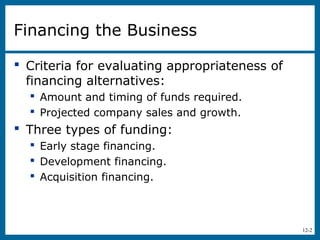
Financing the Business
 Criteria for evaluating appropriateness of
financing alternatives:
 Amount and timing of funds required.
 Projected company sales and growth.
 Three types of funding:
 Early stage financing.
 Development financing.
 Acquisition financing.
12-3
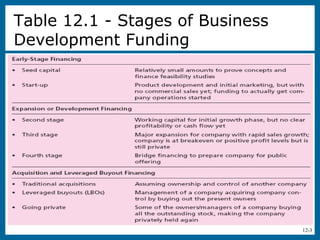
Table 12.1 - Stages of Business
Development Funding
12-4
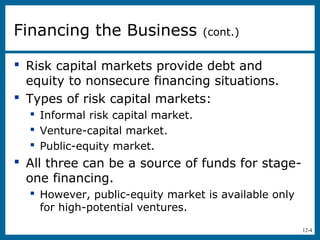
 Risk capital markets provide debt and
equity to nonsecure financing situations.
 Types of risk capital markets:
 Informal risk capital market.
 Venture-capital market.
 Public-equity market.
 All three can be a source of funds for stage-
one financing.
 However, public-equity market is available only
for high-potential ventures.
Financing the Business (cont.)
12-5
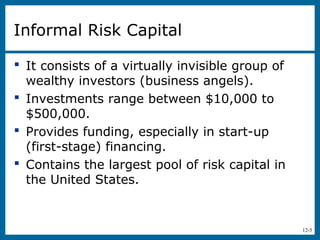
Informal Risk Capital
 It consists of a virtually invisible group of
wealthy investors (business angels).
 Investments range between $10,000 to
$500,000.
 Provides funding, especially in start-up
(first-stage) financing.
 Contains the largest pool of risk capital in
the United States.
12-6
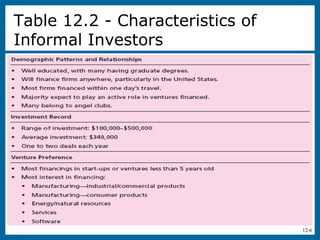
Table 12.2 - Characteristics of
Informal Investors
12-7
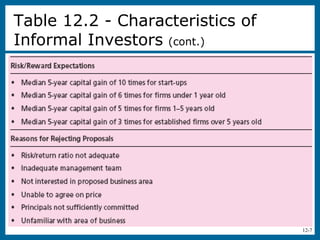
Table 12.2 - Characteristics of
Informal Investors (cont.)
12-8
Venture Capital
 Nature of Venture Capital
 A long-term investment discipline, usually
occurring over a five-year period.
 The equity pool is formed from the resources of
wealthy limited partners.
 Found in:
 Creation of early-stage companies.
 Expansion and revitalization of businesses.
 Financing of leveraged buyouts of existing divisions of
major corporations or privately owned businesses.
 Venture capitalist takes an equity participation
in each of the investments.
12-9
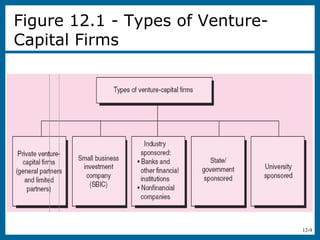
Figure 12.1 - Types of Venture-
Capital Firms
12-10
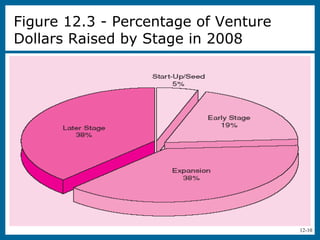
Figure 12.3 - Percentage of Venture
Dollars Raised by Stage in 2008
12-11
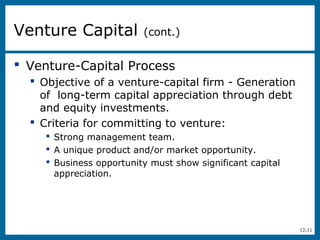
 Venture-Capital Process
 Objective of a venture-capital firm - Generation
of long-term capital appreciation through debt
and equity investments.
 Criteria for committing to venture:
 Strong management team.
 A unique product and/or market opportunity.
 Business opportunity must show significant capital
appreciation.
Venture Capital (cont.)
12-12
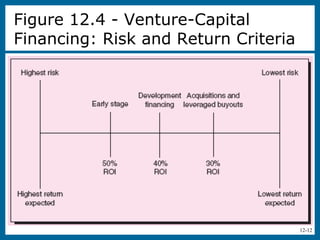
Figure 12.4 - Venture-Capital
Financing: Risk and Return Criteria
12-13
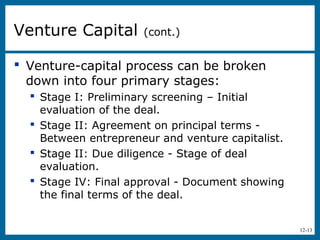
 Venture-capital process can be broken
down into four primary stages:
 Stage I: Preliminary screening – Initial
evaluation of the deal.
 Stage II: Agreement on principal terms -
Between entrepreneur and venture capitalist.
 Stage II: Due diligence - Stage of deal
evaluation.
 Stage IV: Final approval - Document showing
the final terms of the deal.
Venture Capital (cont.)
12-14
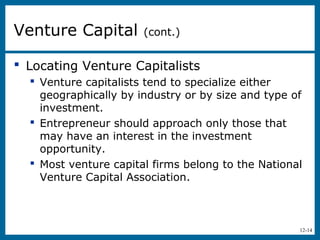
 Locating Venture Capitalists
 Venture capitalists tend to specialize either
geographically by industry or by size and type of
investment.
 Entrepreneur should approach only those that
may have an interest in the investment
opportunity.
 Most venture capital firms belong to the National
Venture Capital Association.
Venture Capital (cont.)
12-15
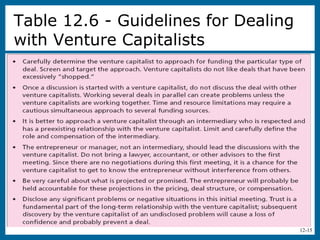
Table 12.6 - Guidelines for Dealing
with Venture Capitalists
12-16
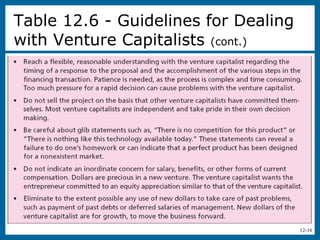
Table 12.6 - Guidelines for Dealing
with Venture Capitalists (cont.)
12-17
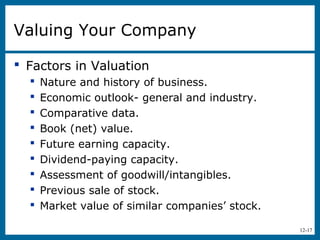
Valuing Your Company
 Factors in Valuation
 Nature and history of business.
 Economic outlook- general and industry.
 Comparative data.
 Book (net) value.
 Future earning capacity.
 Dividend-paying capacity.
 Assessment of goodwill/intangibles.
 Previous sale of stock.
 Market value of similar companies’ stock.
12-18
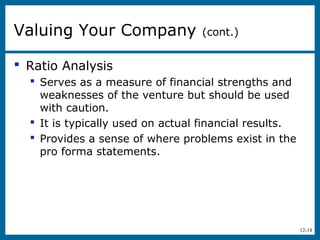
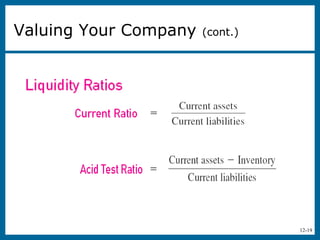
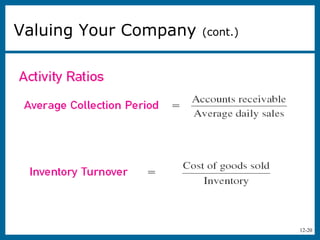
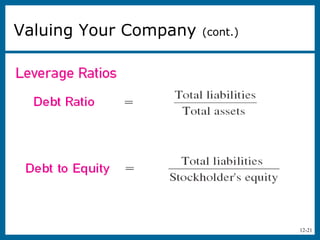
 Ratio Analysis
 Serves as a measure of financial strengths and
weaknesses of the venture but should be used
with caution.
 It is typically used on actual financial results.
 Provides a sense of where problems exist in the
pro forma statements.
Valuing Your Company (cont.)
12-19
Valuing Your Company (cont.)
12-20
Valuing Your Company (cont.)
12-21
Valuing Your Company (cont.)
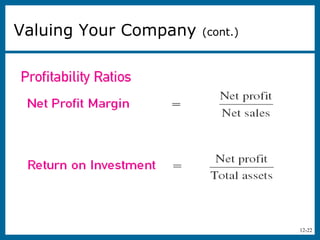
12-22
Valuing Your Company (cont.)
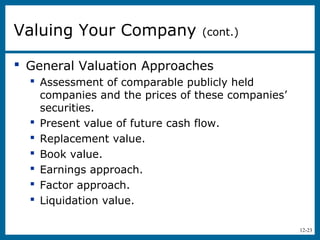
12-23
 General Valuation Approaches
 Assessment of comparable publicly held
companies and the prices of these companies’
securities.
 Present value of future cash flow.
 Replacement value.
 Book value.
 Earnings approach.
 Factor approach.
 Liquidation value.
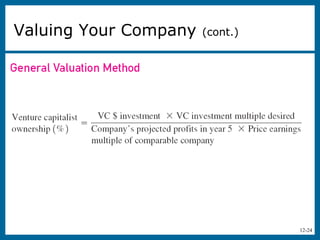
Valuing Your Company (cont.)
12-24
Valuing Your Company (cont.)
12-25
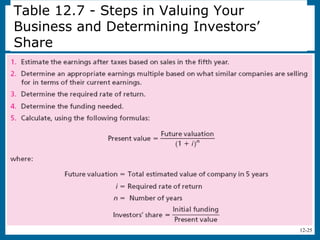
Table 12.7 - Steps in Valuing Your
Business and Determining Investors’
Share
12-26
Evaluation of an Internet Company
 Qualitative portion of due diligence carries
more weight.
 Focus is more on the market itself.
 Company's financial projections are
compared with the future market in terms
of fit, realism, and opportunity.
 Management team is examined.
 Opportunities available in the investor
market are examined.
12-27
Deal Structure
 Terms of the transaction between the
entrepreneur and the funding source.
 Needs of the funding sources:
 Rate of return required.
 Timing and form of return.
 Amount of control desired.
 Perception of risks.
 Entrepreneur’s needs:
 Degree and mechanisms of control.
 Amount of financing needed.
 Goals for the particular firm.
12-28
Going Public
 Selling some part of the company by
registering with the Securities and
Exchange Commission (SEC).
 Resulting capital infusion provides the company
with:
 Financial resources.
 A relatively liquid investment vehicle.
 Company consequently gains:
 Greater access to capital markets in the future.
 A more objective picture of the public’s perception of
the value of the business.
12-29
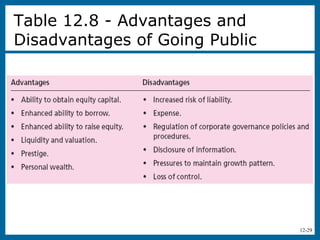
Table 12.8 - Advantages and
Disadvantages of Going Public
12-30
Timing of Going Public and
Underwriter Selection
 Timing
 Is the company large enough?
 What is the amount of the company’s earnings,
and how strong is its financial performance?
 Are the market conditions favorable for an initial
public offering?
 How urgently is the money needed?
 What are the needs and desires of the present
owners?
12-31
 Underwriter Selection
 Managing underwriter - Lead financial firm in
selling stock to the public.
 Underwriting syndicate - A group of firms
involved in selling stock to the public.
 Factors to consider in selection:
 Reputation.
 Distribution capability.
 Advisory services.
 Experience.
 Cost.
Timing of Going Public and
Underwriter Selection (cont.)
12-32
Registration Statement and
Timetable
 “All hands” meeting - Preparing a timetable
for the registration process.
 First public offering requires six to eight
weeks.
 The SEC takes six to 12 weeks to declare
the registration effective.
12-33
 Reasons for delays:
 Heavy periods of market activity.
 Peak seasons.
 Attorney’s unfamiliarity with federal or state
regulations.
 Issues arising over requirements of the SEC.
 When the managing underwriter is
inexperienced.
Registration Statement and
Timetable (cont.)
12-34
 SEC attempts to ensure that the document
makes a full and fair disclosure of the
material reported.
 Registration statement consists of:
 Prospectus.
 Registration statement.
 Most initial public offerings will use a Form
S-1 registration statement.
Registration Statement and
Timetable (cont.)
12-35
 Cover page
 Prospectus summary
 Description of the
company
 Risk factors
 Use of proceeds
 Dividend policy
 Capitalization
 Dilution
 Selected financial
data
 Business,
management, and
owners
 Type of stock
 Underwriter
information
 Actual financial
statements.
Registration Statement and
Timetable (cont.)
Prospectus
12-36
 The Registration Statement
 Information regarding:
 Offering.
 Past unregistered securities offering of the company.
 Other undertakings by the company.
 Includes exhibits:
 Articles of incorporation.
 Underwriting agreement.
 Company bylaws.
 Stock option and pension plans.
 Initial contracts.
Registration Statement and
Timetable (cont.)
12-37
 Procedure
 Preliminary prospectus (red herring) can be
distributed to the underwriting group.
 Deficiencies are communicated through
telephone or a comment letter.
 Pricing amendment - Additional information on
price and distribution is submitted to the SEC to
develop the final prospectus.
 Waiting period - Time between the initial filing
and its effective date is usually around 2 to 10
months.
Registration Statement and
Timetable (cont.)
12-38
Legal Issues and Blue-Sky
Qualifications
 Legal Issues
 Quiet period – 90-day period in going public
when no new company information can be
released.
 Blue-Sky Qualifications
 Blue-sky laws - Laws of each state regulating
public sale of stock.
 May cause additional delays and costs to the
company.
 Many states allow their state securities
administrators to prevent an offering from being
sold in their state.
12-39
After Going Public
 Aftermarket Support
 Actions of underwriters to help support the price
of stock following the public offering.
 Relationship with the Financial Community
 Has a significant effect on the market interest
and the price of the company’s stock.
12-40
 Reporting Requirements
 The company must file:
 Annual reports on Form 10-K.
 Quarterly reports on Form 10-Q.
 Specific transaction or event reports on Form 8-K.
 Company must follow proxy solicitation
requirements.
After Going Public (cont.)

Entrepreneurship Chap 12

  • 1.
    Hisrich Peters Shepherd Chapter 12 Informal RiskCapital, Venture Capital, and Going Public Copyright © 2010 by The McGraw-Hill Companies, Inc. All rights reserved.McGraw-Hill/Irwin
  • 2.
    12-2 Financing the Business Criteria for evaluating appropriateness of financing alternatives:  Amount and timing of funds required.  Projected company sales and growth.  Three types of funding:  Early stage financing.  Development financing.  Acquisition financing.
  • 3.
    12-3 Table 12.1 -Stages of Business Development Funding
  • 4.
    12-4  Risk capitalmarkets provide debt and equity to nonsecure financing situations.  Types of risk capital markets:  Informal risk capital market.  Venture-capital market.  Public-equity market.  All three can be a source of funds for stage- one financing.  However, public-equity market is available only for high-potential ventures. Financing the Business (cont.)
  • 5.
    12-5 Informal Risk Capital It consists of a virtually invisible group of wealthy investors (business angels).  Investments range between $10,000 to $500,000.  Provides funding, especially in start-up (first-stage) financing.  Contains the largest pool of risk capital in the United States.
  • 6.
    12-6 Table 12.2 -Characteristics of Informal Investors
  • 7.
    12-7 Table 12.2 -Characteristics of Informal Investors (cont.)
  • 8.
    12-8 Venture Capital  Natureof Venture Capital  A long-term investment discipline, usually occurring over a five-year period.  The equity pool is formed from the resources of wealthy limited partners.  Found in:  Creation of early-stage companies.  Expansion and revitalization of businesses.  Financing of leveraged buyouts of existing divisions of major corporations or privately owned businesses.  Venture capitalist takes an equity participation in each of the investments.
  • 9.
    12-9 Figure 12.1 -Types of Venture- Capital Firms
  • 10.
    12-10 Figure 12.3 -Percentage of Venture Dollars Raised by Stage in 2008
  • 11.
    12-11  Venture-Capital Process Objective of a venture-capital firm - Generation of long-term capital appreciation through debt and equity investments.  Criteria for committing to venture:  Strong management team.  A unique product and/or market opportunity.  Business opportunity must show significant capital appreciation. Venture Capital (cont.)
  • 12.
    12-12 Figure 12.4 -Venture-Capital Financing: Risk and Return Criteria
  • 13.
    12-13  Venture-capital processcan be broken down into four primary stages:  Stage I: Preliminary screening – Initial evaluation of the deal.  Stage II: Agreement on principal terms - Between entrepreneur and venture capitalist.  Stage II: Due diligence - Stage of deal evaluation.  Stage IV: Final approval - Document showing the final terms of the deal. Venture Capital (cont.)
  • 14.
    12-14  Locating VentureCapitalists  Venture capitalists tend to specialize either geographically by industry or by size and type of investment.  Entrepreneur should approach only those that may have an interest in the investment opportunity.  Most venture capital firms belong to the National Venture Capital Association. Venture Capital (cont.)
  • 15.
    12-15 Table 12.6 -Guidelines for Dealing with Venture Capitalists
  • 16.
    12-16 Table 12.6 -Guidelines for Dealing with Venture Capitalists (cont.)
  • 17.
    12-17 Valuing Your Company Factors in Valuation  Nature and history of business.  Economic outlook- general and industry.  Comparative data.  Book (net) value.  Future earning capacity.  Dividend-paying capacity.  Assessment of goodwill/intangibles.  Previous sale of stock.  Market value of similar companies’ stock.
  • 18.
    12-18  Ratio Analysis Serves as a measure of financial strengths and weaknesses of the venture but should be used with caution.  It is typically used on actual financial results.  Provides a sense of where problems exist in the pro forma statements. Valuing Your Company (cont.)
  • 19.
  • 20.
  • 21.
  • 22.
  • 23.
    12-23  General ValuationApproaches  Assessment of comparable publicly held companies and the prices of these companies’ securities.  Present value of future cash flow.  Replacement value.  Book value.  Earnings approach.  Factor approach.  Liquidation value. Valuing Your Company (cont.)
  • 24.
  • 25.
    12-25 Table 12.7 -Steps in Valuing Your Business and Determining Investors’ Share
  • 26.
    12-26 Evaluation of anInternet Company  Qualitative portion of due diligence carries more weight.  Focus is more on the market itself.  Company's financial projections are compared with the future market in terms of fit, realism, and opportunity.  Management team is examined.  Opportunities available in the investor market are examined.
  • 27.
    12-27 Deal Structure  Termsof the transaction between the entrepreneur and the funding source.  Needs of the funding sources:  Rate of return required.  Timing and form of return.  Amount of control desired.  Perception of risks.  Entrepreneur’s needs:  Degree and mechanisms of control.  Amount of financing needed.  Goals for the particular firm.
  • 28.
    12-28 Going Public  Sellingsome part of the company by registering with the Securities and Exchange Commission (SEC).  Resulting capital infusion provides the company with:  Financial resources.  A relatively liquid investment vehicle.  Company consequently gains:  Greater access to capital markets in the future.  A more objective picture of the public’s perception of the value of the business.
  • 29.
    12-29 Table 12.8 -Advantages and Disadvantages of Going Public
  • 30.
    12-30 Timing of GoingPublic and Underwriter Selection  Timing  Is the company large enough?  What is the amount of the company’s earnings, and how strong is its financial performance?  Are the market conditions favorable for an initial public offering?  How urgently is the money needed?  What are the needs and desires of the present owners?
  • 31.
    12-31  Underwriter Selection Managing underwriter - Lead financial firm in selling stock to the public.  Underwriting syndicate - A group of firms involved in selling stock to the public.  Factors to consider in selection:  Reputation.  Distribution capability.  Advisory services.  Experience.  Cost. Timing of Going Public and Underwriter Selection (cont.)
  • 32.
    12-32 Registration Statement and Timetable “All hands” meeting - Preparing a timetable for the registration process.  First public offering requires six to eight weeks.  The SEC takes six to 12 weeks to declare the registration effective.
  • 33.
    12-33  Reasons fordelays:  Heavy periods of market activity.  Peak seasons.  Attorney’s unfamiliarity with federal or state regulations.  Issues arising over requirements of the SEC.  When the managing underwriter is inexperienced. Registration Statement and Timetable (cont.)
  • 34.
    12-34  SEC attemptsto ensure that the document makes a full and fair disclosure of the material reported.  Registration statement consists of:  Prospectus.  Registration statement.  Most initial public offerings will use a Form S-1 registration statement. Registration Statement and Timetable (cont.)
  • 35.
    12-35  Cover page Prospectus summary  Description of the company  Risk factors  Use of proceeds  Dividend policy  Capitalization  Dilution  Selected financial data  Business, management, and owners  Type of stock  Underwriter information  Actual financial statements. Registration Statement and Timetable (cont.) Prospectus
  • 36.
    12-36  The RegistrationStatement  Information regarding:  Offering.  Past unregistered securities offering of the company.  Other undertakings by the company.  Includes exhibits:  Articles of incorporation.  Underwriting agreement.  Company bylaws.  Stock option and pension plans.  Initial contracts. Registration Statement and Timetable (cont.)
  • 37.
    12-37  Procedure  Preliminaryprospectus (red herring) can be distributed to the underwriting group.  Deficiencies are communicated through telephone or a comment letter.  Pricing amendment - Additional information on price and distribution is submitted to the SEC to develop the final prospectus.  Waiting period - Time between the initial filing and its effective date is usually around 2 to 10 months. Registration Statement and Timetable (cont.)
  • 38.
    12-38 Legal Issues andBlue-Sky Qualifications  Legal Issues  Quiet period – 90-day period in going public when no new company information can be released.  Blue-Sky Qualifications  Blue-sky laws - Laws of each state regulating public sale of stock.  May cause additional delays and costs to the company.  Many states allow their state securities administrators to prevent an offering from being sold in their state.
  • 39.
    12-39 After Going Public Aftermarket Support  Actions of underwriters to help support the price of stock following the public offering.  Relationship with the Financial Community  Has a significant effect on the market interest and the price of the company’s stock.
  • 40.
    12-40  Reporting Requirements The company must file:  Annual reports on Form 10-K.  Quarterly reports on Form 10-Q.  Specific transaction or event reports on Form 8-K.  Company must follow proxy solicitation requirements. After Going Public (cont.)