Hisrich
Peters
Shepherd
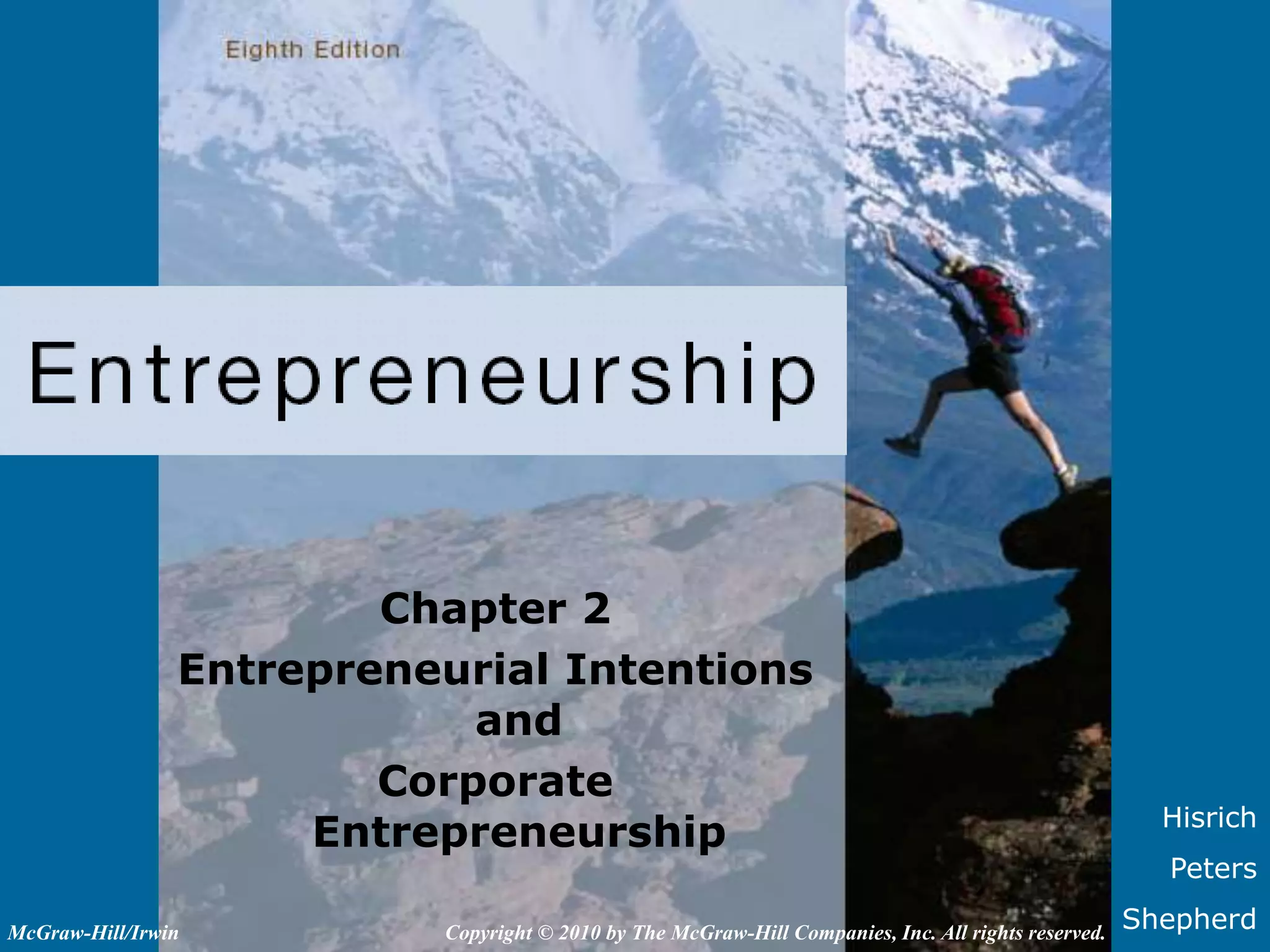
Chapter 2
Entrepreneurial Intentions
and
Corporate
Entrepreneurship
Copyright © 2010 by The McGraw-Hill Companies, Inc. All rights reserved.
McGraw-Hill/Irwin
2-2
The Intention to Act
Entrepreneurially
 Entrepreneurial intentions - Motivational
factors that influence individuals to pursue
entrepreneurial outcomes.
 Intention is stronger when an action is
perceived to be feasible and desirable.
 Entrepreneurial self-efficacy - Conviction that
one can successfully execute the entrepreneurial
process.
 Perceived desirability - The degree to which an
individual has a favorable or unfavorable
evaluation of the potential outcomes.
2-3
Entrepreneur Background and
Characteristics
 Education
 Provides a background about starting a
business.
 Helps in the development of communication
skills and problem-solving skills.
 Provides individuals with a larger opportunity
set.
 Does not determine whether an entrepreneur
will create a new business to exploit the
discovered opportunity.
2-4
Entrepreneur Background and
Characteristics (cont.)
 Age
 Most entrepreneurs initiate their entrepreneurial
careers between the ages of 22 and 45.
 Individuals are more inclined to start an
entrepreneurial career at milestone ages every
five years (25, 30, 35, 40, and 45).
 Male entrepreneurs tend to start their ventures
in their early 30s, while women entrepreneurs
do so in their middle 30s.
2-5
 Work History
 The decision to launch a new venture can be
influenced by:
 Dissatisfaction with one’s job.
 Previous technical and industry experience.
 Managerial skills and entrepreneurial
experiences are also important once the venture
starts growing.
 Previous start-up experience is a relatively good
predictor of starting subsequent businesses.
Entrepreneur Background and
Characteristics (cont.)
2-6
Role Models and Support Systems
 Role models - Individuals influencing an
entrepreneur’s career choice and style
 Can be parents, family members, or other
entrepreneurs.
 Successful entrepreneurs are viewed as
catalysts by potential entrepreneurs.
 Role models can serve in a supportive capacity
as mentors by providing information, advice and
guidance.
 Entrepreneurs need to establish connections and
networks in the venture formation process.
2-7
Role Models and Support System
(cont.)
 Moral-Support Network
 It is important for entrepreneurs to have a
cheering squad—individuals who provide
psychological support.
 Friends can provide honest advice,
encouragement, understanding, and assistance.
 Relatives can be strong sources of moral
support, particularly if they are also
entrepreneurs.
2-8
 Professional-Support Network
 Entrepreneurs need advice and counsel
throughout the establishment of the new
venture which can be obtained from:
 Mentors.
 Business associates.
 Suppliers.
 Trade associations.
 Personal affiliations.
 Entrepreneurial activity is embedded in
networks of interpersonal relationships.
Role Models and Support System
(cont.)
2-9
Minority Entrepreneurs
 There has been significant growth in:
 Female self-employment, with women starting
new ventures at a higher rate than men.
 The number of Asian, African American,
Hispanic, and Native American majority owned
firms.
 This growth is likely to be spurred by:
 Encouragement of entrepreneurship among
minority groups.
 Increase in the number of role models.
2-10
Entrepreneurial Intentions Within
Existing Organizations
 Top management must create an
environment that encourages employees to
think and act entrepreneurially.
 Employees will realize that entrepreneurial
action within the firm is both personally
desirable and feasible.
2-11
Managerial Versus Entrepreneurial
Decision Making
 Entrepreneurial management is distinct
from traditional management in terms of:
 Strategic orientation.
 Commitment to opportunity.
 Commitment of resources.
 Control of resources.
 Management structure.
 Reward philosophy.
 Growth orientation.
 Entrepreneurial culture.
2-12
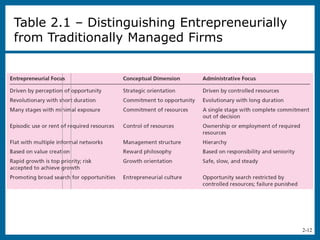
Table 2.1 – Distinguishing Entrepreneurially
from Traditionally Managed Firms
2-13
Managerial Versus Entrepreneurial
Decision Making (cont.)
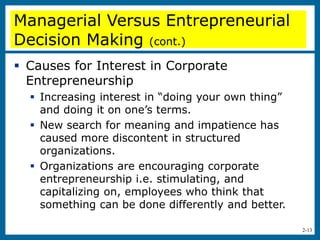
 Causes for Interest in Corporate
Entrepreneurship
 Increasing interest in “doing your own thing”
and doing it on one’s terms.
 New search for meaning and impatience has
caused more discontent in structured
organizations.
 Organizations are encouraging corporate
entrepreneurship i.e. stimulating, and
capitalizing on, employees who think that
something can be done differently and better.
2-14
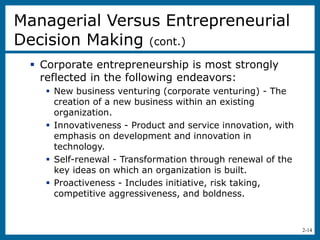
 Corporate entrepreneurship is most strongly
reflected in the following endeavors:
 New business venturing (corporate venturing) - The
creation of a new business within an existing
organization.
 Innovativeness - Product and service innovation, with
emphasis on development and innovation in
technology.
 Self-renewal - Transformation through renewal of the
key ideas on which an organization is built.
 Proactiveness - Includes initiative, risk taking,
competitive aggressiveness, and boldness.
Managerial Versus Entrepreneurial
Decision Making (cont.)
2-15
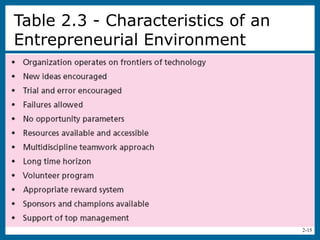
Table 2.3 - Characteristics of an
Entrepreneurial Environment
2-16
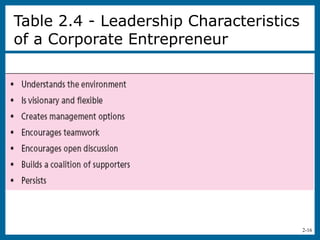
Table 2.4 - Leadership Characteristics
of a Corporate Entrepreneur
2-17
Establishing Corporate
Entrepreneurship in the Organization
 Step one:
 Secure a commitment to corporate
entrepreneurship in the organization by top,
upper, and middle management levels.
 Establish initial framework and embrace the
concept.
 Identify, select, and train corporate
entrepreneurs.
2-18
 Step two:
 Identify ideas and areas that top management is
interested in supporting.
 Identify amount of risk money available to
develop the concept.
 Establish overall program expectations and
target results of each corporate venture.
 Establish mentor/sponsor system.
 Step three:
 Use of technology to ensure organizational
flexibility.
Establishing Corporate Entrepreneurship in
the Organization (cont.)
2-19
 Step four:
 Identify interested managers to train employees
and share their experiences.
 Step five:
 Develop ways for the organization to get closer
to its customers.
 Step six:
 Learn to be more productive with fewer
resources.
Establishing Corporate Entrepreneurship in
the Organization (cont.)
2-20
 Step seven:
 Establish a strong support structure for
corporate entrepreneurship.
 Step eight:
 Tie rewards to the performance of the
entrepreneurial unit.
 Finally:
 Implement an evaluation system that allows
successful entrepreneurial units to expand and
unsuccessful ones to be eliminated.
Establishing Corporate Entrepreneurship in
the Organization (cont.)
2-21
 Problems and Successful Efforts
 A study found that new ventures started within
a corporation performed worse than those
started independently by entrepreneurs.
 Reasons cited:
 Corporation’s difficulty in maintaining a long-term
commitment.
 A lack of freedom to make autonomous decisions.
 A constrained environment.
 On average, independent start-ups become:
 Profitable twice as fast.
 End up twice as profitable.
Establishing Corporate Entrepreneurship in
the Organization (cont.)
2-22
 Companies that have adopted their own version
of the implementation process to launch new
ventures successfully:
 Minnesota Mining and Manufacturing (3M).
 Hewlett-Packard (HP).
 IBM.
Establishing Corporate Entrepreneurship in
the Organization (cont.)

Entrepreneurship chapter 2

  • 1.
    Hisrich Peters Shepherd Chapter 2 Entrepreneurial Intentions and Corporate Entrepreneurship Copyright© 2010 by The McGraw-Hill Companies, Inc. All rights reserved. McGraw-Hill/Irwin
  • 2.
    2-2 The Intention toAct Entrepreneurially  Entrepreneurial intentions - Motivational factors that influence individuals to pursue entrepreneurial outcomes.  Intention is stronger when an action is perceived to be feasible and desirable.  Entrepreneurial self-efficacy - Conviction that one can successfully execute the entrepreneurial process.  Perceived desirability - The degree to which an individual has a favorable or unfavorable evaluation of the potential outcomes.
  • 3.
    2-3 Entrepreneur Background and Characteristics Education  Provides a background about starting a business.  Helps in the development of communication skills and problem-solving skills.  Provides individuals with a larger opportunity set.  Does not determine whether an entrepreneur will create a new business to exploit the discovered opportunity.
  • 4.
    2-4 Entrepreneur Background and Characteristics(cont.)  Age  Most entrepreneurs initiate their entrepreneurial careers between the ages of 22 and 45.  Individuals are more inclined to start an entrepreneurial career at milestone ages every five years (25, 30, 35, 40, and 45).  Male entrepreneurs tend to start their ventures in their early 30s, while women entrepreneurs do so in their middle 30s.
  • 5.
    2-5  Work History The decision to launch a new venture can be influenced by:  Dissatisfaction with one’s job.  Previous technical and industry experience.  Managerial skills and entrepreneurial experiences are also important once the venture starts growing.  Previous start-up experience is a relatively good predictor of starting subsequent businesses. Entrepreneur Background and Characteristics (cont.)
  • 6.
    2-6 Role Models andSupport Systems  Role models - Individuals influencing an entrepreneur’s career choice and style  Can be parents, family members, or other entrepreneurs.  Successful entrepreneurs are viewed as catalysts by potential entrepreneurs.  Role models can serve in a supportive capacity as mentors by providing information, advice and guidance.  Entrepreneurs need to establish connections and networks in the venture formation process.
  • 7.
    2-7 Role Models andSupport System (cont.)  Moral-Support Network  It is important for entrepreneurs to have a cheering squad—individuals who provide psychological support.  Friends can provide honest advice, encouragement, understanding, and assistance.  Relatives can be strong sources of moral support, particularly if they are also entrepreneurs.
  • 8.
    2-8  Professional-Support Network Entrepreneurs need advice and counsel throughout the establishment of the new venture which can be obtained from:  Mentors.  Business associates.  Suppliers.  Trade associations.  Personal affiliations.  Entrepreneurial activity is embedded in networks of interpersonal relationships. Role Models and Support System (cont.)
  • 9.
    2-9 Minority Entrepreneurs  Therehas been significant growth in:  Female self-employment, with women starting new ventures at a higher rate than men.  The number of Asian, African American, Hispanic, and Native American majority owned firms.  This growth is likely to be spurred by:  Encouragement of entrepreneurship among minority groups.  Increase in the number of role models.
  • 10.
    2-10 Entrepreneurial Intentions Within ExistingOrganizations  Top management must create an environment that encourages employees to think and act entrepreneurially.  Employees will realize that entrepreneurial action within the firm is both personally desirable and feasible.
  • 11.
    2-11 Managerial Versus Entrepreneurial DecisionMaking  Entrepreneurial management is distinct from traditional management in terms of:  Strategic orientation.  Commitment to opportunity.  Commitment of resources.  Control of resources.  Management structure.  Reward philosophy.  Growth orientation.  Entrepreneurial culture.
  • 12.
    2-12 Table 2.1 –Distinguishing Entrepreneurially from Traditionally Managed Firms
  • 13.
    2-13 Managerial Versus Entrepreneurial DecisionMaking (cont.)  Causes for Interest in Corporate Entrepreneurship  Increasing interest in “doing your own thing” and doing it on one’s terms.  New search for meaning and impatience has caused more discontent in structured organizations.  Organizations are encouraging corporate entrepreneurship i.e. stimulating, and capitalizing on, employees who think that something can be done differently and better.
  • 14.
    2-14  Corporate entrepreneurshipis most strongly reflected in the following endeavors:  New business venturing (corporate venturing) - The creation of a new business within an existing organization.  Innovativeness - Product and service innovation, with emphasis on development and innovation in technology.  Self-renewal - Transformation through renewal of the key ideas on which an organization is built.  Proactiveness - Includes initiative, risk taking, competitive aggressiveness, and boldness. Managerial Versus Entrepreneurial Decision Making (cont.)
  • 15.
    2-15 Table 2.3 -Characteristics of an Entrepreneurial Environment
  • 16.
    2-16 Table 2.4 -Leadership Characteristics of a Corporate Entrepreneur
  • 17.
    2-17 Establishing Corporate Entrepreneurship inthe Organization  Step one:  Secure a commitment to corporate entrepreneurship in the organization by top, upper, and middle management levels.  Establish initial framework and embrace the concept.  Identify, select, and train corporate entrepreneurs.
  • 18.
    2-18  Step two: Identify ideas and areas that top management is interested in supporting.  Identify amount of risk money available to develop the concept.  Establish overall program expectations and target results of each corporate venture.  Establish mentor/sponsor system.  Step three:  Use of technology to ensure organizational flexibility. Establishing Corporate Entrepreneurship in the Organization (cont.)
  • 19.
    2-19  Step four: Identify interested managers to train employees and share their experiences.  Step five:  Develop ways for the organization to get closer to its customers.  Step six:  Learn to be more productive with fewer resources. Establishing Corporate Entrepreneurship in the Organization (cont.)
  • 20.
    2-20  Step seven: Establish a strong support structure for corporate entrepreneurship.  Step eight:  Tie rewards to the performance of the entrepreneurial unit.  Finally:  Implement an evaluation system that allows successful entrepreneurial units to expand and unsuccessful ones to be eliminated. Establishing Corporate Entrepreneurship in the Organization (cont.)
  • 21.
    2-21  Problems andSuccessful Efforts  A study found that new ventures started within a corporation performed worse than those started independently by entrepreneurs.  Reasons cited:  Corporation’s difficulty in maintaining a long-term commitment.  A lack of freedom to make autonomous decisions.  A constrained environment.  On average, independent start-ups become:  Profitable twice as fast.  End up twice as profitable. Establishing Corporate Entrepreneurship in the Organization (cont.)
  • 22.
    2-22  Companies thathave adopted their own version of the implementation process to launch new ventures successfully:  Minnesota Mining and Manufacturing (3M).  Hewlett-Packard (HP).  IBM. Establishing Corporate Entrepreneurship in the Organization (cont.)