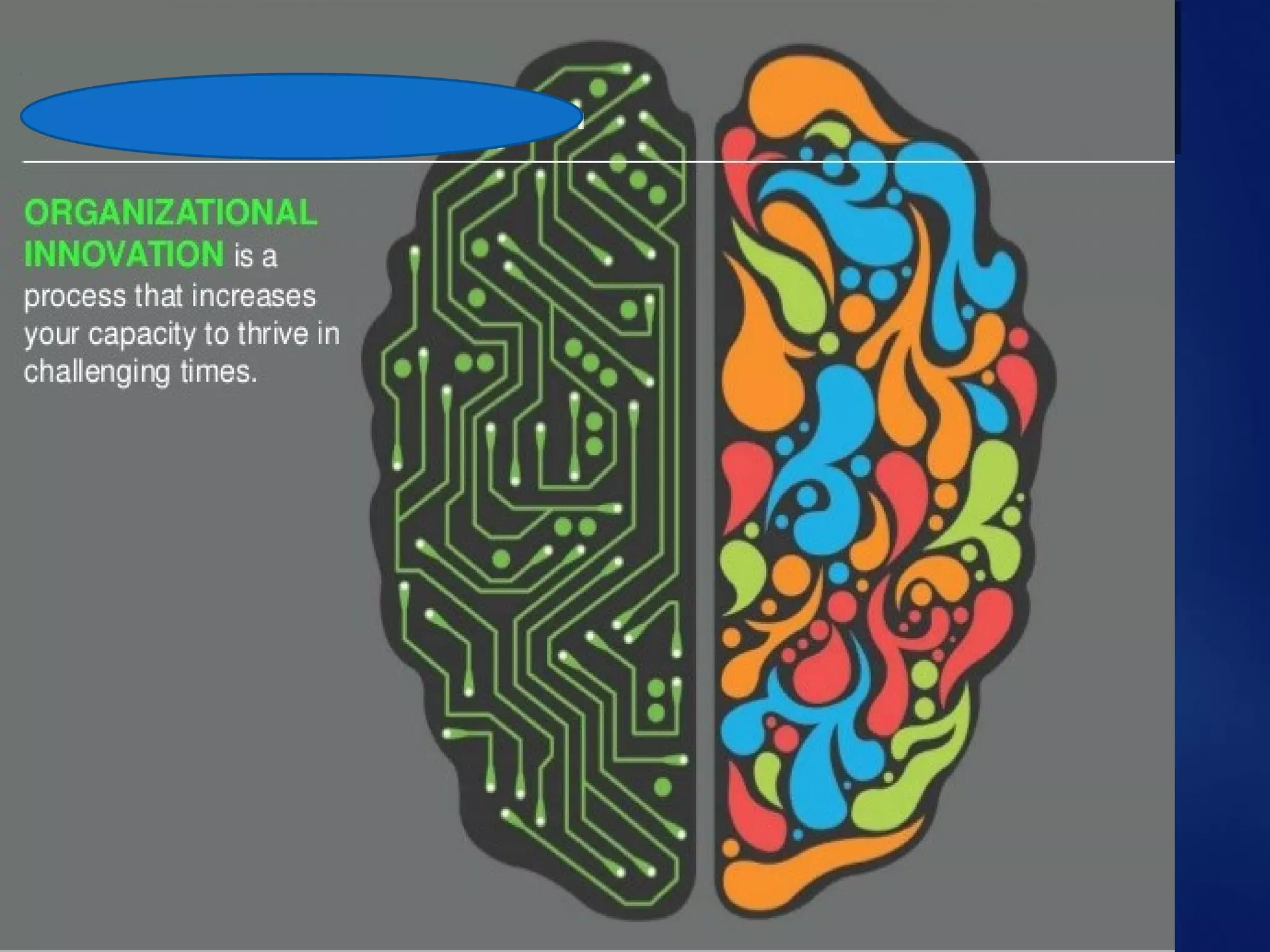
Organizational Innovation
Mairaj Nadeem
mairajrm@gmail.com
In business and economics,
innovation is the catalyst to growth
ORGANIZATION
 A social unit of people that is structured and
managed to meet a need or to pursue
collective goals.
 An organization or organization is an entity
comprising multiple people, such as an
institution or an association, that has a
collective goal and is linked to an external
environment.
Innovation
 Innovation is simply the process of creating
and implementing a new idea or ideas.
 Three main types of innovation exist:
 Process Innovation
 Technical Innovation
 Administrative Innovation
Process Innovation
 Process innovation is achieved through the
creation of a new means of producing,
selling, and/or distributing an existing product
or service.
 Some examples are:
 Supply Chain Mgt
 E-commerce
Technical Innovation
 Technical innovation is simply the creation of
a new product or service.
 Some examples:
 A new line of automobiles
 The introduction of cellular telephones
Administrative Innovation
 Administrative innovation is the creation
of a new organization design which
better supports the creation, production
and delivery of services or products.
 An example is:
 Virtual Teams: any task-focused group
that meets w/out all members being
in the same room or even working at
the same time.
Christensen (1997)
Incremental innovation in terms of: ‘a change that
builds on a firm’s expertise in component technology
within an established architecture.’
Incremental innovation is a series of small
improvements or upgrades made to a company's
existing products, services, processes or methods. The
changes implemented through incremental
innovation are usually focused on improving an
existing product's development efficiency, productivity
and competitive differentiation.
Example of Incremental Innovation
Henderson and Clark’s (1990) terms:
‘Radical innovation establishes a new dominant design,
and hence a new set of core design concepts embodied in
components that are linked together in a new architecture.’
Examples of Radical Innovation
In late November 2004, Dixons, a major UK electrical
retailer, announced that they would no longer stock VCRs
(video cassette recorders) because these have been
outmoded by DVDs (digital versatile disks) and digital hard-
disk storage products.
In services, we are currently seeing the decline of
photographic film development and printing services, as
photographers switch to digital cameras and home printers.
The postal service for letters and cards is being replaced by
e-mail and mobile telephone communications.
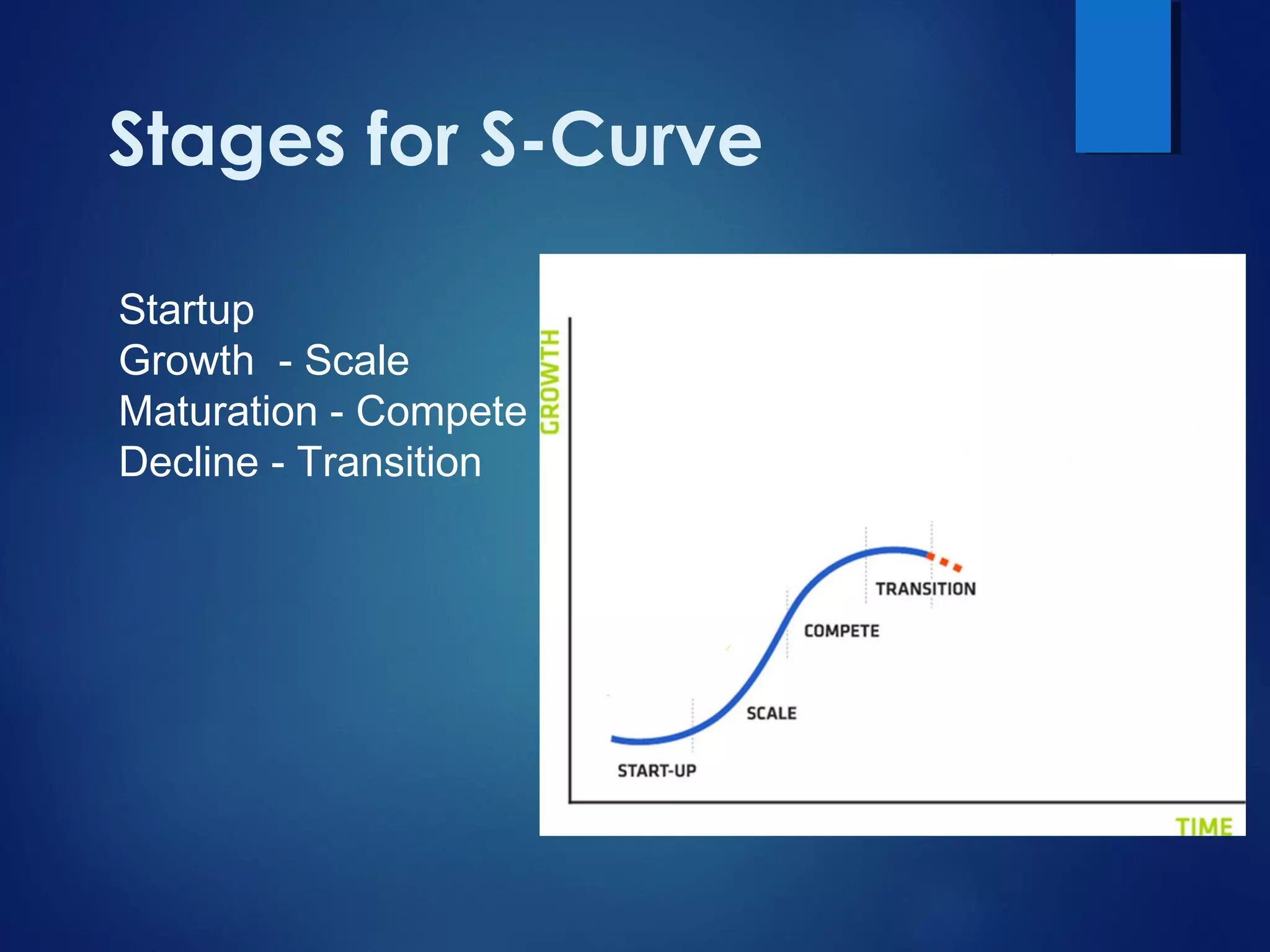
 S-Curve is a measure of the speed of
adoption of an innovation.
 First used by in 1903 by Gabriel
Tarde, who first plotted the S-shaped
diffusion curve.
 This process has been proposed as
the standard life cycle of
innovations can be described using
the S-Curve
Adoption and S-Curve
Stages for S-Curve
Startup
Growth - Scale
Maturation - Compete
Decline - Transition
Challenges
• Startup
Survival, market validation, funding
• Scale
Increasing market, expanding to new geography,
increased manufacturing, hiring
• Compete
Increased number of competitors, lower margins,
heads down
• Transition
Compromises to stay alive, staff layoffs
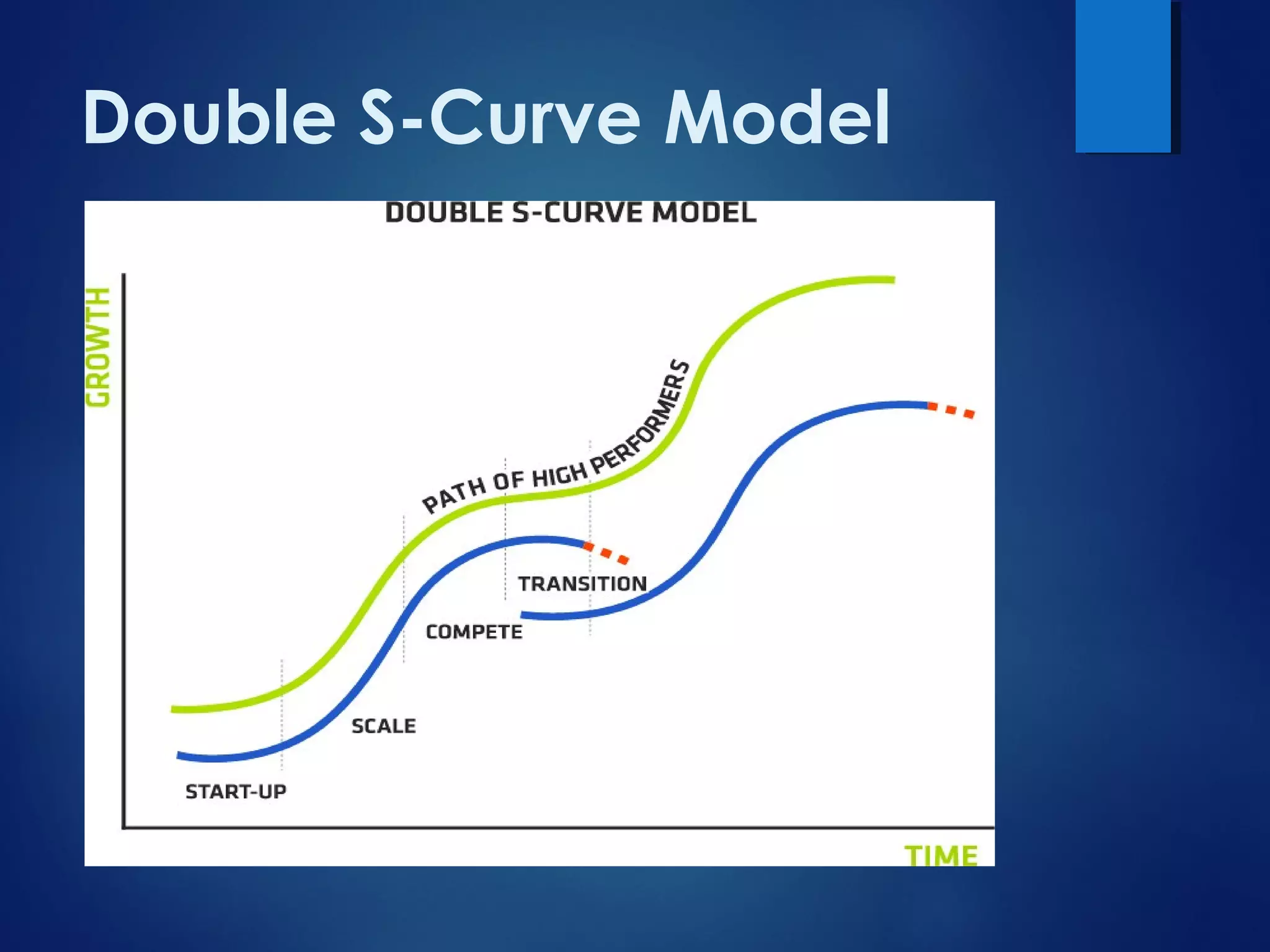
Double S-Curve Model
Where Do Ideas Come From?
• Great ideas do not necessarily come from tech-focused
research. They’re often derived by studying
demographic, geo-political, societal, economic and other
global dynamics
• Brainstorming for ideas does not often work
Features or Sustaining
Innovations
 Continuing to add features to one product is
not the same as innovation
 It really just slightly modifies the one single
s-curve. (i.e. different models of Honda Cars)
 a sustaining innovation does not create
new markets or value networks but rather
only evolves existing ones with better value,
allowing the firms within to compete against
each other's sustaining improvements.
Sustaining innovations may be either
"discontinuous" or "continuous"
3 Horizon Growth
 Horizon 1 – current business
 Horizon 2 – related business
 Horizon 3 – completely new business
 Alchemy of Growth
 Simple type of portfolio management
 Great starting point
 Teaches about the differences of innovation
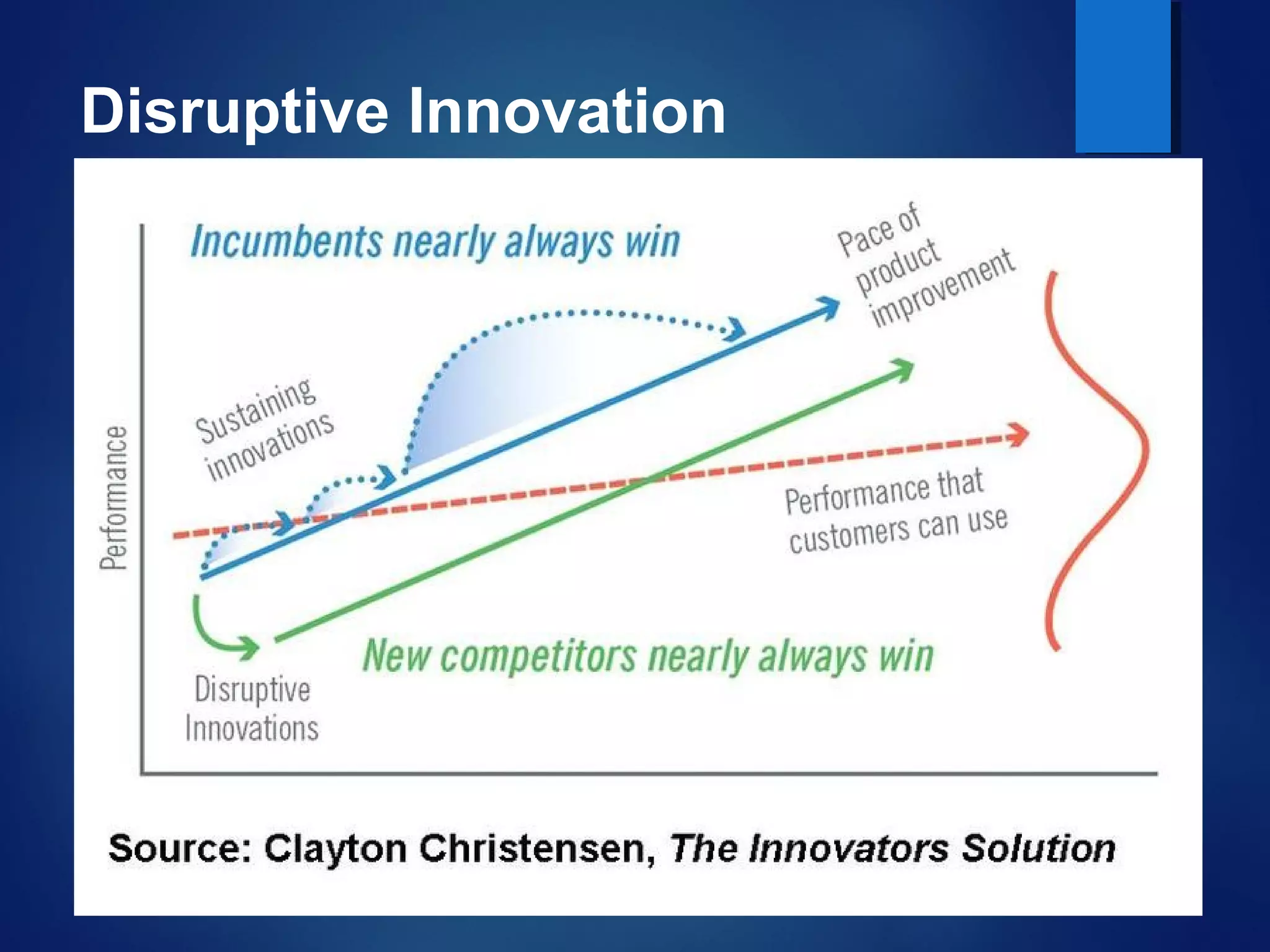
Disruptive Innovation
A disruptive innovation is an innovation 
that creates a new market and value network 
and eventually disrupts an existing market and 
value network, displacing established market 
leading firms, products and alliances.
Disruptive Innovation
Examples of Disruptive Innovation
Innovation Disrupted
Market
Details of Disruption
Digital
photography
Chemical
based
photography
First examples of digital cameras were
very poor quality and laughed at
LCD CRT LCD were first monochromatic and low
resolution
Wikipedia Traditional
encyclopedias
Encyclopedia Britannica ended print
production in 2012
LED lights Light bulbs Initial LED lights were only strong
enough to be indicators, now replacing
most lighting
Role of Culture & Leadership
 There is no innovation without leadership
 Innovation is a collaborative activity
 No single person can manage the innovation for an 
organization
 Innovation often happens outside of normal process
 Essential roles for managers
 Promoting an attitude and expectation of 
innovation
 Instituting policies and strategies that makes 
innovation real 
 enabling innovation while engaging in dedicated 
obstacle obliteration 
 Remove obstacles for staff
Organisational Innovation - Organisational Theory and Design

Organisational Innovation - Organisational Theory and Design

  • 1.
  • 2.
  • 3.
    In business andeconomics, innovation is the catalyst to growth
  • 4.
    ORGANIZATION  A socialunit of people that is structured and managed to meet a need or to pursue collective goals.  An organization or organization is an entity comprising multiple people, such as an institution or an association, that has a collective goal and is linked to an external environment.
  • 5.
    Innovation  Innovation issimply the process of creating and implementing a new idea or ideas.  Three main types of innovation exist:  Process Innovation  Technical Innovation  Administrative Innovation
  • 7.
    Process Innovation  Processinnovation is achieved through the creation of a new means of producing, selling, and/or distributing an existing product or service.  Some examples are:  Supply Chain Mgt  E-commerce
  • 8.
    Technical Innovation  Technicalinnovation is simply the creation of a new product or service.  Some examples:  A new line of automobiles  The introduction of cellular telephones
  • 9.
    Administrative Innovation  Administrativeinnovation is the creation of a new organization design which better supports the creation, production and delivery of services or products.  An example is:  Virtual Teams: any task-focused group that meets w/out all members being in the same room or even working at the same time.
  • 10.
    Christensen (1997) Incremental innovationin terms of: ‘a change that builds on a firm’s expertise in component technology within an established architecture.’ Incremental innovation is a series of small improvements or upgrades made to a company's existing products, services, processes or methods. The changes implemented through incremental innovation are usually focused on improving an existing product's development efficiency, productivity and competitive differentiation.
  • 11.
  • 12.
    Henderson and Clark’s(1990) terms: ‘Radical innovation establishes a new dominant design, and hence a new set of core design concepts embodied in components that are linked together in a new architecture.’
  • 13.
    Examples of RadicalInnovation In late November 2004, Dixons, a major UK electrical retailer, announced that they would no longer stock VCRs (video cassette recorders) because these have been outmoded by DVDs (digital versatile disks) and digital hard- disk storage products. In services, we are currently seeing the decline of photographic film development and printing services, as photographers switch to digital cameras and home printers. The postal service for letters and cards is being replaced by e-mail and mobile telephone communications.
  • 14.
     S-Curve isa measure of the speed of adoption of an innovation.  First used by in 1903 by Gabriel Tarde, who first plotted the S-shaped diffusion curve.  This process has been proposed as the standard life cycle of innovations can be described using the S-Curve
  • 15.
  • 16.
    Stages for S-Curve Startup Growth- Scale Maturation - Compete Decline - Transition
  • 17.
    Challenges • Startup Survival, marketvalidation, funding • Scale Increasing market, expanding to new geography, increased manufacturing, hiring • Compete Increased number of competitors, lower margins, heads down • Transition Compromises to stay alive, staff layoffs
  • 18.
  • 19.
    Where Do IdeasCome From? • Great ideas do not necessarily come from tech-focused research. They’re often derived by studying demographic, geo-political, societal, economic and other global dynamics • Brainstorming for ideas does not often work
  • 20.
    Features or Sustaining Innovations Continuing to add features to one product is not the same as innovation  It really just slightly modifies the one single s-curve. (i.e. different models of Honda Cars)  a sustaining innovation does not create new markets or value networks but rather only evolves existing ones with better value, allowing the firms within to compete against each other's sustaining improvements. Sustaining innovations may be either "discontinuous" or "continuous"
  • 21.
    3 Horizon Growth Horizon 1 – current business  Horizon 2 – related business  Horizon 3 – completely new business  Alchemy of Growth  Simple type of portfolio management  Great starting point  Teaches about the differences of innovation
  • 22.
  • 23.
  • 24.
    Examples of DisruptiveInnovation Innovation Disrupted Market Details of Disruption Digital photography Chemical based photography First examples of digital cameras were very poor quality and laughed at LCD CRT LCD were first monochromatic and low resolution Wikipedia Traditional encyclopedias Encyclopedia Britannica ended print production in 2012 LED lights Light bulbs Initial LED lights were only strong enough to be indicators, now replacing most lighting
  • 25.
    Role of Culture& Leadership  There is no innovation without leadership  Innovation is a collaborative activity  No single person can manage the innovation for an  organization  Innovation often happens outside of normal process  Essential roles for managers  Promoting an attitude and expectation of  innovation  Instituting policies and strategies that makes  innovation real   enabling innovation while engaging in dedicated  obstacle obliteration   Remove obstacles for staff