Managing and Organizing
Innovation in Emerging New
Knowledge Economy

            Prof Parameshwar P. Iyer
            CSIC Management Studies
            Indian Institute of Science

                     (C) Prof Parameshwar P Iyer
ICITM2006 03-02-06    Indian Institute of Science   1
Agenda
    Introduction
    Objectives
    Methodology
    Results
    Model for Managing Organizing Innovation
    Management Characteristics
    Organizational Characteristics
    Conclusions
                     (C) Prof Parameshwar P Iyer
ICITM2006 03-02-06    Indian Institute of Science   2
Introduction
    Increased turbulence and complexity
    Focus attention on Innovation
    Knowledge as principal source of competitive
    advantage
    Western approach – Hard, quantifiable,
    objective procedures, efficiency based
    Contrast with tacit, subjective, intuitive,
    insight based
    Get it from the “horses’ mouth”
                     (C) Prof Parameshwar P Iyer
ICITM2006 03-02-06    Indian Institute of Science   3
Objectives
    Learn from wisdom of world class
    performers
    Generic model for managing and
    organizing innovation
    Links between innovation and
    performance at management level
    Links between innovation and process
    parameters at organizational level
                     (C) Prof Parameshwar P Iyer
ICITM2006 03-02-06    Indian Institute of Science   4
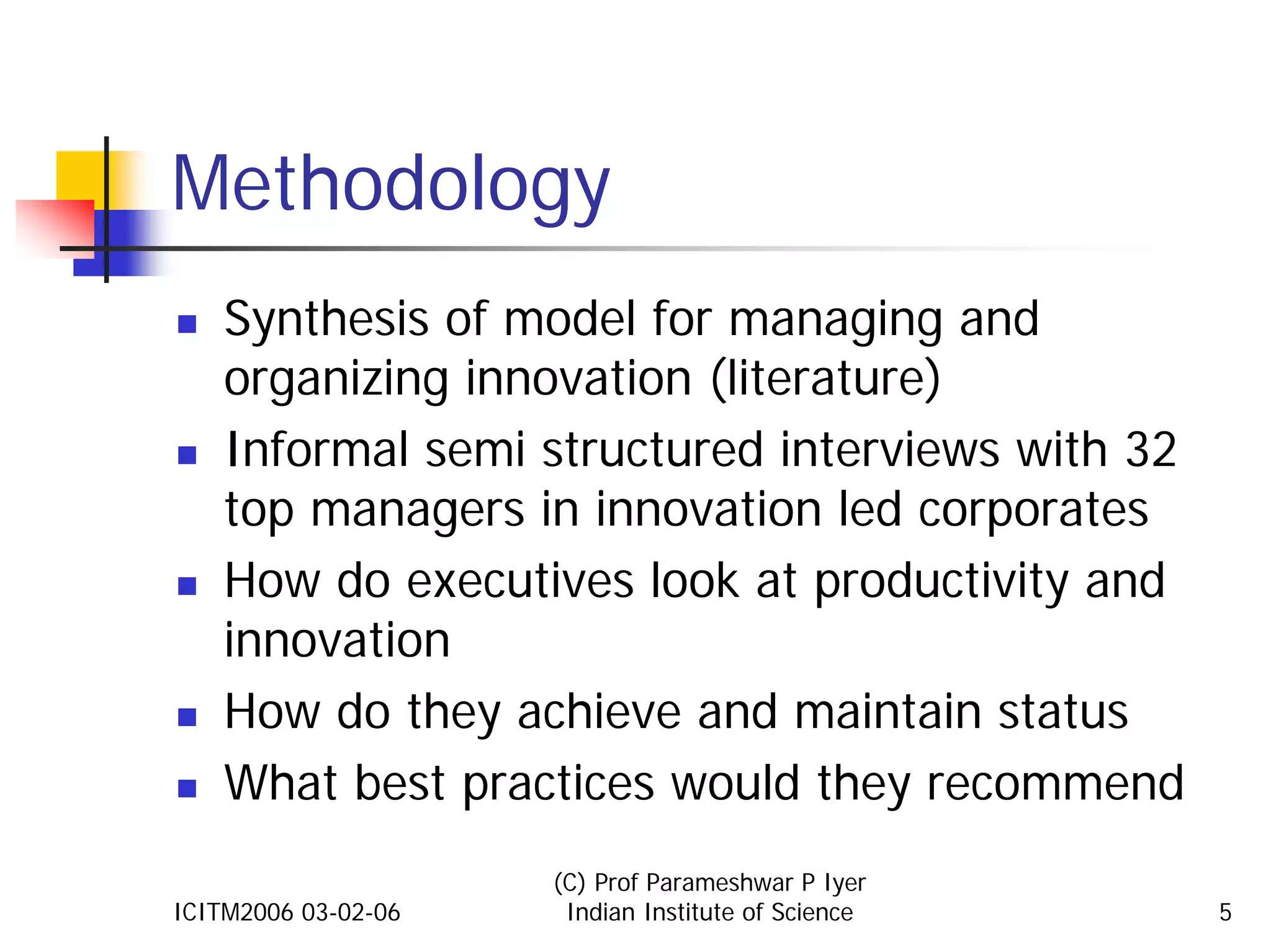
Methodology
    Synthesis of model for managing and
    organizing innovation (literature)
    Informal semi structured interviews with 32
    top managers in innovation led corporates
    How do executives look at productivity and
    innovation
    How do they achieve and maintain status
    What best practices would they recommend
                     (C) Prof Parameshwar P Iyer
ICITM2006 03-02-06    Indian Institute of Science   5
Results: Model for Managing
and Organizing Innovation
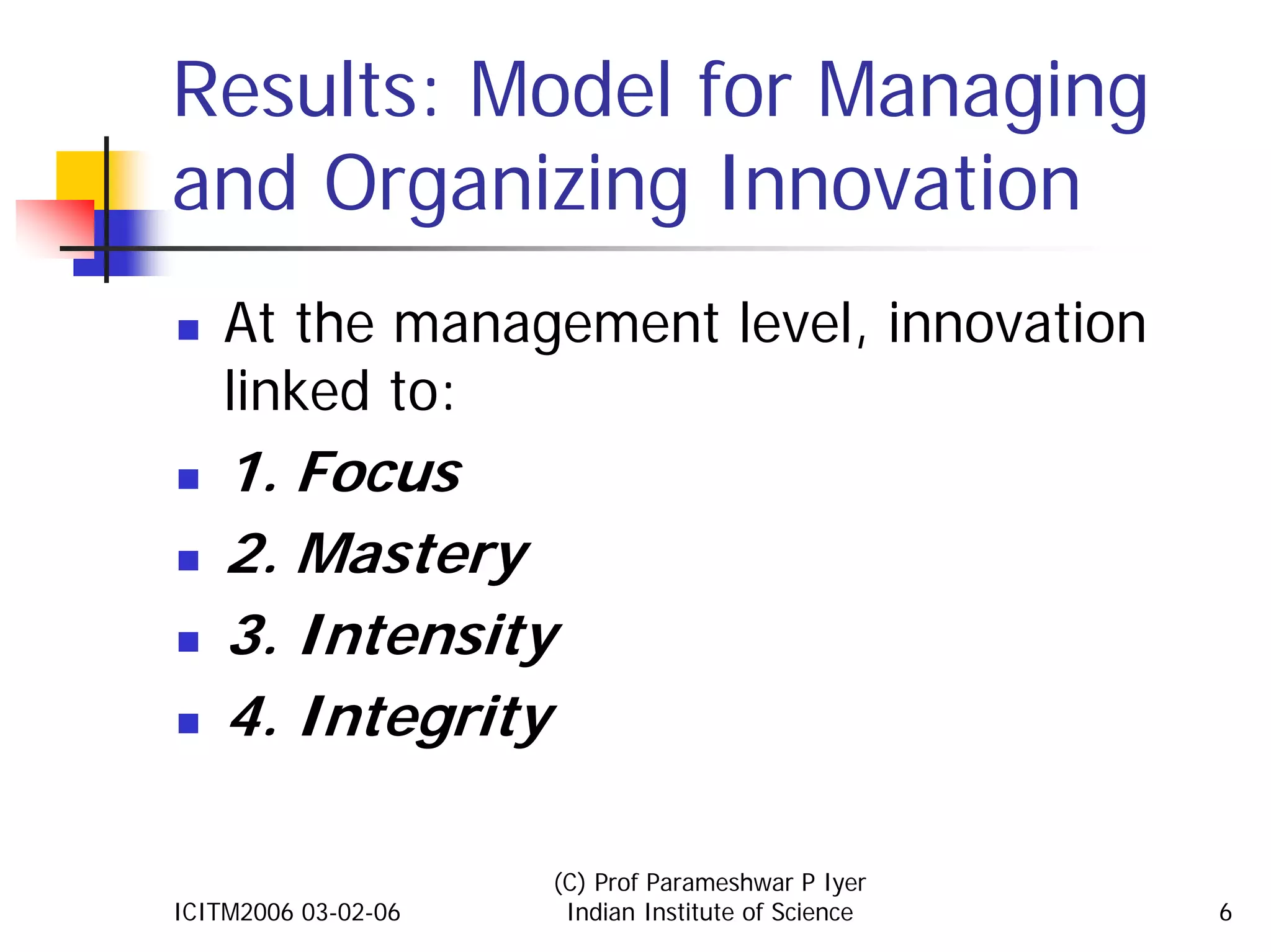
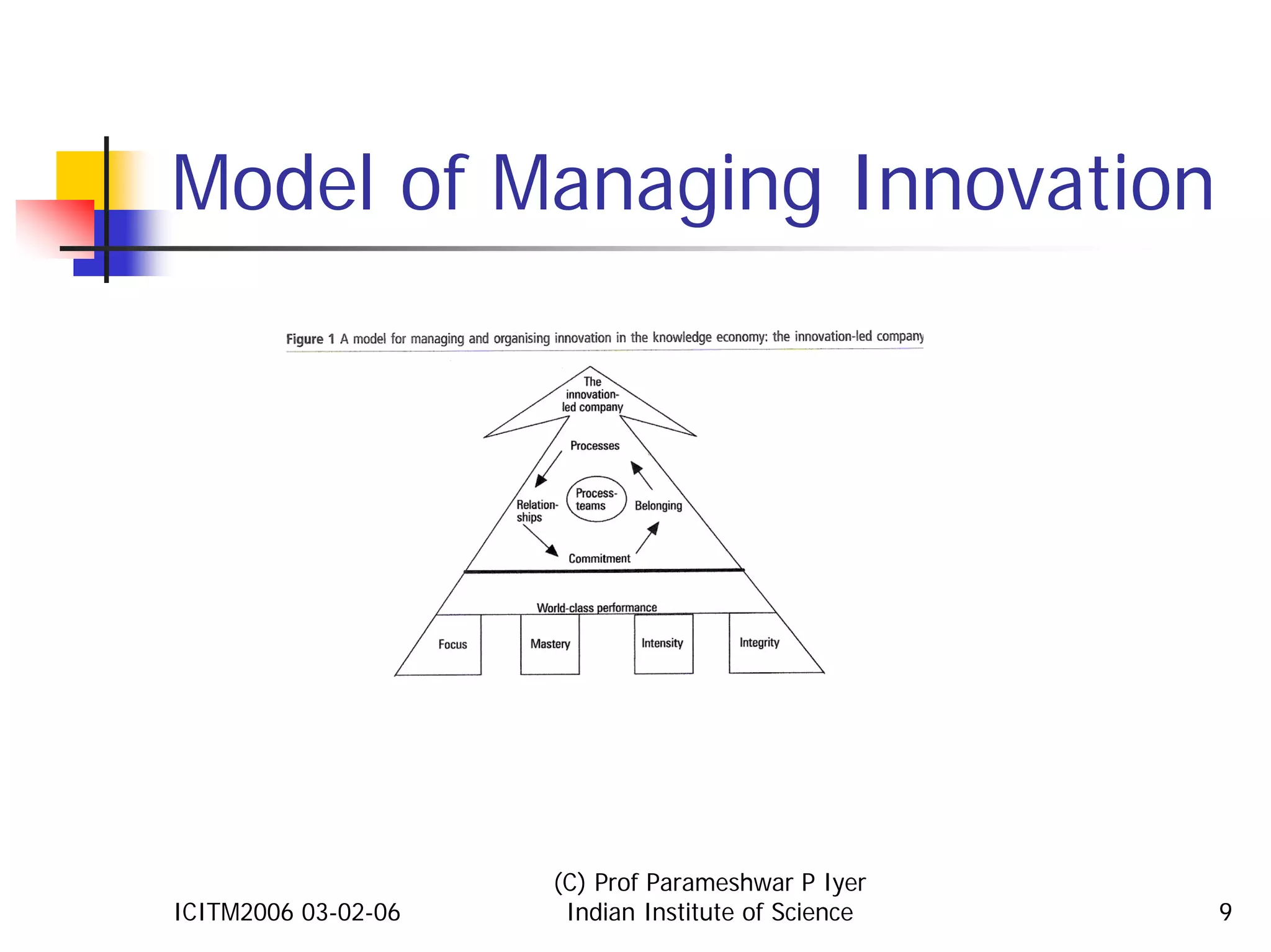
    At the management level, innovation
    linked to:
    1. Focus
    2. Mastery
    3. Intensity
    4. Integrity

                     (C) Prof Parameshwar P Iyer
ICITM2006 03-02-06    Indian Institute of Science   6
Results: Model for Managing
and Organizing Innovation
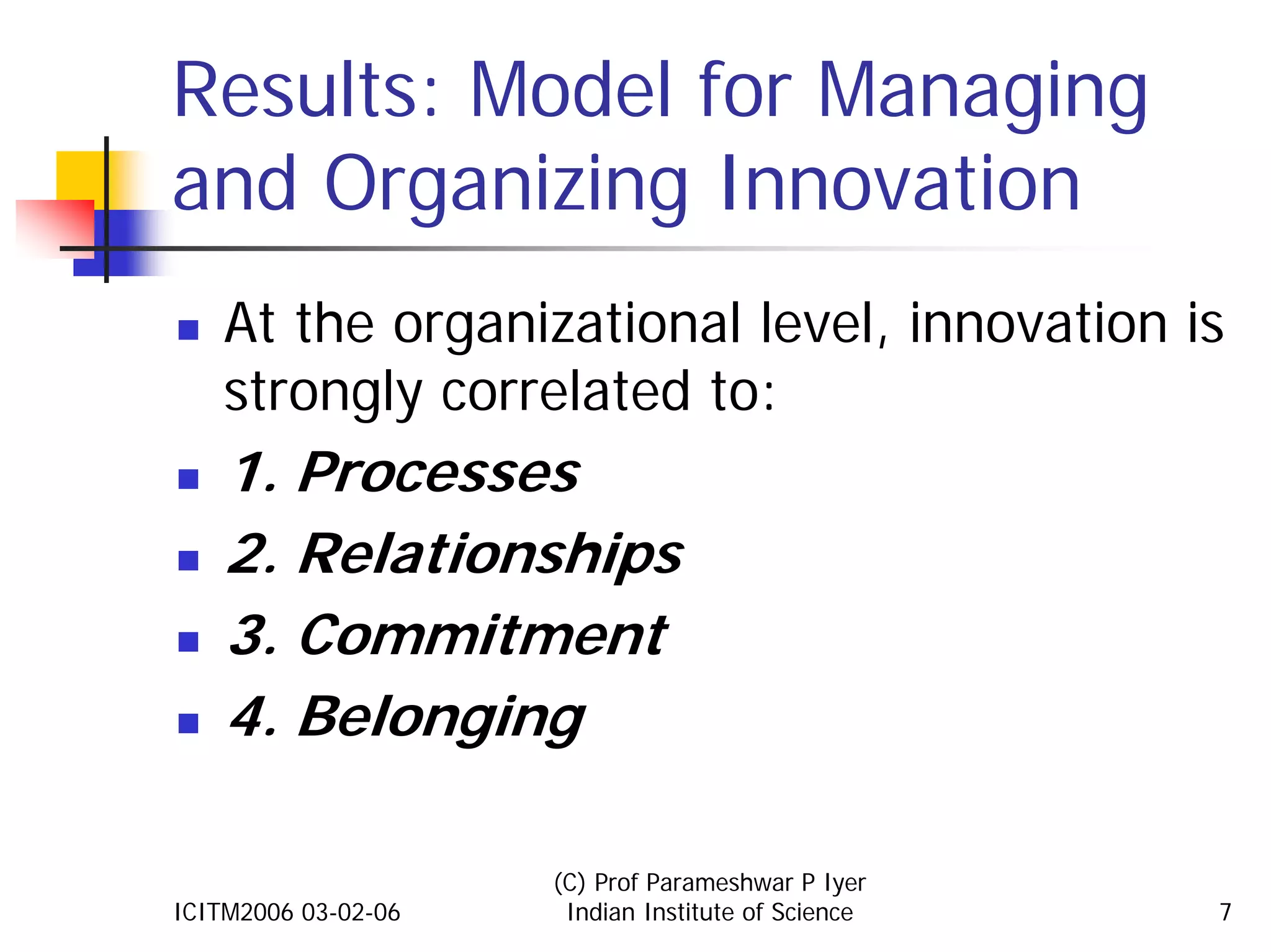
    At the organizational level, innovation is
    strongly correlated to:
    1. Processes
    2. Relationships
    3. Commitment
    4. Belonging

                     (C) Prof Parameshwar P Iyer
ICITM2006 03-02-06    Indian Institute of Science   7
Model of Managing Innovation
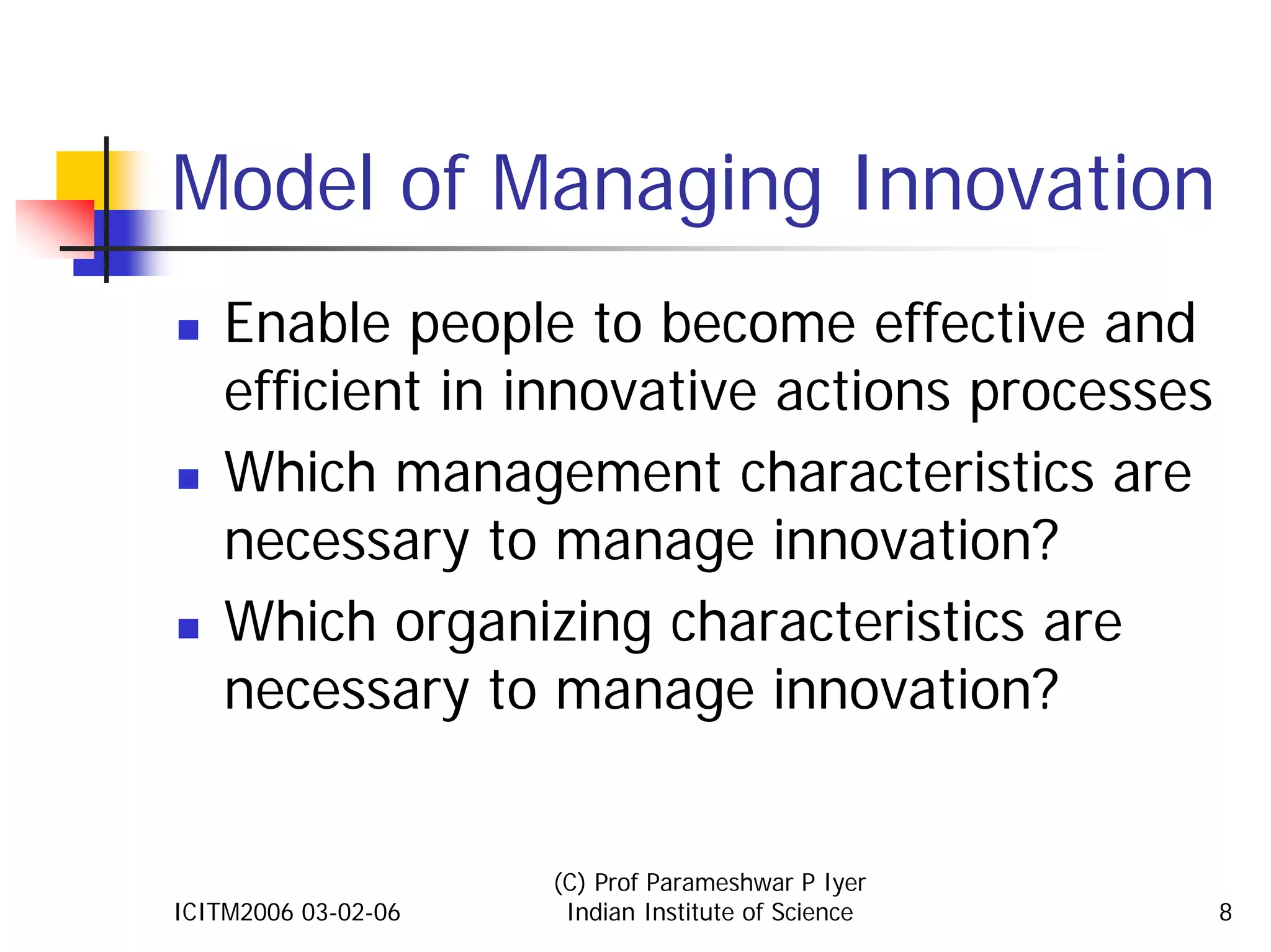
    Enable people to become effective and
    efficient in innovative actions processes
    Which management characteristics are
    necessary to manage innovation?
    Which organizing characteristics are
    necessary to manage innovation?


                     (C) Prof Parameshwar P Iyer
ICITM2006 03-02-06    Indian Institute of Science   8
Model of Managing Innovation


                     (C) Prof Parameshwar P Iyer
ICITM2006 03-02-06    Indian Institute of Science   9
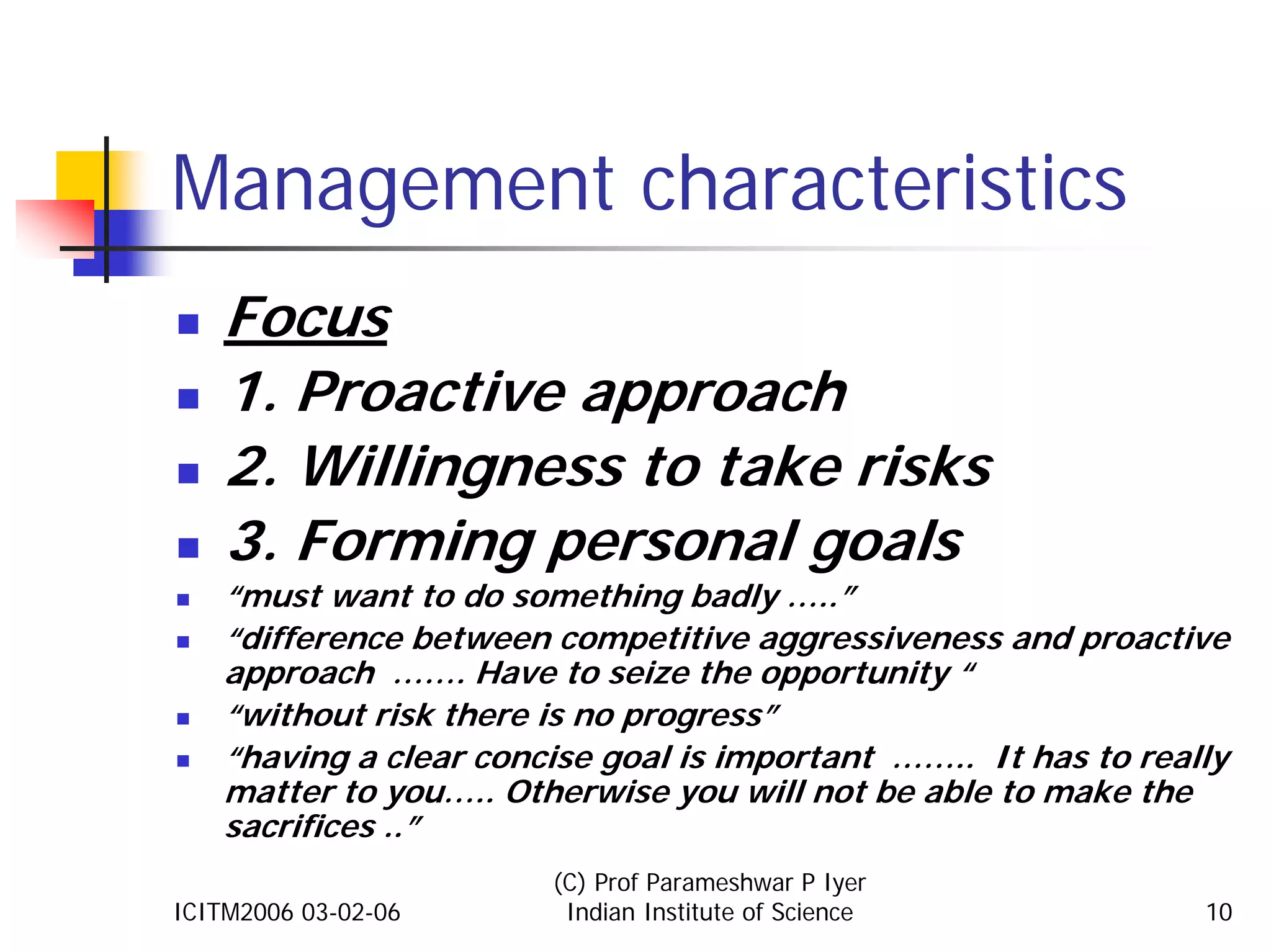
Management characteristics
    Focus
    1. Proactive approach
    2. Willingness to take risks
    3. Forming personal goals
    “must want to do something badly …..”
    “difference between competitive aggressiveness and proactive
    approach ……. Have to seize the opportunity “
    “without risk there is no progress”
    “having a clear concise goal is important …….. It has to really
    matter to you….. Otherwise you will not be able to make the
    sacrifices ..”
                        (C) Prof Parameshwar P Iyer
ICITM2006 03-02-06       Indian Institute of Science             10
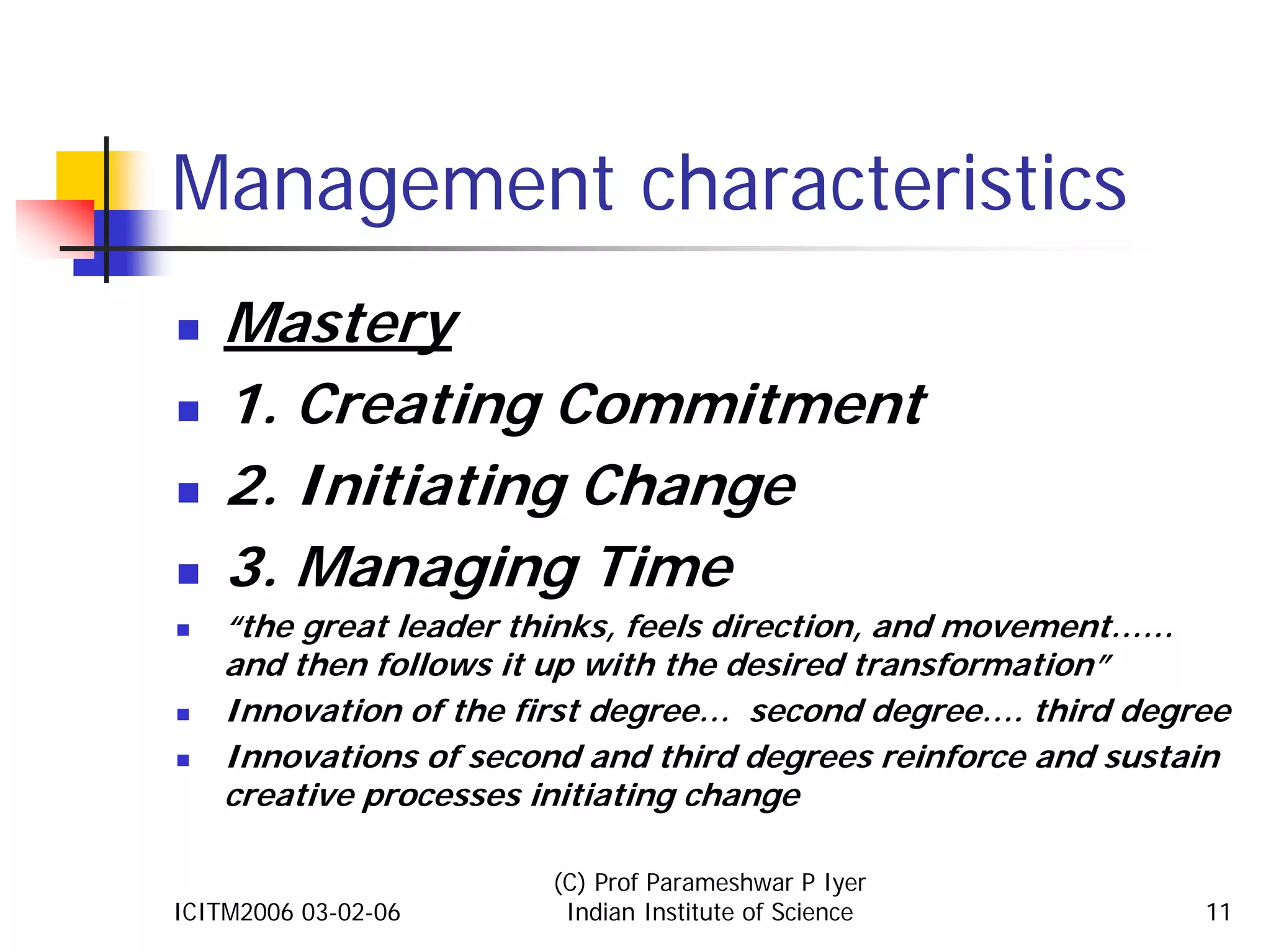
Management characteristics
    Mastery
    1. Creating Commitment
    2. Initiating Change
    3. Managing Time
    “the great leader thinks, feels direction, and movement……
    and then follows it up with the desired transformation”
    Innovation of the first degree… second degree…. third degree
    Innovations of second and third degrees reinforce and sustain
    creative processes initiating change

                       (C) Prof Parameshwar P Iyer
ICITM2006 03-02-06      Indian Institute of Science            11
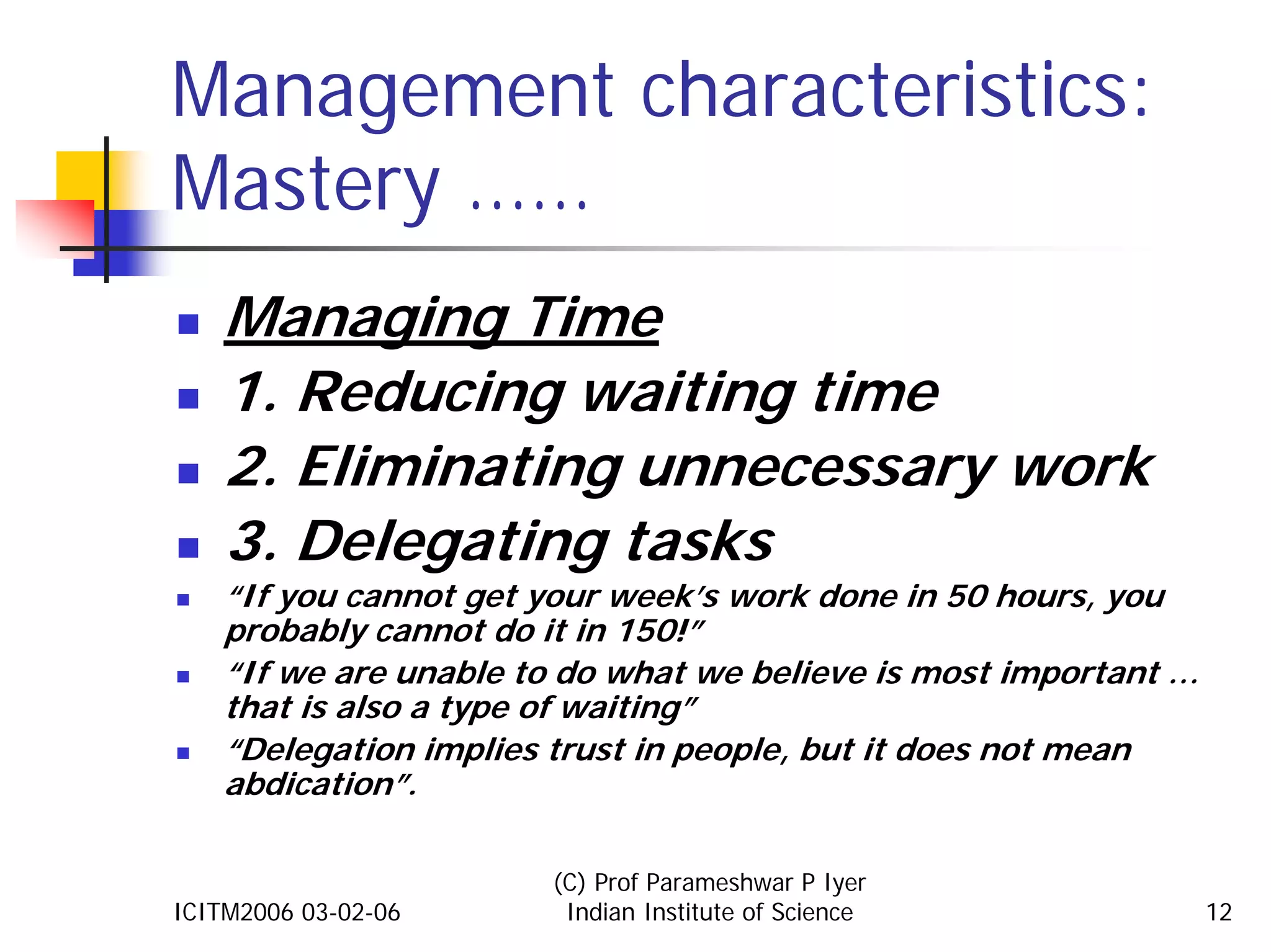
Management characteristics:
Mastery ……
    Managing Time
    1. Reducing waiting time
    2. Eliminating unnecessary work
    3. Delegating tasks
    “If you cannot get your week’s work done in 50 hours, you
    probably cannot do it in 150!”
    “If we are unable to do what we believe is most important …
    that is also a type of waiting”
    “Delegation implies trust in people, but it does not mean
    abdication”.

                       (C) Prof Parameshwar P Iyer
ICITM2006 03-02-06      Indian Institute of Science               12
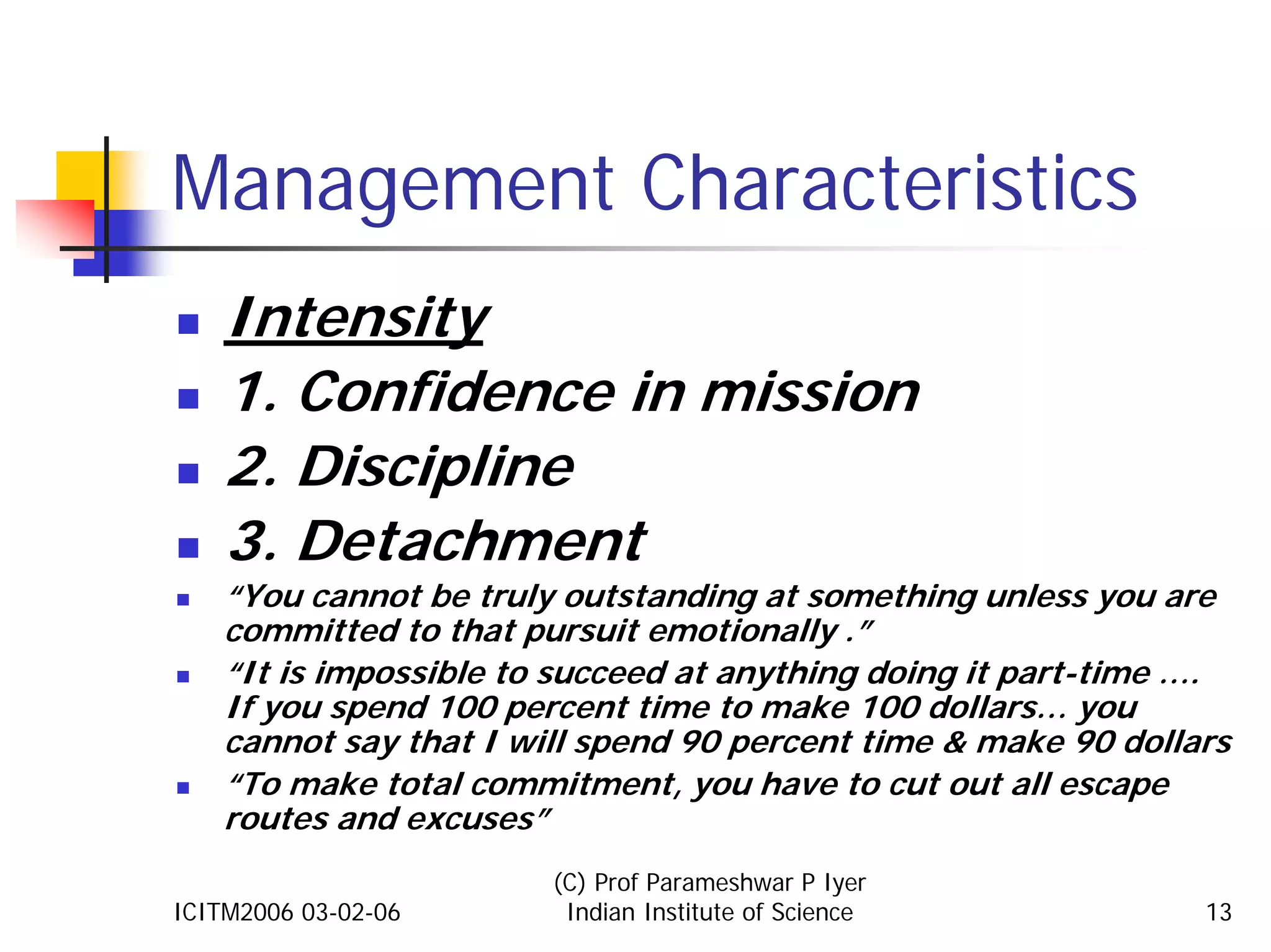
Management Characteristics
    Intensity
    1. Confidence in mission
    2. Discipline
    3. Detachment
    “You cannot be truly outstanding at something unless you are
    committed to that pursuit emotionally .”
    “It is impossible to succeed at anything doing it part-time ….
    If you spend 100 percent time to make 100 dollars… you
    cannot say that I will spend 90 percent time & make 90 dollars
    “To make total commitment, you have to cut out all escape
    routes and excuses”
                        (C) Prof Parameshwar P Iyer
ICITM2006 03-02-06       Indian Institute of Science            13
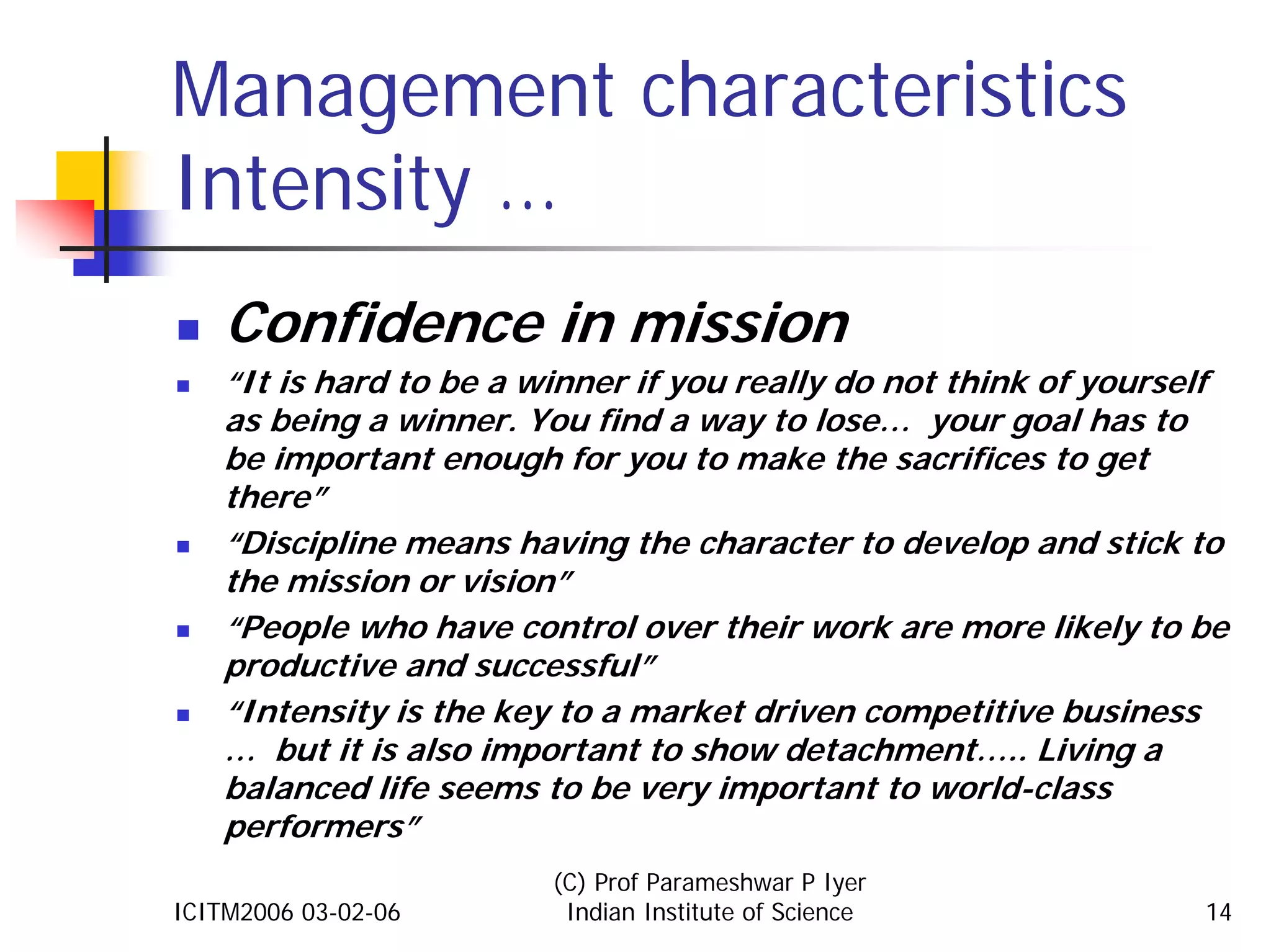
Management characteristics
Intensity …
    Confidence in mission
    “It is hard to be a winner if you really do not think of yourself
    as being a winner. You find a way to lose… your goal has to
    be important enough for you to make the sacrifices to get
    there”
    “Discipline means having the character to develop and stick to
    the mission or vision”
    “People who have control over their work are more likely to be
    productive and successful”
    “Intensity is the key to a market driven competitive business
    … but it is also important to show detachment….. Living a
    balanced life seems to be very important to world-class
    performers”
                         (C) Prof Parameshwar P Iyer
ICITM2006 03-02-06        Indian Institute of Science              14
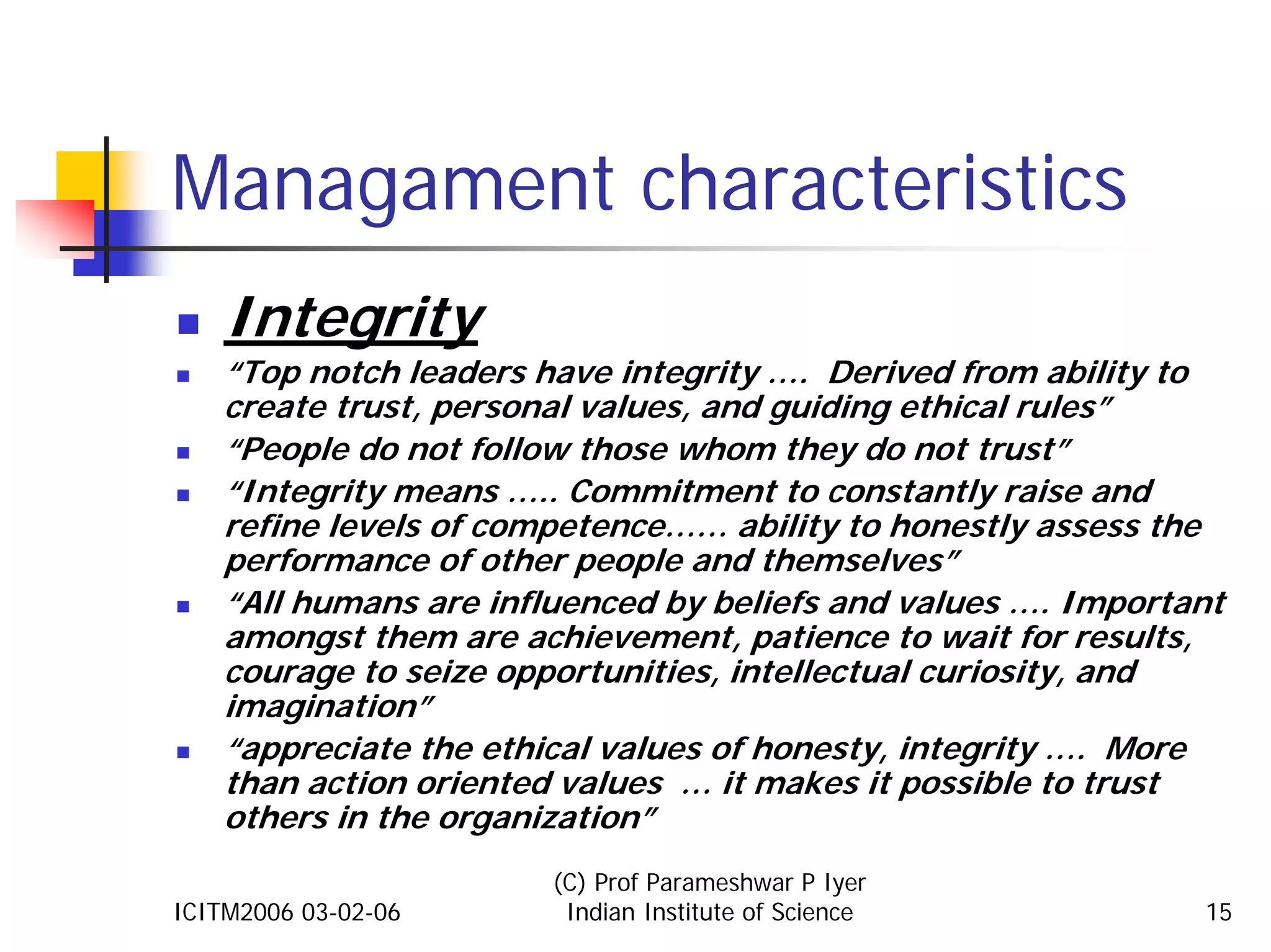
Managament characteristics
    Integrity
    “Top notch leaders have integrity …. Derived from ability to
    create trust, personal values, and guiding ethical rules”
    “People do not follow those whom they do not trust”
    “Integrity means ….. Commitment to constantly raise and
    refine levels of competence…… ability to honestly assess the
    performance of other people and themselves”
    “All humans are influenced by beliefs and values …. Important
    amongst them are achievement, patience to wait for results,
    courage to seize opportunities, intellectual curiosity, and
    imagination”
    “appreciate the ethical values of honesty, integrity …. More
    than action oriented values … it makes it possible to trust
    others in the organization”
                        (C) Prof Parameshwar P Iyer
ICITM2006 03-02-06       Indian Institute of Science           15
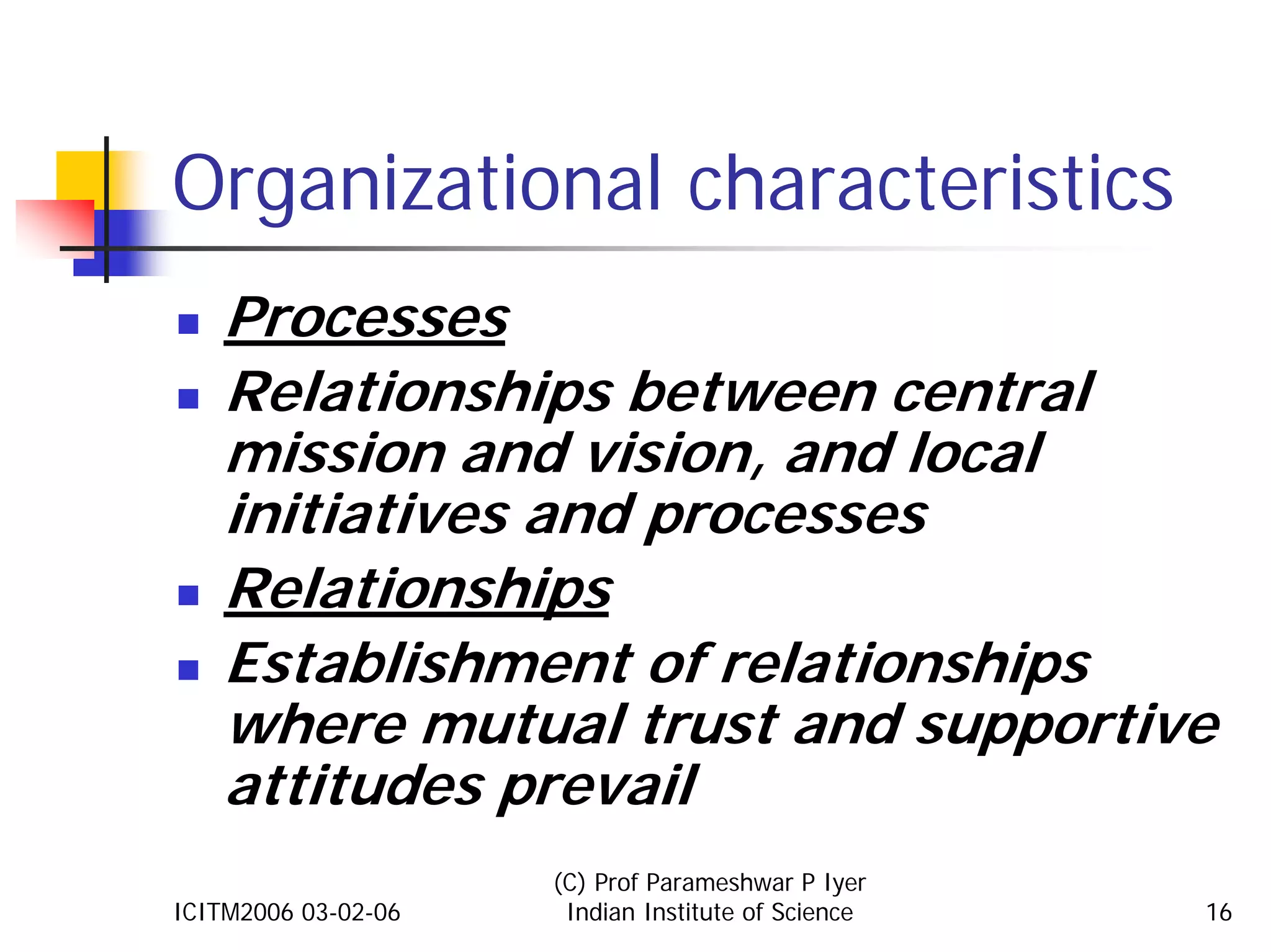
Organizational characteristics
    Processes
    Relationships between central
    mission and vision, and local
    initiatives and processes
    Relationships
    Establishment of relationships
    where mutual trust and supportive
    attitudes prevail
                     (C) Prof Parameshwar P Iyer
ICITM2006 03-02-06    Indian Institute of Science   16
Organizational characteristics
    Commitment
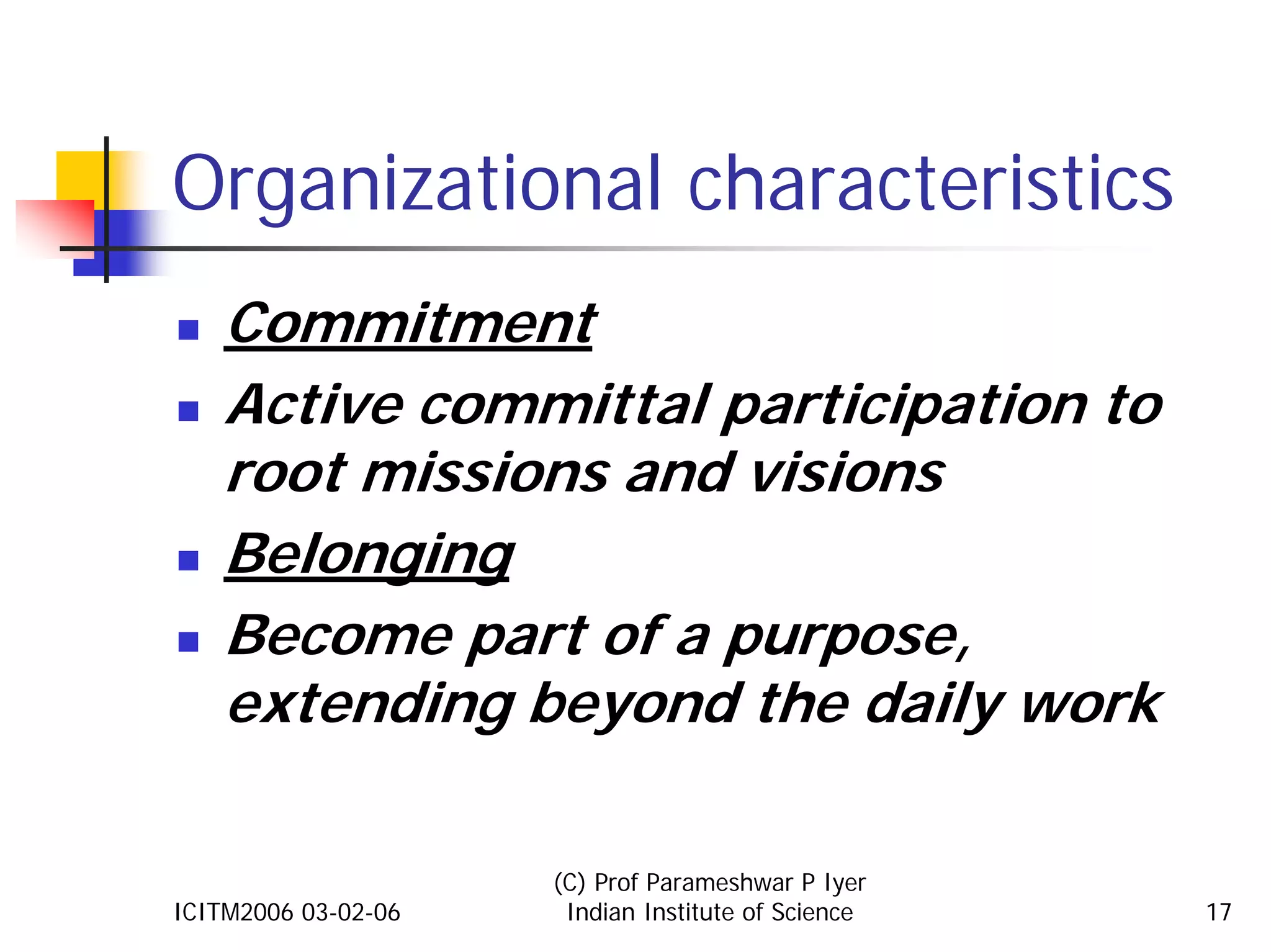
    Active committal participation to
    root missions and visions
    Belonging
    Become part of a purpose,
    extending beyond the daily work

                     (C) Prof Parameshwar P Iyer
ICITM2006 03-02-06    Indian Institute of Science   17
Organizational characteristics
Processes
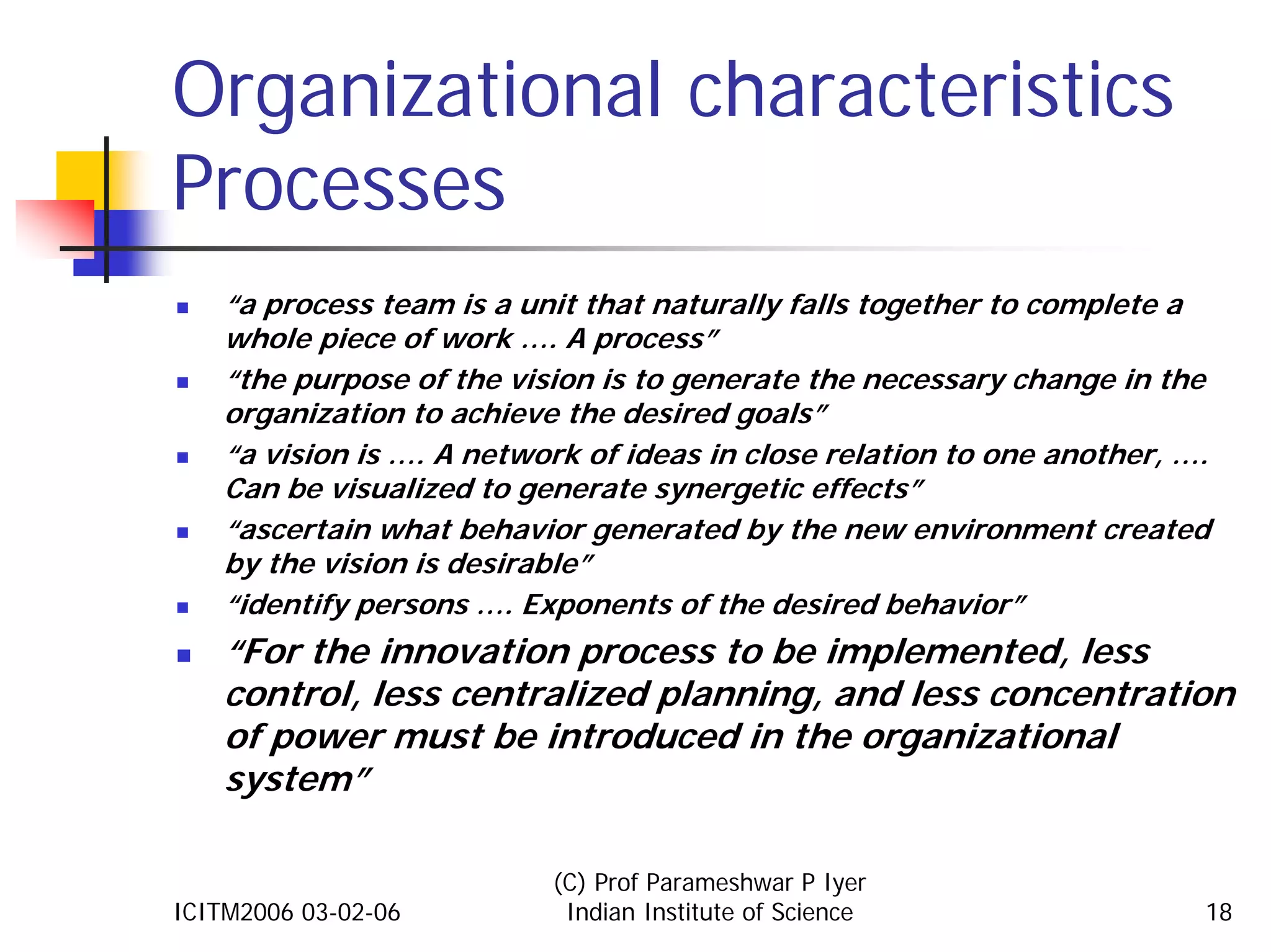
    “a process team is a unit that naturally falls together to complete a
    whole piece of work …. A process”
    “the purpose of the vision is to generate the necessary change in the
    organization to achieve the desired goals”
    “a vision is …. A network of ideas in close relation to one another, ….
    Can be visualized to generate synergetic effects”
    “ascertain what behavior generated by the new environment created
    by the vision is desirable”
    “identify persons …. Exponents of the desired behavior”
    “For the innovation process to be implemented, less
    control, less centralized planning, and less concentration
    of power must be introduced in the organizational
    system”

                           (C) Prof Parameshwar P Iyer
ICITM2006 03-02-06          Indian Institute of Science                   18
Conclusions
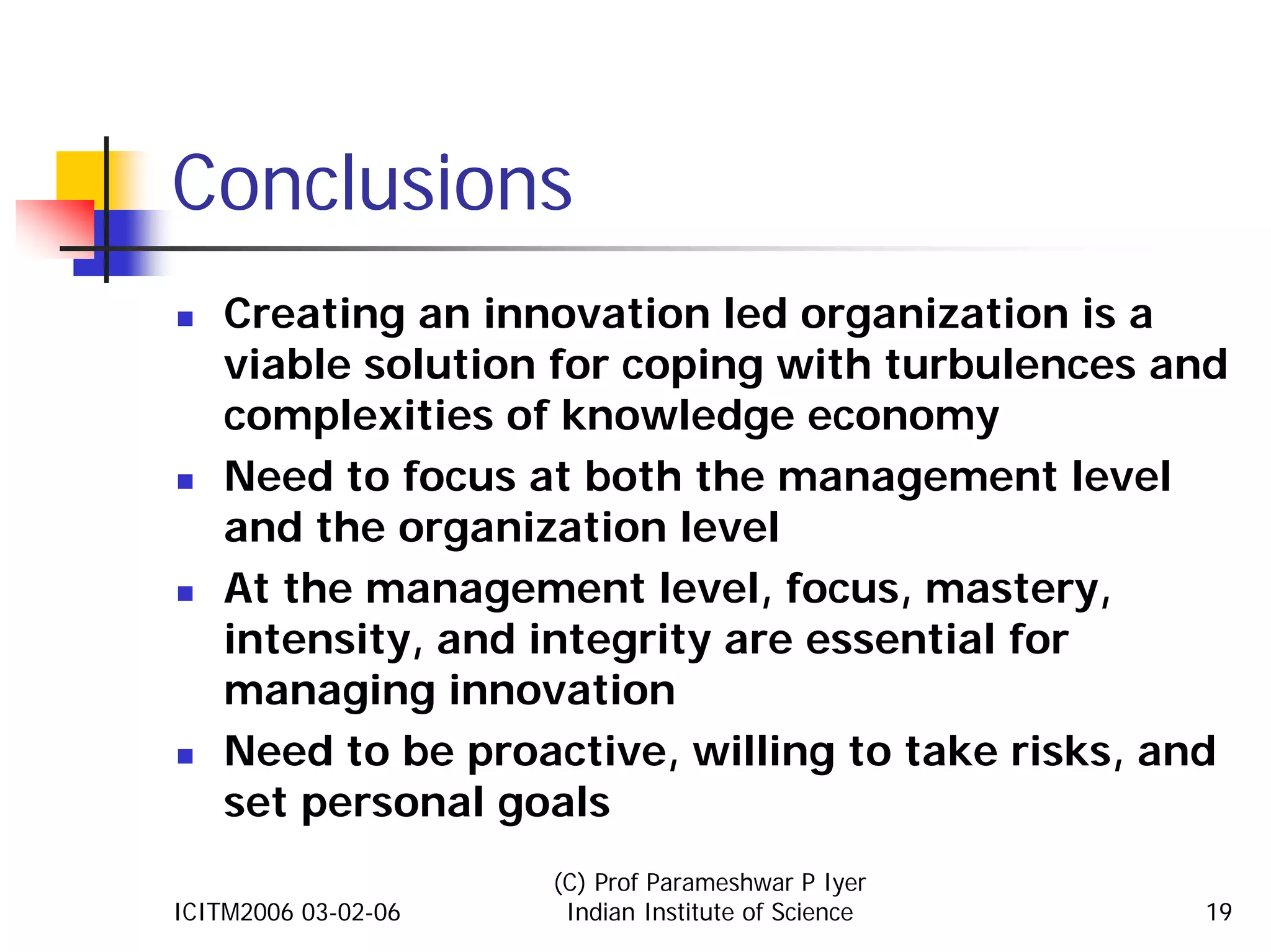
    Creating an innovation led organization is a
    viable solution for coping with turbulences and
    complexities of knowledge economy
    Need to focus at both the management level
    and the organization level
    At the management level, focus, mastery,
    intensity, and integrity are essential for
    managing innovation
    Need to be proactive, willing to take risks, and
    set personal goals
                     (C) Prof Parameshwar P Iyer
ICITM2006 03-02-06    Indian Institute of Science   19
Conclusions
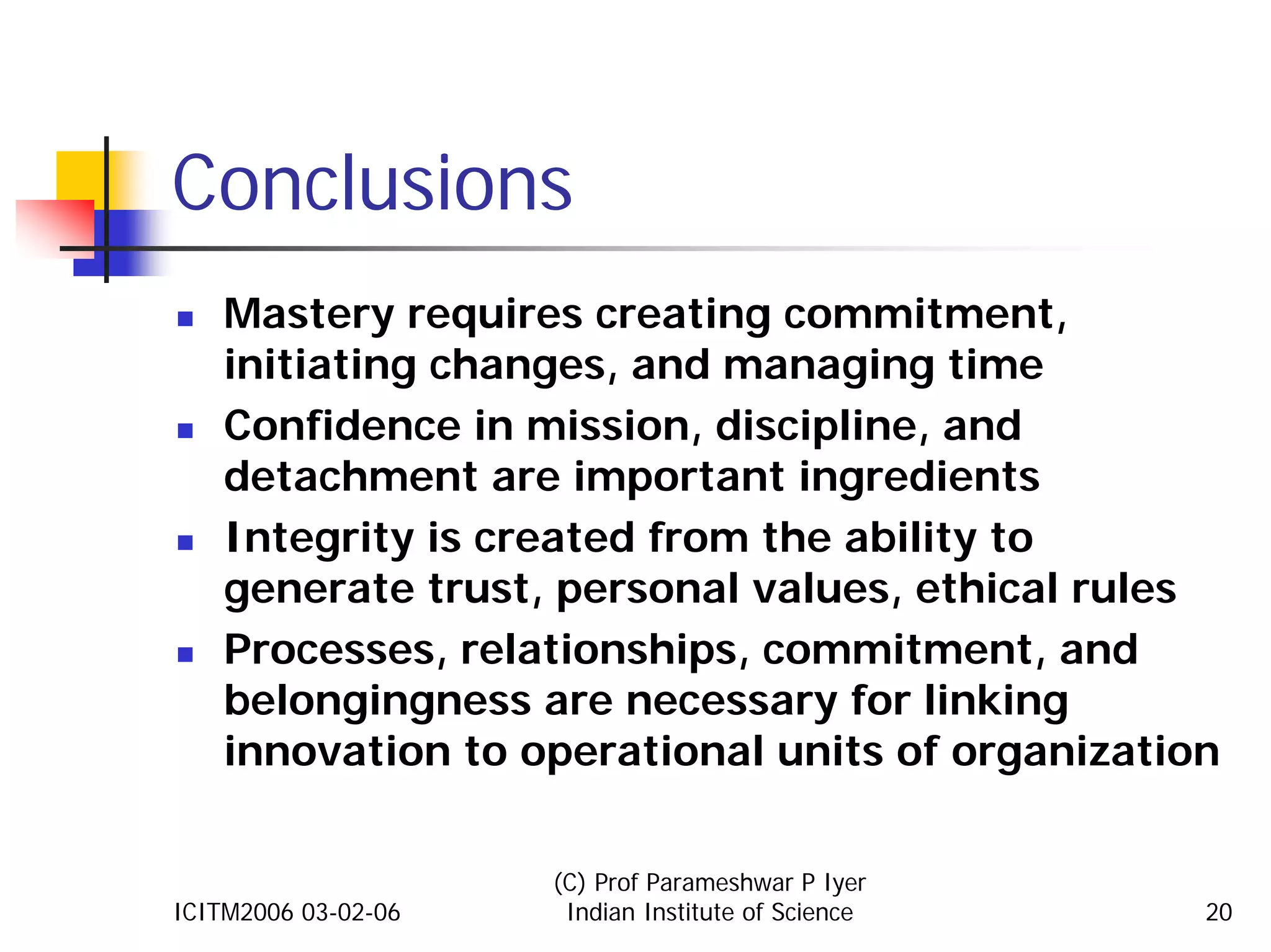
    Mastery requires creating commitment,
    initiating changes, and managing time
    Confidence in mission, discipline, and
    detachment are important ingredients
    Integrity is created from the ability to
    generate trust, personal values, ethical rules
    Processes, relationships, commitment, and
    belongingness are necessary for linking
    innovation to operational units of organization

                     (C) Prof Parameshwar P Iyer
ICITM2006 03-02-06    Indian Institute of Science   20

Icimt 2006 Managing And Organizing Innovation In Emerging New Knowledge Economy 03 02 2006

  • 1.
    Managing and Organizing Innovationin Emerging New Knowledge Economy Prof Parameshwar P. Iyer CSIC Management Studies Indian Institute of Science (C) Prof Parameshwar P Iyer ICITM2006 03-02-06 Indian Institute of Science 1
  • 2.
    Agenda Introduction Objectives Methodology Results Model for Managing Organizing Innovation Management Characteristics Organizational Characteristics Conclusions (C) Prof Parameshwar P Iyer ICITM2006 03-02-06 Indian Institute of Science 2
  • 3.
    Introduction Increased turbulence and complexity Focus attention on Innovation Knowledge as principal source of competitive advantage Western approach – Hard, quantifiable, objective procedures, efficiency based Contrast with tacit, subjective, intuitive, insight based Get it from the “horses’ mouth” (C) Prof Parameshwar P Iyer ICITM2006 03-02-06 Indian Institute of Science 3
  • 4.
    Objectives Learn from wisdom of world class performers Generic model for managing and organizing innovation Links between innovation and performance at management level Links between innovation and process parameters at organizational level (C) Prof Parameshwar P Iyer ICITM2006 03-02-06 Indian Institute of Science 4
  • 5.
    Methodology Synthesis of model for managing and organizing innovation (literature) Informal semi structured interviews with 32 top managers in innovation led corporates How do executives look at productivity and innovation How do they achieve and maintain status What best practices would they recommend (C) Prof Parameshwar P Iyer ICITM2006 03-02-06 Indian Institute of Science 5
  • 6.
    Results: Model forManaging and Organizing Innovation At the management level, innovation linked to: 1. Focus 2. Mastery 3. Intensity 4. Integrity (C) Prof Parameshwar P Iyer ICITM2006 03-02-06 Indian Institute of Science 6
  • 7.
    Results: Model forManaging and Organizing Innovation At the organizational level, innovation is strongly correlated to: 1. Processes 2. Relationships 3. Commitment 4. Belonging (C) Prof Parameshwar P Iyer ICITM2006 03-02-06 Indian Institute of Science 7
  • 8.
    Model of ManagingInnovation Enable people to become effective and efficient in innovative actions processes Which management characteristics are necessary to manage innovation? Which organizing characteristics are necessary to manage innovation? (C) Prof Parameshwar P Iyer ICITM2006 03-02-06 Indian Institute of Science 8
  • 9.
    Model of ManagingInnovation (C) Prof Parameshwar P Iyer ICITM2006 03-02-06 Indian Institute of Science 9
  • 10.
    Management characteristics Focus 1. Proactive approach 2. Willingness to take risks 3. Forming personal goals “must want to do something badly …..” “difference between competitive aggressiveness and proactive approach ……. Have to seize the opportunity “ “without risk there is no progress” “having a clear concise goal is important …….. It has to really matter to you….. Otherwise you will not be able to make the sacrifices ..” (C) Prof Parameshwar P Iyer ICITM2006 03-02-06 Indian Institute of Science 10
  • 11.
    Management characteristics Mastery 1. Creating Commitment 2. Initiating Change 3. Managing Time “the great leader thinks, feels direction, and movement…… and then follows it up with the desired transformation” Innovation of the first degree… second degree…. third degree Innovations of second and third degrees reinforce and sustain creative processes initiating change (C) Prof Parameshwar P Iyer ICITM2006 03-02-06 Indian Institute of Science 11
  • 12.
    Management characteristics: Mastery …… Managing Time 1. Reducing waiting time 2. Eliminating unnecessary work 3. Delegating tasks “If you cannot get your week’s work done in 50 hours, you probably cannot do it in 150!” “If we are unable to do what we believe is most important … that is also a type of waiting” “Delegation implies trust in people, but it does not mean abdication”. (C) Prof Parameshwar P Iyer ICITM2006 03-02-06 Indian Institute of Science 12
  • 13.
    Management Characteristics Intensity 1. Confidence in mission 2. Discipline 3. Detachment “You cannot be truly outstanding at something unless you are committed to that pursuit emotionally .” “It is impossible to succeed at anything doing it part-time …. If you spend 100 percent time to make 100 dollars… you cannot say that I will spend 90 percent time & make 90 dollars “To make total commitment, you have to cut out all escape routes and excuses” (C) Prof Parameshwar P Iyer ICITM2006 03-02-06 Indian Institute of Science 13
  • 14.
    Management characteristics Intensity … Confidence in mission “It is hard to be a winner if you really do not think of yourself as being a winner. You find a way to lose… your goal has to be important enough for you to make the sacrifices to get there” “Discipline means having the character to develop and stick to the mission or vision” “People who have control over their work are more likely to be productive and successful” “Intensity is the key to a market driven competitive business … but it is also important to show detachment….. Living a balanced life seems to be very important to world-class performers” (C) Prof Parameshwar P Iyer ICITM2006 03-02-06 Indian Institute of Science 14
  • 15.
    Managament characteristics Integrity “Top notch leaders have integrity …. Derived from ability to create trust, personal values, and guiding ethical rules” “People do not follow those whom they do not trust” “Integrity means ….. Commitment to constantly raise and refine levels of competence…… ability to honestly assess the performance of other people and themselves” “All humans are influenced by beliefs and values …. Important amongst them are achievement, patience to wait for results, courage to seize opportunities, intellectual curiosity, and imagination” “appreciate the ethical values of honesty, integrity …. More than action oriented values … it makes it possible to trust others in the organization” (C) Prof Parameshwar P Iyer ICITM2006 03-02-06 Indian Institute of Science 15
  • 16.
    Organizational characteristics Processes Relationships between central mission and vision, and local initiatives and processes Relationships Establishment of relationships where mutual trust and supportive attitudes prevail (C) Prof Parameshwar P Iyer ICITM2006 03-02-06 Indian Institute of Science 16
  • 17.
    Organizational characteristics Commitment Active committal participation to root missions and visions Belonging Become part of a purpose, extending beyond the daily work (C) Prof Parameshwar P Iyer ICITM2006 03-02-06 Indian Institute of Science 17
  • 18.
    Organizational characteristics Processes “a process team is a unit that naturally falls together to complete a whole piece of work …. A process” “the purpose of the vision is to generate the necessary change in the organization to achieve the desired goals” “a vision is …. A network of ideas in close relation to one another, …. Can be visualized to generate synergetic effects” “ascertain what behavior generated by the new environment created by the vision is desirable” “identify persons …. Exponents of the desired behavior” “For the innovation process to be implemented, less control, less centralized planning, and less concentration of power must be introduced in the organizational system” (C) Prof Parameshwar P Iyer ICITM2006 03-02-06 Indian Institute of Science 18
  • 19.
    Conclusions Creating an innovation led organization is a viable solution for coping with turbulences and complexities of knowledge economy Need to focus at both the management level and the organization level At the management level, focus, mastery, intensity, and integrity are essential for managing innovation Need to be proactive, willing to take risks, and set personal goals (C) Prof Parameshwar P Iyer ICITM2006 03-02-06 Indian Institute of Science 19
  • 20.
    Conclusions Mastery requires creating commitment, initiating changes, and managing time Confidence in mission, discipline, and detachment are important ingredients Integrity is created from the ability to generate trust, personal values, ethical rules Processes, relationships, commitment, and belongingness are necessary for linking innovation to operational units of organization (C) Prof Parameshwar P Iyer ICITM2006 03-02-06 Indian Institute of Science 20