Hisrich
Peters
Shepherd
Chapter 9
The Organizational Plan
Copyright © 2010 by The McGraw-Hill Companies, Inc. All rights reserved.McGraw-Hill/Irwin
9-2
Developing the Management Team
 Investors demand that the management
team not operate the business as a part-
time venture.
 It is assumed that the management team is
prepared to operate the business full time
and at a modest salary.
 An attempt to draw a large salary out of the
new venture may be perceived as a lack of
commitment to the business.
9-3
Legal Forms of Business
 Three basic legal forms of business:
 Proprietorship - Single owner, unlimited liability,
controls all decisions, and receives all profits.
 Partnership - Two or more individuals having
unlimited liability who have pooled resources to
own a business.
 Corporation (C corporation) - Most common
form of corporation; regulated by statute;
treated as a separate legal entity for liability and
tax purposes.
9-4
 New forms of business formations:
 Limited liability company (LLC).
 Limited liability partnership (LLP).
 S corporation.
Legal Forms of Business (cont.)
9-5
Table 9.1 - Three Forms of
Business Formation
9-6
Table 9.1 - Three Forms of
Business Formation (cont.)
9-7
Table 9.1 - Three Forms of
Business Formation (cont.)
9-8
Tax Attributes of Forms of Business
 Tax Issues for Proprietorship
 IRS treats business as the individual owner; not
regarded as a separate tax entity.
 All income appears on owner’s return as
personal income.
 Tax advantages:
 No double tax when profits are distributed to owner.
 No capital stock tax or penalty for retained earnings.
 Tax Issues for Partnership (general)
 Tax advantages and disadvantages similar sole
proprietorship.
9-9
 Tax Issues for Partnership (limited)
 Has the advantage of limited liability.
 Treated the same as the LLC for tax purposes.
 Tax Issues for Corporation:
 Can take many deductions and expenses not
available to proprietorship or partnership.
 Distribution of dividends is taxed twice.
 Double taxation can be avoided if income is
distributed to entrepreneur(s) in the form of
salary.
Tax Attributes of Forms of Business
(cont.)
9-10
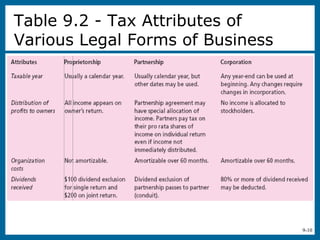
Table 9.2 - Tax Attributes of
Various Legal Forms of Business
9-11
Table 9.2 - Tax Attributes of
Various Legal Forms of Business (cont.)
9-12
Table 9.2 - Tax Attributes of
Various Legal Forms of Business (cont.)
9-13
The Limited Liability Company
Versus S Corporation
 Venture capitalists prefer LLCs as a form of
business entity.
 A new regulation allows LLCs to be taxed as
a partnership.
 The S corporation was the most popular
choice of organization structure by new
ventures and small businesses.
 Growth rate of S corporations has leveled
off mainly because of the wide acceptance
of LLCs.
9-14
S Corporation
 A special type of corporation where profits
are distributed to stockholders and taxed as
personal income.
 The Small Business Protection Act of 1996
reduced some restrictions.
 In 2004, Congress responded to criticisms
of the restrictions on S corporations as
compared to LLCs.
 Intent was to make the S corporation as
advantageous as the LLC.
 Status of the S corporation must be
monitored and maintained.
9-15
 Advantages of an S Corporation
 Capital gains or losses are treated as personal
income or losses.
 Limited liability protection.
 Not subject to a minimum tax.
 Transfer of stock to low-income-bracket family
members
 Stock may be voting or nonvoting.
 Cash method of accounting.
 Corporate long-term capital gains and losses are
deductible directly by the shareholders.
S Corporation (cont.)
9-16
 Disadvantages of an S Corporation
 Some restrictions for qualification.
 Potential tax disadvantages.
 Most fringe benefits not deductible for
shareholders.
 Must have a calendar year for tax purposes.
 Only one class of stock is permitted.
 Net loss is limited to shareholder’s stock plus
loans to business.
 No more than 100 shareholders.
S Corporation (cont.)
9-17
The Limited Liability Company
 A partnership/corporation hybrid.
 Laws governing its formation differ from
state to state.
 LLC has members.
 No shares issued; each member owns an
interest as designated by the articles of
organization.
 Liability does not extend beyond member’s
capital contribution.
9-18
 Transfer of interest requires unanimous
consent.
 It is taxed as a partnership.
 Standard acceptable term is 30 years;
continuity restricted.
The Limited Liability Company (cont.)
9-19
 Advantages of LLC
 Partners can add their proportionate shares of
the LLC liabilities to their partnership interests.
 Most states do not tax LLCs.
 One or more (without limit) individuals,
corporations, partnerships, trusts, or other
entities form an LLC.
 Members share income, profit, expense,
deduction, loss and credit, and equity of the LLC
among themselves.
The Limited Liability Company (cont.)
9-20
Designing the Organization
 This is the entrepreneur’s formal and
explicit indication to the members of the
organization as to what is expected of
them; expectations can be grouped into:
 Organization structure.
 Planning, measurement, and evaluation
schemes.
 Rewards.
 Selection criteria.
 Training.
9-21
Figure 9.1 - Stages in
Organizational Design
9-22
Building the Management Team and a
Successful Organization Culture
 A management team must be able to
accomplish three functions:
 Execute the business plan.
 Identify fundamental changes in the business as
they occur.
 Make adjustments to the plan based on changes
in the environment and market that will
maintain profitability.
9-23
 Important factors in establishing an
effective team:
 Desired culture must match business strategy
outlined in the business plan.
 Employees must be motivated and rewarded for
good work.
 Entrepreneur should be flexible to try different
things.
 Spend extra time in the hiring process.
 Core values and appropriate tools must be
provided for employees to effectively complete
their jobs.
Building the Management Team and a
Successful Organization Culture (cont.)
9-24
The Role of a Board of Directors
 Functions of the board of directors:
 Reviewing operating and capital budgets.
 Developing longer-term strategic plans for
growth and expansion.
 Supporting day-to-day activities.
 Resolving conflicts among owners or
shareholders.
 Ensuring the proper use of assets.
 Developing a network of information sources for
the entrepreneurs.
9-25
 They meet the requirements of the
Sarbanes-Oxley Act and the following
criteria:
 Ability to work with a diverse group and commit
to the venture’s mission.
 Ability to understand the market environment.
 Ability to contribute important skills to the new
venture’s achievement of planning goals.
 Ability to show good judgment in business
decision making.
The Role of a Board of Directors
(cont.)
9-26
The Board of Advisors
 They serve only in an advisory capacity.
 No legal status; not subject to regulations
stipulated in the Sarbanes-Oxley Act.
 Likely to meet less frequently.
 Useful in a family business.
 Selection process is similar to the process
for selecting a board of directors.
 Advisors may be compensated on a per-
meeting basis or with stock or stock
options.
9-27
The Organization and Use of
Advisors
 Outside advisors are usually used on an as-
needed basis.
 They can become a part of the organization
and need to be managed.
 The relationship between the entrepreneur
and outside advisors can be enhanced by
involving them thoroughly and at an early
stage.
 Even after hiring advisors, the entrepreneur
should question their advice.

Entrepreneurship Chap 9

  • 1.
    Hisrich Peters Shepherd Chapter 9 The OrganizationalPlan Copyright © 2010 by The McGraw-Hill Companies, Inc. All rights reserved.McGraw-Hill/Irwin
  • 2.
    9-2 Developing the ManagementTeam  Investors demand that the management team not operate the business as a part- time venture.  It is assumed that the management team is prepared to operate the business full time and at a modest salary.  An attempt to draw a large salary out of the new venture may be perceived as a lack of commitment to the business.
  • 3.
    9-3 Legal Forms ofBusiness  Three basic legal forms of business:  Proprietorship - Single owner, unlimited liability, controls all decisions, and receives all profits.  Partnership - Two or more individuals having unlimited liability who have pooled resources to own a business.  Corporation (C corporation) - Most common form of corporation; regulated by statute; treated as a separate legal entity for liability and tax purposes.
  • 4.
    9-4  New formsof business formations:  Limited liability company (LLC).  Limited liability partnership (LLP).  S corporation. Legal Forms of Business (cont.)
  • 5.
    9-5 Table 9.1 -Three Forms of Business Formation
  • 6.
    9-6 Table 9.1 -Three Forms of Business Formation (cont.)
  • 7.
    9-7 Table 9.1 -Three Forms of Business Formation (cont.)
  • 8.
    9-8 Tax Attributes ofForms of Business  Tax Issues for Proprietorship  IRS treats business as the individual owner; not regarded as a separate tax entity.  All income appears on owner’s return as personal income.  Tax advantages:  No double tax when profits are distributed to owner.  No capital stock tax or penalty for retained earnings.  Tax Issues for Partnership (general)  Tax advantages and disadvantages similar sole proprietorship.
  • 9.
    9-9  Tax Issuesfor Partnership (limited)  Has the advantage of limited liability.  Treated the same as the LLC for tax purposes.  Tax Issues for Corporation:  Can take many deductions and expenses not available to proprietorship or partnership.  Distribution of dividends is taxed twice.  Double taxation can be avoided if income is distributed to entrepreneur(s) in the form of salary. Tax Attributes of Forms of Business (cont.)
  • 10.
    9-10 Table 9.2 -Tax Attributes of Various Legal Forms of Business
  • 11.
    9-11 Table 9.2 -Tax Attributes of Various Legal Forms of Business (cont.)
  • 12.
    9-12 Table 9.2 -Tax Attributes of Various Legal Forms of Business (cont.)
  • 13.
    9-13 The Limited LiabilityCompany Versus S Corporation  Venture capitalists prefer LLCs as a form of business entity.  A new regulation allows LLCs to be taxed as a partnership.  The S corporation was the most popular choice of organization structure by new ventures and small businesses.  Growth rate of S corporations has leveled off mainly because of the wide acceptance of LLCs.
  • 14.
    9-14 S Corporation  Aspecial type of corporation where profits are distributed to stockholders and taxed as personal income.  The Small Business Protection Act of 1996 reduced some restrictions.  In 2004, Congress responded to criticisms of the restrictions on S corporations as compared to LLCs.  Intent was to make the S corporation as advantageous as the LLC.  Status of the S corporation must be monitored and maintained.
  • 15.
    9-15  Advantages ofan S Corporation  Capital gains or losses are treated as personal income or losses.  Limited liability protection.  Not subject to a minimum tax.  Transfer of stock to low-income-bracket family members  Stock may be voting or nonvoting.  Cash method of accounting.  Corporate long-term capital gains and losses are deductible directly by the shareholders. S Corporation (cont.)
  • 16.
    9-16  Disadvantages ofan S Corporation  Some restrictions for qualification.  Potential tax disadvantages.  Most fringe benefits not deductible for shareholders.  Must have a calendar year for tax purposes.  Only one class of stock is permitted.  Net loss is limited to shareholder’s stock plus loans to business.  No more than 100 shareholders. S Corporation (cont.)
  • 17.
    9-17 The Limited LiabilityCompany  A partnership/corporation hybrid.  Laws governing its formation differ from state to state.  LLC has members.  No shares issued; each member owns an interest as designated by the articles of organization.  Liability does not extend beyond member’s capital contribution.
  • 18.
    9-18  Transfer ofinterest requires unanimous consent.  It is taxed as a partnership.  Standard acceptable term is 30 years; continuity restricted. The Limited Liability Company (cont.)
  • 19.
    9-19  Advantages ofLLC  Partners can add their proportionate shares of the LLC liabilities to their partnership interests.  Most states do not tax LLCs.  One or more (without limit) individuals, corporations, partnerships, trusts, or other entities form an LLC.  Members share income, profit, expense, deduction, loss and credit, and equity of the LLC among themselves. The Limited Liability Company (cont.)
  • 20.
    9-20 Designing the Organization This is the entrepreneur’s formal and explicit indication to the members of the organization as to what is expected of them; expectations can be grouped into:  Organization structure.  Planning, measurement, and evaluation schemes.  Rewards.  Selection criteria.  Training.
  • 21.
    9-21 Figure 9.1 -Stages in Organizational Design
  • 22.
    9-22 Building the ManagementTeam and a Successful Organization Culture  A management team must be able to accomplish three functions:  Execute the business plan.  Identify fundamental changes in the business as they occur.  Make adjustments to the plan based on changes in the environment and market that will maintain profitability.
  • 23.
    9-23  Important factorsin establishing an effective team:  Desired culture must match business strategy outlined in the business plan.  Employees must be motivated and rewarded for good work.  Entrepreneur should be flexible to try different things.  Spend extra time in the hiring process.  Core values and appropriate tools must be provided for employees to effectively complete their jobs. Building the Management Team and a Successful Organization Culture (cont.)
  • 24.
    9-24 The Role ofa Board of Directors  Functions of the board of directors:  Reviewing operating and capital budgets.  Developing longer-term strategic plans for growth and expansion.  Supporting day-to-day activities.  Resolving conflicts among owners or shareholders.  Ensuring the proper use of assets.  Developing a network of information sources for the entrepreneurs.
  • 25.
    9-25  They meetthe requirements of the Sarbanes-Oxley Act and the following criteria:  Ability to work with a diverse group and commit to the venture’s mission.  Ability to understand the market environment.  Ability to contribute important skills to the new venture’s achievement of planning goals.  Ability to show good judgment in business decision making. The Role of a Board of Directors (cont.)
  • 26.
    9-26 The Board ofAdvisors  They serve only in an advisory capacity.  No legal status; not subject to regulations stipulated in the Sarbanes-Oxley Act.  Likely to meet less frequently.  Useful in a family business.  Selection process is similar to the process for selecting a board of directors.  Advisors may be compensated on a per- meeting basis or with stock or stock options.
  • 27.
    9-27 The Organization andUse of Advisors  Outside advisors are usually used on an as- needed basis.  They can become a part of the organization and need to be managed.  The relationship between the entrepreneur and outside advisors can be enhanced by involving them thoroughly and at an early stage.  Even after hiring advisors, the entrepreneur should question their advice.