Identifying and
Analyzing Opportunists
Chapter-5
Opportunity Recognition and Opportunity Assessment Plan
Opportunity recognition
 Successful entrepreneurs are opportunity recognizer that can see ahead of
everyone else and act on those opportunity first. Opportunity recognizer tend
to think outside the box and stretch the limit of their imagination to come up
with a new or improve ways of doing thing that allow them to turn their idea
into reality.
 They can look at the same situation as everyone else, but see the bigger
picture, and envision something else.
 While opportunity recognition is crucial in the beginning it is when forming
a company that when they must be able to constantly recognize opportunity in
order to grow, compete, and evolve with the changing trend of the
market.
 This step is essential and will always be part of any entrepreneur, whether
they just starting out or an experienced entrepreneur.
Opportunity assessment plan
The next part is the ability to review those opportunity. This is
where entrepreneur must assess those opportunities by analyzing
business models and conduct market and economic analyses by
asking “Can I bring this idea to market in an economically
successful way?”
It involves answering key questions about the product, the market,
the customer, and the production process.
The process then involve reviewing of the plan to determine
whether to stay on course or deviate from the plan as the
company grows.
Opportunity Recognition and Opportunity Assessment Plan
An opportunity assessment plan has four sections:
The first section focuses on analyzing competitive products and
companies, and identifies the unique selling propositions.
The second section focuses on the market—its size, trends,
characteristics, and growth rate.
The third section focuses on the entrepreneur’s and management
team’s skills and experience.
The final section develops a time line indicating the steps to
successfully launch the venture.
Sources of Information for Start-up Entrepreneurs in Nepal
1. Government sources (Ministry of Industry, Ministry of Commerce and
Supplies, Ministry of Agricultural Development etc.)
2. Nepal Tourism Board
3. Investment Board Nepal(IBN, 2011, PPP)
4. Trade and Export Promotion Center(2006)
5. Competitive products and their information
6. The Federation of Nepalese Chambers of Commerce and Industry
(FNCCI)
7. Search engine and publications
8. Various donor funded projects
Micro- Enterprise Development Program (MEDP, 1998, ministry of
industry and UNDP)
Informal Sector Enterprise Development Employment Generation
Program (Run by Swiss Development Agency-Helvetas)
Nature and Significance of International Entrepreneurship
 International entrepreneurship is the process of an entrepreneur
conducting business activities across national boundaries.
 The activities necessary for ascertaining and satisfying the needs and
wants of target consumers take place in more than one country.
Significance of International Entrepreneurship
1. Increased sales and profit
2. Advantage of cheap labor and lower manufacturing cost
3. Growth opportunities (when domestic market falls on saturation)
4. Globalization of customers (makes global customer)
5. International market competition (motivates companies to do extra
effort)
Domestic vs. International Entrepreneurship
Some affecting entrepreneurial performance
A. Economics
B. Stages of economic development
C. Types of economic system
D. Political legal environment
E. Language
Domestic vs. International Entrepreneurship
A. Economics
In a domestic business strategy, the entire country is organized under
a single economic system and has the same currency.
Creating a business strategy for a multi-country area means dealing
with differences in:
Currency valuations.
Inflationary pressure
Available bank and financial institutions
Domestic vs. International Entrepreneurship
B. Stage of economic development
When entrepreneur is operating at domestic level, he should focus
on developmental stage of domestic country, on the contrary when
he is operating on international scale, he has to view country from
underdeveloped, developing and developed perspective and
should prepare business strategy as accordingly.
Domestic vs. International Entrepreneurship
C. Types of economic system
In domestic entrepreneurship, entrepreneurs pays attention towards a
particular type of economic system of a home country. On the other
hand, in case of international entrepreneurship, entrepreneurs have
to understand various types of economic-centrally planned, mixed
and liberal or capitalist economic system.
Domestic vs. International Entrepreneurship
D. Political legal environment
Prior to entering into business in another country, countries political
system(democratic or autocratic) nature of government policies
(whether there are favorable policies for entrepreneurs) should be
assessed.
Types of political risks:
• Ownership risk
• Operating risk. (north Korea……)
• Transfer risk. (from one country to another)
Domestic vs. International Entrepreneurship
E. Language
 One of the biggest problems for the entrepreneur is
finding a translator.
 Significant problems can occur with careless
translation.
 Care should be taken to hire a translator whose native
tongue is the target language and whose expertise
matches that of the original authors.
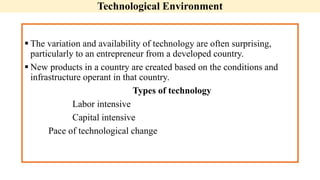
Technological Environment
 The variation and availability of technology are often surprising,
particularly to an entrepreneur from a developed country.
 New products in a country are created based on the conditions and
infrastructure operant in that country.
Types of technology
Labor intensive
Capital intensive
Pace of technological change
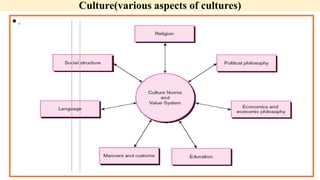
Culture(various aspects of cultures)
 .
Technological Environment
 The variation and availability of technology are often surprising,
particularly to an entrepreneur from a developed country.
 New products in a country are created based on the conditions and
infrastructure operant in that country.
Types of technology
Labor intensive
Capital intensive
Pace of technological change
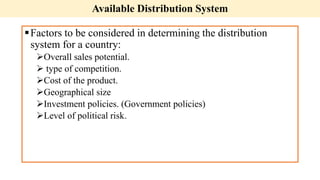
Available Distribution System
Factors to be considered in determining the distribution
system for a country:
Overall sales potential.
 type of competition.
Cost of the product.
Geographical size
Investment policies. (Government policies)
Level of political risk.
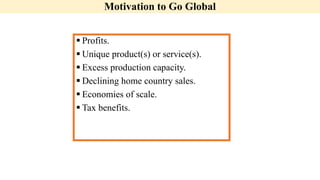
Motivation to Go Global
 Profits.
 Unique product(s) or service(s).
 Excess production capacity.
 Declining home country sales.
 Economies of scale.
 Tax benefits.
Foreign Market Selection
 One good market selection model employs a five-step approach:
A. Develop appropriate indicators
B. Collect data and convert into comparable indicators.
C. Establish an appropriate weight for each indicator.
D. Analyze the data.
E. Select the appropriate market from the market rankings.
Motivation to Go Global
A. Develop appropriate indicators
Overall market size indicator (Population, per pita income, market
for the consumer product, market for industrial product and profit)
B. Collect data and convert into comparable indicators
Collect primary and secondary data for particular indicators. The
collected data needs to be converted to a point score. It is to
compare for each indicator against global standard)
C. Establish an appropriate weights for each indicator
To establish appropriate weights for the indicators to reflect the
importance of a particular indicator in predicting foreign market
potential. The given weightage may vary from indicator to indicator
and entrepreneur to entrepreneur as well )
Motivation to Go Global
D. Analyze the data
In this stage, entrepreneurs analyze the result comparing the
score of individual indicator with the given weight.
E. Select the appropriate market from the market rankings.
After making the careful comparison, entrepreneurs have to
select a particular country or countries depending on the
comparable weightage of the indicators and entrepreneurs
resource potential)
Entrepreneurial Entry Strategies
A. Exporting
Direct exporting
Indirect exporting
B. Non-equity arrangement
Licensing
Turn-key projects
Management contracts
C. Direct Foreign investment
Minority interest
Joint ventures
Majority interest
Mergers
Entrepreneurial Entry Strategies
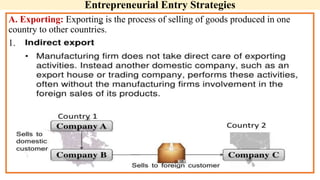
A. Exporting: Exporting is the process of selling of goods produced in one
country to other countries.
1.
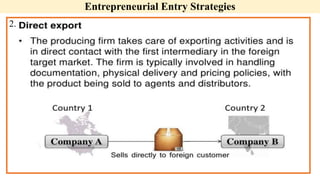
Entrepreneurial Entry Strategies
2.
Entrepreneurial Entry Strategies
B. Non-equity arrangement
I. Licensing : Licensing involves an entrepreneurs who is a
manufacturer(licensee) giving a foreign manufacture(licensor) to
use trademark, technology, production process etc. in return for the
payment of a royalty. This is most appropriate when the
entrepreneur has no intention of entering a particular market
through exporting or direct investment.
II. Turn-key projects: A method of doing international business
whereby a foreign entrepreneur supplies the manufacturing
technology or infrastructure for a business and turns it over a local
owners in exchange for a fee. The customer is usually a
government agency.
Entrepreneurial Entry Strategies
III. Management contracts: Several entrepreneurs
successfully entre international business by contracting their
management technique and skills. The management contract
allows the purchasing country to gain foreign expertise without
giving ownership of its resources to a foreigner. For the
entrepreneur, the management contract is another way of
entering a foreign market without a large equity investment.
C. Direct Foreign investment
I. Minority interest: A form of direct investment in which the investing
entrepreneur holds a minority ownership position in the foreign venture.
II. Majority interest: The purchase of over 50% equity in a foreign business.
III. Merger: A merger is a deal to unite two existing companies into one new
company. From a commercial and economic point of view, both types of
transactions generally result in the consolidation of assets and liabilities
under one entity.
Entrepreneurial Entry Strategies
Types of merger
1. Horizontal Merger
2. Market Extension Mergers
3. Product Extension Mergers
4. Vertical Merger
5. Conglomerate
I. Horizontal Merger
 A merger occurring between companies in the same industry. Horizontal
merger is a business consolidation that occurs between firms who operate in
the same space, often as competitors offering the same goods or service.
Example
 A merger between Coca-Cola and the Pepsi beverage division, for example,
would be horizontal in nature. The goal of a horizontal merger is to create a
new, larger organization with more market share.
Entrepreneurial Entry Strategies
2. Vertical Merger
A merger between two companies producing different goods or services
for one specific finished product. A vertical merger occurs when two or
more firms, operating at different levels within an industry's supply
chain, merge operations. Most often the logic behind the merger is to
increase synergies created by merging firms that would be more efficient
operating as one.
Example
A vertical merger joins two companies that may not compete with each
other, but exist in the same supply chain. An automobile company
joining with a parts supplier would be an example of a vertical merger.
Entrepreneurial Entry Strategies
3. Market extension merger: A market extension merger takes place between
two companies that deal in the same products but in separate markets. The
main purpose of the market extension merger is to make sure that the merging
companies can get access to a bigger market and that ensures a bigger client
base.
4. Product extension merger: A product extension merger takes place between
two business organizations that deal related products in the same market.
They do not deal the product that compete directly with each other.
5. Conglomerate(diversified activity merger):A merger between firms that are
involved in totally unrelated business activities.
Example
 A leading manufacturer of athletic shoes, merges with a soft drink firm
Entrepreneurial Partnering
 One of the best methods for an entrepreneur to enter an international market is
to partner with an entrepreneur in that country. The foreign entrepreneurs
know the country and culture and therefore can facilitate business transaction.
The information about the potential can be obtained from
1. Embassy officials
2. Members of the country’s chambers of commerce
3. Firms doing business in that country
4. Customers of the potential partner
Barriers to International Trade
1. Attitude: “My company is too small to export.”
2. Lack of information about how to get started.
3. Lack of export financing.
4. Lack of network (PR)
5. Tariffs - Taxes a government imposes on goods and services
imported into that country.
6. Quotas - Limits on the amount of a product imported into a
country.
7. Embargoes - Total bans on imports of certain products.
8. Political barriers - rules, regulations, and risks.
9. Cultural barriers - Differing languages, philosophies, traditions,
and accepted business practices.

identifying and analyzing opportunity....

  • 1.
  • 2.
    Opportunity Recognition andOpportunity Assessment Plan Opportunity recognition  Successful entrepreneurs are opportunity recognizer that can see ahead of everyone else and act on those opportunity first. Opportunity recognizer tend to think outside the box and stretch the limit of their imagination to come up with a new or improve ways of doing thing that allow them to turn their idea into reality.  They can look at the same situation as everyone else, but see the bigger picture, and envision something else.  While opportunity recognition is crucial in the beginning it is when forming a company that when they must be able to constantly recognize opportunity in order to grow, compete, and evolve with the changing trend of the market.  This step is essential and will always be part of any entrepreneur, whether they just starting out or an experienced entrepreneur.
  • 3.
    Opportunity assessment plan Thenext part is the ability to review those opportunity. This is where entrepreneur must assess those opportunities by analyzing business models and conduct market and economic analyses by asking “Can I bring this idea to market in an economically successful way?” It involves answering key questions about the product, the market, the customer, and the production process. The process then involve reviewing of the plan to determine whether to stay on course or deviate from the plan as the company grows. Opportunity Recognition and Opportunity Assessment Plan
  • 4.
    Opportunity Recognition andOpportunity Assessment Plan An opportunity assessment plan has four sections: The first section focuses on analyzing competitive products and companies, and identifies the unique selling propositions. The second section focuses on the market—its size, trends, characteristics, and growth rate. The third section focuses on the entrepreneur’s and management team’s skills and experience. The final section develops a time line indicating the steps to successfully launch the venture.
  • 5.
    Sources of Informationfor Start-up Entrepreneurs in Nepal 1. Government sources (Ministry of Industry, Ministry of Commerce and Supplies, Ministry of Agricultural Development etc.) 2. Nepal Tourism Board 3. Investment Board Nepal(IBN, 2011, PPP) 4. Trade and Export Promotion Center(2006) 5. Competitive products and their information 6. The Federation of Nepalese Chambers of Commerce and Industry (FNCCI) 7. Search engine and publications 8. Various donor funded projects Micro- Enterprise Development Program (MEDP, 1998, ministry of industry and UNDP) Informal Sector Enterprise Development Employment Generation Program (Run by Swiss Development Agency-Helvetas)
  • 6.
    Nature and Significanceof International Entrepreneurship  International entrepreneurship is the process of an entrepreneur conducting business activities across national boundaries.  The activities necessary for ascertaining and satisfying the needs and wants of target consumers take place in more than one country.
  • 7.
    Significance of InternationalEntrepreneurship 1. Increased sales and profit 2. Advantage of cheap labor and lower manufacturing cost 3. Growth opportunities (when domestic market falls on saturation) 4. Globalization of customers (makes global customer) 5. International market competition (motivates companies to do extra effort)
  • 8.
    Domestic vs. InternationalEntrepreneurship Some affecting entrepreneurial performance A. Economics B. Stages of economic development C. Types of economic system D. Political legal environment E. Language
  • 9.
    Domestic vs. InternationalEntrepreneurship A. Economics In a domestic business strategy, the entire country is organized under a single economic system and has the same currency. Creating a business strategy for a multi-country area means dealing with differences in: Currency valuations. Inflationary pressure Available bank and financial institutions
  • 10.
    Domestic vs. InternationalEntrepreneurship B. Stage of economic development When entrepreneur is operating at domestic level, he should focus on developmental stage of domestic country, on the contrary when he is operating on international scale, he has to view country from underdeveloped, developing and developed perspective and should prepare business strategy as accordingly.
  • 11.
    Domestic vs. InternationalEntrepreneurship C. Types of economic system In domestic entrepreneurship, entrepreneurs pays attention towards a particular type of economic system of a home country. On the other hand, in case of international entrepreneurship, entrepreneurs have to understand various types of economic-centrally planned, mixed and liberal or capitalist economic system.
  • 12.
    Domestic vs. InternationalEntrepreneurship D. Political legal environment Prior to entering into business in another country, countries political system(democratic or autocratic) nature of government policies (whether there are favorable policies for entrepreneurs) should be assessed. Types of political risks: • Ownership risk • Operating risk. (north Korea……) • Transfer risk. (from one country to another)
  • 13.
    Domestic vs. InternationalEntrepreneurship E. Language  One of the biggest problems for the entrepreneur is finding a translator.  Significant problems can occur with careless translation.  Care should be taken to hire a translator whose native tongue is the target language and whose expertise matches that of the original authors.
  • 14.
    Technological Environment  Thevariation and availability of technology are often surprising, particularly to an entrepreneur from a developed country.  New products in a country are created based on the conditions and infrastructure operant in that country. Types of technology Labor intensive Capital intensive Pace of technological change
  • 15.
  • 16.
    Technological Environment  Thevariation and availability of technology are often surprising, particularly to an entrepreneur from a developed country.  New products in a country are created based on the conditions and infrastructure operant in that country. Types of technology Labor intensive Capital intensive Pace of technological change
  • 17.
    Available Distribution System Factorsto be considered in determining the distribution system for a country: Overall sales potential.  type of competition. Cost of the product. Geographical size Investment policies. (Government policies) Level of political risk.
  • 18.
    Motivation to GoGlobal  Profits.  Unique product(s) or service(s).  Excess production capacity.  Declining home country sales.  Economies of scale.  Tax benefits.
  • 19.
    Foreign Market Selection One good market selection model employs a five-step approach: A. Develop appropriate indicators B. Collect data and convert into comparable indicators. C. Establish an appropriate weight for each indicator. D. Analyze the data. E. Select the appropriate market from the market rankings.
  • 20.
    Motivation to GoGlobal A. Develop appropriate indicators Overall market size indicator (Population, per pita income, market for the consumer product, market for industrial product and profit) B. Collect data and convert into comparable indicators Collect primary and secondary data for particular indicators. The collected data needs to be converted to a point score. It is to compare for each indicator against global standard) C. Establish an appropriate weights for each indicator To establish appropriate weights for the indicators to reflect the importance of a particular indicator in predicting foreign market potential. The given weightage may vary from indicator to indicator and entrepreneur to entrepreneur as well )
  • 21.
    Motivation to GoGlobal D. Analyze the data In this stage, entrepreneurs analyze the result comparing the score of individual indicator with the given weight. E. Select the appropriate market from the market rankings. After making the careful comparison, entrepreneurs have to select a particular country or countries depending on the comparable weightage of the indicators and entrepreneurs resource potential)
  • 22.
    Entrepreneurial Entry Strategies A.Exporting Direct exporting Indirect exporting B. Non-equity arrangement Licensing Turn-key projects Management contracts C. Direct Foreign investment Minority interest Joint ventures Majority interest Mergers
  • 23.
    Entrepreneurial Entry Strategies A.Exporting: Exporting is the process of selling of goods produced in one country to other countries. 1.
  • 24.
  • 25.
    Entrepreneurial Entry Strategies B.Non-equity arrangement I. Licensing : Licensing involves an entrepreneurs who is a manufacturer(licensee) giving a foreign manufacture(licensor) to use trademark, technology, production process etc. in return for the payment of a royalty. This is most appropriate when the entrepreneur has no intention of entering a particular market through exporting or direct investment. II. Turn-key projects: A method of doing international business whereby a foreign entrepreneur supplies the manufacturing technology or infrastructure for a business and turns it over a local owners in exchange for a fee. The customer is usually a government agency.
  • 26.
    Entrepreneurial Entry Strategies III.Management contracts: Several entrepreneurs successfully entre international business by contracting their management technique and skills. The management contract allows the purchasing country to gain foreign expertise without giving ownership of its resources to a foreigner. For the entrepreneur, the management contract is another way of entering a foreign market without a large equity investment.
  • 27.
    C. Direct Foreigninvestment I. Minority interest: A form of direct investment in which the investing entrepreneur holds a minority ownership position in the foreign venture. II. Majority interest: The purchase of over 50% equity in a foreign business. III. Merger: A merger is a deal to unite two existing companies into one new company. From a commercial and economic point of view, both types of transactions generally result in the consolidation of assets and liabilities under one entity. Entrepreneurial Entry Strategies
  • 28.
    Entrepreneurial Entry Strategies Typesof merger 1. Horizontal Merger 2. Market Extension Mergers 3. Product Extension Mergers 4. Vertical Merger 5. Conglomerate
  • 29.
    I. Horizontal Merger A merger occurring between companies in the same industry. Horizontal merger is a business consolidation that occurs between firms who operate in the same space, often as competitors offering the same goods or service. Example  A merger between Coca-Cola and the Pepsi beverage division, for example, would be horizontal in nature. The goal of a horizontal merger is to create a new, larger organization with more market share. Entrepreneurial Entry Strategies
  • 30.
    Entrepreneurial Entry Strategies 2.Vertical Merger A merger between two companies producing different goods or services for one specific finished product. A vertical merger occurs when two or more firms, operating at different levels within an industry's supply chain, merge operations. Most often the logic behind the merger is to increase synergies created by merging firms that would be more efficient operating as one. Example A vertical merger joins two companies that may not compete with each other, but exist in the same supply chain. An automobile company joining with a parts supplier would be an example of a vertical merger.
  • 31.
    Entrepreneurial Entry Strategies 3.Market extension merger: A market extension merger takes place between two companies that deal in the same products but in separate markets. The main purpose of the market extension merger is to make sure that the merging companies can get access to a bigger market and that ensures a bigger client base. 4. Product extension merger: A product extension merger takes place between two business organizations that deal related products in the same market. They do not deal the product that compete directly with each other. 5. Conglomerate(diversified activity merger):A merger between firms that are involved in totally unrelated business activities. Example  A leading manufacturer of athletic shoes, merges with a soft drink firm
  • 32.
    Entrepreneurial Partnering  Oneof the best methods for an entrepreneur to enter an international market is to partner with an entrepreneur in that country. The foreign entrepreneurs know the country and culture and therefore can facilitate business transaction. The information about the potential can be obtained from 1. Embassy officials 2. Members of the country’s chambers of commerce 3. Firms doing business in that country 4. Customers of the potential partner
  • 33.
    Barriers to InternationalTrade 1. Attitude: “My company is too small to export.” 2. Lack of information about how to get started. 3. Lack of export financing. 4. Lack of network (PR) 5. Tariffs - Taxes a government imposes on goods and services imported into that country. 6. Quotas - Limits on the amount of a product imported into a country. 7. Embargoes - Total bans on imports of certain products. 8. Political barriers - rules, regulations, and risks. 9. Cultural barriers - Differing languages, philosophies, traditions, and accepted business practices.