Hisrich
Peters
Shepherd
Chapter 6
Protecting the Idea
and
Other Legal Issues for the
Entrepreneur
Copyright © 2010 by The McGraw-Hill Companies, Inc. All rights reserved.McGraw-Hill/Irwin
6-2
What is Intellectual Property?
 It includes patents, trademarks, copyrights,
and trade secrets.
 These represents important assets to the
entrepreneur.
 Intellectual property should be understood
even before engaging the services of an
attorney.
6-3
How to Select a Lawyer
 An entrepreneur needs to be aware of any
regulations that may affect a venture.
 A lawyer may work on a retainer basis or
may be hired for a one-time fee.
 A good working relationship with a lawyer:
 Eases some of the risk in starting a new
business.
 Gives the entrepreneur necessary confidence.
 Entrepreneur can offer the lawyer stock in
exchange for services.
6-4
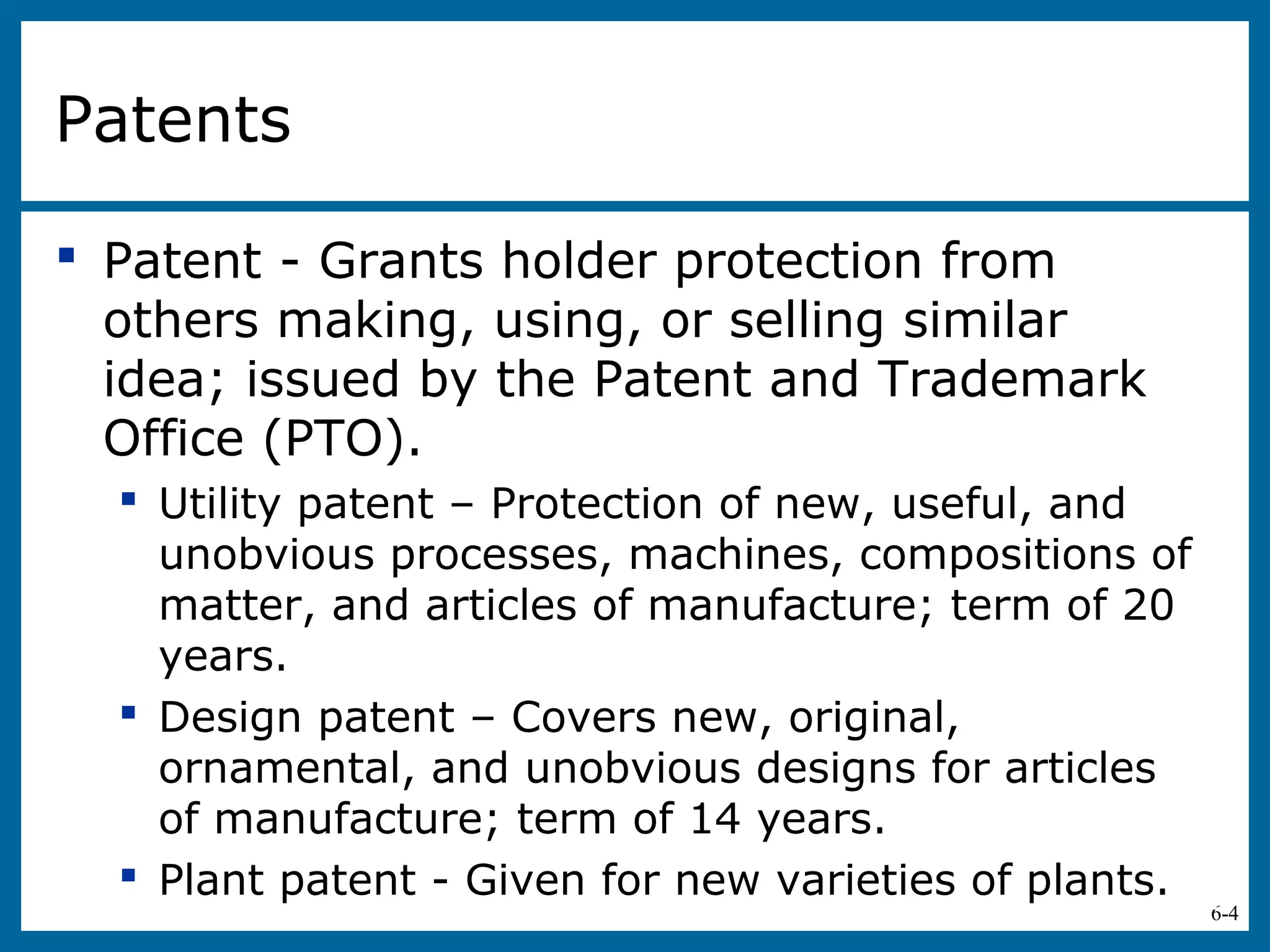
Patents
 Patent - Grants holder protection from
others making, using, or selling similar
idea; issued by the Patent and Trademark
Office (PTO).
 Utility patent – Protection of new, useful, and
unobvious processes, machines, compositions of
matter, and articles of manufacture; term of 20
years.
 Design patent – Covers new, original,
ornamental, and unobvious designs for articles
of manufacture; term of 14 years.
 Plant patent - Given for new varieties of plants.
6-5
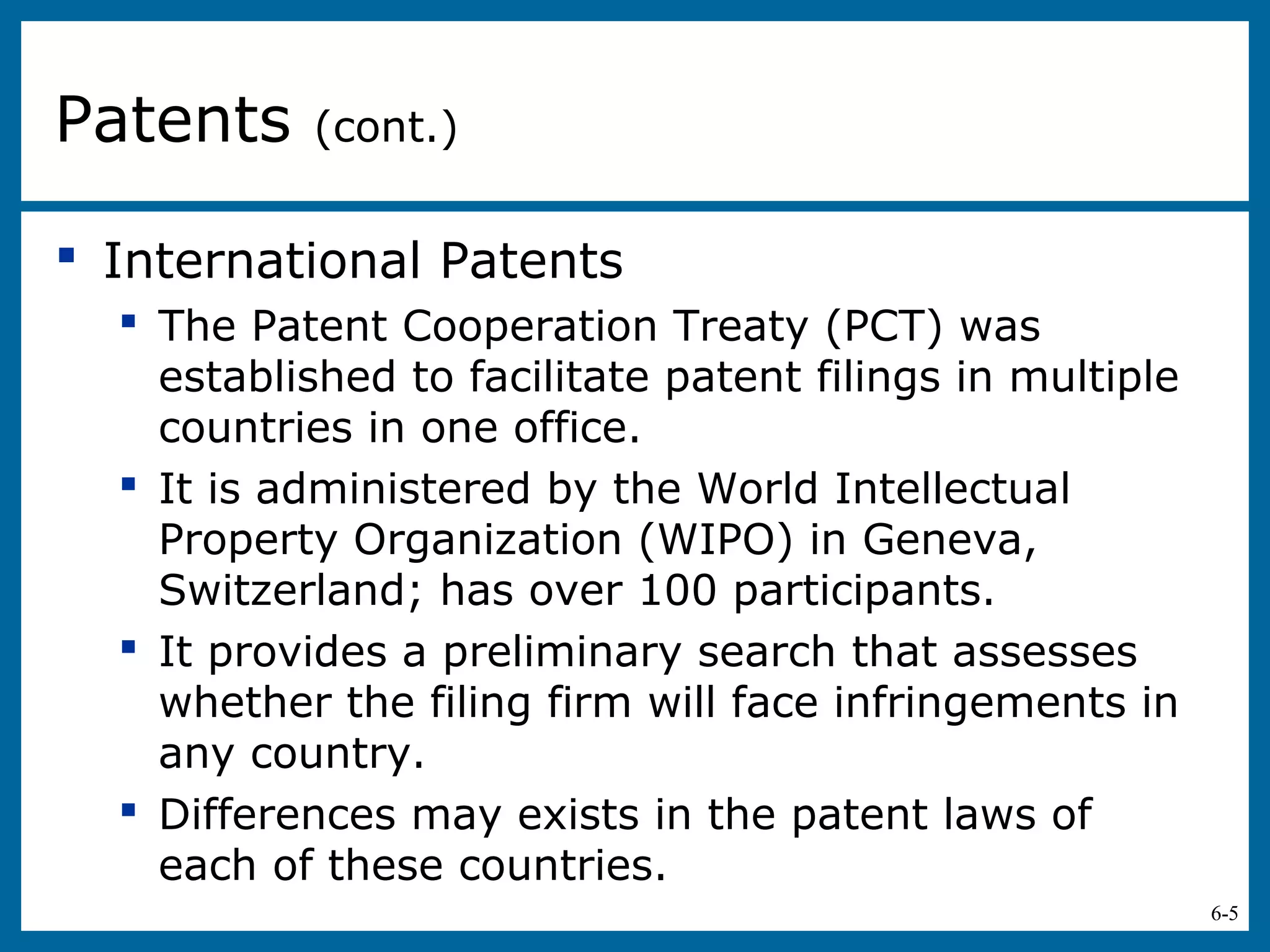
 International Patents
 The Patent Cooperation Treaty (PCT) was
established to facilitate patent filings in multiple
countries in one office.
 It is administered by the World Intellectual
Property Organization (WIPO) in Geneva,
Switzerland; has over 100 participants.
 It provides a preliminary search that assesses
whether the filing firm will face infringements in
any country.
 Differences may exists in the patent laws of
each of these countries.
Patents (cont.)
6-6
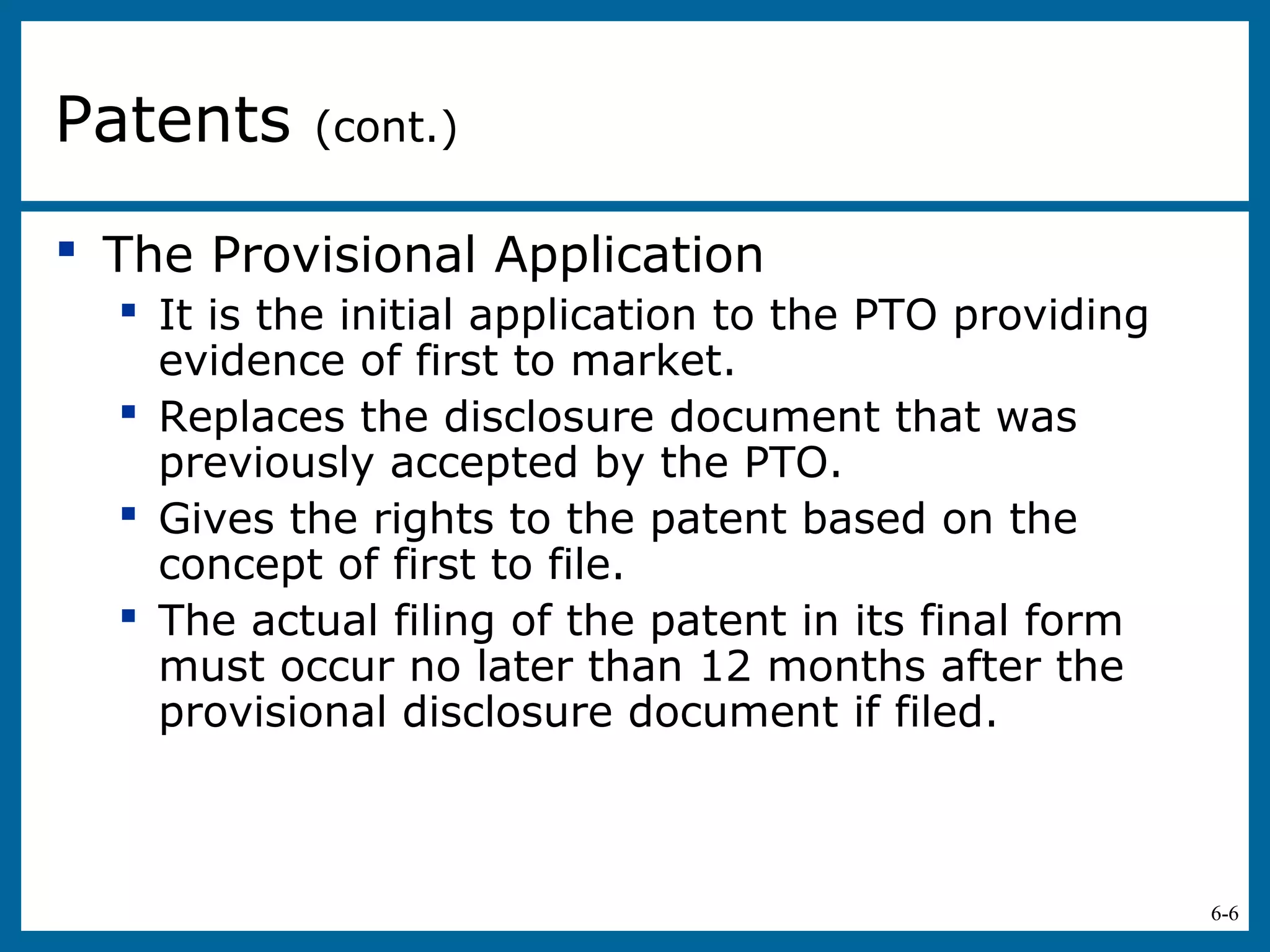
 The Provisional Application
 It is the initial application to the PTO providing
evidence of first to market.
 Replaces the disclosure document that was
previously accepted by the PTO.
 Gives the rights to the patent based on the
concept of first to file.
 The actual filing of the patent in its final form
must occur no later than 12 months after the
provisional disclosure document if filed.
Patents (cont.)
6-7
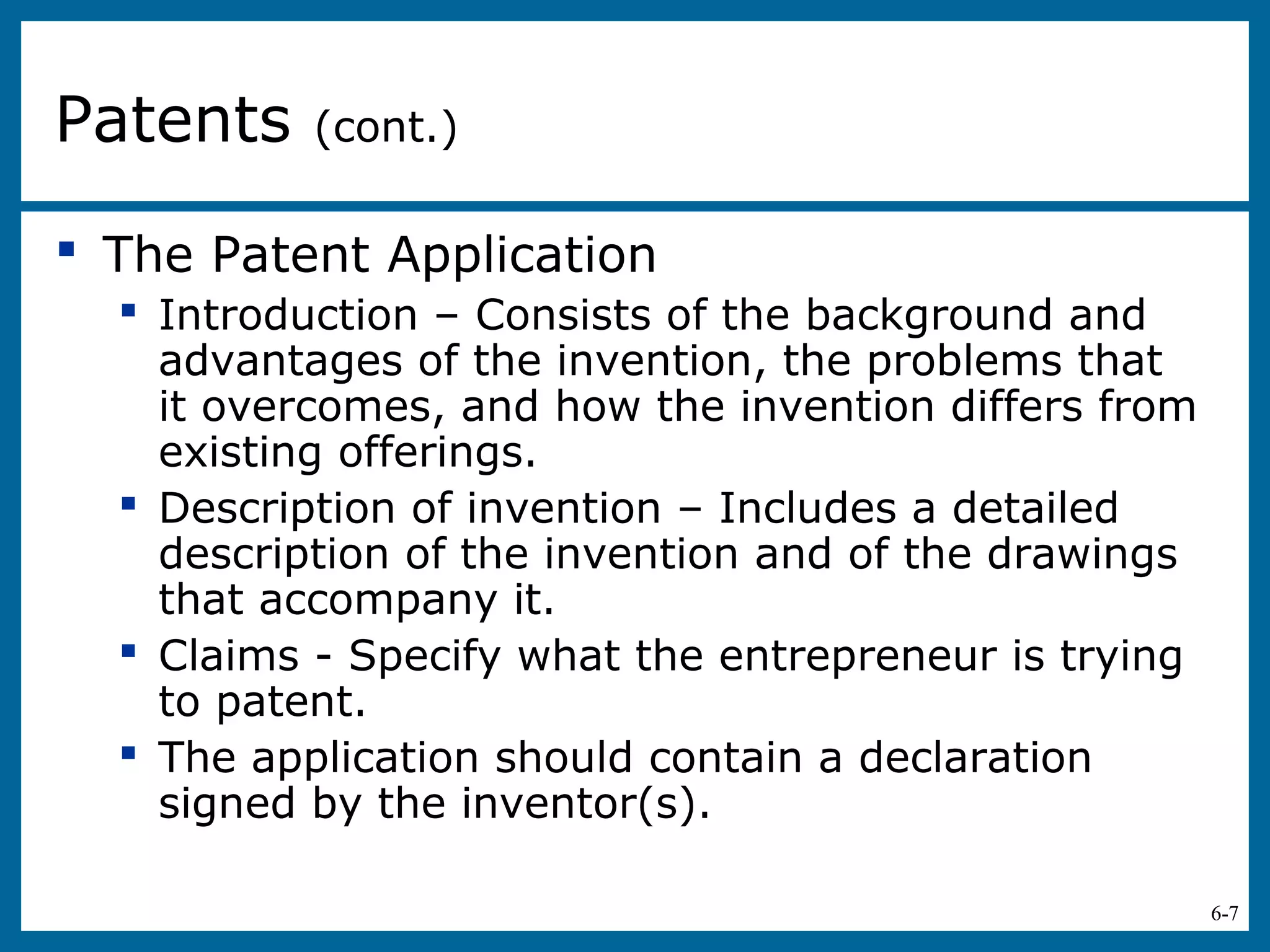
 The Patent Application
 Introduction – Consists of the background and
advantages of the invention, the problems that
it overcomes, and how the invention differs from
existing offerings.
 Description of invention – Includes a detailed
description of the invention and of the drawings
that accompany it.
 Claims - Specify what the entrepreneur is trying
to patent.
 The application should contain a declaration
signed by the inventor(s).
Patents (cont.)
6-8
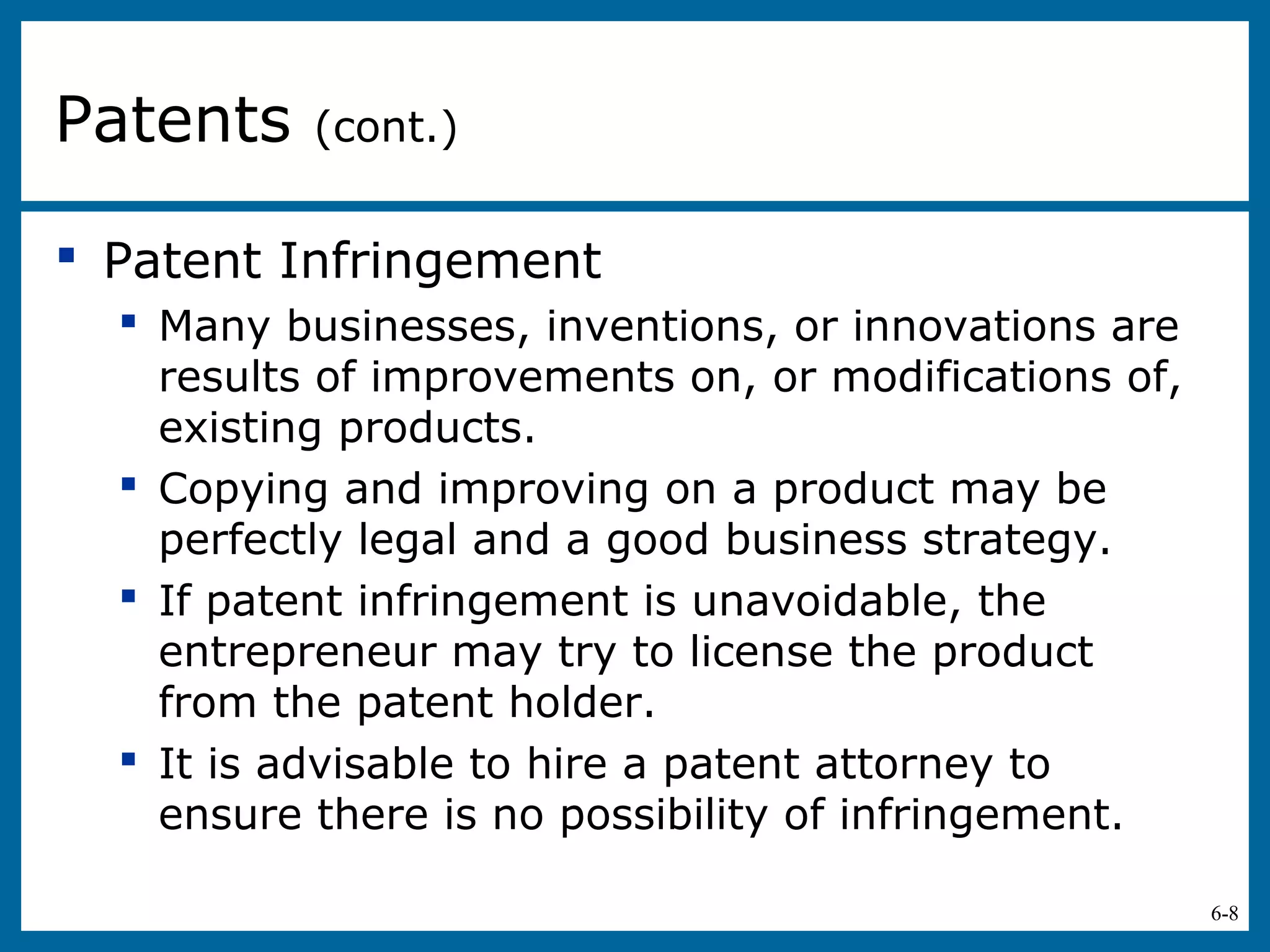
 Patent Infringement
 Many businesses, inventions, or innovations are
results of improvements on, or modifications of,
existing products.
 Copying and improving on a product may be
perfectly legal and a good business strategy.
 If patent infringement is unavoidable, the
entrepreneur may try to license the product
from the patent holder.
 It is advisable to hire a patent attorney to
ensure there is no possibility of infringement.
Patents (cont.)
6-9
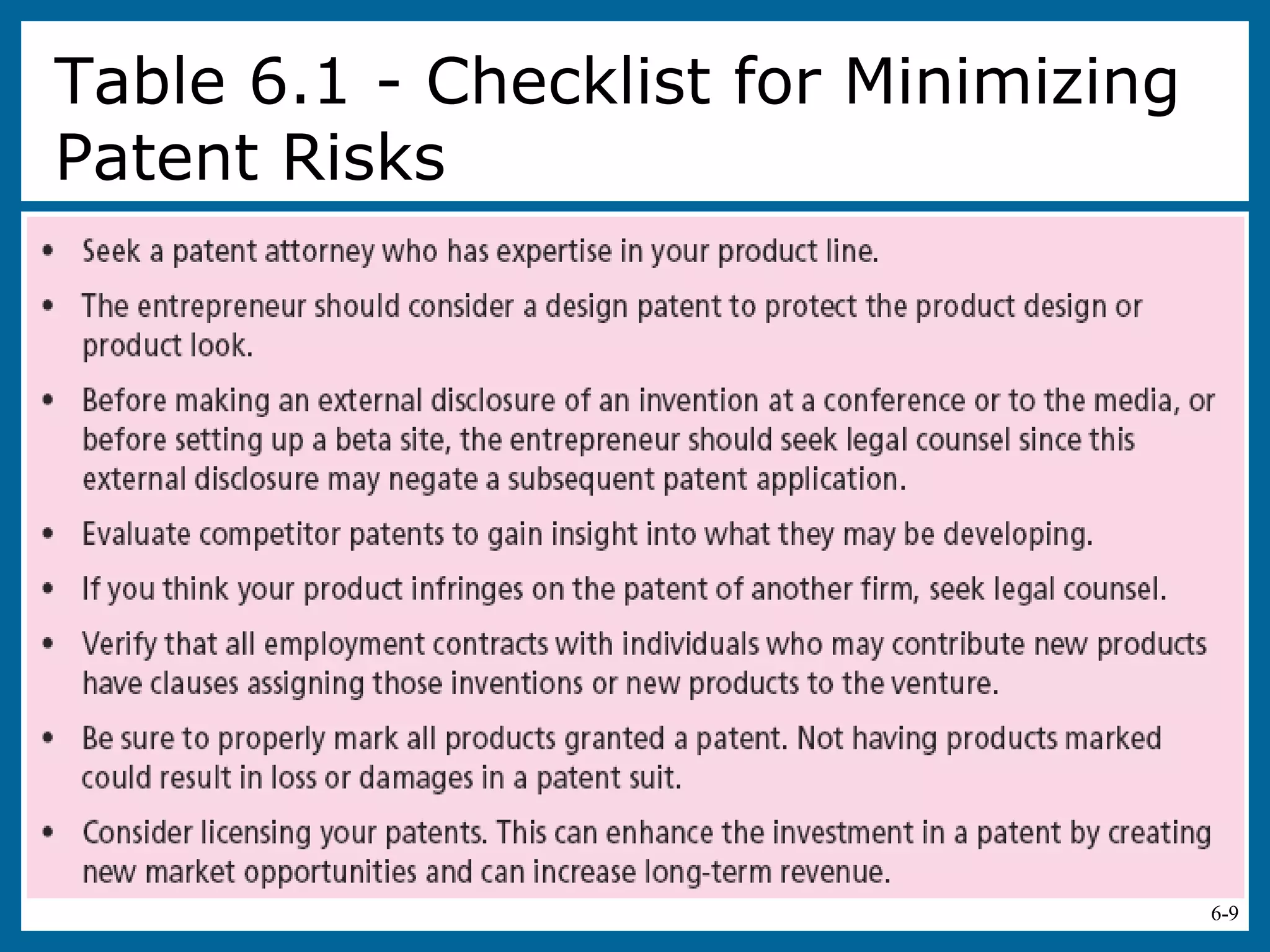
Table 6.1 - Checklist for Minimizing
Patent Risks
Table 6.1
6-10
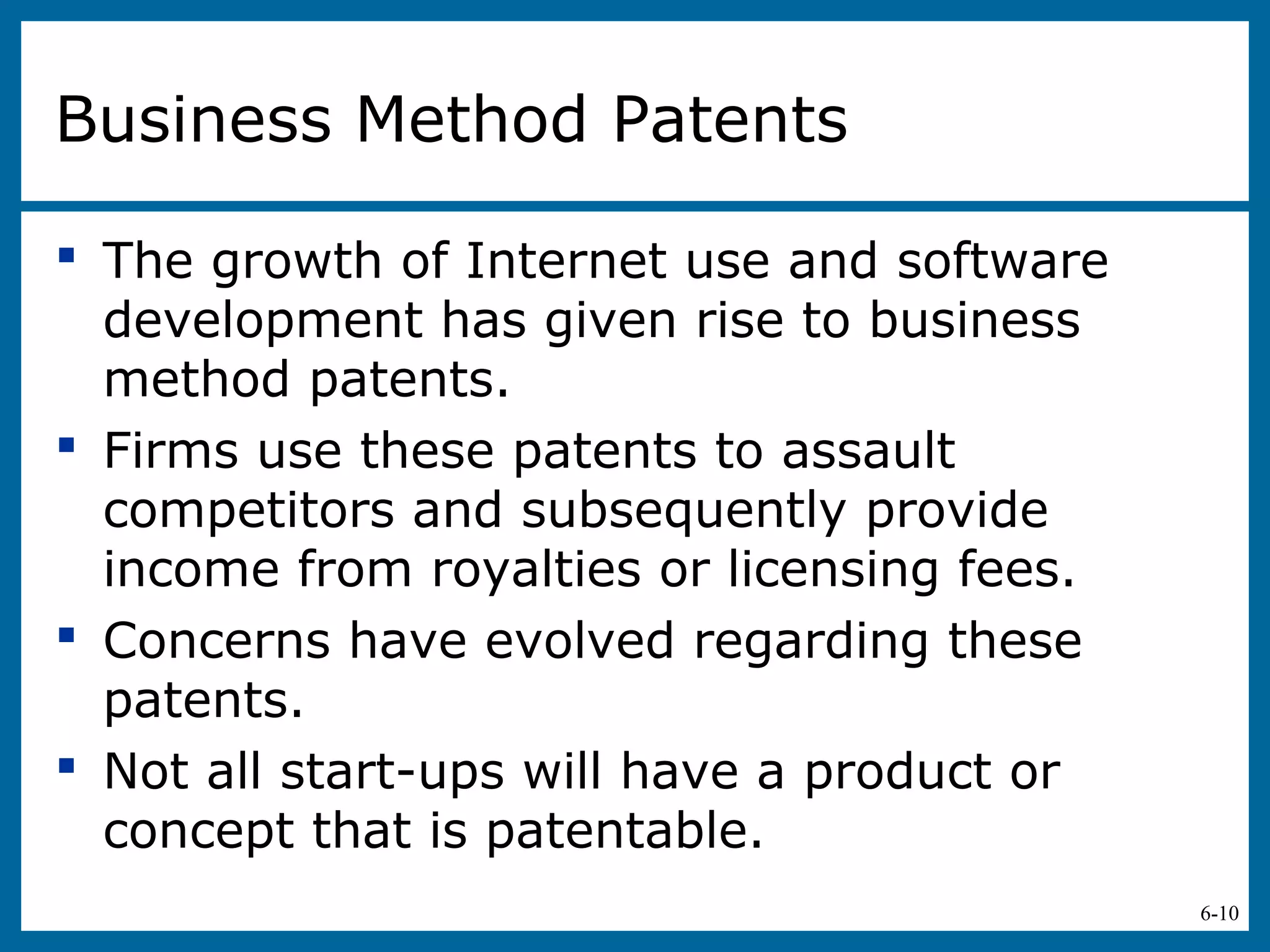
Business Method Patents
 The growth of Internet use and software
development has given rise to business
method patents.
 Firms use these patents to assault
competitors and subsequently provide
income from royalties or licensing fees.
 Concerns have evolved regarding these
patents.
 Not all start-ups will have a product or
concept that is patentable.
6-11
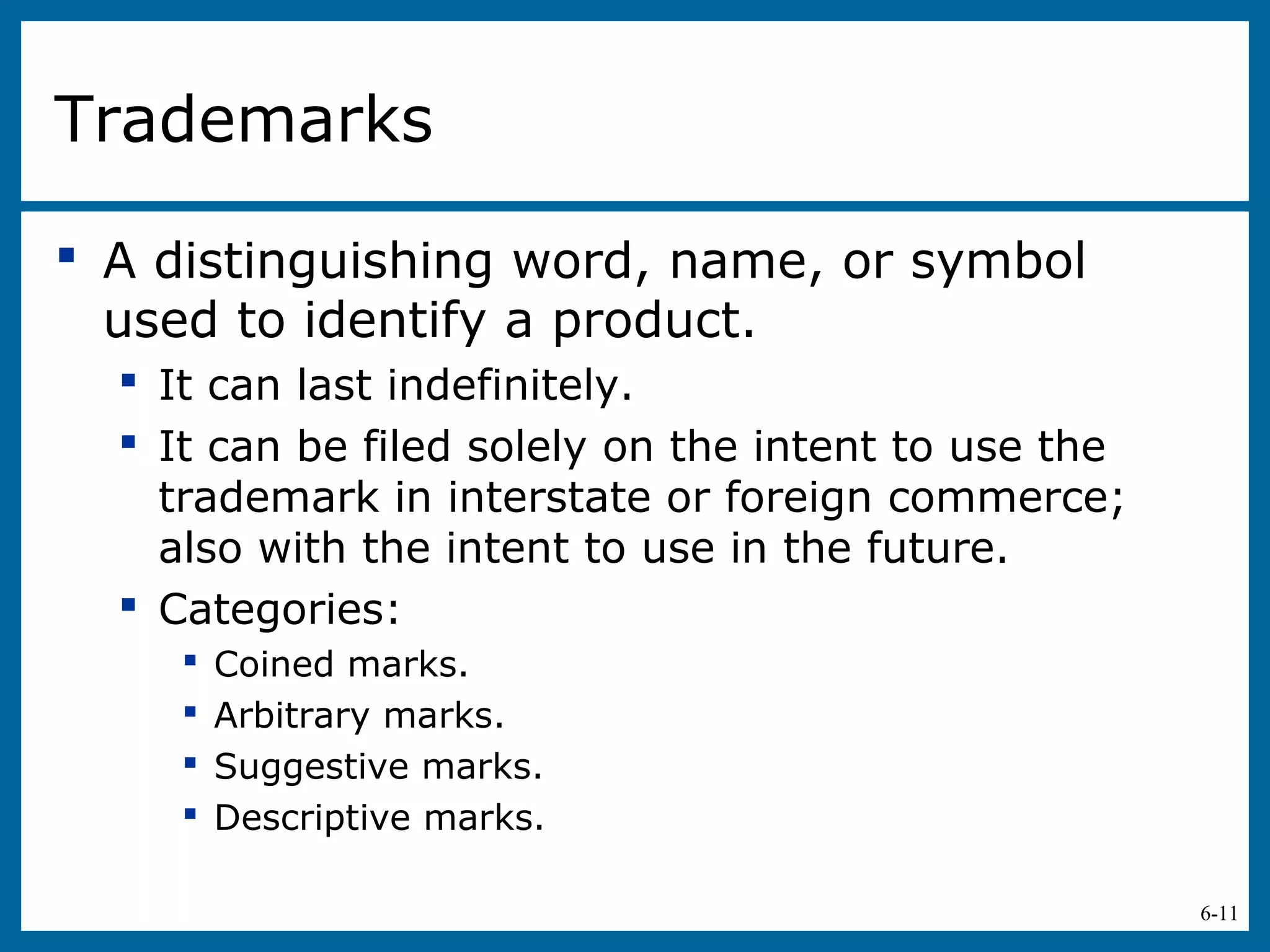
Trademarks
 A distinguishing word, name, or symbol
used to identify a product.
 It can last indefinitely.
 It can be filed solely on the intent to use the
trademark in interstate or foreign commerce;
also with the intent to use in the future.
 Categories:
 Coined marks.
 Arbitrary marks.
 Suggestive marks.
 Descriptive marks.
6-12
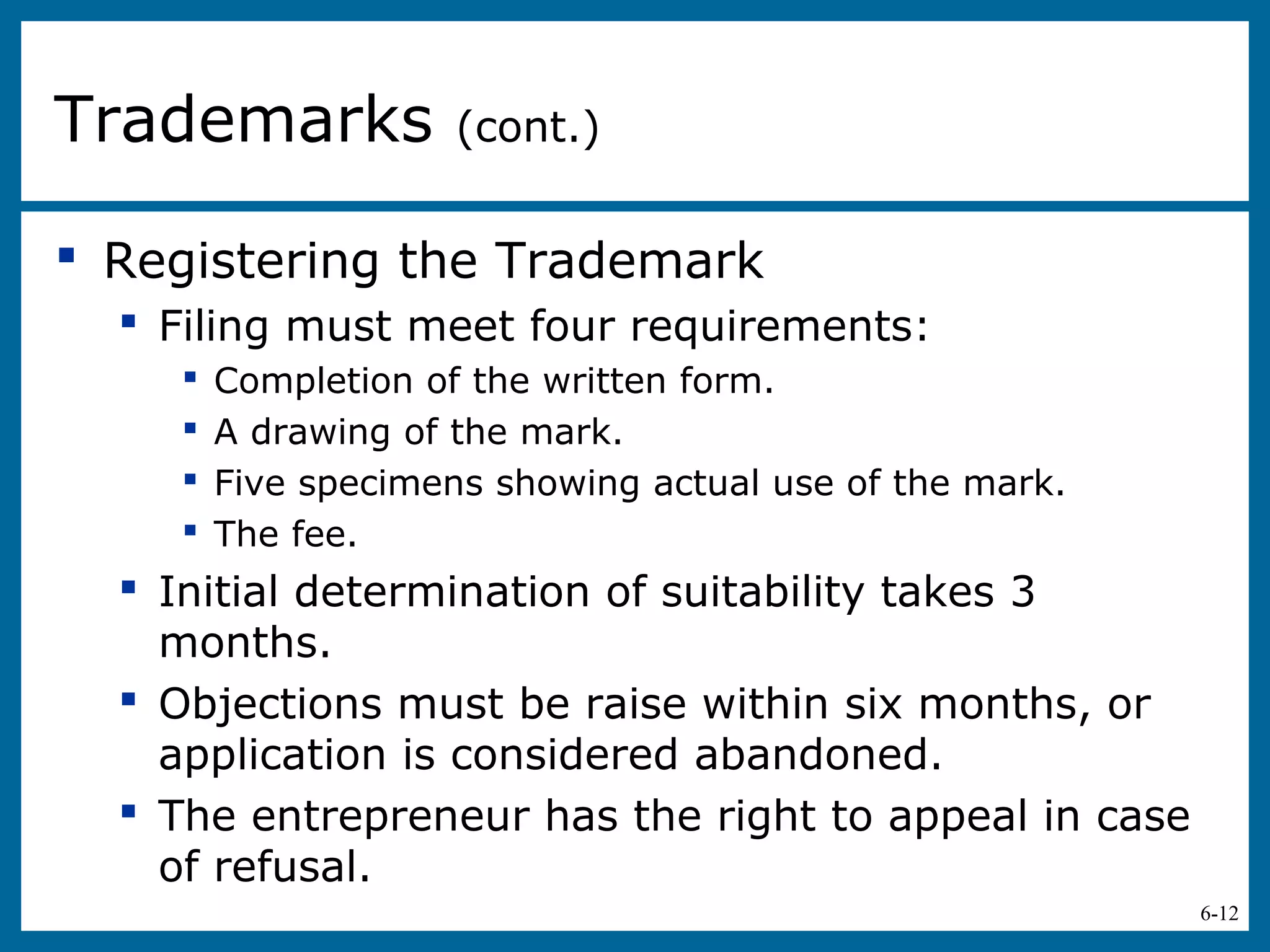
 Registering the Trademark
 Filing must meet four requirements:
 Completion of the written form.
 A drawing of the mark.
 Five specimens showing actual use of the mark.
 The fee.
 Initial determination of suitability takes 3
months.
 Objections must be raise within six months, or
application is considered abandoned.
 The entrepreneur has the right to appeal in case
of refusal.
Trademarks (cont.)
6-13
 Once accepted, trademark is published in the
Trademark Official Gazette to allow any party 30
days to oppose or request an extension to
oppose.
 Registration is issued if no opposition is filed.
 Procedure takes about 13 months from initial
filing.
Trademarks (cont.)
6-14
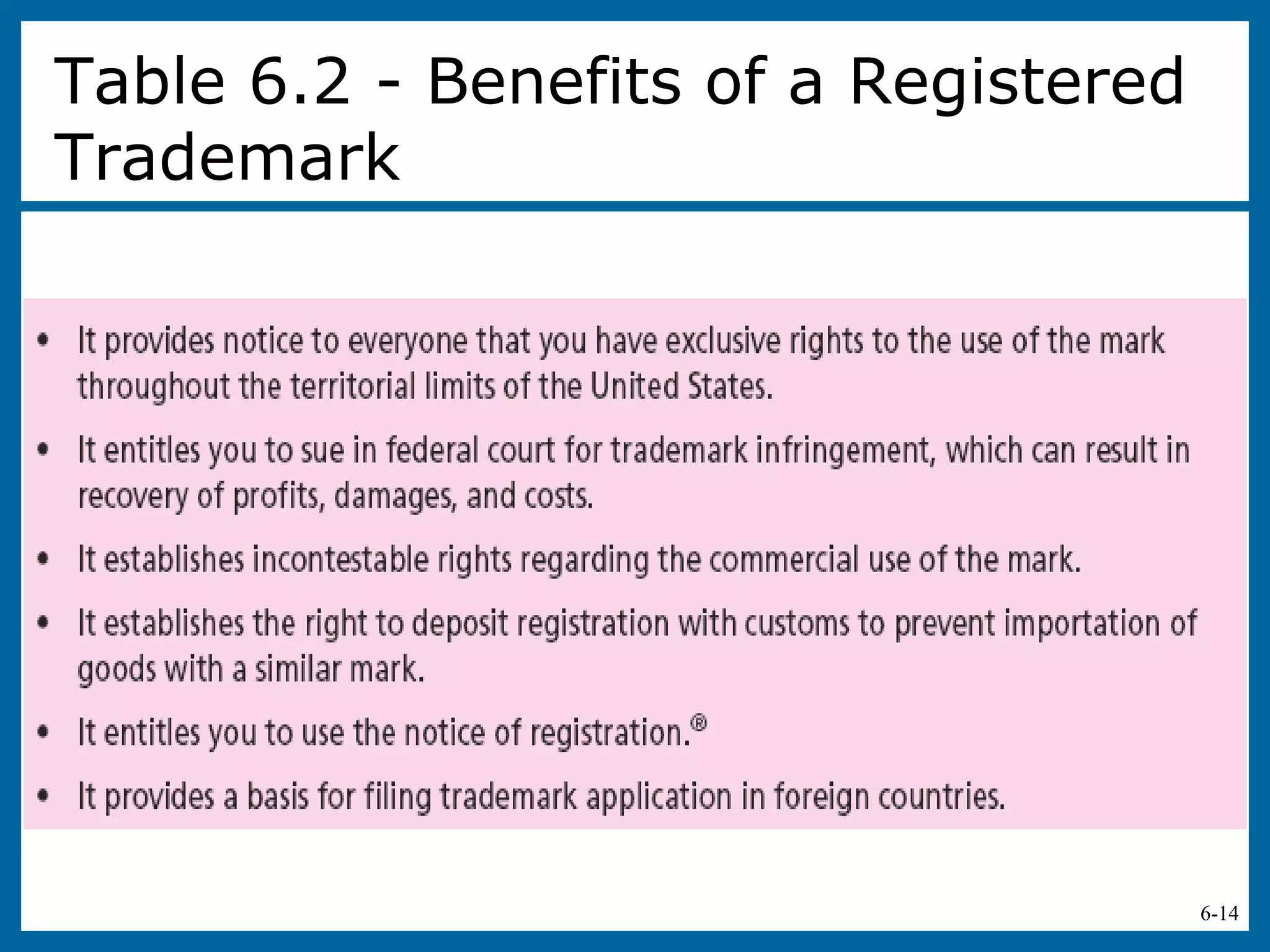
Table 6.2 - Benefits of a Registered
Trademark
Table 6.2
6-15
Copyrights
 Right given to prevent others from printing,
copying, or publishing any original works of
authorship.
 Issues surrounding access to material on
the Internet have led to major legal battles
for the entertainment industry.
 Copyrights are registered with the Library
of Congress.
 Term of the copyright is the life of the
author plus 70 years.
6-16
Trade Secrets
 Provides protection against others revealing
or disclosing information that could be
damaging to business.
 Trade secrets have a life as long as the idea or
process remains a secret.
 It is not covered by any federal law but is
recognized under a governing body of common
laws in each state.
 Employees may be asked to sign a confidential
information agreement.
 Entrepreneur needs to take proper precautions.
 Legal action is possible only after the secret has
been revealed.
6-17
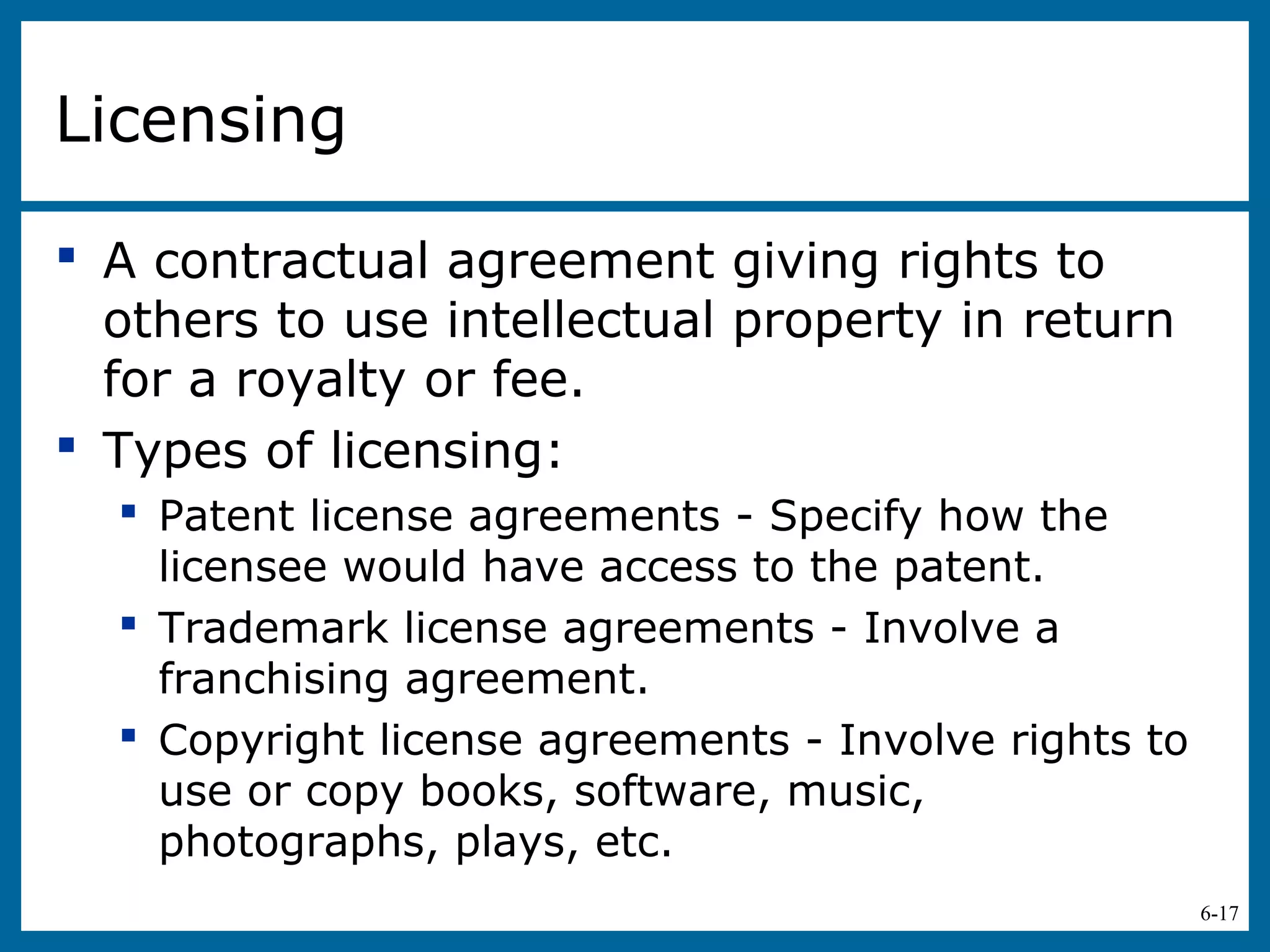
Licensing
 A contractual agreement giving rights to
others to use intellectual property in return
for a royalty or fee.
 Types of licensing:
 Patent license agreements - Specify how the
licensee would have access to the patent.
 Trademark license agreements - Involve a
franchising agreement.
 Copyright license agreements - Involve rights to
use or copy books, software, music,
photographs, plays, etc.
6-18
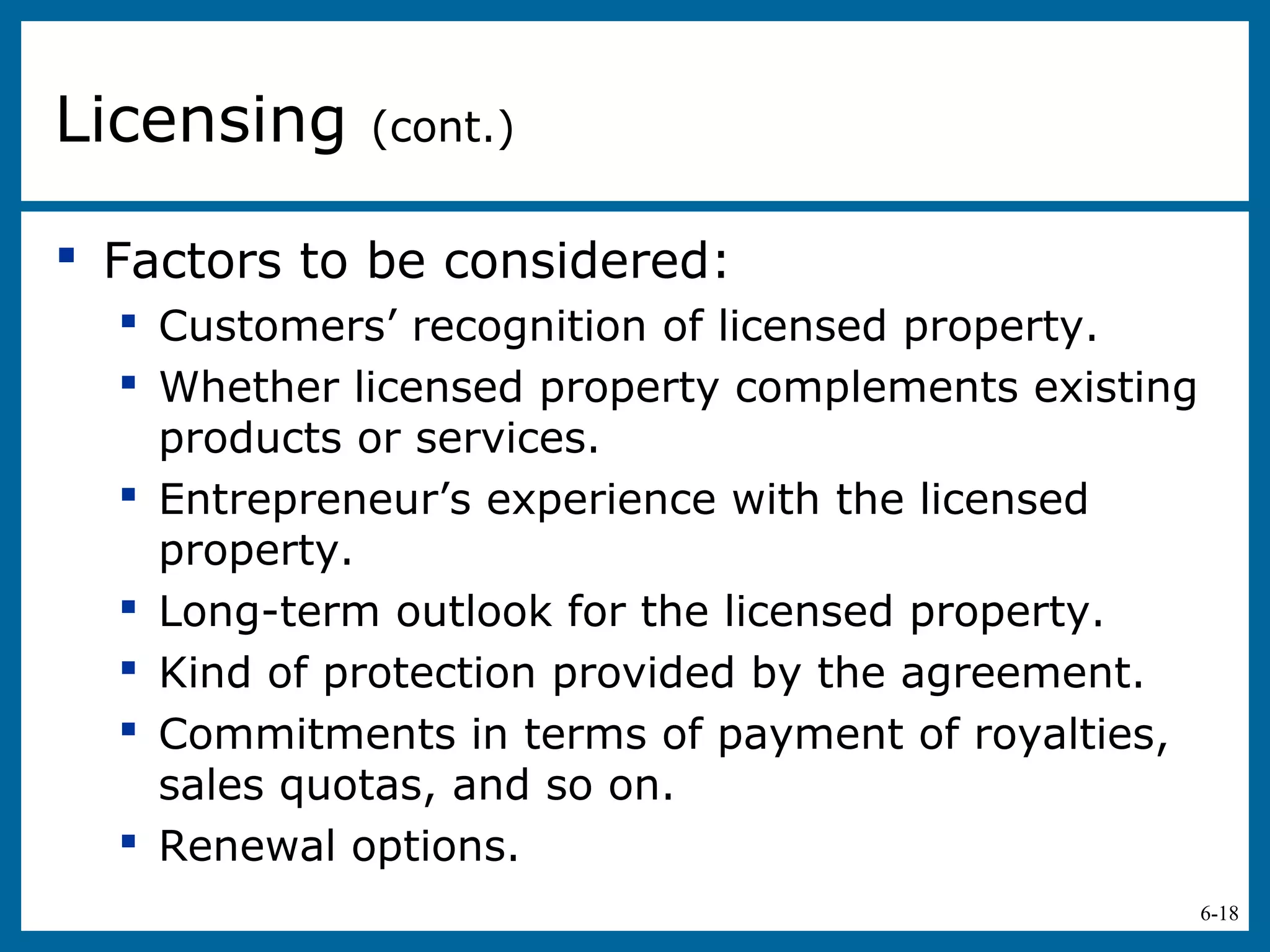
 Factors to be considered:
 Customers’ recognition of licensed property.
 Whether licensed property complements existing
products or services.
 Entrepreneur’s experience with the licensed
property.
 Long-term outlook for the licensed property.
 Kind of protection provided by the agreement.
 Commitments in terms of payment of royalties,
sales quotas, and so on.
 Renewal options.
Licensing (cont.)
6-19
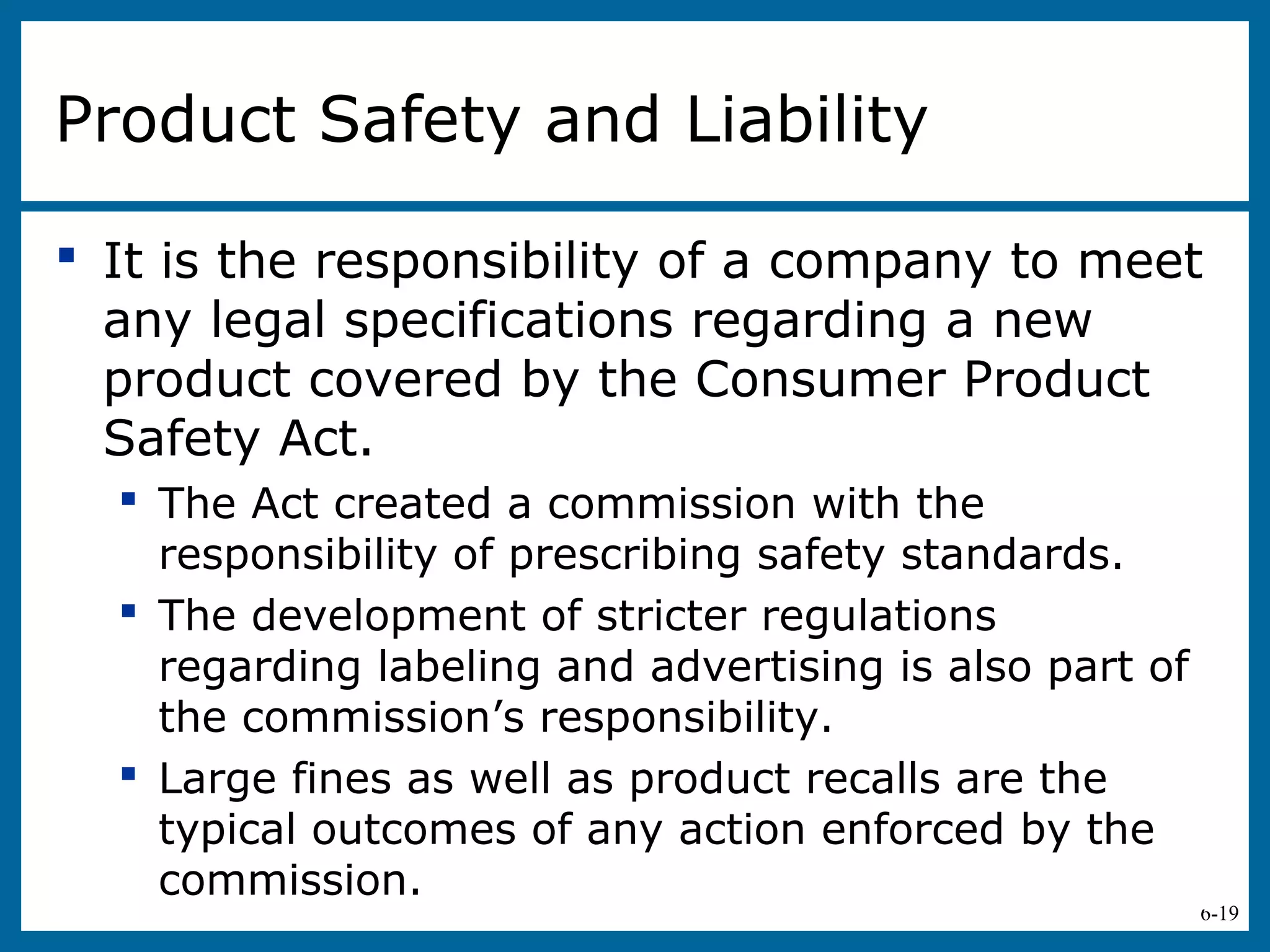
Product Safety and Liability
 It is the responsibility of a company to meet
any legal specifications regarding a new
product covered by the Consumer Product
Safety Act.
 The Act created a commission with the
responsibility of prescribing safety standards.
 The development of stricter regulations
regarding labeling and advertising is also part of
the commission’s responsibility.
 Large fines as well as product recalls are the
typical outcomes of any action enforced by the
commission.
6-20
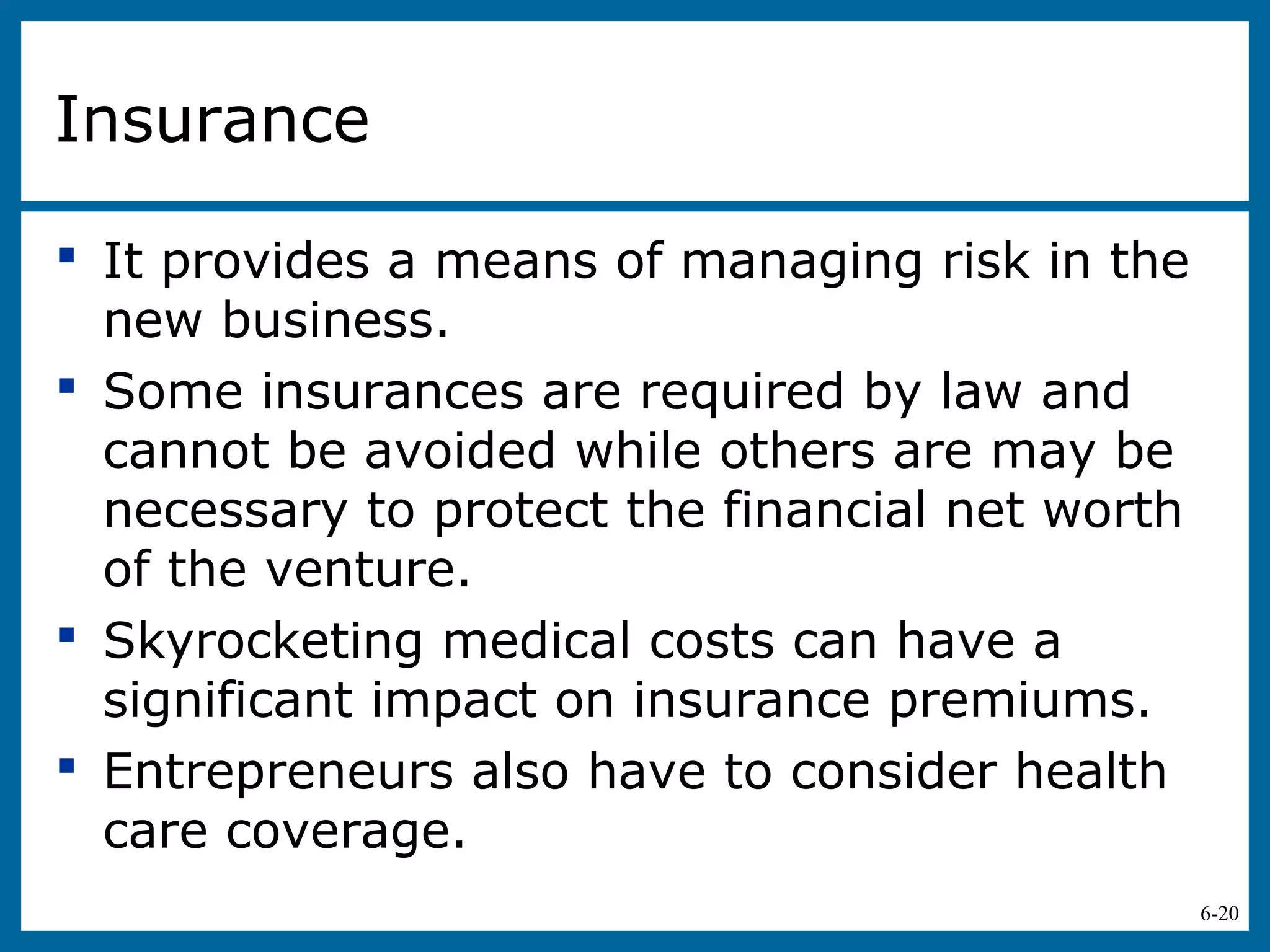
Insurance
 It provides a means of managing risk in the
new business.
 Some insurances are required by law and
cannot be avoided while others are may be
necessary to protect the financial net worth
of the venture.
 Skyrocketing medical costs can have a
significant impact on insurance premiums.
 Entrepreneurs also have to consider health
care coverage.
6-21
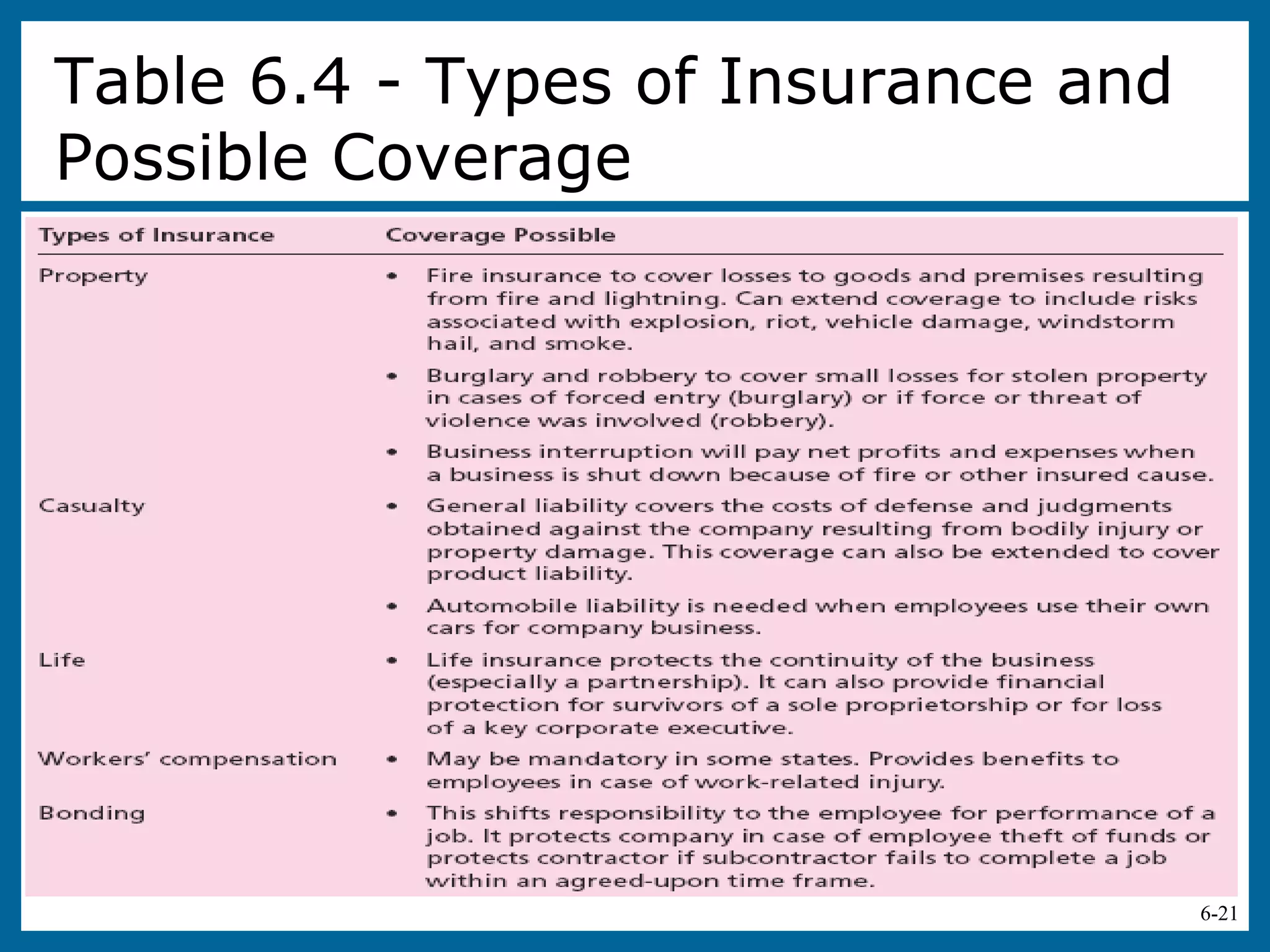
Table 6.4 - Types of Insurance and
Possible Coverage
6-22
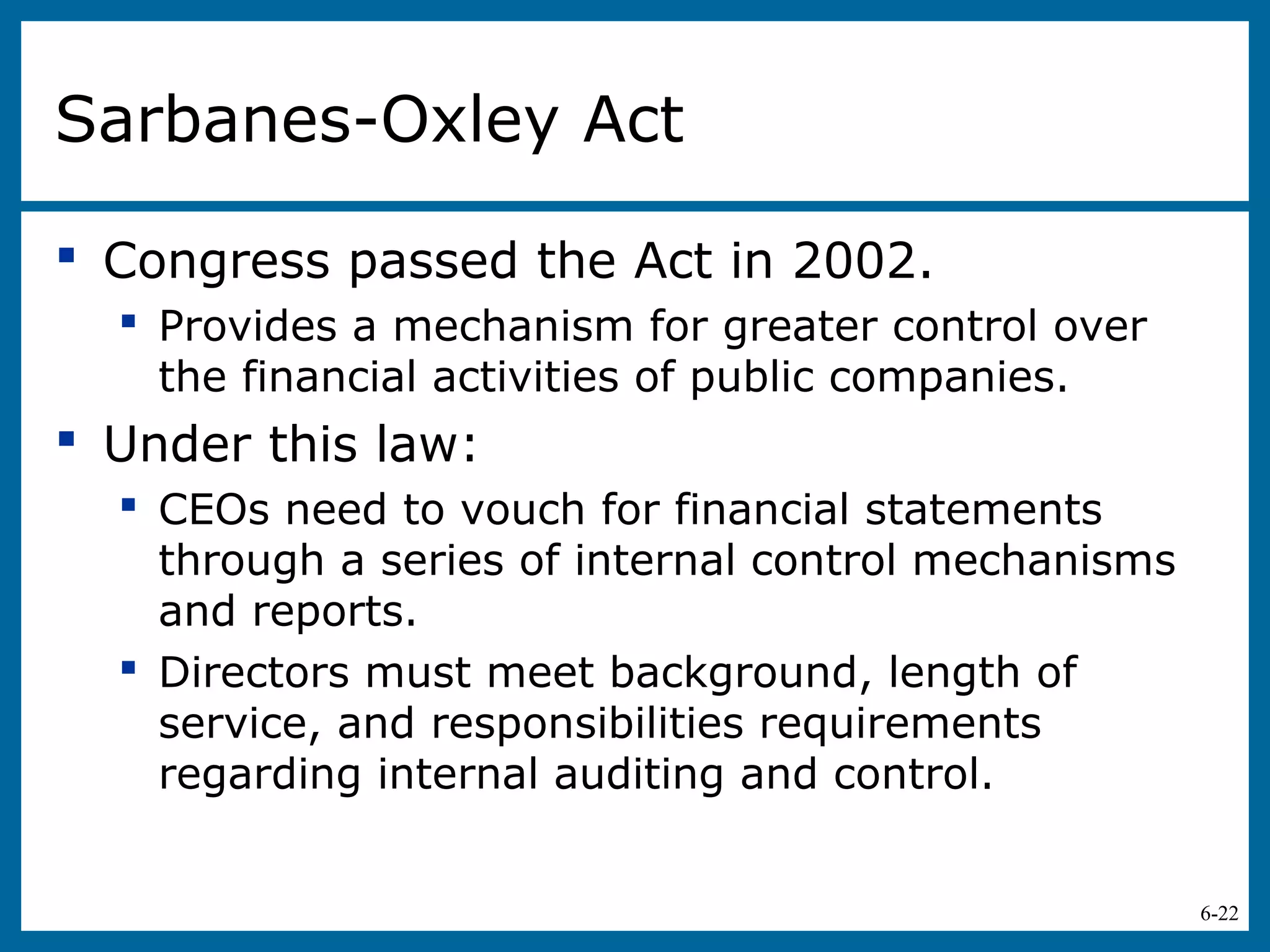
Sarbanes-Oxley Act
 Congress passed the Act in 2002.
 Provides a mechanism for greater control over
the financial activities of public companies.
 Under this law:
 CEOs need to vouch for financial statements
through a series of internal control mechanisms
and reports.
 Directors must meet background, length of
service, and responsibilities requirements
regarding internal auditing and control.
6-23
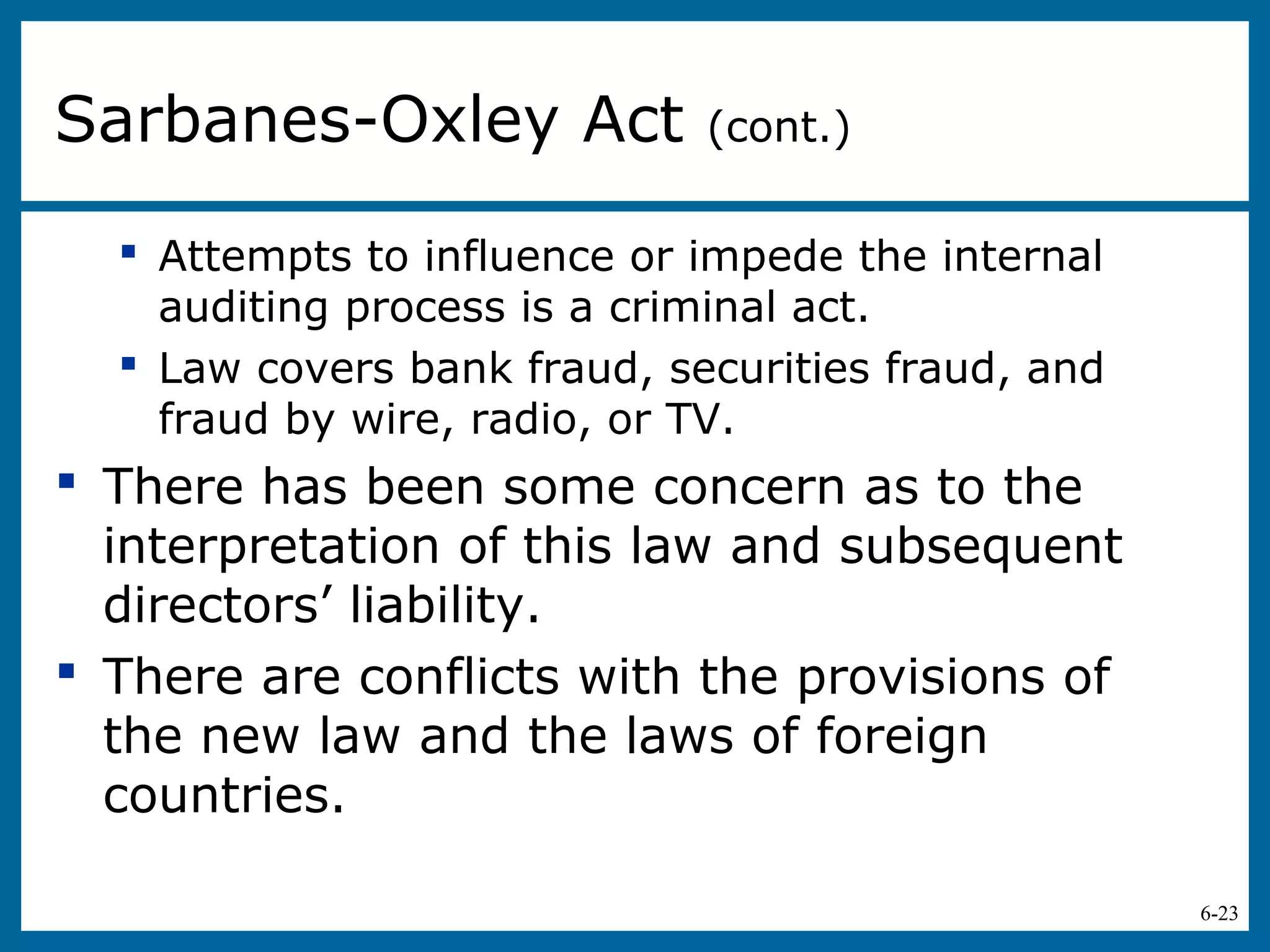
 Attempts to influence or impede the internal
auditing process is a criminal act.
 Law covers bank fraud, securities fraud, and
fraud by wire, radio, or TV.
 There has been some concern as to the
interpretation of this law and subsequent
directors’ liability.
 There are conflicts with the provisions of
the new law and the laws of foreign
countries.
Sarbanes-Oxley Act (cont.)
6-24
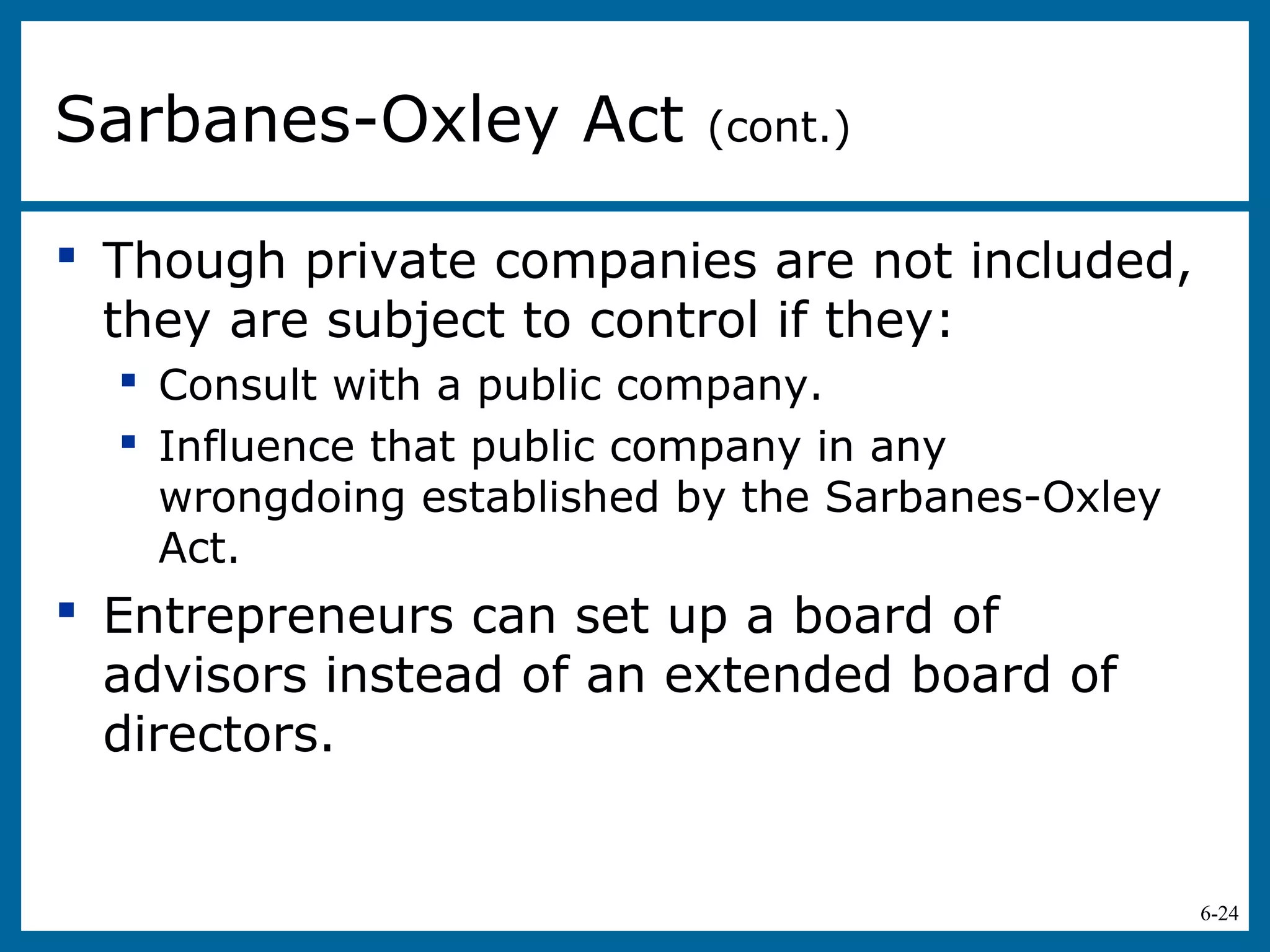
 Though private companies are not included,
they are subject to control if they:
 Consult with a public company.
 Influence that public company in any
wrongdoing established by the Sarbanes-Oxley
Act.
 Entrepreneurs can set up a board of
advisors instead of an extended board of
directors.
Sarbanes-Oxley Act (cont.)
6-25
Contracts
 A legally binding agreement between two
parties.
 Often business deals are concluded with a
handshake.
 The rule is to not to rely on a handshake if
a deal cannot be completed within one
year.
 Courts insist on a written contract for all
transactions over $500.
6-26
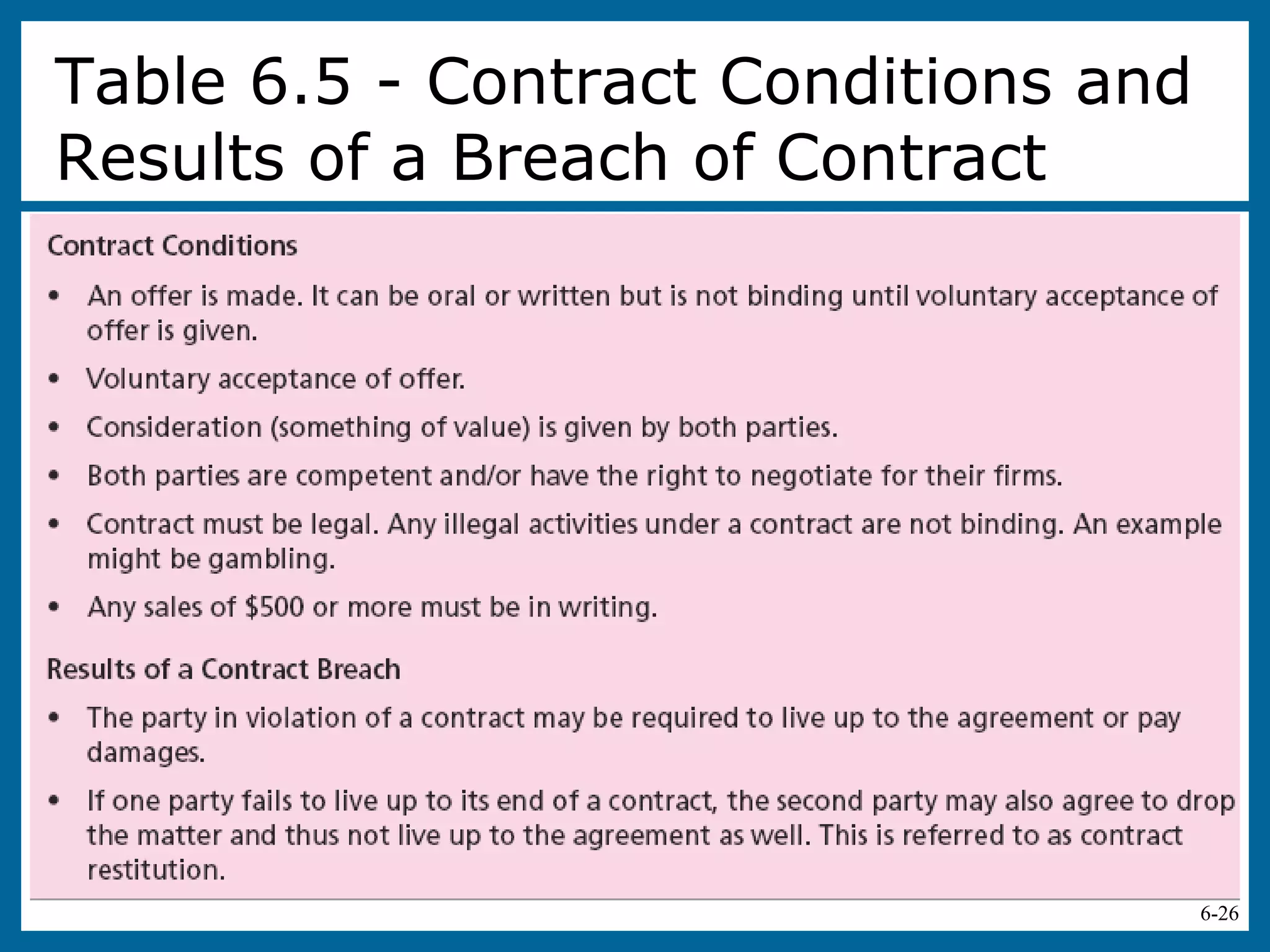
Table 6.5 - Contract Conditions and
Results of a Breach of Contract
6-27
 Four essential items in an agreement to
provide the best legal protection:
 Understand the terms and conditions in the
contract.
 Cross out anything that you do not agree to.
 Do not sign if there are blank spaces (these can
be crossed out).
 Make a copy for your files after signing.
Contracts (cont.)

Entrepreneurship Chap 6

  • 1.
    Hisrich Peters Shepherd Chapter 6 Protecting theIdea and Other Legal Issues for the Entrepreneur Copyright © 2010 by The McGraw-Hill Companies, Inc. All rights reserved.McGraw-Hill/Irwin
  • 2.
    6-2 What is IntellectualProperty?  It includes patents, trademarks, copyrights, and trade secrets.  These represents important assets to the entrepreneur.  Intellectual property should be understood even before engaging the services of an attorney.
  • 3.
    6-3 How to Selecta Lawyer  An entrepreneur needs to be aware of any regulations that may affect a venture.  A lawyer may work on a retainer basis or may be hired for a one-time fee.  A good working relationship with a lawyer:  Eases some of the risk in starting a new business.  Gives the entrepreneur necessary confidence.  Entrepreneur can offer the lawyer stock in exchange for services.
  • 4.
    6-4 Patents  Patent -Grants holder protection from others making, using, or selling similar idea; issued by the Patent and Trademark Office (PTO).  Utility patent – Protection of new, useful, and unobvious processes, machines, compositions of matter, and articles of manufacture; term of 20 years.  Design patent – Covers new, original, ornamental, and unobvious designs for articles of manufacture; term of 14 years.  Plant patent - Given for new varieties of plants.
  • 5.
    6-5  International Patents The Patent Cooperation Treaty (PCT) was established to facilitate patent filings in multiple countries in one office.  It is administered by the World Intellectual Property Organization (WIPO) in Geneva, Switzerland; has over 100 participants.  It provides a preliminary search that assesses whether the filing firm will face infringements in any country.  Differences may exists in the patent laws of each of these countries. Patents (cont.)
  • 6.
    6-6  The ProvisionalApplication  It is the initial application to the PTO providing evidence of first to market.  Replaces the disclosure document that was previously accepted by the PTO.  Gives the rights to the patent based on the concept of first to file.  The actual filing of the patent in its final form must occur no later than 12 months after the provisional disclosure document if filed. Patents (cont.)
  • 7.
    6-7  The PatentApplication  Introduction – Consists of the background and advantages of the invention, the problems that it overcomes, and how the invention differs from existing offerings.  Description of invention – Includes a detailed description of the invention and of the drawings that accompany it.  Claims - Specify what the entrepreneur is trying to patent.  The application should contain a declaration signed by the inventor(s). Patents (cont.)
  • 8.
    6-8  Patent Infringement Many businesses, inventions, or innovations are results of improvements on, or modifications of, existing products.  Copying and improving on a product may be perfectly legal and a good business strategy.  If patent infringement is unavoidable, the entrepreneur may try to license the product from the patent holder.  It is advisable to hire a patent attorney to ensure there is no possibility of infringement. Patents (cont.)
  • 9.
    6-9 Table 6.1 -Checklist for Minimizing Patent Risks Table 6.1
  • 10.
    6-10 Business Method Patents The growth of Internet use and software development has given rise to business method patents.  Firms use these patents to assault competitors and subsequently provide income from royalties or licensing fees.  Concerns have evolved regarding these patents.  Not all start-ups will have a product or concept that is patentable.
  • 11.
    6-11 Trademarks  A distinguishingword, name, or symbol used to identify a product.  It can last indefinitely.  It can be filed solely on the intent to use the trademark in interstate or foreign commerce; also with the intent to use in the future.  Categories:  Coined marks.  Arbitrary marks.  Suggestive marks.  Descriptive marks.
  • 12.
    6-12  Registering theTrademark  Filing must meet four requirements:  Completion of the written form.  A drawing of the mark.  Five specimens showing actual use of the mark.  The fee.  Initial determination of suitability takes 3 months.  Objections must be raise within six months, or application is considered abandoned.  The entrepreneur has the right to appeal in case of refusal. Trademarks (cont.)
  • 13.
    6-13  Once accepted,trademark is published in the Trademark Official Gazette to allow any party 30 days to oppose or request an extension to oppose.  Registration is issued if no opposition is filed.  Procedure takes about 13 months from initial filing. Trademarks (cont.)
  • 14.
    6-14 Table 6.2 -Benefits of a Registered Trademark Table 6.2
  • 15.
    6-15 Copyrights  Right givento prevent others from printing, copying, or publishing any original works of authorship.  Issues surrounding access to material on the Internet have led to major legal battles for the entertainment industry.  Copyrights are registered with the Library of Congress.  Term of the copyright is the life of the author plus 70 years.
  • 16.
    6-16 Trade Secrets  Providesprotection against others revealing or disclosing information that could be damaging to business.  Trade secrets have a life as long as the idea or process remains a secret.  It is not covered by any federal law but is recognized under a governing body of common laws in each state.  Employees may be asked to sign a confidential information agreement.  Entrepreneur needs to take proper precautions.  Legal action is possible only after the secret has been revealed.
  • 17.
    6-17 Licensing  A contractualagreement giving rights to others to use intellectual property in return for a royalty or fee.  Types of licensing:  Patent license agreements - Specify how the licensee would have access to the patent.  Trademark license agreements - Involve a franchising agreement.  Copyright license agreements - Involve rights to use or copy books, software, music, photographs, plays, etc.
  • 18.
    6-18  Factors tobe considered:  Customers’ recognition of licensed property.  Whether licensed property complements existing products or services.  Entrepreneur’s experience with the licensed property.  Long-term outlook for the licensed property.  Kind of protection provided by the agreement.  Commitments in terms of payment of royalties, sales quotas, and so on.  Renewal options. Licensing (cont.)
  • 19.
    6-19 Product Safety andLiability  It is the responsibility of a company to meet any legal specifications regarding a new product covered by the Consumer Product Safety Act.  The Act created a commission with the responsibility of prescribing safety standards.  The development of stricter regulations regarding labeling and advertising is also part of the commission’s responsibility.  Large fines as well as product recalls are the typical outcomes of any action enforced by the commission.
  • 20.
    6-20 Insurance  It providesa means of managing risk in the new business.  Some insurances are required by law and cannot be avoided while others are may be necessary to protect the financial net worth of the venture.  Skyrocketing medical costs can have a significant impact on insurance premiums.  Entrepreneurs also have to consider health care coverage.
  • 21.
    6-21 Table 6.4 -Types of Insurance and Possible Coverage
  • 22.
    6-22 Sarbanes-Oxley Act  Congresspassed the Act in 2002.  Provides a mechanism for greater control over the financial activities of public companies.  Under this law:  CEOs need to vouch for financial statements through a series of internal control mechanisms and reports.  Directors must meet background, length of service, and responsibilities requirements regarding internal auditing and control.
  • 23.
    6-23  Attempts toinfluence or impede the internal auditing process is a criminal act.  Law covers bank fraud, securities fraud, and fraud by wire, radio, or TV.  There has been some concern as to the interpretation of this law and subsequent directors’ liability.  There are conflicts with the provisions of the new law and the laws of foreign countries. Sarbanes-Oxley Act (cont.)
  • 24.
    6-24  Though privatecompanies are not included, they are subject to control if they:  Consult with a public company.  Influence that public company in any wrongdoing established by the Sarbanes-Oxley Act.  Entrepreneurs can set up a board of advisors instead of an extended board of directors. Sarbanes-Oxley Act (cont.)
  • 25.
    6-25 Contracts  A legallybinding agreement between two parties.  Often business deals are concluded with a handshake.  The rule is to not to rely on a handshake if a deal cannot be completed within one year.  Courts insist on a written contract for all transactions over $500.
  • 26.
    6-26 Table 6.5 -Contract Conditions and Results of a Breach of Contract
  • 27.
    6-27  Four essentialitems in an agreement to provide the best legal protection:  Understand the terms and conditions in the contract.  Cross out anything that you do not agree to.  Do not sign if there are blank spaces (these can be crossed out).  Make a copy for your files after signing. Contracts (cont.)