„The organizational designs that support innovation are very different from those that support delivery of current performance.“John Roberts, Professor of Economics, Strategic Management, and International Business Stanford Graduate School of Business
But…what are they???14 March 20082© Marc Sniukas
Organizing for Innovation & GrowthA synthesis of readings & research findings
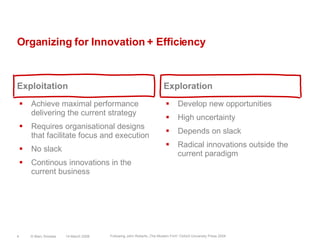
Organizing for Innovation + EfficiencyExploitationAchieve maximal performance delivering the current strategyRequires organisational designs that facilitate focus and executionNo slackContinous innovations in the current businessExplorationDevelop new opportunitiesHigh uncertaintyDepends on slackRadical innovations outside the current paradigm14 March 2008© Marc Sniukas4Following John Roberts „The Modern Firm“ Oxford University Press 2004
Organizing for PerformanceExploitation14 March 2008© Marc Sniukas5
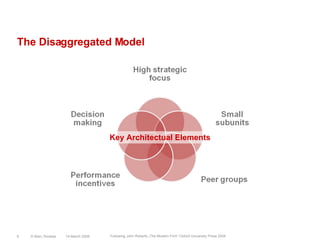
The Disaggregated Model14 March 2008© Marc Sniukas6Key Architectual ElementsFollowing John Roberts „The Modern Firm“ Oxford University Press 2004
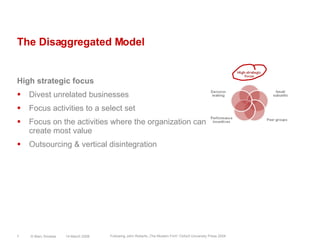
The Disaggregated ModelHigh strategic focusDivest unrelated businessesFocus activities to a select setFocus on the activities where the organization can create most valueOutsourcing & vertical disintegration14 March 2008© Marc Sniukas7Following John Roberts „The Modern Firm“ Oxford University Press 2004
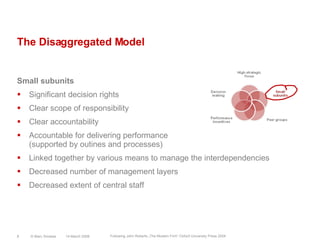
The Disaggregated ModelSmall subunitsSignificant decision rightsClear scope of responsibilityClear accountabilityAccountable for delivering performance(supported by outines and processes)Linked together by various means to manage the interdependenciesDecreased number of management layersDecreased extent of central staff14 March 2008© Marc Sniukas8Following John Roberts „The Modern Firm“ Oxford University Press 2004
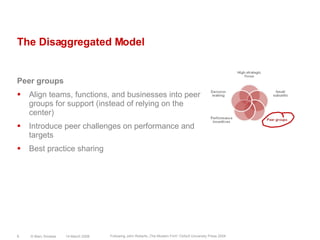
The Disaggregated ModelPeer groupsAlign teams, functions, and businesses into peer groups for support (instead of relying on the center)Introduce peer challenges on performance and targetsBest practice sharing14 March 2008© Marc Sniukas9Following John Roberts „The Modern Firm“ Oxford University Press 2004
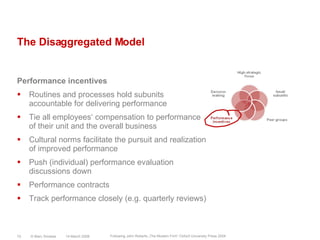
The Disaggregated ModelPerformance incentivesRoutines and processes hold subunits accountable for delivering performanceTie all employees‘ compensation to performance of their unit and the overall businessCultural norms facilitate the pursuit and realization of improved performancePush (individual) performance evaluation discussions downPerformance contractsTrack performance closely (e.g. quarterly reviews)14 March 2008© Marc Sniukas10Following John Roberts „The Modern Firm“ Oxford University Press 2004
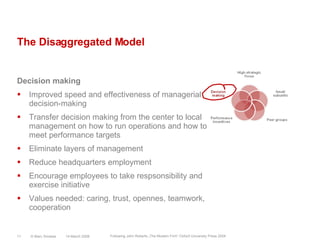
The Disaggregated ModelDecision makingImproved speed and effectiveness of managerial decision-makingTransfer decision making from the center to local management on how to run operations and how to meet performance targetsEliminate layers of managementReduce headquarters employmentEncourage employees to take respsonsibility and exercise initiativeValues needed: caring, trust, opennes, teamwork, cooperation14 March 2008© Marc Sniukas11Following John Roberts „The Modern Firm“ Oxford University Press 2004
The Disaggregated ModelHow to do it?Establish clarity about strategy and corporate policiesCreate discrete organizational units that are smaller than previously favoredGive the units‘ leaders increased operational and strategic authorityHold them strictly accountable for resultsReduce the number of layers in the hierachy (delayering)Reduce the number of central staff positionsIncrease incentives for performance at the unit and individual levelsIncrease rewards tied to overall performanceIncrease the resources devoted to management training and developmentPromote horizontal linkages and communication among managers, staff and peer unitsImprove information systems that facilitate both the measurement of performance and communication across units and up and down the hierachy.14 March 2008© Marc Sniukas12John Roberts „The Modern Firm“ Oxford University Press 2004 pages 232f
Organizing for InnovationExploration14 March 2008© Marc Sniukas13
What does it take?ImaginationThinking outside the boxWillingness to take significant riskAccept failures (and even celebrate them)Opennes to the new and untriedSlack resources to generate and develop ideas14 March 2008© Marc Sniukas14Following John Roberts „The Modern Firm“ Oxford University Press 2004
How to do it?Organizational models supporting innovationEstablish multiple R&D groupsDo not attempt to coordinate and rationalize activity across themEncourage direct communication among the groupsGive them the freedom and autonomy to decide how and what to work onPerformance measures & rewards: subjective evaluations or milestones achieved (not financial numbers generated)14 March 2008© Marc Sniukas15Following John Roberts „The Modern Firm“ Oxford University Press 2004
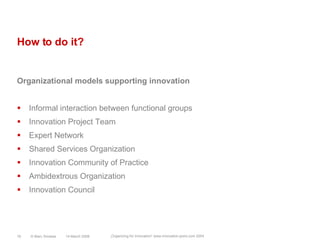
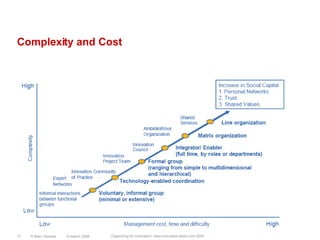
How to do it?Organizational models supporting innovationInformal interaction between functional groupsInnovation Project TeamExpert NetworkShared Services OrganizationInnovation Community of PracticeAmbidextrous OrganizationInnovation Council14 March 2008© Marc Sniukas16„Organizing for Innovation“ www.innovation-point.com 2004
Complexity and Cost14 March 2008© Marc Sniukas17„Organizing for Innovation“ www.innovation-point.com 2004
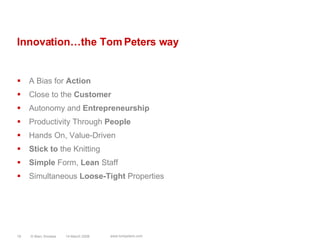
Innovation…the Tom Peters wayA Bias for ActionClose to the CustomerAutonomy and EntrepreneurshipProductivity Through PeopleHands On, Value-DrivenStick to the KnittingSimple Form, Lean StaffSimultaneous Loose-Tight Properties14 March 2008© Marc Sniukas18www.tompeters.com
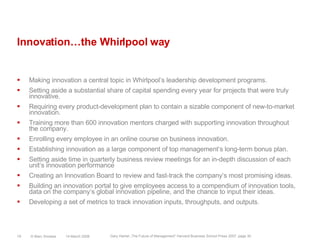
Innovation…the Whirlpool wayMaking innovation a central topic in Whirlpool‘s leadership development programs.Setting aside a substantial share of capital spending every year for projects that were truly innovative.Requiring every product-development plan to contain a sizable component of new-to-market innovation.Training more than 600 innovation mentors charged with supporting innovation throughout the company.Enrolling every employee in an online course on business innovation.Establishing innovation as a large component of top management‘s long-term bonus plan.Setting aside time in quarterly business review meetings for an in-depth discussion of each unit‘s innovation performanceCreating an Innovation Board to review and fast-track the company‘s most promising ideas.Building an innovation portal to give employees access to a compendium of innovation tools, data on the company‘s global innovation pipeline, and the chance to input their ideas.Developing a set of metrics to track innovation inputs, throughputs, and outputs. 14 March 2008© Marc Sniukas19Gary Hamel „The Future of Management“ Harvard Business School Press 2007, page 30
„…firms must develop multiple business opportunities, and to continue to grow and survive they must do this on an ongoing basis.“John Roberts, Professor of Economics, Strategic Management, and International Business Stanford Graduate School of Business
HOW???14 March 2008© Marc Sniukas21
Have a portfolio of activities!14 March 2008© Marc Sniukas22
„Searching for new opportunities, selecting among identified opportunities, building new businesses, running existing ones, exiting others – all may need to be done at once.“John Roberts, Professor of Economics, Strategic Management, and International Business Stanford Graduate School of Business
Difficulties with Multi-TaskingMotivation!Exploratory activity is typically hard to measure in a precise and timely way.According behavior is hard to specify, connection between efforts and results achieved is subject to randomnessExploitation is more easily measured  rewardedInducing one sort of behavior increases the cost of getting the other.14 March 2008© Marc Sniukas24Following John Roberts „The Modern Firm“ Oxford University Press 2004
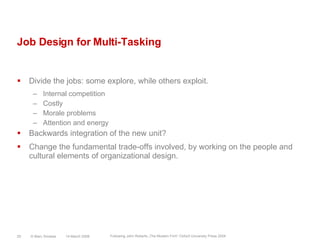
Job Design for Multi-TaskingDivide the jobs: some explore, while others exploit.Internal competitionCostlyMorale problemsAttention and energyBackwards integration of the new unit?Change the fundamental trade-offs involved, by working on the people and cultural elements of organizational design.14 March 2008© Marc Sniukas25Following John Roberts „The Modern Firm“ Oxford University Press 2004
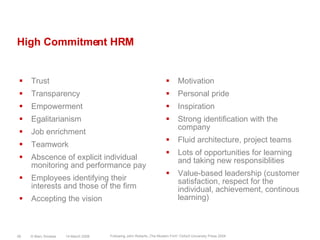
High Commitment HRMTrustTransparencyEmpowermentEgalitarianismJob enrichmentTeamworkAbscence of explicit individual monitoring and performance payEmployees identifying their interests and those of the firmAccepting the visionMotivationPersonal prideInspirationStrong identification with the companyFluid architecture, project teamsLots of opportunities for learning and taking new responsiblitiesValue-based leadership (customer satisfaction, respect for the individual, achievement, continous learning)14 March 2008© Marc Sniukas26Following John Roberts „The Modern Firm“ Oxford University Press 2004
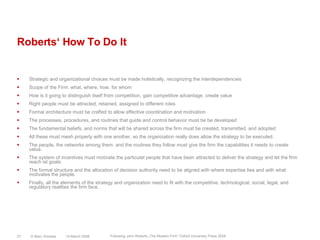
Roberts‘ How To Do ItStrategic and organizational choices must be made holistically, recognizing the interdependenciesScope of the Firm: what, where, how, for whomHow is it going to distinguish itself from competition, gain competitive advantage, create valueRight people must be attracted, retained, assigned to different rolesFormal architecture must be crafted to allow effective coordination and motivationThe processes, procedures, and routines that guide and control behavior must be be developedThe fundamental beliefs, and norms that will be shared across the firm must be created, transmitted, and adoptedAll these must mesh properly with one another, so the organization really does allow the strategy to be executed.The people, the networks among them, and the routines they follow must give the firm the capabilities it needs to create value.The system of incentives must motivate the particulat people that have been attracted to deliver the strategy and let the firm reach ist goals.The formal structure and the allocation of decision authority need to be aligned with where expertise liea and with what motivates the people.Finally, all the elements of the strategy and organization need to fit with the competitive, technological, social, legal, and regulatory realities the firm face.14 March 2008© Marc Sniukas27Following John Roberts „The Modern Firm“ Oxford University Press 2004
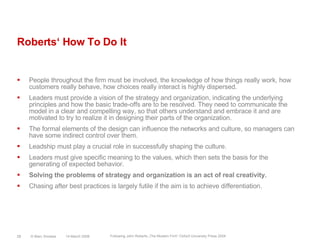
Roberts‘ How To Do ItPeople throughout the firm must be involved, the knowledge of how things really work, how customers really behave, how choices really interact is highly dispersed.Leaders must provide a vision of the strategy and organization, indicating the underlying principles and how the basic trade-offs are to be resolved. They need to communicate the model in a clear and compelling way, so that others understand and embrace it and are motivated to try to realize it in designing their parts of the organization.The formal elements of the design can influence the networks and culture, so managers can have some indirect control over them.Leadship must play a crucial role in successfully shaping the culture.Leaders must give specific meaning to the values, which then sets the basis for the generating of expected behavior.Solving the problems of strategy and organization is an act of real creativity.Chasing after best practices is largely futile if the aim is to achieve differentiation.14 March 2008© Marc Sniukas28Following John Roberts „The Modern Firm“ Oxford University Press 2004
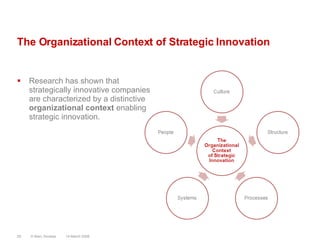
The Organizational Context of Strategic Innovation14 March 2008© Marc Sniukas29Research has shown that strategically innovative companies are characterized by a distinctive organizational context enabling strategic innovation.
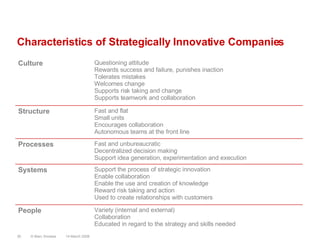
Characteristics of Strategically Innovative Companies14 March 2008© Marc Sniukas30
Well folks…that‘s it!All you‘ll have to do now is getting started!14 March 2008© Marc Sniukas31
Want more?© Marc Sniukas         www.sevenprophets.com3210.08.2009
www.sevenprophets.com© Marc Sniukas         www.sevenprophets.com3310.08.2009
A presentation by Marc Sniukaswww.sniukas.com10.08.2009© Marc Sniukas         www.sevenprophets.com34

Organizing For Innovation & Growth

  • 1.
    „The organizational designsthat support innovation are very different from those that support delivery of current performance.“John Roberts, Professor of Economics, Strategic Management, and International Business Stanford Graduate School of Business
  • 2.
    But…what are they???14March 20082© Marc Sniukas
  • 3.
    Organizing for Innovation& GrowthA synthesis of readings & research findings
  • 4.
    Organizing for Innovation+ EfficiencyExploitationAchieve maximal performance delivering the current strategyRequires organisational designs that facilitate focus and executionNo slackContinous innovations in the current businessExplorationDevelop new opportunitiesHigh uncertaintyDepends on slackRadical innovations outside the current paradigm14 March 2008© Marc Sniukas4Following John Roberts „The Modern Firm“ Oxford University Press 2004
  • 5.
  • 6.
    The Disaggregated Model14March 2008© Marc Sniukas6Key Architectual ElementsFollowing John Roberts „The Modern Firm“ Oxford University Press 2004
  • 7.
    The Disaggregated ModelHighstrategic focusDivest unrelated businessesFocus activities to a select setFocus on the activities where the organization can create most valueOutsourcing & vertical disintegration14 March 2008© Marc Sniukas7Following John Roberts „The Modern Firm“ Oxford University Press 2004
  • 8.
    The Disaggregated ModelSmallsubunitsSignificant decision rightsClear scope of responsibilityClear accountabilityAccountable for delivering performance(supported by outines and processes)Linked together by various means to manage the interdependenciesDecreased number of management layersDecreased extent of central staff14 March 2008© Marc Sniukas8Following John Roberts „The Modern Firm“ Oxford University Press 2004
  • 9.
    The Disaggregated ModelPeergroupsAlign teams, functions, and businesses into peer groups for support (instead of relying on the center)Introduce peer challenges on performance and targetsBest practice sharing14 March 2008© Marc Sniukas9Following John Roberts „The Modern Firm“ Oxford University Press 2004
  • 10.
    The Disaggregated ModelPerformanceincentivesRoutines and processes hold subunits accountable for delivering performanceTie all employees‘ compensation to performance of their unit and the overall businessCultural norms facilitate the pursuit and realization of improved performancePush (individual) performance evaluation discussions downPerformance contractsTrack performance closely (e.g. quarterly reviews)14 March 2008© Marc Sniukas10Following John Roberts „The Modern Firm“ Oxford University Press 2004
  • 11.
    The Disaggregated ModelDecisionmakingImproved speed and effectiveness of managerial decision-makingTransfer decision making from the center to local management on how to run operations and how to meet performance targetsEliminate layers of managementReduce headquarters employmentEncourage employees to take respsonsibility and exercise initiativeValues needed: caring, trust, opennes, teamwork, cooperation14 March 2008© Marc Sniukas11Following John Roberts „The Modern Firm“ Oxford University Press 2004
  • 12.
    The Disaggregated ModelHowto do it?Establish clarity about strategy and corporate policiesCreate discrete organizational units that are smaller than previously favoredGive the units‘ leaders increased operational and strategic authorityHold them strictly accountable for resultsReduce the number of layers in the hierachy (delayering)Reduce the number of central staff positionsIncrease incentives for performance at the unit and individual levelsIncrease rewards tied to overall performanceIncrease the resources devoted to management training and developmentPromote horizontal linkages and communication among managers, staff and peer unitsImprove information systems that facilitate both the measurement of performance and communication across units and up and down the hierachy.14 March 2008© Marc Sniukas12John Roberts „The Modern Firm“ Oxford University Press 2004 pages 232f
  • 13.
    Organizing for InnovationExploration14March 2008© Marc Sniukas13
  • 14.
    What does ittake?ImaginationThinking outside the boxWillingness to take significant riskAccept failures (and even celebrate them)Opennes to the new and untriedSlack resources to generate and develop ideas14 March 2008© Marc Sniukas14Following John Roberts „The Modern Firm“ Oxford University Press 2004
  • 15.
    How to doit?Organizational models supporting innovationEstablish multiple R&D groupsDo not attempt to coordinate and rationalize activity across themEncourage direct communication among the groupsGive them the freedom and autonomy to decide how and what to work onPerformance measures & rewards: subjective evaluations or milestones achieved (not financial numbers generated)14 March 2008© Marc Sniukas15Following John Roberts „The Modern Firm“ Oxford University Press 2004
  • 16.
    How to doit?Organizational models supporting innovationInformal interaction between functional groupsInnovation Project TeamExpert NetworkShared Services OrganizationInnovation Community of PracticeAmbidextrous OrganizationInnovation Council14 March 2008© Marc Sniukas16„Organizing for Innovation“ www.innovation-point.com 2004
  • 17.
    Complexity and Cost14March 2008© Marc Sniukas17„Organizing for Innovation“ www.innovation-point.com 2004
  • 18.
    Innovation…the Tom PeterswayA Bias for ActionClose to the CustomerAutonomy and EntrepreneurshipProductivity Through PeopleHands On, Value-DrivenStick to the KnittingSimple Form, Lean StaffSimultaneous Loose-Tight Properties14 March 2008© Marc Sniukas18www.tompeters.com
  • 19.
    Innovation…the Whirlpool wayMakinginnovation a central topic in Whirlpool‘s leadership development programs.Setting aside a substantial share of capital spending every year for projects that were truly innovative.Requiring every product-development plan to contain a sizable component of new-to-market innovation.Training more than 600 innovation mentors charged with supporting innovation throughout the company.Enrolling every employee in an online course on business innovation.Establishing innovation as a large component of top management‘s long-term bonus plan.Setting aside time in quarterly business review meetings for an in-depth discussion of each unit‘s innovation performanceCreating an Innovation Board to review and fast-track the company‘s most promising ideas.Building an innovation portal to give employees access to a compendium of innovation tools, data on the company‘s global innovation pipeline, and the chance to input their ideas.Developing a set of metrics to track innovation inputs, throughputs, and outputs. 14 March 2008© Marc Sniukas19Gary Hamel „The Future of Management“ Harvard Business School Press 2007, page 30
  • 20.
    „…firms must developmultiple business opportunities, and to continue to grow and survive they must do this on an ongoing basis.“John Roberts, Professor of Economics, Strategic Management, and International Business Stanford Graduate School of Business
  • 21.
    HOW???14 March 2008©Marc Sniukas21
  • 22.
    Have a portfolioof activities!14 March 2008© Marc Sniukas22
  • 23.
    „Searching for newopportunities, selecting among identified opportunities, building new businesses, running existing ones, exiting others – all may need to be done at once.“John Roberts, Professor of Economics, Strategic Management, and International Business Stanford Graduate School of Business
  • 24.
    Difficulties with Multi-TaskingMotivation!Exploratoryactivity is typically hard to measure in a precise and timely way.According behavior is hard to specify, connection between efforts and results achieved is subject to randomnessExploitation is more easily measured  rewardedInducing one sort of behavior increases the cost of getting the other.14 March 2008© Marc Sniukas24Following John Roberts „The Modern Firm“ Oxford University Press 2004
  • 25.
    Job Design forMulti-TaskingDivide the jobs: some explore, while others exploit.Internal competitionCostlyMorale problemsAttention and energyBackwards integration of the new unit?Change the fundamental trade-offs involved, by working on the people and cultural elements of organizational design.14 March 2008© Marc Sniukas25Following John Roberts „The Modern Firm“ Oxford University Press 2004
  • 26.
    High Commitment HRMTrustTransparencyEmpowermentEgalitarianismJobenrichmentTeamworkAbscence of explicit individual monitoring and performance payEmployees identifying their interests and those of the firmAccepting the visionMotivationPersonal prideInspirationStrong identification with the companyFluid architecture, project teamsLots of opportunities for learning and taking new responsiblitiesValue-based leadership (customer satisfaction, respect for the individual, achievement, continous learning)14 March 2008© Marc Sniukas26Following John Roberts „The Modern Firm“ Oxford University Press 2004
  • 27.
    Roberts‘ How ToDo ItStrategic and organizational choices must be made holistically, recognizing the interdependenciesScope of the Firm: what, where, how, for whomHow is it going to distinguish itself from competition, gain competitive advantage, create valueRight people must be attracted, retained, assigned to different rolesFormal architecture must be crafted to allow effective coordination and motivationThe processes, procedures, and routines that guide and control behavior must be be developedThe fundamental beliefs, and norms that will be shared across the firm must be created, transmitted, and adoptedAll these must mesh properly with one another, so the organization really does allow the strategy to be executed.The people, the networks among them, and the routines they follow must give the firm the capabilities it needs to create value.The system of incentives must motivate the particulat people that have been attracted to deliver the strategy and let the firm reach ist goals.The formal structure and the allocation of decision authority need to be aligned with where expertise liea and with what motivates the people.Finally, all the elements of the strategy and organization need to fit with the competitive, technological, social, legal, and regulatory realities the firm face.14 March 2008© Marc Sniukas27Following John Roberts „The Modern Firm“ Oxford University Press 2004
  • 28.
    Roberts‘ How ToDo ItPeople throughout the firm must be involved, the knowledge of how things really work, how customers really behave, how choices really interact is highly dispersed.Leaders must provide a vision of the strategy and organization, indicating the underlying principles and how the basic trade-offs are to be resolved. They need to communicate the model in a clear and compelling way, so that others understand and embrace it and are motivated to try to realize it in designing their parts of the organization.The formal elements of the design can influence the networks and culture, so managers can have some indirect control over them.Leadship must play a crucial role in successfully shaping the culture.Leaders must give specific meaning to the values, which then sets the basis for the generating of expected behavior.Solving the problems of strategy and organization is an act of real creativity.Chasing after best practices is largely futile if the aim is to achieve differentiation.14 March 2008© Marc Sniukas28Following John Roberts „The Modern Firm“ Oxford University Press 2004
  • 29.
    The Organizational Contextof Strategic Innovation14 March 2008© Marc Sniukas29Research has shown that strategically innovative companies are characterized by a distinctive organizational context enabling strategic innovation.
  • 30.
    Characteristics of StrategicallyInnovative Companies14 March 2008© Marc Sniukas30
  • 31.
    Well folks…that‘s it!Allyou‘ll have to do now is getting started!14 March 2008© Marc Sniukas31
  • 32.
    Want more?© MarcSniukas www.sevenprophets.com3210.08.2009
  • 33.
    www.sevenprophets.com© Marc Sniukas www.sevenprophets.com3310.08.2009
  • 34.
    A presentation byMarc Sniukaswww.sniukas.com10.08.2009© Marc Sniukas www.sevenprophets.com34

Editor's Notes

  • #2 Organizing for InnovationOrganizational models that support strategic innovationor most organizations, the ability to deliver innovative solutions on a sustainable basis requires them to look within and to renew the fabric of the business itself. There are three aspects of this internally-focused innovation:· Culture – the mindset and norms that allowindividuals and teams to think imaginatively, to take prudent risks, and to seek out, create and introduceinnovative solutions· Process – the general business processes andpractices that enable functional groups to operate effectively and collaborate toward a common goal –as well as a robust set of innovation methodologies and tools· Structure – organizational structures andsupporting technologies that enable collaboration across functional linesThis paper looks at the third aspect and briefly describes six organizational models that supportinnovation, each with different goals and levels of formality and complexity. All except the “ambidextrousorganization” are relatively informal, “virtual” models in which the personnel involved continue to report into their traditional functional groups.Innovation Project TeamThis is a multi-disciplinary virtual team that works together for a finite period – perhaps to identifyinnovation opportunities and/or to deliver a specific project. The team is comprised of (1) different functions (e.g., consumer insights, R&D, marketing, brand management, manufacturing, channel management, sales, and from outside the sponsoring business unit or geography, etc.), (2) different levels and perspectives (decision makers, subject matter experts and implementers), and (3) different mindsets (strategic thinkers comfortable with an ambiguous, exploratory process, and pragmatic, operational thinkers.Expert NetworkThis is a set of individuals inside an organization with specialized expertise/knowledge who are known as the “Go To” persons on that topic. Typically, these individuals do not often interact with each other, but arecalled upon independently as needed. However, some combination of the network may be brought together on an “event” basis to address a specific issue. As these experts become more actively involved with each other, an Expert Network might evolve to become a Community of Practice. Sometimes a set of content experts from outside the organization may be formed as an external Advisory Board.Shared Services OrganizationSome enterprises establish corporate-level functional groups to provide specialized services (e.g., “Corporate Marketing”, “Corporate Market Research”, “Central R&D”) that act as a resource to their counterpart functions in the business units. These groups often offer specialized skill sets not available at the BU level. They may conduct ongoing research (e.g., scanning for emerging technologies, large-scale trend analysis) or short-term projects, or seek out and contract with specialized third party resources.These shared services groups are tightly aligned with the needs of the business units, so that they can deliver explicit value. At the same time, part of their charter is to “push the envelope” of BU-level thinking, by engaging in activities and explorations that are not on the business unit’s radar screen. Example: 3M.Innovation Community of PracticeA “Community of Practice” is a self-governing, multidisciplinary virtual community focused on learning,generating knowledge and building capability around a specific topic – in this case, Innovation. One goal of such a community is to gather “tacit knowledge” so it can be leveraged as “explicit knowledge” that becomes more accessible across the organization. Supported by a technology platform with onlinecollaborative tools, an Innovation Community of Practice might share several types of information: marketresearch, consumer insights, “work-in-progress thinking”, specific new product platforms and concepts,procedures, templates, best practices/“next practices”, and an “idea bank”. Over time the goals, levels of formality and participant roster of the community will change. After initially focusing on information sharing, the community may evolve so that members collaborate in real time on specific projects. A successful community is not viewed as a “rogue activity”, but is acknowledged and supported by senior management as a critical enabler and driver of innovation across the organization.Ambidextrous OrganizationThis is a small, autonomous, multi-disciplinary group, whose role is to drive rapid implementation. Thiscohesive group typically has its own staff, a physically distinct location, separate funding, discrete performance metrics, and often a highly entrepreneurial culture, etc. This relatively independent operating structure is intended to allow the group to effectively manage its own destiny without interference from the larger organization. With “starved resources” a reality at many large organizations, functional managers are often reluctant to allocate funding and staff, especially to projects they perceive as risky, or that don’t help them meet their own performance metrics. The ambidextrous approach establishes strong operating agreements that protect fragile start-ups or experimental ventures, especially in the area offinancial and human resource allocation. The ambidextrous organization draws upon selectedcorporate resources (both initially and over time) and may in some cases have special provisionsthat facilitate better access to resources or quicker turnaround. Example: 8th Continent, a jointventure by DuPont and General Mills.Innovation CouncilComposed of senior personnel from various functions (e.g., an executive sponsor for enterprise innovation, R&D, business line executives, marketing, finance, HR, etc.), the Innovation Council’s role is to establish corporate priorities for new ventures, and to sponsor and support entrepreneurial efforts that may drive growth in new areas. A “venture team” (or an individual) with an unfunded idea or business concept presents a proposal to the Council. The Council provides feedback, funds the most promising ventures, provides a variety of resources and facilitates introductions to external parties that can provide support. Examples: Intel, HP, IBM, 3M, Shell.First stepsSeveral of these models (as well as the usual informal interactions between functional groups) may exist within an organization at the same time. All help an enterprise drive growth by taking a strategic approach to innovation. Some models arise and evolve spontaneously, while others need to be intentionallycreated and managed. As seen below, increasing levels of complexity are accompanied by increasingcommitments in terms of cost, time and maintenance. At the same time the organization will benefit from the “social capital” that drives sustainable innovation, namely personal networks, cross-functional trust and shared values. There is no typical “migration path” that an enterprise would follow. When exploring alternative organizational structures the first steps are to understand what kinds of structures currently exist within the enterprise, and then to assess the extent to which these structures are aligned with and support the organization’s strategic goals. The key is to choose the organizational model(s) thatbest supports strategy execution. Too little organization results in poor execution, while too much results in excessive cost.About InnovationPoint LLCInnovationPoint is a non-traditional consulting firm that helps its Fortune 1000 clients take a strategic approach to innovation. InnovationPoint blends traditional and unconventional methodologies to identify breakthrough opportunities, develop growth strategies and new products, and to align organizational strategy and design in a way that supports sustainable innovation. InnovationPoint’s clients include Hewlett-Packard, Cisco, PepsiCo, Frito-Lay, Philips, Charles Schwab and Nestlé.