The Business Plan :
Creating and Starting
The Venture
Planning as Part of The
Business Operation
• Planning is a process than never ends
for a business.
• As the venture grow up to mature
business, planning will continue …
What is a Business Plan?
• A business plan is a written document
prepared by the entrepreneur that
describes all the relevant internal and
external elements and strategies for
starting a new venture.
• It is a integration of functional plans such
as marketing, finance, manufacturing, sales
and human resources.
Who should write the plan?
• The business plan should be prepared
by the entrepreneur.
• The entrepreneur may consult with
many other sources in its
preparation, such as lawyers,
accountants, marketing consultants,
and engineers.
Who Reads The Plans?
• The business plan may be read by
employees, investors, bankers, venture
capitalists, suppliers, customers, advisors,
and consultants.
• There are three perspectives should be
considered in preparing the plan :
– Perspective of the entrepreneur
– Marketing perspective
– Investor’s perspective
Why Have a Business Plan?
• The business plan is valuable to the entrepreneur,
potential investors, or even new personnel, who
are trying to familiarize themselves with the
venture, it goals, and objectives.
– It helps determine the viability of the venture in a
designated market
– It provides guidance to the entrepreneur in organizing
his or her planning activities
– It serves as an important tool in helping to obtain
financing.
Presenting The Plan
• It is often necessary for an entrepreneur
to orally present the business plan before
an audience of potential investors.
• In this typical forum the entrepreneur
would be expected to provide a short
(perhaps 20-minutes or half-hour)
presentation of the business plan.
Information Needs
• Before committing time and energy to
preparing a business plan, the
entrepreneur should do a quick
feasibility study of the business
concept to see whether there a any
possible barriers to success.
• Internet can be a valuable resource.
Outline of a Business Plan
• Introductory Page
– Name and address of business
– Name(s) and address(es) of principal(s)
– Nature of business
– Statement of financing needed
– Statement of confidentially of report
Outline …
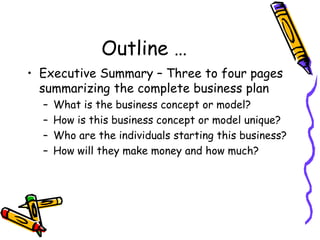
• Executive Summary – Three to four pages
summarizing the complete business plan
– What is the business concept or model?
– How is this business concept or model unique?
– Who are the individuals starting this business?
– How will they make money and how much?
Outline …
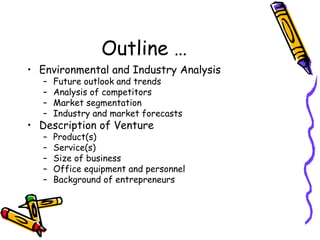
• Environmental and Industry Analysis
– Future outlook and trends
– Analysis of competitors
– Market segmentation
– Industry and market forecasts
• Description of Venture
– Product(s)
– Service(s)
– Size of business
– Office equipment and personnel
– Background of entrepreneurs
Outline …
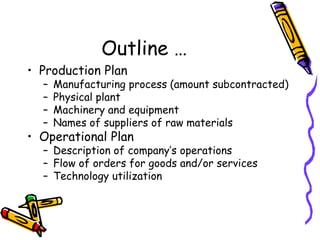
• Production Plan
– Manufacturing process (amount subcontracted)
– Physical plant
– Machinery and equipment
– Names of suppliers of raw materials
• Operational Plan
– Description of company’s operations
– Flow of orders for goods and/or services
– Technology utilization
Outline …
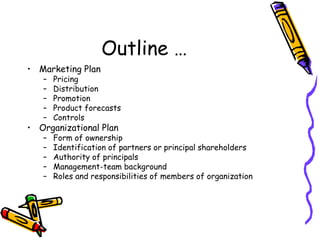
• Marketing Plan
– Pricing
– Distribution
– Promotion
– Product forecasts
– Controls
• Organizational Plan
– Form of ownership
– Identification of partners or principal shareholders
– Authority of principals
– Management-team background
– Roles and responsibilities of members of organization
Outline …
• Assessment of Risk
– Evaluate weakness of business
– New technologies
– Contingency Plans
• Financial Plan
– Pro forma income statement
– Cash flow projections
– Pro forma balance sheet
– Break-even analysis
– Sources and applications of funds
Outline …
• Appendix (contains backup material)
– Letters
– Market research data
– Leases or contracts
– Price lists from suppliers.
Using and Implementing
The Business Plan
• The business plan is designed to guide the
entrepreneur through the first year of
operations.
• Implementation of the strategy contain
control point to ascertain progress and to
initiate contingency plan if necessary.
• Business plan not end up in a drawer
somewhere once the financing has been
attained and the business launched.
Measuring Plan Progress
• Entrepreneur should check the profit and loss
statement, cash flow projections, and information
on inventory, production, quality, sales, collection
of accounts receivable, and disbursements for the
previous month.
– Inventory control
– Production control
– Quality control
– Sales control
– Disbursements
Updating the Plan
• The most effective business plan can
become out-of-date if condition change.
• If the change are likely to affect the
business plan, the entrepreneur should
determine what revisions are needed.
• In this manner, the entrepreneur can
maintain reasonable targets and goals and
keep the new venture on a course that will
increase probability of success.
Why Some
Business Plans Fail
• Goals set by the entrepreneur are unreasonable.
• Goals are not measurable
• The entrepreneur has not made a total commitment to
the business or to the family.
• The entrepreneur has no experience in the planned
business.
• The entrepreneur has no sense of potential threats or
weaknesses to the business.
• No customer need was established for the proposed
product or service.
The End

EP_Unit 4_notes.ppt

  • 1.
    The Business Plan: Creating and Starting The Venture
  • 2.
    Planning as Partof The Business Operation • Planning is a process than never ends for a business. • As the venture grow up to mature business, planning will continue …
  • 3.
    What is aBusiness Plan? • A business plan is a written document prepared by the entrepreneur that describes all the relevant internal and external elements and strategies for starting a new venture. • It is a integration of functional plans such as marketing, finance, manufacturing, sales and human resources.
  • 4.
    Who should writethe plan? • The business plan should be prepared by the entrepreneur. • The entrepreneur may consult with many other sources in its preparation, such as lawyers, accountants, marketing consultants, and engineers.
  • 5.
    Who Reads ThePlans? • The business plan may be read by employees, investors, bankers, venture capitalists, suppliers, customers, advisors, and consultants. • There are three perspectives should be considered in preparing the plan : – Perspective of the entrepreneur – Marketing perspective – Investor’s perspective
  • 6.
    Why Have aBusiness Plan? • The business plan is valuable to the entrepreneur, potential investors, or even new personnel, who are trying to familiarize themselves with the venture, it goals, and objectives. – It helps determine the viability of the venture in a designated market – It provides guidance to the entrepreneur in organizing his or her planning activities – It serves as an important tool in helping to obtain financing.
  • 7.
    Presenting The Plan •It is often necessary for an entrepreneur to orally present the business plan before an audience of potential investors. • In this typical forum the entrepreneur would be expected to provide a short (perhaps 20-minutes or half-hour) presentation of the business plan.
  • 8.
    Information Needs • Beforecommitting time and energy to preparing a business plan, the entrepreneur should do a quick feasibility study of the business concept to see whether there a any possible barriers to success. • Internet can be a valuable resource.
  • 9.
    Outline of aBusiness Plan • Introductory Page – Name and address of business – Name(s) and address(es) of principal(s) – Nature of business – Statement of financing needed – Statement of confidentially of report
  • 10.
    Outline … • ExecutiveSummary – Three to four pages summarizing the complete business plan – What is the business concept or model? – How is this business concept or model unique? – Who are the individuals starting this business? – How will they make money and how much?
  • 11.
    Outline … • Environmentaland Industry Analysis – Future outlook and trends – Analysis of competitors – Market segmentation – Industry and market forecasts • Description of Venture – Product(s) – Service(s) – Size of business – Office equipment and personnel – Background of entrepreneurs
  • 12.
    Outline … • ProductionPlan – Manufacturing process (amount subcontracted) – Physical plant – Machinery and equipment – Names of suppliers of raw materials • Operational Plan – Description of company’s operations – Flow of orders for goods and/or services – Technology utilization
  • 13.
    Outline … • MarketingPlan – Pricing – Distribution – Promotion – Product forecasts – Controls • Organizational Plan – Form of ownership – Identification of partners or principal shareholders – Authority of principals – Management-team background – Roles and responsibilities of members of organization
  • 14.
    Outline … • Assessmentof Risk – Evaluate weakness of business – New technologies – Contingency Plans • Financial Plan – Pro forma income statement – Cash flow projections – Pro forma balance sheet – Break-even analysis – Sources and applications of funds
  • 15.
    Outline … • Appendix(contains backup material) – Letters – Market research data – Leases or contracts – Price lists from suppliers.
  • 16.
    Using and Implementing TheBusiness Plan • The business plan is designed to guide the entrepreneur through the first year of operations. • Implementation of the strategy contain control point to ascertain progress and to initiate contingency plan if necessary. • Business plan not end up in a drawer somewhere once the financing has been attained and the business launched.
  • 17.
    Measuring Plan Progress •Entrepreneur should check the profit and loss statement, cash flow projections, and information on inventory, production, quality, sales, collection of accounts receivable, and disbursements for the previous month. – Inventory control – Production control – Quality control – Sales control – Disbursements
  • 18.
    Updating the Plan •The most effective business plan can become out-of-date if condition change. • If the change are likely to affect the business plan, the entrepreneur should determine what revisions are needed. • In this manner, the entrepreneur can maintain reasonable targets and goals and keep the new venture on a course that will increase probability of success.
  • 19.
    Why Some Business PlansFail • Goals set by the entrepreneur are unreasonable. • Goals are not measurable • The entrepreneur has not made a total commitment to the business or to the family. • The entrepreneur has no experience in the planned business. • The entrepreneur has no sense of potential threats or weaknesses to the business. • No customer need was established for the proposed product or service.
  • 20.