Hisrich
Peters
Shepherd
Chapter 15
Succession Planning and
Strategies for Harvesting
and Ending the Venture
Copyright © 2010 by The McGraw-Hill Companies, Inc. All rights reserved.McGraw-Hill/Irwin
15-2
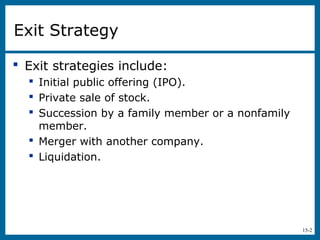
Exit Strategy
 Exit strategies include:
 Initial public offering (IPO).
 Private sale of stock.
 Succession by a family member or a nonfamily
member.
 Merger with another company.
 Liquidation.
15-3
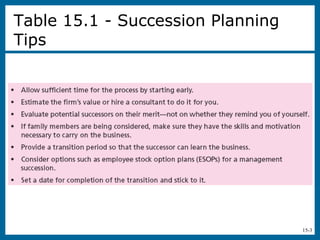
Table 15.1 - Succession Planning
Tips
15-4
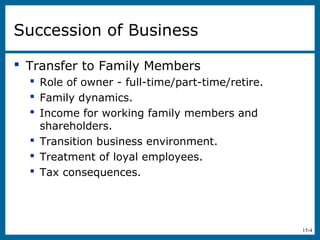
Succession of Business
 Transfer to Family Members
 Role of owner - full-time/part-time/retire.
 Family dynamics.
 Income for working family members and
shareholders.
 Transition business environment.
 Treatment of loyal employees.
 Tax consequences.
15-5
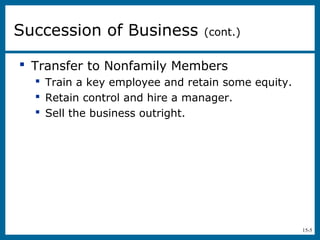
 Transfer to Nonfamily Members
 Train a key employee and retain some equity.
 Retain control and hire a manager.
 Sell the business outright.
Succession of Business (cont.)
15-6
Options for Selling the Business
 Direct Sale
 Strategies to be considered:
 Focus on a narrow, well-defined segment.
 Control costs and focus on higher margins and profits.
 Get all financial statements in order.
 Prepare a management documentation.
 Assess the condition of capital equipment.
 Get tax advice.
 Get nondisclosures from key employees.
 Try to maintain a good management team.
 Prepare and plan in advance.
15-7
 An important consideration is the type of
payment the buyer will use.
 Business brokers may be helpful.
 The best way to communicate the business to
potential buyers is through the business plan.
 The role of an entrepreneur may vary
depending on the sale agreement or contract
with the new owner(s).
Options for Selling the Business
(cont.)
15-8
 Employee Stock Option Plan
 Establishes a new legal entity—an employee
stock ownership trust.
 Obligates the firm to repay the loan plus
interest out of business cash flows.
 Results in significant stock values for
employees.
Options for Selling the Business
(cont.)
15-9
Options for Selling the Business
(cont.)
Advantages:
Motivates employees to put in extra time or effort.
Provides a mechanism to pay back loyal employees.
Allows transfer of business under a planned written
agreement.
Permits the company to reap the advantage of
deducting contributions on ESOP or any dividends paid.
15-10
 Management Buyout
 Usually involves a direct sale of the venture for
some predetermined price.
 To establish a price, the entrepreneur should:
 Have an appraisal of all the assets.
 Determine the goodwill value established from past
revenue.
 Sale of a venture can be:
 For cash.
 Financed through banks
 Through sale of voting or nonvoting stock.
 The entrepreneur may agree to carry a note.
Options for Selling the Business
(cont.)
15-11
Bankruptcy—An Overview
 Most common types of bankruptcies:
 Chapter 7 or liquidation (69% in 2008).
 Chapter 11 or reorganization (19% in 2008).
 Chapter 13 or installment payments (12% in
2008).
15-12
 Bankruptcy lessons:
 Too much time and effort is spent on
diversifying in markets where entrepreneurs lack
knowledge.
 Bankruptcy protects entrepreneurs from
creditors, not from competitors.
 It is difficult to separate entrepreneurs from the
business.
 Entrepreneurs should file for bankruptcy early.
 Bankruptcy needs to be shared with employees
and everybody else involved.
Bankruptcy—An Overview (cont.)
15-13
 Bankruptcy Act of 1978 (with amendments
added in 1984 and 2005) ensures:
 Fair distribution of assets to creditors.
 Protection of debtors from unfair depletion of
assets.
 Protection of debtors from unfair demands by
creditors.
Bankruptcy—An Overview (cont.)
15-14
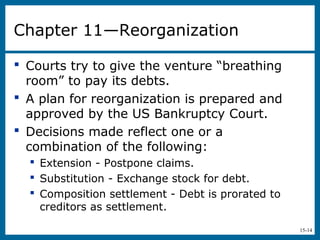
Chapter 11—Reorganization
 Courts try to give the venture “breathing
room” to pay its debts.
 A plan for reorganization is prepared and
approved by the US Bankruptcy Court.
 Decisions made reflect one or a
combination of the following:
 Extension - Postpone claims.
 Substitution - Exchange stock for debt.
 Composition settlement - Debt is prorated to
creditors as settlement.
15-15
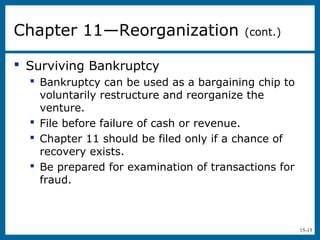
 Surviving Bankruptcy
 Bankruptcy can be used as a bargaining chip to
voluntarily restructure and reorganize the
venture.
 File before failure of cash or revenue.
 Chapter 11 should be filed only if a chance of
recovery exists.
 Be prepared for examination of transactions for
fraud.
Chapter 11—Reorganization (cont.)
15-16
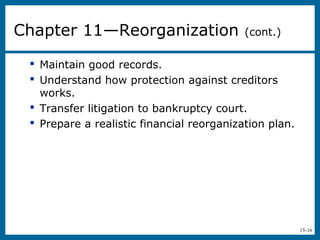
 Maintain good records.
 Understand how protection against creditors
works.
 Transfer litigation to bankruptcy court.
 Prepare a realistic financial reorganization plan.
Chapter 11—Reorganization (cont.)
15-17
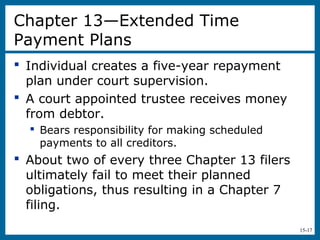
Chapter 13—Extended Time
Payment Plans
 Individual creates a five-year repayment
plan under court supervision.
 A court appointed trustee receives money
from debtor.
 Bears responsibility for making scheduled
payments to all creditors.
 About two of every three Chapter 13 filers
ultimately fail to meet their planned
obligations, thus resulting in a Chapter 7
filing.
15-18
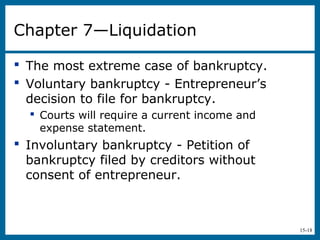
Chapter 7—Liquidation
 The most extreme case of bankruptcy.
 Voluntary bankruptcy - Entrepreneur’s
decision to file for bankruptcy.
 Courts will require a current income and
expense statement.
 Involuntary bankruptcy - Petition of
bankruptcy filed by creditors without
consent of entrepreneur.
15-19
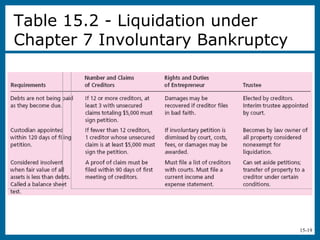
Table 15.2 - Liquidation under
Chapter 7 Involuntary Bankruptcy
15-20
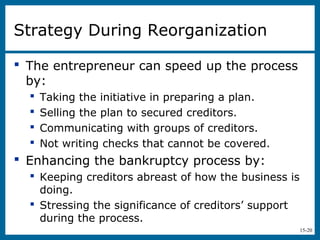
Strategy During Reorganization
 The entrepreneur can speed up the process
by:
 Taking the initiative in preparing a plan.
 Selling the plan to secured creditors.
 Communicating with groups of creditors.
 Not writing checks that cannot be covered.
 Enhancing the bankruptcy process by:
 Keeping creditors abreast of how the business is
doing.
 Stressing the significance of creditors’ support
during the process.
15-21
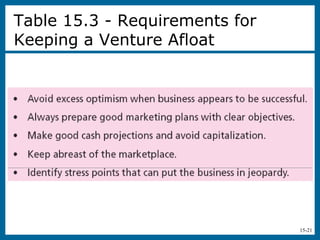
Table 15.3 - Requirements for
Keeping a Venture Afloat
15-22
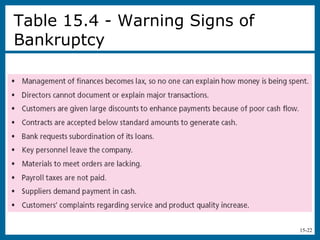
Table 15.4 - Warning Signs of
Bankruptcy
15-23
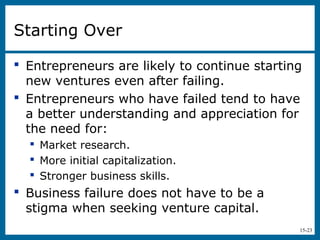
Starting Over
 Entrepreneurs are likely to continue starting
new ventures even after failing.
 Entrepreneurs who have failed tend to have
a better understanding and appreciation for
the need for:
 Market research.
 More initial capitalization.
 Stronger business skills.
 Business failure does not have to be a
stigma when seeking venture capital.
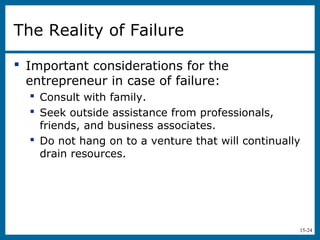
15-24
The Reality of Failure
 Important considerations for the
entrepreneur in case of failure:
 Consult with family.
 Seek outside assistance from professionals,
friends, and business associates.
 Do not hang on to a venture that will continually
drain resources.
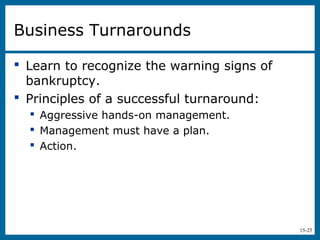
15-25
Business Turnarounds
 Learn to recognize the warning signs of
bankruptcy.
 Principles of a successful turnaround:
 Aggressive hands-on management.
 Management must have a plan.
 Action.

Entrepreneurship Chap 15

  • 1.
    Hisrich Peters Shepherd Chapter 15 Succession Planningand Strategies for Harvesting and Ending the Venture Copyright © 2010 by The McGraw-Hill Companies, Inc. All rights reserved.McGraw-Hill/Irwin
  • 2.
    15-2 Exit Strategy  Exitstrategies include:  Initial public offering (IPO).  Private sale of stock.  Succession by a family member or a nonfamily member.  Merger with another company.  Liquidation.
  • 3.
    15-3 Table 15.1 -Succession Planning Tips
  • 4.
    15-4 Succession of Business Transfer to Family Members  Role of owner - full-time/part-time/retire.  Family dynamics.  Income for working family members and shareholders.  Transition business environment.  Treatment of loyal employees.  Tax consequences.
  • 5.
    15-5  Transfer toNonfamily Members  Train a key employee and retain some equity.  Retain control and hire a manager.  Sell the business outright. Succession of Business (cont.)
  • 6.
    15-6 Options for Sellingthe Business  Direct Sale  Strategies to be considered:  Focus on a narrow, well-defined segment.  Control costs and focus on higher margins and profits.  Get all financial statements in order.  Prepare a management documentation.  Assess the condition of capital equipment.  Get tax advice.  Get nondisclosures from key employees.  Try to maintain a good management team.  Prepare and plan in advance.
  • 7.
    15-7  An importantconsideration is the type of payment the buyer will use.  Business brokers may be helpful.  The best way to communicate the business to potential buyers is through the business plan.  The role of an entrepreneur may vary depending on the sale agreement or contract with the new owner(s). Options for Selling the Business (cont.)
  • 8.
    15-8  Employee StockOption Plan  Establishes a new legal entity—an employee stock ownership trust.  Obligates the firm to repay the loan plus interest out of business cash flows.  Results in significant stock values for employees. Options for Selling the Business (cont.)
  • 9.
    15-9 Options for Sellingthe Business (cont.) Advantages: Motivates employees to put in extra time or effort. Provides a mechanism to pay back loyal employees. Allows transfer of business under a planned written agreement. Permits the company to reap the advantage of deducting contributions on ESOP or any dividends paid.
  • 10.
    15-10  Management Buyout Usually involves a direct sale of the venture for some predetermined price.  To establish a price, the entrepreneur should:  Have an appraisal of all the assets.  Determine the goodwill value established from past revenue.  Sale of a venture can be:  For cash.  Financed through banks  Through sale of voting or nonvoting stock.  The entrepreneur may agree to carry a note. Options for Selling the Business (cont.)
  • 11.
    15-11 Bankruptcy—An Overview  Mostcommon types of bankruptcies:  Chapter 7 or liquidation (69% in 2008).  Chapter 11 or reorganization (19% in 2008).  Chapter 13 or installment payments (12% in 2008).
  • 12.
    15-12  Bankruptcy lessons: Too much time and effort is spent on diversifying in markets where entrepreneurs lack knowledge.  Bankruptcy protects entrepreneurs from creditors, not from competitors.  It is difficult to separate entrepreneurs from the business.  Entrepreneurs should file for bankruptcy early.  Bankruptcy needs to be shared with employees and everybody else involved. Bankruptcy—An Overview (cont.)
  • 13.
    15-13  Bankruptcy Actof 1978 (with amendments added in 1984 and 2005) ensures:  Fair distribution of assets to creditors.  Protection of debtors from unfair depletion of assets.  Protection of debtors from unfair demands by creditors. Bankruptcy—An Overview (cont.)
  • 14.
    15-14 Chapter 11—Reorganization  Courtstry to give the venture “breathing room” to pay its debts.  A plan for reorganization is prepared and approved by the US Bankruptcy Court.  Decisions made reflect one or a combination of the following:  Extension - Postpone claims.  Substitution - Exchange stock for debt.  Composition settlement - Debt is prorated to creditors as settlement.
  • 15.
    15-15  Surviving Bankruptcy Bankruptcy can be used as a bargaining chip to voluntarily restructure and reorganize the venture.  File before failure of cash or revenue.  Chapter 11 should be filed only if a chance of recovery exists.  Be prepared for examination of transactions for fraud. Chapter 11—Reorganization (cont.)
  • 16.
    15-16  Maintain goodrecords.  Understand how protection against creditors works.  Transfer litigation to bankruptcy court.  Prepare a realistic financial reorganization plan. Chapter 11—Reorganization (cont.)
  • 17.
    15-17 Chapter 13—Extended Time PaymentPlans  Individual creates a five-year repayment plan under court supervision.  A court appointed trustee receives money from debtor.  Bears responsibility for making scheduled payments to all creditors.  About two of every three Chapter 13 filers ultimately fail to meet their planned obligations, thus resulting in a Chapter 7 filing.
  • 18.
    15-18 Chapter 7—Liquidation  Themost extreme case of bankruptcy.  Voluntary bankruptcy - Entrepreneur’s decision to file for bankruptcy.  Courts will require a current income and expense statement.  Involuntary bankruptcy - Petition of bankruptcy filed by creditors without consent of entrepreneur.
  • 19.
    15-19 Table 15.2 -Liquidation under Chapter 7 Involuntary Bankruptcy
  • 20.
    15-20 Strategy During Reorganization The entrepreneur can speed up the process by:  Taking the initiative in preparing a plan.  Selling the plan to secured creditors.  Communicating with groups of creditors.  Not writing checks that cannot be covered.  Enhancing the bankruptcy process by:  Keeping creditors abreast of how the business is doing.  Stressing the significance of creditors’ support during the process.
  • 21.
    15-21 Table 15.3 -Requirements for Keeping a Venture Afloat
  • 22.
    15-22 Table 15.4 -Warning Signs of Bankruptcy
  • 23.
    15-23 Starting Over  Entrepreneursare likely to continue starting new ventures even after failing.  Entrepreneurs who have failed tend to have a better understanding and appreciation for the need for:  Market research.  More initial capitalization.  Stronger business skills.  Business failure does not have to be a stigma when seeking venture capital.
  • 24.
    15-24 The Reality ofFailure  Important considerations for the entrepreneur in case of failure:  Consult with family.  Seek outside assistance from professionals, friends, and business associates.  Do not hang on to a venture that will continually drain resources.
  • 25.
    15-25 Business Turnarounds  Learnto recognize the warning signs of bankruptcy.  Principles of a successful turnaround:  Aggressive hands-on management.  Management must have a plan.  Action.