Strongyloides
Family- Strongyloididae
Genus-
1. Strongyloides
2. Parastongyloides
3. Leipernema
Strongyloides
• Also known as thread worms
• Nearly 52 species
• Infect birds, reptiles, amphibians, livestock and other
primates
• Important zoonotic spp. are
1. S. stecoralis
2. S. fueleborni
3. S. ransomi ( Experimentally human can be infected)
• Some important parasites of animals are
a) S. ransomi
b) S. westeri
c) S. papilosus
History…..
• Previously known as Cochin China Diarrhoea (First
discovered in 1876 in French soldiers who had been
in Cochin China)
• Discovered by French Naval Physician Louis
Norman (1876)
• Bravey (1877) named it separately Anguillula
stercoralis (Free living rhabditiform) & A.
intestinalis (Intestinal filarifom)
• Grassi & Parona (1878)- Homogonic cycle
• Peroncito (1881) – Heterogonic cycle
S. stercoralis
•1.0 mm length
•50μ diameter
•Filariform
Adult female
•Free-living adult males measure up to 750 µm long; free-living
females measure up to 1.0 mm long.
•Mucosa of duodenum, jejunum of man, other primates and dog
•Parthenogenetic repoduction in parasitic phase
Rhabditiform
oesophagus
Short Buccal
Canal Rhabditiform
oesophagus
Genital
primodium
L1 Larva
180-380 µm long
Free living stage
Excreted through faeces
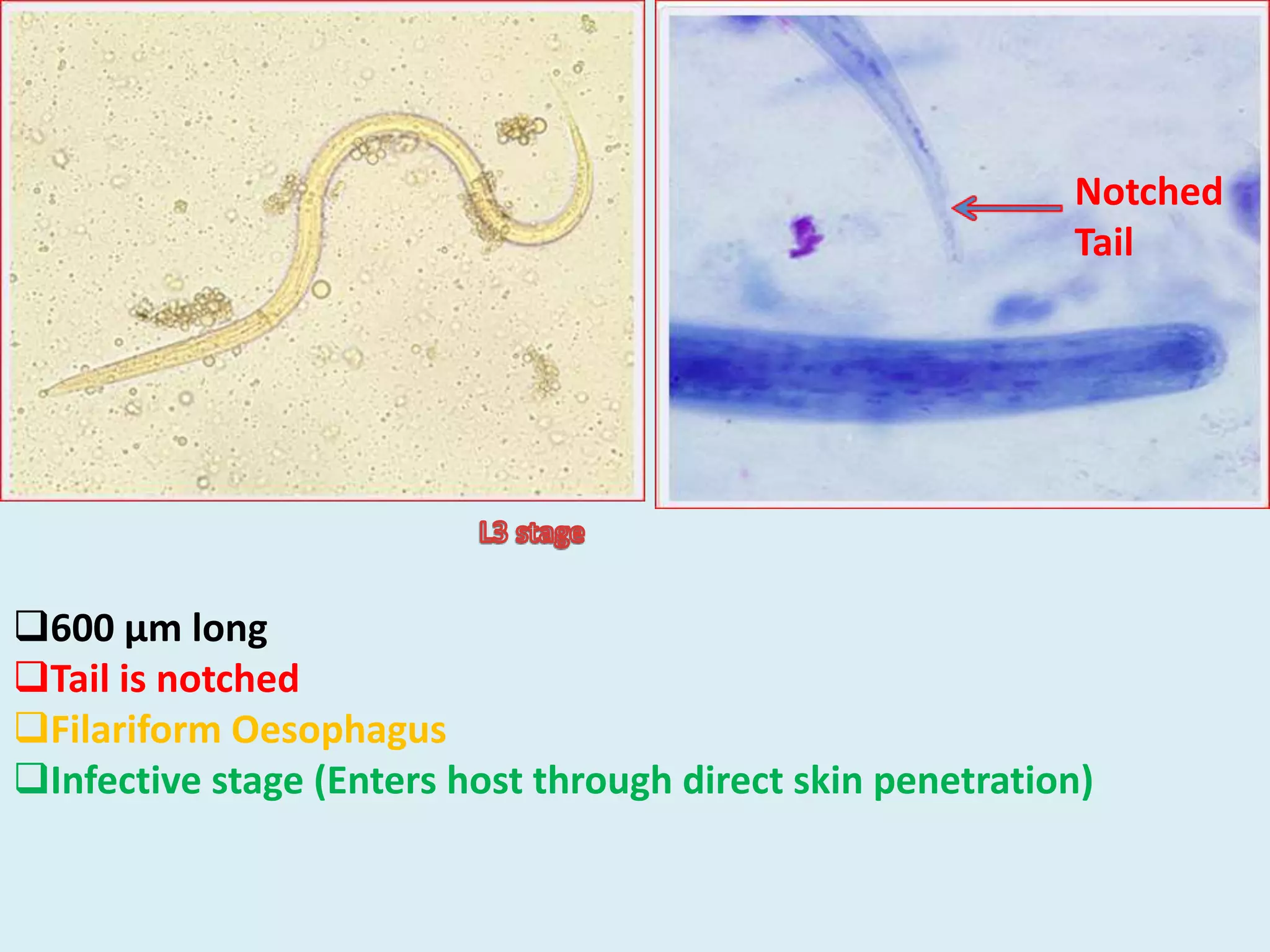
Notched
Tail
600 µm long
Tail is notched
Filariform Oesophagus
Infective stage (Enters host through direct skin penetration)
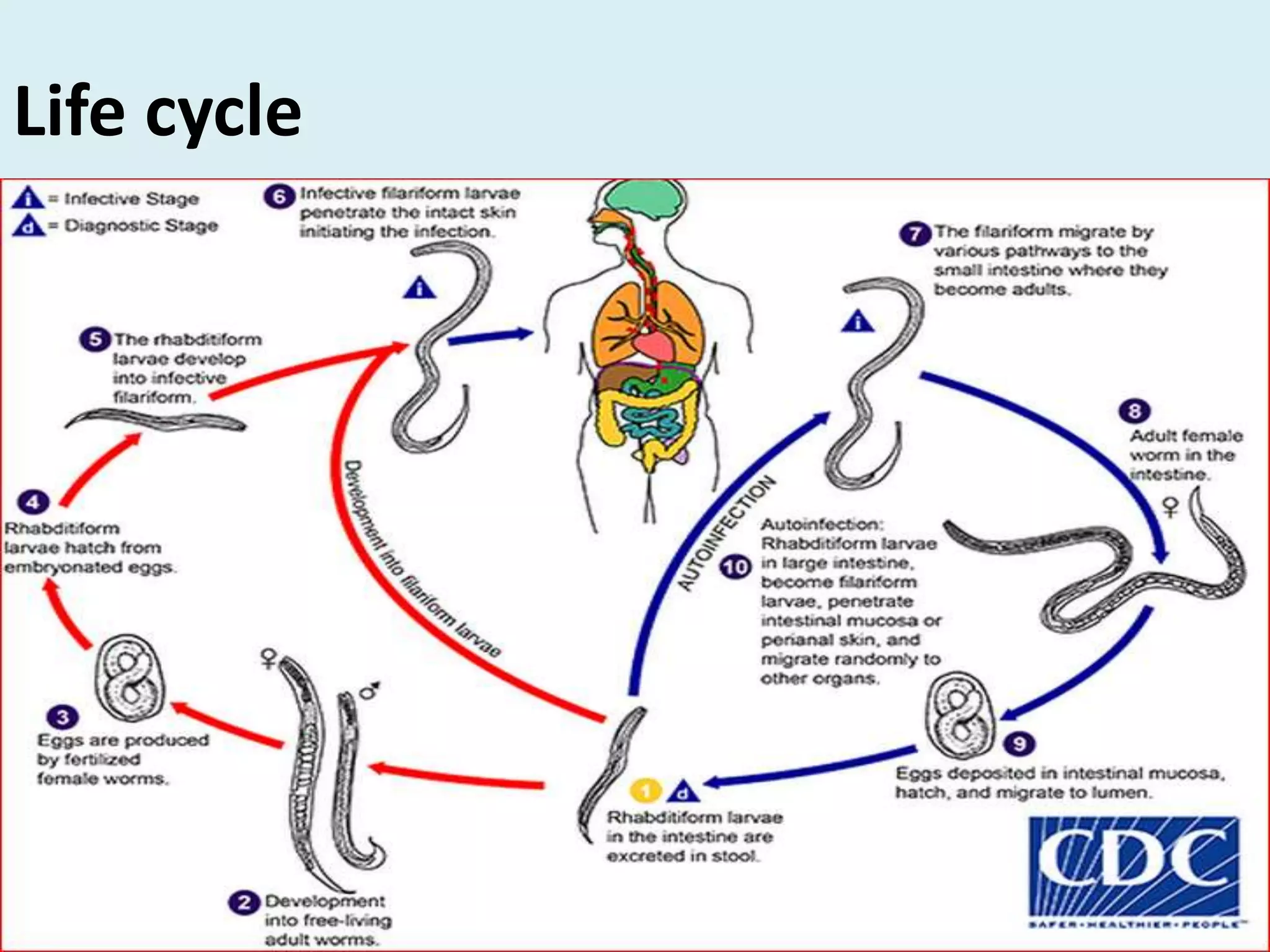
Life cycle
Homogonic cycle
• Adverse environmental condition
1) Acidic soil
2) Temperature (<200 C or >370 C)
Egg L1Excreted through
faces
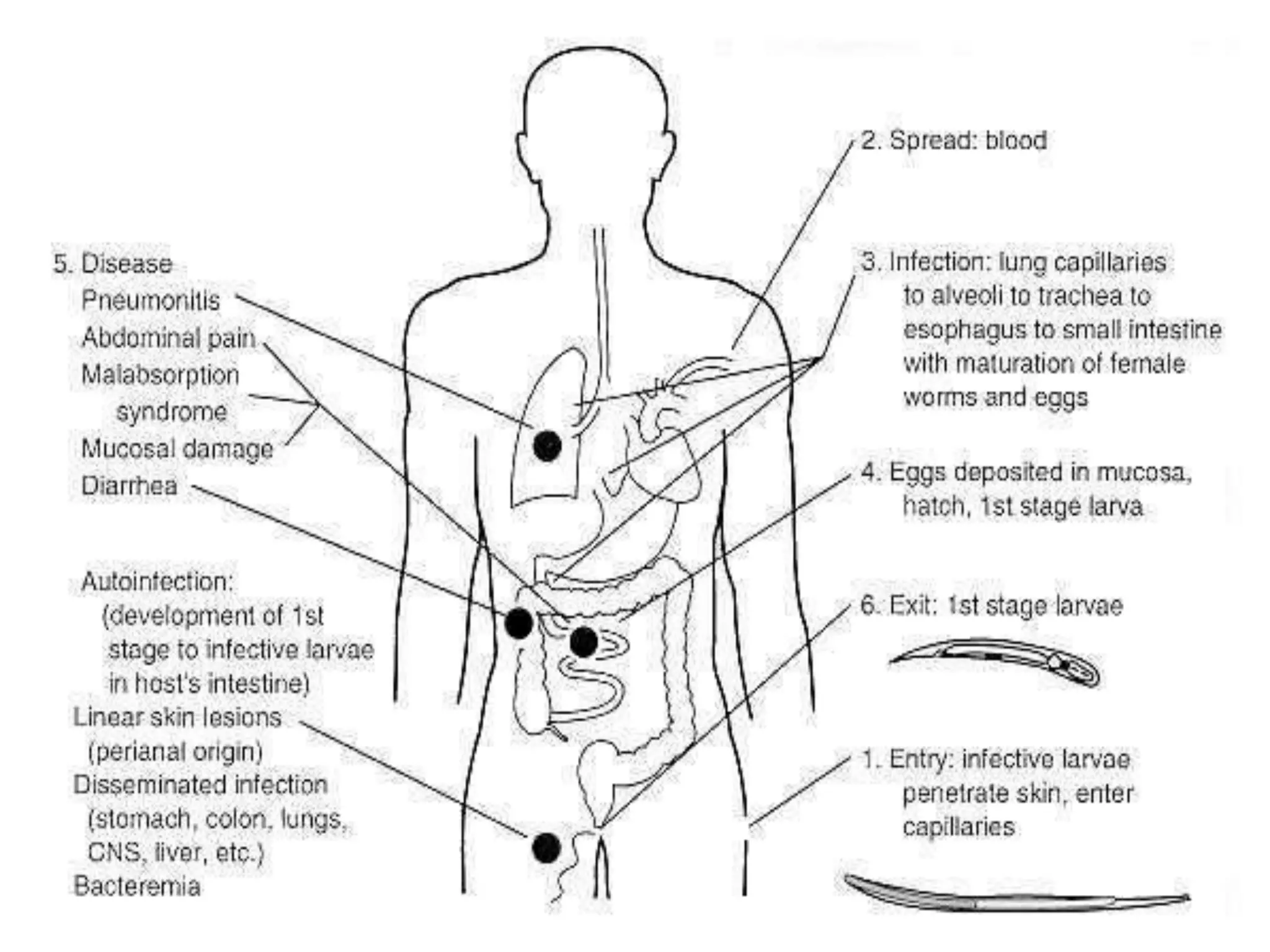
GIT L3 (Infective stage)
L3 enters through direct skin penetration
Migrate through blood vessels to lungs
Rupture alveoli and blood vessels
Reach trachea
Swallowed back to intestine where they mature
Heterogonic cycle
• Alternate type of L.C. (Free living + Parasitic)
• amplifier mechanism
• Under suitable condition
• Egg
Environmental cue is detected by 2 Amphidian Neuron at
the mid stage of L1 and accordingly development occurs
L1
Free living adult
(Rhabditifom)
Egg
L3(Filariform & Infective)
Super infection
1. Hyper infection
2. Auto infection
Hyper Infection
L3
Penetrate from lower part of intestine (Ileum & Colon) then migrate randomly in
various organs
L1
Migrate to upper part intestine and moult to L3
Egg
Laid by female in Intestine
Auto infection
• Filarifom larva excreted though faeces
• Penetrate skin though perianal or perineal
region
2 factors regulates super infection
1. Host resistance
2. Self regulatory mechanism (Crowding effect
due to declining level of Ecdysteroids after
certain level of population)
Epidemiology
• Poor countries
• Tropical
• Warm and humid
climate
Prevalence is up to 85%
• Hot and semi arid area
Prevalence is less than
3%
Disease in Human
 Depends upon immunity of human
 In immune individual remain as Hypobiotic form
 Until immune breakdown occurs (Mostly after
receiving coticosteroids)
 Clinical signs according to site of localization of
parasite (Cutaneous/ Pulmonary/ Gastro intestinal
form)
Cutaneous Symptoms
• Erythematous pustule at
the site of entry
• Leads to intense pruritus
and urticariae (more
severe in previously
sensitized individual)
• Linear/ serpiginous
urticarial inflammatiom
(Larva currens)
• Peripheral eosinophillia
Lava Currens
Distinguished from cutaneous
larva migrans by its rapid
migration, perianal involvement and
wide band of urticaria and
chronicity of infection
Pulmonary Symptoms
1. Bronchopneumonia
2. Breaking of capillary results in haemorrhage
3. Peripheral eosinophillia
 Associated with
a) Age <5 years
b) Steroid therapy
c) Use of anti histamines
d) Chronic debilitating disease
Intestinal symptoms
• More dominant form
• Atrophy of villi and hyperplasia of crypts (Thickening of
intestinal wall)
• Cattharal gastroenteritis
• Diarrhoea, epigastric pain, dyspnoea
>50% cases don’t show any signs
Manifests more severe infection due to hyper infection
when immune breakdown occurs
Disseminated form
• In immuno compromised individuals (particularly on
steroid therapy)
• Due to hyper infection
• Any system can be affected (mostly respiratory
system)
• Sometimes purulent meningitis
• Helps in dissemination intestinal bacteria
Steroid therapy- immunity breakdown + ecdysteoid
like substance in host tissue & intestinal wall.
increase moulting from L1 to L3
In animals…..
• Only observed in puppies
• >6 months resistant to autoinfection
• May be sub-clinical
• In clinical cases- Loss of appetite, purulent
conjunctivitis, bronchopneumonia
• At site of entry puritus, erythema, alopecia
• GI symptoms- Diarrhoea symptoms, abdominal pain,
vomiting
• In severe cases dehydration, emaciation, anemia and
bloody diarhoea is seen
Source of infection
1. Human reservoir host
2. Skin penetration is more common
3. In dogs also through oral, transmammary, uterine
route transmission occurs
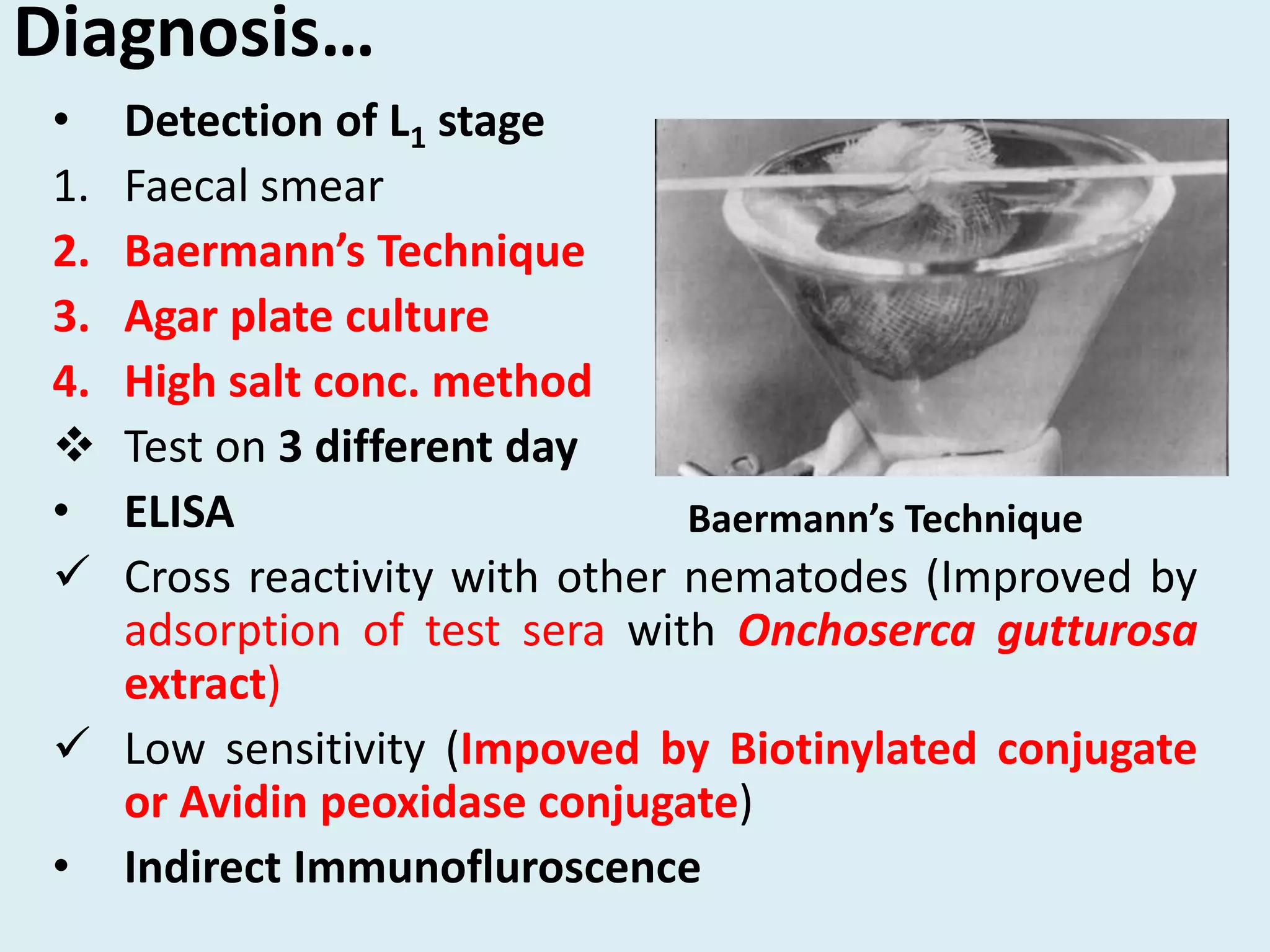
Diagnosis…
• Detection of L1 stage
1. Faecal smear
2. Baermann’s Technique
3. Agar plate culture
4. High salt conc. method
 Test on 3 different day
• ELISA
 Cross reactivity with other nematodes (Improved by
adsorption of test sera with Onchoserca gutturosa
extract)
 Low sensitivity (Impoved by Biotinylated conjugate
or Avidin peoxidase conjugate)
• Indirect Immunofluroscence
Baermann’s Technique
• L3 stage can be detected in parentral
tissue/body fluid (in disseminated infection),
sputum and tracheal wash
• Parastongylus trichosuri (parasite of
Australian marsupials) is used as lab model
for Strongyloides
Strongyloid on blood agar
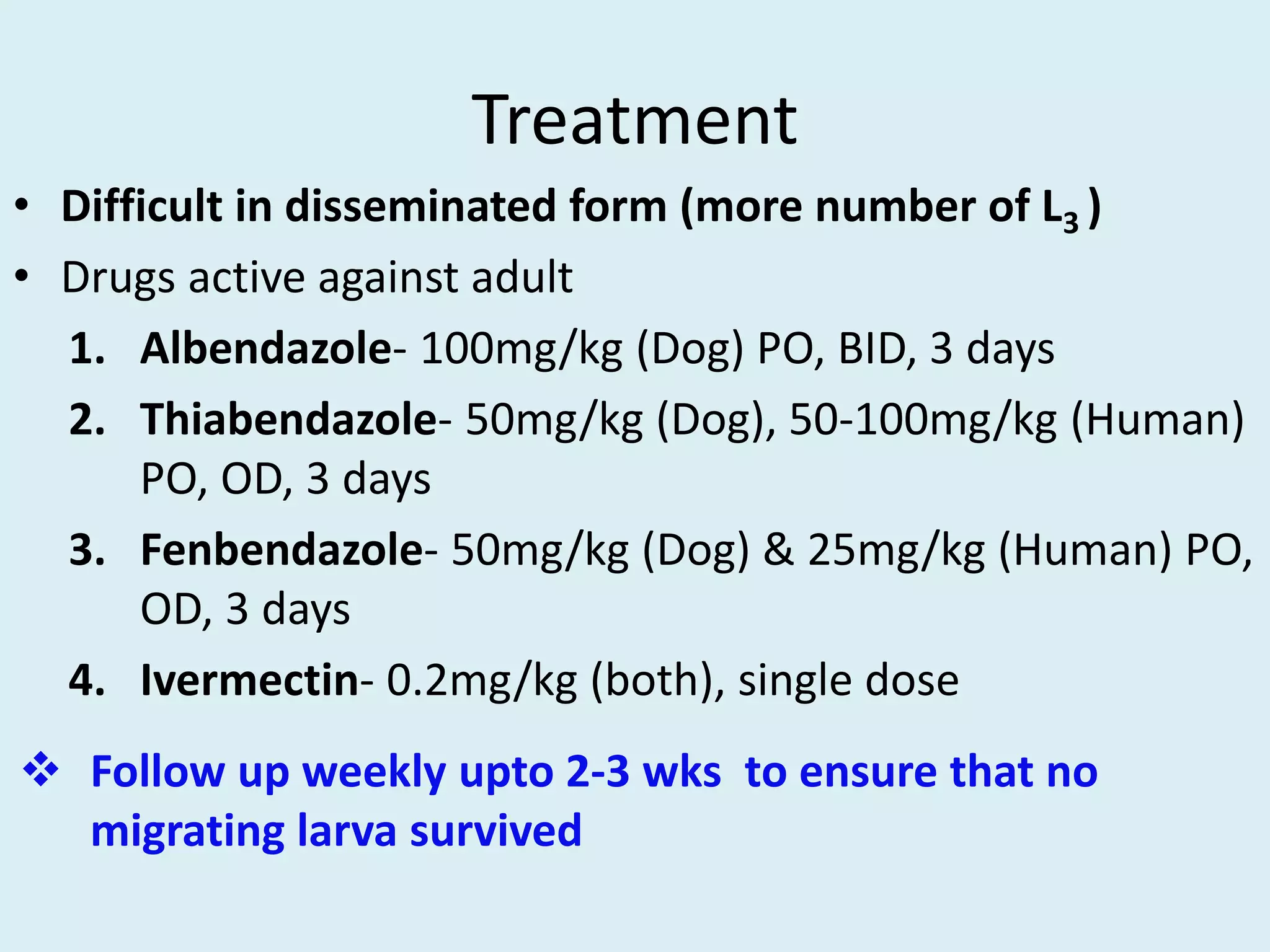
Treatment
• Difficult in disseminated form (more number of L3 )
• Drugs active against adult
1. Albendazole- 100mg/kg (Dog) PO, BID, 3 days
2. Thiabendazole- 50mg/kg (Dog), 50-100mg/kg (Human)
PO, OD, 3 days
3. Fenbendazole- 50mg/kg (Dog) & 25mg/kg (Human) PO,
OD, 3 days
4. Ivermectin- 0.2mg/kg (both), single dose
 Follow up weekly upto 2-3 wks to ensure that no
migrating larva survived
Prevention
1. Sanitary disposal of faeces
2. Treatment of clinical and sub-clinical cases
3. Using protective shoes
4. Washing hand before eating
5. Before steroid therapy patient s’d be treated for
strongyloidiasis and complete removal
S. fuelleborni
• More common in cental african humid jungle
e.g.- Cameroon, Ethiopia, Central African Republic, New
Guinea
• Also found in other places Zambia, Democratic Republican
of Congo, African Savannah
• In human it causes abdominal pain and diarrhoea
• In primates it causes benign infection to intense
haemorrhagic diarrhoea
• In faeces eggs are detected for diagnosis
Strongyloidiasis

Strongyloidiasis

  • 1.
  • 2.
  • 3.
    Strongyloides • Also knownas thread worms • Nearly 52 species • Infect birds, reptiles, amphibians, livestock and other primates • Important zoonotic spp. are 1. S. stecoralis 2. S. fueleborni 3. S. ransomi ( Experimentally human can be infected) • Some important parasites of animals are a) S. ransomi b) S. westeri c) S. papilosus
  • 4.
    History….. • Previously knownas Cochin China Diarrhoea (First discovered in 1876 in French soldiers who had been in Cochin China) • Discovered by French Naval Physician Louis Norman (1876) • Bravey (1877) named it separately Anguillula stercoralis (Free living rhabditiform) & A. intestinalis (Intestinal filarifom) • Grassi & Parona (1878)- Homogonic cycle • Peroncito (1881) – Heterogonic cycle
  • 5.
    S. stercoralis •1.0 mmlength •50μ diameter •Filariform Adult female •Free-living adult males measure up to 750 µm long; free-living females measure up to 1.0 mm long. •Mucosa of duodenum, jejunum of man, other primates and dog •Parthenogenetic repoduction in parasitic phase
  • 6.
    Rhabditiform oesophagus Short Buccal Canal Rhabditiform oesophagus Genital primodium L1Larva 180-380 µm long Free living stage Excreted through faeces
  • 7.
    Notched Tail 600 µm long Tailis notched Filariform Oesophagus Infective stage (Enters host through direct skin penetration)
  • 8.
  • 9.
    Homogonic cycle • Adverseenvironmental condition 1) Acidic soil 2) Temperature (<200 C or >370 C) Egg L1Excreted through faces GIT L3 (Infective stage) L3 enters through direct skin penetration Migrate through blood vessels to lungs Rupture alveoli and blood vessels Reach trachea Swallowed back to intestine where they mature
  • 10.
    Heterogonic cycle • Alternatetype of L.C. (Free living + Parasitic) • amplifier mechanism • Under suitable condition • Egg Environmental cue is detected by 2 Amphidian Neuron at the mid stage of L1 and accordingly development occurs L1 Free living adult (Rhabditifom) Egg L3(Filariform & Infective)
  • 11.
    Super infection 1. Hyperinfection 2. Auto infection
  • 12.
    Hyper Infection L3 Penetrate fromlower part of intestine (Ileum & Colon) then migrate randomly in various organs L1 Migrate to upper part intestine and moult to L3 Egg Laid by female in Intestine
  • 13.
    Auto infection • Filarifomlarva excreted though faeces • Penetrate skin though perianal or perineal region 2 factors regulates super infection 1. Host resistance 2. Self regulatory mechanism (Crowding effect due to declining level of Ecdysteroids after certain level of population)
  • 14.
    Epidemiology • Poor countries •Tropical • Warm and humid climate Prevalence is up to 85% • Hot and semi arid area Prevalence is less than 3%
  • 15.
    Disease in Human Depends upon immunity of human  In immune individual remain as Hypobiotic form  Until immune breakdown occurs (Mostly after receiving coticosteroids)  Clinical signs according to site of localization of parasite (Cutaneous/ Pulmonary/ Gastro intestinal form)
  • 16.
    Cutaneous Symptoms • Erythematouspustule at the site of entry • Leads to intense pruritus and urticariae (more severe in previously sensitized individual) • Linear/ serpiginous urticarial inflammatiom (Larva currens) • Peripheral eosinophillia Lava Currens Distinguished from cutaneous larva migrans by its rapid migration, perianal involvement and wide band of urticaria and chronicity of infection
  • 17.
    Pulmonary Symptoms 1. Bronchopneumonia 2.Breaking of capillary results in haemorrhage 3. Peripheral eosinophillia  Associated with a) Age <5 years b) Steroid therapy c) Use of anti histamines d) Chronic debilitating disease
  • 18.
    Intestinal symptoms • Moredominant form • Atrophy of villi and hyperplasia of crypts (Thickening of intestinal wall) • Cattharal gastroenteritis • Diarrhoea, epigastric pain, dyspnoea >50% cases don’t show any signs Manifests more severe infection due to hyper infection when immune breakdown occurs
  • 19.
    Disseminated form • Inimmuno compromised individuals (particularly on steroid therapy) • Due to hyper infection • Any system can be affected (mostly respiratory system) • Sometimes purulent meningitis • Helps in dissemination intestinal bacteria Steroid therapy- immunity breakdown + ecdysteoid like substance in host tissue & intestinal wall. increase moulting from L1 to L3
  • 20.
    In animals….. • Onlyobserved in puppies • >6 months resistant to autoinfection • May be sub-clinical • In clinical cases- Loss of appetite, purulent conjunctivitis, bronchopneumonia • At site of entry puritus, erythema, alopecia • GI symptoms- Diarrhoea symptoms, abdominal pain, vomiting • In severe cases dehydration, emaciation, anemia and bloody diarhoea is seen
  • 21.
    Source of infection 1.Human reservoir host 2. Skin penetration is more common 3. In dogs also through oral, transmammary, uterine route transmission occurs
  • 23.
    Diagnosis… • Detection ofL1 stage 1. Faecal smear 2. Baermann’s Technique 3. Agar plate culture 4. High salt conc. method  Test on 3 different day • ELISA  Cross reactivity with other nematodes (Improved by adsorption of test sera with Onchoserca gutturosa extract)  Low sensitivity (Impoved by Biotinylated conjugate or Avidin peoxidase conjugate) • Indirect Immunofluroscence Baermann’s Technique
  • 24.
    • L3 stagecan be detected in parentral tissue/body fluid (in disseminated infection), sputum and tracheal wash • Parastongylus trichosuri (parasite of Australian marsupials) is used as lab model for Strongyloides
  • 25.
  • 26.
    Treatment • Difficult indisseminated form (more number of L3 ) • Drugs active against adult 1. Albendazole- 100mg/kg (Dog) PO, BID, 3 days 2. Thiabendazole- 50mg/kg (Dog), 50-100mg/kg (Human) PO, OD, 3 days 3. Fenbendazole- 50mg/kg (Dog) & 25mg/kg (Human) PO, OD, 3 days 4. Ivermectin- 0.2mg/kg (both), single dose  Follow up weekly upto 2-3 wks to ensure that no migrating larva survived
  • 27.
    Prevention 1. Sanitary disposalof faeces 2. Treatment of clinical and sub-clinical cases 3. Using protective shoes 4. Washing hand before eating 5. Before steroid therapy patient s’d be treated for strongyloidiasis and complete removal
  • 28.
    S. fuelleborni • Morecommon in cental african humid jungle e.g.- Cameroon, Ethiopia, Central African Republic, New Guinea • Also found in other places Zambia, Democratic Republican of Congo, African Savannah • In human it causes abdominal pain and diarrhoea • In primates it causes benign infection to intense haemorrhagic diarrhoea • In faeces eggs are detected for diagnosis