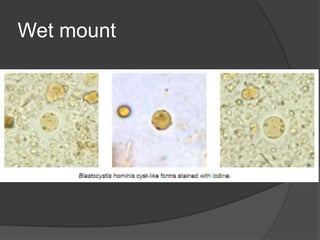
Wet mount
 Initially described by Prowasek and
  Alexeieff, then named by Brumpt in
  1912
 Blastocystis hominis is an inhabitant of
  the lower intestinal tract of humans and
  other animals
 Formerly classified as a yeast under the
  genus Schizosaccharomyces, while
  other taxonomists considered it to be
  related to Blastomyces
 Lacks a cell wall but has a mitochondrion
  with protozoan morphology.
 Capable of pseudopodial extension and
  retraction
 Asexual reproduction by binary fission or
  sporulation under strict anaerobic conditions
 Optimal growth= 37 oC in the presence of
  bacteria; does not grow on fungal media
Parasite Biology
 Multiplication of Blastocystis hominis is by
  binary fission
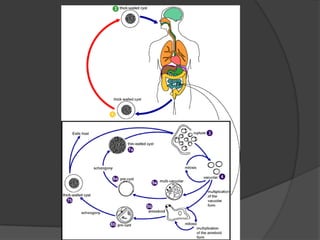
 Transmitted by fecal-oral route
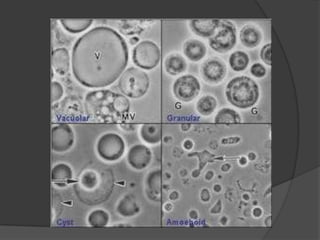
 Morphological forms:
    1. Vacuolated
    2. Ameba-like
    3. Granular
    4. Multiple fission
    5. Cyst
    6. Avacuolar
Vacuolated form
 Most predominant form in fecal specimen
 Spherical in shape, measuring 5-10 µm in
  diameter
 Large central vacuole pushes the cytoplasm
  and nuclei to the periphery of the cell
 Sometimes, very thick capsule surround them
 Prominent central vacuole has been found to be
  a reproductive organelle
 Main type of Blastocystis causing diarrhea
Ameba-like forms
 Occasionally observed in stool samples
 Exhibit active extension and retraction of
  pseudopodia
 The nuclear chromatin, when visible,
  characteristically shows peripheral clumping
 Appears to be an intermediate stage
  between the vacuolar and pre-cystic form
 Allows the parasite to ingest bacteria to
  enhance encystment
Granular forms
 Mainly observed from old cultures
 Diameter of the cell varies from 10 -60
  µm
 Granular contents develop into daughter
  cells of the ameba-form when the cell
  ruptures
Multiple Fission
 Arise from vacuolated forms
 It is believed that these multiple fission
  forms produce many vacuolated forms.
Cystic form
 Size in about 3-55 µm
 Has a very prominent and thick osmophilic
  electron dense wall
 Appears as a sharply demarcated polymorphic,
  but mostly oval or circular, dense body
  surrounded by a loose outer membranous layer
  (seen in contrast microscopy)
 Membranous layer corresponds to the fibrillar
  layer described around the cyst at ultrastructural
  level; easiest diagnostic feature
   It is assumed that the thick-walled cyst
    might be responsible for external
    transmission while those cysts with thin
    walls might be the cause of re-infection
    within a host’s intestinal tract
Pathogenesis and Clinical
Manifestation
 Blastocystosis- infection with Blastocystis
  hominis
 Blastocystis hominis as a cause of
  gastrointestinal pathology is controversial
 Several studies showed that the presence of
  parasite in a majority of patients was not
  associated with symptoms, or is found with
  other organisms that are more likely to be
  cause of the symptoms
 Other studies concluded that presence of
  Blastocystis in large numbers produce a
  wide variety of intestinal disorders:
  abdominal cramps, irritable bowel syndrome,
  bloating, flatulence, mild to moderate
  diarrhea without fecal leucocytes or blood,
  nausea, vomiting, low grade fever, and
  malaise
 Symptoms usually last about 3-10 days, but
  may sometimes persist for weeks or months
 It has been found out that in subjects
  suffering from Blastocystis showed a
  significant association with
  gastrointestinal symptoms
 Other studies also provided evidence of
  cellular immune function changes in
  infected individuals
Diagnosis
 Laboratory detection from stool is needed for
  confirmation
 Stool samples should be collected more than
  once from patients showing signs and
  symptoms
 Microscopic examination using direct fecal
  smear is useful but sensitivity is increased
  when concentration techniques are used
 Hematoxylin or trichome staining offers
  a very convenient and easy method to
  differentiate the various stages of
  Blastocystis
 Leukocytes are usually seen in fecal
  smears and stool eosinophilia may also be
  observed
 The organism can be cultured using the
  Boeck and Drbohlav’s or the Nelson
  and Jones media
Treatment
 Blastocystis is difficult to erradicate
 Hides in the intestinal mucus, sticks and
  holds on the intestinal membranes
 Drug of choice is metronidazole given at
  750 mg 3x daily for 10 days (Pedriatric
  dose: 35-50 mg per kg per day in 3 doses
  for 5 days) or iodoquinol given at 650
  mg 3x daily for 20 days.
 However, there are reported cases of
  resistance of Blastocystis to
  metronidazole
 Trimethroprim-sulfamethaxazole
  (TMP-SMX) has been found to be highly
  effective against Blastocystis
Epidemiology
 Reported practically worldwide, with
  infections common in tropical , subtropical
  and developing countries
 In general, studies from developed
  countries report approx. 1.5% - 10% overall
  prevalence of Blastocystis hominis
 All ages are affected but symptomatic
  cases are commonly found in children and
  in those with weakened immune systems
 A prevalence of up to 11.6% was reported
  from Stanford University Hospital
 Occurrence of parasite in temperate
  countries is generally associated with
  recent travel to the tropics and
  consumption of untreated drinking water,
  an indication that infection is possibly
  through the oral route and it is more likely
  to occur in crowded and unsanitary
  conditions
 Outbreaks of Blastocystis hominis in day
  care centers were reported in Spain, Brazil
  and Canada
 In the Philippines, results of 355 stools
  examined in 1997 by the Department of
  Parasitology, College of Public Health,
  University of the Philippines Manila,
  showed a prevalence of 22.8% with or
  without other intestinal parasites or
  organisms
 In 1988, the prevalence was 20.7% in
  772 stool samples examined.
 Studies have shown prevalence rates of
  40.6% among food service workers in a
  tertiary hospital and 23.6% among food
  handlers in selected school canteens in
  Manila
 Several animals like the pig-tailed
  macaques, chicken, dogs, and ostriches
  harbor Blastocystis similar to those found
  in humans.
 Evidence also shows that it is present in
  house lizards and cockroaches, thus
  implying that food and water contaminated
  by fecal droppings of these “home visitors”
  may transmit Blastocystis
Prevention and Control
 Disease can be prevented by consuming
  safe drinking water
 Provisions for sanitary preparation may
  be of value in efforts to prevent and
  control this infection
 The cysts of Blastocystis hominis can
  survive up to 19 days in water at normal
  temperature and have shown resistance
  to chlorine at the standard concentrations

Blastocystis hominis

  • 2.
  • 3.
     Initially describedby Prowasek and Alexeieff, then named by Brumpt in 1912  Blastocystis hominis is an inhabitant of the lower intestinal tract of humans and other animals  Formerly classified as a yeast under the genus Schizosaccharomyces, while other taxonomists considered it to be related to Blastomyces
  • 4.
     Lacks acell wall but has a mitochondrion with protozoan morphology.  Capable of pseudopodial extension and retraction  Asexual reproduction by binary fission or sporulation under strict anaerobic conditions  Optimal growth= 37 oC in the presence of bacteria; does not grow on fungal media
  • 5.
    Parasite Biology  Multiplicationof Blastocystis hominis is by binary fission  Transmitted by fecal-oral route  Morphological forms: 1. Vacuolated 2. Ameba-like 3. Granular 4. Multiple fission 5. Cyst 6. Avacuolar
  • 6.
    Vacuolated form  Mostpredominant form in fecal specimen  Spherical in shape, measuring 5-10 µm in diameter  Large central vacuole pushes the cytoplasm and nuclei to the periphery of the cell  Sometimes, very thick capsule surround them  Prominent central vacuole has been found to be a reproductive organelle  Main type of Blastocystis causing diarrhea
  • 7.
    Ameba-like forms  Occasionallyobserved in stool samples  Exhibit active extension and retraction of pseudopodia  The nuclear chromatin, when visible, characteristically shows peripheral clumping  Appears to be an intermediate stage between the vacuolar and pre-cystic form  Allows the parasite to ingest bacteria to enhance encystment
  • 8.
    Granular forms  Mainlyobserved from old cultures  Diameter of the cell varies from 10 -60 µm  Granular contents develop into daughter cells of the ameba-form when the cell ruptures
  • 9.
    Multiple Fission  Arisefrom vacuolated forms  It is believed that these multiple fission forms produce many vacuolated forms.
  • 10.
    Cystic form  Sizein about 3-55 µm  Has a very prominent and thick osmophilic electron dense wall  Appears as a sharply demarcated polymorphic, but mostly oval or circular, dense body surrounded by a loose outer membranous layer (seen in contrast microscopy)  Membranous layer corresponds to the fibrillar layer described around the cyst at ultrastructural level; easiest diagnostic feature
  • 11.
    It is assumed that the thick-walled cyst might be responsible for external transmission while those cysts with thin walls might be the cause of re-infection within a host’s intestinal tract
  • 14.
    Pathogenesis and Clinical Manifestation Blastocystosis- infection with Blastocystis hominis  Blastocystis hominis as a cause of gastrointestinal pathology is controversial  Several studies showed that the presence of parasite in a majority of patients was not associated with symptoms, or is found with other organisms that are more likely to be cause of the symptoms
  • 15.
     Other studiesconcluded that presence of Blastocystis in large numbers produce a wide variety of intestinal disorders: abdominal cramps, irritable bowel syndrome, bloating, flatulence, mild to moderate diarrhea without fecal leucocytes or blood, nausea, vomiting, low grade fever, and malaise  Symptoms usually last about 3-10 days, but may sometimes persist for weeks or months
  • 16.
     It hasbeen found out that in subjects suffering from Blastocystis showed a significant association with gastrointestinal symptoms  Other studies also provided evidence of cellular immune function changes in infected individuals
  • 17.
    Diagnosis  Laboratory detectionfrom stool is needed for confirmation  Stool samples should be collected more than once from patients showing signs and symptoms  Microscopic examination using direct fecal smear is useful but sensitivity is increased when concentration techniques are used
  • 18.
     Hematoxylin ortrichome staining offers a very convenient and easy method to differentiate the various stages of Blastocystis  Leukocytes are usually seen in fecal smears and stool eosinophilia may also be observed  The organism can be cultured using the Boeck and Drbohlav’s or the Nelson and Jones media
  • 19.
    Treatment  Blastocystis isdifficult to erradicate  Hides in the intestinal mucus, sticks and holds on the intestinal membranes  Drug of choice is metronidazole given at 750 mg 3x daily for 10 days (Pedriatric dose: 35-50 mg per kg per day in 3 doses for 5 days) or iodoquinol given at 650 mg 3x daily for 20 days.
  • 20.
     However, thereare reported cases of resistance of Blastocystis to metronidazole  Trimethroprim-sulfamethaxazole (TMP-SMX) has been found to be highly effective against Blastocystis
  • 21.
    Epidemiology  Reported practicallyworldwide, with infections common in tropical , subtropical and developing countries  In general, studies from developed countries report approx. 1.5% - 10% overall prevalence of Blastocystis hominis  All ages are affected but symptomatic cases are commonly found in children and in those with weakened immune systems
  • 22.
     A prevalenceof up to 11.6% was reported from Stanford University Hospital  Occurrence of parasite in temperate countries is generally associated with recent travel to the tropics and consumption of untreated drinking water, an indication that infection is possibly through the oral route and it is more likely to occur in crowded and unsanitary conditions
  • 23.
     Outbreaks ofBlastocystis hominis in day care centers were reported in Spain, Brazil and Canada  In the Philippines, results of 355 stools examined in 1997 by the Department of Parasitology, College of Public Health, University of the Philippines Manila, showed a prevalence of 22.8% with or without other intestinal parasites or organisms
  • 24.
     In 1988,the prevalence was 20.7% in 772 stool samples examined.  Studies have shown prevalence rates of 40.6% among food service workers in a tertiary hospital and 23.6% among food handlers in selected school canteens in Manila
  • 25.
     Several animalslike the pig-tailed macaques, chicken, dogs, and ostriches harbor Blastocystis similar to those found in humans.  Evidence also shows that it is present in house lizards and cockroaches, thus implying that food and water contaminated by fecal droppings of these “home visitors” may transmit Blastocystis
  • 26.
    Prevention and Control Disease can be prevented by consuming safe drinking water  Provisions for sanitary preparation may be of value in efforts to prevent and control this infection  The cysts of Blastocystis hominis can survive up to 19 days in water at normal temperature and have shown resistance to chlorine at the standard concentrations