ENT Referrals
-To & From Other Branches
Dr Harjitpal Singh
Assistant Professor
Department of ENT
HOARSENESS
 Hoarseness is a symptom resulting from the
underlying disease process
– AND IT IS NOT A diagnosis
 Hoarseness has a number of causes,
ranging from simple inflammatory
processes to less common psychiatric
disorders to more serious systemic,
neurologic, or cancerous conditions.
POTENTIAL CAUSES OF VOICE
DISORDERS/HOARESENESS
a) Misuse/abuse – Yelling, Excessive Talking, Excessive Crying, Chronic
Coughing, Throat Clearing, Poor Hydration, Misuse Of Pitch,
Chronic Exposure To Irritants, Excessive Muscle Tension
b) Structural impairment –Nodules, Cysts, Polyps, Laryngeal Webs,
Stenosis, Chronic Upper Airway Impairment, Laryngeal Scarring,
Limited Breath Support For Speech, Inflammation Due To Acid
Reflux, Laryngeal Papilloma, Growth Involving Larynx
C) Neurogenic – Cerebral Palsy, Head Injury, Muscular Dystrophy, Vocal
Fold Paralysis, CVA, Parkinson Disease, Myasthenia Gravis
D) Psychological – Mutational Falsetto/ Puberphonia- Unusual high pitch
that persists beyond puberty, Conversion Aphonia/Dysphonia
e) Hearing loss – May cause patient to speak with high intensity or
louder than normal
Steroid inhaler laryngitis
 Steroid inhaler laryngitis, a clinical entity that is caused
by the use of inhaled steroids and manifested by
dysphonia, throat clearing, and fullness.
 Steroid inhaler laryngitis is a form of chemical
laryngopharyngitis induced by topical steroid
administration. Symptoms and physical findings mimic
laryngopharyngeal reflux, but only respond completely
to discontinuation of the inhaled steroid therapy.
Physical Examination
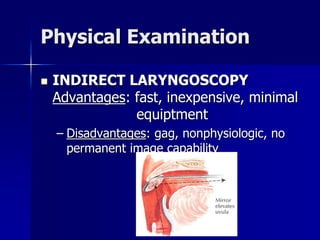
 INDIRECT LARYNGOSCOPY
Advantages: fast, inexpensive, minimal
equiptment
– Disadvantages: gag, nonphysiologic, no
permanent image capability
Physical Examination
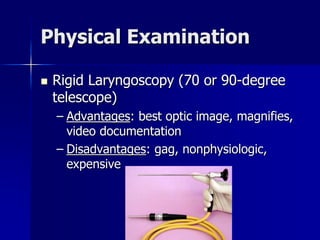
 Rigid Laryngoscopy (70 or 90-degree
telescope)
– Advantages: best optic image, magnifies,
video documentation
– Disadvantages: gag, nonphysiologic,
expensive
Physical Examination
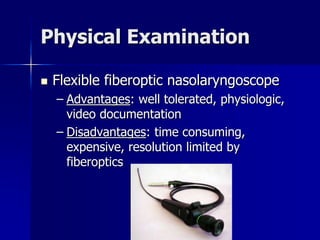
 Flexible fiberoptic nasolaryngoscope
– Advantages: well tolerated, physiologic,
video documentation
– Disadvantages: time consuming,
expensive, resolution limited by
fiberoptics
Physical Examination
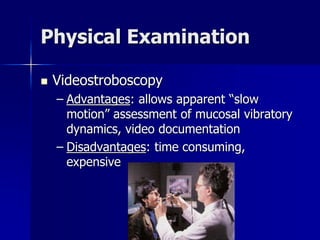
 Videostroboscopy
– Advantages: allows apparent “slow
motion” assessment of mucosal vibratory
dynamics, video documentation
– Disadvantages: time consuming,
expensive
Physical Examination
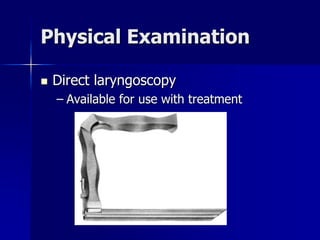
 Direct laryngoscopy
– Available for use with treatment
Differential Diangosis
 Benign Laryngeal Conditions
 Vocal cord nodules are commonly secondary to chronic phonotrauma (vocal
abuse)
– They are benign lesions that are frequently bilateral, occurring at the
junction between the anterior and middle third of the vocal folds.
– Management is mainly from the Speech and Language Therapy (SALT)
team, however in severe or resistant cases, surgical intervention may be
warranted
 Muscle tension dysphonia is caused by habitual misuse of the muscles of
the larynx or phonatory gap
– Commonly present with a hoarse voice worsening towards the end of the
day or following prolonged use.
– Diagnosis can be confirmed via stroboscopy and the mainstay of
management is from the Speech therapy.
 Vocal cord polyps are typically benign lesions, however unlike vocal cord
nodules, they are normally unilateral and may need surgical excision to exclude
malignancy.
Differential Diangosis
 Laryngeal papillomas are also benign lesions in the larynx,
commonly caused by HPV infection
– If left untreated, papillomas can grow to cause airway
obstruction and hence need surgical excision or debulking.
It is not uncommon for patients to need repeat procedures
as papillomas can recur.
 Reflux laryngitis is a cause of hoarseness caused by
acid reflux resulting in inflammation of the larynx.
– Clinical examination will often be unremarkable, but IDL
will reveal an erythematous larynx.
 Reinke’s oedema is oedema of the vocal folds. It is strongly
linked to smoking. Smoking cessation and voice therapy are
the mainstay of treatment.
Differential Diangosis
 Infective
 Laryngitis is inflammation of the vocal cords, commonly following
respiratory tract infections
– Clinical examination will be normal but IDL will reveal an
inflamed larynx. This can be managed conservatively and should
result in complete recovery.
 Acute epiglottitis is infection of the epiglottis
 Neurological
 A recurrent laryngeal nerve palsy can be caused by a wide
variety of underlying causes, including thyroid cancer, lung cancer,
aortic aneurysm, multiple sclerosis , or stroke.
 Extensive examinations are key to further delineating the underlying
diagnosis such as neck examination and cranial nerve examination.
Initial investigation if examination is unremarkable would be CT
imaging from skull base to diaphragm to assess for any pathology
affecting the recurrent laryngeal nerve.
Key Points
 Wide range of pathology can result
in hoarseness, from inflammatory to
neurological
 All patients should undergo INDIRECT
LARYNGOSCOPY OR flexible nasal
endoscopy to allow for the
visualization of the larynx and the
vocal cords, before further
investigations can occur
CHRONIC
PHARYNGITIS
CHRONIC PHARYNGITIS
 Pharyngitis is defined as inflammation of the
pharynx.
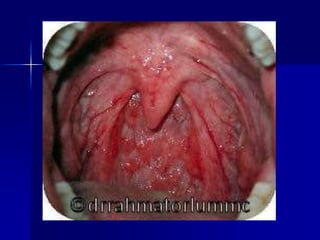
 Chronic Pharyngitis is characterized by
hypertrophy of mucosa, seromucinous glands
and sub epithelial lymphoid tissues
 The anatomic region of the pharynx invariably
affected in adults is the oropharynx.
 The predominant symptom is sore throat, which
overall is the third most common chief complaint
to physicians in an office-based practice.
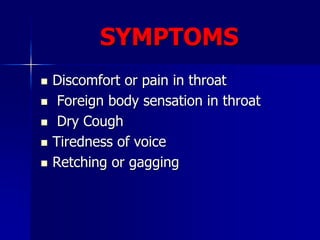
SYMPTOMS
 Discomfort or pain in throat
 Foreign body sensation in throat
 Dry Cough
 Tiredness of voice
 Retching or gagging
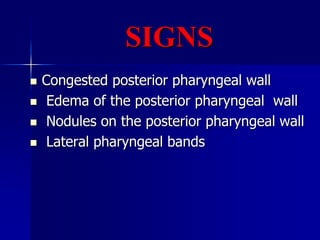
SIGNS
 Congested posterior pharyngeal wall
 Edema of the posterior pharyngeal wall
 Nodules on the posterior pharyngeal wall
 Lateral pharyngeal bands
EPISTAXIS
EPISTAXIS
 Epistaxis is a Greek word meaning nose
bleed, has been a part of the human
experience from earliest times.
CLASSIFICATION OF EPISTAXIS
 Primary –no obvious
cause
 Mild – no hemodynamic
alteration
 Anterior : Kiesselbach’s
plexus/Littles area
 Seasonal : cold dry
months
 Unilateral : one nostril
bleed
 Secondary-cause present
 Moderate to severe-
hemodynamically unstable
 Posterior : Woodruff's
plexus
 Perennial: throughout year
 Bilateral : bleeds into
throat or from both nostrils
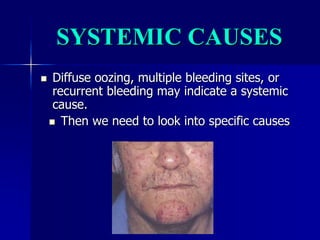
SYSTEMIC CAUSES
 Diffuse oozing, multiple bleeding sites, or
recurrent bleeding may indicate a systemic
cause.
 Then we need to look into specific causes
SYSTEMIC CAUSES(Cont.)
 Haemophilia
 Hypertension
 Raised venous pressure in cardiac or
pulmonary diseases e. g miteral stenosis
 Leukemia
 Liver disease (e.g., cirrhosis,Factor defeciency)
 Medications e.g., aspirin, anticoagulants, nonsteroidal anti-
inflammatory drugs
 Platelet dysfunction & Thrombocytopenia
SYSTEMIC CAUSES(Cont.)
 Liver disease
• Hepatic cirrhosis(deficiency of factor II,VII,, IX, and X)
 Kidney disease(Chronic nephritis)
 Drugs
• Sallicylates and other analgesic
• Anticoagulant therapy
 Mediastinal compression(tumor causing raised venous pressure)
 Acute general infection(influenza, measules, whooping cough)
 Vicarious menstruation -during the period.
ETIOLOGY AND AGE
 Children - foreign body, nose picking
 Adults - trauma, idiopathic
 Middle age - tumors
 Old age - hypertension
Aetiology
Local Causes
Trauma
– Nose picking,
– Fractures (nasal bone, sinuses and/or skull base)
– Nasal intubation
– Surgery
Infections
● Fungal infection
● Suppurative sinusitis
● Influenza, Measles,Diphtheria,Tuberculosis
● Atrophic rhinitis
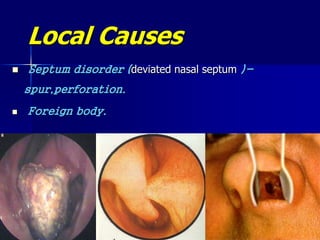
Local Causes
 Septum disorder (deviated nasal septum )-
spur,perforation.
 Foreign body.
.
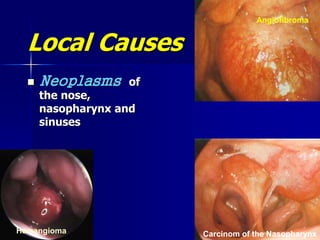
Local Causes
 Neoplasms of
the nose,
nasopharynx and
sinuses
Carcinom of the Nasopharynx
Angiofibroma
Hemangioma
Environmental reason
 High altitudes
(drier and lower atm. pressure)
 Air-conditioning
 Extreme changes in temperature
Idiopathic
 Vast majority of cases come under this category
 “Spontaneous” is a better description.
 Usually initiated by minor ‘digital’ trauma.
 Often associated with atmospheric drying.
OTALGIA
OTALGIA
Otogenic or Primary otalgia:
is the pain that originates by a
disease within the ear.
Referred or secondary otalgia:
is the pain that originates by a
disease outside the ear.
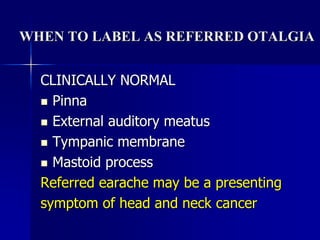
WHEN TO LABEL AS REFERRED OTALGIA
CLINICALLY NORMAL
 Pinna
 External auditory meatus
 Tympanic membrane
 Mastoid process
Referred earache may be a presenting
symptom of head and neck cancer
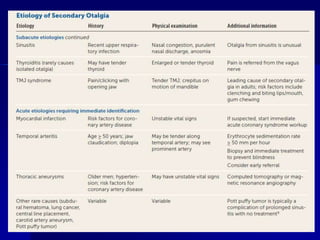
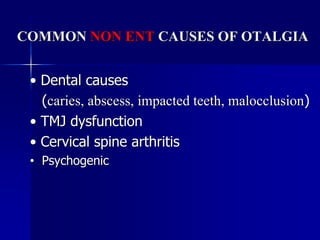
COMMON NON ENT CAUSES OF OTALGIA
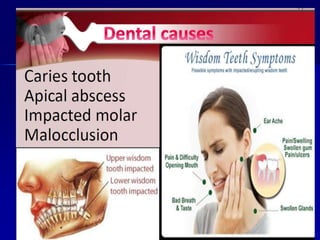
• Dental causes
(caries, abscess, impacted teeth, malocclusion)
• TMJ dysfunction
• Cervical spine arthritis
• Psychogenic
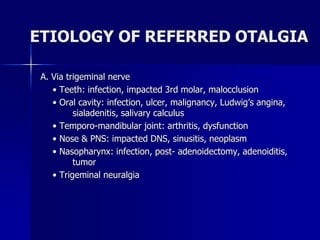
ETIOLOGY OF REFERRED OTALGIA
A. Via trigeminal nerve
• Teeth: infection, impacted 3rd molar, malocclusion
• Oral cavity: infection, ulcer, malignancy, Ludwig’s angina,
sialadenitis, salivary calculus
• Temporo-mandibular joint: arthritis, dysfunction
• Nose & PNS: impacted DNS, sinusitis, neoplasm
• Nasopharynx: infection, post- adenoidectomy, adenoiditis,
tumor
• Trigeminal neuralgia
ETIOLOGY OF REFERRED OTALGIA (cont.)
B. Via glossopharyngeal nerve
• Tonsil: tonsillitis, peritonsillar abscess, posttonsillectomy,
neoplasm
• Oropharynx: infection, ulcer, retropharyngeal +parapharyngeal
abscess, trauma, neoplasm
• Eagle’s syndrome (stylalgia)
• Glossopharyngeal neuralgia
C. Via facial nerve:
Herpes zoster oticus, vestibular schwannoma
ETIOLOGY OF REFERRED OTALGIA (cont.)
D. Via vagus nerve:
Larynx + hypopharynx: neoplasm, infection, tuberculosis,
trauma, foreign body
E. Via second & third cervical nerves:
Herpes zoster, cervical spondylosis & arthritis
Cervical Spine Artheritis
 Cause crepitus or neck and ear pain with
neck movements
 Decreased neck range of motion
 Tender spinous processes or Para-spinal
muscles
 Pain referred to ear from C2,C3 cervical
nerve root
Psychogenic Otalgia
When no cause to the pain in ears can be
found, it suggest a functional origin.
The patient in such cases should be kept
under observation with periodic re-
evaluation.
Ent Referrals- To & from Other Branches

Ent Referrals- To & from Other Branches

  • 1.
    ENT Referrals -To &From Other Branches Dr Harjitpal Singh Assistant Professor Department of ENT
  • 2.
    HOARSENESS  Hoarseness isa symptom resulting from the underlying disease process – AND IT IS NOT A diagnosis  Hoarseness has a number of causes, ranging from simple inflammatory processes to less common psychiatric disorders to more serious systemic, neurologic, or cancerous conditions.
  • 3.
    POTENTIAL CAUSES OFVOICE DISORDERS/HOARESENESS a) Misuse/abuse – Yelling, Excessive Talking, Excessive Crying, Chronic Coughing, Throat Clearing, Poor Hydration, Misuse Of Pitch, Chronic Exposure To Irritants, Excessive Muscle Tension b) Structural impairment –Nodules, Cysts, Polyps, Laryngeal Webs, Stenosis, Chronic Upper Airway Impairment, Laryngeal Scarring, Limited Breath Support For Speech, Inflammation Due To Acid Reflux, Laryngeal Papilloma, Growth Involving Larynx C) Neurogenic – Cerebral Palsy, Head Injury, Muscular Dystrophy, Vocal Fold Paralysis, CVA, Parkinson Disease, Myasthenia Gravis D) Psychological – Mutational Falsetto/ Puberphonia- Unusual high pitch that persists beyond puberty, Conversion Aphonia/Dysphonia e) Hearing loss – May cause patient to speak with high intensity or louder than normal
  • 4.
    Steroid inhaler laryngitis Steroid inhaler laryngitis, a clinical entity that is caused by the use of inhaled steroids and manifested by dysphonia, throat clearing, and fullness.  Steroid inhaler laryngitis is a form of chemical laryngopharyngitis induced by topical steroid administration. Symptoms and physical findings mimic laryngopharyngeal reflux, but only respond completely to discontinuation of the inhaled steroid therapy.
  • 5.
    Physical Examination  INDIRECTLARYNGOSCOPY Advantages: fast, inexpensive, minimal equiptment – Disadvantages: gag, nonphysiologic, no permanent image capability
  • 6.
    Physical Examination  RigidLaryngoscopy (70 or 90-degree telescope) – Advantages: best optic image, magnifies, video documentation – Disadvantages: gag, nonphysiologic, expensive
  • 7.
    Physical Examination  Flexiblefiberoptic nasolaryngoscope – Advantages: well tolerated, physiologic, video documentation – Disadvantages: time consuming, expensive, resolution limited by fiberoptics
  • 8.
    Physical Examination  Videostroboscopy –Advantages: allows apparent “slow motion” assessment of mucosal vibratory dynamics, video documentation – Disadvantages: time consuming, expensive
  • 9.
    Physical Examination  Directlaryngoscopy – Available for use with treatment
  • 10.
    Differential Diangosis  BenignLaryngeal Conditions  Vocal cord nodules are commonly secondary to chronic phonotrauma (vocal abuse) – They are benign lesions that are frequently bilateral, occurring at the junction between the anterior and middle third of the vocal folds. – Management is mainly from the Speech and Language Therapy (SALT) team, however in severe or resistant cases, surgical intervention may be warranted  Muscle tension dysphonia is caused by habitual misuse of the muscles of the larynx or phonatory gap – Commonly present with a hoarse voice worsening towards the end of the day or following prolonged use. – Diagnosis can be confirmed via stroboscopy and the mainstay of management is from the Speech therapy.  Vocal cord polyps are typically benign lesions, however unlike vocal cord nodules, they are normally unilateral and may need surgical excision to exclude malignancy.
  • 11.
    Differential Diangosis  Laryngealpapillomas are also benign lesions in the larynx, commonly caused by HPV infection – If left untreated, papillomas can grow to cause airway obstruction and hence need surgical excision or debulking. It is not uncommon for patients to need repeat procedures as papillomas can recur.  Reflux laryngitis is a cause of hoarseness caused by acid reflux resulting in inflammation of the larynx. – Clinical examination will often be unremarkable, but IDL will reveal an erythematous larynx.  Reinke’s oedema is oedema of the vocal folds. It is strongly linked to smoking. Smoking cessation and voice therapy are the mainstay of treatment.
  • 12.
    Differential Diangosis  Infective Laryngitis is inflammation of the vocal cords, commonly following respiratory tract infections – Clinical examination will be normal but IDL will reveal an inflamed larynx. This can be managed conservatively and should result in complete recovery.  Acute epiglottitis is infection of the epiglottis  Neurological  A recurrent laryngeal nerve palsy can be caused by a wide variety of underlying causes, including thyroid cancer, lung cancer, aortic aneurysm, multiple sclerosis , or stroke.  Extensive examinations are key to further delineating the underlying diagnosis such as neck examination and cranial nerve examination. Initial investigation if examination is unremarkable would be CT imaging from skull base to diaphragm to assess for any pathology affecting the recurrent laryngeal nerve.
  • 13.
    Key Points  Widerange of pathology can result in hoarseness, from inflammatory to neurological  All patients should undergo INDIRECT LARYNGOSCOPY OR flexible nasal endoscopy to allow for the visualization of the larynx and the vocal cords, before further investigations can occur
  • 14.
  • 15.
    CHRONIC PHARYNGITIS  Pharyngitisis defined as inflammation of the pharynx.  Chronic Pharyngitis is characterized by hypertrophy of mucosa, seromucinous glands and sub epithelial lymphoid tissues  The anatomic region of the pharynx invariably affected in adults is the oropharynx.  The predominant symptom is sore throat, which overall is the third most common chief complaint to physicians in an office-based practice.
  • 19.
    SYMPTOMS  Discomfort orpain in throat  Foreign body sensation in throat  Dry Cough  Tiredness of voice  Retching or gagging
  • 20.
    SIGNS  Congested posteriorpharyngeal wall  Edema of the posterior pharyngeal wall  Nodules on the posterior pharyngeal wall  Lateral pharyngeal bands
  • 22.
  • 23.
    EPISTAXIS  Epistaxis isa Greek word meaning nose bleed, has been a part of the human experience from earliest times.
  • 24.
    CLASSIFICATION OF EPISTAXIS Primary –no obvious cause  Mild – no hemodynamic alteration  Anterior : Kiesselbach’s plexus/Littles area  Seasonal : cold dry months  Unilateral : one nostril bleed  Secondary-cause present  Moderate to severe- hemodynamically unstable  Posterior : Woodruff's plexus  Perennial: throughout year  Bilateral : bleeds into throat or from both nostrils
  • 25.
    SYSTEMIC CAUSES  Diffuseoozing, multiple bleeding sites, or recurrent bleeding may indicate a systemic cause.  Then we need to look into specific causes
  • 26.
    SYSTEMIC CAUSES(Cont.)  Haemophilia Hypertension  Raised venous pressure in cardiac or pulmonary diseases e. g miteral stenosis  Leukemia  Liver disease (e.g., cirrhosis,Factor defeciency)  Medications e.g., aspirin, anticoagulants, nonsteroidal anti- inflammatory drugs  Platelet dysfunction & Thrombocytopenia
  • 27.
    SYSTEMIC CAUSES(Cont.)  Liverdisease • Hepatic cirrhosis(deficiency of factor II,VII,, IX, and X)  Kidney disease(Chronic nephritis)  Drugs • Sallicylates and other analgesic • Anticoagulant therapy  Mediastinal compression(tumor causing raised venous pressure)  Acute general infection(influenza, measules, whooping cough)  Vicarious menstruation -during the period.
  • 28.
    ETIOLOGY AND AGE Children - foreign body, nose picking  Adults - trauma, idiopathic  Middle age - tumors  Old age - hypertension
  • 29.
    Aetiology Local Causes Trauma – Nosepicking, – Fractures (nasal bone, sinuses and/or skull base) – Nasal intubation – Surgery Infections ● Fungal infection ● Suppurative sinusitis ● Influenza, Measles,Diphtheria,Tuberculosis ● Atrophic rhinitis
  • 30.
    Local Causes  Septumdisorder (deviated nasal septum )- spur,perforation.  Foreign body. .
  • 31.
    Local Causes  Neoplasmsof the nose, nasopharynx and sinuses Carcinom of the Nasopharynx Angiofibroma Hemangioma
  • 32.
    Environmental reason  Highaltitudes (drier and lower atm. pressure)  Air-conditioning  Extreme changes in temperature
  • 33.
    Idiopathic  Vast majorityof cases come under this category  “Spontaneous” is a better description.  Usually initiated by minor ‘digital’ trauma.  Often associated with atmospheric drying.
  • 34.
  • 35.
    OTALGIA Otogenic or Primaryotalgia: is the pain that originates by a disease within the ear. Referred or secondary otalgia: is the pain that originates by a disease outside the ear.
  • 36.
    WHEN TO LABELAS REFERRED OTALGIA CLINICALLY NORMAL  Pinna  External auditory meatus  Tympanic membrane  Mastoid process Referred earache may be a presenting symptom of head and neck cancer
  • 37.
    COMMON NON ENTCAUSES OF OTALGIA • Dental causes (caries, abscess, impacted teeth, malocclusion) • TMJ dysfunction • Cervical spine arthritis • Psychogenic
  • 38.
    ETIOLOGY OF REFERREDOTALGIA A. Via trigeminal nerve • Teeth: infection, impacted 3rd molar, malocclusion • Oral cavity: infection, ulcer, malignancy, Ludwig’s angina, sialadenitis, salivary calculus • Temporo-mandibular joint: arthritis, dysfunction • Nose & PNS: impacted DNS, sinusitis, neoplasm • Nasopharynx: infection, post- adenoidectomy, adenoiditis, tumor • Trigeminal neuralgia
  • 39.
    ETIOLOGY OF REFERREDOTALGIA (cont.) B. Via glossopharyngeal nerve • Tonsil: tonsillitis, peritonsillar abscess, posttonsillectomy, neoplasm • Oropharynx: infection, ulcer, retropharyngeal +parapharyngeal abscess, trauma, neoplasm • Eagle’s syndrome (stylalgia) • Glossopharyngeal neuralgia C. Via facial nerve: Herpes zoster oticus, vestibular schwannoma
  • 40.
    ETIOLOGY OF REFERREDOTALGIA (cont.) D. Via vagus nerve: Larynx + hypopharynx: neoplasm, infection, tuberculosis, trauma, foreign body E. Via second & third cervical nerves: Herpes zoster, cervical spondylosis & arthritis
  • 42.
    Cervical Spine Artheritis Cause crepitus or neck and ear pain with neck movements  Decreased neck range of motion  Tender spinous processes or Para-spinal muscles  Pain referred to ear from C2,C3 cervical nerve root
  • 43.
    Psychogenic Otalgia When nocause to the pain in ears can be found, it suggest a functional origin. The patient in such cases should be kept under observation with periodic re- evaluation.