PRESENTED BY
AWAIS IRSHAD 202005
SHAZAM ALI 202039
LEARNING OBJECTIVES
HORSENESS
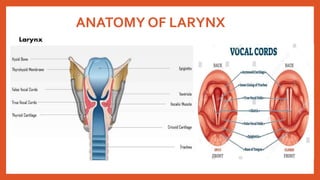
ANATOMY OF LARYNX
DEFINATION OF HOARSENESS
IT’S CAUSES
CLINICAL EVALUATION
TREATMENT
VOCAL NODULES
 DEFINATION
 ATIOPATHOGENESIS
 FEATURE AND PREDISPOSING FACTER
 SYMPTOMS
 DIAGNOSIS
 DEFFERENTIAL DIAGNOSIS
 TREATMENT
ANATOMY OF LARYNX
HOARSENESS
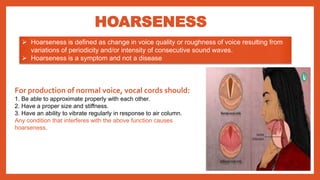
 Hoarseness is defined as change in voice quality or roughness of voice resulting from
variations of periodicity and/or intensity of consecutive sound waves.
 Hoarseness is a symptom and not a disease
For production of normal voice, vocal cords should:
1. Be able to approximate properly with each other.
2. Have a proper size and stiffness.
3. Have an ability to vibrate regularly in response to air column.
Any condition that interferes with the above function causes
hoarseness.
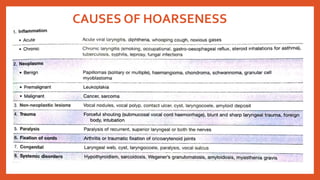
CAUSES OF HOARSENESS
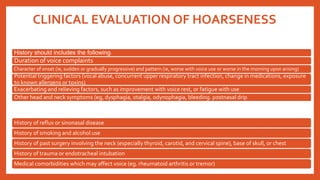
CLINICAL EVALUATION OF HOARSENESS
History should includes the following:
Duration of voice complaints
Character of onset (ie, sudden or gradually progressive) and pattern (ie, worse with voice use or worse in the morning upon arising)
Potential triggering factors (vocal abuse, concurrent upper respiratory tract infection, change in medications, exposure
to known allergens or toxins)
Exacerbating and relieving factors, such as improvement with voice rest, or fatigue with use
Other head and neck symptoms (eg, dysphagia, otalgia, odynophagia, bleeding. postnasal drip)
History of reflux or sinonasal disease
History of smoking and alcohol use
History of past surgery involving the neck (especially thyroid, carotid, and cervical spine), base of skull, or chest
History of trauma or endotracheal intubation
Medical comorbidities which may affect voice (eg. rheumatoid arthritis or tremor)
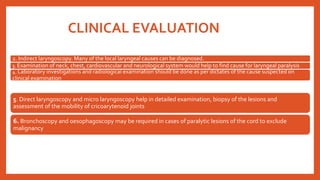
CLINICAL EVALUATION
5. Direct laryngoscopy and micro laryngoscopy help in detailed examination, biopsy of the lesions and
assessment of the mobility of cricoarytenoid joints
6. Bronchoscopy and oesophagoscopy may be required in cases of paralytic lesions of the cord to exclude
malignancy
2. Indirect laryngoscopy. Many of the local laryngeal causes can be diagnosed.
3. Examination of neck, chest, cardiovascular and neurological system would help to find cause for laryngeal paralysis.
4. Laboratory investigations and radiological examination should be done as per dictates of the cause suspected on
clinical examination.
1-DYSPHONIA PLICAVENTRICULARIS
(VENTRICULAR DYSPHONIA)
 Here voice is produced by ventricular folds (false cords) which have taken over the function
of true cords.
 It is due to impaired function of true vocal cord and may be functional (cause is
psychogenic).
Voice is rough, low-pitched and unpleasant
OTHER CAUSES
2-FUNCTIONAL APHONIA
(HYSTERICAL APHONIA)
Aphonia is usually sudden and unaccompanied by other laryngeal
symptoms.
Patient communicates with whisper
On examination, vocal cords are seen in abducted position and fail
to adduct on phonation; however, adduction of vocal cords can be
seen on coughing, indicating normal adductor function.
3-PUBERPHONIA
(MUTATIONALFALSETTO VOICE)
Normally, childhood voice has a higher pitch. When the larynx matures at puberty, vocal
cords lengthen and the voice changes to one of lower pitch this feature exclusive to males.
It is seen in boys who are emotionally immature, feel insecure and show excessive fixation
to their mother.
(Gutzmann’s pressure test)
Pressing the thyroid prominence in a backward and downward direction relaxes the overstretched
cords and low tone voice can be produced
4-PHONASTHENIA
It is weakness of voice due to fatigue of phonatory muscles. Thyroarytenoid and
interarytenoids or both may be affected.
Treatment is voice rest and vocal hygiene, emphasizing on
periods of voice rest after excessive use of voice
5-DYSPHONIA
Dysphonia can be divided into three types:
1- Adductor
2- abductor
3- mixed
ADDUCTOR DYSPHONIA
The adductor muscles of larynx go into spasm causing vocal cords
to go into adduction.
It is due to spasms of posterior cricoarytenoid muscle (the only
abductor) and thus keeping the glottis open. Patient gets a breathy
voice or breathy breaks in voice
ABDUCTOR DYSPHONIA
MIXED DYSPHONIA
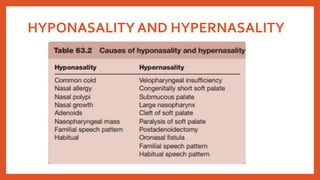
HYPONASALITY AND HYPERNASALITY
VOCAL NODULES
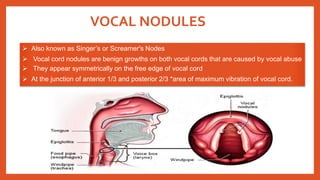
 Also known as Singer’s or Screamer's Nodes
 Vocal cord nodules are benign growths on both vocal cords that are caused by vocal abuse
 They appear symmetrically on the free edge of vocal cord
 At the junction of anterior 1/3 and posterior 2/3 *area of maximum vibration of vocal cord.
AETIOPATHOGENESIS
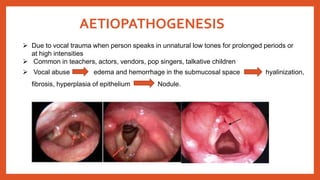
 Due to vocal trauma when person speaks in unnatural low tones for prolonged periods or
at high intensities
 Common in teachers, actors, vendors, pop singers, talkative children
 Vocal abuse edema and hemorrhage in the submucosal space hyalinization,
fibrosis, hyperplasia of epithelium Nodule.
FEATURES
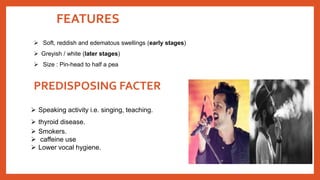
 Speaking activity i.e. singing, teaching.
 thyroid disease.
 Smokers.
 caffeine use
 Lower vocal hygiene.
PREDISPOSING FACTER
 Soft, reddish and edematous swellings (early stages)
 Greyish / white (later stages)
 Size : Pin-head to half a pea
SYMPTOMS
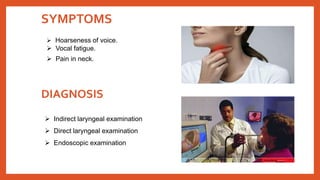
 Hoarseness of voice.
 Vocal fatigue.
 Pain in neck.
DIAGNOSIS
 Indirect laryngeal examination
 Direct laryngeal examination
 Endoscopic examination
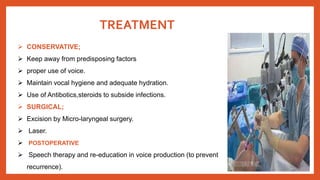
TREATMENT
 CONSERVATIVE;
 Keep away from predisposing factors
 proper use of voice.
 Maintain vocal hygiene and adequate hydration.
 Use of Antibotics,steroids to subside infections.
 SURGICAL;
 Excision by Micro-laryngeal surgery.
 Laser.
 POSTOPERATIVE
 Speech therapy and re-education in voice production (to prevent
recurrence).
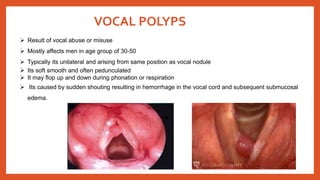
VOCAL POLYPS
 Result of vocal abuse or misuse
 Mostly affects men in age group of 30-50
 Typically its unilateral and arising from same position as vocal nodule
 Its soft smooth and often pedunculated
 It may flop up and down during phonation or respiration
 Its caused by sudden shouting resulting in hemorrhage in the vocal cord and subsequent submucosal
edema.
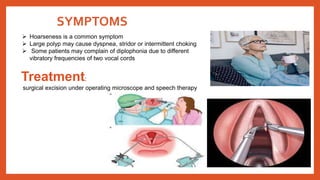
SYMPTOMS
 Hoarseness is a common symptom
 Large polyp may cause dyspnea, stridor or intermittent choking
 Some patients may complain of diplophonia due to different
vibratory frequencies of two vocal cords
Treatment:
surgical excision under operating microscope and speech therapy
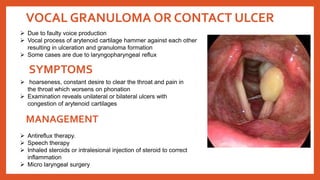
VOCAL GRANULOMA OR CONTACT ULCER
 Due to faulty voice production
 Vocal process of arytenoid cartilage hammer against each other
resulting in ulceration and granuloma formation
 Some cases are due to laryngopharyngeal reflux
 hoarseness, constant desire to clear the throat and pain in
the throat which worsens on phonation
 Examination reveals unilateral or bilateral ulcers with
congestion of arytenoid cartilages
SYMPTOMS
 Antireflux therapy.
 Speech therapy
 Inhaled steroids or intralesional injection of steroid to correct
inflammation
 Micro laryngeal surgery
MANAGEMENT
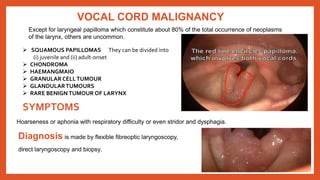
VOCAL CORD MALIGNANCY
Except for laryngeal papilloma which constitute about 80% of the total occurrence of neoplasms
of the larynx, others are uncommon.
 SQUAMOUS PAPILLOMAS They can be divided into
(i) juvenile and (ii) adult-onset
 CHONDROMA
 HAEMANGMAIO
 GRANULAR CELLTUMOUR
 GLANDULARTUMOURS
 RARE BENIGN TUMOUR OF LARYNX
Hoarseness or aphonia with respiratory difficulty or even stridor and dysphagia.
Diagnosis is made by flexible fibreoptic laryngoscopy,
direct laryngoscopy and biopsy.
SYMPTOMS
SPECIFIC QUESTIONS FOR HISTORY
 Mode of onset
 Duration of illness
 Associated symptoms
 Difficulty in speech?
 Difficulty in eating
 Pain in throat
 Any similar previous history
 Aggravating and relieving factors
 Patient's occupation
 Habits i.e. smoking
DD’S OFVOCAL NODULES
Vocal nodules
Vocal cord polyp
Contact ulcer
Chronic laryngitis
Reinkes edema
Hyperkeratosis and leukoplakia
Atrophic laryngitis
Laryngeal diphtheria
Neoplastic growth.
A 32-year-old male, teacher by profession comes to the OPD with complains of
change in voice for past 4 months. Initially the voice became hoarse when he
used to take frequent classes but now the hoarseness has become permanent.
On fibreoptic examination of larynx, you find smooth rounded elevations on mid
one third of both vocal cords apposing each other when patient tries to speak.
 What specific question you would ask in history to elicit the diagnosis?
 Give your differential diagnosis.
 Give management plan of most probable diagnosis.
 Differentiate between vocal nodules, vocal polyps, vocal cord granulomas and vocal cord malignancy?
 Discuss the preventive measures in such a condition. What are the aggravating factors?
 Write prescription for this patient
CBL-17
THANKS

VOCAL NODULE AND HORSENESS.pptx

  • 1.
    PRESENTED BY AWAIS IRSHAD202005 SHAZAM ALI 202039
  • 2.
    LEARNING OBJECTIVES HORSENESS ANATOMY OFLARYNX DEFINATION OF HOARSENESS IT’S CAUSES CLINICAL EVALUATION TREATMENT VOCAL NODULES  DEFINATION  ATIOPATHOGENESIS  FEATURE AND PREDISPOSING FACTER  SYMPTOMS  DIAGNOSIS  DEFFERENTIAL DIAGNOSIS  TREATMENT
  • 3.
  • 4.
    HOARSENESS  Hoarseness isdefined as change in voice quality or roughness of voice resulting from variations of periodicity and/or intensity of consecutive sound waves.  Hoarseness is a symptom and not a disease For production of normal voice, vocal cords should: 1. Be able to approximate properly with each other. 2. Have a proper size and stiffness. 3. Have an ability to vibrate regularly in response to air column. Any condition that interferes with the above function causes hoarseness.
  • 5.
  • 6.
    CLINICAL EVALUATION OFHOARSENESS History should includes the following: Duration of voice complaints Character of onset (ie, sudden or gradually progressive) and pattern (ie, worse with voice use or worse in the morning upon arising) Potential triggering factors (vocal abuse, concurrent upper respiratory tract infection, change in medications, exposure to known allergens or toxins) Exacerbating and relieving factors, such as improvement with voice rest, or fatigue with use Other head and neck symptoms (eg, dysphagia, otalgia, odynophagia, bleeding. postnasal drip) History of reflux or sinonasal disease History of smoking and alcohol use History of past surgery involving the neck (especially thyroid, carotid, and cervical spine), base of skull, or chest History of trauma or endotracheal intubation Medical comorbidities which may affect voice (eg. rheumatoid arthritis or tremor)
  • 7.
    CLINICAL EVALUATION 5. Directlaryngoscopy and micro laryngoscopy help in detailed examination, biopsy of the lesions and assessment of the mobility of cricoarytenoid joints 6. Bronchoscopy and oesophagoscopy may be required in cases of paralytic lesions of the cord to exclude malignancy 2. Indirect laryngoscopy. Many of the local laryngeal causes can be diagnosed. 3. Examination of neck, chest, cardiovascular and neurological system would help to find cause for laryngeal paralysis. 4. Laboratory investigations and radiological examination should be done as per dictates of the cause suspected on clinical examination.
  • 8.
    1-DYSPHONIA PLICAVENTRICULARIS (VENTRICULAR DYSPHONIA) Here voice is produced by ventricular folds (false cords) which have taken over the function of true cords.  It is due to impaired function of true vocal cord and may be functional (cause is psychogenic). Voice is rough, low-pitched and unpleasant OTHER CAUSES
  • 9.
    2-FUNCTIONAL APHONIA (HYSTERICAL APHONIA) Aphoniais usually sudden and unaccompanied by other laryngeal symptoms. Patient communicates with whisper On examination, vocal cords are seen in abducted position and fail to adduct on phonation; however, adduction of vocal cords can be seen on coughing, indicating normal adductor function.
  • 10.
    3-PUBERPHONIA (MUTATIONALFALSETTO VOICE) Normally, childhoodvoice has a higher pitch. When the larynx matures at puberty, vocal cords lengthen and the voice changes to one of lower pitch this feature exclusive to males. It is seen in boys who are emotionally immature, feel insecure and show excessive fixation to their mother. (Gutzmann’s pressure test) Pressing the thyroid prominence in a backward and downward direction relaxes the overstretched cords and low tone voice can be produced
  • 11.
    4-PHONASTHENIA It is weaknessof voice due to fatigue of phonatory muscles. Thyroarytenoid and interarytenoids or both may be affected. Treatment is voice rest and vocal hygiene, emphasizing on periods of voice rest after excessive use of voice 5-DYSPHONIA Dysphonia can be divided into three types: 1- Adductor 2- abductor 3- mixed
  • 12.
    ADDUCTOR DYSPHONIA The adductormuscles of larynx go into spasm causing vocal cords to go into adduction. It is due to spasms of posterior cricoarytenoid muscle (the only abductor) and thus keeping the glottis open. Patient gets a breathy voice or breathy breaks in voice ABDUCTOR DYSPHONIA MIXED DYSPHONIA
  • 13.
  • 14.
    VOCAL NODULES  Alsoknown as Singer’s or Screamer's Nodes  Vocal cord nodules are benign growths on both vocal cords that are caused by vocal abuse  They appear symmetrically on the free edge of vocal cord  At the junction of anterior 1/3 and posterior 2/3 *area of maximum vibration of vocal cord.
  • 15.
    AETIOPATHOGENESIS  Due tovocal trauma when person speaks in unnatural low tones for prolonged periods or at high intensities  Common in teachers, actors, vendors, pop singers, talkative children  Vocal abuse edema and hemorrhage in the submucosal space hyalinization, fibrosis, hyperplasia of epithelium Nodule.
  • 16.
    FEATURES  Speaking activityi.e. singing, teaching.  thyroid disease.  Smokers.  caffeine use  Lower vocal hygiene. PREDISPOSING FACTER  Soft, reddish and edematous swellings (early stages)  Greyish / white (later stages)  Size : Pin-head to half a pea
  • 17.
    SYMPTOMS  Hoarseness ofvoice.  Vocal fatigue.  Pain in neck. DIAGNOSIS  Indirect laryngeal examination  Direct laryngeal examination  Endoscopic examination
  • 18.
    TREATMENT  CONSERVATIVE;  Keepaway from predisposing factors  proper use of voice.  Maintain vocal hygiene and adequate hydration.  Use of Antibotics,steroids to subside infections.  SURGICAL;  Excision by Micro-laryngeal surgery.  Laser.  POSTOPERATIVE  Speech therapy and re-education in voice production (to prevent recurrence).
  • 19.
    VOCAL POLYPS  Resultof vocal abuse or misuse  Mostly affects men in age group of 30-50  Typically its unilateral and arising from same position as vocal nodule  Its soft smooth and often pedunculated  It may flop up and down during phonation or respiration  Its caused by sudden shouting resulting in hemorrhage in the vocal cord and subsequent submucosal edema.
  • 20.
    SYMPTOMS  Hoarseness isa common symptom  Large polyp may cause dyspnea, stridor or intermittent choking  Some patients may complain of diplophonia due to different vibratory frequencies of two vocal cords Treatment: surgical excision under operating microscope and speech therapy
  • 21.
    VOCAL GRANULOMA ORCONTACT ULCER  Due to faulty voice production  Vocal process of arytenoid cartilage hammer against each other resulting in ulceration and granuloma formation  Some cases are due to laryngopharyngeal reflux  hoarseness, constant desire to clear the throat and pain in the throat which worsens on phonation  Examination reveals unilateral or bilateral ulcers with congestion of arytenoid cartilages SYMPTOMS  Antireflux therapy.  Speech therapy  Inhaled steroids or intralesional injection of steroid to correct inflammation  Micro laryngeal surgery MANAGEMENT
  • 22.
    VOCAL CORD MALIGNANCY Exceptfor laryngeal papilloma which constitute about 80% of the total occurrence of neoplasms of the larynx, others are uncommon.  SQUAMOUS PAPILLOMAS They can be divided into (i) juvenile and (ii) adult-onset  CHONDROMA  HAEMANGMAIO  GRANULAR CELLTUMOUR  GLANDULARTUMOURS  RARE BENIGN TUMOUR OF LARYNX Hoarseness or aphonia with respiratory difficulty or even stridor and dysphagia. Diagnosis is made by flexible fibreoptic laryngoscopy, direct laryngoscopy and biopsy. SYMPTOMS
  • 23.
    SPECIFIC QUESTIONS FORHISTORY  Mode of onset  Duration of illness  Associated symptoms  Difficulty in speech?  Difficulty in eating  Pain in throat  Any similar previous history  Aggravating and relieving factors  Patient's occupation  Habits i.e. smoking
  • 24.
    DD’S OFVOCAL NODULES Vocalnodules Vocal cord polyp Contact ulcer Chronic laryngitis Reinkes edema Hyperkeratosis and leukoplakia Atrophic laryngitis Laryngeal diphtheria Neoplastic growth.
  • 25.
    A 32-year-old male,teacher by profession comes to the OPD with complains of change in voice for past 4 months. Initially the voice became hoarse when he used to take frequent classes but now the hoarseness has become permanent. On fibreoptic examination of larynx, you find smooth rounded elevations on mid one third of both vocal cords apposing each other when patient tries to speak.  What specific question you would ask in history to elicit the diagnosis?  Give your differential diagnosis.  Give management plan of most probable diagnosis.  Differentiate between vocal nodules, vocal polyps, vocal cord granulomas and vocal cord malignancy?  Discuss the preventive measures in such a condition. What are the aggravating factors?  Write prescription for this patient CBL-17
  • 26.