NASAL POLYPOSIS
Dr Harjitpal Singh
Assistant Professor(ENT),
Dr RKGMC, Hamirpur
DEFINITION
• Polyp is Latin word meaning polypus, i.e. many
footed
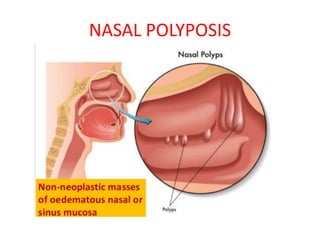
• The polypus is a projection of hypertrophied
edematous mucous membrane.
• It consists of loose fibroedematous tissue
covered with columnar ciliated epithelium.
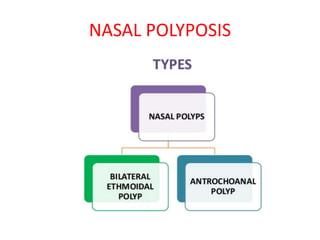
• They are divided into two types
1. Bilateral ethmoidal polypi.
2. Antrochoanal polyp.
EPIDEMIOLOGY
• The prevalence of nasal polyps (NP) in the
population has been grossly estimated as 1–4%.
• It increases with age, reaching a peak in those
aged 50 years and older.
• Male: Female = 2:1
• Nasal polyposis occurs with a high frequency in
groups of patients having specific airway
diseases
• Genetic inheritance has been proposed as a
possible etiology of NP.
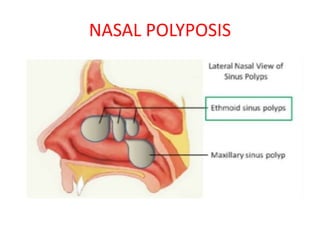
NASAL POLYPOSIS
NASAL POLYPOSIS
NASAL POLYPOSIS
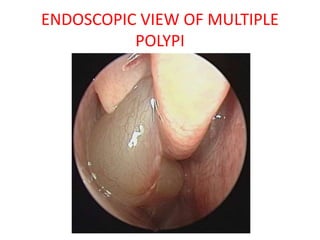
ENDOSCOPIC VIEW OF MULTIPLE
POLYPI
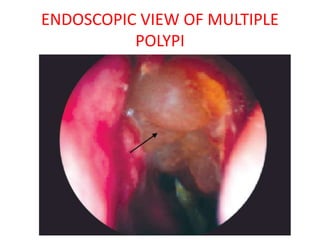
ENDOSCOPIC VIEW OF MULTIPLE
POLYPI
ETHMOIDAL POLYPS
AETIOLOGY
• Aetiology of nasal polyposis is very complex .
• They may arise in:
• Inflammatory conditions of nasal mucosa (rhinosinusitis),
• Disorders of ciliary motility or
• Abnormal composition of nasal mucus (cystic fibrosis).
• Various diseases associated with the formation of nasal polypi
are:
1. Chronic rhinosinusitis.
Polypi are seen in chronic rhinosinusitis of both allergic and
nonallergic origin.
Nonallergic rhinitis with eosinophilia syndrome (NARES) is a
form of chronic rhinitis associated with polypi.
ETHMOIDAL POLYPS
2. Asthma. Seven per cent of the patients with asthma of
atopic or non atopic origin show nasal polypi.
3. Aspirin intolerance. Some patients with aspirin
intolerance may show polypi.
Samter's triad consists of nasal polypi, asthma and aspirin
intolerance.
4. Cystic fibrosis. Twenty per cent of patients with cystic
fibrosis form polypi. It is due to abnormal mucus.
5. Allergic fungal sinusitis. Almost all cases of fungal
sinusitis form nasal polypi.
ETHMOIDAL POLYPS
6. Kartagener syndrome. This consists of bronchiectasis
sinusitis, situs inversus and ciliary dyskinesis.
7. Young syndrome. It consists of sinopulmonary disease
and azoospermia.
8. Churg–Strauss syndrome. Consists of asthma, fever,
eosinophilia, vasculitis and granuloma.
9. Nasal mastocytosis. It is a form of chronic rhinitis in
which nasal mucosa is infiltrated with mast cells but
few eosinophil's. Skin tests for allergy and IgE levels
are normal.
PATHOGENESIS
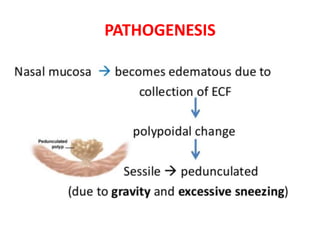
• Nasal mucosa, particularly in the region of middle
meatus and turbinate, becomes oedematous due to
collection of extracellular fluid causing polypoidal
change.
• Polypi which are sessile in the beginning become
pedunculated due to and excessive sneezing.
PATHOGENESIS
PATHOLOGY
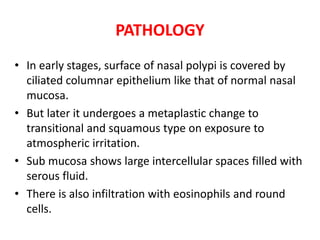
• In early stages, surface of nasal polypi is covered by
ciliated columnar epithelium like that of normal nasal
mucosa.
• But later it undergoes a metaplastic change to
transitional and squamous type on exposure to
atmospheric irritation.
• Sub mucosa shows large intercellular spaces filled with
serous fluid.
• There is also infiltration with eosinophils and round
cells.
SITE OF ORIGIN
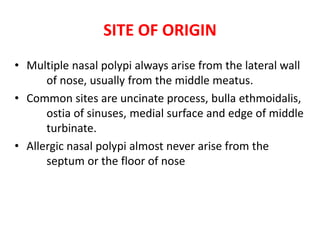
• Multiple nasal polypi always arise from the lateral wall
of nose, usually from the middle meatus.
• Common sites are uncinate process, bulla ethmoidalis,
ostia of sinuses, medial surface and edge of middle
turbinate.
• Allergic nasal polypi almost never arise from the
septum or the floor of nose
ETHMOIDAL POLYPS
Symptoms:
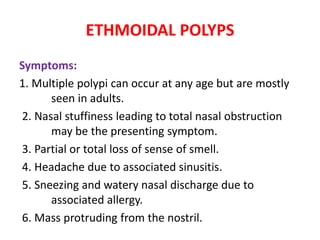
1. Multiple polypi can occur at any age but are mostly
seen in adults.
2. Nasal stuffiness leading to total nasal obstruction
may be the presenting symptom.
3. Partial or total loss of sense of smell.
4. Headache due to associated sinusitis.
5. Sneezing and watery nasal discharge due to
associated allergy.
6. Mass protruding from the nostril.
ETHMOIDAL POLYPS
Signs:
• Polypi appear as smooth, glistening, masses often pale
in colour.
• They may be sessile or pedunculated.
• Insensitive to probing and do not bleed on touch.
• Often they are multiple and bilateral.
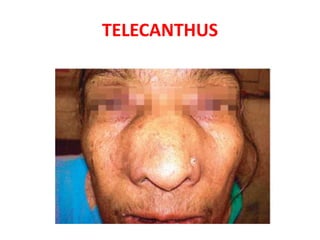
• Long-standing cases present with broadening of nose
and increased intercanthal distance.
• Nasal cavity may show purulent discharge due to
associated sinusitis.
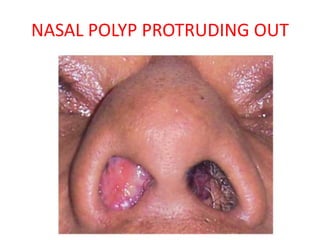
• May protrude from the nostril & appear pink, vascular
simulating neoplasm .
TELECANTHUS
NASAL POLYP PROTRUDING OUT
ETHMOIDAL POLYPS
Signs:
• Probing of a solitary ethmoidal polyp may be necessary
to differentiate it from hypertrophy of the turbinate
or cystic middle turbinate.
• Potential complications of nasal polypi includes
anosmia, cranial neuropathies, osteitis and proptosis.
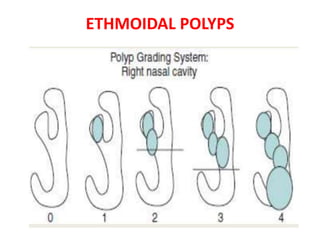
• Staging Polyps can be staged as following according to
their size(Meltzer et al):
Stage I: Limited to the extent of middle turbinate. „
Stage II: Extending beyond the limit of middle
turbinate. „
Stage III: Approaching to inferior turbinate. „
Stage IV: Going up to the floor of nose.
ETHMOIDAL POLYPS
ETHMOIDAL POLYPS
Diagnosis:
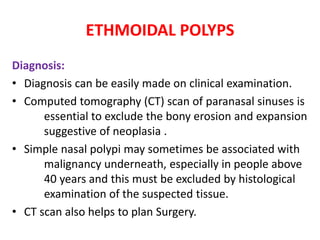
• Diagnosis can be easily made on clinical examination.
• Computed tomography (CT) scan of paranasal sinuses is
essential to exclude the bony erosion and expansion
suggestive of neoplasia .
• Simple nasal polypi may sometimes be associated with
malignancy underneath, especially in people above
40 years and this must be excluded by histological
examination of the suspected tissue.
• CT scan also helps to plan Surgery.
ETHMOIDAL POLYPS
Differential Diagnosis:
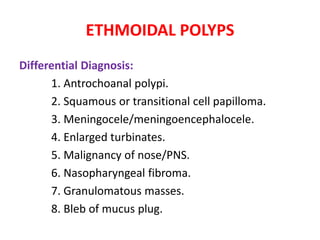
1. Antrochoanal polypi.
2. Squamous or transitional cell papilloma.
3. Meningocele/meningoencephalocele.
4. Enlarged turbinates.
5. Malignancy of nose/PNS.
6. Nasopharyngeal fibroma.
7. Granulomatous masses.
8. Bleb of mucus plug.
ETHMOIDAL POLYPS
Treatment:
CONSERVATIVE
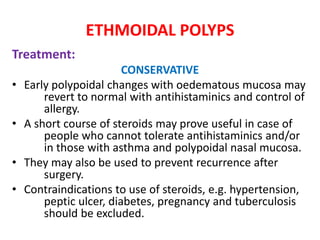
• Early polypoidal changes with oedematous mucosa may
revert to normal with antihistaminics and control of
allergy.
• A short course of steroids may prove useful in case of
people who cannot tolerate antihistaminics and/or
in those with asthma and polypoidal nasal mucosa.
• They may also be used to prevent recurrence after
surgery.
• Contraindications to use of steroids, e.g. hypertension,
peptic ulcer, diabetes, pregnancy and tuberculosis
should be excluded.
ETHMOIDAL POLYPS
Treatment:
CONSERVATIVE
Intranasal corticosteroids help in:
• Reducing polyp size
• Increase nasal patency
• Reduction in rhinitis symptoms
• Reduction in loss of sense of smell
• Reduction in recurrence of polyp
• Safety
ETHMOIDAL POLYPS
Treatment:
CONSERVATIVE
Side effect of Intra Nasal steroids:
• Excoriation and bleeding
• Beclomethasone dipropionate nasal spray is
associated with the onset of increased
intraocular pressure.
• Delay in growth in prepubescent children has
led to an FDA warning on all INS
ETHMOIDAL POLYPS
Treatment:
CONSERVATIVE
• Systemic Corrticosteroids can be given as
tablets and depot-injections.
• Oral prednisolone can be given at
25mg/daily for 10-14 days.
• As a depot-injection corresponds 100mg
prednisolone.
• It may serve as medical polypectomy.
ETHMOIDAL POLYPS
Treatment:
CONSERVATIVE
Risks of systemic steroid:
• Insomnia
• Personality change
• Truncal obesity
• Weight gain
• Glaucoma
• Cataracts
• Osteoporosis (requires greater than 3 months usage)
• Peptic ulcer disease
• Increased incidence of infection
ETHMOIDAL POLYPS
Treatment:
Surgical
• Polypectomy. One or two polyps which are
pedunculated can be removed with snare. .
• Intranasal ethmoidectomy. When polypi are
multiple and sessile, they require uncapping of
the ethmoidal air cells by intranasal route, a
procedure called intranasal ethmoidectomy.
ETHMOIDAL POLYPS
Treatment:
• Extranasal ethmoidectomy. This is indicated when
polypi recur after intranasal procedures and
surgical landmarks are ill-defined due to previous
surgery. Approach is through the medial wall of the
orbit by an external incision, medial to medial
canthus.
• Jansen Horgan’s transantral ethmoidectomy: It is
done in case maxillary antra also needs to be
cleared along with the ethmoids. Ethmoids are
approached through medial wall of maxillary antra.
ETHMOIDAL POLYPS
Treatment:
• Endoscopic sinus surgery. These days, ethmoidal
polypi are removed by endoscopic sinus surgery
more popularly called functional endoscopic sinus
surgery (FESS). It is done with various endoscopes
of 0°, 30° and 70° angulation. Polypi can be
removed more accurately when ethmoid cells are
removed, and drainage and ventilation provided to
the other involved sinuses such as maxillary,
sphenoidal or frontal.
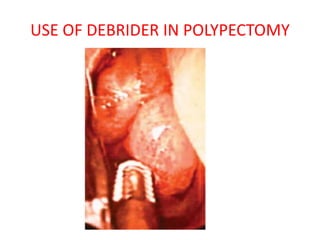
• Polypectomy using microdebrider is another addition
in the treatment of nasal polypi
USE OF DEBRIDER IN POLYPECTOMY
ETHMOIDAL POLYPS
Histologic finding:
NPs are characterised by
• Pseudo stratified ciliated columnar epithalium
• Thickening of epithelial basement membrane
• Stroma of NP is oedematous
• Vascularization is poor and lacks innervation
• Hyperplasia of seromucous gland when comparing with
inferior or middle turbinate.
• Eosinophil's are most commonly found inflammatory cell in NP
(found in 80-90% of polyps)
• Another inflammatory cell, neutrophil, occurs in 7% cases.
This type of NP associates with CF, primary ciliary
dyskinesia or Young syndrome.
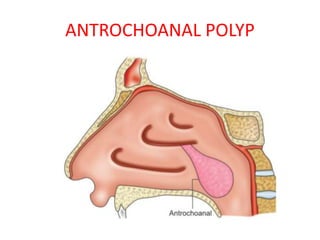
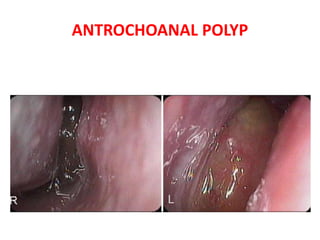
ANTROCHOANAL POLYP(KILLIAN’S POYP)
• This polyp arises from mucous membrane of the
floor and medial wall of maxillary sinus close to the
accessory ostium.
• Comes out of it and starts growing towards the
choana and nasal cavityum.
• Thus it has three parts.
• Antral, which is a thin stalk.
• Nasal, which is flat from side to side.
• Choanal, which is round and globular.
ANTROCHOANAL POLYP
ANTROCHOANAL POLYP
ANTROCHOANAL POLYP
ANTROCHOANAL POLYP
Aetiology:
• Exact cause is unknown.
• Nasal allergy coupled with sinus infection is
incriminated.
• Antrochoanal polypi are commonly seen in
adolescence
• For an unknown reason, ACP predominates in
male population,.
• Usually they are single and unilateral.
ANTROCHOANAL POLYP
ANTROCHOANAL POLYP
Symptoms:
• Unilateral nasal obstruction is the presenting symptom.
• Obstruction may become bilateral when polyp grows
into the nasopharynx and starts obstructing the
opposite choana.
• Voice may become thick and dull due to hyponasality.
• Nasal discharge, mostly mucoid, may be seen on one or
both sides.
• Conductive deafness due to eustachian tube
dysfunction
• Snoring
ANTROCHOANAL POLYP
Signs:
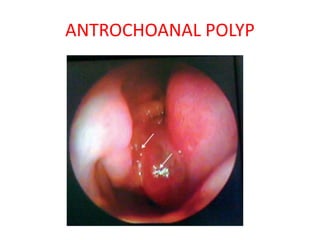
• As the antrochoanal polyp grows posteriorly, it may be
missed on anterior rhinoscopy initially.
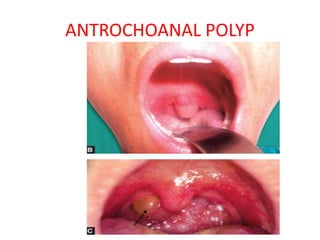
• Posterior rhinoscopy may show a smooth, greyish
white, spherical mass in the choana and may be seen
projecting below the soft palate
• When large, a smooth greyish mass covered with nasal
discharge may be seen.
• It is soft and can be moved up and down with a probe.
• A large polyp may protrude from the nostril and show a
pink congested look on its exposed part .
ANTROCHOANAL POLYP
Diagnosis:
• X-rays of paranasal sinuses may show opacity of
the involved antrum.
• X-ray (lateral view), soft tissue nasopharynx,
reveals a globular swelling in the postnasal space.
• It is differentiated from angiofibroma by the
presence of a column of air behind the polyp.
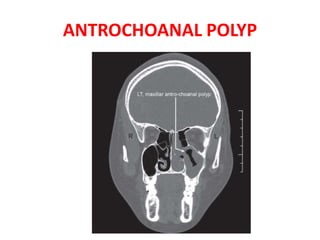
• Computed tomograhy (CT) scan PNS, particularly
osteomeatal complex both coronal and axial
sections.
ANTROCHOANAL POLYP
ANTROCHOANAL POLYP
Treatment:
• An antrochoanal polyp is easily removed by avulsion
either through the nasal or oral route.
• Recurrence is uncommon after complete removal.
• In cases which do recur, Caldwell–Luc operation may be
required to remove the polyp completely from the site of
its origin and to deal with coexistent maxillary sinusitis.
• Polyp is removed and inferior meatal antrostomy is made
for subsequent cleaning and drainage.
• These days, endoscopic sinus surgery has superceded
other modes of polyp removal. Caldwell–Luc operation is
avoided.
NASAL POLYPOSIS
Points to remember:
• If a polypus is red and fleshy, friable and has granular
surface, especially in older patients, it suggests
malignancy.
• Simple nasal polyp may masquerade a malignancy
underneath. Hence all polypi should be subjected to
histopathology.
• A simple polyp in a child may be a glioma, an
encephalocele or a meningoencephalocele.
• It should always be aspirated and fluid examined for
CSF. Careless removal of such polyp would result in
CSF rhinorrhoea and meningitis.
NASAL POLYPOSIS
• Multiple nasal polypi in children may be
associated with mucoviscidosis.
• Epistaxis and orbital symptoms associated with
a polyp should always arouse the suspicion of
malignancy.
• Samter’s triad: It consists of nasal polyps,
bronchial asthma and aspirin sensitivity
DIFFERENCES
ANTROCHOANAL POLYP
1.Common in children.
2.Aetiology is infection.
3. Single mass and trilobed.
4.Unilateral.
5.Site of origin is maxillary
sinus near the ostium.
6. Recurrence is uncommon, if
removed completely
ETHMOIDAL POLYPS
1.Common in adults.
2.Aetiology allergic/multifactorial
3.Multiple, like a bunch of grapes
4.Bilateral
5. Ethmoidal sinuses, uncinate
process, middle turbinate
and middle meatus.
6.Recurrence is common.
CAUSES OF UNILATERAL NASAL
OBSTRUCTION
Vestibule
• Furuncle
• Vestibulitis
• Stenosis of nares
• Atresia
• Nasoalveolar cyst
• Papilloma
• Squamous cell carcinoma
CAUSES OF UNILATERAL NASAL
OBSTRUCTION
Nasal cavity
• Foreign body
• Deviated nasal septum (DNS)
• Hypertrophic turbinates
• Concha bullosa
• Antrochoanal polyp
CAUSES OF UNILATERAL NASAL
OBSTRUCTION
• Synechia
• Rhinolith
• Bleeding polypus of septum
• Benign and malignant tumours of nose and
paranasal sinuses
• Sinusitis, unilateral
• Unilateral choanal atresia
CAUSES OF BILATERAL NASAL
OBSTRUCTION
• Vestibule-Bilateral vestibulitis
• Collapsing nasal alae
• Stenosis of nares
• Congenital atresia of nares
CAUSES OF BILATERAL NASAL
OBSTRUCTION
Nasal cavity
• Acute rhinitis (viral and bacterial)
• Chronic rhinitis and sinusitis
• Rhinitis medicamentosa
• Allergic rhinitis
• Hypertrophic turbinates
• DNS
• Nasal polypi
• Atrophic rhinitis
• Rhinitis sicca
• Septal haematoma
• Septal abscess
• Bilateral choanal atresia
CAUSES OF BILATERAL NASAL
OBSTRUCTION
Nasopharynx
• Adenoid hyperplasia
• Large choanal polyp
• Thornwaldt’s cyst
• Adhesions between soft palate and posterior
pharyngeal wall
• Large benign and malignant tumours
THANKS

NASAL POLYPS

  • 1.
    NASAL POLYPOSIS Dr HarjitpalSingh Assistant Professor(ENT), Dr RKGMC, Hamirpur
  • 2.
    DEFINITION • Polyp isLatin word meaning polypus, i.e. many footed • The polypus is a projection of hypertrophied edematous mucous membrane. • It consists of loose fibroedematous tissue covered with columnar ciliated epithelium. • They are divided into two types 1. Bilateral ethmoidal polypi. 2. Antrochoanal polyp.
  • 3.
    EPIDEMIOLOGY • The prevalenceof nasal polyps (NP) in the population has been grossly estimated as 1–4%. • It increases with age, reaching a peak in those aged 50 years and older. • Male: Female = 2:1 • Nasal polyposis occurs with a high frequency in groups of patients having specific airway diseases • Genetic inheritance has been proposed as a possible etiology of NP.
  • 4.
  • 5.
  • 6.
  • 7.
    ENDOSCOPIC VIEW OFMULTIPLE POLYPI
  • 8.
    ENDOSCOPIC VIEW OFMULTIPLE POLYPI
  • 9.
    ETHMOIDAL POLYPS AETIOLOGY • Aetiologyof nasal polyposis is very complex . • They may arise in: • Inflammatory conditions of nasal mucosa (rhinosinusitis), • Disorders of ciliary motility or • Abnormal composition of nasal mucus (cystic fibrosis). • Various diseases associated with the formation of nasal polypi are: 1. Chronic rhinosinusitis. Polypi are seen in chronic rhinosinusitis of both allergic and nonallergic origin. Nonallergic rhinitis with eosinophilia syndrome (NARES) is a form of chronic rhinitis associated with polypi.
  • 10.
    ETHMOIDAL POLYPS 2. Asthma.Seven per cent of the patients with asthma of atopic or non atopic origin show nasal polypi. 3. Aspirin intolerance. Some patients with aspirin intolerance may show polypi. Samter's triad consists of nasal polypi, asthma and aspirin intolerance. 4. Cystic fibrosis. Twenty per cent of patients with cystic fibrosis form polypi. It is due to abnormal mucus. 5. Allergic fungal sinusitis. Almost all cases of fungal sinusitis form nasal polypi.
  • 11.
    ETHMOIDAL POLYPS 6. Kartagenersyndrome. This consists of bronchiectasis sinusitis, situs inversus and ciliary dyskinesis. 7. Young syndrome. It consists of sinopulmonary disease and azoospermia. 8. Churg–Strauss syndrome. Consists of asthma, fever, eosinophilia, vasculitis and granuloma. 9. Nasal mastocytosis. It is a form of chronic rhinitis in which nasal mucosa is infiltrated with mast cells but few eosinophil's. Skin tests for allergy and IgE levels are normal.
  • 12.
    PATHOGENESIS • Nasal mucosa,particularly in the region of middle meatus and turbinate, becomes oedematous due to collection of extracellular fluid causing polypoidal change. • Polypi which are sessile in the beginning become pedunculated due to and excessive sneezing.
  • 13.
  • 14.
    PATHOLOGY • In earlystages, surface of nasal polypi is covered by ciliated columnar epithelium like that of normal nasal mucosa. • But later it undergoes a metaplastic change to transitional and squamous type on exposure to atmospheric irritation. • Sub mucosa shows large intercellular spaces filled with serous fluid. • There is also infiltration with eosinophils and round cells.
  • 15.
    SITE OF ORIGIN •Multiple nasal polypi always arise from the lateral wall of nose, usually from the middle meatus. • Common sites are uncinate process, bulla ethmoidalis, ostia of sinuses, medial surface and edge of middle turbinate. • Allergic nasal polypi almost never arise from the septum or the floor of nose
  • 16.
    ETHMOIDAL POLYPS Symptoms: 1. Multiplepolypi can occur at any age but are mostly seen in adults. 2. Nasal stuffiness leading to total nasal obstruction may be the presenting symptom. 3. Partial or total loss of sense of smell. 4. Headache due to associated sinusitis. 5. Sneezing and watery nasal discharge due to associated allergy. 6. Mass protruding from the nostril.
  • 17.
    ETHMOIDAL POLYPS Signs: • Polypiappear as smooth, glistening, masses often pale in colour. • They may be sessile or pedunculated. • Insensitive to probing and do not bleed on touch. • Often they are multiple and bilateral. • Long-standing cases present with broadening of nose and increased intercanthal distance. • Nasal cavity may show purulent discharge due to associated sinusitis. • May protrude from the nostril & appear pink, vascular simulating neoplasm .
  • 18.
  • 19.
  • 20.
    ETHMOIDAL POLYPS Signs: • Probingof a solitary ethmoidal polyp may be necessary to differentiate it from hypertrophy of the turbinate or cystic middle turbinate. • Potential complications of nasal polypi includes anosmia, cranial neuropathies, osteitis and proptosis. • Staging Polyps can be staged as following according to their size(Meltzer et al): Stage I: Limited to the extent of middle turbinate. „ Stage II: Extending beyond the limit of middle turbinate. „ Stage III: Approaching to inferior turbinate. „ Stage IV: Going up to the floor of nose.
  • 21.
  • 22.
    ETHMOIDAL POLYPS Diagnosis: • Diagnosiscan be easily made on clinical examination. • Computed tomography (CT) scan of paranasal sinuses is essential to exclude the bony erosion and expansion suggestive of neoplasia . • Simple nasal polypi may sometimes be associated with malignancy underneath, especially in people above 40 years and this must be excluded by histological examination of the suspected tissue. • CT scan also helps to plan Surgery.
  • 23.
    ETHMOIDAL POLYPS Differential Diagnosis: 1.Antrochoanal polypi. 2. Squamous or transitional cell papilloma. 3. Meningocele/meningoencephalocele. 4. Enlarged turbinates. 5. Malignancy of nose/PNS. 6. Nasopharyngeal fibroma. 7. Granulomatous masses. 8. Bleb of mucus plug.
  • 24.
    ETHMOIDAL POLYPS Treatment: CONSERVATIVE • Earlypolypoidal changes with oedematous mucosa may revert to normal with antihistaminics and control of allergy. • A short course of steroids may prove useful in case of people who cannot tolerate antihistaminics and/or in those with asthma and polypoidal nasal mucosa. • They may also be used to prevent recurrence after surgery. • Contraindications to use of steroids, e.g. hypertension, peptic ulcer, diabetes, pregnancy and tuberculosis should be excluded.
  • 25.
    ETHMOIDAL POLYPS Treatment: CONSERVATIVE Intranasal corticosteroidshelp in: • Reducing polyp size • Increase nasal patency • Reduction in rhinitis symptoms • Reduction in loss of sense of smell • Reduction in recurrence of polyp • Safety
  • 26.
    ETHMOIDAL POLYPS Treatment: CONSERVATIVE Side effectof Intra Nasal steroids: • Excoriation and bleeding • Beclomethasone dipropionate nasal spray is associated with the onset of increased intraocular pressure. • Delay in growth in prepubescent children has led to an FDA warning on all INS
  • 27.
    ETHMOIDAL POLYPS Treatment: CONSERVATIVE • SystemicCorrticosteroids can be given as tablets and depot-injections. • Oral prednisolone can be given at 25mg/daily for 10-14 days. • As a depot-injection corresponds 100mg prednisolone. • It may serve as medical polypectomy.
  • 28.
    ETHMOIDAL POLYPS Treatment: CONSERVATIVE Risks ofsystemic steroid: • Insomnia • Personality change • Truncal obesity • Weight gain • Glaucoma • Cataracts • Osteoporosis (requires greater than 3 months usage) • Peptic ulcer disease • Increased incidence of infection
  • 29.
    ETHMOIDAL POLYPS Treatment: Surgical • Polypectomy.One or two polyps which are pedunculated can be removed with snare. . • Intranasal ethmoidectomy. When polypi are multiple and sessile, they require uncapping of the ethmoidal air cells by intranasal route, a procedure called intranasal ethmoidectomy.
  • 30.
    ETHMOIDAL POLYPS Treatment: • Extranasalethmoidectomy. This is indicated when polypi recur after intranasal procedures and surgical landmarks are ill-defined due to previous surgery. Approach is through the medial wall of the orbit by an external incision, medial to medial canthus. • Jansen Horgan’s transantral ethmoidectomy: It is done in case maxillary antra also needs to be cleared along with the ethmoids. Ethmoids are approached through medial wall of maxillary antra.
  • 31.
    ETHMOIDAL POLYPS Treatment: • Endoscopicsinus surgery. These days, ethmoidal polypi are removed by endoscopic sinus surgery more popularly called functional endoscopic sinus surgery (FESS). It is done with various endoscopes of 0°, 30° and 70° angulation. Polypi can be removed more accurately when ethmoid cells are removed, and drainage and ventilation provided to the other involved sinuses such as maxillary, sphenoidal or frontal. • Polypectomy using microdebrider is another addition in the treatment of nasal polypi
  • 32.
    USE OF DEBRIDERIN POLYPECTOMY
  • 33.
    ETHMOIDAL POLYPS Histologic finding: NPsare characterised by • Pseudo stratified ciliated columnar epithalium • Thickening of epithelial basement membrane • Stroma of NP is oedematous • Vascularization is poor and lacks innervation • Hyperplasia of seromucous gland when comparing with inferior or middle turbinate. • Eosinophil's are most commonly found inflammatory cell in NP (found in 80-90% of polyps) • Another inflammatory cell, neutrophil, occurs in 7% cases. This type of NP associates with CF, primary ciliary dyskinesia or Young syndrome.
  • 34.
    ANTROCHOANAL POLYP(KILLIAN’S POYP) •This polyp arises from mucous membrane of the floor and medial wall of maxillary sinus close to the accessory ostium. • Comes out of it and starts growing towards the choana and nasal cavityum. • Thus it has three parts. • Antral, which is a thin stalk. • Nasal, which is flat from side to side. • Choanal, which is round and globular.
  • 35.
  • 36.
  • 37.
  • 38.
    ANTROCHOANAL POLYP Aetiology: • Exactcause is unknown. • Nasal allergy coupled with sinus infection is incriminated. • Antrochoanal polypi are commonly seen in adolescence • For an unknown reason, ACP predominates in male population,. • Usually they are single and unilateral.
  • 39.
  • 40.
    ANTROCHOANAL POLYP Symptoms: • Unilateralnasal obstruction is the presenting symptom. • Obstruction may become bilateral when polyp grows into the nasopharynx and starts obstructing the opposite choana. • Voice may become thick and dull due to hyponasality. • Nasal discharge, mostly mucoid, may be seen on one or both sides. • Conductive deafness due to eustachian tube dysfunction • Snoring
  • 41.
    ANTROCHOANAL POLYP Signs: • Asthe antrochoanal polyp grows posteriorly, it may be missed on anterior rhinoscopy initially. • Posterior rhinoscopy may show a smooth, greyish white, spherical mass in the choana and may be seen projecting below the soft palate • When large, a smooth greyish mass covered with nasal discharge may be seen. • It is soft and can be moved up and down with a probe. • A large polyp may protrude from the nostril and show a pink congested look on its exposed part .
  • 42.
    ANTROCHOANAL POLYP Diagnosis: • X-raysof paranasal sinuses may show opacity of the involved antrum. • X-ray (lateral view), soft tissue nasopharynx, reveals a globular swelling in the postnasal space. • It is differentiated from angiofibroma by the presence of a column of air behind the polyp. • Computed tomograhy (CT) scan PNS, particularly osteomeatal complex both coronal and axial sections.
  • 43.
  • 44.
    ANTROCHOANAL POLYP Treatment: • Anantrochoanal polyp is easily removed by avulsion either through the nasal or oral route. • Recurrence is uncommon after complete removal. • In cases which do recur, Caldwell–Luc operation may be required to remove the polyp completely from the site of its origin and to deal with coexistent maxillary sinusitis. • Polyp is removed and inferior meatal antrostomy is made for subsequent cleaning and drainage. • These days, endoscopic sinus surgery has superceded other modes of polyp removal. Caldwell–Luc operation is avoided.
  • 45.
    NASAL POLYPOSIS Points toremember: • If a polypus is red and fleshy, friable and has granular surface, especially in older patients, it suggests malignancy. • Simple nasal polyp may masquerade a malignancy underneath. Hence all polypi should be subjected to histopathology. • A simple polyp in a child may be a glioma, an encephalocele or a meningoencephalocele. • It should always be aspirated and fluid examined for CSF. Careless removal of such polyp would result in CSF rhinorrhoea and meningitis.
  • 46.
    NASAL POLYPOSIS • Multiplenasal polypi in children may be associated with mucoviscidosis. • Epistaxis and orbital symptoms associated with a polyp should always arouse the suspicion of malignancy. • Samter’s triad: It consists of nasal polyps, bronchial asthma and aspirin sensitivity
  • 47.
    DIFFERENCES ANTROCHOANAL POLYP 1.Common inchildren. 2.Aetiology is infection. 3. Single mass and trilobed. 4.Unilateral. 5.Site of origin is maxillary sinus near the ostium. 6. Recurrence is uncommon, if removed completely ETHMOIDAL POLYPS 1.Common in adults. 2.Aetiology allergic/multifactorial 3.Multiple, like a bunch of grapes 4.Bilateral 5. Ethmoidal sinuses, uncinate process, middle turbinate and middle meatus. 6.Recurrence is common.
  • 48.
    CAUSES OF UNILATERALNASAL OBSTRUCTION Vestibule • Furuncle • Vestibulitis • Stenosis of nares • Atresia • Nasoalveolar cyst • Papilloma • Squamous cell carcinoma
  • 49.
    CAUSES OF UNILATERALNASAL OBSTRUCTION Nasal cavity • Foreign body • Deviated nasal septum (DNS) • Hypertrophic turbinates • Concha bullosa • Antrochoanal polyp
  • 50.
    CAUSES OF UNILATERALNASAL OBSTRUCTION • Synechia • Rhinolith • Bleeding polypus of septum • Benign and malignant tumours of nose and paranasal sinuses • Sinusitis, unilateral • Unilateral choanal atresia
  • 51.
    CAUSES OF BILATERALNASAL OBSTRUCTION • Vestibule-Bilateral vestibulitis • Collapsing nasal alae • Stenosis of nares • Congenital atresia of nares
  • 52.
    CAUSES OF BILATERALNASAL OBSTRUCTION Nasal cavity • Acute rhinitis (viral and bacterial) • Chronic rhinitis and sinusitis • Rhinitis medicamentosa • Allergic rhinitis • Hypertrophic turbinates • DNS • Nasal polypi • Atrophic rhinitis • Rhinitis sicca • Septal haematoma • Septal abscess • Bilateral choanal atresia
  • 53.
    CAUSES OF BILATERALNASAL OBSTRUCTION Nasopharynx • Adenoid hyperplasia • Large choanal polyp • Thornwaldt’s cyst • Adhesions between soft palate and posterior pharyngeal wall • Large benign and malignant tumours
  • 54.