
Business Model 
Engage 
Digital Publishing & Marketing 
خطة عمل - التسويق و الأعلام الإلكتروني 
Written & designed by: 
AbdelRhman Tantawy
We aim to creating unique, regionally relevant and trusted 
content in Middle east. 
While helping brands, non-profits and start-ups to reach targeted 
audiences on both the web, social media and mobile. 
هدفنا انشاء مصادر مميزة و موثوقة للمنطقة العربية و خاصتاً مصر و الخليج. 
و خلال ذلك نعمل علي مساعدة العلامات التجارية المحلية و الجمعيات 
الخيرية للوصول إلي عملائهم عن طريق الأنترنت, شبكات التواصل 
الاجتماعي و الموبايل . و أيضا مساعدة الشركات العالمية للوصول 
لعملائهم و في المنطقة بالطريقة و اللغة المناسبة.
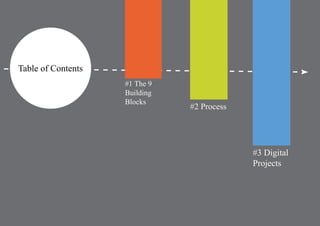
#1 The 9 
Building 
Blocks #2 Process 
#3 Digital 
Projects 
Table of Contents
Table of Contents 
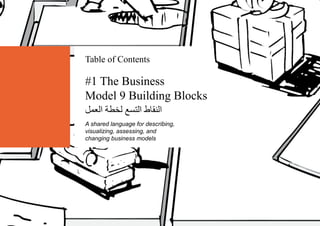
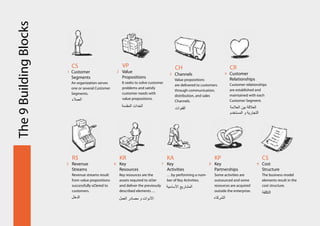
#1 The Business 
Model 9 Building Blocks 
النقاط التسع لخطة العمل 
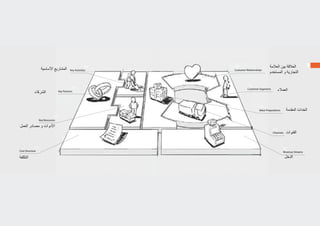
A shared language for describing, 
visualizing, assessing, and 
changing business models
العملاء 
العلاقة بين العلامة القنوات الخدات المقدمة 
التجارية و المستخدم 
الأدوات و مصادر العمل الدخل 
المشاريع الأساسية 
الشركاء 
التكلفة
المشاريع الأساسية 
KR 
الشركاء 
Key Resources 
KP 
Key Partners 
KA 
Key Activities 
C$ 
Cost Structure 
CR 
Customer Relationships 
العلاقة بين العلامة 
التجارية و المستخدم 
CS 
Customer Segments 
العملاء 
VP 
Value Propositions 
CH 
Channels 
الخدات المقدمة 
القنوات 
R$ 
Revenue Streams 
الدخل 
الأدوات و مصادر العمل 
التكلفة
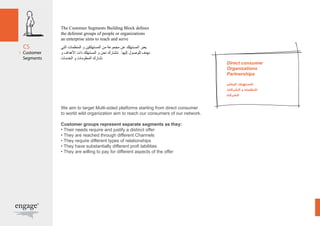
The Customer Segments Building Block defines 
the deferent groups of people or organizations 
an enterprise aims to reach and serve 
يعبر المستهلك عن مجموعة من المستهلكين و المنظمات التي 
نهدف للوصول إليها . نتشارك نحن و المستهلك ذات الأهداف و 
نشارك المعلومات و الخدمات 
We aim to target Multi-sided platforms starting from direct consumer 
to world wild organization aim to reach our consumers of our network. 
Customer groups represent separate segments as they: 
• Their needs require and justify a distinct offer 
• They are reached through different Channels 
• They require different types of relationships 
• They have substantially different profi tabilities 
• They are willing to pay for different aspects of the offer 
Direct consumer 
Organizations 
Partnerships 
المستهلك المباشر 
المنظمات و الشركات 
الشركاء
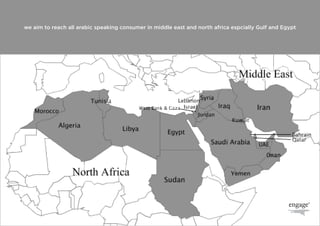
we aim to reach all arabic speaking consumer in middle east and north africa espcially Gulf and Egypt
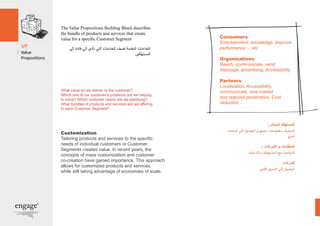
The Value Propositions Building Block describes 
the bundle of products and services that create 
value for a specific Customer Segment 
الخدامات المقدمة تصف الخدامات التي تأدي إلي فائدة إلي 
المستهلكين 
What value do we deliver to the customer? 
Which one of our customer’s problems are we helping 
to solve? Which customer needs are we satisfying? 
What bundles of products and services are we offering 
to each Customer Segment? 
Customization 
Tailoring products and services to the specific 
needs of individual customers or Customer 
Segments creates value. In recent years, the 
concepts of mass customization and customer 
co-creation have gained importance. This approach 
allows for customized products and services, 
while still taking advantage of economies of scale. 
Consumers: 
Entertainment, knowledge, improve 
performance ... etc 
Organizations: 
Reach, communicate, send 
message, advertising, Accessibility . 
Partners: 
Localization, Accessibility, 
communicate, new market 
and regional penetration, Cost 
reduction... 
المستهلك المباشر: 
الترفية, معلومات, تسهيل الوصول إلي خدمات 
أخري 
المنظمات و الشركات : 
التواصل مع المستهلك و الدعاية. 
الشركاء: 
الوصول إلي السوق المحلي
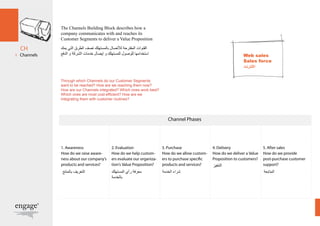
The Channels Building Block describes how a 
company communicates with and reaches its 
Customer Segments to deliver a Value Proposition 
القنوات المقترحة للأتصال بالمستهلك تصف الطرق التي يمك 
Web sales استخدامها للوصول للمستهلك و إيصال خدمات الشركة و الدفع 
Sales force 
الأنترنت 
Through which Channels do our Customer Segments 
want to be reached? How are we reaching them now? 
How are our Channels integrated? Which ones work best? 
Which ones are most cost-efficient? How are we 
integrating them with customer routines? 
معرفة رأي المستهلك التعريف بالمنتج 
بالخدمة 
شراء الخدمة 
التنفيز 
المتابعة
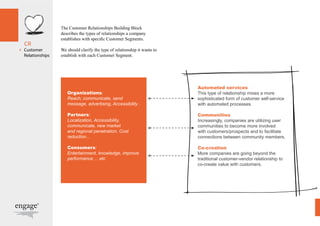
The Customer Relationships Building Block 
describes the types of relationships a company 
establishes with specific Customer Segments. 
We should clarify the type of relationship it wants to 
establish with each Customer Segment. 
Automated services 
This type of relationship mixes a more 
sophisticated form of customer self-service 
with automated processes. 
Communities 
Increasingly, companies are utilizing user 
communities to become more involved 
with customers/prospects and to facilitate 
connections between community members. 
Co-creation 
More companies are going beyond the 
traditional customer-vendor relationship to 
co-create value with customers. 
Organizations: 
Reach, communicate, send 
message, advertising, Accessibility . 
Partners: 
Localization, Accessibility, 
communicate, new market 
and regional penetration, Cost 
reduction... 
Consumers: 
Entertainment, knowledge, improve 
performance ... etc
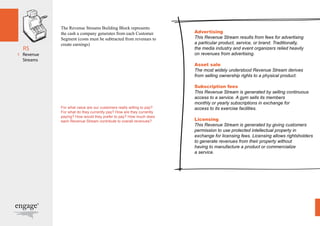
The Revenue Streams Building Block represents 
the cash a company generates from each Customer 
Segment (costs must be subtracted from revenues to 
create earnings) 
For what value are our customers really willing to pay? 
For what do they currently pay? How are they currently 
paying? How would they prefer to pay? How much does 
each Revenue Stream contribute to overall revenues? 
Advertising 
This Revenue Stream results from fees for advertising 
a particular product, service, or brand. Traditionally, 
the media industry and event organizers relied heavily 
on revenues from advertising. 
Asset sale 
The most widely understood Revenue Stream derives 
from selling ownership rights to a physical product. 
Subscription fees 
This Revenue Stream is generated by selling continuous 
access to a service. A gym sells its members 
monthly or yearly subscriptions in exchange for 
access to its exercise facilities. 
Licensing 
This Revenue Stream is generated by giving customers 
permission to use protected intellectual property in 
exchange for licensing fees. Licensing allows rightsholders 
to generate revenues from their property without 
having to manufacture a product or commercialize 
a service.
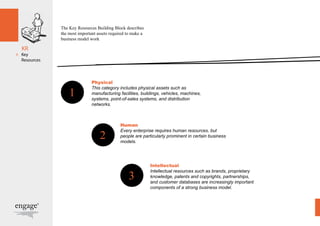
The Key Resources Building Block describes 
the most important assets required to make a 
business model work 
Physical 
This category includes physical assets such as 
manufacturing facilities, buildings, vehicles, machines, 
systems, point-of-sales systems, and distribution 
networks. 
Human 
Every enterprise requires human resources, but 
people are particularly prominent in certain business 
models. 
Intellectual 
Intellectual resources such as brands, proprietary 
knowledge, patents and copyrights, partnerships, 
and customer databases are increasingly important 
components of a strong business model. 
1 
2 
3
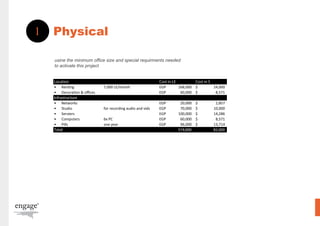
1 Physical 
usine the minimum office size and special requirments needed 
to activate this project
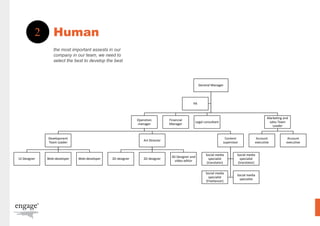
2 Human 
the most important assests in our 
company in our team, we need to 
select the best to develop the best 
General Manager 
Operation 
manager 
Development 
Team Leader 
UI Designer Web-developer Web-developer 
Art Director 
2D designer 2D designer 3D Designer and 
video editor 
Content 
supervisor 
Social media 
specialist 
(translator) 
Social media 
specialist 
(translator) 
Social media 
specialist 
(Freelancer) 
Social media 
specialist 
Financial 
Manager Legal consultant 
Marketing and 
sales Team 
Leader 
Account 
executive 
Account 
executive 
PA
2 Human 
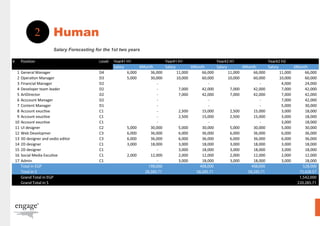
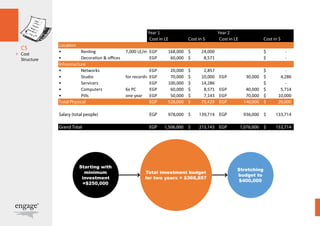
Salary Forecasting for the 1st two years
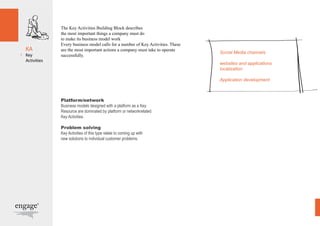
The Key Activities Building Block describes 
the most important things a company must do 
to make its business model work 
Every business model calls for a number of Key Activities. These 
are the most important actions a company must take to operate 
successfully. Social Media channels 
websites and applications 
localization 
Application development 
Platform/network 
Business models designed with a platform as a Key 
Resource are dominated by platform or networkrelated 
Key Activities. 
Problem solving 
Key Activities of this type relate to coming up with 
new solutions to individual customer problems.
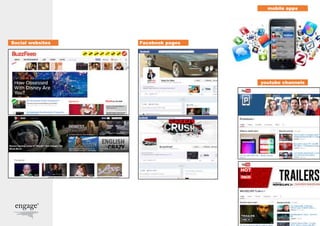
Social websites Facebook pages 
mobile apps 
youtube channels
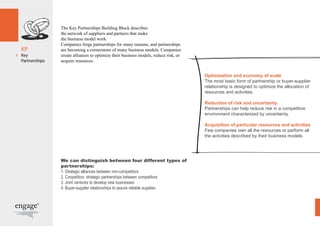
The Key Partnerships Building Block describes 
the network of suppliers and partners that make 
the business model work 
Companies forge partnerships for many reasons, and partnerships 
are becoming a cornerstone of many business models. Companies 
create alliances to optimize their business models, reduce risk, or 
acquire resources. 
Optimization and economy of scale 
The most basic form of partnership or buyer-supplier 
relationship is designed to optimize the allocation of 
resources and activities. 
Reduction of risk and uncertainty 
Partnerships can help reduce risk in a competitive 
environment characterized by uncertainty. 
Acquisition of particular resources and activities 
Few companies own all the resources or perform all 
the activities described by their business models. 
We can distinguish between four different types of 
partnerships: 
1. Strategic alliances between non-competitors 
2. Coopetition: strategic partnerships between competitors 
3. Joint ventures to develop new businesses 
4. Buyer-supplier relationships to assure reliable supplies
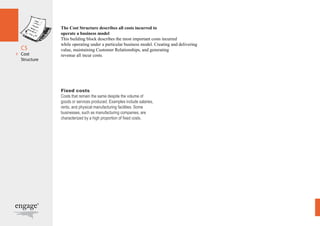
The Cost Structure describes all costs incurred to 
operate a business model 
This building block describes the most important costs incurred 
while operating under a particular business model. Creating and delivering 
value, maintaining Customer Relationships, and generating 
revenue all incur costs. 
Fixed costs 
Costs that remain the same despite the volume of 
goods or services produced. Examples include salaries, 
rents, and physical manufacturing facilities. Some 
businesses, such as manufacturing companies, are 
characterized by a high proportion of fixed costs.
Total investment budget 
for two years = $368,857 
Starting with 
minimum 
investment 
=$250,000 
Stretching 
budget to 
$400,000
Direct consumer 
Organizations 
Partnerships 
Consumers: 
Entertainment, knowledge, 
improve performance ... etc 
Organizations: 
Reach, communicate, send 
message, advertising, 
Accessibility . 
Partners: 
Localization, Accessibility, 
communicate, new market 
and regional penetration, 
Cost reduction... 
Automated 
services 
Communities 
Co-creation 
Sales force 
Web sales 
Advertising 
Asset sale 
Subscription fees 
Licensing 
Social Media channels 
websites and 
applications 
localization 
Application 
development 
Physical 
Human 
Intellectual 
1 
2 
3 
Optimization and 
economy of scale 
Reduction of risk 
and uncertainty 
Acquisition 
of particular 
resources and 
activities 
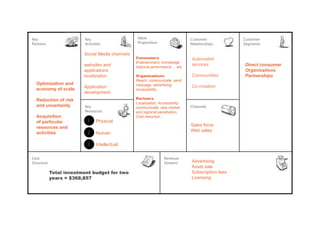
Total investment budget for two 
years = $368,857
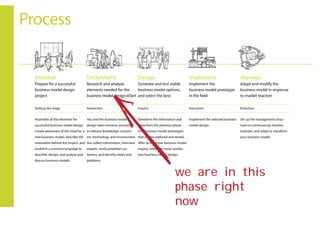
we are in this 
phase right 
now
Engage 9 Blocks Business Model case study

Engage 9 Blocks Business Model case study

  • 1.
    Business Model Engage Digital Publishing & Marketing خطة عمل - التسويق و الأعلام الإلكتروني Written & designed by: AbdelRhman Tantawy
  • 2.
    We aim tocreating unique, regionally relevant and trusted content in Middle east. While helping brands, non-profits and start-ups to reach targeted audiences on both the web, social media and mobile. هدفنا انشاء مصادر مميزة و موثوقة للمنطقة العربية و خاصتاً مصر و الخليج. و خلال ذلك نعمل علي مساعدة العلامات التجارية المحلية و الجمعيات الخيرية للوصول إلي عملائهم عن طريق الأنترنت, شبكات التواصل الاجتماعي و الموبايل . و أيضا مساعدة الشركات العالمية للوصول لعملائهم و في المنطقة بالطريقة و اللغة المناسبة.
  • 3.
    #1 The 9 Building Blocks #2 Process #3 Digital Projects Table of Contents
  • 4.
    Table of Contents #1 The Business Model 9 Building Blocks النقاط التسع لخطة العمل A shared language for describing, visualizing, assessing, and changing business models
  • 5.
    العملاء العلاقة بينالعلامة القنوات الخدات المقدمة التجارية و المستخدم الأدوات و مصادر العمل الدخل المشاريع الأساسية الشركاء التكلفة
  • 6.
    المشاريع الأساسية KR الشركاء Key Resources KP Key Partners KA Key Activities C$ Cost Structure CR Customer Relationships العلاقة بين العلامة التجارية و المستخدم CS Customer Segments العملاء VP Value Propositions CH Channels الخدات المقدمة القنوات R$ Revenue Streams الدخل الأدوات و مصادر العمل التكلفة
  • 7.
    The Customer SegmentsBuilding Block defines the deferent groups of people or organizations an enterprise aims to reach and serve يعبر المستهلك عن مجموعة من المستهلكين و المنظمات التي نهدف للوصول إليها . نتشارك نحن و المستهلك ذات الأهداف و نشارك المعلومات و الخدمات We aim to target Multi-sided platforms starting from direct consumer to world wild organization aim to reach our consumers of our network. Customer groups represent separate segments as they: • Their needs require and justify a distinct offer • They are reached through different Channels • They require different types of relationships • They have substantially different profi tabilities • They are willing to pay for different aspects of the offer Direct consumer Organizations Partnerships المستهلك المباشر المنظمات و الشركات الشركاء
  • 8.
    we aim toreach all arabic speaking consumer in middle east and north africa espcially Gulf and Egypt
  • 9.
    The Value PropositionsBuilding Block describes the bundle of products and services that create value for a specific Customer Segment الخدامات المقدمة تصف الخدامات التي تأدي إلي فائدة إلي المستهلكين What value do we deliver to the customer? Which one of our customer’s problems are we helping to solve? Which customer needs are we satisfying? What bundles of products and services are we offering to each Customer Segment? Customization Tailoring products and services to the specific needs of individual customers or Customer Segments creates value. In recent years, the concepts of mass customization and customer co-creation have gained importance. This approach allows for customized products and services, while still taking advantage of economies of scale. Consumers: Entertainment, knowledge, improve performance ... etc Organizations: Reach, communicate, send message, advertising, Accessibility . Partners: Localization, Accessibility, communicate, new market and regional penetration, Cost reduction... المستهلك المباشر: الترفية, معلومات, تسهيل الوصول إلي خدمات أخري المنظمات و الشركات : التواصل مع المستهلك و الدعاية. الشركاء: الوصول إلي السوق المحلي
  • 10.
    The Channels BuildingBlock describes how a company communicates with and reaches its Customer Segments to deliver a Value Proposition القنوات المقترحة للأتصال بالمستهلك تصف الطرق التي يمك Web sales استخدامها للوصول للمستهلك و إيصال خدمات الشركة و الدفع Sales force الأنترنت Through which Channels do our Customer Segments want to be reached? How are we reaching them now? How are our Channels integrated? Which ones work best? Which ones are most cost-efficient? How are we integrating them with customer routines? معرفة رأي المستهلك التعريف بالمنتج بالخدمة شراء الخدمة التنفيز المتابعة
  • 11.
    The Customer RelationshipsBuilding Block describes the types of relationships a company establishes with specific Customer Segments. We should clarify the type of relationship it wants to establish with each Customer Segment. Automated services This type of relationship mixes a more sophisticated form of customer self-service with automated processes. Communities Increasingly, companies are utilizing user communities to become more involved with customers/prospects and to facilitate connections between community members. Co-creation More companies are going beyond the traditional customer-vendor relationship to co-create value with customers. Organizations: Reach, communicate, send message, advertising, Accessibility . Partners: Localization, Accessibility, communicate, new market and regional penetration, Cost reduction... Consumers: Entertainment, knowledge, improve performance ... etc
  • 12.
    The Revenue StreamsBuilding Block represents the cash a company generates from each Customer Segment (costs must be subtracted from revenues to create earnings) For what value are our customers really willing to pay? For what do they currently pay? How are they currently paying? How would they prefer to pay? How much does each Revenue Stream contribute to overall revenues? Advertising This Revenue Stream results from fees for advertising a particular product, service, or brand. Traditionally, the media industry and event organizers relied heavily on revenues from advertising. Asset sale The most widely understood Revenue Stream derives from selling ownership rights to a physical product. Subscription fees This Revenue Stream is generated by selling continuous access to a service. A gym sells its members monthly or yearly subscriptions in exchange for access to its exercise facilities. Licensing This Revenue Stream is generated by giving customers permission to use protected intellectual property in exchange for licensing fees. Licensing allows rightsholders to generate revenues from their property without having to manufacture a product or commercialize a service.
  • 15.
    The Key ResourcesBuilding Block describes the most important assets required to make a business model work Physical This category includes physical assets such as manufacturing facilities, buildings, vehicles, machines, systems, point-of-sales systems, and distribution networks. Human Every enterprise requires human resources, but people are particularly prominent in certain business models. Intellectual Intellectual resources such as brands, proprietary knowledge, patents and copyrights, partnerships, and customer databases are increasingly important components of a strong business model. 1 2 3
  • 16.
    1 Physical usinethe minimum office size and special requirments needed to activate this project
  • 17.
    2 Human themost important assests in our company in our team, we need to select the best to develop the best General Manager Operation manager Development Team Leader UI Designer Web-developer Web-developer Art Director 2D designer 2D designer 3D Designer and video editor Content supervisor Social media specialist (translator) Social media specialist (translator) Social media specialist (Freelancer) Social media specialist Financial Manager Legal consultant Marketing and sales Team Leader Account executive Account executive PA
  • 18.
    2 Human SalaryForecasting for the 1st two years
  • 19.
    The Key ActivitiesBuilding Block describes the most important things a company must do to make its business model work Every business model calls for a number of Key Activities. These are the most important actions a company must take to operate successfully. Social Media channels websites and applications localization Application development Platform/network Business models designed with a platform as a Key Resource are dominated by platform or networkrelated Key Activities. Problem solving Key Activities of this type relate to coming up with new solutions to individual customer problems.
  • 20.
    Social websites Facebookpages mobile apps youtube channels
  • 21.
    The Key PartnershipsBuilding Block describes the network of suppliers and partners that make the business model work Companies forge partnerships for many reasons, and partnerships are becoming a cornerstone of many business models. Companies create alliances to optimize their business models, reduce risk, or acquire resources. Optimization and economy of scale The most basic form of partnership or buyer-supplier relationship is designed to optimize the allocation of resources and activities. Reduction of risk and uncertainty Partnerships can help reduce risk in a competitive environment characterized by uncertainty. Acquisition of particular resources and activities Few companies own all the resources or perform all the activities described by their business models. We can distinguish between four different types of partnerships: 1. Strategic alliances between non-competitors 2. Coopetition: strategic partnerships between competitors 3. Joint ventures to develop new businesses 4. Buyer-supplier relationships to assure reliable supplies
  • 22.
    The Cost Structuredescribes all costs incurred to operate a business model This building block describes the most important costs incurred while operating under a particular business model. Creating and delivering value, maintaining Customer Relationships, and generating revenue all incur costs. Fixed costs Costs that remain the same despite the volume of goods or services produced. Examples include salaries, rents, and physical manufacturing facilities. Some businesses, such as manufacturing companies, are characterized by a high proportion of fixed costs.
  • 23.
    Total investment budget for two years = $368,857 Starting with minimum investment =$250,000 Stretching budget to $400,000
  • 24.
    Direct consumer Organizations Partnerships Consumers: Entertainment, knowledge, improve performance ... etc Organizations: Reach, communicate, send message, advertising, Accessibility . Partners: Localization, Accessibility, communicate, new market and regional penetration, Cost reduction... Automated services Communities Co-creation Sales force Web sales Advertising Asset sale Subscription fees Licensing Social Media channels websites and applications localization Application development Physical Human Intellectual 1 2 3 Optimization and economy of scale Reduction of risk and uncertainty Acquisition of particular resources and activities Total investment budget for two years = $368,857
  • 28.
    we are inthis phase right now