CUSTOMER BASED BRAND EQUITY
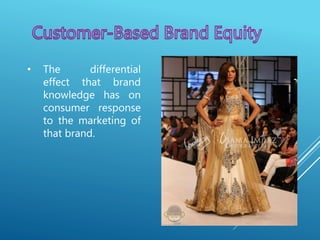
• The differential
effect that brand
knowledge has on
consumer response
to the marketing of
that brand.
There are three ingredients of Brand Equity
 Differential effect
• Differences in consumer response
 Brand knowledge
• A result of consumers’ knowledge about the brand
 Consumer response to marketing
• Choice of a brand
• Recall of copy points from an ad
• Response to a sales promotion
• Evaluations of a proposed brand extension
.
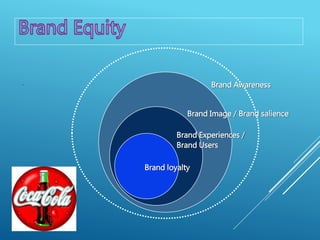
Awareness
Brand Awareness
Brand Image / Brand salience
Brand Experiences /
Brand Users
Brand loyalty
.
Brand as a reflection of past investments in
the marketing
Brand as a direction for future marketing
actions or programs
.
.
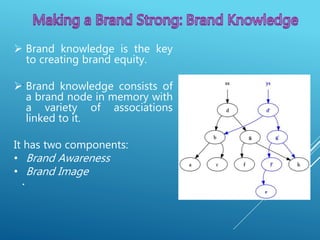
 Brand knowledge is the key
to creating brand equity.
 Brand knowledge consists of
a brand node in memory with
a variety of associations
linked to it.
It has two components:
• Brand Awareness
• Brand Image
.
.
Brand Awareness
It consists of the performance of brand
recognition & brand recall
• Brand Recognition: Ability of consumer to
confirm prior exposure to the brand when
given brand as a cue
• Brand Recall: Ability of consumer to retrieve the
brand from memory when given product
category as cue
.
.
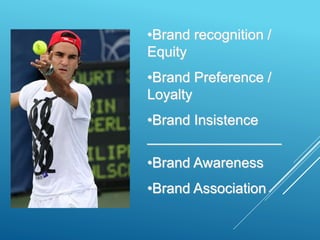
•Brand recognition /
Equity
•Brand Preference /
Loyalty
•Brand Insistence
_________________
•Brand Awareness
•Brand Association
.
Learning advantages
Register the brand in the minds of consumers
Consideration advantages
Likelihood that the brand will be a member of
the consideration set
Choice advantages
Affect choices among brands in the
consideration set
.
.
Increasing the familiarity of the brand
through repeated exposure (for brand
recognition)
Forging strong associations with the
appropriate product category or other
relevant purchase or consumption cues
(for brand recall)
.
.
Brand image
A positive image is created by marketing
programs that link strong, favorable, &
unique associations to the brand in
memory
• Strength of Brand Association
• favorability of Brand Association
• uniqueness of Brand Association
.
.
Brand Associations
• Does not matter which source of brand
association
• Need to be favorable, strong, and unique
• Marketers should recognize the influence of
these other sources of information by both
managing them as well as possible and by
adequately accounting for them in designing
communication strategies.
.
.
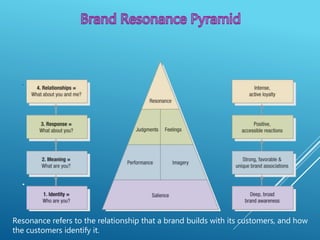
1. Ensure identification of the brand with customers
and an association of the brand in customers’
minds
2. Establish the totality of brand meaning in the minds
of consumers
3. Elicit the proper customer responses to the brand
identification and brand meaning
4. Convert brand response to create an intense, active
loyalty relationship between customers and the
brand
.
.
1. Who are you? (brand identity)
2. What are you? (brand meaning)
3. What about you? What do I think or feel
about you? (brand responses)
4. What about you and me? What kind of
association and how much of a connection
would I like to have with you? (brand
relationships)
.
.
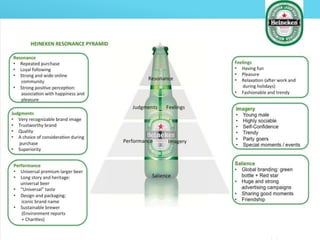
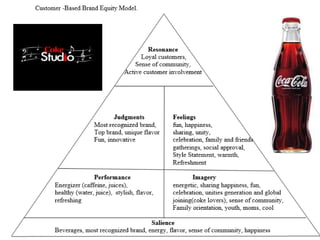
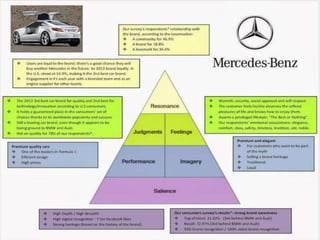
Resonance refers to the relationship that a brand builds with its customers, and how
the customers identify it.
.
.
• Depth of brand awareness
– Ease of recognition and recall
– Strength and clarity of category membership
• Breadth of brand awareness
– Purchase consideration
– Consumption consideration
.
.
• The product category hierarchy shows us
not only the depth of awareness matters
but also the breadth.
• The brand must not only be top-of-mind
and have sufficient “mind share,” but it
must also do so at the right times and
places.
.
• To fully understand brand recall, we need
to appreciate product category structure,
or how product categories are organized
in memory.
.
.
• Primary characteristics and supplementary
features
• Product reliability, durability, and
serviceability
• Service effectiveness, efficiency, and
empathy
• Style and design
• Price
.
.
• User profiles
Demographic and psychographic characteristics
Actual or aspirational
Group perceptions—popularity
• Purchase and usage situations
Type of channel, specific stores, ease of purchase
Time (day, week, month, year, etc.), location, and context of
usage
• Personality and values
Sincerity, excitement, competence, sophistication, and
ruggedness
• History, heritage, and experiences
Nostalgia
Memories
.
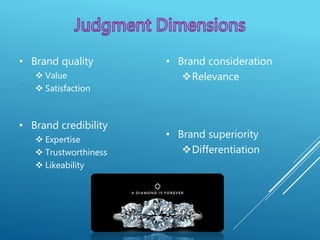
• Brand quality
 Value
 Satisfaction
• Brand credibility
 Expertise
 Trustworthiness
 Likeability
• Brand consideration
Relevance
• Brand superiority
Differentiation
.
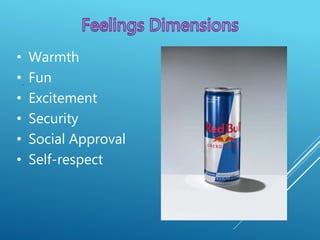
• Warmth
• Fun
• Excitement
• Security
• Social Approval
• Self-respect
.
.
• Behavioral loyalty
– Frequency and amount of repeat purchases
• Attitudinal attachment
– Love brand (favorite possessions; “a little pleasure”)
– Proud of brand
• Sense of community
– Kinship
– Affiliation
• Active engagement
– Seek information
– Join club
– Visit website, chat rooms
.
• Customers own brands.
• Don’t take shortcuts with
brands.
• Brands should have a
duality.
• Brands should have
richness.
• Brand resonance
provides important focus.
.
• Customer-brand relationships are the
foundation of brand resonance and
building a strong brand.
• The customer-based brand equity model
certainly puts that notion front and
center.
.
.
1. Is the company looking for ways to take care
of you?
2. Does the company know its customers well
enough to differentiate between them?
3. Is someone accountable for customers?
4. Is the company managed for shareholder
value?
5. Is the company testing new customer offers
and learning from the results?
.
• Uses a company’s data systems and
applications to track consumer activity and
manage customer interactions with the
company
.
.
• Blattberg and Deighton (1996) offer eight guidelines as a
means of maximizing customer equity:
– Invest in highest-value customers first
– Transform product management into customer management
– Consider how add-on sales and cross-selling can increase customer
equity
– Look for ways to reduce acquisition costs
– Track customer equity gains and losses against marketing programs
– Relate branding to customer equity
– Monitor the intrinsic retainability of your customer
– Consider writing separate marketing plans—or even building two
marketing organizations—for acquisition and retention efforts
.
.
• The sum of lifetime values of all customers
• Customer lifetime value (CLV) is affected
by revenue and by the cost of customer
acquisition, retention, and cross-selling
• Consists of three components:
– Value equity
– Brand equity
– Relationship equity
.
.
• Customers drive the success of brands but
brands are the necessary touch point that
firms have to connect with their customers.
• Customer-based brand equity maintains that
brands create value by eliciting differential
customer response to marketing activities.
• The higher price premiums and increased
levels of loyalty engendered by brands
generate incremental cash flows.

Chapter 2 (customer based brand equity)

  • 1.
  • 2.
    • The differential effectthat brand knowledge has on consumer response to the marketing of that brand.
  • 3.
    There are threeingredients of Brand Equity  Differential effect • Differences in consumer response  Brand knowledge • A result of consumers’ knowledge about the brand  Consumer response to marketing • Choice of a brand • Recall of copy points from an ad • Response to a sales promotion • Evaluations of a proposed brand extension
  • 4.
    . Awareness Brand Awareness Brand Image/ Brand salience Brand Experiences / Brand Users Brand loyalty
  • 5.
    . Brand as areflection of past investments in the marketing Brand as a direction for future marketing actions or programs
  • 6.
    . .  Brand knowledgeis the key to creating brand equity.  Brand knowledge consists of a brand node in memory with a variety of associations linked to it. It has two components: • Brand Awareness • Brand Image
  • 7.
    . . Brand Awareness It consistsof the performance of brand recognition & brand recall • Brand Recognition: Ability of consumer to confirm prior exposure to the brand when given brand as a cue • Brand Recall: Ability of consumer to retrieve the brand from memory when given product category as cue
  • 8.
    . . •Brand recognition / Equity •BrandPreference / Loyalty •Brand Insistence _________________ •Brand Awareness •Brand Association
  • 9.
    . Learning advantages Register thebrand in the minds of consumers Consideration advantages Likelihood that the brand will be a member of the consideration set Choice advantages Affect choices among brands in the consideration set
  • 10.
    . . Increasing the familiarityof the brand through repeated exposure (for brand recognition) Forging strong associations with the appropriate product category or other relevant purchase or consumption cues (for brand recall)
  • 11.
    . . Brand image A positiveimage is created by marketing programs that link strong, favorable, & unique associations to the brand in memory • Strength of Brand Association • favorability of Brand Association • uniqueness of Brand Association
  • 12.
    . . Brand Associations • Doesnot matter which source of brand association • Need to be favorable, strong, and unique • Marketers should recognize the influence of these other sources of information by both managing them as well as possible and by adequately accounting for them in designing communication strategies.
  • 13.
    . . 1. Ensure identificationof the brand with customers and an association of the brand in customers’ minds 2. Establish the totality of brand meaning in the minds of consumers 3. Elicit the proper customer responses to the brand identification and brand meaning 4. Convert brand response to create an intense, active loyalty relationship between customers and the brand
  • 14.
    . . 1. Who areyou? (brand identity) 2. What are you? (brand meaning) 3. What about you? What do I think or feel about you? (brand responses) 4. What about you and me? What kind of association and how much of a connection would I like to have with you? (brand relationships)
  • 15.
    . . Resonance refers tothe relationship that a brand builds with its customers, and how the customers identify it.
  • 19.
    . . • Depth ofbrand awareness – Ease of recognition and recall – Strength and clarity of category membership • Breadth of brand awareness – Purchase consideration – Consumption consideration
  • 20.
    . . • The productcategory hierarchy shows us not only the depth of awareness matters but also the breadth. • The brand must not only be top-of-mind and have sufficient “mind share,” but it must also do so at the right times and places.
  • 21.
    . • To fullyunderstand brand recall, we need to appreciate product category structure, or how product categories are organized in memory.
  • 22.
    . . • Primary characteristicsand supplementary features • Product reliability, durability, and serviceability • Service effectiveness, efficiency, and empathy • Style and design • Price
  • 23.
    . . • User profiles Demographicand psychographic characteristics Actual or aspirational Group perceptions—popularity • Purchase and usage situations Type of channel, specific stores, ease of purchase Time (day, week, month, year, etc.), location, and context of usage • Personality and values Sincerity, excitement, competence, sophistication, and ruggedness • History, heritage, and experiences Nostalgia Memories
  • 24.
    . • Brand quality Value  Satisfaction • Brand credibility  Expertise  Trustworthiness  Likeability • Brand consideration Relevance • Brand superiority Differentiation
  • 25.
    . • Warmth • Fun •Excitement • Security • Social Approval • Self-respect
  • 26.
    . . • Behavioral loyalty –Frequency and amount of repeat purchases • Attitudinal attachment – Love brand (favorite possessions; “a little pleasure”) – Proud of brand • Sense of community – Kinship – Affiliation • Active engagement – Seek information – Join club – Visit website, chat rooms
  • 27.
    . • Customers ownbrands. • Don’t take shortcuts with brands. • Brands should have a duality. • Brands should have richness. • Brand resonance provides important focus.
  • 28.
    . • Customer-brand relationshipsare the foundation of brand resonance and building a strong brand. • The customer-based brand equity model certainly puts that notion front and center.
  • 29.
    . . 1. Is thecompany looking for ways to take care of you? 2. Does the company know its customers well enough to differentiate between them? 3. Is someone accountable for customers? 4. Is the company managed for shareholder value? 5. Is the company testing new customer offers and learning from the results?
  • 30.
    . • Uses acompany’s data systems and applications to track consumer activity and manage customer interactions with the company
  • 31.
    . . • Blattberg andDeighton (1996) offer eight guidelines as a means of maximizing customer equity: – Invest in highest-value customers first – Transform product management into customer management – Consider how add-on sales and cross-selling can increase customer equity – Look for ways to reduce acquisition costs – Track customer equity gains and losses against marketing programs – Relate branding to customer equity – Monitor the intrinsic retainability of your customer – Consider writing separate marketing plans—or even building two marketing organizations—for acquisition and retention efforts
  • 32.
    . . • The sumof lifetime values of all customers • Customer lifetime value (CLV) is affected by revenue and by the cost of customer acquisition, retention, and cross-selling • Consists of three components: – Value equity – Brand equity – Relationship equity
  • 33.
    . . • Customers drivethe success of brands but brands are the necessary touch point that firms have to connect with their customers. • Customer-based brand equity maintains that brands create value by eliciting differential customer response to marketing activities. • The higher price premiums and increased levels of loyalty engendered by brands generate incremental cash flows.