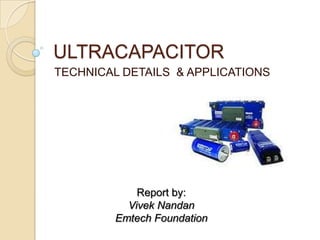
ULTRACAPACITORTECHNICAL DETAILS  & APPLICATIONSReport by:VivekNandanEmtech Foundation
Table of contents1.Introduction.2.Attractive Features.3.Advantages to conventional Energy Storing Devices.4.Inside a  Supercapacitor/Ultracapacitor.5.Working.6.Applications.7.Drawbacks.
IntroductionWhat is a Ultracapacitor?A charge storing device(Capacitor) .Differ in constructional features with respect to simple capacitors.Has ability to store tremendous charge.Capacitance ranges up to 5000F!Also called Super capacitor or Double-layered capacitor.Invented by Engineers at Standard Oil,1966.
Attractive FeaturesCapacitance ranges to 5000 F.No chemical reaction involved.Much more effective at rapid, regenerative energy storage than chemical batteries .Works even at low temperatures  -40 degrees Celsius.Ultracapacitors can store 5 percent as much energy as a modern lithium-ion battery. 5000 farads measure about 5 centimeters by 5 cm by 15 cm, which is an amazingly high capacitance relative to its volume.Can effectively fulfill the requirement of High current pulses that can kill a battery if used instead.
Advantages to conventional energy storing devices.Batteries:
Degrade within a few thousand charge-discharge cycles. Ulracapacitors can have more than 300 000 charging cycles, which is far more than a battery can handle.
Ultra capacitor charges within seconds whereas batteries  takes hrs.
Because no chemical reaction is involved, ultracapacitors--also known as supercapacitors and double-layer capacitors--are much more effective at rapid, regenerative energy storage than chemical batteries are.
Batteries fail where high charging discharging takes place whereas ultracapacitor fares extremely well.Ordinary Capacitors:Higher capacitance.
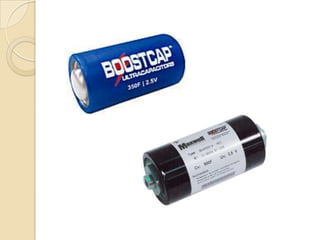
Put two ordinary capacitors the size of a D-cell battery in your flashlight, each charged to 1.5 volts, and the bulb will go out in less than a second, if it lights at all. An ultracapacitor of the same size, however, has a capacitance of about 350 farads and could light the bulb for about 2 minutes.
Ultra Capacitors are Expensive.Inside a Super CapacitorTwo Electrodes  coated with sponge like activated carbon.Electrolyte :Contains free mobile ions.Porous Seprator-:Prevents electrodes from shoritng out.
The combination of enormous surface area and extremely small charge separation gives the ultracapacitor its outstanding capacitance relative to conventional capacitors.
Constructional FeaturesOriginally electrodes were made of aluminum. Standard Oil engineers coated these aluminum with 100-micrometer-thick layer of carbon.The carbon was first chemically etched to produce many holes that extended through the material, as in a sponge, so that the interior surface area was about 100 000 times as large as the outside. (This process is said to ”activate” the carbon.)They filled the interior with an electrolyte and used a porous insulator, one similar to paper, to keep the electrodes from shorting out.carbon is inert and does not react chemically with the ions attached to it. Nor do the ions become oxidized or reduced, as they do at the higher voltages used in an electrolytic cell.
WorkingWhen a voltage is applied, the ions are attracted to the electrode with the opposite charge, where they cling electrostatically to the pores in the carbon.At the low voltages used in ultracapacitors, carbon is inert and does not react chemically with the ions attached to it. Nor do the ions become oxidized or reduced, as they do at the higher voltages used in an electrolytic cell.As the effective area  where ions are stuck is much larger, appreciably high value of capacitance is obtained.
Modern UltracapacitorsNanotechnology is being employed in the design.The active carbon is replaced by a thin layer of billions of Nanotubes .Each Nanotube is like a uniform hollow cylinder with 5nm and 100 µm long.These Nanotubes  are verically grown over the conducting electrodes.
NANOTUBES STRUCTURES

Ultracapacitors

  • 1.
    ULTRACAPACITORTECHNICAL DETAILS & APPLICATIONSReport by:VivekNandanEmtech Foundation
  • 2.
    Table of contents1.Introduction.2.AttractiveFeatures.3.Advantages to conventional Energy Storing Devices.4.Inside a Supercapacitor/Ultracapacitor.5.Working.6.Applications.7.Drawbacks.
  • 3.
    IntroductionWhat is aUltracapacitor?A charge storing device(Capacitor) .Differ in constructional features with respect to simple capacitors.Has ability to store tremendous charge.Capacitance ranges up to 5000F!Also called Super capacitor or Double-layered capacitor.Invented by Engineers at Standard Oil,1966.
  • 4.
    Attractive FeaturesCapacitance rangesto 5000 F.No chemical reaction involved.Much more effective at rapid, regenerative energy storage than chemical batteries .Works even at low temperatures -40 degrees Celsius.Ultracapacitors can store 5 percent as much energy as a modern lithium-ion battery. 5000 farads measure about 5 centimeters by 5 cm by 15 cm, which is an amazingly high capacitance relative to its volume.Can effectively fulfill the requirement of High current pulses that can kill a battery if used instead.
  • 6.
    Advantages to conventionalenergy storing devices.Batteries:
  • 7.
    Degrade within afew thousand charge-discharge cycles. Ulracapacitors can have more than 300 000 charging cycles, which is far more than a battery can handle.
  • 8.
    Ultra capacitor chargeswithin seconds whereas batteries takes hrs.
  • 9.
    Because no chemicalreaction is involved, ultracapacitors--also known as supercapacitors and double-layer capacitors--are much more effective at rapid, regenerative energy storage than chemical batteries are.
  • 10.
    Batteries fail wherehigh charging discharging takes place whereas ultracapacitor fares extremely well.Ordinary Capacitors:Higher capacitance.
  • 11.
    Put two ordinarycapacitors the size of a D-cell battery in your flashlight, each charged to 1.5 volts, and the bulb will go out in less than a second, if it lights at all. An ultracapacitor of the same size, however, has a capacitance of about 350 farads and could light the bulb for about 2 minutes.
  • 12.
    Ultra Capacitors areExpensive.Inside a Super CapacitorTwo Electrodes coated with sponge like activated carbon.Electrolyte :Contains free mobile ions.Porous Seprator-:Prevents electrodes from shoritng out.
  • 13.
    The combination ofenormous surface area and extremely small charge separation gives the ultracapacitor its outstanding capacitance relative to conventional capacitors.
  • 14.
    Constructional FeaturesOriginally electrodeswere made of aluminum. Standard Oil engineers coated these aluminum with 100-micrometer-thick layer of carbon.The carbon was first chemically etched to produce many holes that extended through the material, as in a sponge, so that the interior surface area was about 100 000 times as large as the outside. (This process is said to ”activate” the carbon.)They filled the interior with an electrolyte and used a porous insulator, one similar to paper, to keep the electrodes from shorting out.carbon is inert and does not react chemically with the ions attached to it. Nor do the ions become oxidized or reduced, as they do at the higher voltages used in an electrolytic cell.
  • 15.
    WorkingWhen a voltageis applied, the ions are attracted to the electrode with the opposite charge, where they cling electrostatically to the pores in the carbon.At the low voltages used in ultracapacitors, carbon is inert and does not react chemically with the ions attached to it. Nor do the ions become oxidized or reduced, as they do at the higher voltages used in an electrolytic cell.As the effective area where ions are stuck is much larger, appreciably high value of capacitance is obtained.
  • 16.
    Modern UltracapacitorsNanotechnology isbeing employed in the design.The active carbon is replaced by a thin layer of billions of Nanotubes .Each Nanotube is like a uniform hollow cylinder with 5nm and 100 µm long.These Nanotubes are verically grown over the conducting electrodes.
  • 17.

Editor's Notes

  • #3 Introduction,attractivefeatures,advantages to conventional energy storing devices,inside a supercapacitor,working ,applications,summary