BASIC ELECTRICAL
ENGINEERING
Course seminar on;
….What you've just experienced is an example of an alternator breathing
its last breath.
Your first thought might have been the battery is dying. In a sense, you
would be right because the battery and the alternator are related, but the
battery tends to get all the press.
This presentation aims to explain the mechanics of alternators, how you
can diagnose problems and what you can do if you have a bad alternator.
You will come to now to some background information about alternators
and the war of the currents.
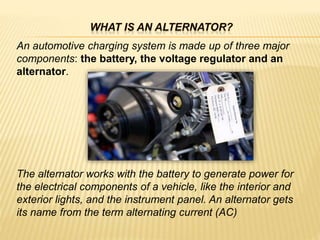
An automotive charging system is made up of three major
components: the battery, the voltage regulator and an
alternator.
The alternator works with the battery to generate power for
the electrical components of a vehicle, like the interior and
exterior lights, and the instrument panel. An alternator gets
its name from the term alternating current (AC)
Alternators produce AC power through electromagnetism formed
through the stator and rotor
The electricity is channeled into the battery, providing voltage to run
the various electrical systems.
Most cars today have a serpentine belt, or one belt that drives all
components that rely on crankshaft power. Most alternators are mounted
using brackets that bolt to a specific point on the engine. One of the
brackets is usually a fixed point, while the other is adjustable to tighten
the drive belt.
Alternators are typically found near the front of the engine and are
driven by the crankshaft, which converts the pistons' up-and-down
movement into circular movement.
IG
ALTERNATOR COMPONENTS
On the back side of the alternator you'll find several
terminals (or connecting points in an electrical circuit). Let's
take a look at those:
S terminal - Senses battery voltage
IG terminal - Ignition switch that turns the voltage
regulator on
L terminal - Closes the circuit to the warning lamp
B terminal - Main alternator output terminal (connected to
the battery)
F terminal - Full-field bypass for regulator
ALTERNATOR COMPONENTS
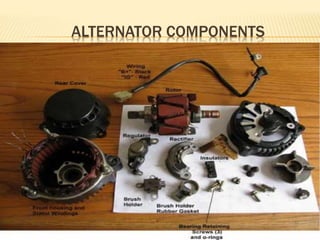
As we start to disassemble the alternator, we find :
1. The diode rectifier: The regulator distributes the power the alternator
creates, and it controls the output of power to the battery
2. The voltage regulator: The rectifier bridge converts the power
3 .Slip rings
both help to conduct current to the rotor field winding,
4. Brushes:
5. The alternator reveals a large cylinder with triangular finger poles around
the circumference. This is the rotor
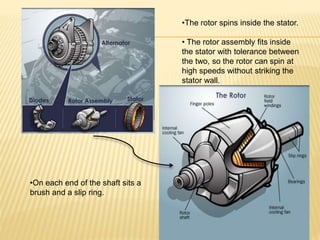
•The rotor spins inside the stator.
• The rotor assembly fits inside
the stator with tolerance between
the two, so the rotor can spin at
high speeds without striking the
stator wall.
•On each end of the shaft sits a
brush and a slip ring.
In the early days, cars used generators rather than alternators
to power the vehicle's electrical system and charge the battery
Generators produce direct current, which travels in one
direction, as opposed to the alternating current for the
electricity in our houses, which periodically reverses directions.
Alternating current became more attractive as it generates
higher voltage more efficiently, But car batteries can't use AC
power since they produce DC power.
As a result, the alternator's power output is fed through
diodes, which convert the AC power to DC power.
The rotor and the stator are the two components that generate
power.
As the engine rotates the alternator pulley, This is referred to
as a three-phase current.
This AC current is fed through stator leads into a connecting
set of diodes. Two diodes connect to each stator lead to
regulate the current.
The diodes are used to essentially block and direct the
current.
Since batteries need DC current, the diodes become a one-
way valve that will only allow current to pass in the same
direction.
THE TWO BASIC STATOR WINDING DESIGNS
DELTA WOUND WYE STYLE
Delta wound are easily
identifiable by their shape,
as they're triangular
These windings allow for a
high current flow at lower
RPM
Wye windings resemble
the flux capacitor
These windings are ideal
for diesel engines, as they
produce higher voltage
than delta stators at even
lower RPM.
The resulting voltage is ready to use in the battery.
Too much or too little voltage can damage the battery,
as well as other electrical components
To ensure the correct amount, a voltage regulator
determines when and how much voltage is needed in
the battery.
One of two types of regulators are found in most
alternators: The grounded regulator works by
controlling the amount of negative or battery ground
going into the winding in the rotor, while a grounded
field type works vice versa
THE LIFE AND DEATH OF AN ALTERNATOR
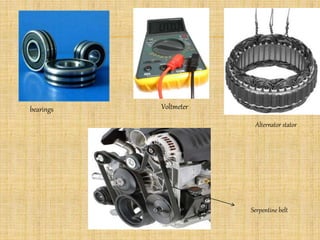
Bearing failure: The needle bearings that allow
the rotor to spin freely inside the stator can break
down from dirt and heat
When the bearings fail, the rotor will not
spin efficiently and can eventually seize.
Usually an alternator with bearings failure
makes a loud grinding noise
Stator windings : Test whether your car had an issue
with one of its stator windings, you'd need to use a
voltmeter to check the voltage . This is called a load test
If you have a failing alternator, the voltage will be well
below 14 volts. If so, it's time to replace the alternator.
Serpentine belt : If the belt is worn or loose, the
alternator won't function properly. A bad belt is easy to
replace
Voltmeterbearings
Serpentine belt
Alternator stator
ALTERNATOR S ,THE POWER SUPPLIER
Alternators are less expensive than say, a power
steering pump or air conditioner compressor
Batteries can only be recharged so many times
before they'll lose their ability to hold a charge
A bad alternator will ruin a good battery if you
don't address it quickly.
High-output alternators have become popular
with custom car shops and in high-performance
cars.
Some custom shops are even installing dual-
alternator systems to handle the additional
Presented by,
VedavyasP. Burli

Basic electrical engineering

  • 1.
  • 2.
    ….What you've justexperienced is an example of an alternator breathing its last breath. Your first thought might have been the battery is dying. In a sense, you would be right because the battery and the alternator are related, but the battery tends to get all the press. This presentation aims to explain the mechanics of alternators, how you can diagnose problems and what you can do if you have a bad alternator. You will come to now to some background information about alternators and the war of the currents.
  • 3.
    An automotive chargingsystem is made up of three major components: the battery, the voltage regulator and an alternator. The alternator works with the battery to generate power for the electrical components of a vehicle, like the interior and exterior lights, and the instrument panel. An alternator gets its name from the term alternating current (AC)
  • 4.
    Alternators produce ACpower through electromagnetism formed through the stator and rotor The electricity is channeled into the battery, providing voltage to run the various electrical systems. Most cars today have a serpentine belt, or one belt that drives all components that rely on crankshaft power. Most alternators are mounted using brackets that bolt to a specific point on the engine. One of the brackets is usually a fixed point, while the other is adjustable to tighten the drive belt. Alternators are typically found near the front of the engine and are driven by the crankshaft, which converts the pistons' up-and-down movement into circular movement.
  • 5.
  • 6.
    ALTERNATOR COMPONENTS On theback side of the alternator you'll find several terminals (or connecting points in an electrical circuit). Let's take a look at those: S terminal - Senses battery voltage IG terminal - Ignition switch that turns the voltage regulator on L terminal - Closes the circuit to the warning lamp B terminal - Main alternator output terminal (connected to the battery) F terminal - Full-field bypass for regulator
  • 7.
  • 8.
    As we startto disassemble the alternator, we find : 1. The diode rectifier: The regulator distributes the power the alternator creates, and it controls the output of power to the battery 2. The voltage regulator: The rectifier bridge converts the power 3 .Slip rings both help to conduct current to the rotor field winding, 4. Brushes: 5. The alternator reveals a large cylinder with triangular finger poles around the circumference. This is the rotor
  • 10.
    •The rotor spinsinside the stator. • The rotor assembly fits inside the stator with tolerance between the two, so the rotor can spin at high speeds without striking the stator wall. •On each end of the shaft sits a brush and a slip ring.
  • 11.
    In the earlydays, cars used generators rather than alternators to power the vehicle's electrical system and charge the battery Generators produce direct current, which travels in one direction, as opposed to the alternating current for the electricity in our houses, which periodically reverses directions. Alternating current became more attractive as it generates higher voltage more efficiently, But car batteries can't use AC power since they produce DC power. As a result, the alternator's power output is fed through diodes, which convert the AC power to DC power.
  • 12.
    The rotor andthe stator are the two components that generate power. As the engine rotates the alternator pulley, This is referred to as a three-phase current. This AC current is fed through stator leads into a connecting set of diodes. Two diodes connect to each stator lead to regulate the current. The diodes are used to essentially block and direct the current. Since batteries need DC current, the diodes become a one- way valve that will only allow current to pass in the same direction.
  • 13.
    THE TWO BASICSTATOR WINDING DESIGNS DELTA WOUND WYE STYLE Delta wound are easily identifiable by their shape, as they're triangular These windings allow for a high current flow at lower RPM Wye windings resemble the flux capacitor These windings are ideal for diesel engines, as they produce higher voltage than delta stators at even lower RPM.
  • 15.
    The resulting voltageis ready to use in the battery. Too much or too little voltage can damage the battery, as well as other electrical components To ensure the correct amount, a voltage regulator determines when and how much voltage is needed in the battery. One of two types of regulators are found in most alternators: The grounded regulator works by controlling the amount of negative or battery ground going into the winding in the rotor, while a grounded field type works vice versa
  • 16.
    THE LIFE ANDDEATH OF AN ALTERNATOR Bearing failure: The needle bearings that allow the rotor to spin freely inside the stator can break down from dirt and heat When the bearings fail, the rotor will not spin efficiently and can eventually seize. Usually an alternator with bearings failure makes a loud grinding noise
  • 17.
    Stator windings :Test whether your car had an issue with one of its stator windings, you'd need to use a voltmeter to check the voltage . This is called a load test If you have a failing alternator, the voltage will be well below 14 volts. If so, it's time to replace the alternator. Serpentine belt : If the belt is worn or loose, the alternator won't function properly. A bad belt is easy to replace
  • 18.
  • 19.
    ALTERNATOR S ,THEPOWER SUPPLIER Alternators are less expensive than say, a power steering pump or air conditioner compressor Batteries can only be recharged so many times before they'll lose their ability to hold a charge A bad alternator will ruin a good battery if you don't address it quickly. High-output alternators have become popular with custom car shops and in high-performance cars. Some custom shops are even installing dual- alternator systems to handle the additional
  • 20.