1
How Compressed Air Stores EnergyHow Compressed Air Stores Energy
ANG SovannANG Sovann
2
1. Introduction
2. Technology
2.1. Basic principles
2.2. Operation process
2.2.1. Compression process
2.2.2. Expansion process
2.2.3. Air storage
2.3. Type of CAES system
2.3.1. Diabatic system
2.3.2. Adiabatic system
2.3.3. Isothermal system
Content
3. Environment
3.1. Advantages
3.2. Disadvantages
4. Economic of applicable
5. Conclusion
6. References
3
1. Introduction
 Compressed Air Energy Storage(CAES) is one among the
other storage plants ( Flywheel, Battery, Superconductor and
so on.
 CAES is combination between pure storage plant and power
plant( consume fuel).
 The underground salt cavern was patented by Stal Laval in
1949.
 In 1978, the first CAES plant of 290-MW capacity was built at
Huntorf in Germany.
 In 1991, another 110-MW plant was built in McIntosh, Albama,
USA.
4
2. Technology
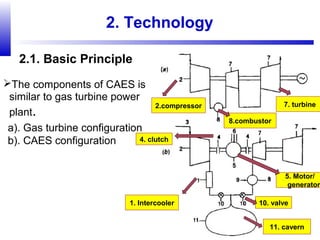
The components of CAES is
similar to gas turbine power
plant.
2.1. Basic Principle
a). Gas turbine configuration
b). CAES configuration
2.compressor 7. turbine
11. cavern
5. Motor/
generator
1. Intercooler
8.combustor
4. clutch
10. valve
5
2. Technology
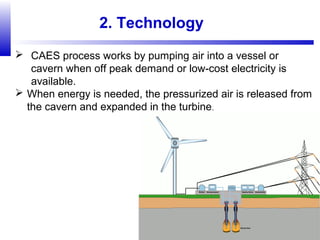
 CAES process works by pumping air into a vessel or
cavern when off peak demand or low-cost electricity is
available.
 When energy is needed, the pressurized air is released from
the cavern and expanded in the turbine.
6
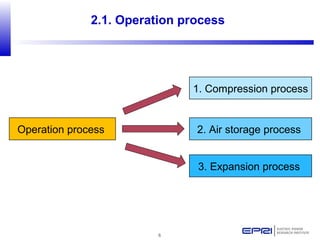
2.1. Operation process
Operation process
1. Compression process
2. Air storage process
3. Expansion process
7
2.1. Operation process
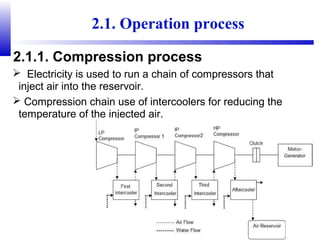
 Electricity is used to run a chain of compressors that
inject air into the reservoir.
 Compression chain use of intercoolers for reducing the
temperature of the injected air.
2.1.1. Compression process
8
2.1. Operation process
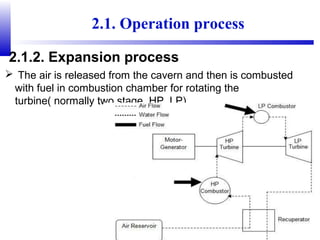
2.1.2. Expansion process
 The air is released from the cavern and then is combusted
with fuel in combustion chamber for rotating the
turbine( normally two stage, HP, LP).
9
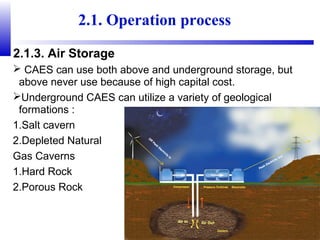
 CAES can use both above and underground storage, but
above never use because of high capital cost.
Underground CAES can utilize a variety of geological
formations :
1.Salt cavern
2.Depleted Natural
Gas Caverns
1.Hard Rock
2.Porous Rock
2.1. Operation process
2.1.3. Air Storage
10
2.1.3. Air Storage
2.1.3.1. Above the ground
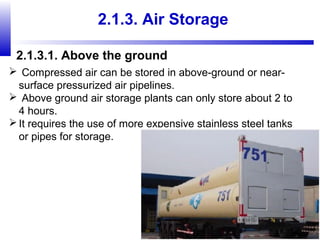
 Compressed air can be stored in above-ground or near-
surface pressurized air pipelines.
 Above ground air storage plants can only store about 2 to
4 hours.
It requires the use of more expensive stainless steel tanks
or pipes for storage.
11
2.1.3. Air Storage
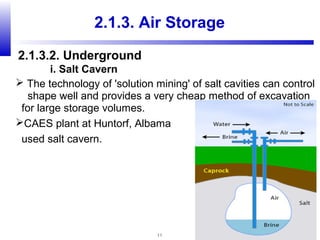
 The technology of 'solution mining' of salt cavities can control
shape well and provides a very cheap method of excavation
for large storage volumes.
CAES plant at Huntorf, Albama
used salt cavern.
2.1.3.2. Underground
i. Salt Cavern
12
 Depleted natural gas caverns are very attractive since they
already exist and can withstand the pressure.
But, they may not be readily usable because natural-gas storage
caverns are developed to be subjected to very slow pressure
changes that occur over long periods of time, while CAES storage
requires daily variations between minimum and maximum
pressure.
2.1.3. Air Storage
ii. Depleted Natural Gas Caverns
13
 Although hard rock is an option for CAES, the cost of mining
a new reservoir is often relatively high.
 Hard-rock caverns are more costly to mine (60% higher) than
salt-caverns for CAES purposes.
2.1.3. Air Storage
iii. Hard rock
14
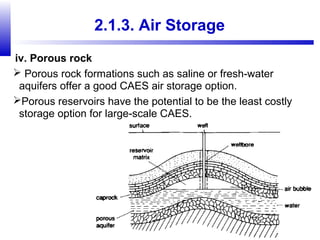
 Porous rock formations such as saline or fresh-water
aquifers offer a good CAES air storage option.
Porous reservoirs have the potential to be the least costly
storage option for large-scale CAES.
2.1.3. Air Storage
iv. Porous rock
15
2.3. Type of CAES system
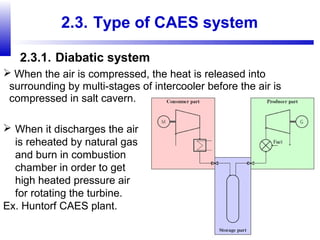
 When the air is compressed, the heat is released into
surrounding by multi-stages of intercooler before the air is
compressed in salt cavern.
2.3.1. Diabatic system
 When it discharges the air
is reheated by natural gas
and burn in combustion
chamber in order to get
high heated pressure air
for rotating the turbine.
Ex. Huntorf CAES plant.
16
2.3. Type of CAES system
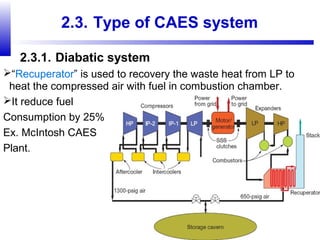
“Recuperator” is used to recovery the waste heat from LP to
heat the compressed air with fuel in combustion chamber.
It reduce fuel
Consumption by 25%.
Ex. McIntosh CAES
Plant.
2.3.1. Diabatic system
17
2.3. Type of CAES system
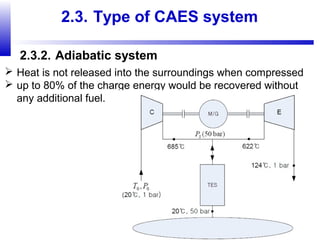
2.3.2. Adiabatic system
 Heat is not released into the surroundings when compressed
 up to 80% of the charge energy would be recovered without
any additional fuel.
18
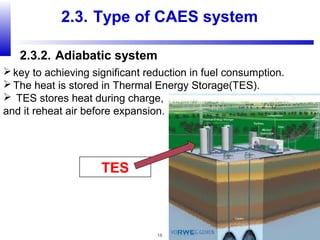
2.3. Type of CAES system
2.3.2. Adiabatic system
key to achieving significant reduction in fuel consumption.
The heat is stored in Thermal Energy Storage(TES).
 TES stores heat during charge,
and it reheat air before expansion.
TES
19
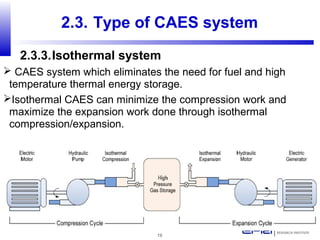
2.3. Type of CAES system
 CAES system which eliminates the need for fuel and high
temperature thermal energy storage.
Isothermal CAES can minimize the compression work and
maximize the expansion work done through isothermal
compression/expansion.
2.3.3.Isothermal system
20
3. Environment
1. Reduce CO2 emission
2. No fuel consumption(Adiabatic system)
3.1. Advantages
21
3. Environment
1. Not pure energy storage
2. Contaminate water
3. The salt waste
3.2. Disadvantages
22
4. Economic of applicable
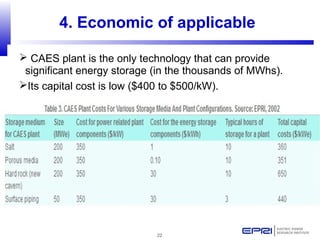
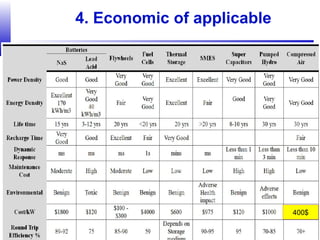
 CAES plant is the only technology that can provide
significant energy storage (in the thousands of MWhs).
Its capital cost is low ($400 to $500/kW).
23
4. Economic of applicable
400$
24
5. Conclusion
 Although CAES has some problems such as location, not
pure energy.
 CAES is still a good choice for storing energy due to its
capacity, capital cost, and potential.
 According to new technology (Adiabatic), CAES will not
consume fuel any more.
25
Thanks for yourThanks for your
paying attentionpaying attention

Compressed air energy storage

  • 1.
    1 How Compressed AirStores EnergyHow Compressed Air Stores Energy ANG SovannANG Sovann
  • 2.
    2 1. Introduction 2. Technology 2.1.Basic principles 2.2. Operation process 2.2.1. Compression process 2.2.2. Expansion process 2.2.3. Air storage 2.3. Type of CAES system 2.3.1. Diabatic system 2.3.2. Adiabatic system 2.3.3. Isothermal system Content 3. Environment 3.1. Advantages 3.2. Disadvantages 4. Economic of applicable 5. Conclusion 6. References
  • 3.
    3 1. Introduction  CompressedAir Energy Storage(CAES) is one among the other storage plants ( Flywheel, Battery, Superconductor and so on.  CAES is combination between pure storage plant and power plant( consume fuel).  The underground salt cavern was patented by Stal Laval in 1949.  In 1978, the first CAES plant of 290-MW capacity was built at Huntorf in Germany.  In 1991, another 110-MW plant was built in McIntosh, Albama, USA.
  • 4.
    4 2. Technology The componentsof CAES is similar to gas turbine power plant. 2.1. Basic Principle a). Gas turbine configuration b). CAES configuration 2.compressor 7. turbine 11. cavern 5. Motor/ generator 1. Intercooler 8.combustor 4. clutch 10. valve
  • 5.
    5 2. Technology  CAESprocess works by pumping air into a vessel or cavern when off peak demand or low-cost electricity is available.  When energy is needed, the pressurized air is released from the cavern and expanded in the turbine.
  • 6.
    6 2.1. Operation process Operationprocess 1. Compression process 2. Air storage process 3. Expansion process
  • 7.
    7 2.1. Operation process Electricity is used to run a chain of compressors that inject air into the reservoir.  Compression chain use of intercoolers for reducing the temperature of the injected air. 2.1.1. Compression process
  • 8.
    8 2.1. Operation process 2.1.2.Expansion process  The air is released from the cavern and then is combusted with fuel in combustion chamber for rotating the turbine( normally two stage, HP, LP).
  • 9.
    9  CAES canuse both above and underground storage, but above never use because of high capital cost. Underground CAES can utilize a variety of geological formations : 1.Salt cavern 2.Depleted Natural Gas Caverns 1.Hard Rock 2.Porous Rock 2.1. Operation process 2.1.3. Air Storage
  • 10.
    10 2.1.3. Air Storage 2.1.3.1.Above the ground  Compressed air can be stored in above-ground or near- surface pressurized air pipelines.  Above ground air storage plants can only store about 2 to 4 hours. It requires the use of more expensive stainless steel tanks or pipes for storage.
  • 11.
    11 2.1.3. Air Storage The technology of 'solution mining' of salt cavities can control shape well and provides a very cheap method of excavation for large storage volumes. CAES plant at Huntorf, Albama used salt cavern. 2.1.3.2. Underground i. Salt Cavern
  • 12.
    12  Depleted naturalgas caverns are very attractive since they already exist and can withstand the pressure. But, they may not be readily usable because natural-gas storage caverns are developed to be subjected to very slow pressure changes that occur over long periods of time, while CAES storage requires daily variations between minimum and maximum pressure. 2.1.3. Air Storage ii. Depleted Natural Gas Caverns
  • 13.
    13  Although hardrock is an option for CAES, the cost of mining a new reservoir is often relatively high.  Hard-rock caverns are more costly to mine (60% higher) than salt-caverns for CAES purposes. 2.1.3. Air Storage iii. Hard rock
  • 14.
    14  Porous rockformations such as saline or fresh-water aquifers offer a good CAES air storage option. Porous reservoirs have the potential to be the least costly storage option for large-scale CAES. 2.1.3. Air Storage iv. Porous rock
  • 15.
    15 2.3. Type ofCAES system  When the air is compressed, the heat is released into surrounding by multi-stages of intercooler before the air is compressed in salt cavern. 2.3.1. Diabatic system  When it discharges the air is reheated by natural gas and burn in combustion chamber in order to get high heated pressure air for rotating the turbine. Ex. Huntorf CAES plant.
  • 16.
    16 2.3. Type ofCAES system “Recuperator” is used to recovery the waste heat from LP to heat the compressed air with fuel in combustion chamber. It reduce fuel Consumption by 25%. Ex. McIntosh CAES Plant. 2.3.1. Diabatic system
  • 17.
    17 2.3. Type ofCAES system 2.3.2. Adiabatic system  Heat is not released into the surroundings when compressed  up to 80% of the charge energy would be recovered without any additional fuel.
  • 18.
    18 2.3. Type ofCAES system 2.3.2. Adiabatic system key to achieving significant reduction in fuel consumption. The heat is stored in Thermal Energy Storage(TES).  TES stores heat during charge, and it reheat air before expansion. TES
  • 19.
    19 2.3. Type ofCAES system  CAES system which eliminates the need for fuel and high temperature thermal energy storage. Isothermal CAES can minimize the compression work and maximize the expansion work done through isothermal compression/expansion. 2.3.3.Isothermal system
  • 20.
    20 3. Environment 1. ReduceCO2 emission 2. No fuel consumption(Adiabatic system) 3.1. Advantages
  • 21.
    21 3. Environment 1. Notpure energy storage 2. Contaminate water 3. The salt waste 3.2. Disadvantages
  • 22.
    22 4. Economic ofapplicable  CAES plant is the only technology that can provide significant energy storage (in the thousands of MWhs). Its capital cost is low ($400 to $500/kW).
  • 23.
    23 4. Economic ofapplicable 400$
  • 24.
    24 5. Conclusion  AlthoughCAES has some problems such as location, not pure energy.  CAES is still a good choice for storing energy due to its capacity, capital cost, and potential.  According to new technology (Adiabatic), CAES will not consume fuel any more.
  • 25.
    25 Thanks for yourThanksfor your paying attentionpaying attention

Editor's Notes

  • #6 For more than a century, the technology for using falling water to create hydroelectricity has existed.
  • #9 The total worldwide technical potential for hydropower is estimated at 14,576 TWh/yr (52.47 EJ/yr), over four times the current worldwide annual generation. This technical potential corresponds to a derived estimate of installed capacity of 3,721 GW.
  • #12 Hydroelectric generation can also work without dams, in a process known as diversion, or run-of-the-river. Run-of-the-river hydroelectric stations are those with small or no reservoir capacity, so that the water coming from upstream must be used for generation at that moment, or must be allowed to bypass the dam. Run-of-river schemes use the natural flow of a river, where a weir can enhance the continuity of the flow. Both storage and run-of-river schemes can be diversion schemes, where water is channeled from a river, lake or dammed reservoir to a remote powerhouse, containing the turbine
  • #14 water pumped to a storage pool above the power plant at a time when customer demand for energy is low. The water is then allowed to flow back through the turbine-generators at times when demand is high.
  • #16 Global installed hydropower capacity was estimated to be between 926 GW and 956 GW in 2009/2010, excluding pumped storage hydropower capacity.