OUTLINE QUESTION
•What is Capacitors?
•What are supercapacitors?
•History of supercapacitors.
•Why supercapacitors?
•Disadvantage.
•Applications.
WHAT IS CAPACITOR?
• A capacitor (originally known as condenser ) is a passive two-
terminal electrical component used to store energy in an electric
field.
• When there is a potential difference (voltage) across the
conductors, a static electric field develops across the dielectric,
causing positive charge to collect on one plate and negative
charge on the other plate. Energy is stored in the form of
electrostatic field.
WHAT IS SUPERCAPACITOR
• A supercapacitor or ultracapacitor is an
electrochemical capacitor that has an unusually high
energy density when compared to common capacitors.
They are of particular interest in automotive applications
for hybrid vehicles and as supplementary storage for
battery electric vehicles
HISTORY OF
SUPERCAPACITORS
• The first supercapacitor based on a double layer
mechanism was developed in 1947 by General Electric
using a porous carbon electrode.
• It was believed that the energy was stored in the carbon
pores & it exhibited “exceptionally high capacitance”,
although the mechanism was unknown at the time. It was
the Standard Oil Company, Cleveland (SOHIO) in 1966
that patented a device that stored energy in the double
layer interface.
ADVANTAGES RELATIVE TO
BATTERIES
• Very high rates of charge & discharge.
• Little degradation over hundreds of thousands of cycles.
• Good reversibility.
• Low toxicity of materials used.
• High cycle efficiency (95% or more).
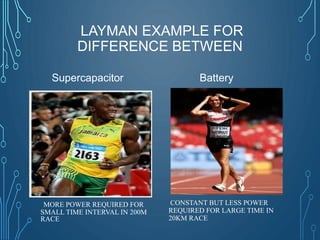
LAYMAN EXAMPLE FOR
DIFFERENCE BETWEEN
MORE POWER REQUIRED FOR
SMALL TIME INTERVAL IN 200M
RACE
CONSTANT BUT LESS POWER
REQUIRED FOR LARGE TIME IN
20KM RACE
Supercapacitor Battery
WHY CAPACITORS?
• Supercapacitors are known for over 50years.
• Supercapacitor are able to store & deliver energy at
relatively high rates.
• A specific power of 5000W/kg can be reached.
• Supercapacitor exhibit very high degree of reversibility
in repetitive charge-discharge cycling. Cycle life over
500000 cycles demonstrated.
DISADVANTAGE
• The amount of energy stored per unit weight is
considerably lower than that of an electrochemical
battery .Its also only about 1/10,000th the volumetric
energy density of gasoline.
• The voltage varies with the energy stored. To effectively
store & recover energy requires sophisticated electronic
control & switching equipment.
• Has the highest dielectric absorption of all types of
capacitors.
APPLICATIONS
• Maintenance free applications
• Public transportation, HEVs, Start-Stop System
• Back-up & UPS systems
• Systems of Energy Recuperation
• Consumer electronics
Supercapacitor.pptx

Supercapacitor.pptx

  • 2.
    OUTLINE QUESTION •What isCapacitors? •What are supercapacitors? •History of supercapacitors. •Why supercapacitors? •Disadvantage. •Applications.
  • 3.
    WHAT IS CAPACITOR? •A capacitor (originally known as condenser ) is a passive two- terminal electrical component used to store energy in an electric field. • When there is a potential difference (voltage) across the conductors, a static electric field develops across the dielectric, causing positive charge to collect on one plate and negative charge on the other plate. Energy is stored in the form of electrostatic field.
  • 4.
    WHAT IS SUPERCAPACITOR •A supercapacitor or ultracapacitor is an electrochemical capacitor that has an unusually high energy density when compared to common capacitors. They are of particular interest in automotive applications for hybrid vehicles and as supplementary storage for battery electric vehicles
  • 5.
    HISTORY OF SUPERCAPACITORS • Thefirst supercapacitor based on a double layer mechanism was developed in 1947 by General Electric using a porous carbon electrode. • It was believed that the energy was stored in the carbon pores & it exhibited “exceptionally high capacitance”, although the mechanism was unknown at the time. It was the Standard Oil Company, Cleveland (SOHIO) in 1966 that patented a device that stored energy in the double layer interface.
  • 6.
    ADVANTAGES RELATIVE TO BATTERIES •Very high rates of charge & discharge. • Little degradation over hundreds of thousands of cycles. • Good reversibility. • Low toxicity of materials used. • High cycle efficiency (95% or more).
  • 7.
    LAYMAN EXAMPLE FOR DIFFERENCEBETWEEN MORE POWER REQUIRED FOR SMALL TIME INTERVAL IN 200M RACE CONSTANT BUT LESS POWER REQUIRED FOR LARGE TIME IN 20KM RACE Supercapacitor Battery
  • 8.
    WHY CAPACITORS? • Supercapacitorsare known for over 50years. • Supercapacitor are able to store & deliver energy at relatively high rates. • A specific power of 5000W/kg can be reached. • Supercapacitor exhibit very high degree of reversibility in repetitive charge-discharge cycling. Cycle life over 500000 cycles demonstrated.
  • 9.
    DISADVANTAGE • The amountof energy stored per unit weight is considerably lower than that of an electrochemical battery .Its also only about 1/10,000th the volumetric energy density of gasoline. • The voltage varies with the energy stored. To effectively store & recover energy requires sophisticated electronic control & switching equipment. • Has the highest dielectric absorption of all types of capacitors.
  • 10.
    APPLICATIONS • Maintenance freeapplications • Public transportation, HEVs, Start-Stop System • Back-up & UPS systems • Systems of Energy Recuperation • Consumer electronics