

Energy Harvesting Elective

Are the Environmental Energy Going to Waste?
     Harness Renewable Energy from the
                Environment

              Presenter: Mr. Tan Yen Kheng
                 (g0600108@nus.edu.sg)


       Department of Electrical & Computer Engineering

       Cordially invited Raffles Junior College for the presentation
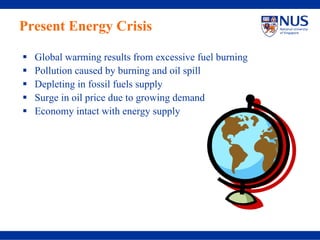
Present Energy Crisis

  Global warming results from excessive fuel burning
  Pollution caused by burning and oil spill
  Depleting in fossil fuels supply
  Surge in oil price due to growing demand
  Economy intact with energy supply
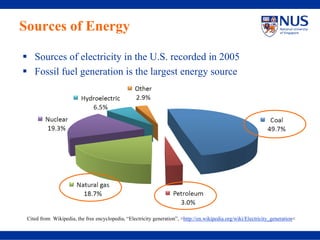
Sources of Energy

    Sources of electricity in the U.S. recorded in 2005
    Fossil fuel generation is the largest energy source


 Cited from Wikipedia, the free encyclopedia, “Electricity generation”, >http://en.wikipedia.org/wiki/Electricity_generation<
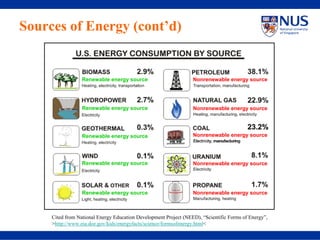
Sources of Energy (cont’d)


                  Renewable energy source                         Nonrenewable energy source


                  Renewable energy source                         Nonrenewable energy source


                  Renewable energy source                         Nonrenewable energy source


                  Renewable energy source                         Nonrenewable energy source


                  Renewable energy source                         Nonrenewable energy source


     Cited from National Energy Education Development Project (NEED), “Scientific Forms of Energy”,
     >http://www.eia.doe.gov/kids/energyfacts/science/formsofenergy.html<
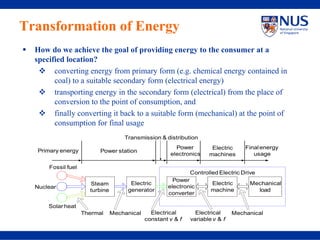
Transformation of Energy
  How do we achieve the goal of providing energy to the consumer at a
  specified location?
        converting energy from primary form (e.g. chemical energy contained in
        coal) to a suitable secondary form (electrical energy)
        transporting energy in the secondary form (electrical) from the place of
        conversion to the point of consumption, and
        finally converting it back to a suitable form (mechanical) at the point of
        consumption for final usage
                                    Transmission & distribution
                                                        Power         Electric     Final energy
  Primary energy          Power station
                                                      electronics    machines         usage

      Fossil fuel
                                                              Controlled Electric Drive
                                                       Power
                      Steam           Electric                        Electric      Mechanical
  Nuclear                                            electronic
                      turbine        generator                        machine         load
                                                     converter

      Solar heat
                    Thermal     Mechanical     Electrical       Electrical     Mechanical
                                             constant v & f   variable v & f
Transformation of Energy
  Energy in electrical form is most versatile and
  universally useful:
       instant availability
       easy transmit-ability
       easy controllability
  For these reasons:
       centralized electric power generating stations are built
       transmission and distribution networks have been developed
       to convert, transmit and deliver energy to the point of
       consumption
Motivation of Energy Harvesting
   “The pervasiveness and near-invisibility of computing will be helped
along by new technologies such as … inductively powered computers that
rely on heat and motion from their environment to run without batteries.”
                                Bill Gates in ‘The Economist’, Dec. 2002.

   “The $170 million initiative is part of an over $1 billion research
blueprint, to generate new breakthroughs, grow top R&D talent and pursue
a new research area - clean energy.”
                            article in ‘Strait times Newspaper’, Mar. 2007.


  Goal: To investigate various energy harvesting technologies that can
power mobile low-power electronic devices
Overview of Energy Harvesting
  What is energy harvesting?
     Gather energy from ambient environment and convert into
     usable electrical energy
  Importance of energy harvesting
     Need for endless energy supply to electronic systems
     To reduce dependency on batteries
     Accelerated interest for powering ubiquitously deployed
     sensor networks and mobile electronic products
     To conserve energy consumption and promote
     environmental friendliness
Overview of Energy Harvesting
  Advantages
     Boundless supply ⇒ Self-sustainable
     Ample energy solution ⇒ Unlimited usage
     Readily available, anywhere, everywhere
     ⇒ Mobility and promote truly autonomous
     Green and clean
     ⇒ Environmental friendliness

      Eliminate the problems that arise from replacement
      /recharging of batteries
      Suitable for numerous deployment at unreachable location
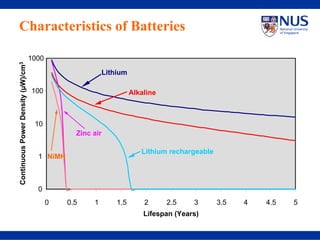
Characteristics of Batteries

                                    1000
Continuous Power Density (µW)/cm3


                                                          Lithium

                                    100                             Alkaline


                                     10
                                                 Zinc air

                                                                       Lithium rechargeable
                                      1 NiMH


                                      0
                                           0   0.5    1       1.5       2      2.5    3       3.5   4   4.5   5
                                                                        Lifespan (Years)
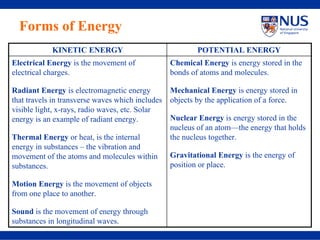
Forms of Energy
            KINETIC ENERGY                              POTENTIAL ENERGY
Electrical Energy is the movement of           Chemical Energy is energy stored in the
electrical charges.                            bonds of atoms and molecules.

Radiant Energy is electromagnetic energy        Mechanical Energy is energy stored in
that travels in transverse waves which includes objects by the application of a force.
visible light, x-rays, radio waves, etc. Solar
energy is an example of radiant energy.         Nuclear Energy is energy stored in the
                                                nucleus of an atom––the energy that holds
Thermal Energy or heat, is the internal         the nucleus together.
energy in substances – the vibration and
movement of the atoms and molecules within      Gravitational Energy is the energy of
substances.                                     position or place.

Motion Energy is the movement of objects
from one place to another.

Sound is the movement of energy through
substances in longitudinal waves.
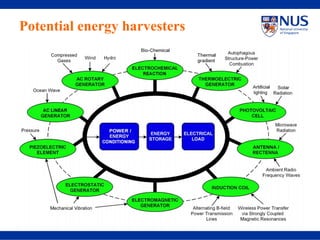
Potential energy harvesters
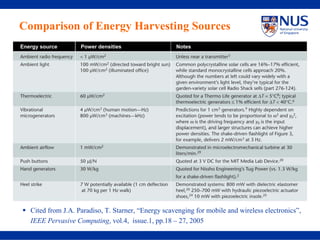
Comparison of Energy Harvesting Sources
Energy source       Power densities                  Notes


   Cited from J.A. Paradiso, T. Starner, “Energy scavenging for mobile and wireless electronics”,
   IEEE Pervasive Computing, vol.4, issue.1, pp.18 – 27, 2005
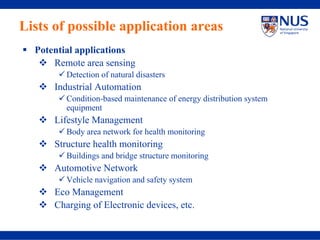
Lists of possible application areas
  Potential applications
      Remote area sensing
         Detection of natural disasters
      Industrial Automation
         Condition-based maintenance of energy distribution system
         equipment
      Lifestyle Management
         Body area network for health monitoring
      Structure health monitoring
         Buildings and bridge structure monitoring
      Automotive Network
         Vehicle navigation and safety system
      Eco Management
      Charging of Electronic devices, etc.
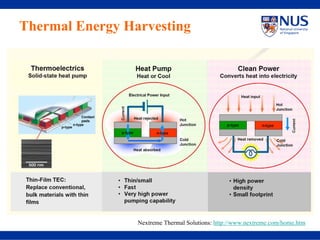
Thermal Energy Harvesting


                 Nextreme Thermal Solutions: http://www.nextreme.com/home.htm
Thermal Energy Harvesting (cont’d)
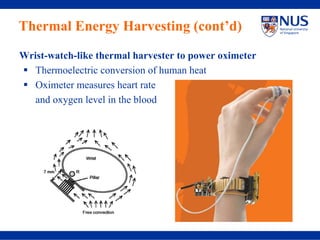
Wrist-watch-like thermal harvester to power oximeter
   Thermoelectric conversion of human heat
   Oximeter measures heart rate
   and oxygen level in the blood
Thermal Energy Harvesting (cont’d)
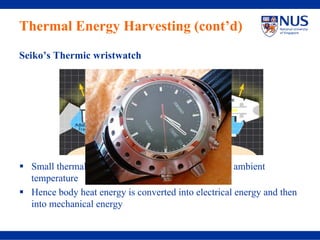
Seiko’s Thermic wristwatch


  Small thermal gradient provided by body heat over ambient
  temperature
  Hence body heat energy is converted into electrical energy and then
  into mechanical energy
Vibration Energy Harvesting
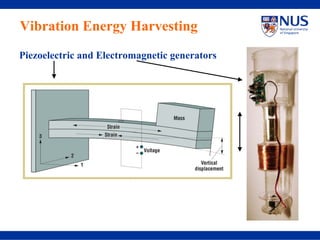
Piezoelectric and Electromagnetic generators
Vibration Energy Harvesting (cont’d)
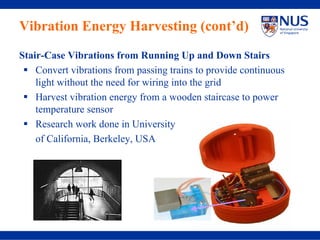
Stair-Case Vibrations from Running Up and Down Stairs
    Convert vibrations from passing trains to provide continuous
    light without the need for wiring into the grid
    Harvest vibration energy from a wooden staircase to power
    temperature sensor
    Research work done in University
    of California, Berkeley, USA
Vibration Energy Harvesting (cont’d)
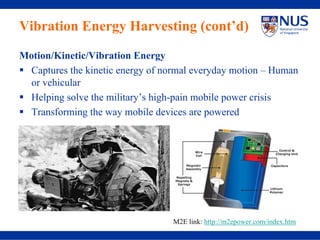
Motion/Kinetic/Vibration Energy
 Captures the kinetic energy of normal everyday motion – Human
 or vehicular
 Helping solve the military’s high-pain mobile power crisis
 Transforming the way mobile devices are powered


                                  M2E link: http://m2epower.com/index.htm
Vibration Energy Harvesting (cont’d)
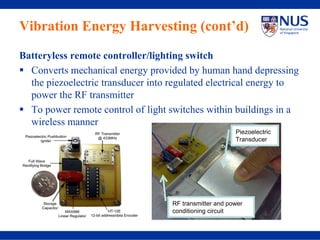
Batteryless remote controller/lighting switch
  Converts mechanical energy provided by human hand depressing
  the piezoelectric transducer into regulated electrical energy to
  power the RF transmitter
  To power remote control of light switches within buildings in a
  wireless manner
                                                         Piezoelectric
                                                         Transducer


                                    RF transmitter and power
                                    conditioning circuit
Motion Energy Harvesting
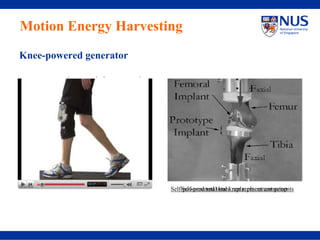
Knee-powered generator


                         Self-powered totaltotal knee replacement setup
                             Self-powered knee replacement components
Wind Energy Harvesting
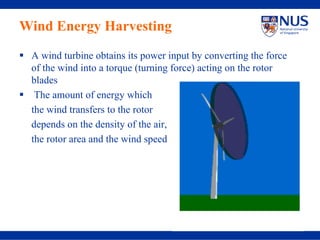
 A wind turbine obtains its power input by converting the force
 of the wind into a torque (turning force) acting on the rotor
 blades
  The amount of energy which
 the wind transfers to the rotor
 depends on the density of the air,
 the rotor area and the wind speed
Wind Energy Harvesting (cont’d)
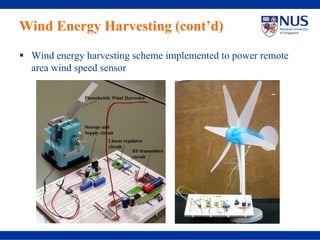
 Wind energy harvesting scheme implemented to power remote
 area wind speed sensor
Solar Energy Harvesting
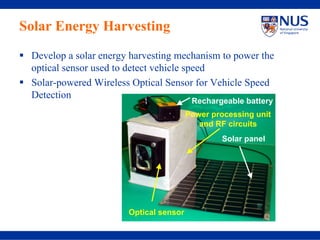
 Develop a solar energy harvesting mechanism to power the
 optical sensor used to detect vehicle speed
 Solar-powered Wireless Optical Sensor for Vehicle Speed
 Detection
                                         Rechargeable battery
                                        Power processing unit
                                           and RF circuits
                                                 Solar panel


                       Optical sensor
Solar Energy Harvesting (cont’d)

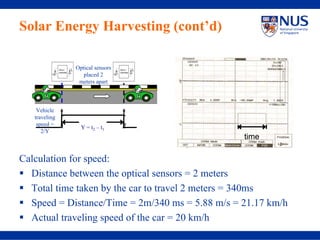
                   Optical sensors
                      placed 2
                    meters apart


    Vehicle
   traveling
               t                     t
    speed =    1                     2
                     Y = t2 – t1
      2/Y
                                                 time

Calculation for speed:
  Distance between the optical sensors = 2 meters
  Total time taken by the car to travel 2 meters = 340ms
  Speed = Distance/Time = 2m/340 ms = 5.88 m/s = 21.17 km/h
  Actual traveling speed of the car = 20 km/h
Design considerations for energy
harvesting circuit

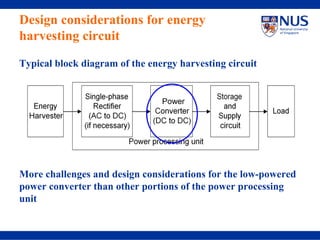
Typical block diagram of the energy harvesting circuit


More challenges and design considerations for the low-powered
power converter than other portions of the power processing
unit
Photovoltaic Technology

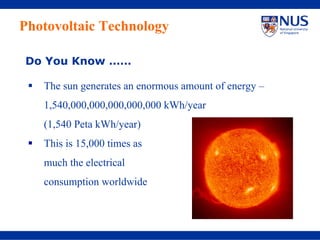
Do You Know ……

   The sun generates an enormous amount of energy –
   1,540,000,000,000,000,000 kWh/year
   (1,540 Peta kWh/year)
   This is 15,000 times as
   much the electrical
   consumption worldwide
Photovoltaic Technology (cont’d)

  PV stands for Photovoltaic and is short for photovoltaic
  solar energy
  Photovoltaic solar cells or PV cells convert sunlight
  directly into electrical energy
  Solar cell’s energy conversion efficiency is the percentage
  of power converted from absorbed light into electrical
  energy
  For example, solar cells of 1 m² surface area producing
  120 watt of peak power (Wp) under Standard Test
  Condition (STC) has efficiency of 12%
How Photovoltaic Works
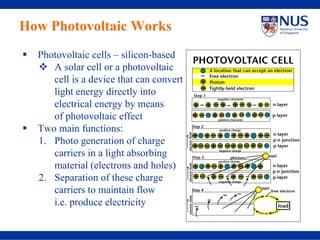
  Photovoltaic cells – silicon-based
     A solar cell or a photovoltaic
     cell is a device that can convert
     light energy directly into
     electrical energy by means
     of photovoltaic effect
  Two main functions:
  1. Photo generation of charge
     carriers in a light absorbing
     material (electrons and holes)
  2. Separation of these charge
     carriers to maintain flow
     i.e. produce electricity
How Photovoltaic Works (cont’d)
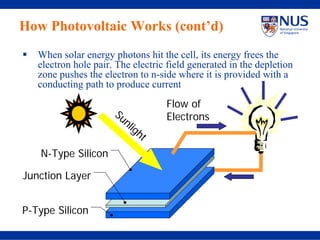
   When solar energy photons hit the cell, its energy frees the
   electron hole pair. The electric field generated in the depletion
   zone pushes the electron to n-side where it is provided with a
   conducting path to produce current
                                   Flow of
                      Su           Electrons
                         nl
                           ig
                             ht

   N-Type Silicon

Junction Layer


P-Type Silicon
Types of PV cells

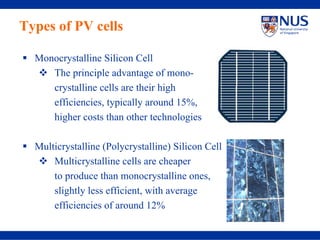
  Monocrystalline Silicon Cell
     The principle advantage of mono-
     crystalline cells are their high
     efficiencies, typically around 15%,
     higher costs than other technologies

  Multicrystalline (Polycrystalline) Silicon Cell
      Multicrystalline cells are cheaper
      to produce than monocrystalline ones,
      slightly less efficient, with average
      efficiencies of around 12%
Types of PV cells

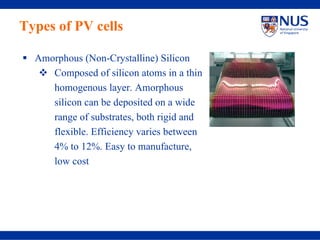
  Amorphous (Non-Crystalline) Silicon
     Composed of silicon atoms in a thin
     homogenous layer. Amorphous
     silicon can be deposited on a wide
     range of substrates, both rigid and
     flexible. Efficiency varies between
     4% to 12%. Easy to manufacture,
     low cost
Types of PV cells

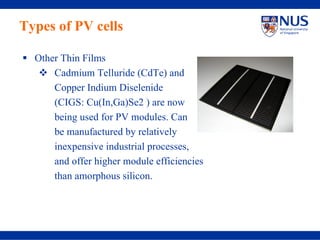
  Other Thin Films
      Cadmium Telluride (CdTe) and
      Copper Indium Diselenide
      (CIGS: Cu(In,Ga)Se2 ) are now
      being used for PV modules. Can
      be manufactured by relatively
      inexpensive industrial processes,
      and offer higher module efficiencies
      than amorphous silicon.
Factors Affecting PV Performance

  Solar Isolation
  Angle of Incidence and Orientation
  Temperature
  Spectrum of Light
  Shadows
  Dust, Dirt, Fungus, Birds
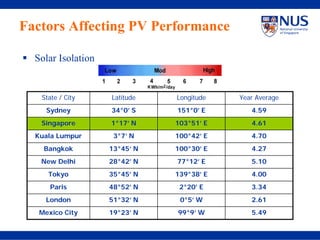
Factors Affecting PV Performance

  Solar Isolation


   State / City     Latitude   Longitude   Year Average
     Sydney         34°0’ S    151°0’ E       4.59
   Singapore        1°17’ N    103°51’ E      4.61
  Kuala Lumpur       3°7’ N    100°42’ E      4.70
    Bangkok         13°45’ N   100°30’ E      4.27
   New Delhi        28°42’ N   77°12’ E       5.10
     Tokyo          35°45’ N   139°38’ E      4.00
      Paris         48°52’ N    2°20’ E       3.34
    London          51°32’ N    0°5’ W        2.61
   Mexico City      19°23’ N   99°9’ W        5.49
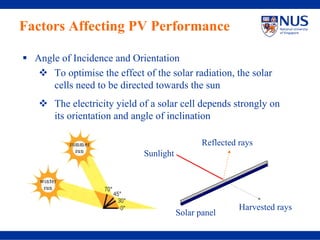
Factors Affecting PV Performance

  Angle of Incidence and Orientation
      To optimise the effect of the solar radiation, the solar
      cells need to be directed towards the sun
       The electricity yield of a solar cell depends strongly on
       its orientation and angle of inclination

                                               Reflected rays
                             Sunlight


                                                         Harvested rays
                                        Solar panel
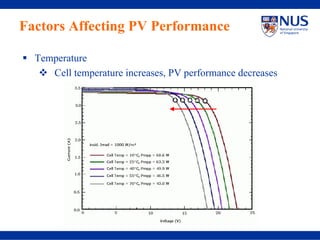
Factors Affecting PV Performance

  Temperature
     Cell temperature increases, PV performance decreases
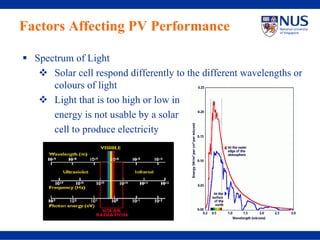
Factors Affecting PV Performance

  Spectrum of Light
      Solar cell respond differently to the different wavelengths or
      colours of light
      Light that is too high or low in
      energy is not usable by a solar
      cell to produce electricity
Factors Affecting PV Performance

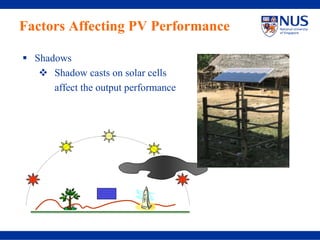
  Shadows
      Shadow casts on solar cells
      affect the output performance
Factors Affecting PV Performance

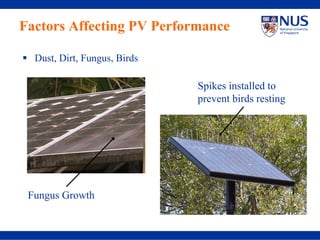
  Dust, Dirt, Fungus, Birds

                              Spikes installed to
                              prevent birds resting


 Fungus Growth
Conclusions

  Discuss on the topic of Energy
  Overview of Energy Harvesting
  Illustrate some applications of EH in both academic and
  industry
  Learn about photovoltaic technology
  Investigate on various factors that affect the PV
  performance
Q&A


          Thank you
      for your attention!
Energy Harvesting Elective

  Objectives of Elective
     Getting to know Solar Energy Harvesting
     Understand how power is harvested and transferred to
     the load
     Characteristic the performance of the solar panel
     Design and implement solar energy harvesting in
     practical application system
Energy Harvesting Activity (cont’d)

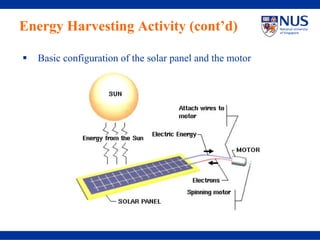
  Basic configuration of the solar panel and the motor
Energy Harvesting Activity (cont’d)

  Materials to be provided to each team include: -
     2 x Solar Panels
     1 x Solar Motor
     3 x LEDs (Red, Yellow, Green)
     1 x Buzzer
     1 x Variable resistor
     1 x Digital Multimeter
     1 x Breadboard
Energy Harvesting Activity (cont’d)

  Guidelines for the hand-on sessions
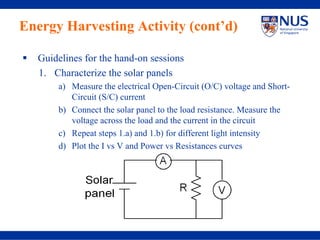
  1. Characterize the solar panels
      a) Measure the electrical Open-Circuit (O/C) voltage and Short-
         Circuit (S/C) current
      b) Connect the solar panel to the load resistance. Measure the
         voltage across the load and the current in the circuit
      c) Repeat steps 1.a) and 1.b) for different light intensity
      d) Plot the I vs V and Power vs Resistances curves
Energy Harvesting Activity (cont’d)

  Guidelines for the hand-on sessions
  2. Use the solar panel to power the given loads i.e. LEDs,
     motor and buzzer
      a) Measure the voltage required by each load
      b) Measure the current required by each load
      c) Compute the power required by each load based on

                 Power = Voltage x Current
Energy Harvesting Activity (cont’d)

  Guidelines for the hand-on sessions
   3. Design Scenario
       a) Imagine you are a contractor who is tasked to design
           a three room apartment to run on sun energy
       b) The design of the apartment must fulfilled the
           following constrains by the owner
            I. At least one ‘ON’ LED per room
            II. At least one fan in one of the rooms
            III. Place a door bell in the apartment
            IV. Under bright light intensity
       c) Draft out the circuit schematic drawing to verify that
           your design is working
Q&A


      Q&A

Energy Harvesting Presentation Rjc Tyk 2

  • 1.
    Energy Harvesting Elective Arethe Environmental Energy Going to Waste? Harness Renewable Energy from the Environment Presenter: Mr. Tan Yen Kheng (g0600108@nus.edu.sg) Department of Electrical & Computer Engineering Cordially invited Raffles Junior College for the presentation
  • 2.
    Present Energy Crisis Global warming results from excessive fuel burning Pollution caused by burning and oil spill Depleting in fossil fuels supply Surge in oil price due to growing demand Economy intact with energy supply
  • 3.
    Sources of Energy Sources of electricity in the U.S. recorded in 2005 Fossil fuel generation is the largest energy source Cited from Wikipedia, the free encyclopedia, “Electricity generation”, >http://en.wikipedia.org/wiki/Electricity_generation<
  • 4.
    Sources of Energy(cont’d) Renewable energy source Nonrenewable energy source Renewable energy source Nonrenewable energy source Renewable energy source Nonrenewable energy source Renewable energy source Nonrenewable energy source Renewable energy source Nonrenewable energy source Cited from National Energy Education Development Project (NEED), “Scientific Forms of Energy”, >http://www.eia.doe.gov/kids/energyfacts/science/formsofenergy.html<
  • 5.
    Transformation of Energy How do we achieve the goal of providing energy to the consumer at a specified location? converting energy from primary form (e.g. chemical energy contained in coal) to a suitable secondary form (electrical energy) transporting energy in the secondary form (electrical) from the place of conversion to the point of consumption, and finally converting it back to a suitable form (mechanical) at the point of consumption for final usage Transmission & distribution Power Electric Final energy Primary energy Power station electronics machines usage Fossil fuel Controlled Electric Drive Power Steam Electric Electric Mechanical Nuclear electronic turbine generator machine load converter Solar heat Thermal Mechanical Electrical Electrical Mechanical constant v & f variable v & f
  • 6.
    Transformation of Energy Energy in electrical form is most versatile and universally useful: instant availability easy transmit-ability easy controllability For these reasons: centralized electric power generating stations are built transmission and distribution networks have been developed to convert, transmit and deliver energy to the point of consumption
  • 7.
    Motivation of EnergyHarvesting “The pervasiveness and near-invisibility of computing will be helped along by new technologies such as … inductively powered computers that rely on heat and motion from their environment to run without batteries.” Bill Gates in ‘The Economist’, Dec. 2002. “The $170 million initiative is part of an over $1 billion research blueprint, to generate new breakthroughs, grow top R&D talent and pursue a new research area - clean energy.” article in ‘Strait times Newspaper’, Mar. 2007. Goal: To investigate various energy harvesting technologies that can power mobile low-power electronic devices
  • 8.
    Overview of EnergyHarvesting What is energy harvesting? Gather energy from ambient environment and convert into usable electrical energy Importance of energy harvesting Need for endless energy supply to electronic systems To reduce dependency on batteries Accelerated interest for powering ubiquitously deployed sensor networks and mobile electronic products To conserve energy consumption and promote environmental friendliness
  • 9.
    Overview of EnergyHarvesting Advantages Boundless supply ⇒ Self-sustainable Ample energy solution ⇒ Unlimited usage Readily available, anywhere, everywhere ⇒ Mobility and promote truly autonomous Green and clean ⇒ Environmental friendliness Eliminate the problems that arise from replacement /recharging of batteries Suitable for numerous deployment at unreachable location
  • 10.
    Characteristics of Batteries 1000 Continuous Power Density (µW)/cm3 Lithium 100 Alkaline 10 Zinc air Lithium rechargeable 1 NiMH 0 0 0.5 1 1.5 2 2.5 3 3.5 4 4.5 5 Lifespan (Years)
  • 11.
    Forms of Energy KINETIC ENERGY POTENTIAL ENERGY Electrical Energy is the movement of Chemical Energy is energy stored in the electrical charges. bonds of atoms and molecules. Radiant Energy is electromagnetic energy Mechanical Energy is energy stored in that travels in transverse waves which includes objects by the application of a force. visible light, x-rays, radio waves, etc. Solar energy is an example of radiant energy. Nuclear Energy is energy stored in the nucleus of an atom––the energy that holds Thermal Energy or heat, is the internal the nucleus together. energy in substances – the vibration and movement of the atoms and molecules within Gravitational Energy is the energy of substances. position or place. Motion Energy is the movement of objects from one place to another. Sound is the movement of energy through substances in longitudinal waves.
  • 12.
  • 13.
    Comparison of EnergyHarvesting Sources Energy source Power densities Notes Cited from J.A. Paradiso, T. Starner, “Energy scavenging for mobile and wireless electronics”, IEEE Pervasive Computing, vol.4, issue.1, pp.18 – 27, 2005
  • 14.
    Lists of possibleapplication areas Potential applications Remote area sensing Detection of natural disasters Industrial Automation Condition-based maintenance of energy distribution system equipment Lifestyle Management Body area network for health monitoring Structure health monitoring Buildings and bridge structure monitoring Automotive Network Vehicle navigation and safety system Eco Management Charging of Electronic devices, etc.
  • 15.
    Thermal Energy Harvesting Nextreme Thermal Solutions: http://www.nextreme.com/home.htm
  • 16.
    Thermal Energy Harvesting(cont’d) Wrist-watch-like thermal harvester to power oximeter Thermoelectric conversion of human heat Oximeter measures heart rate and oxygen level in the blood
  • 17.
    Thermal Energy Harvesting(cont’d) Seiko’s Thermic wristwatch Small thermal gradient provided by body heat over ambient temperature Hence body heat energy is converted into electrical energy and then into mechanical energy
  • 18.
    Vibration Energy Harvesting Piezoelectricand Electromagnetic generators
  • 19.
    Vibration Energy Harvesting(cont’d) Stair-Case Vibrations from Running Up and Down Stairs Convert vibrations from passing trains to provide continuous light without the need for wiring into the grid Harvest vibration energy from a wooden staircase to power temperature sensor Research work done in University of California, Berkeley, USA
  • 20.
    Vibration Energy Harvesting(cont’d) Motion/Kinetic/Vibration Energy Captures the kinetic energy of normal everyday motion – Human or vehicular Helping solve the military’s high-pain mobile power crisis Transforming the way mobile devices are powered M2E link: http://m2epower.com/index.htm
  • 21.
    Vibration Energy Harvesting(cont’d) Batteryless remote controller/lighting switch Converts mechanical energy provided by human hand depressing the piezoelectric transducer into regulated electrical energy to power the RF transmitter To power remote control of light switches within buildings in a wireless manner Piezoelectric Transducer RF transmitter and power conditioning circuit
  • 22.
    Motion Energy Harvesting Knee-poweredgenerator Self-powered totaltotal knee replacement setup Self-powered knee replacement components
  • 23.
    Wind Energy Harvesting A wind turbine obtains its power input by converting the force of the wind into a torque (turning force) acting on the rotor blades The amount of energy which the wind transfers to the rotor depends on the density of the air, the rotor area and the wind speed
  • 24.
    Wind Energy Harvesting(cont’d) Wind energy harvesting scheme implemented to power remote area wind speed sensor
  • 25.
    Solar Energy Harvesting Develop a solar energy harvesting mechanism to power the optical sensor used to detect vehicle speed Solar-powered Wireless Optical Sensor for Vehicle Speed Detection Rechargeable battery Power processing unit and RF circuits Solar panel Optical sensor
  • 26.
    Solar Energy Harvesting(cont’d) Optical sensors placed 2 meters apart Vehicle traveling t t speed = 1 2 Y = t2 – t1 2/Y time Calculation for speed: Distance between the optical sensors = 2 meters Total time taken by the car to travel 2 meters = 340ms Speed = Distance/Time = 2m/340 ms = 5.88 m/s = 21.17 km/h Actual traveling speed of the car = 20 km/h
  • 27.
    Design considerations forenergy harvesting circuit Typical block diagram of the energy harvesting circuit More challenges and design considerations for the low-powered power converter than other portions of the power processing unit
  • 28.
    Photovoltaic Technology Do YouKnow …… The sun generates an enormous amount of energy – 1,540,000,000,000,000,000 kWh/year (1,540 Peta kWh/year) This is 15,000 times as much the electrical consumption worldwide
  • 29.
    Photovoltaic Technology (cont’d) PV stands for Photovoltaic and is short for photovoltaic solar energy Photovoltaic solar cells or PV cells convert sunlight directly into electrical energy Solar cell’s energy conversion efficiency is the percentage of power converted from absorbed light into electrical energy For example, solar cells of 1 m² surface area producing 120 watt of peak power (Wp) under Standard Test Condition (STC) has efficiency of 12%
  • 30.
    How Photovoltaic Works Photovoltaic cells – silicon-based A solar cell or a photovoltaic cell is a device that can convert light energy directly into electrical energy by means of photovoltaic effect Two main functions: 1. Photo generation of charge carriers in a light absorbing material (electrons and holes) 2. Separation of these charge carriers to maintain flow i.e. produce electricity
  • 31.
    How Photovoltaic Works(cont’d) When solar energy photons hit the cell, its energy frees the electron hole pair. The electric field generated in the depletion zone pushes the electron to n-side where it is provided with a conducting path to produce current Flow of Su Electrons nl ig ht N-Type Silicon Junction Layer P-Type Silicon
  • 32.
    Types of PVcells Monocrystalline Silicon Cell The principle advantage of mono- crystalline cells are their high efficiencies, typically around 15%, higher costs than other technologies Multicrystalline (Polycrystalline) Silicon Cell Multicrystalline cells are cheaper to produce than monocrystalline ones, slightly less efficient, with average efficiencies of around 12%
  • 33.
    Types of PVcells Amorphous (Non-Crystalline) Silicon Composed of silicon atoms in a thin homogenous layer. Amorphous silicon can be deposited on a wide range of substrates, both rigid and flexible. Efficiency varies between 4% to 12%. Easy to manufacture, low cost
  • 34.
    Types of PVcells Other Thin Films Cadmium Telluride (CdTe) and Copper Indium Diselenide (CIGS: Cu(In,Ga)Se2 ) are now being used for PV modules. Can be manufactured by relatively inexpensive industrial processes, and offer higher module efficiencies than amorphous silicon.
  • 35.
    Factors Affecting PVPerformance Solar Isolation Angle of Incidence and Orientation Temperature Spectrum of Light Shadows Dust, Dirt, Fungus, Birds
  • 36.
    Factors Affecting PVPerformance Solar Isolation State / City Latitude Longitude Year Average Sydney 34°0’ S 151°0’ E 4.59 Singapore 1°17’ N 103°51’ E 4.61 Kuala Lumpur 3°7’ N 100°42’ E 4.70 Bangkok 13°45’ N 100°30’ E 4.27 New Delhi 28°42’ N 77°12’ E 5.10 Tokyo 35°45’ N 139°38’ E 4.00 Paris 48°52’ N 2°20’ E 3.34 London 51°32’ N 0°5’ W 2.61 Mexico City 19°23’ N 99°9’ W 5.49
  • 37.
    Factors Affecting PVPerformance Angle of Incidence and Orientation To optimise the effect of the solar radiation, the solar cells need to be directed towards the sun The electricity yield of a solar cell depends strongly on its orientation and angle of inclination Reflected rays Sunlight Harvested rays Solar panel
  • 38.
    Factors Affecting PVPerformance Temperature Cell temperature increases, PV performance decreases
  • 39.
    Factors Affecting PVPerformance Spectrum of Light Solar cell respond differently to the different wavelengths or colours of light Light that is too high or low in energy is not usable by a solar cell to produce electricity
  • 40.
    Factors Affecting PVPerformance Shadows Shadow casts on solar cells affect the output performance
  • 41.
    Factors Affecting PVPerformance Dust, Dirt, Fungus, Birds Spikes installed to prevent birds resting Fungus Growth
  • 42.
    Conclusions Discusson the topic of Energy Overview of Energy Harvesting Illustrate some applications of EH in both academic and industry Learn about photovoltaic technology Investigate on various factors that affect the PV performance
  • 43.
    Q&A Thank you for your attention!
  • 44.
    Energy Harvesting Elective Objectives of Elective Getting to know Solar Energy Harvesting Understand how power is harvested and transferred to the load Characteristic the performance of the solar panel Design and implement solar energy harvesting in practical application system
  • 45.
    Energy Harvesting Activity(cont’d) Basic configuration of the solar panel and the motor
  • 46.
    Energy Harvesting Activity(cont’d) Materials to be provided to each team include: - 2 x Solar Panels 1 x Solar Motor 3 x LEDs (Red, Yellow, Green) 1 x Buzzer 1 x Variable resistor 1 x Digital Multimeter 1 x Breadboard
  • 47.
    Energy Harvesting Activity(cont’d) Guidelines for the hand-on sessions 1. Characterize the solar panels a) Measure the electrical Open-Circuit (O/C) voltage and Short- Circuit (S/C) current b) Connect the solar panel to the load resistance. Measure the voltage across the load and the current in the circuit c) Repeat steps 1.a) and 1.b) for different light intensity d) Plot the I vs V and Power vs Resistances curves
  • 48.
    Energy Harvesting Activity(cont’d) Guidelines for the hand-on sessions 2. Use the solar panel to power the given loads i.e. LEDs, motor and buzzer a) Measure the voltage required by each load b) Measure the current required by each load c) Compute the power required by each load based on Power = Voltage x Current
  • 49.
    Energy Harvesting Activity(cont’d) Guidelines for the hand-on sessions 3. Design Scenario a) Imagine you are a contractor who is tasked to design a three room apartment to run on sun energy b) The design of the apartment must fulfilled the following constrains by the owner I. At least one ‘ON’ LED per room II. At least one fan in one of the rooms III. Place a door bell in the apartment IV. Under bright light intensity c) Draft out the circuit schematic drawing to verify that your design is working
  • 50.
    Q&A Q&A