SEMINAR ON
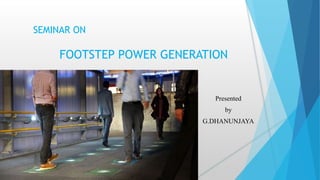
FOOTSTEP POWER GENERATION
Presented
by
G.DHANUNJAYA
CONTENTS
 Introduction
 Need of the system
 Principle & Block diagram
 Components
 Working
 Application
 Advantages & disadvantages
 Conclusion
INTRODUCTION
 For an alternate method to generate electricity there are
number of methods by which electricity can be produced, if
such methods footstep energy generation can be an effective
method to generate electricity.
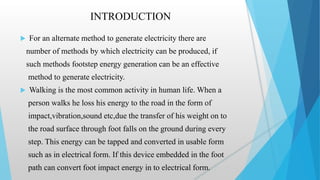
 Walking is the most common activity in human life. When a
person walks he loss his energy to the road in the form of
impact,vibration,sound etc,due the transfer of his weight on to
the road surface through foot falls on the ground during every
step. This energy can be tapped and converted in usable form
such as in electrical form. If this device embedded in the foot
path can convert foot impact energy in to electrical form.
CONVENTIONAL & NON-CONVENTIONAL
ENERGY SOURCES
 Energy produced by coal, petroleum, natural gas etc.,
are quite familiar to country is called conventional
energy source.
 Where as the sources like Biomass, wind, solar etc.,
are not quite familiar to the country is non-
convectional energy source.
NEED FOR THE SYSTEM
 Proposal for the utilization of the waste energy of foot power with
human locomotion is very much relevant and important for highly
populated countries like china and India where the roads, railway
stations, bus stops, temples etc., are all over crowded and million
of people moves around the clock. This whole human being wasted if
can be made for possible for it will be great invention and crowed
energy farm will very useful energy sources in crowed
countries. Walking across a crowed farm, then will be a fun for ideal
people who can improve their health by exercising in such farms
with earning. The electrical energy generated at such farms will be
useful for near by applications.
BASIC PRINCIPLE
 When a pedestrian steps on the top plate of
device, the plate will dip down slightly.
 The downward movement of the plate results in
the rotation of the shaft of an alternator, fitted
in the device to produce electrical energy. The
top plates reverts back to its original position due
to negating springs provided in the device.
BLOCK DIAGRAM
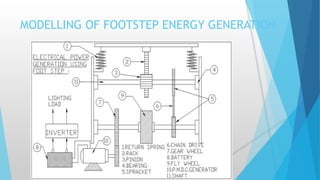
MODELLING OF FOOTSTEP ENERGY GENERATION
COMPONENTS
 Lever
 Rack and Pinion
 Shaft
 Ball Bearing
 Ratchet Gear
 Flywheel
 DC Generator
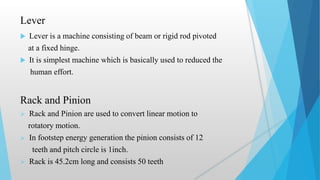
Lever
 Lever is a machine consisting of beam or rigid rod pivoted
at a fixed hinge.
 It is simplest machine which is basically used to reduced the
human effort.
Rack and Pinion
 Rack and Pinion are used to convert linear motion to
rotatory motion.
 In footstep energy generation the pinion consists of 12
teeth and pitch circle is 1inch.
 Rack is 45.2cm long and consists 50 teeth
Shaft
 Shaft is mechanical component for transmitting torque and
rotation.
 In footstep energy generation pinion and ratchet gear are
mounted on the same shaft.
Ball Bearing
 The purpose of all bearing is to reduce rotational friction and
support radial and axial loads.
 The diameter of inner ring is 2.5cm.
Ratchet Gear
 A ratchet gear is a mechanical device that allows continuous linear or
rotatory motion only in one direction while preventing the opposite motion.
Flywheel
 Flywheel is a rotating mechanical device that is used to store rotational
energy.
 In footstep energy generation flywheel is used to drive the DC generator
which produces the electrical energy.
DC generator
 It is an electrical device which is used to convert mechanical energy into
electrical energy.
 In this footstep generation 30 volts DC has been used.
WORKING PRINCIPLE
 The complete diagram of the footstep power generation is given above. The
pushing power is converted in to electrical energy by proper arrangement.
The gear wheel is coupled to the generator shaft with the with help of
another gear wheel.
 The generator is used here is permanent magnet DC generator. The
generated voltage is 12volt DC. This DC voltage is stored to the Lead-acid
12volts battery. The battery is connected to the inverter. This inverter is
used to convert the 12volts D.C to 230volts A.C. This 230volts is used to
activate lights, fans etc., by increasing the battery capacity and inverter
circuit, the power rating is increased.
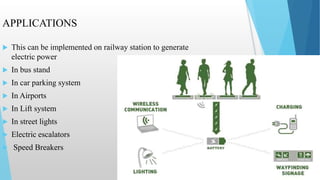
APPLICATIONS
 This can be implemented on railway station to generate
electric power
 In bus stand
 In car parking system
 In Airports
 In Lift system
 In street lights
 Electric escalators
 Speed Breakers
ADVANTAGES
 Power generation simply walking on steps.
 Power also generated by running.
 No need fuel input.
 This is a conventional system.
 Battery is used to store the generated electricity.
DISADVANTAGES
 Only applicable for Particular places.
 Initial cost of this arrangement is high.
 Mechanical moving part is high.
 Care should be taken for batteries.
CONCLUSION
 In concluding the words of our project, since the power generation using foot
step get its energy requirements from the Non-renewable source of energy.
There is no need of power from the mains and there is less pollution in this
source of energy. It is very useful to the places all roads and as well as all
kind of foot step which is used to generate the non conventional energy like
electricity.
 It is able to extend this project by using same arrangement and construct in
the foot steps/speed breaker so that increase the power production rate by
fixing school and colleges, highways etc.
Thank you

Footstep Power Generation

  • 1.
    SEMINAR ON FOOTSTEP POWERGENERATION Presented by G.DHANUNJAYA
  • 2.
    CONTENTS  Introduction  Needof the system  Principle & Block diagram  Components  Working  Application  Advantages & disadvantages  Conclusion
  • 3.
    INTRODUCTION  For analternate method to generate electricity there are number of methods by which electricity can be produced, if such methods footstep energy generation can be an effective method to generate electricity.  Walking is the most common activity in human life. When a person walks he loss his energy to the road in the form of impact,vibration,sound etc,due the transfer of his weight on to the road surface through foot falls on the ground during every step. This energy can be tapped and converted in usable form such as in electrical form. If this device embedded in the foot path can convert foot impact energy in to electrical form.
  • 4.
    CONVENTIONAL & NON-CONVENTIONAL ENERGYSOURCES  Energy produced by coal, petroleum, natural gas etc., are quite familiar to country is called conventional energy source.  Where as the sources like Biomass, wind, solar etc., are not quite familiar to the country is non- convectional energy source.
  • 5.
    NEED FOR THESYSTEM  Proposal for the utilization of the waste energy of foot power with human locomotion is very much relevant and important for highly populated countries like china and India where the roads, railway stations, bus stops, temples etc., are all over crowded and million of people moves around the clock. This whole human being wasted if can be made for possible for it will be great invention and crowed energy farm will very useful energy sources in crowed countries. Walking across a crowed farm, then will be a fun for ideal people who can improve their health by exercising in such farms with earning. The electrical energy generated at such farms will be useful for near by applications.
  • 6.
    BASIC PRINCIPLE  Whena pedestrian steps on the top plate of device, the plate will dip down slightly.  The downward movement of the plate results in the rotation of the shaft of an alternator, fitted in the device to produce electrical energy. The top plates reverts back to its original position due to negating springs provided in the device.
  • 7.
  • 8.
    MODELLING OF FOOTSTEPENERGY GENERATION
  • 9.
    COMPONENTS  Lever  Rackand Pinion  Shaft  Ball Bearing  Ratchet Gear  Flywheel  DC Generator
  • 10.
    Lever  Lever isa machine consisting of beam or rigid rod pivoted at a fixed hinge.  It is simplest machine which is basically used to reduced the human effort. Rack and Pinion  Rack and Pinion are used to convert linear motion to rotatory motion.  In footstep energy generation the pinion consists of 12 teeth and pitch circle is 1inch.  Rack is 45.2cm long and consists 50 teeth
  • 11.
    Shaft  Shaft ismechanical component for transmitting torque and rotation.  In footstep energy generation pinion and ratchet gear are mounted on the same shaft. Ball Bearing  The purpose of all bearing is to reduce rotational friction and support radial and axial loads.  The diameter of inner ring is 2.5cm.
  • 12.
    Ratchet Gear  Aratchet gear is a mechanical device that allows continuous linear or rotatory motion only in one direction while preventing the opposite motion. Flywheel  Flywheel is a rotating mechanical device that is used to store rotational energy.  In footstep energy generation flywheel is used to drive the DC generator which produces the electrical energy. DC generator  It is an electrical device which is used to convert mechanical energy into electrical energy.  In this footstep generation 30 volts DC has been used.
  • 13.
    WORKING PRINCIPLE  Thecomplete diagram of the footstep power generation is given above. The pushing power is converted in to electrical energy by proper arrangement. The gear wheel is coupled to the generator shaft with the with help of another gear wheel.  The generator is used here is permanent magnet DC generator. The generated voltage is 12volt DC. This DC voltage is stored to the Lead-acid 12volts battery. The battery is connected to the inverter. This inverter is used to convert the 12volts D.C to 230volts A.C. This 230volts is used to activate lights, fans etc., by increasing the battery capacity and inverter circuit, the power rating is increased.
  • 14.
    APPLICATIONS  This canbe implemented on railway station to generate electric power  In bus stand  In car parking system  In Airports  In Lift system  In street lights  Electric escalators  Speed Breakers
  • 15.
    ADVANTAGES  Power generationsimply walking on steps.  Power also generated by running.  No need fuel input.  This is a conventional system.  Battery is used to store the generated electricity.
  • 16.
    DISADVANTAGES  Only applicablefor Particular places.  Initial cost of this arrangement is high.  Mechanical moving part is high.  Care should be taken for batteries.
  • 17.
    CONCLUSION  In concludingthe words of our project, since the power generation using foot step get its energy requirements from the Non-renewable source of energy. There is no need of power from the mains and there is less pollution in this source of energy. It is very useful to the places all roads and as well as all kind of foot step which is used to generate the non conventional energy like electricity.  It is able to extend this project by using same arrangement and construct in the foot steps/speed breaker so that increase the power production rate by fixing school and colleges, highways etc.
  • 18.