
Technical seminar
on
“INTERNET OF THINGS (IOT) IN
ELECTRICAL & ELECTRONICS ENGINEERING”
Submitted by
LOKESH.K.N
BE(EEE)
University BDT College of Engineering
Davangere
Under the guidance of
DR. ASHOKA.H.N
ASSOCIATE PROFESSOR, Dept of E&E
U.B.D.T. College of Engineering
INTRODUCTION
Technology plays important role in our day to day life.
Internet is an integral part of todays society, connecting people and sharing
information from all around the globe.
If change our mind sets of what the internet is, and what it is used for, we will have to
decide who can use the internet, machines as well as humans. This way we can have
an Internet of Things (IoT)
The term IoT was coined by Kevin Ashton 1999 through Auto-ID centre at MIT
IoT is the network of physical objects or "things" embedded with electronics,
software, sensors, and network connectivity, which enables these objects to collect
and exchange data.
What is IoT
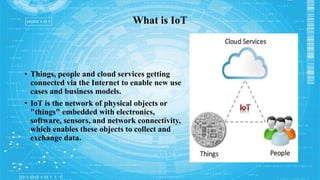
• Things, people and cloud services getting
connected via the Internet to enable new use
cases and business models.
• IoT is the network of physical objects or
"things" embedded with electronics,
software, sensors, and network connectivity,
which enables these objects to collect and
exchange data.
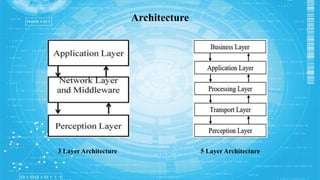
Architecture
3 Layer Architecture 5 Layer Architecture
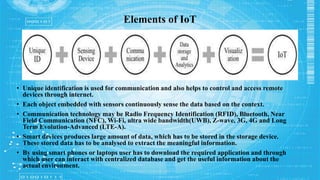
• Unique identification is used for communication and also helps to control and access remote
devices through internet.
• Each object embedded with sensors continuously sense the data based on the context.
• Communication technology may be Radio Frequency Identification (RFID), Bluetooth, Near
Field Communication (NFC), Wi-Fi, ultra wide bandwidth(UWB), Z-wave, 3G, 4G and Long
Term Evolution-Advanced (LTE-A).
• Smart devices produces large amount of data, which has to be stored in the storage device.
These stored data has to be analysed to extract the meaningful information.
• By using smart phones or laptops user has to download the required application and through
which user can interact with centralized database and get the useful information about the
actual environment.
Elements of IoT
• Wireless sensor networks (WSNs) play a very important role in IoT
• The wireless sensor networks are one of the most important technologies in 21st
century. In a few years, sensors will be everywhere, in our houses, in the animals, even
in the human body.
• Smart network contains a large number of sensors that communicate wirelessly
(specially in HAN and NAN) one to each other in order to exchange information.
• IEEE 802.15.4 based protocol ZigBee and the IETF IPv6 over Low Power WPAN
(6LoWPAN) are the two most commonly used protocol in HAN and NAN network.
These are specifically designed for transmitting short-range and low speed data over
wireless personal area networks (WPAN).
Wireless Sensor Networks (WSNs)
IoT in EEE
• IOT increased the use of wireless technology to connect power industry
assets and infrastructure in order to lower the power consumption and
cost.
• Fusing both – IoT and machine learning, technologies will definitely
help the mankind to overcome real-time difficulties.
• If IoT technology is used in the smart grid, important technical
support – real time monitoring, maintenance assist, fault location
detection for the generation, transmission, substation, distribution,
electricity and other aspects of power grid can be effectively provided
SCADA
(Supervisory Control And Data Acquisition)
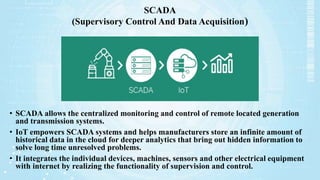
• SCADA allows the centralized monitoring and control of remote located generation
and transmission systems.
• IoT empowers SCADA systems and helps manufacturers store an infinite amount of
historical data in the cloud for deeper analytics that bring out hidden information to
solve long time unresolved problems.
• It integrates the individual devices, machines, sensors and other electrical equipment
with internet by realizing the functionality of supervision and control.
SMART METERING
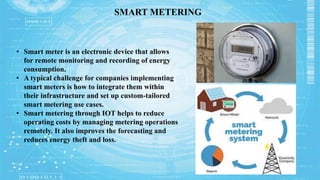
• Smart meter is an electronic device that allows
for remote monitoring and recording of energy
consumption.
• A typical challenge for companies implementing
smart meters is how to integrate them within
their infrastructure and set up custom-tailored
smart metering use cases.
• Smart metering through IOT helps to reduce
operating costs by managing metering operations
remotely. It also improves the forecasting and
reduces energy theft and loss.
BUILDING AUTOMATION
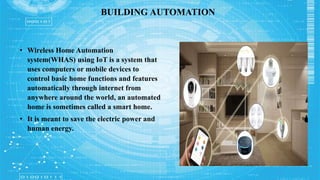
• Wireless Home Automation
system(WHAS) using IoT is a system that
uses computers or mobile devices to
control basic home functions and features
automatically through internet from
anywhere around the world, an automated
home is sometimes called a smart home.
• It is meant to save the electric power and
human energy.
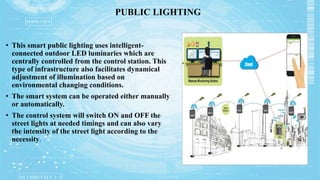
• This smart public lighting uses intelligent-
connected outdoor LED luminaries which are
centrally controlled from the control station. This
type of infrastructure also facilitates dynamical
adjustment of illumination based on
environmental changing conditions.
• The smart system can be operated either manually
or automatically.
• The control system will switch ON and OFF the
street lights at needed timings and can also vary
the intensity of the street light according to the
necessity.
PUBLIC LIGHTING
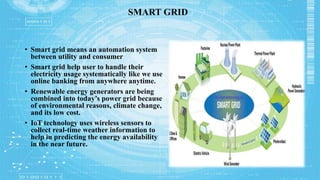
• Smart grid means an automation system
between utility and consumer
• Smart grid help user to handle their
electricity usage systematically like we use
online banking from anywhere anytime.
• Renewable energy generators are being
combined into today’s power grid because
of environmental reasons, climate change,
and its low cost.
• IoT technology uses wireless sensors to
collect real-time weather information to
help in predicting the energy availability
in the near future.
SMART GRID
CHALLENGES
One of the biggest challenges of implementing millions of new devices for the Smart Grid is that each of
these devices could become a potential target for hackers, being in this sense security a vital point to be
solved with full safeguards against intrusion by a third party.
Ukraine attack is a wake-up call, this attack was relatively short-lived.
Around 3:30p.m. December 23 ,2015
Ukraine experienced the first confirmed cyber-takedown of a power system. Prykarpattya Oblenergo, a
power distributor says 27 of its substations went dead. Immediately, 103 cities were "completely blacked
out," and another 186 cities were left partially in the dark. Hackers launched a telephone denial-of
service attack against customer call centres Within a few hours, electricity was flowing again. But the
control centres were not fully operational even after two months later.
BENIFITS OF IOT
• Advantages
Data
Tracking
Time
Money
• Disadvantages
Compatibility
Complexity
Privacy/Security
The Internet has changed drastically the way we live, moving interactions
between people at a virtual level in several contexts spanning from the
professional life to social relationships. The IoT has the potential to add a new
dimension to this process by enabling communications with and among smart
objects, thus leading to the vision of “anytime, anywhere, any media, anything”
communications.
The better future of the mankind lies in the development of IoT. There is no
doubt that IoT will change the way we interact with devices, things or systems.
CONCLUSTION
THANK YOU

IOT in Electrical & Electronics Engineering

  • 2.
    Technical seminar on “INTERNET OFTHINGS (IOT) IN ELECTRICAL & ELECTRONICS ENGINEERING” Submitted by LOKESH.K.N BE(EEE) University BDT College of Engineering Davangere Under the guidance of DR. ASHOKA.H.N ASSOCIATE PROFESSOR, Dept of E&E U.B.D.T. College of Engineering
  • 3.
    INTRODUCTION Technology plays importantrole in our day to day life. Internet is an integral part of todays society, connecting people and sharing information from all around the globe. If change our mind sets of what the internet is, and what it is used for, we will have to decide who can use the internet, machines as well as humans. This way we can have an Internet of Things (IoT) The term IoT was coined by Kevin Ashton 1999 through Auto-ID centre at MIT IoT is the network of physical objects or "things" embedded with electronics, software, sensors, and network connectivity, which enables these objects to collect and exchange data.
  • 4.
    What is IoT •Things, people and cloud services getting connected via the Internet to enable new use cases and business models. • IoT is the network of physical objects or "things" embedded with electronics, software, sensors, and network connectivity, which enables these objects to collect and exchange data.
  • 5.
  • 6.
    • Unique identificationis used for communication and also helps to control and access remote devices through internet. • Each object embedded with sensors continuously sense the data based on the context. • Communication technology may be Radio Frequency Identification (RFID), Bluetooth, Near Field Communication (NFC), Wi-Fi, ultra wide bandwidth(UWB), Z-wave, 3G, 4G and Long Term Evolution-Advanced (LTE-A). • Smart devices produces large amount of data, which has to be stored in the storage device. These stored data has to be analysed to extract the meaningful information. • By using smart phones or laptops user has to download the required application and through which user can interact with centralized database and get the useful information about the actual environment. Elements of IoT
  • 7.
    • Wireless sensornetworks (WSNs) play a very important role in IoT • The wireless sensor networks are one of the most important technologies in 21st century. In a few years, sensors will be everywhere, in our houses, in the animals, even in the human body. • Smart network contains a large number of sensors that communicate wirelessly (specially in HAN and NAN) one to each other in order to exchange information. • IEEE 802.15.4 based protocol ZigBee and the IETF IPv6 over Low Power WPAN (6LoWPAN) are the two most commonly used protocol in HAN and NAN network. These are specifically designed for transmitting short-range and low speed data over wireless personal area networks (WPAN). Wireless Sensor Networks (WSNs)
  • 8.
    IoT in EEE •IOT increased the use of wireless technology to connect power industry assets and infrastructure in order to lower the power consumption and cost. • Fusing both – IoT and machine learning, technologies will definitely help the mankind to overcome real-time difficulties. • If IoT technology is used in the smart grid, important technical support – real time monitoring, maintenance assist, fault location detection for the generation, transmission, substation, distribution, electricity and other aspects of power grid can be effectively provided
  • 9.
    SCADA (Supervisory Control AndData Acquisition) • SCADA allows the centralized monitoring and control of remote located generation and transmission systems. • IoT empowers SCADA systems and helps manufacturers store an infinite amount of historical data in the cloud for deeper analytics that bring out hidden information to solve long time unresolved problems. • It integrates the individual devices, machines, sensors and other electrical equipment with internet by realizing the functionality of supervision and control.
  • 10.
    SMART METERING • Smartmeter is an electronic device that allows for remote monitoring and recording of energy consumption. • A typical challenge for companies implementing smart meters is how to integrate them within their infrastructure and set up custom-tailored smart metering use cases. • Smart metering through IOT helps to reduce operating costs by managing metering operations remotely. It also improves the forecasting and reduces energy theft and loss.
  • 11.
    BUILDING AUTOMATION • WirelessHome Automation system(WHAS) using IoT is a system that uses computers or mobile devices to control basic home functions and features automatically through internet from anywhere around the world, an automated home is sometimes called a smart home. • It is meant to save the electric power and human energy.
  • 12.
    • This smartpublic lighting uses intelligent- connected outdoor LED luminaries which are centrally controlled from the control station. This type of infrastructure also facilitates dynamical adjustment of illumination based on environmental changing conditions. • The smart system can be operated either manually or automatically. • The control system will switch ON and OFF the street lights at needed timings and can also vary the intensity of the street light according to the necessity. PUBLIC LIGHTING
  • 13.
    • Smart gridmeans an automation system between utility and consumer • Smart grid help user to handle their electricity usage systematically like we use online banking from anywhere anytime. • Renewable energy generators are being combined into today’s power grid because of environmental reasons, climate change, and its low cost. • IoT technology uses wireless sensors to collect real-time weather information to help in predicting the energy availability in the near future. SMART GRID
  • 14.
    CHALLENGES One of thebiggest challenges of implementing millions of new devices for the Smart Grid is that each of these devices could become a potential target for hackers, being in this sense security a vital point to be solved with full safeguards against intrusion by a third party. Ukraine attack is a wake-up call, this attack was relatively short-lived. Around 3:30p.m. December 23 ,2015 Ukraine experienced the first confirmed cyber-takedown of a power system. Prykarpattya Oblenergo, a power distributor says 27 of its substations went dead. Immediately, 103 cities were "completely blacked out," and another 186 cities were left partially in the dark. Hackers launched a telephone denial-of service attack against customer call centres Within a few hours, electricity was flowing again. But the control centres were not fully operational even after two months later.
  • 15.
    BENIFITS OF IOT •Advantages Data Tracking Time Money • Disadvantages Compatibility Complexity Privacy/Security
  • 16.
    The Internet haschanged drastically the way we live, moving interactions between people at a virtual level in several contexts spanning from the professional life to social relationships. The IoT has the potential to add a new dimension to this process by enabling communications with and among smart objects, thus leading to the vision of “anytime, anywhere, any media, anything” communications. The better future of the mankind lies in the development of IoT. There is no doubt that IoT will change the way we interact with devices, things or systems. CONCLUSTION
  • 17.