
Thermal and Mechanical Energy Harvesting Materials  Krzysztof Grzybowski
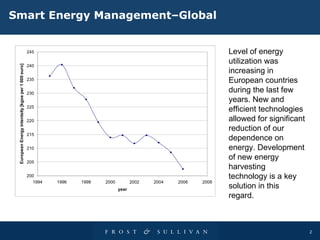
Smart Energy Management–Global  Level of energy utilization was increasing in European countries during the last few years. New and efficient technologies allowed for significant reduction of our dependence on energy. Development of new energy harvesting technology is a key solution in this regard.
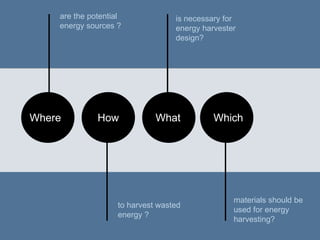
are the potential energy sources ? to harvest wasted energy ? is necessary for energy harvester design? materials should be used for energy harvesting? How Where What Which
are potential energy sources ? Where
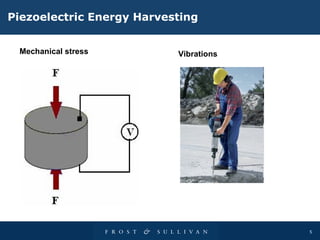
Piezoelectric  E nergy  H arvesting Mechanical stress  Vibrations
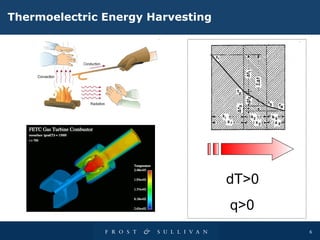
Thermoelectric  E nergy  H arvesting dT>0 q>0
Energy sources used for harvesting Presence of the s treams of wasted energy that could be recovered and re - utilized ( such as  heat or vibrations) . Presence of the s treams of energies in systems that are stand alone and cannot be powered by conventional sources, or the powering is too expensive . Self - powered solutions operating on batteries that could be more conveniently  supplied  by energy harvesters. Energy harvesters are usually applied in case of
to harvest wasted energy ? How
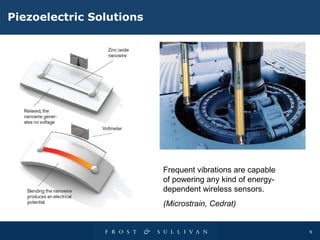
Piezoelectric  S olutions Frequent vibrations are capable  of  power ing  any kind of energy -  dependent wireless sensors .   (Microstrain, Cedrat)
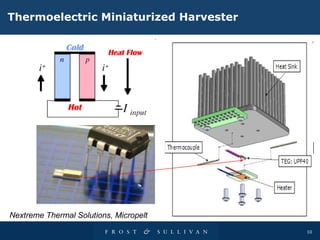
Thermoelectric  M iniaturized  H arvester Nextreme Thermal Solutions, Micropelt
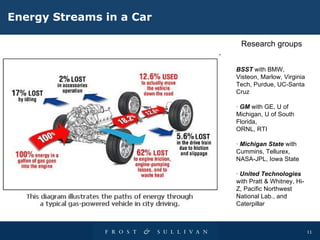
Energy  S treams in  a C ar BSST  with BMW, Visteon, Marlow, Virginia Tech,   Purdue, UC-Santa Cruz ·  GM  with GE, U of Michigan, U of South Florida, ORNL, RTI ·  Michigan State  with Cummins, Tellurex, NASA-JPL,   Iowa State ·  United Technologies  with Pratt &   Whitney, Hi-Z,   Pacific Northwest National Lab., and Caterpillar Research groups
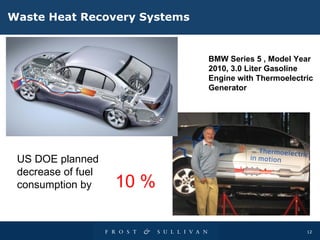
Waste  H eat  R ecovery  S ystems BMW Series 5 , Model Year 2010, 3.0 Liter Gasoline Engine with Thermoelectric Generator   US D O E planned decrease of fuel consumption by 10 %
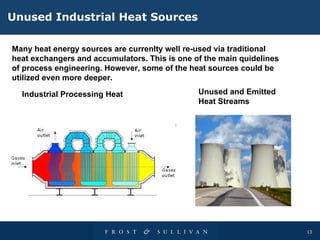
Unused  I ndustrial  H eat  S ources Many heat energy sources are currenlty well re - used via traditional heat exchangers  and  accumulators. This is one of the main quidelines of process engineering. However, some of the heat sources could be utilized even more deeper.  Industrial  P rocessing  H eat Unused and  E mitted  H eat  S treams
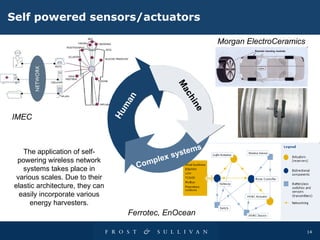
Self powered sensors/actuators The application of self- powering wireless network systems takes place in various scales. Due to their elastic architecture, they can easily incorporate various energy harvesters. IMEC Morgan ElectroCeramics Ferrotec, EnOcean Human Machine Complex systems
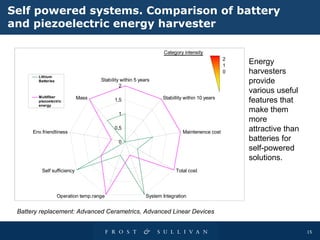
Self powered systems. Comparison of battery and piezoelectric energy harvester  Energy harvesters provide various useful features that make them more attractive than batteries for self-powered solutions.  Battery replacement: Advanced Cerametrics, Advanced Linear Devices
is necessary for the energy harvester design? What
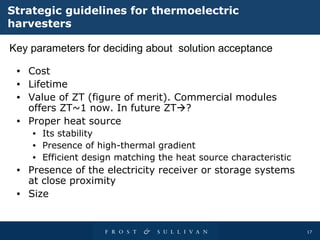
Strategic guidelines for thermoelectric harvesters Cost Lifetime Value of ZT (figure of merit). Commercial modules offers ZT~1 now. In future ZT  ? Proper heat source  Its stability Presence of high-thermal gradient Efficient design matching the heat source characteristic Presence of the electricity receiver or storage systems at close proximity Size Key parameters for deciding about  solution acceptance
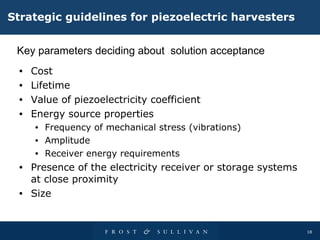
Strategic guidelines for piezoelectric harvesters  Cost Lifetime Value of piezoelectricity coefficient Energy source properties Frequency of mechanical stress (vibrations) Amplitude Receiver energy requirements  Presence of the electricity receiver or storage systems at close proximity Size Key parameters deciding about  solution acceptance
materials should be used for energy harvesting? Which
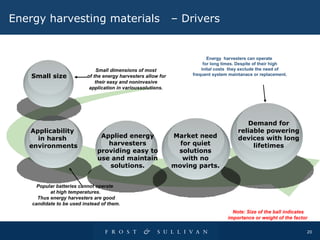
Applicability in harsh environments Energy harvesting materials  – Drivers Small size Note: Size of the ball indicates importance or weight of the factor   Small dimensions of most of the energy harvesters allow for their easy and noninvasive  application in varioussolutions. Popular batteries cannot operate  at high temperatures. Thus energy harvesters are good candidate to be used instead of them. Applied energy harvesters providing easy to use and maintain solutions. Energy  harvesters can operate for long times. Despite of their high inital costs  they exclude the need of frequent system maintanace or replacement. Demand for reliable powering devices with long lifetimes Market need for quiet solutions with no moving parts.
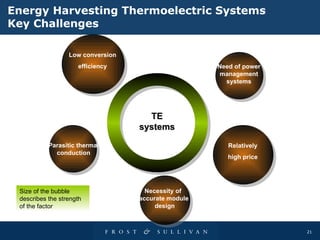
Energy Harvesting  T hermoelectric  S ystems   Key   Challenges TE systems Low conversion efficiency Necessity of  accurate module design Need of power management systems Relatively  high price  Parasitic thermal conduction Size of the bubble describes the strength of the factor
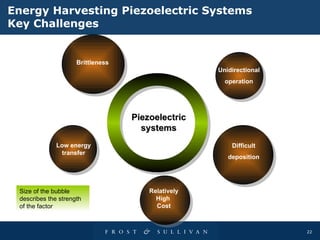
Energy Harvesting  Piezoelectric S ystems   Key   Challenges Piezoelectric systems Brittleness Relatively High  Cost Unidirectional operation Difficult deposition Low energy transfer Size of the bubble describes the strength of the factor
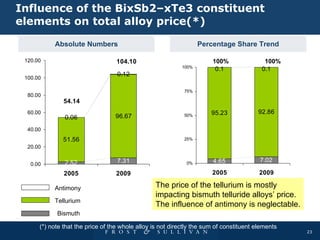
Influence of the BixSb2–xTe3 constituent elements on total alloy price(*)   Absolute Numbers Percentage Share Trend 100% 100% (*) note that the price of the whole alloy is not directly the sum of constituent elements Bismuth Antimony Tellurium The price of the tellurium is mostly impacting bismuth telluride alloys’ price. The influence of antimony is neglectable.
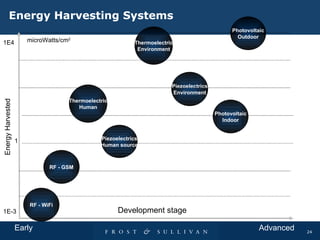
Energy  H arvesting  S ystems Piezoelectrics Human source Piezoelectrics Environment Photovoltaic Outdoor RF - GSM 1E-3 microWatts/cm 2 1E4 1 Photovoltaic Indoor RF - WiFi Thermoelectric Environment Thermoelectric Human Energy Harvested Development stage Early Advanced
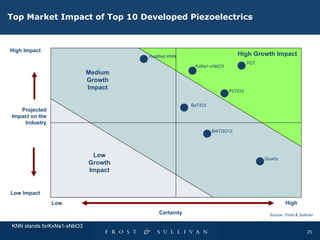
Top  Market Impact of Top 10  Developed Piezoelectrics Projected Impact on the Industry High Impact Low Impact Certainty Low  High Bi4Ti3O12 KxNa1-xNbO3 modified KNN PbTiO3 PZT BaTiO3 Quartz High Growth Impact Low Growth Impact Medium Growth Impact Source  Frost & Sullivan. KNN stands forKxNa1-xNbO3
Thank you

Ab 2009 9

  • 1.
    Thermal and MechanicalEnergy Harvesting Materials Krzysztof Grzybowski
  • 2.
    Smart Energy Management–Global Level of energy utilization was increasing in European countries during the last few years. New and efficient technologies allowed for significant reduction of our dependence on energy. Development of new energy harvesting technology is a key solution in this regard.
  • 3.
    are the potentialenergy sources ? to harvest wasted energy ? is necessary for energy harvester design? materials should be used for energy harvesting? How Where What Which
  • 4.
    are potential energysources ? Where
  • 5.
    Piezoelectric Energy H arvesting Mechanical stress Vibrations
  • 6.
    Thermoelectric Energy H arvesting dT>0 q>0
  • 7.
    Energy sources usedfor harvesting Presence of the s treams of wasted energy that could be recovered and re - utilized ( such as heat or vibrations) . Presence of the s treams of energies in systems that are stand alone and cannot be powered by conventional sources, or the powering is too expensive . Self - powered solutions operating on batteries that could be more conveniently supplied by energy harvesters. Energy harvesters are usually applied in case of
  • 8.
    to harvest wastedenergy ? How
  • 9.
    Piezoelectric Solutions Frequent vibrations are capable of power ing any kind of energy - dependent wireless sensors . (Microstrain, Cedrat)
  • 10.
    Thermoelectric Miniaturized H arvester Nextreme Thermal Solutions, Micropelt
  • 11.
    Energy Streams in a C ar BSST with BMW, Visteon, Marlow, Virginia Tech, Purdue, UC-Santa Cruz · GM with GE, U of Michigan, U of South Florida, ORNL, RTI · Michigan State with Cummins, Tellurex, NASA-JPL, Iowa State · United Technologies with Pratt & Whitney, Hi-Z, Pacific Northwest National Lab., and Caterpillar Research groups
  • 12.
    Waste Heat R ecovery S ystems BMW Series 5 , Model Year 2010, 3.0 Liter Gasoline Engine with Thermoelectric Generator US D O E planned decrease of fuel consumption by 10 %
  • 13.
    Unused Industrial H eat S ources Many heat energy sources are currenlty well re - used via traditional heat exchangers and accumulators. This is one of the main quidelines of process engineering. However, some of the heat sources could be utilized even more deeper. Industrial P rocessing H eat Unused and E mitted H eat S treams
  • 14.
    Self powered sensors/actuatorsThe application of self- powering wireless network systems takes place in various scales. Due to their elastic architecture, they can easily incorporate various energy harvesters. IMEC Morgan ElectroCeramics Ferrotec, EnOcean Human Machine Complex systems
  • 15.
    Self powered systems.Comparison of battery and piezoelectric energy harvester Energy harvesters provide various useful features that make them more attractive than batteries for self-powered solutions. Battery replacement: Advanced Cerametrics, Advanced Linear Devices
  • 16.
    is necessary forthe energy harvester design? What
  • 17.
    Strategic guidelines forthermoelectric harvesters Cost Lifetime Value of ZT (figure of merit). Commercial modules offers ZT~1 now. In future ZT  ? Proper heat source Its stability Presence of high-thermal gradient Efficient design matching the heat source characteristic Presence of the electricity receiver or storage systems at close proximity Size Key parameters for deciding about solution acceptance
  • 18.
    Strategic guidelines forpiezoelectric harvesters Cost Lifetime Value of piezoelectricity coefficient Energy source properties Frequency of mechanical stress (vibrations) Amplitude Receiver energy requirements Presence of the electricity receiver or storage systems at close proximity Size Key parameters deciding about solution acceptance
  • 19.
    materials should beused for energy harvesting? Which
  • 20.
    Applicability in harshenvironments Energy harvesting materials – Drivers Small size Note: Size of the ball indicates importance or weight of the factor Small dimensions of most of the energy harvesters allow for their easy and noninvasive application in varioussolutions. Popular batteries cannot operate at high temperatures. Thus energy harvesters are good candidate to be used instead of them. Applied energy harvesters providing easy to use and maintain solutions. Energy harvesters can operate for long times. Despite of their high inital costs they exclude the need of frequent system maintanace or replacement. Demand for reliable powering devices with long lifetimes Market need for quiet solutions with no moving parts.
  • 21.
    Energy Harvesting T hermoelectric S ystems Key Challenges TE systems Low conversion efficiency Necessity of accurate module design Need of power management systems Relatively high price Parasitic thermal conduction Size of the bubble describes the strength of the factor
  • 22.
    Energy Harvesting Piezoelectric S ystems Key Challenges Piezoelectric systems Brittleness Relatively High Cost Unidirectional operation Difficult deposition Low energy transfer Size of the bubble describes the strength of the factor
  • 23.
    Influence of theBixSb2–xTe3 constituent elements on total alloy price(*) Absolute Numbers Percentage Share Trend 100% 100% (*) note that the price of the whole alloy is not directly the sum of constituent elements Bismuth Antimony Tellurium The price of the tellurium is mostly impacting bismuth telluride alloys’ price. The influence of antimony is neglectable.
  • 24.
    Energy Harvesting S ystems Piezoelectrics Human source Piezoelectrics Environment Photovoltaic Outdoor RF - GSM 1E-3 microWatts/cm 2 1E4 1 Photovoltaic Indoor RF - WiFi Thermoelectric Environment Thermoelectric Human Energy Harvested Development stage Early Advanced
  • 25.
    Top MarketImpact of Top 10 Developed Piezoelectrics Projected Impact on the Industry High Impact Low Impact Certainty Low High Bi4Ti3O12 KxNa1-xNbO3 modified KNN PbTiO3 PZT BaTiO3 Quartz High Growth Impact Low Growth Impact Medium Growth Impact Source Frost & Sullivan. KNN stands forKxNa1-xNbO3
  • 26.