Internet of Things (IOT)
in Electrical Engineering
By:
B.Deepak
What is Internet of Things (IOT)?
Internet of Things is an emerging paradigm of internet connected
things that allows the physical objects or things to connect, interact and
communicate with one another similar to the way humans talk through
web in today’s environment. It connects systems, sensors and actuator
instruments to the broader internet.
IOT Usage in the Electrical Power Industry
The evaluation of the IOT in the electrical power industry
transformed the way things performed in usual manner. IOT
increased the use of wireless technology to connect power
industry assets and infrastructure in order to lower the power
consumption and cost. Some of the examples of IOT usage
include SCADA, smart metering, building automation, smart grid,
and connected public lighting.
SCADA
SCADA is one of the
major application areas of IOT.
SCADA allows the centralized
monitoring and control of remote
located generation and
transmission systems. It consists
of sensors, actuators, controllers
and communication devices at
the remote field place, and
central master unit with
communication systems at the
controlling side
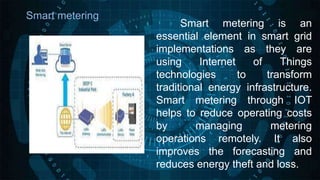
Smart metering is an
essential element in smart grid
implementations as they are
using Internet of Things
technologies to transform
traditional energy infrastructure.
Smart metering through IOT
helps to reduce operating costs
by managing metering
operations remotely. It also
improves the forecasting and
reduces energy theft and loss.
Smart metering
Building Automation
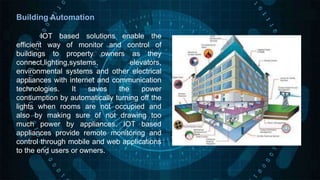
IOT based solutions enable the
efficient way of monitor and control of
buildings to property owners as they
connect,lighting,systems, elevators,
environmental systems and other electrical
appliances with internet and communication
technologies. It saves the power
consumption by automatically turning off the
lights when rooms are not occupied and
also by making sure of not drawing too
much power by appliances. IOT based
appliances provide remote monitoring and
control through mobile and web applications
to the end users or owners.
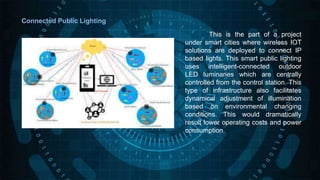
This is the part of a project
under smart cities where wireless IOT
solutions are deployed to connect IP
based lights. This smart public lighting
uses intelligent-connected outdoor
LED luminaries which are centrally
controlled from the control station. This
type of infrastructure also facilitates
dynamical adjustment of illumination
based on environmental changing
conditions. This would dramatically
result lower operating costs and power
consumption.
Connected Public Lighting
Smart Grid
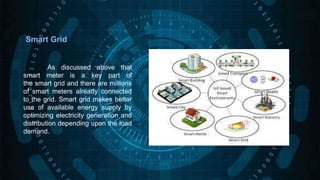
As discussed above that
smart meter is a key part of
the smart grid and there are millions
of smart meters already connected
to the grid. Smart grid makes better
use of available energy supply by
optimizing electricity generation and
distribution depending upon the load
demand.
THANK YOU

IOT in electrical engineering

  • 1.
    Internet of Things(IOT) in Electrical Engineering By: B.Deepak
  • 2.
    What is Internetof Things (IOT)? Internet of Things is an emerging paradigm of internet connected things that allows the physical objects or things to connect, interact and communicate with one another similar to the way humans talk through web in today’s environment. It connects systems, sensors and actuator instruments to the broader internet.
  • 3.
    IOT Usage inthe Electrical Power Industry The evaluation of the IOT in the electrical power industry transformed the way things performed in usual manner. IOT increased the use of wireless technology to connect power industry assets and infrastructure in order to lower the power consumption and cost. Some of the examples of IOT usage include SCADA, smart metering, building automation, smart grid, and connected public lighting.
  • 4.
    SCADA SCADA is oneof the major application areas of IOT. SCADA allows the centralized monitoring and control of remote located generation and transmission systems. It consists of sensors, actuators, controllers and communication devices at the remote field place, and central master unit with communication systems at the controlling side
  • 5.
    Smart metering isan essential element in smart grid implementations as they are using Internet of Things technologies to transform traditional energy infrastructure. Smart metering through IOT helps to reduce operating costs by managing metering operations remotely. It also improves the forecasting and reduces energy theft and loss. Smart metering
  • 6.
    Building Automation IOT basedsolutions enable the efficient way of monitor and control of buildings to property owners as they connect,lighting,systems, elevators, environmental systems and other electrical appliances with internet and communication technologies. It saves the power consumption by automatically turning off the lights when rooms are not occupied and also by making sure of not drawing too much power by appliances. IOT based appliances provide remote monitoring and control through mobile and web applications to the end users or owners.
  • 7.
    This is thepart of a project under smart cities where wireless IOT solutions are deployed to connect IP based lights. This smart public lighting uses intelligent-connected outdoor LED luminaries which are centrally controlled from the control station. This type of infrastructure also facilitates dynamical adjustment of illumination based on environmental changing conditions. This would dramatically result lower operating costs and power consumption. Connected Public Lighting
  • 8.
    Smart Grid As discussedabove that smart meter is a key part of the smart grid and there are millions of smart meters already connected to the grid. Smart grid makes better use of available energy supply by optimizing electricity generation and distribution depending upon the load demand.
  • 9.