Energy BalanceEnergy Balance
and Bodyand Body
CompositionComposition
Chapter 8Chapter 8
Energy BalanceEnergy Balance
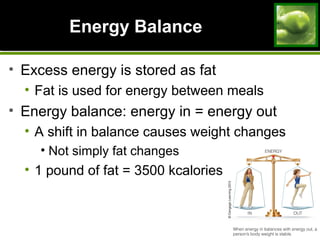
• Excess energy is stored as fat
• Fat is used for energy between meals
• Energy balance: energy in = energy out
• A shift in balance causes weight changes
• Not simply fat changes
• 1 pound of fat = 3500 kcalories
Energy In: Food CompositionEnergy In: Food Composition
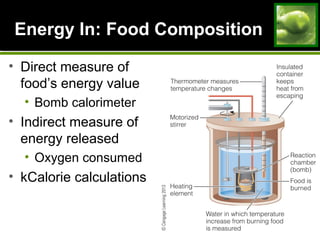
• Direct measure of
food’s energy value
• Bomb calorimeter
• Indirect measure of
energy released
• Oxygen consumed
• kCalorie calculations
Energy In: Food IntakeEnergy In: Food Intake
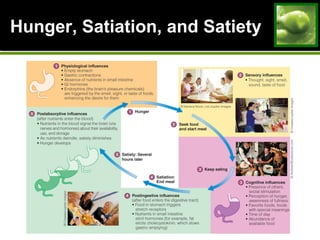
• Hunger
• Physiological response to nerve signals and
chemical messengers
• Hypothalamus
• Influences
• Satiation – stop eating
• Satiety – not to start eating again
Hunger, Satiation, and SatietyHunger, Satiation, and Satiety
Energy In: Food IntakeEnergy In: Food Intake
• Overriding hunger and satiety
• Stress eating
• External cues
• Time of day, availability, sight, taste of food
• Environmental influences
• Examples
• Cognitive influences
• Disordered eating
Energy In: Food IntakeEnergy In: Food Intake
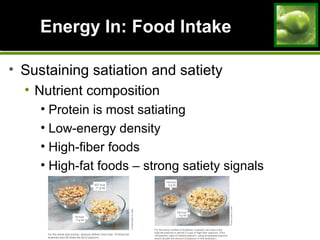
• Sustaining satiation and satiety
• Nutrient composition
• Protein is most satiating
• Low-energy density
• High-fiber foods
• High-fat foods – strong satiety signals
Energy In: Food IntakeEnergy In: Food Intake
• The hypothalamus
• Control center for eating
• Integrates messages
• Energy intake, expenditure, storage
• Gastrointestinal hormones
Energy OutEnergy Out
• Thermogenesis
• Basal metabolism
• Physical activity
• Food consumption
• Adaptation
Energy Out: Basal MetabolismEnergy Out: Basal Metabolism
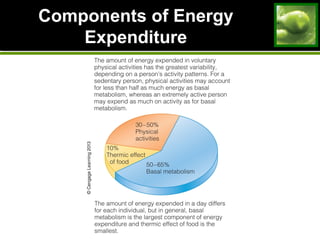
• About two-thirds of energy expended in a
day
• Metabolic activities
• All basic processes of life
• Basal metabolic rate (BMR)
• Variations
• Weight
• Lean tissue
• Resting metabolic rate (RMR)
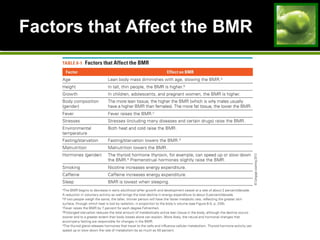
Factors that Affect the BMRFactors that Affect the BMR
Energy Out: Physical ActivityEnergy Out: Physical Activity
• Voluntary movement of skeletal muscles
• Most variable component of energy
expenditure
• Amount of energy needed
• Muscle mass
• Body weight
• Activity
• Frequency, intensity, and duration
Energy Out: Thermic Effect ofEnergy Out: Thermic Effect of
FoodFood
• Acceleration of GI tract functioning in
response to food presence
• Releases heat
• Approximately 10 percent of energy intake
• High-protein foods vs. high-fat foods
• Meal consumption time frame
Energy Out: AdaptiveEnergy Out: Adaptive
ThermogenesisThermogenesis
• Adapt to dramatically changing
circumstances
• Examples
• Extra work done by body
• Amount expended is extremely variable
• Not included in energy requirement
calculations
Components of Energy
Expenditure
Estimating EnergyEstimating Energy
RequirementsRequirements
• Gender
• BMR
• Growth
• Groups with
adjusted energy
requirements
• Age
• Changes with age
• Physical activity
• Levels of intensity
for each gender
• Body composition &
body size
• Height
• Weight
Defining Healthy Body WeightDefining Healthy Body Weight
• Ideal
• Not appearance based
• Perceived body image and actual body size
• Damaging behaviors
• Subjective
• Little in common with health
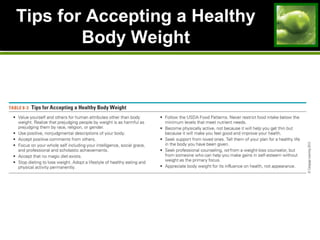
Tips for Accepting a Healthy
Body Weight
Defining Healthy Body WeightDefining Healthy Body Weight
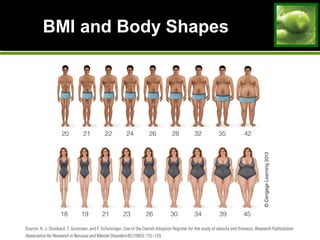
• Body mass index
• Relative weight for height
• BMI = weight (kg)
height (m)2
• Health-related classifications
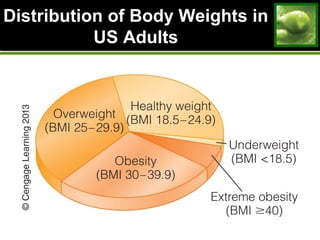
• Healthy weight: BMI = 18.5 to 24.9
• Other classifications
• Not a measure of body composition
• Variations
BMI and Body ShapesBMI and Body Shapes
Distribution of Body Weights inDistribution of Body Weights in
US AdultsUS Adults
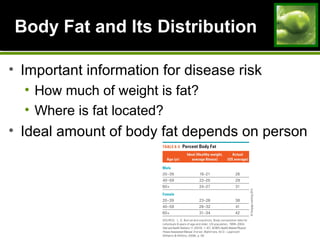
Body Fat and Its DistributionBody Fat and Its Distribution
• Important information for disease risk
• How much of weight is fat?
• Where is fat located?
• Ideal amount of body fat depends on person
Body Fat and Its DistributionBody Fat and Its Distribution
• Needing less body fat
• Some athletes
• Needing more body fat
• Example groups
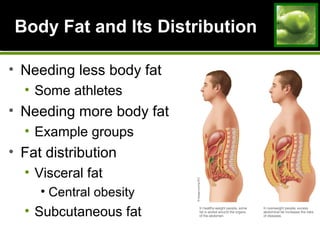
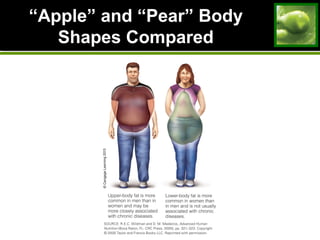
• Fat distribution
• Visceral fat
• Central obesity
• Subcutaneous fat
““Apple” and “Pear” BodyApple” and “Pear” Body
Shapes ComparedShapes Compared
Body Fat and Its DistributionBody Fat and Its Distribution
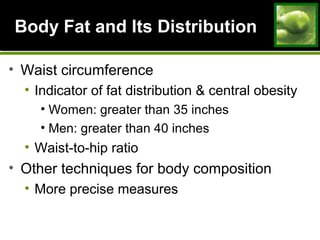
• Waist circumference
• Indicator of fat distribution & central obesity
• Women: greater than 35 inches
• Men: greater than 40 inches
• Waist-to-hip ratio
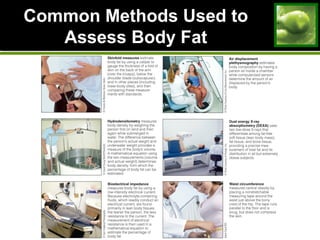
• Other techniques for body composition
• More precise measures
Common Methods Used toCommon Methods Used to
Assess Body FatAssess Body Fat
Health Risks Associated withHealth Risks Associated with
Body Weight & Body FatBody Weight & Body Fat
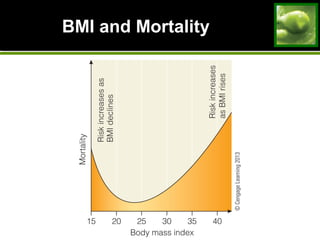
• Body weight and fat distribution correlate
with disease risk and life expectancy
• Correlations are not causes
• Risks associated with being underweight
• Fighting against wasting diseases
• Menstrual irregularities and infertility
• Osteoporosis and bone fractures
BMI and MortalityBMI and Mortality
Health Risks Associated withHealth Risks Associated with
Body Weight & Body FatBody Weight & Body Fat
• Risks associated with being overweight
• Obesity is a designated disease
• Health risks
• More likely to be disabled in later years
• Costs
• Money
• Lives
• Yo-yo dieting
Health Risks Associated withHealth Risks Associated with
Body Weight & Body FatBody Weight & Body Fat
• Cardiovascular disease
• Elevated blood cholesterol & hypertension
• Central obesity
• Diabetes – type II
• Central obesity
• Weight gains and body weight
• Cancer
• Relationship is not fully understood
Health Risks Associated withHealth Risks Associated with
Body Weight & Body FatBody Weight & Body Fat
• Inflammation & metabolic syndrome
• Change in body’s metabolism
• Cluster of symptoms
• Fat accumulation
• Inflammation
• Elevated blood lipids
• Promote inflammation
• Fit and fat versus sedentary and slim
Eating DisordersEating Disorders
Highlight 8Highlight 8
Eating DisordersEating Disorders
• Three disorders
• Anorexia nervosa
• Bulimia nervosa
• Binge eating disorder
• Prevalence of various eating disorders
• Causes
• Multiple factors
• Athletes and eating disorders
Female Athlete TriadFemale Athlete Triad
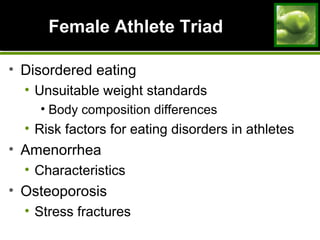
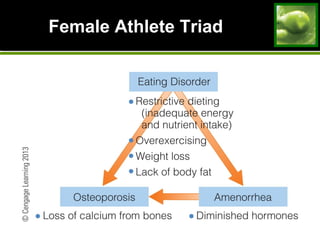
• Disordered eating
• Unsuitable weight standards
• Body composition differences
• Risk factors for eating disorders in athletes
• Amenorrhea
• Characteristics
• Osteoporosis
• Stress fractures
Female Athlete TriadFemale Athlete Triad
Other Dangerous Practices ofOther Dangerous Practices of
AthletesAthletes
• Muscle dysmorphia
• Characteristic behaviors
• Similarities to others with distorted body
images
• Food deprivation and dehydration practices
• Impair physical performance
• Reduce muscle strength
• Decrease anaerobic power
• Reduce endurance capacity
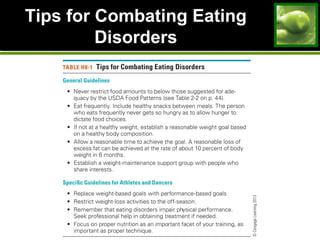
Tips for Combating Eating
Disorders
Anorexia NervosaAnorexia Nervosa
• Distorted body image
• Central to diagnosis
• Cannot be self-diagnosed
• Malnutrition
• Impacts brain function and judgment
• Causes lethargy, confusion, and delirium
• Denial
• Levels are high among anorexics
Anorexia NervosaAnorexia Nervosa
• Need for self-control
• Protein-energy malnutrition (PEM)
• Similar to marasmus
• Impact on body
• Growth ceases and normal development
falters
• Changes in heart size and strength
• Other bodily consequences
Anorexia NervosaAnorexia Nervosa
• Treatment
• Multidisciplinary approach
• Food and weight issues
• Relationship issues
• After recovery
• Energy intakes and eating behaviors may not
return to normal
• High mortality rate among psychiatric
disorders
Bulimia NervosaBulimia Nervosa
• Distinct and more prevalent than anorexia
nervosa
• True incidence is difficult to establish
• Secretive nature
• Not as physically apparent
• Common background characteristics of
bulimics
Bulimia NervosaBulimia Nervosa
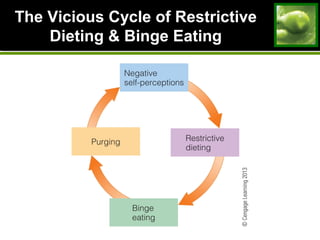
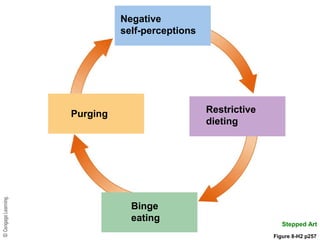
• Binge-purge cycle
• Lack of control
• Consume food for emotional comfort
• Cannot stop
• Done in secret
• Purge
• Cathartic
• Emetic
• Shame and guilt
The Vicious Cycle of RestrictiveThe Vicious Cycle of Restrictive
Dieting & Binge EatingDieting & Binge Eating
Negative
self-perceptions
Purging Restrictive
dieting
Binge
eating
Stepped Art
Figure 8-H2 p257
Bulimia NervosaBulimia Nervosa
• Physical consequences of binge-purge cycle
• Subclinical malnutrition
• Effects
• Physical effects
• Tooth erosion, red eyes, calloused hands
• Clinical depression and substance abuse
rates are high
Bulimia NervosaBulimia Nervosa
• Treatment
• Discontinuing purging and restrictive diet
habits
• Learn to eat three meals a day
• Plus snacks
• Treatment team
• Length of recovery
• Overlap between anorexia nervosa and
bulimia nervosa
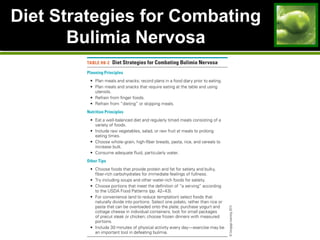
Diet Strategies for CombatingDiet Strategies for Combating
Bulimia NervosaBulimia Nervosa
Binge-Eating DisorderBinge-Eating Disorder
• Periodic binging
• Typically no purging
• Contrast with bulimia nervosa
• Compare with bulimia nervosa
• Feelings
• Differences between obese binge eaters
and obese people who do not binge
• Behavioral disorder responsive to treatment
Eating Disorders in SocietyEating Disorders in Society
• Society plays central role in eating disorders
• Known only in developed nations
• More prevalent as wealth increases
• Food becomes plentiful
• Body dissatisfaction
• Characteristics of disordered eating

Chapter8

  • 1.
    Energy BalanceEnergy Balance andBodyand Body CompositionComposition Chapter 8Chapter 8
  • 2.
    Energy BalanceEnergy Balance •Excess energy is stored as fat • Fat is used for energy between meals • Energy balance: energy in = energy out • A shift in balance causes weight changes • Not simply fat changes • 1 pound of fat = 3500 kcalories
  • 3.
    Energy In: FoodCompositionEnergy In: Food Composition • Direct measure of food’s energy value • Bomb calorimeter • Indirect measure of energy released • Oxygen consumed • kCalorie calculations
  • 4.
    Energy In: FoodIntakeEnergy In: Food Intake • Hunger • Physiological response to nerve signals and chemical messengers • Hypothalamus • Influences • Satiation – stop eating • Satiety – not to start eating again
  • 5.
    Hunger, Satiation, andSatietyHunger, Satiation, and Satiety
  • 6.
    Energy In: FoodIntakeEnergy In: Food Intake • Overriding hunger and satiety • Stress eating • External cues • Time of day, availability, sight, taste of food • Environmental influences • Examples • Cognitive influences • Disordered eating
  • 7.
    Energy In: FoodIntakeEnergy In: Food Intake • Sustaining satiation and satiety • Nutrient composition • Protein is most satiating • Low-energy density • High-fiber foods • High-fat foods – strong satiety signals
  • 8.
    Energy In: FoodIntakeEnergy In: Food Intake • The hypothalamus • Control center for eating • Integrates messages • Energy intake, expenditure, storage • Gastrointestinal hormones
  • 9.
    Energy OutEnergy Out •Thermogenesis • Basal metabolism • Physical activity • Food consumption • Adaptation
  • 10.
    Energy Out: BasalMetabolismEnergy Out: Basal Metabolism • About two-thirds of energy expended in a day • Metabolic activities • All basic processes of life • Basal metabolic rate (BMR) • Variations • Weight • Lean tissue • Resting metabolic rate (RMR)
  • 11.
    Factors that Affectthe BMRFactors that Affect the BMR
  • 12.
    Energy Out: PhysicalActivityEnergy Out: Physical Activity • Voluntary movement of skeletal muscles • Most variable component of energy expenditure • Amount of energy needed • Muscle mass • Body weight • Activity • Frequency, intensity, and duration
  • 13.
    Energy Out: ThermicEffect ofEnergy Out: Thermic Effect of FoodFood • Acceleration of GI tract functioning in response to food presence • Releases heat • Approximately 10 percent of energy intake • High-protein foods vs. high-fat foods • Meal consumption time frame
  • 14.
    Energy Out: AdaptiveEnergyOut: Adaptive ThermogenesisThermogenesis • Adapt to dramatically changing circumstances • Examples • Extra work done by body • Amount expended is extremely variable • Not included in energy requirement calculations
  • 15.
  • 16.
    Estimating EnergyEstimating Energy RequirementsRequirements •Gender • BMR • Growth • Groups with adjusted energy requirements • Age • Changes with age • Physical activity • Levels of intensity for each gender • Body composition & body size • Height • Weight
  • 17.
    Defining Healthy BodyWeightDefining Healthy Body Weight • Ideal • Not appearance based • Perceived body image and actual body size • Damaging behaviors • Subjective • Little in common with health
  • 18.
    Tips for Acceptinga Healthy Body Weight
  • 19.
    Defining Healthy BodyWeightDefining Healthy Body Weight • Body mass index • Relative weight for height • BMI = weight (kg) height (m)2 • Health-related classifications • Healthy weight: BMI = 18.5 to 24.9 • Other classifications • Not a measure of body composition • Variations
  • 20.
    BMI and BodyShapesBMI and Body Shapes
  • 21.
    Distribution of BodyWeights inDistribution of Body Weights in US AdultsUS Adults
  • 22.
    Body Fat andIts DistributionBody Fat and Its Distribution • Important information for disease risk • How much of weight is fat? • Where is fat located? • Ideal amount of body fat depends on person
  • 23.
    Body Fat andIts DistributionBody Fat and Its Distribution • Needing less body fat • Some athletes • Needing more body fat • Example groups • Fat distribution • Visceral fat • Central obesity • Subcutaneous fat
  • 24.
    ““Apple” and “Pear”BodyApple” and “Pear” Body Shapes ComparedShapes Compared
  • 25.
    Body Fat andIts DistributionBody Fat and Its Distribution • Waist circumference • Indicator of fat distribution & central obesity • Women: greater than 35 inches • Men: greater than 40 inches • Waist-to-hip ratio • Other techniques for body composition • More precise measures
  • 26.
    Common Methods UsedtoCommon Methods Used to Assess Body FatAssess Body Fat
  • 27.
    Health Risks AssociatedwithHealth Risks Associated with Body Weight & Body FatBody Weight & Body Fat • Body weight and fat distribution correlate with disease risk and life expectancy • Correlations are not causes • Risks associated with being underweight • Fighting against wasting diseases • Menstrual irregularities and infertility • Osteoporosis and bone fractures
  • 28.
    BMI and MortalityBMIand Mortality
  • 29.
    Health Risks AssociatedwithHealth Risks Associated with Body Weight & Body FatBody Weight & Body Fat • Risks associated with being overweight • Obesity is a designated disease • Health risks • More likely to be disabled in later years • Costs • Money • Lives • Yo-yo dieting
  • 30.
    Health Risks AssociatedwithHealth Risks Associated with Body Weight & Body FatBody Weight & Body Fat • Cardiovascular disease • Elevated blood cholesterol & hypertension • Central obesity • Diabetes – type II • Central obesity • Weight gains and body weight • Cancer • Relationship is not fully understood
  • 31.
    Health Risks AssociatedwithHealth Risks Associated with Body Weight & Body FatBody Weight & Body Fat • Inflammation & metabolic syndrome • Change in body’s metabolism • Cluster of symptoms • Fat accumulation • Inflammation • Elevated blood lipids • Promote inflammation • Fit and fat versus sedentary and slim
  • 32.
  • 33.
    Eating DisordersEating Disorders •Three disorders • Anorexia nervosa • Bulimia nervosa • Binge eating disorder • Prevalence of various eating disorders • Causes • Multiple factors • Athletes and eating disorders
  • 34.
    Female Athlete TriadFemaleAthlete Triad • Disordered eating • Unsuitable weight standards • Body composition differences • Risk factors for eating disorders in athletes • Amenorrhea • Characteristics • Osteoporosis • Stress fractures
  • 35.
  • 36.
    Other Dangerous PracticesofOther Dangerous Practices of AthletesAthletes • Muscle dysmorphia • Characteristic behaviors • Similarities to others with distorted body images • Food deprivation and dehydration practices • Impair physical performance • Reduce muscle strength • Decrease anaerobic power • Reduce endurance capacity
  • 37.
    Tips for CombatingEating Disorders
  • 38.
    Anorexia NervosaAnorexia Nervosa •Distorted body image • Central to diagnosis • Cannot be self-diagnosed • Malnutrition • Impacts brain function and judgment • Causes lethargy, confusion, and delirium • Denial • Levels are high among anorexics
  • 39.
    Anorexia NervosaAnorexia Nervosa •Need for self-control • Protein-energy malnutrition (PEM) • Similar to marasmus • Impact on body • Growth ceases and normal development falters • Changes in heart size and strength • Other bodily consequences
  • 40.
    Anorexia NervosaAnorexia Nervosa •Treatment • Multidisciplinary approach • Food and weight issues • Relationship issues • After recovery • Energy intakes and eating behaviors may not return to normal • High mortality rate among psychiatric disorders
  • 41.
    Bulimia NervosaBulimia Nervosa •Distinct and more prevalent than anorexia nervosa • True incidence is difficult to establish • Secretive nature • Not as physically apparent • Common background characteristics of bulimics
  • 42.
    Bulimia NervosaBulimia Nervosa •Binge-purge cycle • Lack of control • Consume food for emotional comfort • Cannot stop • Done in secret • Purge • Cathartic • Emetic • Shame and guilt
  • 43.
    The Vicious Cycleof RestrictiveThe Vicious Cycle of Restrictive Dieting & Binge EatingDieting & Binge Eating
  • 44.
  • 45.
    Bulimia NervosaBulimia Nervosa •Physical consequences of binge-purge cycle • Subclinical malnutrition • Effects • Physical effects • Tooth erosion, red eyes, calloused hands • Clinical depression and substance abuse rates are high
  • 46.
    Bulimia NervosaBulimia Nervosa •Treatment • Discontinuing purging and restrictive diet habits • Learn to eat three meals a day • Plus snacks • Treatment team • Length of recovery • Overlap between anorexia nervosa and bulimia nervosa
  • 47.
    Diet Strategies forCombatingDiet Strategies for Combating Bulimia NervosaBulimia Nervosa
  • 48.
    Binge-Eating DisorderBinge-Eating Disorder •Periodic binging • Typically no purging • Contrast with bulimia nervosa • Compare with bulimia nervosa • Feelings • Differences between obese binge eaters and obese people who do not binge • Behavioral disorder responsive to treatment
  • 49.
    Eating Disorders inSocietyEating Disorders in Society • Society plays central role in eating disorders • Known only in developed nations • More prevalent as wealth increases • Food becomes plentiful • Body dissatisfaction • Characteristics of disordered eating

Editor's Notes

  • #45 Figure H8-2 The Vicious Cycle of Restrictive Dieting and Binge Eating