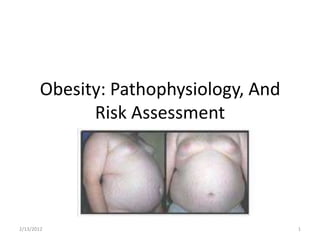
Obesity: Pathophysiology, And
              Risk Assessment


2/13/2012                               1
• Obesity:
• Excessive amount of body fat.
      – Women with > 35% body fat.
      – Men with > 25% body fat.
• Increased risk for health problems.
• Are usually overweight, but can have healthy
  Body Mass Index(BMI) and high % fat.
• BMI =weight kilograms / height meters2


2/13/2012                                        2
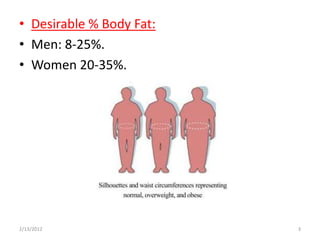
• Desirable % Body Fat:
• Men: 8-25%.
• Women 20-35%.


2/13/2012                 3
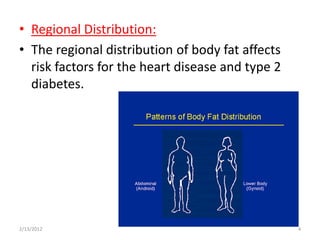
• Regional Distribution:
• The regional distribution of body fat affects
  risk factors for the heart disease and type 2
  diabetes.


2/13/2012                                         4
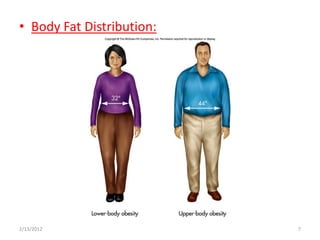
•   Body Fat Distribution: Gynoid
•   Lower-body obesity--Pear shape.
•   Encouraged by estrogen and progesterone.
•   Less health risk than upper-body obesity.
•   After menopause, upper-body obesity
    appears.


2/13/2012                                       5
• Body Fat Distribution: Android
• Upper-body obesity--apple shape.
• Associated with more heart
  disease, Hypertensiion(HTN), Type II Diabetes.
• Abdominal fat is released right into the liver.
• Encouraged by testosterone and excessive
  alcohol intake.
• Defined as waist measurement of > 40” for
  men and >35” for women.


2/13/2012                                           6
• Body Fat Distribution:


2/13/2012                  7
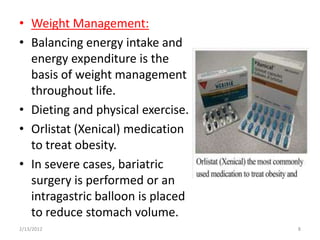
• Weight Management:
• Balancing energy intake and
  energy expenditure is the
  basis of weight management
  throughout life.
• Dieting and physical exercise.
• Orlistat (Xenical) medication
  to treat obesity.
• In severe cases, bariatric
  surgery is performed or an
  intragastric balloon is placed
  to reduce stomach volume.
2/13/2012                          8
Pathophysiology


2/13/2012                     9
• Role of Brain Neurotransmitters:
• Neurotransmitters govern the body’s response
  to starvation and dietary intake.
• Decreases in serotonin and increases in
  neuropeptide Y are associated with an
  increase in carbohydrate appetite.
• Neuropeptide Y increases during deprivation;
  may account for increase in appetite after
  dieting.


2/13/2012                                    10
• Hormonal Regulation of Body Weight:
• Norepinephrine and dopamine—released by
  sympathetic nervous system in response to
  dietary intake.
• Fasting and semistarvation lead to decreased
  levels of these neurotransmitters—more
  epinephrine is made and substrate is
  mobilized.


2/13/2012                                        11
• Hormones And Weight:
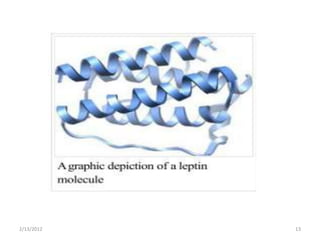
• Leptin is produced by adipose tissue to signal
  fat storage reserves in the body, and mediates
  long-term appetitive controls (i.e. to eat more
  when fat storages are low and less when fat
  storages are high).
• Ghrelin produced by the stomach modulating
  short-term appetitive control (i.e. to eat when
  the stomach is empty and to stop when the
  stomach is stretched)

2/13/2012                                       12
2/13/2012   13
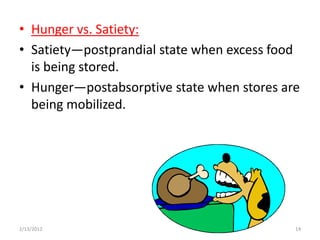
• Hunger vs. Satiety:
• Satiety—postprandial state when excess food
  is being stored.
• Hunger—postabsorptive state when stores are
  being mobilized.


2/13/2012                                   14
• Hunger vs. Satiety—contd:
• Feedback mechanism with signal from adipose
  mass when weight loss occurs—eating is the
  natural result.
• Not always identified in the elderly.
• This occurs mostly in young people.


2/13/2012                                   15
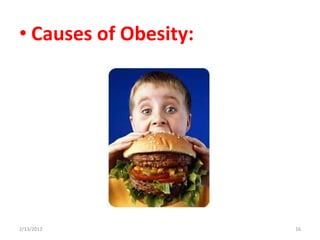
• Causes of Obesity:


2/13/2012              16
• Causes of Excessive Energy Intake:
• Active: large portion sizes, frequent meals and
  snacks.
• Passive: excessive intake of energy-dense
  foods containing hidden calories.
• Variety of options: the greater the variety of
  foods offered, the greater the intake.


2/13/2012                                       17
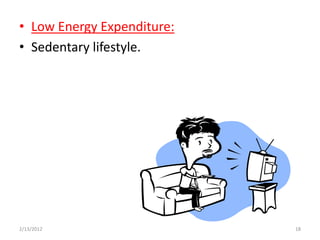
• Low Energy Expenditure:
• Sedentary lifestyle.


2/13/2012                   18
• Genetics:
• Identical twins have similar weights.
• Genes affect metabolic rate, fuel use, brain
  chemistry, body shape.
• The thrifty gene hypothesis postulates that
  due to dietary scarcity during human
  evolution people are prone to obesity.
• Thrifty metabolism gene allows for more fat
  storage to protect against famine.

2/13/2012                                        19
Genetics:
Obesity tends to run in families.
• If both parents are normal weight – 10%
  chance of obesity in offspring.
• If one parent is obese – 40% chance.
• If both parents obese – 80% chance.


2/13/2012                                   20
•   Environmental factors influence weight:
•   Overeating learned early in childhood.
•   Urging children to eat more, clean their plates.
•   Use of food as a reward.


2/13/2012                                          21
• Medical and psychiatric illness:
• Physical and mental illnesses and the
  pharmaceutical substances.
• Hypothyroidism, Cushing’s syndrome, growth
  hormone deficiency, and the eating disorders:
  Binge eating disorder and Night eating syndrome.
• Insulin, sulfonylureas, thiazolidinediones, atypical
  antipsychotics, antidepressants, steroids, certain
  anticonvulsants (phenytoin and valproate), and
  some hormonal contraception.


2/13/2012                                            22
• Obesity is a Growing Problem:
• 127 million adults in the U.S. are
  overweight, 60 million obese, and 9 million
  severely obese.
• 66 percent of U.S. adults are overweight
  (BMI≥25).
• 32 percent are obese (BMI≥30).
• 17% of children and adolescents ages 2-19 are
  overweight.


2/13/2012                                     23
• Obesity: A Major Health Issue:
• Obesity is the SECOND preventable cause of
  death and disability (smoking is #1).
• Obesity is associated with increased risk of
  heart disease, stroke, gallbladder
  disease, cancer, osteoarthritis, sleep apnea.
• Obesity-related health problems cost $75
  billion annually (2003 data).
• The public pays about $39 billion a year -- or
  about $175 per person -- for obesity through
  Medicare and Medicaid programs.

2/13/2012                                          24
• Health Problems Associated with Excess Body
  Fat:                  • Type 2 diabetes
    • Surgical risk
                            • Gallstones
    • Lung (pulmonary)
      disease
                            • Cancers
                              (breast, colon, pa
    • Sleep apnea
                              ncreas, gallbladde
    • HTN                     r)
    • CVD
                            • Infertility
    • Bone and joint
                            • Pregnancy-
      disorders
      (gout, osteoarthrit     difficult delivery
      is)
2/13/2012
                            • Reduced agility      25
• Metabolic Syndrome Criteria*:
Three or more of the following abnormalities:
• Waist circumference >102 cm (40 inches) in
  men and > 88 cm (35 inches) in women.
• Serum triglycerides of at least 150 mg/dL.
• High density lipoprotein level <40 mg/dL in
  men and <50 mg/dl in women.
• Blood pressure >=135/85 mm hg.
• Serum glucose >=110 mg/dl.
      –*Adult Treatment Panel (ATP) III Guidelines.
            National Cholesterol Education Program, 2001.
2/13/2012                                                   26
• Polycystic Ovary Syndrome (PCOS):
• Endocrine disorder characterized by
  hyperandrogenism and insulin resistance.
• Associated with android obesity.
• Affects 5-10% of reproductive age women.
• Erratic menstrual periods, chronic
  anovulations resulting in multiple ovarian
  cysts; infertility, acne, hirsutism and alopecia.
• Increased risk of heart disease, type 2
  diabetes, reproductive cancers.

2/13/2012                                         27
• Management of PCOS:
• Symptom oriented, as etiology is unclear.
• Individualized diet and exercise plan to
  promote weight loss and normalize insulin
  levels.
• Medications to alleviate symptoms.


2/13/2012                                     28
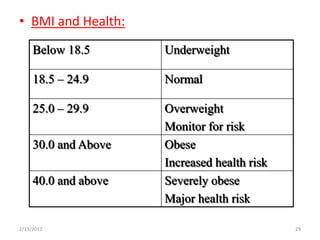
• BMI and Health:
     Below 18.5       Underweight

     18.5 – 24.9      Normal

     25.0 – 29.9      Overweight
                      Monitor for risk
     30.0 and Above   Obese
                      Increased health risk
     40.0 and above   Severely obese
                      Major health risk

2/13/2012                                     29
• REFERENCE:
• Internet: http://medicalppt.blogspot.com
• en.wikipedia.org


2/13/2012                                    30

Obesity

  • 1.
    Obesity: Pathophysiology, And Risk Assessment 2/13/2012 1
  • 2.
    • Obesity: • Excessiveamount of body fat. – Women with > 35% body fat. – Men with > 25% body fat. • Increased risk for health problems. • Are usually overweight, but can have healthy Body Mass Index(BMI) and high % fat. • BMI =weight kilograms / height meters2 2/13/2012 2
  • 3.
    • Desirable %Body Fat: • Men: 8-25%. • Women 20-35%. 2/13/2012 3
  • 4.
    • Regional Distribution: •The regional distribution of body fat affects risk factors for the heart disease and type 2 diabetes. 2/13/2012 4
  • 5.
    Body Fat Distribution: Gynoid • Lower-body obesity--Pear shape. • Encouraged by estrogen and progesterone. • Less health risk than upper-body obesity. • After menopause, upper-body obesity appears. 2/13/2012 5
  • 6.
    • Body FatDistribution: Android • Upper-body obesity--apple shape. • Associated with more heart disease, Hypertensiion(HTN), Type II Diabetes. • Abdominal fat is released right into the liver. • Encouraged by testosterone and excessive alcohol intake. • Defined as waist measurement of > 40” for men and >35” for women. 2/13/2012 6
  • 7.
    • Body FatDistribution: 2/13/2012 7
  • 8.
    • Weight Management: •Balancing energy intake and energy expenditure is the basis of weight management throughout life. • Dieting and physical exercise. • Orlistat (Xenical) medication to treat obesity. • In severe cases, bariatric surgery is performed or an intragastric balloon is placed to reduce stomach volume. 2/13/2012 8
  • 9.
  • 10.
    • Role ofBrain Neurotransmitters: • Neurotransmitters govern the body’s response to starvation and dietary intake. • Decreases in serotonin and increases in neuropeptide Y are associated with an increase in carbohydrate appetite. • Neuropeptide Y increases during deprivation; may account for increase in appetite after dieting. 2/13/2012 10
  • 11.
    • Hormonal Regulationof Body Weight: • Norepinephrine and dopamine—released by sympathetic nervous system in response to dietary intake. • Fasting and semistarvation lead to decreased levels of these neurotransmitters—more epinephrine is made and substrate is mobilized. 2/13/2012 11
  • 12.
    • Hormones AndWeight: • Leptin is produced by adipose tissue to signal fat storage reserves in the body, and mediates long-term appetitive controls (i.e. to eat more when fat storages are low and less when fat storages are high). • Ghrelin produced by the stomach modulating short-term appetitive control (i.e. to eat when the stomach is empty and to stop when the stomach is stretched) 2/13/2012 12
  • 13.
  • 14.
    • Hunger vs.Satiety: • Satiety—postprandial state when excess food is being stored. • Hunger—postabsorptive state when stores are being mobilized. 2/13/2012 14
  • 15.
    • Hunger vs.Satiety—contd: • Feedback mechanism with signal from adipose mass when weight loss occurs—eating is the natural result. • Not always identified in the elderly. • This occurs mostly in young people. 2/13/2012 15
  • 16.
    • Causes ofObesity: 2/13/2012 16
  • 17.
    • Causes ofExcessive Energy Intake: • Active: large portion sizes, frequent meals and snacks. • Passive: excessive intake of energy-dense foods containing hidden calories. • Variety of options: the greater the variety of foods offered, the greater the intake. 2/13/2012 17
  • 18.
    • Low EnergyExpenditure: • Sedentary lifestyle. 2/13/2012 18
  • 19.
    • Genetics: • Identicaltwins have similar weights. • Genes affect metabolic rate, fuel use, brain chemistry, body shape. • The thrifty gene hypothesis postulates that due to dietary scarcity during human evolution people are prone to obesity. • Thrifty metabolism gene allows for more fat storage to protect against famine. 2/13/2012 19
  • 20.
    Genetics: Obesity tends torun in families. • If both parents are normal weight – 10% chance of obesity in offspring. • If one parent is obese – 40% chance. • If both parents obese – 80% chance. 2/13/2012 20
  • 21.
    Environmental factors influence weight: • Overeating learned early in childhood. • Urging children to eat more, clean their plates. • Use of food as a reward. 2/13/2012 21
  • 22.
    • Medical andpsychiatric illness: • Physical and mental illnesses and the pharmaceutical substances. • Hypothyroidism, Cushing’s syndrome, growth hormone deficiency, and the eating disorders: Binge eating disorder and Night eating syndrome. • Insulin, sulfonylureas, thiazolidinediones, atypical antipsychotics, antidepressants, steroids, certain anticonvulsants (phenytoin and valproate), and some hormonal contraception. 2/13/2012 22
  • 23.
    • Obesity isa Growing Problem: • 127 million adults in the U.S. are overweight, 60 million obese, and 9 million severely obese. • 66 percent of U.S. adults are overweight (BMI≥25). • 32 percent are obese (BMI≥30). • 17% of children and adolescents ages 2-19 are overweight. 2/13/2012 23
  • 24.
    • Obesity: AMajor Health Issue: • Obesity is the SECOND preventable cause of death and disability (smoking is #1). • Obesity is associated with increased risk of heart disease, stroke, gallbladder disease, cancer, osteoarthritis, sleep apnea. • Obesity-related health problems cost $75 billion annually (2003 data). • The public pays about $39 billion a year -- or about $175 per person -- for obesity through Medicare and Medicaid programs. 2/13/2012 24
  • 25.
    • Health ProblemsAssociated with Excess Body Fat: • Type 2 diabetes • Surgical risk • Gallstones • Lung (pulmonary) disease • Cancers (breast, colon, pa • Sleep apnea ncreas, gallbladde • HTN r) • CVD • Infertility • Bone and joint • Pregnancy- disorders (gout, osteoarthrit difficult delivery is) 2/13/2012 • Reduced agility 25
  • 26.
    • Metabolic SyndromeCriteria*: Three or more of the following abnormalities: • Waist circumference >102 cm (40 inches) in men and > 88 cm (35 inches) in women. • Serum triglycerides of at least 150 mg/dL. • High density lipoprotein level <40 mg/dL in men and <50 mg/dl in women. • Blood pressure >=135/85 mm hg. • Serum glucose >=110 mg/dl. –*Adult Treatment Panel (ATP) III Guidelines. National Cholesterol Education Program, 2001. 2/13/2012 26
  • 27.
    • Polycystic OvarySyndrome (PCOS): • Endocrine disorder characterized by hyperandrogenism and insulin resistance. • Associated with android obesity. • Affects 5-10% of reproductive age women. • Erratic menstrual periods, chronic anovulations resulting in multiple ovarian cysts; infertility, acne, hirsutism and alopecia. • Increased risk of heart disease, type 2 diabetes, reproductive cancers. 2/13/2012 27
  • 28.
    • Management ofPCOS: • Symptom oriented, as etiology is unclear. • Individualized diet and exercise plan to promote weight loss and normalize insulin levels. • Medications to alleviate symptoms. 2/13/2012 28
  • 29.
    • BMI andHealth: Below 18.5 Underweight 18.5 – 24.9 Normal 25.0 – 29.9 Overweight Monitor for risk 30.0 and Above Obese Increased health risk 40.0 and above Severely obese Major health risk 2/13/2012 29
  • 30.
    • REFERENCE: • Internet:http://medicalppt.blogspot.com • en.wikipedia.org 2/13/2012 30