Recommendations and Tools for Healthy Eating
Nutrient density  – makes contribution to meeting several essential nutrient needs compared to energy provided Fruits, vegetables, whole grains, lean protein Energy density  – makes little contribution to meeting essential nutrient needs compared to energy provided Highly processed, high simple sugar/high fat foods
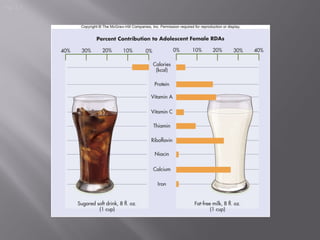
Fig. 2.1
Desirable/optimal Adequately nourished in Calories and essential nutrients Marginal/subclinical Long-term, borderline nutrient intake that only detected when a person is injured, ill or experiences physical trauma Malnutrition/undernourished Starvation, individual nutrient deficiency Overnutrition Generally characterized by excess body weight or disease due to nutrient toxicity
A = anthropometric Measuring the body – weight, height, skinfold thicknesses, circumference B = biochemical Lab test on body tissues and fluids C = clinical Search by a health professional for physical evidence of diet-related disease D = diet history E = environment assessment Living conditions, education level, ability to buy and prepare food
Fig. 2.3
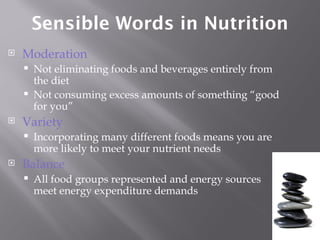
Sensible Words in Nutrition Moderation Not eliminating foods and beverages entirely from the diet Not consuming excess amounts of something “good for you” Variety Incorporating many different foods means you are more likely to meet your nutrient needs Balance All food groups represented and energy sources meet energy expenditure demands
How do we know which nutrients to eat, and how much of them?  How is our health related to the foods we eat (or don’t eat)?  What is the relationship between diet, exercise and weight balance? Where or from whom can we get good nutrition advice? Media, grandmother, neighbor, sales clerk, doctor, gym trainer?
Nutrition is fundamentally a biochemical, physiological and behavioral science Why is there so much conflicting and misleading nutrition information? Poorly designed research gives false or useless conclusions Media reports are oversimplified or sensationalized People tend to believe what they hear often, even if it is not true Results from a single study do not answer all the questions about nutrition
From observation to theory Observations about health, a nutrient, behavior, etc., lead to a  hypothesis (educated guess) Experiment tests hypothesis Results are published Further experimentation is performed to replicate findings or expand previous understanding Consistent, repeatable results are organized into a theory that explains the original observations
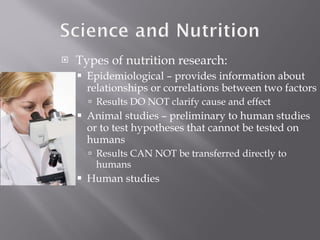
Types of nutrition research: Epidemiological – provides information about relationships or correlations between two factors Results DO NOT clarify cause and effect Animal studies – preliminary to human studies or to test hypotheses that cannot be tested on humans Results CAN NOT be transferred directly to humans Human studies
Human studies Clinical trials – controlled studies with an  experimental group  and a  control group   The control group typically receive a  placebo  which is an imitation treatment (“sugar pill”), so all subjects are “blinded” to who receives treatment Double-blind study Neither the subjects nor the researchers know which group receives the treatment
Dietary Guidelines USDA recommendations – includes messages on: Reduce sodium, total and saturated fat, limit simple sugar intake Increase whole grains (half of grain intake should be whole), fruit and vegetable intake Moderation in alcohol intake (if at all) Increase physical activity Keep foods safe to eat during preparation and storage
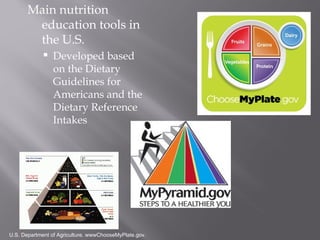
Main nutrition education tools in the U.S. Developed based on the Dietary Guidelines for Americans and the Dietary Reference Intakes U.S. Department of Agriculture. wwwChooseMyPlate.gov.
MyPlate.gov U.S. Department of Agriculture. wwwChooseMyPlate.gov. Balancing Calories   ● Enjoy your food, but eat less.   ● Avoid oversized portions.     Foods to Increase   ● Make half your plate fruits and vegetables.   ● Make at least half your grains whole grains.   ● Switch to fat-free or low-fat (1%) milk.     Foods to Reduce   ● Compare sodium in foods like soup, bread, and frozen meals  ―  and choose the foods with lower numbers.   ● Drink water instead of sugary drinks.
Recommendations for nutrients based on age, gender, lifestage EAR = Estimated Average Requirement RDA = Recommended Dietary Allowance AI = Adequate Intake UL = Tolerable Upper Level Related intake value: DV = Daily Value - based on RDAs for a   2000 kcal diet
Food Labels Practical tool to evaluate the place a food can have in your healthy diet DV = Daily Value Based on a 2000 Calorie diet, rough guide, used on food labels Not the same as DRI values, but close enough for estimates
Fig. 2.12
Health Claims on Food Labels FDA only approves health claims that have strong scientific evidence Specific rules for use Sample health claims: Calcium, vitamin D and osteoporosis Dietary fat and cancer Noncariogenic carbohydrate sweeteners and dental caries (cavities) Saturated fat, cholesterol and  trans  fat and heart disease Fiber and cancer

Nutrition guidelines ch2

  • 1.
    Recommendations and Toolsfor Healthy Eating
  • 2.
    Nutrient density – makes contribution to meeting several essential nutrient needs compared to energy provided Fruits, vegetables, whole grains, lean protein Energy density – makes little contribution to meeting essential nutrient needs compared to energy provided Highly processed, high simple sugar/high fat foods
  • 3.
  • 4.
    Desirable/optimal Adequately nourishedin Calories and essential nutrients Marginal/subclinical Long-term, borderline nutrient intake that only detected when a person is injured, ill or experiences physical trauma Malnutrition/undernourished Starvation, individual nutrient deficiency Overnutrition Generally characterized by excess body weight or disease due to nutrient toxicity
  • 5.
    A = anthropometricMeasuring the body – weight, height, skinfold thicknesses, circumference B = biochemical Lab test on body tissues and fluids C = clinical Search by a health professional for physical evidence of diet-related disease D = diet history E = environment assessment Living conditions, education level, ability to buy and prepare food
  • 6.
  • 7.
    Sensible Words inNutrition Moderation Not eliminating foods and beverages entirely from the diet Not consuming excess amounts of something “good for you” Variety Incorporating many different foods means you are more likely to meet your nutrient needs Balance All food groups represented and energy sources meet energy expenditure demands
  • 8.
    How do weknow which nutrients to eat, and how much of them? How is our health related to the foods we eat (or don’t eat)? What is the relationship between diet, exercise and weight balance? Where or from whom can we get good nutrition advice? Media, grandmother, neighbor, sales clerk, doctor, gym trainer?
  • 9.
    Nutrition is fundamentallya biochemical, physiological and behavioral science Why is there so much conflicting and misleading nutrition information? Poorly designed research gives false or useless conclusions Media reports are oversimplified or sensationalized People tend to believe what they hear often, even if it is not true Results from a single study do not answer all the questions about nutrition
  • 10.
    From observation totheory Observations about health, a nutrient, behavior, etc., lead to a hypothesis (educated guess) Experiment tests hypothesis Results are published Further experimentation is performed to replicate findings or expand previous understanding Consistent, repeatable results are organized into a theory that explains the original observations
  • 11.
    Types of nutritionresearch: Epidemiological – provides information about relationships or correlations between two factors Results DO NOT clarify cause and effect Animal studies – preliminary to human studies or to test hypotheses that cannot be tested on humans Results CAN NOT be transferred directly to humans Human studies
  • 12.
    Human studies Clinicaltrials – controlled studies with an experimental group and a control group The control group typically receive a placebo which is an imitation treatment (“sugar pill”), so all subjects are “blinded” to who receives treatment Double-blind study Neither the subjects nor the researchers know which group receives the treatment
  • 13.
    Dietary Guidelines USDArecommendations – includes messages on: Reduce sodium, total and saturated fat, limit simple sugar intake Increase whole grains (half of grain intake should be whole), fruit and vegetable intake Moderation in alcohol intake (if at all) Increase physical activity Keep foods safe to eat during preparation and storage
  • 14.
    Main nutrition educationtools in the U.S. Developed based on the Dietary Guidelines for Americans and the Dietary Reference Intakes U.S. Department of Agriculture. wwwChooseMyPlate.gov.
  • 15.
    MyPlate.gov U.S. Departmentof Agriculture. wwwChooseMyPlate.gov. Balancing Calories   ● Enjoy your food, but eat less.   ● Avoid oversized portions.     Foods to Increase   ● Make half your plate fruits and vegetables.   ● Make at least half your grains whole grains.   ● Switch to fat-free or low-fat (1%) milk.     Foods to Reduce   ● Compare sodium in foods like soup, bread, and frozen meals ― and choose the foods with lower numbers.   ● Drink water instead of sugary drinks.
  • 16.
    Recommendations for nutrientsbased on age, gender, lifestage EAR = Estimated Average Requirement RDA = Recommended Dietary Allowance AI = Adequate Intake UL = Tolerable Upper Level Related intake value: DV = Daily Value - based on RDAs for a 2000 kcal diet
  • 17.
    Food Labels Practicaltool to evaluate the place a food can have in your healthy diet DV = Daily Value Based on a 2000 Calorie diet, rough guide, used on food labels Not the same as DRI values, but close enough for estimates
  • 18.
  • 19.
    Health Claims onFood Labels FDA only approves health claims that have strong scientific evidence Specific rules for use Sample health claims: Calcium, vitamin D and osteoporosis Dietary fat and cancer Noncariogenic carbohydrate sweeteners and dental caries (cavities) Saturated fat, cholesterol and trans fat and heart disease Fiber and cancer