 Overweight is defined as 1-19% above one’s ideal weight
    Obese is defined as above 19% one’s ideal weight
  Also can be defined in terms of total body fat content
Many health risks associated

 Diabetes
                    
 Heart disease
 Dyslipidemia (high blood cholesterol)
 Sleep apnea and breathing problems
 Cancer
 Depression
 Hypertension (high blood pressure)
Body Image

                        for You
Determining the Right Weight
  • Reference Table 10.1 for Healthy Weight
    Ranges
•Based on
   Body structure
   Height
   Distribution of weight
   Ratio of lean tissue to body fat
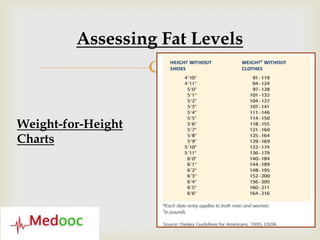
Assessing Fat Levels
                    

Weight-for-Height
Charts
Body Image

Weight tables give acceptable ranges
                                     
    Low end of range for low ratio of lean mass to fat mass
    High end of range for more muscular body
“Ideal” body composition
    Men’s range is 11-15%
    Women’s range is 18-22%
 Lean body mass consists of muscle, bone, body water,
  cellular elements and organs
 Body fats are essential or stored fats
    Essential fats for physiological functions
       3-15% of total body weight
       Storage fat is remainder of body fat
Assessing Fat Levels
Body Mass Index               
    Index of the relationship between height and weight
    BMI of 19-25 indicates healthy weight
    Does have limitations
      Very muscular people may fall into overweight category
      “Underweight” people may be in healthy weight category yet too
       thin

 Waist-to-Hip Ratio
   A measure of regional fat distribution
   Excess fat in abdominals is health risk
        High blood pressure
        Diabetes
        Heart disease
        Certain cancers
Assessing Fat Levels
                            
 Waist-to-Hip Ratio (continued)
   Men and postmenopausal women store fat in upper region:
    abdominals, arms and chest
   Premenopausal women store fat in lower region: hips,
    buttocks and thighs
   A waistline greater than 40 inches for men and 35 inches for
    women may indicate health risk
Measures of Body Fat
   Hydrostatic Weighing Technique
   Pinch and Skinfold Measure
   Girth and Circumference Measure
   Soft-Tissue Roentgenogram
   Bioelectrical Impedance Analysis
   Total Body Electrical Conductivity
Risk Factors for Obesity
Key Environmental Factors
  
     Increased energy intake:
                                          
      Most common nutritional disorder in the U.S.

         Bombarded with advertising
         Changes in working families
         Bottle feeding
     Decreased energy expenditure:
         Increased sedentary nature of many jobs
         TV and video games, automated equipment
Heredity
     Body type and genes
         Genes may set metabolic rates
     Obesity genes
         Ob gene, leptin, GLP-1
Hunger, Appetite, and Satiety
     Hunger is physiological response to nutritional need
     Appetite is psychological response tied to emotional reaction, not nutritional need
Risk Factors for Obesity
                           
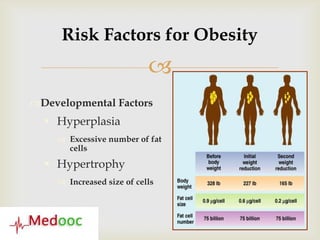
Developmental Factors
   Hyperplasia
     Excessive number of fat
      cells
   Hypertrophy
     Increased size of cells
Managing Your Weight
 What is a Calorie?
    

    
                                          
        The calorie, or gram calorie, is the quantity of heat required to raise the
        temperature of 1 gram of pure water 1°C.
        Unit of measure of the amount of energy obtained from food
       One pound of fat = 3,500 calories
 Exercise
       Resting Metabolic Rate-90% of calories burned
       Exercising Metabolic Rate-other 10%
 Changing Your Eating Habits
       What triggers eating?
       Changing Your Triggers, see Skills for Behavior Change, p. 271
 Selecting a Nutritional Plan
       Set realistic, attainable goals
       Seek help from reputable sources
       Successful plans allow good food choices without sacrificing everything
Managing Your Weight
Changing Your Eating Habits
     What triggers eating?        
     Changing Your Triggers, see Skills for Behavior Change, p. 271
Selecting a Nutritional Plan
     Set realistic, attainable goals
     Seek help from reputable sources
     Successful plans allow good food choices without sacrificing
      everything
Trying to Gain Weight
     Control exercise
     Eat more calories
     Supplement your diet
     Relax
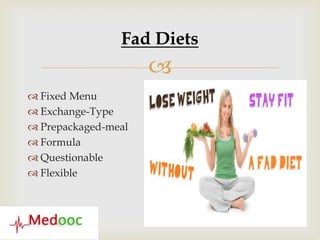
Fad Diets
                     
 Fixed Menu
 Exchange-Type
 Prepackaged-meal
 Formula
 Questionable
 Flexible
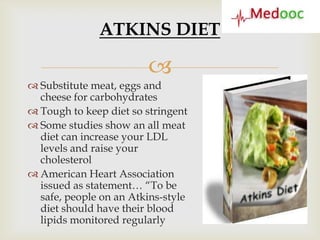
ATKINS DIET

                        
 Substitute meat, eggs and
  cheese for carbohydrates
 Tough to keep diet so stringent
 Some studies show an all meat
  diet can increase your LDL
  levels and raise your
  cholesterol
 American Heart Association
  issued as statement… “To be
  safe, people on an Atkins-style
  diet should have their blood
  lipids monitored regularly
CABBAGE SOUP DIET
 Cabbage soup has fat burning qualities.
 Claims you can loose 10 lbs in a week
                          
 HOW? As much water as you want!
Day 1: Cabbage soup plus as much fruit as you would like.
Day 2: Cabbage soup plus vegetables including 2 jacket
   potato with a little butter.
Day 3: Cabbage soup plus fruit and veggies excluding
   potatoes and bananas
Day 4: Cabbage soup plus up to eight bananas and as much
   skimmed milk as you like
Day 5: Cabbage soup plus up to 20 ounces of beef and up to
   6 tomatoes
Day 6: Cabbage soup plus as much beef and vegetables
(excluding potatoes) as you like.
Day 7: Cabbage soup plus brown rice, vegetables and
   unsweetened fruit juice.
 Short Term weight loss. (Weight loss from water, muscle
   tissue not fat reserves.)
 Starvation diet…
Eating Disorders

                            
Anorexia Nervosa
   Self-starvation
   Intense fear of fat
Bulimia Nervosa
   Binge and then take inappropriate measures to lose calories
   3% of adolescent and young females
Bulimia Nervosa (continued)
   Males 1 for every 10 females
   Often at normal weight
Binge Eating Disorder
   Often clinically obese
   Eat excessive amounts without purging
Eating Disorders
                          
Treatments for Eating Disorders
   Goal is to stabilize the patient’s life
   Long-term therapy
   Multidimensional approach
      Psychological, social, environmental, and
       physiological factors

Weight loss

  • 1.
     Overweight isdefined as 1-19% above one’s ideal weight  Obese is defined as above 19% one’s ideal weight  Also can be defined in terms of total body fat content
  • 2.
    Many health risksassociated  Diabetes   Heart disease  Dyslipidemia (high blood cholesterol)  Sleep apnea and breathing problems  Cancer  Depression  Hypertension (high blood pressure)
  • 3.
    Body Image  for You Determining the Right Weight • Reference Table 10.1 for Healthy Weight Ranges •Based on  Body structure  Height  Distribution of weight  Ratio of lean tissue to body fat
  • 4.
    Assessing Fat Levels  Weight-for-Height Charts
  • 5.
    Body Image Weight tablesgive acceptable ranges   Low end of range for low ratio of lean mass to fat mass  High end of range for more muscular body “Ideal” body composition  Men’s range is 11-15%  Women’s range is 18-22%  Lean body mass consists of muscle, bone, body water, cellular elements and organs  Body fats are essential or stored fats  Essential fats for physiological functions  3-15% of total body weight  Storage fat is remainder of body fat
  • 6.
    Assessing Fat Levels BodyMass Index   Index of the relationship between height and weight  BMI of 19-25 indicates healthy weight  Does have limitations  Very muscular people may fall into overweight category  “Underweight” people may be in healthy weight category yet too thin  Waist-to-Hip Ratio  A measure of regional fat distribution  Excess fat in abdominals is health risk  High blood pressure  Diabetes  Heart disease  Certain cancers
  • 7.
    Assessing Fat Levels   Waist-to-Hip Ratio (continued)  Men and postmenopausal women store fat in upper region: abdominals, arms and chest  Premenopausal women store fat in lower region: hips, buttocks and thighs  A waistline greater than 40 inches for men and 35 inches for women may indicate health risk Measures of Body Fat  Hydrostatic Weighing Technique  Pinch and Skinfold Measure  Girth and Circumference Measure  Soft-Tissue Roentgenogram  Bioelectrical Impedance Analysis  Total Body Electrical Conductivity
  • 8.
    Risk Factors forObesity Key Environmental Factors   Increased energy intake:  Most common nutritional disorder in the U.S.  Bombarded with advertising  Changes in working families  Bottle feeding  Decreased energy expenditure:  Increased sedentary nature of many jobs  TV and video games, automated equipment Heredity  Body type and genes  Genes may set metabolic rates  Obesity genes  Ob gene, leptin, GLP-1 Hunger, Appetite, and Satiety  Hunger is physiological response to nutritional need  Appetite is psychological response tied to emotional reaction, not nutritional need
  • 9.
    Risk Factors forObesity  Developmental Factors  Hyperplasia  Excessive number of fat cells  Hypertrophy  Increased size of cells
  • 10.
    Managing Your Weight What is a Calorie?    The calorie, or gram calorie, is the quantity of heat required to raise the temperature of 1 gram of pure water 1°C. Unit of measure of the amount of energy obtained from food  One pound of fat = 3,500 calories Exercise  Resting Metabolic Rate-90% of calories burned  Exercising Metabolic Rate-other 10% Changing Your Eating Habits  What triggers eating?  Changing Your Triggers, see Skills for Behavior Change, p. 271 Selecting a Nutritional Plan  Set realistic, attainable goals  Seek help from reputable sources  Successful plans allow good food choices without sacrificing everything
  • 11.
    Managing Your Weight ChangingYour Eating Habits  What triggers eating?   Changing Your Triggers, see Skills for Behavior Change, p. 271 Selecting a Nutritional Plan  Set realistic, attainable goals  Seek help from reputable sources  Successful plans allow good food choices without sacrificing everything Trying to Gain Weight  Control exercise  Eat more calories  Supplement your diet  Relax
  • 12.
    Fad Diets   Fixed Menu  Exchange-Type  Prepackaged-meal  Formula  Questionable  Flexible
  • 13.
    ATKINS DIET   Substitute meat, eggs and cheese for carbohydrates  Tough to keep diet so stringent  Some studies show an all meat diet can increase your LDL levels and raise your cholesterol  American Heart Association issued as statement… “To be safe, people on an Atkins-style diet should have their blood lipids monitored regularly
  • 14.
    CABBAGE SOUP DIET Cabbage soup has fat burning qualities.  Claims you can loose 10 lbs in a week   HOW? As much water as you want! Day 1: Cabbage soup plus as much fruit as you would like. Day 2: Cabbage soup plus vegetables including 2 jacket potato with a little butter. Day 3: Cabbage soup plus fruit and veggies excluding potatoes and bananas Day 4: Cabbage soup plus up to eight bananas and as much skimmed milk as you like Day 5: Cabbage soup plus up to 20 ounces of beef and up to 6 tomatoes Day 6: Cabbage soup plus as much beef and vegetables (excluding potatoes) as you like. Day 7: Cabbage soup plus brown rice, vegetables and unsweetened fruit juice.  Short Term weight loss. (Weight loss from water, muscle tissue not fat reserves.)  Starvation diet…
  • 15.
    Eating Disorders  Anorexia Nervosa  Self-starvation  Intense fear of fat Bulimia Nervosa  Binge and then take inappropriate measures to lose calories  3% of adolescent and young females Bulimia Nervosa (continued)  Males 1 for every 10 females  Often at normal weight Binge Eating Disorder  Often clinically obese  Eat excessive amounts without purging
  • 16.
    Eating Disorders  Treatments for Eating Disorders  Goal is to stabilize the patient’s life  Long-term therapy  Multidimensional approach  Psychological, social, environmental, and physiological factors