Physical Fitness can be defined as:
“the ability to carry out daily tasks (work and play) with vigour and
alertness, without undue fatigue and with ample reserve energy to
enjoy leisure time pursuits and to meet unforeseen emergencies.”
Physical fitness is an individual matter related to the
specific needs of each individual, their
strengths, weaknesses and interests and the
requirements of their chosen sport. Since all of these
factors can change, fitness should not be seen as a
static thing.
•cardio-respiratory, or endurance / aerobic power
•muscular strength
•local muscular endurance
•anaerobic power
•flexibility
•body composition.
The following are additional components that are
motor-skill related:
•speed
•muscular power
•agility
•coordination
•balance
•reaction time
Rarely in sport are fitness components utilised in isolation.
It is the interaction of a number of components that
produces the performance

•muscular power, for instance, depends upon muscular
strength and speed

•agility could be said to be a combination of
power, speed, flexibility, balance, coordination and
reaction time

•local muscular endurance depends on strength
Cardio-respiratory endurance is also commonly called
•circulo-respiratory endurance
•aerobic endurance
•aerobic capacity
•aerobic power.

This is the ability of the heart, lungs and blood vessels to deliver oxygen and
nutrients to the tissues of the body and to remove waste products such as
carbon dioxide. In this way energy is made available to the working muscles.

Cardio-respiratory endurance is most evident
•at rest;
•during sustained activity involving the whole body, such as
running, swimming and cycling long distances; and during recovery.
•It is the most essential physical fitness component, evident in everyday
activities and in most team sports. Most of the benefits attributable to
improved physical fitness are in fact due to increased cardio-respiratory
endurance.
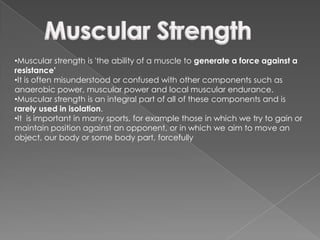
•Muscular strength is 'the ability of a muscle to generate a force against a
resistance'
•It is often misunderstood or confused with other components such as
anaerobic power, muscular power and local muscular endurance.
•Muscular strength is an integral part of all of these components and is
rarely used in isolation.
•It is important in many sports, for example those in which we try to gain or
maintain position against an opponent, or in which we aim to move an
object, our body or some body part, forcefully
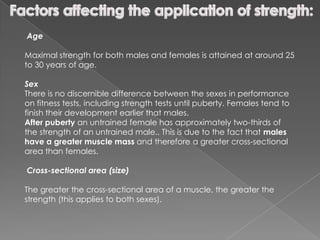
Age

Maximal strength for both males and females is attained at around 25
to 30 years of age.

Sex
There is no discernible difference between the sexes in performance
on fitness tests, including strength tests until puberty. Females tend to
finish their development earlier that males.
After puberty an untrained female has approximately two-thirds of
the strength of an untrained male.. This is due to the fact that males
have a greater muscle mass and therefore a greater cross-sectional
area than females.

Cross-sectional area (size)

The greater the cross-sectional area of a muscle, the greater the
strength (this applies to both sexes).
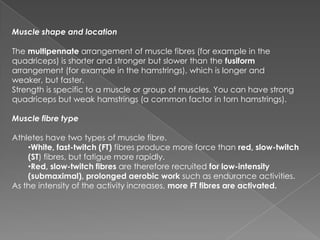
Muscle shape and location

The multipennate arrangement of muscle fibres (for example in the
quadriceps) is shorter and stronger but slower than the fusiform
arrangement (for example in the hamstrings), which is longer and
weaker, but faster.
Strength is specific to a muscle or group of muscles. You can have strong
quadriceps but weak hamstrings (a common factor in torn hamstrings).

Muscle fibre type

Athletes have two types of muscle fibre.
    •White, fast-twitch (FT) fibres produce more force than red, slow-twitch
    (ST) fibres, but fatigue more rapidly.
    •Red, slow-twitch fibres are therefore recruited for low-intensity
    (submaximal), prolonged aerobic work such as endurance activities.
As the intensity of the activity increases, more FT fibres are activated.

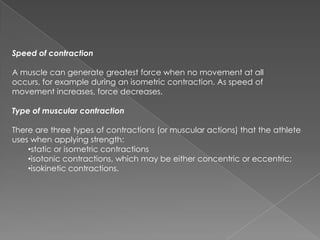
Speed of contraction

A muscle can generate greatest force when no movement at all
occurs, for example during an isometric contraction. As speed of
movement increases, force decreases.

Type of muscular contraction

There are three types of contractions (or muscular actions) that the athlete
uses when applying strength:
    •static or isometric contractions
    •isotonic contractions, which may be either concentric or eccentric;
    •isokinetic contractions.
The ability of a muscle or group of muscles to sustain an activity for a short
time in the face of considerable local fatigue is known as local muscular
endurance.

Local muscular endurance tasks such as push-ups, sit-ups and chin-ups
require additional anaerobic energy to that supplied aerobically.
    •This is because the pressure of the contracting muscles causes almost
    complete occlusion (blocking) of the blood vessels that supply the
    muscle tissue.
    •Since oxygen cannot be provided to the working muscles (even at
    submaximal levels) the muscles are dependent upon the sources of
    energy immediately available within the muscle itself, ATP and creatine
    phosphate (phosphocreatine), and subsequently, the breakdown of
    glycogen anaerobically.

The exact factors limiting the duration of local muscular endurance are not
fully understood, but recent research suggests that the accumulation of
fatigue causing lactic acid is the most likely cause (rather than the
depletion of anaerobic energy stores, the phosphagens ATP and PC).
Age

Older men and women fatigue more rapidly than their younger
counterparts, although the loss of endurance is less than might be
expected.
Sex

There is no significant difference in muscular endurance due to sex, if the
strength factor is ruled out (or equal).
Circulation

Improved peripheral circulation due to increased quantities of blood
vessels in active muscle tissue as a result of training is one of the most
important factors in the development of muscular endurance.

Tolerance of lactic acid

The degree to which an athlete can tolerate high levels of lactic acid in
her muscles appears to be the most significant factor in limiting
performance in local muscular endurance activities.
Anaerobic power refers to the ability to produce energy without using
oxygen.

The efficiency of the ATP-PC and Lactic Acid systems is therefore a central
factor in anaerobic power.
The greater the efficiency of these anaerobic pathways, the greater the
athlete's anaerobic power.
Speed refers to the ability to move the whole body or a body part from one
point to another in the shortest possible time.

    •This typically occurs when the athlete is participating in an activity of
    short duration and high intensity, which therefore utilises the anaerobic
    pathways.
    •It is characterised by activities such as sprinting; the run-up in long
    jump, triple jump and javelin in athletics; speed skating and the run-up
    to vault in gymnastics. An exchange of volleys in tennis and a slips catch
    from a fast bowler in cricket could also be regarded as speed activities.
    •It will ultimately be limited by the capacity of her anaerobic energy
    systems (anaerobic power)

Speed and genetics :
•the size of bones
•angle of joints;
•the position of attachments of ligaments and tendons
•the proportion of white, fast-twitch fibres
              •the more white, fast- twitch muscle fibres, the greater the
              potential for speed
Flexibility refers to the range of possible movement about a joint or
sequence of joints.
•It is the ability to move your joints, to bend, stretch and twist body parts
readily.
•Flexibility has important implications for injury prevention, freedom of
movement and aesthetic appearance.
•Flexibility can be either static or dynamic.
       •Dynamic (or active) flexibility is concerned with how easily a limb can
       be moved through its range of motions when executing a skill, for
       example, the arm action in backstroke, or the follow-through when
       kicking a ball.
       •Static flexibility is concerned with determining one's ability to move a
       joint to its maximum range of motions, for example, when doing the
       splits. The position, once attained, is held static.
•A certain degree of flexibility is desirable, but the degree is dependent
upon the type of activity undertaken. Swimmers, for example, require a level
of flexibility in the wrist and ankle joints that could prove undesirable for a
footballer, who requires these joints to be quite stable.
•Flexibility, along with body composition and strength, is one of the most
readily modified components of fitness.
Joint structure
The more stable the joint, the greater the strength but the less movement or flexibility it
allows.
     The ball and socket joint of the hip, for example, is more stable than the shoulder
     joint but allows less movement.

Length of muscles at rest
 Muscles tend to shorten, with a corresponding loss of flexibility about the associated
joints, if they are at rest (not exercised) for extended periods of time, for example due to
a sedentary lifestyle.

Age
Almost from birth, and progressively as we age, we lose flexibility

Sex
Females tend to be more flexible than males due to hormonal differences resulting
in, for example, less muscle bulk.

Body build
Excessive adipose (fat) tissue or muscle bulk may limit an individual's flexibility.

Disease
 Diseases such as arthritis (causing prolonged inactivity or malformed bones and joints)
result in reduced flexibility.
Muscular power is 'the ability to exert a “maximal" contraction in one
explosive act'.
•It is dependent upon the interaction of two other components of
fitness, strength and speed.

•A muscle that contracts very quickly has insufficient time to develop
maximum force, whereas a very forceful contraction takes time, resulting in
slow movement.

•Muscular power is exemplified by 'explosive' activities such as the shot
put, discus, hammer-throw and jumping events in athletics; the rebound in
basketball; the leap of a dancer.

•The energy for muscular power is provided anaerobically via the ATP-PC
system.
Agility is 'the ability to change direction accurately and quickly while moving
rapidly'
•It is a composite of a number of components including
power, speed, flexibility, balance and coordination.
•Is characterised by activities such as dodging, baulking, weaving and
recovery in team games like basketball and football and the ability to change
direction quickly in games like squash and tennis.


Coordination is the smooth flow of movement in the execution of a physical
task.
•It is often considered to be the common denominator of all the skill-related
components of fitness.
•It involves the nervous system and the skeletal-muscular system working
harmoniously in hand-eye and foot-eye coordination activities such as the
timing of the ball-toss and racquet-swing in tennis; the lay-up in basketball; the
spike in volleyball and ball control with the foot in soccer.
•It is also exemplified by the integration of the arm and leg action in
breaststroke.
Balance can be defined as the ability to maintain the equilibrium of the
body.

•Static balance involves maintaining the equilibrium in one fixed
position, for example, a held position on the balance beam or parallel
bars in gymnastics.

•Dynamic balance involves maintaining the equilibrium while moving, for
example walking, rolling or leaping on the balance beam or swinging on
the parallel bars; water-skiing; horse riding; skateboarding or in-line
skating.

•Balance is an essential element of most sports, but physical fitness gains
can be achieved without appreciable improvements in balance beyond
the 'normal' range.
Reaction time refers to the athlete's ability to process information via
the nervous system and react.
•It involves the time it takes for the brain to
      •receive information from the senses (particularly the eyes and
      ears),
      •process the information,
      •formulate a response
      •and transmit this response to the motor units (nerves and
      connected muscle fibres) and for the muscles to contract (the
      reaction).

•An example would be the time delay between the starter's gun going
off in a sprint race and the athlete actually blasting out of the blocks.
Body composition:
This is a measure of how much of your body is made up of muscle
compared with how much is made up of fat. It is important to have a
good balance of the two but sports players usually have a greater
proportion of muscle.

Some sports performers, such as rowers, require a large muscle mass to
give them lots of power and strength, but others, such as marathon
runners, require a lower muscle mass so that they don’t have to carry
‘extra’ body mass as they are running. Some sports performers, such as
sumo wrestlers, even require quite a large mass of body fat to be
successful.

Everyone is born with a predisposition to a particular body
composition, although small changes can be made by varying your diet
and the amount/type of exercise that you take part in. The important
thing is to have the correct body composition for your sport
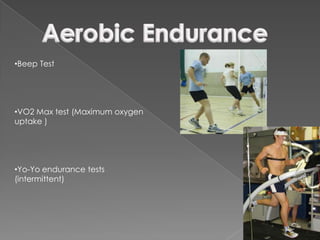
•Beep Test


•VO2 Max test (Maximum oxygen
uptake )


•Yo-Yo endurance tests
(intermittent)
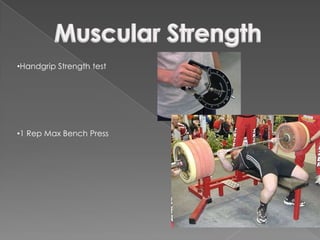
•Handgrip Strength test


•1 Rep Max Bench Press
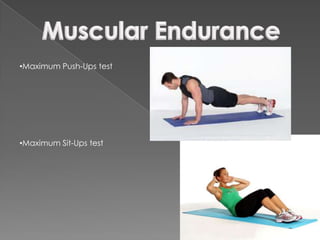
•Maximum Push-Ups test


•Maximum Sit-Ups test
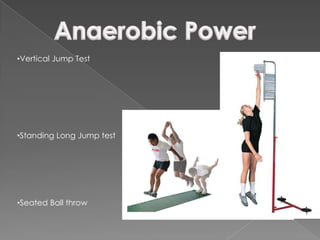
•Vertical Jump Test


•Standing Long Jump test


•Seated Ball throw
•20/30/40/50/60 meter Sprint tests
•Seated Medicine ball throw
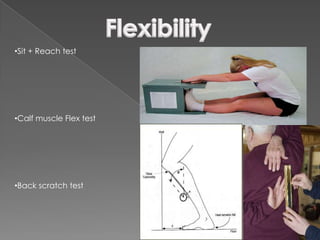
•Sit + Reach test


•Calf muscle Flex test


•Back scratch test
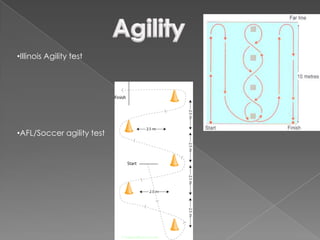
•Illinois Agility test


•AFL/Soccer agility test
•Wall toss and catch test


•Opposite hand throw test
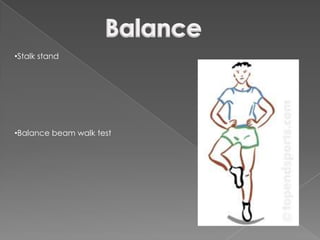
•Stalk stand


•Balance beam walk test
Information processing test
•Skin folds test


•Body weight


•BMI test


•Girth Measurements
Most people take part in weight training in order to increase
their strength. Other reasons include improving muscle tone or muscle
size.

Most forms of weight training are:

Isotonic

Or

Isometric
Isotonic training

Isotonic training means the muscles contract and shorten to produce
movement. Examples include a push-up or squat


Advantages -
•Strengthens the muscle throughout the range of motion
•Can be adapted easily to suit different sports

Disadvantages -
•Muscle soreness after exercise because of the high stress levels
•Muscles gain the most strength when they're at their weakest point of
action
Isometric training

Isometric training means muscles contract but there is no movement at
the muscle or joint. For example the wall sit exercise (stand with your back
to a wall and bend the knees into a squat position and hold).

Advantages -
• Develops static strength
•Inexpensive and easy to perform nearly anywhere as little equipment is
required

Disadvantages -
•Muscles gain most strength at the angle used in exercise
•Avoid if you have heart problems as they cause a rise in blood pressure
due to a drop in blood flow to the muscle during this contraction.
The following types of exercise are good for improving your cardiovascular
endurance:


•Continuous training

•Interval Training

•Fartlek training

•Circuit training
Continuous training
This type of exercise is, as the name suggests, continuous! Rests are not
allowed. To achieve this you must exercise at a constant rate which is
within your aerobic training zone (60-80% max heart rate). Continuous
training should last for bouts of at least 20 minutes (when starting) up to
2 hours or more! (think of a marathon!)

Advantages -
•Needs only a small amount of easy to use, accessible equipment, if
any
•Good for aerobic fitness
•Good for losing weight

Disadvantages -
•can be boring
•Doesn't improve anaerobic fitness so isn't as good for team games like
football or hockey which involve short bursts of speed
Interval training
Intervals are periods of exercising hard, with rest or low intensity periods
inbetween. For example you may run 100 meters at 85% and then 200 at
50% to recover. This is one rep. You may perform this 5-10 times, which
would complete the set.

Advantages -
•Can mix aerobic and anaerobic exercise which replicates team games
•It makes it easier for a coach to see when the athlete isn't trying

Disadvantages -
•It can be hard to keep going when you start to fatigue
•Can become boring
Fartlek training
Fartlek involves training at a continuous exercise, but varying the intensity
and type of exercise. For example, a running session could include
sprinting for 10 seconds, fast walking for 20 seconds, jogging for 1 minute
and repeating this. You can also add in things like running uphill or on
sand.

Advantages -
• Good for sports which require changes in pace
•Easily adapted to suit the individuals level of fitness and sport

Disadvantages -
•Too easy to skip the hard bits
•Can be difficult to see how hard someone is trying!
Circuit training
Circuits can be used to increase either strength, aerobic fitness or both!
There are usually between 8 and 15 stations and at each one you do a
different exercise for 1 minute. At the end you then move on to the next
station. Rest can be incorporated depending on the level of the
participants.

Advantages -
•Less boring because it changes all the time
•Can be easily adapted for strength or endurance or different sports etc

Disadvantages -
•Takes a while to set up
•Takes a lot of equipment
•Plyometric training can be used to develop fast twitch muscle fibres
(WHITE) so that you can get power particularly in the legs.

• It’s based on the idea that a shortening muscular contraction is much
stronger if it immediately follows a lengthening contraction of the same
muscle.

•Muscle fibres transfer energy more quickly and powerfully when they
move in this way. It’s like stretching fully a coiled spring and then letting
it go; energy is released rapidly as the spring recoils.

•Individuals can use activities such as hopping, depth jumping and
bounding.

•Pylometric training should be implemented under supervision, since the
technique and strength necessary to do the activities is broken by
periods of rest to minimize injury.

Fitness components/training/testing methods

  • 2.
    Physical Fitness canbe defined as: “the ability to carry out daily tasks (work and play) with vigour and alertness, without undue fatigue and with ample reserve energy to enjoy leisure time pursuits and to meet unforeseen emergencies.”
  • 3.
    Physical fitness isan individual matter related to the specific needs of each individual, their strengths, weaknesses and interests and the requirements of their chosen sport. Since all of these factors can change, fitness should not be seen as a static thing.
  • 4.
    •cardio-respiratory, or endurance/ aerobic power •muscular strength •local muscular endurance •anaerobic power •flexibility •body composition.
  • 5.
    The following areadditional components that are motor-skill related: •speed •muscular power •agility •coordination •balance •reaction time
  • 6.
    Rarely in sportare fitness components utilised in isolation. It is the interaction of a number of components that produces the performance •muscular power, for instance, depends upon muscular strength and speed •agility could be said to be a combination of power, speed, flexibility, balance, coordination and reaction time •local muscular endurance depends on strength
  • 8.
    Cardio-respiratory endurance isalso commonly called •circulo-respiratory endurance •aerobic endurance •aerobic capacity •aerobic power. This is the ability of the heart, lungs and blood vessels to deliver oxygen and nutrients to the tissues of the body and to remove waste products such as carbon dioxide. In this way energy is made available to the working muscles. Cardio-respiratory endurance is most evident •at rest; •during sustained activity involving the whole body, such as running, swimming and cycling long distances; and during recovery. •It is the most essential physical fitness component, evident in everyday activities and in most team sports. Most of the benefits attributable to improved physical fitness are in fact due to increased cardio-respiratory endurance.
  • 9.
    •Muscular strength is'the ability of a muscle to generate a force against a resistance' •It is often misunderstood or confused with other components such as anaerobic power, muscular power and local muscular endurance. •Muscular strength is an integral part of all of these components and is rarely used in isolation. •It is important in many sports, for example those in which we try to gain or maintain position against an opponent, or in which we aim to move an object, our body or some body part, forcefully
  • 10.
    Age Maximal strength forboth males and females is attained at around 25 to 30 years of age. Sex There is no discernible difference between the sexes in performance on fitness tests, including strength tests until puberty. Females tend to finish their development earlier that males. After puberty an untrained female has approximately two-thirds of the strength of an untrained male.. This is due to the fact that males have a greater muscle mass and therefore a greater cross-sectional area than females. Cross-sectional area (size) The greater the cross-sectional area of a muscle, the greater the strength (this applies to both sexes).
  • 11.
    Muscle shape andlocation The multipennate arrangement of muscle fibres (for example in the quadriceps) is shorter and stronger but slower than the fusiform arrangement (for example in the hamstrings), which is longer and weaker, but faster. Strength is specific to a muscle or group of muscles. You can have strong quadriceps but weak hamstrings (a common factor in torn hamstrings). Muscle fibre type Athletes have two types of muscle fibre. •White, fast-twitch (FT) fibres produce more force than red, slow-twitch (ST) fibres, but fatigue more rapidly. •Red, slow-twitch fibres are therefore recruited for low-intensity (submaximal), prolonged aerobic work such as endurance activities. As the intensity of the activity increases, more FT fibres are activated.
  • 12.
    Speed of contraction Amuscle can generate greatest force when no movement at all occurs, for example during an isometric contraction. As speed of movement increases, force decreases. Type of muscular contraction There are three types of contractions (or muscular actions) that the athlete uses when applying strength: •static or isometric contractions •isotonic contractions, which may be either concentric or eccentric; •isokinetic contractions.
  • 13.
    The ability ofa muscle or group of muscles to sustain an activity for a short time in the face of considerable local fatigue is known as local muscular endurance. Local muscular endurance tasks such as push-ups, sit-ups and chin-ups require additional anaerobic energy to that supplied aerobically. •This is because the pressure of the contracting muscles causes almost complete occlusion (blocking) of the blood vessels that supply the muscle tissue. •Since oxygen cannot be provided to the working muscles (even at submaximal levels) the muscles are dependent upon the sources of energy immediately available within the muscle itself, ATP and creatine phosphate (phosphocreatine), and subsequently, the breakdown of glycogen anaerobically. The exact factors limiting the duration of local muscular endurance are not fully understood, but recent research suggests that the accumulation of fatigue causing lactic acid is the most likely cause (rather than the depletion of anaerobic energy stores, the phosphagens ATP and PC).
  • 14.
    Age Older men andwomen fatigue more rapidly than their younger counterparts, although the loss of endurance is less than might be expected. Sex There is no significant difference in muscular endurance due to sex, if the strength factor is ruled out (or equal). Circulation Improved peripheral circulation due to increased quantities of blood vessels in active muscle tissue as a result of training is one of the most important factors in the development of muscular endurance. Tolerance of lactic acid The degree to which an athlete can tolerate high levels of lactic acid in her muscles appears to be the most significant factor in limiting performance in local muscular endurance activities.
  • 15.
    Anaerobic power refersto the ability to produce energy without using oxygen. The efficiency of the ATP-PC and Lactic Acid systems is therefore a central factor in anaerobic power. The greater the efficiency of these anaerobic pathways, the greater the athlete's anaerobic power.
  • 16.
    Speed refers tothe ability to move the whole body or a body part from one point to another in the shortest possible time. •This typically occurs when the athlete is participating in an activity of short duration and high intensity, which therefore utilises the anaerobic pathways. •It is characterised by activities such as sprinting; the run-up in long jump, triple jump and javelin in athletics; speed skating and the run-up to vault in gymnastics. An exchange of volleys in tennis and a slips catch from a fast bowler in cricket could also be regarded as speed activities. •It will ultimately be limited by the capacity of her anaerobic energy systems (anaerobic power) Speed and genetics : •the size of bones •angle of joints; •the position of attachments of ligaments and tendons •the proportion of white, fast-twitch fibres •the more white, fast- twitch muscle fibres, the greater the potential for speed
  • 17.
    Flexibility refers tothe range of possible movement about a joint or sequence of joints. •It is the ability to move your joints, to bend, stretch and twist body parts readily. •Flexibility has important implications for injury prevention, freedom of movement and aesthetic appearance. •Flexibility can be either static or dynamic. •Dynamic (or active) flexibility is concerned with how easily a limb can be moved through its range of motions when executing a skill, for example, the arm action in backstroke, or the follow-through when kicking a ball. •Static flexibility is concerned with determining one's ability to move a joint to its maximum range of motions, for example, when doing the splits. The position, once attained, is held static. •A certain degree of flexibility is desirable, but the degree is dependent upon the type of activity undertaken. Swimmers, for example, require a level of flexibility in the wrist and ankle joints that could prove undesirable for a footballer, who requires these joints to be quite stable. •Flexibility, along with body composition and strength, is one of the most readily modified components of fitness.
  • 18.
    Joint structure The morestable the joint, the greater the strength but the less movement or flexibility it allows. The ball and socket joint of the hip, for example, is more stable than the shoulder joint but allows less movement. Length of muscles at rest Muscles tend to shorten, with a corresponding loss of flexibility about the associated joints, if they are at rest (not exercised) for extended periods of time, for example due to a sedentary lifestyle. Age Almost from birth, and progressively as we age, we lose flexibility Sex Females tend to be more flexible than males due to hormonal differences resulting in, for example, less muscle bulk. Body build Excessive adipose (fat) tissue or muscle bulk may limit an individual's flexibility. Disease Diseases such as arthritis (causing prolonged inactivity or malformed bones and joints) result in reduced flexibility.
  • 19.
    Muscular power is'the ability to exert a “maximal" contraction in one explosive act'. •It is dependent upon the interaction of two other components of fitness, strength and speed. •A muscle that contracts very quickly has insufficient time to develop maximum force, whereas a very forceful contraction takes time, resulting in slow movement. •Muscular power is exemplified by 'explosive' activities such as the shot put, discus, hammer-throw and jumping events in athletics; the rebound in basketball; the leap of a dancer. •The energy for muscular power is provided anaerobically via the ATP-PC system.
  • 20.
    Agility is 'theability to change direction accurately and quickly while moving rapidly' •It is a composite of a number of components including power, speed, flexibility, balance and coordination. •Is characterised by activities such as dodging, baulking, weaving and recovery in team games like basketball and football and the ability to change direction quickly in games like squash and tennis. Coordination is the smooth flow of movement in the execution of a physical task. •It is often considered to be the common denominator of all the skill-related components of fitness. •It involves the nervous system and the skeletal-muscular system working harmoniously in hand-eye and foot-eye coordination activities such as the timing of the ball-toss and racquet-swing in tennis; the lay-up in basketball; the spike in volleyball and ball control with the foot in soccer. •It is also exemplified by the integration of the arm and leg action in breaststroke.
  • 21.
    Balance can bedefined as the ability to maintain the equilibrium of the body. •Static balance involves maintaining the equilibrium in one fixed position, for example, a held position on the balance beam or parallel bars in gymnastics. •Dynamic balance involves maintaining the equilibrium while moving, for example walking, rolling or leaping on the balance beam or swinging on the parallel bars; water-skiing; horse riding; skateboarding or in-line skating. •Balance is an essential element of most sports, but physical fitness gains can be achieved without appreciable improvements in balance beyond the 'normal' range.
  • 22.
    Reaction time refersto the athlete's ability to process information via the nervous system and react. •It involves the time it takes for the brain to •receive information from the senses (particularly the eyes and ears), •process the information, •formulate a response •and transmit this response to the motor units (nerves and connected muscle fibres) and for the muscles to contract (the reaction). •An example would be the time delay between the starter's gun going off in a sprint race and the athlete actually blasting out of the blocks.
  • 23.
    Body composition: This isa measure of how much of your body is made up of muscle compared with how much is made up of fat. It is important to have a good balance of the two but sports players usually have a greater proportion of muscle. Some sports performers, such as rowers, require a large muscle mass to give them lots of power and strength, but others, such as marathon runners, require a lower muscle mass so that they don’t have to carry ‘extra’ body mass as they are running. Some sports performers, such as sumo wrestlers, even require quite a large mass of body fat to be successful. Everyone is born with a predisposition to a particular body composition, although small changes can be made by varying your diet and the amount/type of exercise that you take part in. The important thing is to have the correct body composition for your sport
  • 25.
    •Beep Test •VO2 Maxtest (Maximum oxygen uptake ) •Yo-Yo endurance tests (intermittent)
  • 26.
    •Handgrip Strength test •1Rep Max Bench Press
  • 27.
  • 28.
    •Vertical Jump Test •StandingLong Jump test •Seated Ball throw
  • 29.
  • 30.
  • 31.
    •Sit + Reachtest •Calf muscle Flex test •Back scratch test
  • 32.
  • 33.
    •Wall toss andcatch test •Opposite hand throw test
  • 34.
  • 35.
  • 36.
    •Skin folds test •Bodyweight •BMI test •Girth Measurements
  • 38.
    Most people takepart in weight training in order to increase their strength. Other reasons include improving muscle tone or muscle size. Most forms of weight training are: Isotonic Or Isometric
  • 39.
    Isotonic training Isotonic trainingmeans the muscles contract and shorten to produce movement. Examples include a push-up or squat Advantages - •Strengthens the muscle throughout the range of motion •Can be adapted easily to suit different sports Disadvantages - •Muscle soreness after exercise because of the high stress levels •Muscles gain the most strength when they're at their weakest point of action
  • 40.
    Isometric training Isometric trainingmeans muscles contract but there is no movement at the muscle or joint. For example the wall sit exercise (stand with your back to a wall and bend the knees into a squat position and hold). Advantages - • Develops static strength •Inexpensive and easy to perform nearly anywhere as little equipment is required Disadvantages - •Muscles gain most strength at the angle used in exercise •Avoid if you have heart problems as they cause a rise in blood pressure due to a drop in blood flow to the muscle during this contraction.
  • 41.
    The following typesof exercise are good for improving your cardiovascular endurance: •Continuous training •Interval Training •Fartlek training •Circuit training
  • 42.
    Continuous training This typeof exercise is, as the name suggests, continuous! Rests are not allowed. To achieve this you must exercise at a constant rate which is within your aerobic training zone (60-80% max heart rate). Continuous training should last for bouts of at least 20 minutes (when starting) up to 2 hours or more! (think of a marathon!) Advantages - •Needs only a small amount of easy to use, accessible equipment, if any •Good for aerobic fitness •Good for losing weight Disadvantages - •can be boring •Doesn't improve anaerobic fitness so isn't as good for team games like football or hockey which involve short bursts of speed
  • 43.
    Interval training Intervals areperiods of exercising hard, with rest or low intensity periods inbetween. For example you may run 100 meters at 85% and then 200 at 50% to recover. This is one rep. You may perform this 5-10 times, which would complete the set. Advantages - •Can mix aerobic and anaerobic exercise which replicates team games •It makes it easier for a coach to see when the athlete isn't trying Disadvantages - •It can be hard to keep going when you start to fatigue •Can become boring
  • 44.
    Fartlek training Fartlek involvestraining at a continuous exercise, but varying the intensity and type of exercise. For example, a running session could include sprinting for 10 seconds, fast walking for 20 seconds, jogging for 1 minute and repeating this. You can also add in things like running uphill or on sand. Advantages - • Good for sports which require changes in pace •Easily adapted to suit the individuals level of fitness and sport Disadvantages - •Too easy to skip the hard bits •Can be difficult to see how hard someone is trying!
  • 45.
    Circuit training Circuits canbe used to increase either strength, aerobic fitness or both! There are usually between 8 and 15 stations and at each one you do a different exercise for 1 minute. At the end you then move on to the next station. Rest can be incorporated depending on the level of the participants. Advantages - •Less boring because it changes all the time •Can be easily adapted for strength or endurance or different sports etc Disadvantages - •Takes a while to set up •Takes a lot of equipment
  • 46.
    •Plyometric training canbe used to develop fast twitch muscle fibres (WHITE) so that you can get power particularly in the legs. • It’s based on the idea that a shortening muscular contraction is much stronger if it immediately follows a lengthening contraction of the same muscle. •Muscle fibres transfer energy more quickly and powerfully when they move in this way. It’s like stretching fully a coiled spring and then letting it go; energy is released rapidly as the spring recoils. •Individuals can use activities such as hopping, depth jumping and bounding. •Pylometric training should be implemented under supervision, since the technique and strength necessary to do the activities is broken by periods of rest to minimize injury.