LIPID
DIGESTION AND ABSORPTION
AnupShamshsher Budhathoki
National Medical College , Birgunj, Nepal
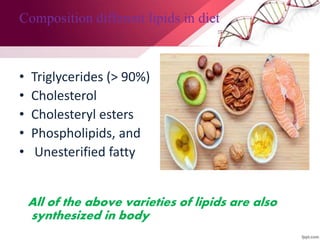
Composition different lipids in diet
• Triglycerides (> 90%)
• Cholesterol
• Cholesteryl esters
• Phospholipids, and
• Unesterified fatty
All of the above varieties of lipids are also
synthesized in body
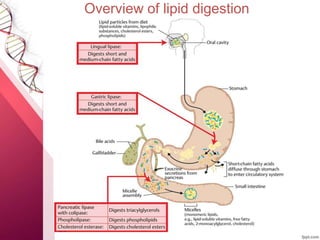
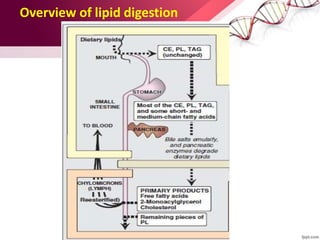
Overview of lipid digestion
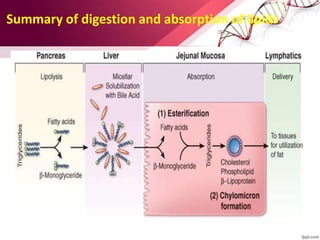
Summary of digestion and absorption of lipids
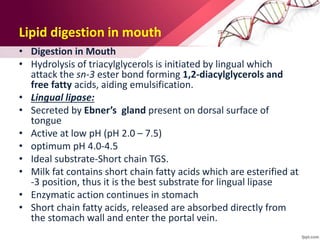
Lipid digestion in mouth
• Digestion in Mouth
• Hydrolysis of triacylglycerols is initiated by lingual which
attack the sn-3 ester bond forming 1,2-diacylglycerols and
free fatty acids, aiding emulsification.
• Lingual lipase:
• Secreted by Ebner’s gland present on dorsal surface of
tongue
• Active at low pH (pH 2.0 – 7.5)
• optimum pH 4.0-4.5
• Ideal substrate-Short chain TGS.
• Milk fat contains short chain fatty acids which are esterified at
-3 position, thus it is the best substrate for lingual lipase
• Enzymatic action continues in stomach
• Short chain fatty acids, released are absorbed directly from
the stomach wall and enter the portal vein.
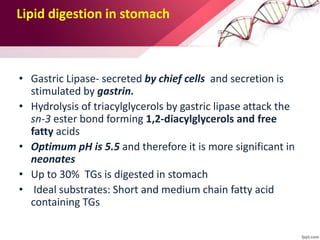
Lipid digestion in stomach
• Gastric Lipase- secreted by chief cells and secretion is
stimulated by gastrin.
• Hydrolysis of triacylglycerols by gastric lipase attack the
sn-3 ester bond forming 1,2-diacylglycerols and free
fatty acids
• Optimum pH is 5.5 and therefore it is more significant in
neonates
• Up to 30% TGs is digested in stomach
• Ideal substrates: Short and medium chain fatty acid
containing TGs
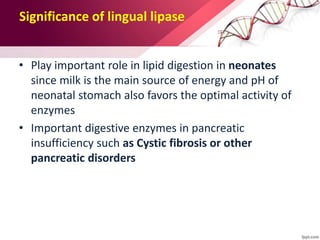
Significance of lingual lipase
• Play important role in lipid digestion in neonates
since milk is the main source of energy and pH of
neonatal stomach also favors the optimal activity of
enzymes
• Important digestive enzymes in pancreatic
insufficiency such as Cystic fibrosis or other
pancreatic disorders
Role of emulsification in digestion
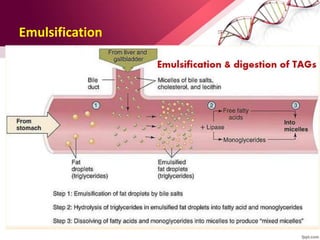
• Emulsification is the process of breaking down of
large fat globules into uniform tiny droplets.
• It is accomplished by bile salts and peristalsis
emulsification
• it occurs in duodenum
• Emulsification decreases the surface tension and
increases the surface area of fat globules and
thereby lipolytic enzymes can hydrolyze lipids
Emulsification
Lipid digestion in small intestine
• Major site of fat digestion
• Effective digestion due to the presence of Pancreatic
enzymes and bile salts.
• Bile salts act as effective emulsifying agents for fats
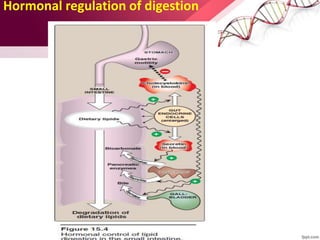
Secretion of pancreatic juice is stimulated by-
• Passage of acid gastric contents in to the duodenum
• By secretion of Secretin, Cholecystokinin
Pancreozymin (CCK-PZ), the gastro intestinal
hormones
Hormonal regulation of digestion
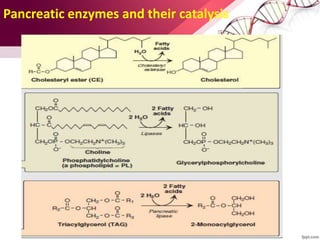
Pancreatic enzymes and their catalysis
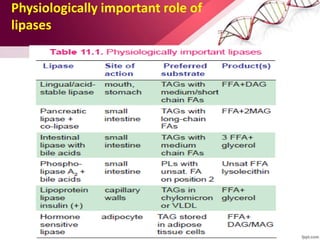
Physiologically important role of
lipases
Absorption of lipid
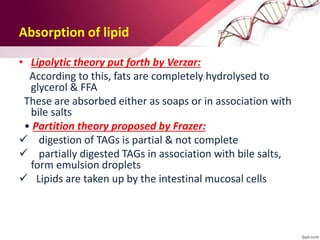
• Lipolytic theory put forth by Verzar:
According to this, fats are completely hydrolysed to
glycerol & FFA
These are absorbed either as soaps or in association with
bile salts
• Partition theory proposed by Frazer:
 digestion of TAGs is partial & not complete
 partially digested TAGs in association with bile salts,
form emulsion droplets
 Lipids are taken up by the intestinal mucosal cells
Absorption of Lipids
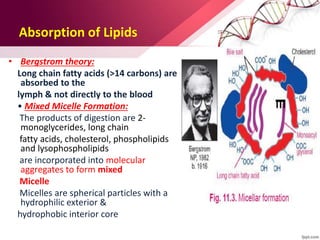
• Bergstrom theory:
Long chain fatty acids (>14 carbons) are
absorbed to the
lymph & not directly to the blood
• Mixed Micelle Formation:
The products of digestion are 2-
monoglycerides, long chain
fatty acids, cholesterol, phospholipids
and lysophospholipids
are incorporated into molecular
aggregates to form mixed
Micelle
Micelles are spherical particles with a
hydrophilic exterior &
hydrophobic interior core
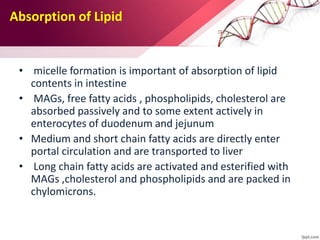
Absorption of Lipid
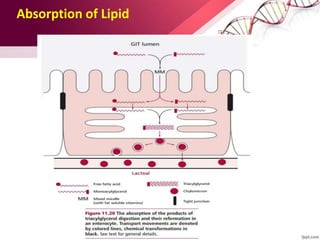
• micelle formation is important of absorption of lipid
contents in intestine
• MAGs, free fatty acids , phospholipids, cholesterol are
absorbed passively and to some extent actively in
enterocytes of duodenum and jejunum
• Medium and short chain fatty acids are directly enter
portal circulation and are transported to liver
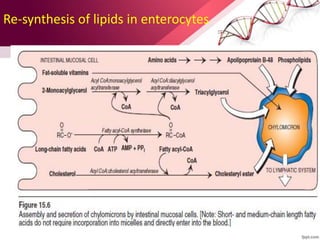
• Long chain fatty acids are activated and esterified with
MAGs ,cholesterol and phospholipids and are packed in
chylomicrons.
Absorption of Lipid
Re-synthesis of lipids in enterocytes
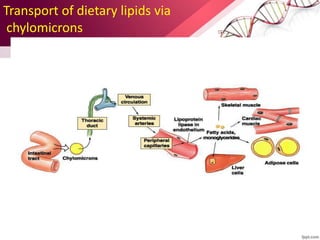
Transport of dietary lipids via
chylomicrons
Clinical conditions
• Defective synthesis- Due to deficiency of apo-B 48 protein.
The triglyceride may accumulate in intestinal cells.
• Defective digestion: In steatorrhea, daily excretion of fat in feces is more
than 6 g per day. (Greek word, "stear", means fat).
• Defective absorption: Celiac disease, surgical removal of intestine and
obstruction in bile duct
Chyluria- Due to an abnormal connection between urinary tract& lymphatic
drainage system of the intestines, Characterized by passage of Milky
urine.
Chylothorax -can result from an abnormal connection between the pleural
cavity and thoracic duct. It is characterized by accumulation of lymph in
pleural cavity

Lipid digestion and absorption

  • 1.
    LIPID DIGESTION AND ABSORPTION AnupShamshsherBudhathoki National Medical College , Birgunj, Nepal
  • 2.
    Composition different lipidsin diet • Triglycerides (> 90%) • Cholesterol • Cholesteryl esters • Phospholipids, and • Unesterified fatty All of the above varieties of lipids are also synthesized in body
  • 3.
  • 4.
  • 5.
    Summary of digestionand absorption of lipids
  • 6.
    Lipid digestion inmouth • Digestion in Mouth • Hydrolysis of triacylglycerols is initiated by lingual which attack the sn-3 ester bond forming 1,2-diacylglycerols and free fatty acids, aiding emulsification. • Lingual lipase: • Secreted by Ebner’s gland present on dorsal surface of tongue • Active at low pH (pH 2.0 – 7.5) • optimum pH 4.0-4.5 • Ideal substrate-Short chain TGS. • Milk fat contains short chain fatty acids which are esterified at -3 position, thus it is the best substrate for lingual lipase • Enzymatic action continues in stomach • Short chain fatty acids, released are absorbed directly from the stomach wall and enter the portal vein.
  • 7.
    Lipid digestion instomach • Gastric Lipase- secreted by chief cells and secretion is stimulated by gastrin. • Hydrolysis of triacylglycerols by gastric lipase attack the sn-3 ester bond forming 1,2-diacylglycerols and free fatty acids • Optimum pH is 5.5 and therefore it is more significant in neonates • Up to 30% TGs is digested in stomach • Ideal substrates: Short and medium chain fatty acid containing TGs
  • 8.
    Significance of linguallipase • Play important role in lipid digestion in neonates since milk is the main source of energy and pH of neonatal stomach also favors the optimal activity of enzymes • Important digestive enzymes in pancreatic insufficiency such as Cystic fibrosis or other pancreatic disorders
  • 9.
    Role of emulsificationin digestion • Emulsification is the process of breaking down of large fat globules into uniform tiny droplets. • It is accomplished by bile salts and peristalsis emulsification • it occurs in duodenum • Emulsification decreases the surface tension and increases the surface area of fat globules and thereby lipolytic enzymes can hydrolyze lipids
  • 10.
  • 11.
    Lipid digestion insmall intestine • Major site of fat digestion • Effective digestion due to the presence of Pancreatic enzymes and bile salts. • Bile salts act as effective emulsifying agents for fats Secretion of pancreatic juice is stimulated by- • Passage of acid gastric contents in to the duodenum • By secretion of Secretin, Cholecystokinin Pancreozymin (CCK-PZ), the gastro intestinal hormones
  • 12.
  • 13.
    Pancreatic enzymes andtheir catalysis
  • 14.
  • 15.
    Absorption of lipid •Lipolytic theory put forth by Verzar: According to this, fats are completely hydrolysed to glycerol & FFA These are absorbed either as soaps or in association with bile salts • Partition theory proposed by Frazer:  digestion of TAGs is partial & not complete  partially digested TAGs in association with bile salts, form emulsion droplets  Lipids are taken up by the intestinal mucosal cells
  • 16.
    Absorption of Lipids •Bergstrom theory: Long chain fatty acids (>14 carbons) are absorbed to the lymph & not directly to the blood • Mixed Micelle Formation: The products of digestion are 2- monoglycerides, long chain fatty acids, cholesterol, phospholipids and lysophospholipids are incorporated into molecular aggregates to form mixed Micelle Micelles are spherical particles with a hydrophilic exterior & hydrophobic interior core
  • 17.
    Absorption of Lipid •micelle formation is important of absorption of lipid contents in intestine • MAGs, free fatty acids , phospholipids, cholesterol are absorbed passively and to some extent actively in enterocytes of duodenum and jejunum • Medium and short chain fatty acids are directly enter portal circulation and are transported to liver • Long chain fatty acids are activated and esterified with MAGs ,cholesterol and phospholipids and are packed in chylomicrons.
  • 18.
  • 19.
    Re-synthesis of lipidsin enterocytes
  • 20.
    Transport of dietarylipids via chylomicrons
  • 21.
    Clinical conditions • Defectivesynthesis- Due to deficiency of apo-B 48 protein. The triglyceride may accumulate in intestinal cells. • Defective digestion: In steatorrhea, daily excretion of fat in feces is more than 6 g per day. (Greek word, "stear", means fat). • Defective absorption: Celiac disease, surgical removal of intestine and obstruction in bile duct Chyluria- Due to an abnormal connection between urinary tract& lymphatic drainage system of the intestines, Characterized by passage of Milky urine. Chylothorax -can result from an abnormal connection between the pleural cavity and thoracic duct. It is characterized by accumulation of lymph in pleural cavity