EATING DISORDERS
EATING DISORDERS Disordered eating Unusual change from typical eating pattern as seen with an illness, holiday,  a response to a stressful event, desire to improve appearance Eating disorder Abnormal eating patterns that can lead to serious health risks Psychological disorders Often with history of abuse Encouraged by culture obsessed with thin body image for women, built body image for men
TYPES OF EATING DISORDERS Three main classifications: Anorexia nervosa Self-induced semi-starvation Bulimia nervosa Binge eating followed by “purging” Binge-eating disorder Compulsive overeating Binge eating without purging
ANOREXIA NERVOSA Means “nervous loss of appetite” Self-induced semi-starvation Drastically lower calorie intake than needed to maintain a healthy weight Weight is typically less than 85% of expected weight for height BMI often less than 17.5 9 out of 10 victims are women Peak onset age: 15 to 19 years old Prevalent in sports and activities that emphasize leanness
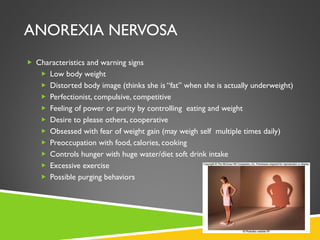
ANOREXIA NERVOSA Characteristics and warning signs Low body weight Distorted body image (thinks she is “fat” when she is actually underweight) Perfectionist, compulsive, competitive Feeling of power or purity by controlling  eating and weight Desire to please others, cooperative Obsessed with fear of weight gain (may weigh self  multiple times daily) Preoccupation with food, calories, cooking Controls hunger with huge water/diet soft drink intake Excessive exercise Possible purging behaviors
ANOREXIA NERVOSA: HEALTH CONSEQUENCES Excessive weight loss Loss of fat stores Muscle loss Cold intolerance Lanugo Organ systems Weakened, small heart Bloating, constipation,  abdominal pain Anemia Other Depression Loss of menstruation osteoporosis
ANOREXIA NERVOSA: TREATMENT Combination of health specialists May include hospitalization with very low weight or serious health complications Psychotherapy Nutritional  intervention to develop realistic view of food
BULIMIA NERVOSA Means “great ox hunger” Binge eating and compensatory purging behavior Typical victim: woman in her 20s or 30s, unmarried Secretive about binge and purge Feel disorganized, out of control with food
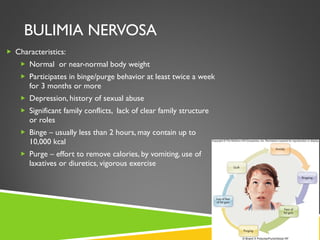
BULIMIA NERVOSA Characteristics: Normal  or near-normal body weight Participates in binge/purge behavior at least twice a week for 3 months or more Depression, history of sexual abuse Significant family conflicts,  lack of clear family structure or roles Binge – usually less than 2 hours, may contain up to 10,000 kcal Purge – effort to remove calories, by vomiting, use of laxatives or diuretics, vigorous exercise
BULIMIA NERVOSA: HEALTH CONSEQUENCES Electrolyte imbalance due to vomiting and diarrhea (laxative abuse) May lead to irregular heartbeat, life-threatening Dental health Erosion of tooth enamel from stomach acid exposure Gastrointestinal Inflammation of salivary glands Esophageal tears, ulcers Other Fatigue, impaired thought processes
BULIMIA NERVOSA: TREATMENT Psychotherapy Depression,  abuse history Medical care, dental care as needed Nutritional intervention to change attitudes toward food
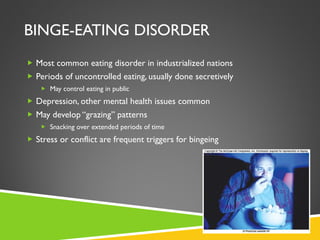
BINGE-EATING DISORDER Most common eating disorder in industrialized nations Periods of uncontrolled eating, usually done secretively May control eating in public Depression, other mental health issues common May develop “grazing” patterns Snacking over extended periods of time Stress or conflict are frequent triggers for bingeing
BINGE-EATING DISORDER Warning signs: Episodes of binge eating Eat when not hungry Frequent dieting Weight fluctuations Depression Treatment Therapy to learn to separate emotions and separate  physiological hunger from emotional need Ongoing support appears to improve recovery Weight-related diseases (obesity, type 2 diabetes, hypertension, etc.) may need to be addressed
FEMALE ATHLETE TRIAD Eating disorders are prevalent in “lean” sports like swimming, gymnastics, dance Reduced body weight (from fat) leads to amenorrhea and cessation of estrogen production Amenorrhea leads to decreased calcium absorption, bone loss

Eating disorders ch13

  • 1.
  • 2.
    EATING DISORDERS Disorderedeating Unusual change from typical eating pattern as seen with an illness, holiday, a response to a stressful event, desire to improve appearance Eating disorder Abnormal eating patterns that can lead to serious health risks Psychological disorders Often with history of abuse Encouraged by culture obsessed with thin body image for women, built body image for men
  • 3.
    TYPES OF EATINGDISORDERS Three main classifications: Anorexia nervosa Self-induced semi-starvation Bulimia nervosa Binge eating followed by “purging” Binge-eating disorder Compulsive overeating Binge eating without purging
  • 4.
    ANOREXIA NERVOSA Means“nervous loss of appetite” Self-induced semi-starvation Drastically lower calorie intake than needed to maintain a healthy weight Weight is typically less than 85% of expected weight for height BMI often less than 17.5 9 out of 10 victims are women Peak onset age: 15 to 19 years old Prevalent in sports and activities that emphasize leanness
  • 5.
    ANOREXIA NERVOSA Characteristicsand warning signs Low body weight Distorted body image (thinks she is “fat” when she is actually underweight) Perfectionist, compulsive, competitive Feeling of power or purity by controlling eating and weight Desire to please others, cooperative Obsessed with fear of weight gain (may weigh self multiple times daily) Preoccupation with food, calories, cooking Controls hunger with huge water/diet soft drink intake Excessive exercise Possible purging behaviors
  • 6.
    ANOREXIA NERVOSA: HEALTHCONSEQUENCES Excessive weight loss Loss of fat stores Muscle loss Cold intolerance Lanugo Organ systems Weakened, small heart Bloating, constipation, abdominal pain Anemia Other Depression Loss of menstruation osteoporosis
  • 7.
    ANOREXIA NERVOSA: TREATMENTCombination of health specialists May include hospitalization with very low weight or serious health complications Psychotherapy Nutritional intervention to develop realistic view of food
  • 8.
    BULIMIA NERVOSA Means“great ox hunger” Binge eating and compensatory purging behavior Typical victim: woman in her 20s or 30s, unmarried Secretive about binge and purge Feel disorganized, out of control with food
  • 9.
    BULIMIA NERVOSA Characteristics:Normal or near-normal body weight Participates in binge/purge behavior at least twice a week for 3 months or more Depression, history of sexual abuse Significant family conflicts, lack of clear family structure or roles Binge – usually less than 2 hours, may contain up to 10,000 kcal Purge – effort to remove calories, by vomiting, use of laxatives or diuretics, vigorous exercise
  • 10.
    BULIMIA NERVOSA: HEALTHCONSEQUENCES Electrolyte imbalance due to vomiting and diarrhea (laxative abuse) May lead to irregular heartbeat, life-threatening Dental health Erosion of tooth enamel from stomach acid exposure Gastrointestinal Inflammation of salivary glands Esophageal tears, ulcers Other Fatigue, impaired thought processes
  • 11.
    BULIMIA NERVOSA: TREATMENTPsychotherapy Depression, abuse history Medical care, dental care as needed Nutritional intervention to change attitudes toward food
  • 12.
    BINGE-EATING DISORDER Mostcommon eating disorder in industrialized nations Periods of uncontrolled eating, usually done secretively May control eating in public Depression, other mental health issues common May develop “grazing” patterns Snacking over extended periods of time Stress or conflict are frequent triggers for bingeing
  • 13.
    BINGE-EATING DISORDER Warningsigns: Episodes of binge eating Eat when not hungry Frequent dieting Weight fluctuations Depression Treatment Therapy to learn to separate emotions and separate physiological hunger from emotional need Ongoing support appears to improve recovery Weight-related diseases (obesity, type 2 diabetes, hypertension, etc.) may need to be addressed
  • 14.
    FEMALE ATHLETE TRIADEating disorders are prevalent in “lean” sports like swimming, gymnastics, dance Reduced body weight (from fat) leads to amenorrhea and cessation of estrogen production Amenorrhea leads to decreased calcium absorption, bone loss