By
Dr. Vidhi Thakar(PT)
Assistant Professor
ARIP
Charusat
Changa

Body Composition and analysis provides information (like
% of body fat, fat distribution, body segment girth etc.)which
are pertinent to athletic performance and for reducing risk
factors associated with musculoskeletal injury and disease.
Learning Objective
8/5/2016
Mc Ardle & Katch- Essentials of exercise physiology,
ACSM's- Resource manual for guidelines for exercise testing and prescription
2

 Definition
 Body composition model
 Techniques of Body composition analysis
8/5/2016
Mc Ardle & Katch- Essentials of exercise physiology,
ACSM's- Resource manual for guidelines for exercise testing and prescription
3
Index

 Body composition describes the relative proportions
of fat, bone and muscles mass in the human body.
 It can be described at 5 levels: -
• Atomic- C, H, O, N
• Molecular – Protein, carbohydrates, lipids.
• Cellular – Fat cells, body fluids, Extracellular solids
• Tissue – Skeletal muscles, bone, blood.
• Whole body – body mass, stature, size, volume, density.
8/5/2016
Mc Ardle & Katch- Essentials of exercise physiology,
ACSM's- Resource manual for guidelines for exercise testing and prescription
4
Definition
 Total body fat = Essential Fat + Storage fat
 Essential fat – in bone marrow, nervous tissue, organs(Young
men – 12% of body mass, Young female – 15% of body mass)
 Storage fat – accumulates in adipose tissue(Young Men- 3% of
body mass, Young female – 12% of body mass)
 Fat free mass(FFM) = body mass – fat mass
 Lean body mass(LBM) contains non-sex specific essential
fat(4% - 7% of body mass)
8/5/2016
Mc Ardle & Katch- Essentials of exercise physiology,
ACSM's- Resource manual for guidelines for exercise testing and prescription
5
Fat

8/5/2016
Mc Ardle & Katch- Essentials of exercise physiology,
ACSM's- Resource manual for guidelines for exercise testing and prescription
6
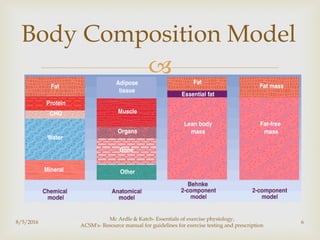
Body Composition Model

 Categorized as direct, indirect or doubly indirect
methods
 Direct method(chemical analysis of whole body or
cadaver) is not suitable in the living body.
 Indirect method(hydrostatic weighing etc.)
- Component and property based model
 Doubly indirect method(skinfolds etc.)
8/5/2016
Mc Ardle & Katch- Essentials of exercise physiology,
ACSM's- Resource manual for guidelines for exercise testing and prescription
7
Body Composition Model

Body composition
analysis method
Indirect Methods
 Height, Body mass, BMI
 Waist and hip circumference
 Hydrodensitometry
 Skinfold assessment
 NIR
 ADP
 CT, PET
 MRI and spectroscopy
 US
 Isotopic dilution
 DEXA
 Three dimensional scanning
Factors to be considered
 Need of the individual
 Purpose of evaluation
 Cost of measurement
 Equipment needed
 Availability of the
assessment tools
 Training
 Advantages vs.
disadvantages
 Accuracy, reliability and
validity
8/5/2016
Mc Ardle & Katch- Essentials of exercise physiology,
ACSM's- Resource manual for guidelines for exercise testing and prescription
8

 Stadiometer
 Subject removes shoes
 Stands straight up and heels together
 Takes a deep breath and hold it
 Stands with head level and looks straight
 Consider standard time and monitoring pre activity
level
• Measured in cms and inches
8/5/2016
Mc Ardle & Katch- Essentials of exercise physiology,
ACSM's- Resource manual for guidelines for exercise testing and prescription
9
Height

 Best measured on a calibrated scale with a beam and
movable weights
 Removes excess layer of clothing and shoes
 Empty pockets, remove jewelery and mobiles
 Consider a standard time
 Body weight(pounds) and mass(kilograms) are
different terminologies
8/5/2016
Mc Ardle & Katch- Essentials of exercise physiology,
ACSM's- Resource manual for guidelines for exercise testing and prescription
10
Body Mass

 Body mass/ height squared
 Determines risks of CVD, diabetes type II and
hypertension
 Poor predictor of body fat
 Not useful for resistance-trained population
 Study of overweight and obesity of larger population
it can be used
8/5/2016
Mc Ardle & Katch- Essentials of exercise physiology,
ACSM's- Resource manual for guidelines for exercise testing and prescription
11
BMI

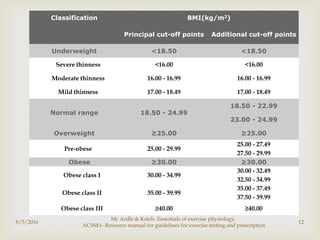
Classification BMI(kg/m2)
Principal cut-off points Additional cut-off points
Underweight <18.50 <18.50
Severe thinness <16.00 <16.00
Moderate thinness 16.00 - 16.99 16.00 - 16.99
Mild thinness 17.00 - 18.49 17.00 - 18.49
Normal range 18.50 - 24.99
18.50 - 22.99
23.00 - 24.99
Overweight ≥25.00 ≥25.00
Pre-obese 25.00 - 29.99
25.00 - 27.49
27.50 - 29.99
Obese ≥30.00 ≥30.00
Obese class I 30.00 - 34.99
30.00 - 32.49
32.50 - 34.99
Obese class II 35.00 - 39.99
35.00 - 37.49
37.50 - 39.99
Obese class III ≥40.00 ≥40.00
8/5/2016
Mc Ardle & Katch- Essentials of exercise physiology,
ACSM's- Resource manual for guidelines for exercise testing and prescription
12

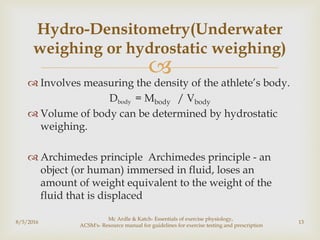
 Involves measuring the density of the athlete’s body.
Dbody = Mbody / Vbody
 Volume of body can be determined by hydrostatic
weighing.
 Archimedes principle Archimedes principle - an
object (or human) immersed in fluid, loses an
amount of weight equivalent to the weight of the
fluid that is displaced
8/5/2016
Mc Ardle & Katch- Essentials of exercise physiology,
ACSM's- Resource manual for guidelines for exercise testing and prescription
13
Hydro-Densitometry(Underwater
weighing or hydrostatic weighing)

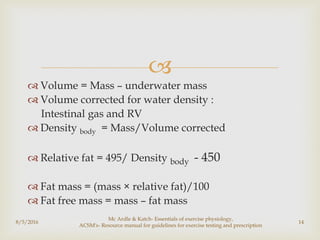
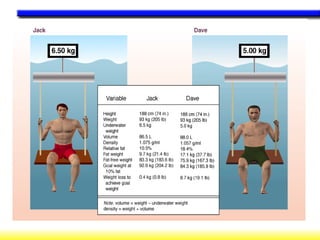
 Volume = Mass – underwater mass
 Volume corrected for water density :
Intestinal gas and RV
 Density body = Mass/Volume corrected
 Relative fat = 495/ Density body - 450
 Fat mass = (mass × relative fat)/100
 Fat free mass = mass – fat mass
8/5/2016
Mc Ardle & Katch- Essentials of exercise physiology,
ACSM's- Resource manual for guidelines for exercise testing and prescription
14

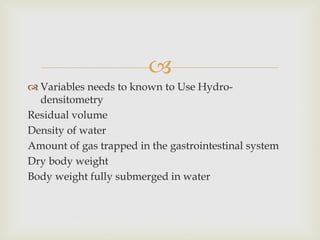
 Variables needs to known to Use Hydro-
densitometry
Residual volume
Density of water
Amount of gas trapped in the gastrointestinal system
Dry body weight
Body weight fully submerged in water

Bioelectrical Impedance
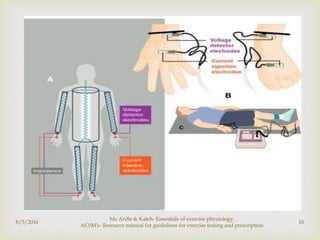
 BIA is a rapid, non invasive and relatively inexpensive
method for evaluating body composition field settings.
 With this method, a low level electrical current is passed
through client’s body and impedance is measured with a
BIA analyzer
 TBW can be estimated from impedance because
electrolytes in TBW are excellent conductors of electrical
current
 When volume of TBW is large, the current flows more
easily through body with less resistance

8/5/2016
Mc Ardle & Katch- Essentials of exercise physiology,
ACSM's- Resource manual for guidelines for exercise testing and prescription
18

 The resistance to current flow is greater in
individuals with large amounts of body fat, since
adipose tissue , with its relatively low water content
is a poor conductor of electrical current
 Because water content of fat free mass is large, FFM
can be predicted from TBW estimates
 Individuals with large FFM and TBW have less
resistance to current flowing through their bodies
than those with a smaller FFM
 Based on gender, age, ethnicity, physical activity
level and level of body fatness
8/5/2016
Mc Ardle & Katch- Essentials of exercise physiology,
ACSM's- Resource manual for guidelines for exercise testing and prescription
19

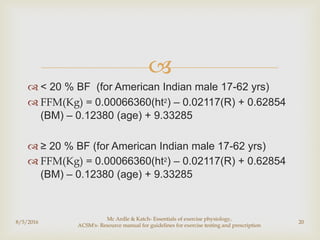
 < 20 % BF (for American Indian male 17-62 yrs)
 FFM(Kg) = 0.00066360(ht2) – 0.02117(R) + 0.62854
(BM) – 0.12380 (age) + 9.33285
 ≥ 20 % BF (for American Indian male 17-62 yrs)
 FFM(Kg) = 0.00066360(ht2) – 0.02117(R) + 0.62854
(BM) – 0.12380 (age) + 9.33285
8/5/2016
Mc Ardle & Katch- Essentials of exercise physiology,
ACSM's- Resource manual for guidelines for exercise testing and prescription
20

 < 30 % BF (for American Indian female 17-62 yrs)
 FFM(Kg) = 0.000646(ht2) – 0.014(R) + 0.421 (BM) –
10.4
 ≥ 30 % BF (for American Indian female 17-62 yrs)
 FFM(Kg) = 0.00091186(ht2) – 0.01466(R) +
0.29990(BM) – 0.07012 (age) + 9.37938
8/5/2016
Mc Ardle & Katch- Essentials of exercise physiology,
ACSM's- Resource manual for guidelines for exercise testing and prescription
21
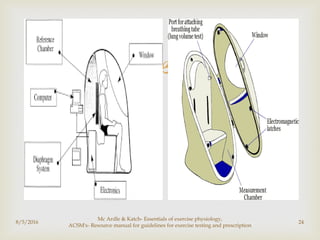
 A densitometry method used in laboratory and
clinical settings to measure Body volume and
estimate body density
 Compared to hydrostatic weighing, it is expensive
requiring use of a whole body plethysmograph
 Plethysmograph is a large, egg shaped fiberglass
chamber that uses air displacement and pressure
volume relationships to derive BV(Boyle’s law)
 ADP is performed using the BOD POD system
8/5/2016
Mc Ardle & Katch- Essentials of exercise physiology,
ACSM's- Resource manual for guidelines for exercise testing and prescription
22
Air displacement
Plethysmography

 BV = Volume of air in empty chamber – Volume of
air remaining in the chamber after the client enters
chamber
 Equipment is expensive and is generally accessible
only in research facilities
 No physical performance requirements for clients
 Require special clothing
8/5/2016
Mc Ardle & Katch- Essentials of exercise physiology,
ACSM's- Resource manual for guidelines for exercise testing and prescription
23

8/5/2016
Mc Ardle & Katch- Essentials of exercise physiology,
ACSM's- Resource manual for guidelines for exercise testing and prescription
24

8/5/2016
Mc Ardle & Katch- Essentials of exercise physiology,
ACSM's- Resource manual for guidelines for exercise testing and prescription
25
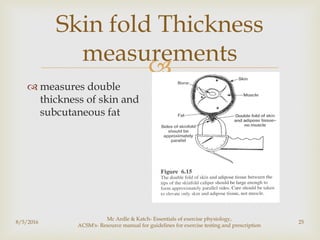
Skin fold Thickness
measurements
 measures double
thickness of skin and
subcutaneous fat

8/5/2016
Mc Ardle & Katch- Essentials of exercise physiology,
ACSM's- Resource manual for guidelines for exercise testing and prescription
26
Assumptions
 predicts non-
subcutaneous fat
>50% of fat is
subcutaneous
 sites selected represent
average thickness of all
subcutaneous fat
 compressibility of fat
similar between
subjects
 thickness of skin
negligible
Limitations
 Technician error
 Skin fold thickness
affected by factors other
than amount of fat
- exercise increases skin
thickness
- dehydration reduces skin
thickness
- edema increases skin
thickness
- dermatitis increases skin
thickness
 Poorly predicts visceral
fat

 Skin fold caliper works on principle same as that of
micrometer to measure 2 points
 The pincer jaws exert a constant tension of 10
g.m/m2 at the point of contact with the double
layer of skin plus subcutaneous tissue
 The caliper dial indicates skin fold thickness in
millimeters
8/5/2016
Mc Ardle & Katch- Essentials of exercise physiology,
ACSM's- Resource manual for guidelines for exercise testing and prescription
27

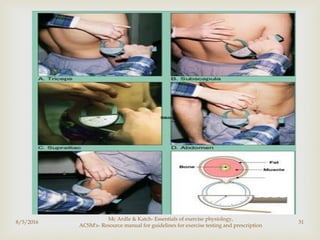
 Measuring skin fold thickness requires grasping a
fold of skin and subcutaneous fat firmly with the
thumb and forefingers pulling it away from
underlying muscle tissue following skin fold's
natural contour
 The skin fold is recorded within 2 seconds after
applying the full force of caliper
 This time limitation avoids skin fold compression
8/5/2016
Mc Ardle & Katch- Essentials of exercise physiology,
ACSM's- Resource manual for guidelines for exercise testing and prescription
28

 Take great care in locating anatomical landmarks for
each site prior to measurement
 Do not take measurements immediately after
exercise, shift in body fluid to the skin spuriously
increases reading
 Take measurements on dry, lotion free skin
8/5/2016
Mc Ardle & Katch- Essentials of exercise physiology,
ACSM's- Resource manual for guidelines for exercise testing and prescription
29

Recording
 Once applied to the skin fold site, the caliper
continues to displace subcutaneous interstitial
water, connective tissue and fat throughout the
measurement period until the skin fold’s rebound
force counteracts the caliper pressure
 More than 70 % of the total compression of skin and
underlying fat takes place within first 4 seconds after
applying caliper
 Thus to record uncompressed skin plus fat
measurement , the reading should be made within 1
or 2 seconds.
 Any prolonged delay in reading the caliper
underestimates the actual skin fold value
8/5/2016
Mc Ardle & Katch- Essentials of exercise physiology,
ACSM's- Resource manual for guidelines for exercise testing and prescription
30

8/5/2016
Mc Ardle & Katch- Essentials of exercise physiology,
ACSM's- Resource manual for guidelines for exercise testing and prescription
31

 Equations and constants for young and older men and
women predict an individual’s percentage of body fat
within ± 2.5 % to ± 4.0 % body fat units of actual value
 These equations should not be used to predict fatness in
individuals who appear excessively thin or fat or who
participate regularly in strenuous sports or resistance
training that can increase girth without altering
subcutaneous fat
 Girths also can analyze patterns of body fat distribution ,
including changes in fat distribution during weight loss
and gain
8/5/2016
Mc Ardle & Katch- Essentials of exercise physiology,
ACSM's- Resource manual for guidelines for exercise testing and prescription
32
Girth measurements

Common sites:-
A. Right upper arm : palm up, arm straight, and
extended in front of body, taken at the midpoint
between shoulder and elbow
B. Right forearm : Maximum girth with arm extended
in front of body with palm up
C. Abdomen : 1 inch above the umbilicus
D. Hips (buttocks) : maximum protrusion with heels
together
E. Right thigh : upper thigh just below the buttocks
F. Right calf : widest girth midway between ankle and
knee
8/5/2016
Mc Ardle & Katch- Essentials of exercise physiology,
ACSM's- Resource manual for guidelines for exercise testing and prescription
33

8/5/2016
Mc Ardle & Katch- Essentials of exercise physiology,
ACSM's- Resource manual for guidelines for exercise testing and prescription
34
Predicting body fat from
girths
 Percentage of fat =
Constant A + Constant B
– Constant C – 10.2
 Fat mass = body mass ×
( % fat / 100)
 FFM = BM - FM
Advantages
 Easy to learn
 Quick to complete
 Inexpensive
 Waist circumference
can be used as an
indicator of disease risk

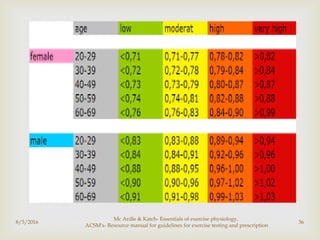
 WHR indicates relative fat distribution in adults and
risk of disease
 A higher ratio reflects a greater proportion of
abdominal fat with greater risk of Type 2 diabetes,
hypercholesterolemia, hypertension, and
atherosclerosis
 WHR = smallest abdominal girth (cm or in)/largest
hip girth (cm or in)
8/5/2016
Mc Ardle & Katch- Essentials of exercise physiology,
ACSM's- Resource manual for guidelines for exercise testing and prescription
35
Waist – To – Hip Girth
Ratio

8/5/2016
Mc Ardle & Katch- Essentials of exercise physiology,
ACSM's- Resource manual for guidelines for exercise testing and prescription
36

 Based on the premise that the degree of infrared light
absorption is related to the composition of the
substance through which light passes
 Fat and Fat-Free Mass absorb and reflect light
differently
8/5/2016
Mc Ardle & Katch- Essentials of exercise physiology,
ACSM's- Resource manual for guidelines for exercise testing and prescription
37
Near Infrared Interactance
(NIR)

8/5/2016
Mc Ardle & Katch- Essentials of exercise physiology,
ACSM's- Resource manual for guidelines for exercise testing and prescription
38
Advantages
 Non-invasive
 Safe
 Easy to administer
 Field technique
Disadvantages
 It does not predict body
fat across a broad range
of body fat levels
 It provides less accuracy
than skin folds
 It overestimates body fat
in lean men and women
and underestimates it in
fatter subjects

Ultrasound technology can
1. Assess the thickness of different tissues(fat & muscle)
2. Obtain an image of the deeper tissues such as a muscle’ s
cross-sectional area
 The method converts electrical energy through a probe
into high frequency sound waves that penetrate the skin
surface in to underlying tissues
 The sound waves pass through adipose tissue and
penetrate the muscle layer and then reflect from the fat –
muscle interface to produce an echo, which returns to a
receiver within the probe
8/5/2016
Mc Ardle & Katch- Essentials of exercise physiology,
ACSM's- Resource manual for guidelines for exercise testing and prescription
39
Ultrasound

 It has application for determining total and
segmental subcutaneous adipose tissue volume
 US exhibits high reliability for repeat measurements
at multiple sites in lying and standing positions o the
same and different days
8/5/2016
Mc Ardle & Katch- Essentials of exercise physiology,
ACSM's- Resource manual for guidelines for exercise testing and prescription
40

 Generates detailed cross-sectional, 2 dimensional
radiographic images.
 Passes x-ray beam through tissues of different
densities.
 Provides quantitative information on:
 Total tissue area
 Total fat and muscle area
 Thickness and volume of tissues w/i organ
8/5/2016
Mc Ardle & Katch- Essentials of exercise physiology,
ACSM's- Resource manual for guidelines for exercise testing and prescription
41
Computed Tomography

 Nuclear imaging technique which determine brown
fat content(it has imp. role in thermogenesis)
 Provides greater precision at organ and tissue level
than other scanning.
 Metabolic tracer are injected in body which are than
detected
8/5/2016
Mc Ardle & Katch- Essentials of exercise physiology,
ACSM's- Resource manual for guidelines for exercise testing and prescription
42
Positron emission
tomography(PET)

 Electromagnetic radiation, not ionizing radiation, in
strong magnetic field excites hydrogen nuclei of
body’s water and lipid molecules. Nuclei then
project detectable signal to visually represent various
body tissues.
 Provides quantitative information on total and
subcutaneous adipose tissue
8/5/2016
Mc Ardle & Katch- Essentials of exercise physiology,
ACSM's- Resource manual for guidelines for exercise testing and prescription
43
Magnetic Resonance
Imaging

 Measures total body weight(TBW) and estimates of
FFM and % body fat.
 TBW is calculated from compartment volume.
 Compartment volume is the ratio of the dose of a
tracer to its concentration in the bodily compartment
after equilibrium is achieved in the body.
 Tracer used areD2O, 18O and titrated water
8/5/2016
Mc Ardle & Katch- Essentials of exercise physiology,
ACSM's- Resource manual for guidelines for exercise testing and prescription
44
Isotopic dilution

Limitation
 Requires correction factor to account for errors in the
calculation of isotopic dilution space
 Isotopic dilution is costly
8/5/2016
Mc Ardle & Katch- Essentials of exercise physiology,
ACSM's- Resource manual for guidelines for exercise testing and prescription
45

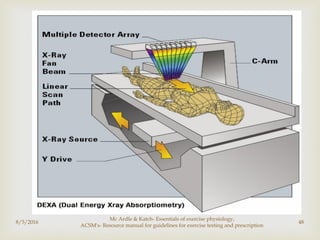
 Principal of absorptiometry is based on exponential
attenuation of X-rays at two energies as they pass
through the body.
 Based on 3 C model of total bone mineral stores,
FFM and fat mass
 X-ray are generated at two energies by X-ray tube
 A detector is positioned overhead on the scanning
arm and interface with computer is a needed for
scanning an image.
8/5/2016
Mc Ardle & Katch- Essentials of exercise physiology,
ACSM's- Resource manual for guidelines for exercise testing and prescription
46
Dual Energy X-ray
Absorptiometry

Limitation and benefits
 Individual size(tall person, obese person).
 Large and expensive instrument
 Assumes same amount of fat lies over bone and
neighboring bone free tissue
 Also assumes constant hydration state.
 Has more clinical utility than just % of body fat.
 Can provide regional measurement on the body
8/5/2016
Mc Ardle & Katch- Essentials of exercise physiology,
ACSM's- Resource manual for guidelines for exercise testing and prescription
47

8/5/2016
Mc Ardle & Katch- Essentials of exercise physiology,
ACSM's- Resource manual for guidelines for exercise testing and prescription
48

 Assess body shape and size via scanners that are
based on laser scanning, structured light or stereo
vision systems
 Subject stands motionless in the center of the scanner
wearing tight clothing and head cap.
 % of body fat determine by measuring body volume
and density with the help of multiple scan.
8/5/2016
Mc Ardle & Katch- Essentials of exercise physiology,
ACSM's- Resource manual for guidelines for exercise testing and prescription
49
Three dimensional body
scanning

8/5/2016
Mc Ardle & Katch- Essentials of exercise physiology,
ACSM's- Resource manual for guidelines for exercise testing and prescription
50

Body composition and analysis

  • 1.
    By Dr. Vidhi Thakar(PT) AssistantProfessor ARIP Charusat Changa
  • 2.
     Body Composition andanalysis provides information (like % of body fat, fat distribution, body segment girth etc.)which are pertinent to athletic performance and for reducing risk factors associated with musculoskeletal injury and disease. Learning Objective 8/5/2016 Mc Ardle & Katch- Essentials of exercise physiology, ACSM's- Resource manual for guidelines for exercise testing and prescription 2
  • 3.
      Definition  Bodycomposition model  Techniques of Body composition analysis 8/5/2016 Mc Ardle & Katch- Essentials of exercise physiology, ACSM's- Resource manual for guidelines for exercise testing and prescription 3 Index
  • 4.
      Body compositiondescribes the relative proportions of fat, bone and muscles mass in the human body.  It can be described at 5 levels: - • Atomic- C, H, O, N • Molecular – Protein, carbohydrates, lipids. • Cellular – Fat cells, body fluids, Extracellular solids • Tissue – Skeletal muscles, bone, blood. • Whole body – body mass, stature, size, volume, density. 8/5/2016 Mc Ardle & Katch- Essentials of exercise physiology, ACSM's- Resource manual for guidelines for exercise testing and prescription 4 Definition
  • 5.
     Total bodyfat = Essential Fat + Storage fat  Essential fat – in bone marrow, nervous tissue, organs(Young men – 12% of body mass, Young female – 15% of body mass)  Storage fat – accumulates in adipose tissue(Young Men- 3% of body mass, Young female – 12% of body mass)  Fat free mass(FFM) = body mass – fat mass  Lean body mass(LBM) contains non-sex specific essential fat(4% - 7% of body mass) 8/5/2016 Mc Ardle & Katch- Essentials of exercise physiology, ACSM's- Resource manual for guidelines for exercise testing and prescription 5 Fat
  • 6.
     8/5/2016 Mc Ardle &Katch- Essentials of exercise physiology, ACSM's- Resource manual for guidelines for exercise testing and prescription 6 Body Composition Model
  • 7.
      Categorized asdirect, indirect or doubly indirect methods  Direct method(chemical analysis of whole body or cadaver) is not suitable in the living body.  Indirect method(hydrostatic weighing etc.) - Component and property based model  Doubly indirect method(skinfolds etc.) 8/5/2016 Mc Ardle & Katch- Essentials of exercise physiology, ACSM's- Resource manual for guidelines for exercise testing and prescription 7 Body Composition Model
  • 8.
     Body composition analysis method IndirectMethods  Height, Body mass, BMI  Waist and hip circumference  Hydrodensitometry  Skinfold assessment  NIR  ADP  CT, PET  MRI and spectroscopy  US  Isotopic dilution  DEXA  Three dimensional scanning Factors to be considered  Need of the individual  Purpose of evaluation  Cost of measurement  Equipment needed  Availability of the assessment tools  Training  Advantages vs. disadvantages  Accuracy, reliability and validity 8/5/2016 Mc Ardle & Katch- Essentials of exercise physiology, ACSM's- Resource manual for guidelines for exercise testing and prescription 8
  • 9.
      Stadiometer  Subjectremoves shoes  Stands straight up and heels together  Takes a deep breath and hold it  Stands with head level and looks straight  Consider standard time and monitoring pre activity level • Measured in cms and inches 8/5/2016 Mc Ardle & Katch- Essentials of exercise physiology, ACSM's- Resource manual for guidelines for exercise testing and prescription 9 Height
  • 10.
      Best measuredon a calibrated scale with a beam and movable weights  Removes excess layer of clothing and shoes  Empty pockets, remove jewelery and mobiles  Consider a standard time  Body weight(pounds) and mass(kilograms) are different terminologies 8/5/2016 Mc Ardle & Katch- Essentials of exercise physiology, ACSM's- Resource manual for guidelines for exercise testing and prescription 10 Body Mass
  • 11.
      Body mass/height squared  Determines risks of CVD, diabetes type II and hypertension  Poor predictor of body fat  Not useful for resistance-trained population  Study of overweight and obesity of larger population it can be used 8/5/2016 Mc Ardle & Katch- Essentials of exercise physiology, ACSM's- Resource manual for guidelines for exercise testing and prescription 11 BMI
  • 12.
     Classification BMI(kg/m2) Principal cut-offpoints Additional cut-off points Underweight <18.50 <18.50 Severe thinness <16.00 <16.00 Moderate thinness 16.00 - 16.99 16.00 - 16.99 Mild thinness 17.00 - 18.49 17.00 - 18.49 Normal range 18.50 - 24.99 18.50 - 22.99 23.00 - 24.99 Overweight ≥25.00 ≥25.00 Pre-obese 25.00 - 29.99 25.00 - 27.49 27.50 - 29.99 Obese ≥30.00 ≥30.00 Obese class I 30.00 - 34.99 30.00 - 32.49 32.50 - 34.99 Obese class II 35.00 - 39.99 35.00 - 37.49 37.50 - 39.99 Obese class III ≥40.00 ≥40.00 8/5/2016 Mc Ardle & Katch- Essentials of exercise physiology, ACSM's- Resource manual for guidelines for exercise testing and prescription 12
  • 13.
      Involves measuringthe density of the athlete’s body. Dbody = Mbody / Vbody  Volume of body can be determined by hydrostatic weighing.  Archimedes principle Archimedes principle - an object (or human) immersed in fluid, loses an amount of weight equivalent to the weight of the fluid that is displaced 8/5/2016 Mc Ardle & Katch- Essentials of exercise physiology, ACSM's- Resource manual for guidelines for exercise testing and prescription 13 Hydro-Densitometry(Underwater weighing or hydrostatic weighing)
  • 14.
      Volume =Mass – underwater mass  Volume corrected for water density : Intestinal gas and RV  Density body = Mass/Volume corrected  Relative fat = 495/ Density body - 450  Fat mass = (mass × relative fat)/100  Fat free mass = mass – fat mass 8/5/2016 Mc Ardle & Katch- Essentials of exercise physiology, ACSM's- Resource manual for guidelines for exercise testing and prescription 14
  • 16.
      Variables needsto known to Use Hydro- densitometry Residual volume Density of water Amount of gas trapped in the gastrointestinal system Dry body weight Body weight fully submerged in water
  • 17.
     Bioelectrical Impedance  BIAis a rapid, non invasive and relatively inexpensive method for evaluating body composition field settings.  With this method, a low level electrical current is passed through client’s body and impedance is measured with a BIA analyzer  TBW can be estimated from impedance because electrolytes in TBW are excellent conductors of electrical current  When volume of TBW is large, the current flows more easily through body with less resistance
  • 18.
     8/5/2016 Mc Ardle &Katch- Essentials of exercise physiology, ACSM's- Resource manual for guidelines for exercise testing and prescription 18
  • 19.
      The resistanceto current flow is greater in individuals with large amounts of body fat, since adipose tissue , with its relatively low water content is a poor conductor of electrical current  Because water content of fat free mass is large, FFM can be predicted from TBW estimates  Individuals with large FFM and TBW have less resistance to current flowing through their bodies than those with a smaller FFM  Based on gender, age, ethnicity, physical activity level and level of body fatness 8/5/2016 Mc Ardle & Katch- Essentials of exercise physiology, ACSM's- Resource manual for guidelines for exercise testing and prescription 19
  • 20.
      < 20% BF (for American Indian male 17-62 yrs)  FFM(Kg) = 0.00066360(ht2) – 0.02117(R) + 0.62854 (BM) – 0.12380 (age) + 9.33285  ≥ 20 % BF (for American Indian male 17-62 yrs)  FFM(Kg) = 0.00066360(ht2) – 0.02117(R) + 0.62854 (BM) – 0.12380 (age) + 9.33285 8/5/2016 Mc Ardle & Katch- Essentials of exercise physiology, ACSM's- Resource manual for guidelines for exercise testing and prescription 20
  • 21.
      < 30% BF (for American Indian female 17-62 yrs)  FFM(Kg) = 0.000646(ht2) – 0.014(R) + 0.421 (BM) – 10.4  ≥ 30 % BF (for American Indian female 17-62 yrs)  FFM(Kg) = 0.00091186(ht2) – 0.01466(R) + 0.29990(BM) – 0.07012 (age) + 9.37938 8/5/2016 Mc Ardle & Katch- Essentials of exercise physiology, ACSM's- Resource manual for guidelines for exercise testing and prescription 21
  • 22.
     A densitometrymethod used in laboratory and clinical settings to measure Body volume and estimate body density  Compared to hydrostatic weighing, it is expensive requiring use of a whole body plethysmograph  Plethysmograph is a large, egg shaped fiberglass chamber that uses air displacement and pressure volume relationships to derive BV(Boyle’s law)  ADP is performed using the BOD POD system 8/5/2016 Mc Ardle & Katch- Essentials of exercise physiology, ACSM's- Resource manual for guidelines for exercise testing and prescription 22 Air displacement Plethysmography
  • 23.
      BV =Volume of air in empty chamber – Volume of air remaining in the chamber after the client enters chamber  Equipment is expensive and is generally accessible only in research facilities  No physical performance requirements for clients  Require special clothing 8/5/2016 Mc Ardle & Katch- Essentials of exercise physiology, ACSM's- Resource manual for guidelines for exercise testing and prescription 23
  • 24.
     8/5/2016 Mc Ardle &Katch- Essentials of exercise physiology, ACSM's- Resource manual for guidelines for exercise testing and prescription 24
  • 25.
     8/5/2016 Mc Ardle &Katch- Essentials of exercise physiology, ACSM's- Resource manual for guidelines for exercise testing and prescription 25 Skin fold Thickness measurements  measures double thickness of skin and subcutaneous fat
  • 26.
     8/5/2016 Mc Ardle &Katch- Essentials of exercise physiology, ACSM's- Resource manual for guidelines for exercise testing and prescription 26 Assumptions  predicts non- subcutaneous fat >50% of fat is subcutaneous  sites selected represent average thickness of all subcutaneous fat  compressibility of fat similar between subjects  thickness of skin negligible Limitations  Technician error  Skin fold thickness affected by factors other than amount of fat - exercise increases skin thickness - dehydration reduces skin thickness - edema increases skin thickness - dermatitis increases skin thickness  Poorly predicts visceral fat
  • 27.
      Skin foldcaliper works on principle same as that of micrometer to measure 2 points  The pincer jaws exert a constant tension of 10 g.m/m2 at the point of contact with the double layer of skin plus subcutaneous tissue  The caliper dial indicates skin fold thickness in millimeters 8/5/2016 Mc Ardle & Katch- Essentials of exercise physiology, ACSM's- Resource manual for guidelines for exercise testing and prescription 27
  • 28.
      Measuring skinfold thickness requires grasping a fold of skin and subcutaneous fat firmly with the thumb and forefingers pulling it away from underlying muscle tissue following skin fold's natural contour  The skin fold is recorded within 2 seconds after applying the full force of caliper  This time limitation avoids skin fold compression 8/5/2016 Mc Ardle & Katch- Essentials of exercise physiology, ACSM's- Resource manual for guidelines for exercise testing and prescription 28
  • 29.
      Take greatcare in locating anatomical landmarks for each site prior to measurement  Do not take measurements immediately after exercise, shift in body fluid to the skin spuriously increases reading  Take measurements on dry, lotion free skin 8/5/2016 Mc Ardle & Katch- Essentials of exercise physiology, ACSM's- Resource manual for guidelines for exercise testing and prescription 29
  • 30.
     Recording  Once appliedto the skin fold site, the caliper continues to displace subcutaneous interstitial water, connective tissue and fat throughout the measurement period until the skin fold’s rebound force counteracts the caliper pressure  More than 70 % of the total compression of skin and underlying fat takes place within first 4 seconds after applying caliper  Thus to record uncompressed skin plus fat measurement , the reading should be made within 1 or 2 seconds.  Any prolonged delay in reading the caliper underestimates the actual skin fold value 8/5/2016 Mc Ardle & Katch- Essentials of exercise physiology, ACSM's- Resource manual for guidelines for exercise testing and prescription 30
  • 31.
     8/5/2016 Mc Ardle &Katch- Essentials of exercise physiology, ACSM's- Resource manual for guidelines for exercise testing and prescription 31
  • 32.
      Equations andconstants for young and older men and women predict an individual’s percentage of body fat within ± 2.5 % to ± 4.0 % body fat units of actual value  These equations should not be used to predict fatness in individuals who appear excessively thin or fat or who participate regularly in strenuous sports or resistance training that can increase girth without altering subcutaneous fat  Girths also can analyze patterns of body fat distribution , including changes in fat distribution during weight loss and gain 8/5/2016 Mc Ardle & Katch- Essentials of exercise physiology, ACSM's- Resource manual for guidelines for exercise testing and prescription 32 Girth measurements
  • 33.
     Common sites:- A. Rightupper arm : palm up, arm straight, and extended in front of body, taken at the midpoint between shoulder and elbow B. Right forearm : Maximum girth with arm extended in front of body with palm up C. Abdomen : 1 inch above the umbilicus D. Hips (buttocks) : maximum protrusion with heels together E. Right thigh : upper thigh just below the buttocks F. Right calf : widest girth midway between ankle and knee 8/5/2016 Mc Ardle & Katch- Essentials of exercise physiology, ACSM's- Resource manual for guidelines for exercise testing and prescription 33
  • 34.
     8/5/2016 Mc Ardle &Katch- Essentials of exercise physiology, ACSM's- Resource manual for guidelines for exercise testing and prescription 34 Predicting body fat from girths  Percentage of fat = Constant A + Constant B – Constant C – 10.2  Fat mass = body mass × ( % fat / 100)  FFM = BM - FM Advantages  Easy to learn  Quick to complete  Inexpensive  Waist circumference can be used as an indicator of disease risk
  • 35.
      WHR indicatesrelative fat distribution in adults and risk of disease  A higher ratio reflects a greater proportion of abdominal fat with greater risk of Type 2 diabetes, hypercholesterolemia, hypertension, and atherosclerosis  WHR = smallest abdominal girth (cm or in)/largest hip girth (cm or in) 8/5/2016 Mc Ardle & Katch- Essentials of exercise physiology, ACSM's- Resource manual for guidelines for exercise testing and prescription 35 Waist – To – Hip Girth Ratio
  • 36.
     8/5/2016 Mc Ardle &Katch- Essentials of exercise physiology, ACSM's- Resource manual for guidelines for exercise testing and prescription 36
  • 37.
      Based onthe premise that the degree of infrared light absorption is related to the composition of the substance through which light passes  Fat and Fat-Free Mass absorb and reflect light differently 8/5/2016 Mc Ardle & Katch- Essentials of exercise physiology, ACSM's- Resource manual for guidelines for exercise testing and prescription 37 Near Infrared Interactance (NIR)
  • 38.
     8/5/2016 Mc Ardle &Katch- Essentials of exercise physiology, ACSM's- Resource manual for guidelines for exercise testing and prescription 38 Advantages  Non-invasive  Safe  Easy to administer  Field technique Disadvantages  It does not predict body fat across a broad range of body fat levels  It provides less accuracy than skin folds  It overestimates body fat in lean men and women and underestimates it in fatter subjects
  • 39.
     Ultrasound technology can 1.Assess the thickness of different tissues(fat & muscle) 2. Obtain an image of the deeper tissues such as a muscle’ s cross-sectional area  The method converts electrical energy through a probe into high frequency sound waves that penetrate the skin surface in to underlying tissues  The sound waves pass through adipose tissue and penetrate the muscle layer and then reflect from the fat – muscle interface to produce an echo, which returns to a receiver within the probe 8/5/2016 Mc Ardle & Katch- Essentials of exercise physiology, ACSM's- Resource manual for guidelines for exercise testing and prescription 39 Ultrasound
  • 40.
      It hasapplication for determining total and segmental subcutaneous adipose tissue volume  US exhibits high reliability for repeat measurements at multiple sites in lying and standing positions o the same and different days 8/5/2016 Mc Ardle & Katch- Essentials of exercise physiology, ACSM's- Resource manual for guidelines for exercise testing and prescription 40
  • 41.
      Generates detailedcross-sectional, 2 dimensional radiographic images.  Passes x-ray beam through tissues of different densities.  Provides quantitative information on:  Total tissue area  Total fat and muscle area  Thickness and volume of tissues w/i organ 8/5/2016 Mc Ardle & Katch- Essentials of exercise physiology, ACSM's- Resource manual for guidelines for exercise testing and prescription 41 Computed Tomography
  • 42.
      Nuclear imagingtechnique which determine brown fat content(it has imp. role in thermogenesis)  Provides greater precision at organ and tissue level than other scanning.  Metabolic tracer are injected in body which are than detected 8/5/2016 Mc Ardle & Katch- Essentials of exercise physiology, ACSM's- Resource manual for guidelines for exercise testing and prescription 42 Positron emission tomography(PET)
  • 43.
      Electromagnetic radiation,not ionizing radiation, in strong magnetic field excites hydrogen nuclei of body’s water and lipid molecules. Nuclei then project detectable signal to visually represent various body tissues.  Provides quantitative information on total and subcutaneous adipose tissue 8/5/2016 Mc Ardle & Katch- Essentials of exercise physiology, ACSM's- Resource manual for guidelines for exercise testing and prescription 43 Magnetic Resonance Imaging
  • 44.
      Measures totalbody weight(TBW) and estimates of FFM and % body fat.  TBW is calculated from compartment volume.  Compartment volume is the ratio of the dose of a tracer to its concentration in the bodily compartment after equilibrium is achieved in the body.  Tracer used areD2O, 18O and titrated water 8/5/2016 Mc Ardle & Katch- Essentials of exercise physiology, ACSM's- Resource manual for guidelines for exercise testing and prescription 44 Isotopic dilution
  • 45.
     Limitation  Requires correctionfactor to account for errors in the calculation of isotopic dilution space  Isotopic dilution is costly 8/5/2016 Mc Ardle & Katch- Essentials of exercise physiology, ACSM's- Resource manual for guidelines for exercise testing and prescription 45
  • 46.
      Principal ofabsorptiometry is based on exponential attenuation of X-rays at two energies as they pass through the body.  Based on 3 C model of total bone mineral stores, FFM and fat mass  X-ray are generated at two energies by X-ray tube  A detector is positioned overhead on the scanning arm and interface with computer is a needed for scanning an image. 8/5/2016 Mc Ardle & Katch- Essentials of exercise physiology, ACSM's- Resource manual for guidelines for exercise testing and prescription 46 Dual Energy X-ray Absorptiometry
  • 47.
     Limitation and benefits Individual size(tall person, obese person).  Large and expensive instrument  Assumes same amount of fat lies over bone and neighboring bone free tissue  Also assumes constant hydration state.  Has more clinical utility than just % of body fat.  Can provide regional measurement on the body 8/5/2016 Mc Ardle & Katch- Essentials of exercise physiology, ACSM's- Resource manual for guidelines for exercise testing and prescription 47
  • 48.
     8/5/2016 Mc Ardle &Katch- Essentials of exercise physiology, ACSM's- Resource manual for guidelines for exercise testing and prescription 48
  • 49.
      Assess bodyshape and size via scanners that are based on laser scanning, structured light or stereo vision systems  Subject stands motionless in the center of the scanner wearing tight clothing and head cap.  % of body fat determine by measuring body volume and density with the help of multiple scan. 8/5/2016 Mc Ardle & Katch- Essentials of exercise physiology, ACSM's- Resource manual for guidelines for exercise testing and prescription 49 Three dimensional body scanning
  • 50.
     8/5/2016 Mc Ardle &Katch- Essentials of exercise physiology, ACSM's- Resource manual for guidelines for exercise testing and prescription 50