ENDODONTIC MISHAPS
Endodontic mishaps :

Constitute the procedure related errors or accidents seen

during the endodontic procedures.
•

Knowledge of etiologic factors involved

•

Methods of recognition

•

Methods of treatment/correction

•

Effects of the mishap on the prognosis of the root
canal therapy
Some of the examples of procedural accidents are:

•

Accidental swallowing /aspiration of an endodontic
instrument

•

Perforations

•

Ledge formations

•

Missed canals

•

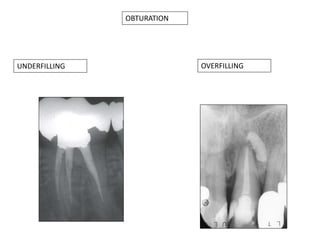
Overfilled/underfilled canals

•

Vertically fractured roots

•

Separated instruments
Legal implications
Does the patient need to know about the mishap ?????????

The patient should be informed about
•

the incident

•

the procedures necessary for its correction

•

alternative treatment modalities

•

effect of the mishap on the prognosis
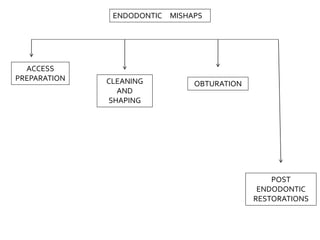
ENDODONTIC MISHAPS

ACCESS
PREPARATION

CLEANING
AND
SHAPING

OBTURATION

POST
ENDODONTIC
RESTORATIONS
ACCESS RELATED :
Main objective of access cavity

▬►

•

straight line access to the canal orifices

•

unobstructed access to the apical foramen
Accidents most commonly encountered during access

opening are:
•

Treating the wrong tooth

•

Missed canals

•

Damage to existing restoration

•

Access cavity perforations

•

Crown fractures
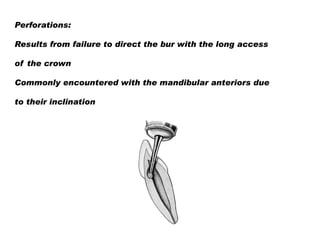
Perforations:

Results from failure to direct the bur with the long access
of the crown
Commonly encountered with the mandibular anteriors due

to their inclination
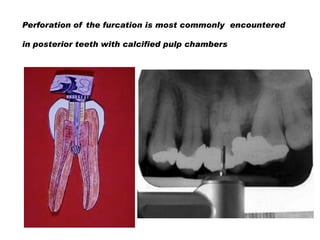
Perforation of the furcation is most commonly encountered

in posterior teeth with calcified pulp chambers
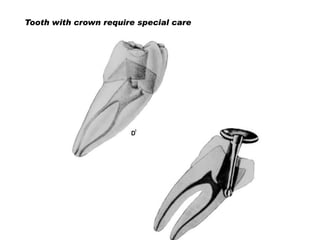
Tooth with crown require special care
 Dentist should not rely completely on the orientation of
the bur as seen on the mirror image

 Periodically the preparation should be stopped and the
access should be examined

 Especially when dealing with calcified chambers
Prevention:
Clinical examination
 Thorough knowledge of tooth morphology and
internal anatomy

 Location and angulation of the tooth with respect
to the adjacent teeth as well as the alveolar bone
Radiographic examination
 Radiographs should be taken at different
angulations
 Presence of calcifications, resorptive defects
Operative procedures:

Rubber dam has to be always placed during endodontic

therapy

Access cavity preparation without rubber dam is indicated in
cases like




Teeth inclines lingually or bucally
teeth with crowns/large restorations
Calcified chambers
This will help in judging the crown root alignment with
respect to the adjacent tooth or the alveolar bone

But once access is achieved the rubber dam should be
placed.

No file/broach should be placed inside the patients mouth
without the rubber dam
Quadrant isolation may help in recognizing the orientation
of the tooth to the adjacent tooth

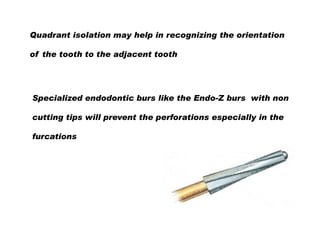
Specialized endodontic burs like the Endo-Z burs with non
cutting tips will prevent the perforations especially in the
furcations
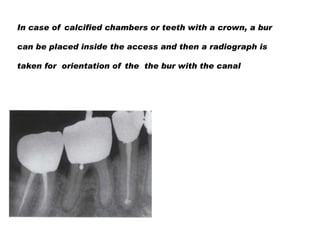
In case of calcified chambers or teeth with a crown, a bur
can be placed inside the access and then a radiograph is
taken for orientation of the the bur with the canal
Important aids for locating canals
-Magnification
- illumination

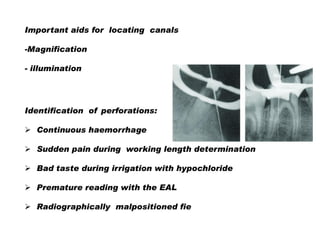
Identification of perforations:
 Continuous haemorrhage
 Sudden pain during working length determination
 Bad taste during irrigation with hypochloride
 Premature reading with the EAL
 Radiographically malpositioned fie
Treatment :

Lateral root perforations:
If above the crestal bone → good prognosis
 Intracoronal placement of restorative material like
Glass ionomer, composite, MTA
 Surgical exposure and sealing the defect externally

Below the crestal bone [coronal third of the root] →
Attachment loss →periodontal pocket
•

Crown lengthening/orthodontic extrusion to expose
the defect and repair
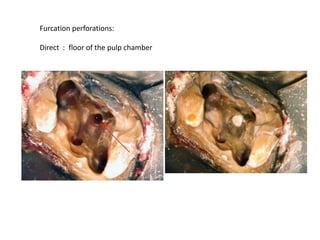
Furcation perforations:
Direct : floor of the pulp chamber
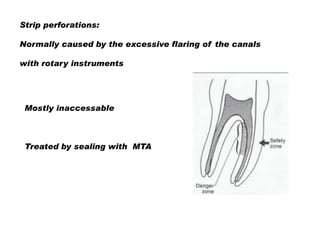
Strip perforations:

Normally caused by the excessive flaring of the canals
with rotary instruments

Mostly inaccessable

Treated by sealing with MTA
Prognosis depends on

size of the perforation
site of perforation
time taken to seal it

Best prognosis if the perforation is sealed immediately.

The sealing material should not block the access of the
canals
CLEANING AND SHAPING
Most common procedural errors during cleaning and shaping
are
•

Ledge formation

•

Artificial canal creation

•

Root perforation

•

Instrument separation

•

Extrusion of the irrigating solution periapically
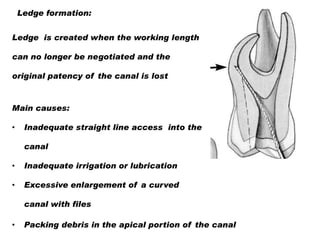
Ledge formation:
Ledge is created when the working length
can no longer be negotiated and the
original patency of the canal is lost

Main causes:
•

Inadequate straight line access into the
canal

•

Inadequate irrigation or lubrication

•

Excessive enlargement of a curved
canal with files

•

Packing debris in the apical portion of the canal
Small, curved and long canals are most prone to ledging
Prevention :
•

Preoperative radiographic evaluation of the root curvatures

•

Straight line access to the canals

•

Precurving the files before the insertion

•

Accurate working length

•

Frequent recapitulation and use of lubricants

•

Recapitulate with a file smaller than the MAF

•

Each file must be worked until loose before moving to the
next size
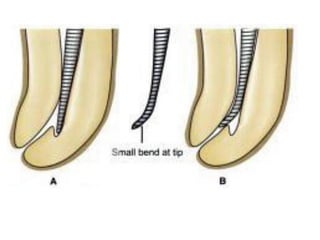
Treatment :

Try to bypass the ledge with the help of smaller instruments
like #8 or #10

Prognosis :
Depends on the amount of debris present beyond the ledge
Creating an artificial canal:

Deviation from the original canal pathway.

Same factors that cause a ledge

Once a ledge is formed and is not diagnosed, the operator

tries to regain the

working length and uses force to

instrument in the direction of the ledge creating a new
pathway
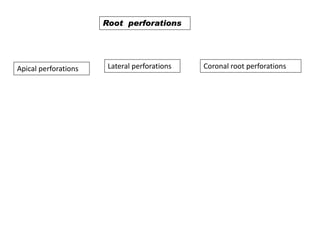
Root perforations

Apical perforations

Lateral perforations

Coronal root perforations
Separated instruments:

Instruments fractured in the canals.

Recognition:

Sudden decrease in the length of the file after removal
from the root canal
Subsequent loss of patency and working length
Prevention:
Check the instruments visually for any deformative each
time the instrument is taken out of the canal
Files are used sequentially without jumping from a small
size to larger size
Treatment:
Bypass the instrument
Retrieve the instrument
Leave the instrument inside the canal
Aspiration or ingestion

Use of rubber dam is mandatory before placing any file in the
canal orifice

The rubber dam clamp is secured with a floss always.

If rubber dam is not used ,atleast tie the instruments with a
floss such that a part of the floss hangs out of the patients
mouth
The patient with the aspirated instrument is referred
to an emergency for the surgical removal of
instrument

the
Extrusion of the irrigant:

Cause:

•

Wedging the needle tightly in the canal during irrigation

•

Forceful expression of the irrigant

Indicators
•

Sudden prolonged and sharp pain during irrigation with

NaOCl
•

Followed by rapid diffuse swelling indicating the
penetration of the fluid into the tissue spaces
How to recognize a NaOCl accident
•

Immediate severe pain (for 2-6 minutes)

•

Ballooning or immediate edema in adjacent soft tissue

•

because of perfusion to the loose connective tissue

•

Extension of edema to a large site of the face such as
cheeks, peri- orbital region, or lips

•

Ecchymosis on skin or mucosa as a result of profuse
interstitial bleeding

•
•

Profuse intraoral bleeding directly from root canal
Chlorine taste or smell because of injected NaOCl to
maxillary sinus
•

Severe initial pain replaced with a constant discomfort or
numbness, related to tissue destruction and distension

•

Reversible or persistent anesthesia

•

Possibility of secondary infection or spreading of former
infection
How to treat a NaOCl accident
•

Remain calm and inform the patient about the cause
and nature of the complication.

•

Immediately irrigate with normal saline to decrease
the soft-tissue irritation by diluting

•

the NaOCl.

•

Let the bleeding response continue as it helps to
flush the irritant out of the tissues.

•

Recommend ice bag compresses for 24 hours (15minute intervals)to minimize swelling.
•

Recommend warm, moist compresses after 24 hours
(15-minute intervals).

•

Recommend rinsing with normal saline for 1 week to

improve circulation to the affected area.
•
•

For pain control
Initial control of acute pain could be achieved with

local anaesthesia
•

Antibiotics are not required

•

Analgesics are given
OBTURATION

UNDERFILLING

OVERFILLING
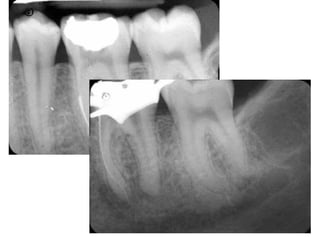
VERTICAL ROOT FRACTURE:
Causes:
 Over instrumentation of canals with increased force

 Cementation of an oversized post

Prevention :

 Less force during cleaning and shaping
 Finger spreaders induce less streses than the hand
spreaders
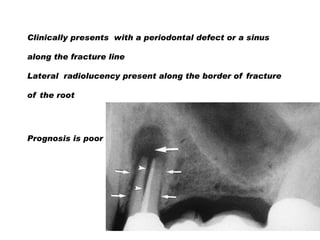
Clinically presents with a periodontal defect or a sinus
along the fracture line
Lateral radiolucency present along the border of fracture

of the root

Prognosis is poor
ACCIDENTS DURING POST PREPARATION:
Most commonly cause perforations
•

Caused due to improper selection of the size of the
drills to create the post space

•

Excessive force during the preparation.

•

Improper characteristics of the post like
short post
large post

•

Improper case selection
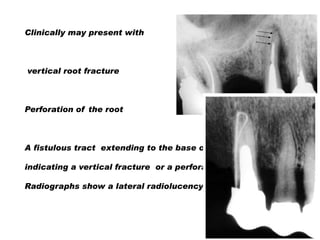
Clinically may present with

vertical root fracture

Perforation of the root

A fistulous tract extending to the base of the post
indicating a vertical fracture or a perforation site
Radiographs show a lateral radiolucency
Prognosis

Vertical root fractures ---------poor

Perforations----------good [surgically exposed and
sealed with MTA]

Endodontic Mishaps

  • 1.
  • 2.
    Endodontic mishaps : Constitutethe procedure related errors or accidents seen during the endodontic procedures.
  • 3.
    • Knowledge of etiologicfactors involved • Methods of recognition • Methods of treatment/correction • Effects of the mishap on the prognosis of the root canal therapy
  • 4.
    Some of theexamples of procedural accidents are: • Accidental swallowing /aspiration of an endodontic instrument • Perforations • Ledge formations • Missed canals • Overfilled/underfilled canals • Vertically fractured roots • Separated instruments
  • 5.
    Legal implications Does thepatient need to know about the mishap ????????? The patient should be informed about • the incident • the procedures necessary for its correction • alternative treatment modalities • effect of the mishap on the prognosis
  • 6.
  • 7.
    ACCESS RELATED : Mainobjective of access cavity ▬► • straight line access to the canal orifices • unobstructed access to the apical foramen
  • 8.
    Accidents most commonlyencountered during access opening are: • Treating the wrong tooth • Missed canals • Damage to existing restoration • Access cavity perforations • Crown fractures
  • 9.
    Perforations: Results from failureto direct the bur with the long access of the crown Commonly encountered with the mandibular anteriors due to their inclination
  • 10.
    Perforation of thefurcation is most commonly encountered in posterior teeth with calcified pulp chambers
  • 11.
    Tooth with crownrequire special care
  • 12.
     Dentist shouldnot rely completely on the orientation of the bur as seen on the mirror image  Periodically the preparation should be stopped and the access should be examined  Especially when dealing with calcified chambers
  • 13.
    Prevention: Clinical examination  Thoroughknowledge of tooth morphology and internal anatomy  Location and angulation of the tooth with respect to the adjacent teeth as well as the alveolar bone Radiographic examination  Radiographs should be taken at different angulations  Presence of calcifications, resorptive defects
  • 14.
    Operative procedures: Rubber damhas to be always placed during endodontic therapy Access cavity preparation without rubber dam is indicated in cases like    Teeth inclines lingually or bucally teeth with crowns/large restorations Calcified chambers
  • 15.
    This will helpin judging the crown root alignment with respect to the adjacent tooth or the alveolar bone But once access is achieved the rubber dam should be placed. No file/broach should be placed inside the patients mouth without the rubber dam
  • 16.
    Quadrant isolation mayhelp in recognizing the orientation of the tooth to the adjacent tooth Specialized endodontic burs like the Endo-Z burs with non cutting tips will prevent the perforations especially in the furcations
  • 17.
    In case ofcalcified chambers or teeth with a crown, a bur can be placed inside the access and then a radiograph is taken for orientation of the the bur with the canal
  • 18.
    Important aids forlocating canals -Magnification - illumination Identification of perforations:  Continuous haemorrhage  Sudden pain during working length determination  Bad taste during irrigation with hypochloride  Premature reading with the EAL  Radiographically malpositioned fie
  • 19.
    Treatment : Lateral rootperforations: If above the crestal bone → good prognosis  Intracoronal placement of restorative material like Glass ionomer, composite, MTA  Surgical exposure and sealing the defect externally Below the crestal bone [coronal third of the root] → Attachment loss →periodontal pocket • Crown lengthening/orthodontic extrusion to expose the defect and repair
  • 20.
    Furcation perforations: Direct :floor of the pulp chamber
  • 21.
    Strip perforations: Normally causedby the excessive flaring of the canals with rotary instruments Mostly inaccessable Treated by sealing with MTA
  • 22.
    Prognosis depends on sizeof the perforation site of perforation time taken to seal it Best prognosis if the perforation is sealed immediately. The sealing material should not block the access of the canals
  • 23.
    CLEANING AND SHAPING Mostcommon procedural errors during cleaning and shaping are • Ledge formation • Artificial canal creation • Root perforation • Instrument separation • Extrusion of the irrigating solution periapically
  • 24.
    Ledge formation: Ledge iscreated when the working length can no longer be negotiated and the original patency of the canal is lost Main causes: • Inadequate straight line access into the canal • Inadequate irrigation or lubrication • Excessive enlargement of a curved canal with files • Packing debris in the apical portion of the canal
  • 25.
    Small, curved andlong canals are most prone to ledging Prevention : • Preoperative radiographic evaluation of the root curvatures • Straight line access to the canals • Precurving the files before the insertion • Accurate working length • Frequent recapitulation and use of lubricants • Recapitulate with a file smaller than the MAF • Each file must be worked until loose before moving to the next size
  • 26.
    Treatment : Try tobypass the ledge with the help of smaller instruments like #8 or #10 Prognosis : Depends on the amount of debris present beyond the ledge
  • 28.
    Creating an artificialcanal: Deviation from the original canal pathway. Same factors that cause a ledge Once a ledge is formed and is not diagnosed, the operator tries to regain the working length and uses force to instrument in the direction of the ledge creating a new pathway
  • 29.
    Root perforations Apical perforations Lateralperforations Coronal root perforations
  • 30.
    Separated instruments: Instruments fracturedin the canals. Recognition: Sudden decrease in the length of the file after removal from the root canal Subsequent loss of patency and working length
  • 31.
    Prevention: Check the instrumentsvisually for any deformative each time the instrument is taken out of the canal Files are used sequentially without jumping from a small size to larger size Treatment: Bypass the instrument Retrieve the instrument Leave the instrument inside the canal
  • 33.
    Aspiration or ingestion Useof rubber dam is mandatory before placing any file in the canal orifice The rubber dam clamp is secured with a floss always. If rubber dam is not used ,atleast tie the instruments with a floss such that a part of the floss hangs out of the patients mouth
  • 34.
    The patient withthe aspirated instrument is referred to an emergency for the surgical removal of instrument the
  • 35.
    Extrusion of theirrigant: Cause: • Wedging the needle tightly in the canal during irrigation • Forceful expression of the irrigant Indicators • Sudden prolonged and sharp pain during irrigation with NaOCl • Followed by rapid diffuse swelling indicating the penetration of the fluid into the tissue spaces
  • 36.
    How to recognizea NaOCl accident • Immediate severe pain (for 2-6 minutes) • Ballooning or immediate edema in adjacent soft tissue • because of perfusion to the loose connective tissue • Extension of edema to a large site of the face such as cheeks, peri- orbital region, or lips • Ecchymosis on skin or mucosa as a result of profuse interstitial bleeding • • Profuse intraoral bleeding directly from root canal Chlorine taste or smell because of injected NaOCl to maxillary sinus
  • 37.
    • Severe initial painreplaced with a constant discomfort or numbness, related to tissue destruction and distension • Reversible or persistent anesthesia • Possibility of secondary infection or spreading of former infection
  • 38.
    How to treata NaOCl accident • Remain calm and inform the patient about the cause and nature of the complication. • Immediately irrigate with normal saline to decrease the soft-tissue irritation by diluting • the NaOCl. • Let the bleeding response continue as it helps to flush the irritant out of the tissues. • Recommend ice bag compresses for 24 hours (15minute intervals)to minimize swelling.
  • 39.
    • Recommend warm, moistcompresses after 24 hours (15-minute intervals). • Recommend rinsing with normal saline for 1 week to improve circulation to the affected area. • • For pain control Initial control of acute pain could be achieved with local anaesthesia • Antibiotics are not required • Analgesics are given
  • 40.
  • 41.
    VERTICAL ROOT FRACTURE: Causes: Over instrumentation of canals with increased force  Cementation of an oversized post Prevention :  Less force during cleaning and shaping  Finger spreaders induce less streses than the hand spreaders
  • 42.
    Clinically presents witha periodontal defect or a sinus along the fracture line Lateral radiolucency present along the border of fracture of the root Prognosis is poor
  • 43.
    ACCIDENTS DURING POSTPREPARATION: Most commonly cause perforations • Caused due to improper selection of the size of the drills to create the post space • Excessive force during the preparation. • Improper characteristics of the post like short post large post • Improper case selection
  • 44.
    Clinically may presentwith vertical root fracture Perforation of the root A fistulous tract extending to the base of the post indicating a vertical fracture or a perforation site Radiographs show a lateral radiolucency
  • 45.
    Prognosis Vertical root fractures---------poor Perforations----------good [surgically exposed and sealed with MTA]