Causes
Prognosis
Classification
Diagnosis
Determining Location Of Perforation
Repair Materials
Prevention Of Perforation
Management
CAUSES
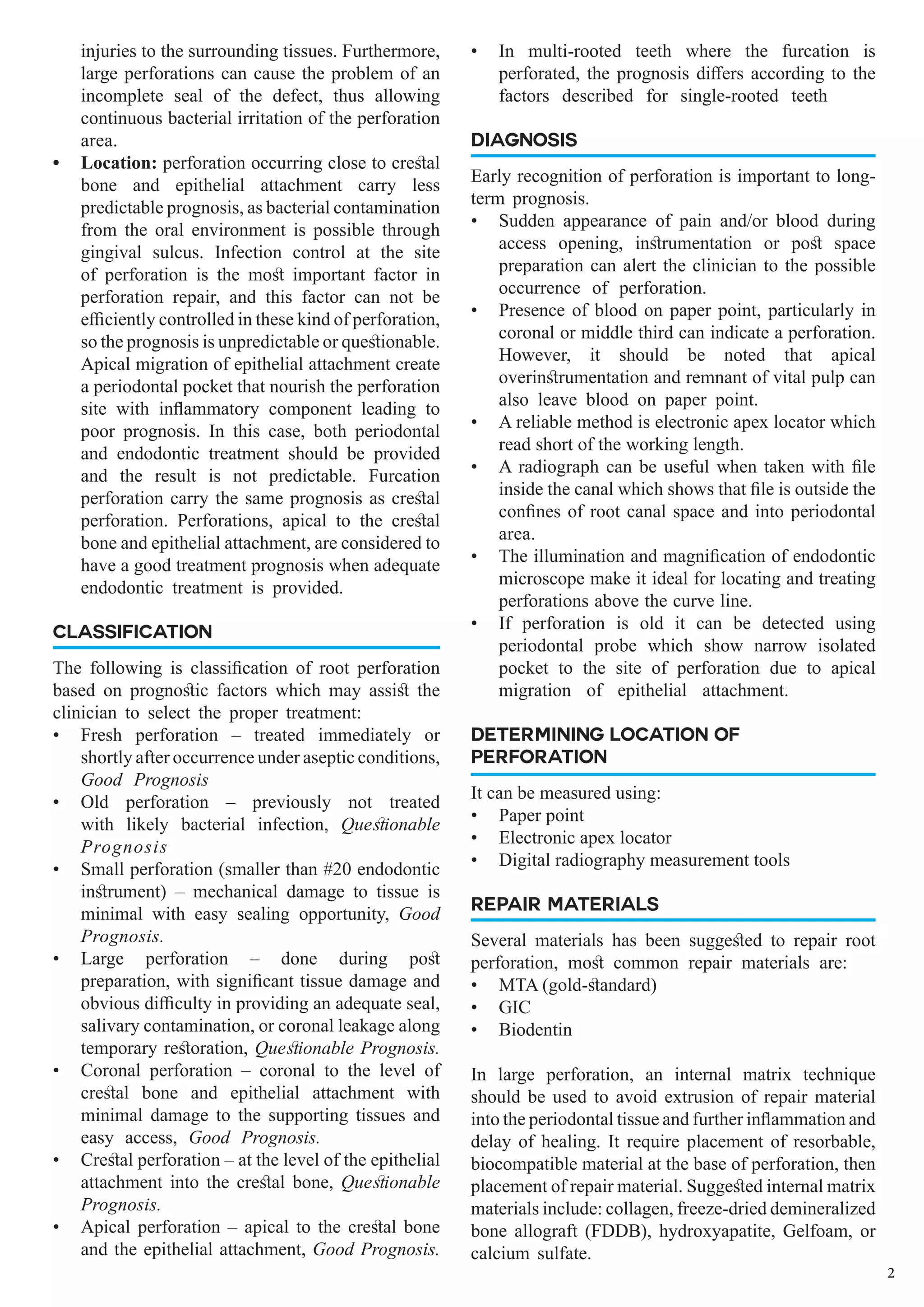
•	 Access preparation: straight line access through
the crown is essential to preserve tooth structure
integrity. However, sometimes crown and root
not aligned that make access opening difficult to
imagine and produce. Such cases include teeth with
fixed prosthesis (crown), dilacerated and rotated
teeth. These teeth should be studied carefully
on parallel or bitewing radiograph and depth of
pulp chamber is measured to avoid overzealous
preparation.
•	 Canal identification: sometimes it’s difficult
to find canal orifices due to calcified or sclerotic
pulp chamber. These cases require referral to
specialist endodontist with experience and
equipments (endodontic microscope). Calcified
pulp chambers should not be negotiated using
rotary bur as this represent the perfect technique
for perforation!
•	 Canal preparation: incorrect use of large
stainless steel instruments in curved canal result in
perforation. Creating glide path for rotary
Ni-Ti files guarantee less iatrogenic errors such as
perforation or ledging. Also the overzealous use of
gates glidden burs in curved portion of canals can
lead to such errors.
•	 Post space preparation: ideally 4-5 mm of
gutta-percha should remain in canal after post space
preparation. Inappropriate use of preparation burs
and instrument to create space for posts in curved
canals can lead to strip perforation. Careful study
of tooth anatomy and measurement is a must.
PROGNOSIS
Several prognostic factors can affect the treatment
outcome of perforation:
•	 Time: is the most crucial and effective factor in
prognosis of perforation. Root perforation that
repaired immediately in the same appointment
carry the best prognosis. If immediate treatment
can not be provided, a temporary restoration is
placed and patient referred to a specialist.
•	 Size: large perforation may not response to repair
as small perforation. Large perforations are more
likely to occur during operative procedures, when
aggressive burs are used, causing more traumatic
Endodontic root perforation
Osama Asadi, B.D.S, Published for Iraqi Dental Academy Blog
Root perforation is an artificial communication between the root canal system and the supporting tissues of
teeth and it occur in 2-12% of endodontically treated teeth. Root perforation are caused either pathological
by resorption and caries, or iatrogenically during root canal treatment (zip, strip, furcation perforation) or
after root canal treatment (post preparation perforation). Root perforation may complicate the success of
root canal treatment if not managed correctly and immediately.
LECTURE OUTLINE
CHAPTER
1
2
injuries to the surrounding tissues. Furthermore,
large perforations can cause the problem of an
incomplete seal of the defect, thus allowing
continuous bacterial irritation of the perforation
area.
•	 Location: perforation occurring close to crestal
bone and epithelial attachment carry less
predictable prognosis, as bacterial contamination
from the oral environment is possible through
gingival sulcus. Infection control at the site
of perforation is the most important factor in
perforation repair, and this factor can not be
efficiently controlled in these kind of perforation,
so the prognosis is unpredictable or questionable.
Apical migration of epithelial attachment create
a periodontal pocket that nourish the perforation
site with inflammatory component leading to
poor prognosis. In this case, both periodontal
and endodontic treatment should be provided
and the result is not predictable. Furcation
perforation carry the same prognosis as crestal
perforation. Perforations, apical to the crestal
bone and epithelial attachment, are considered to
have a good treatment prognosis when adequate
endodontic treatment is provided.
CLASSIFICATION
The following is classification of root perforation
based on prognostic factors which may assist the
clinician to select the proper treatment:
•	 Fresh perforation – treated immediately or
shortly after occurrence under aseptic conditions,
Good Prognosis
•	 Old perforation – previously not treated
with likely bacterial infection, Questionable
Prognosis
•	 Small perforation (smaller than #20 endodontic
instrument) – mechanical damage to tissue is
minimal with easy sealing opportunity, Good
Prognosis.
•	 Large perforation – done during post
preparation, with significant tissue damage and
obvious difficulty in providing an adequate seal,
salivary contamination, or coronal leakage along
temporary restoration, Questionable Prognosis.
•	 Coronal perforation – coronal to the level of
crestal bone and epithelial attachment with
minimal damage to the supporting tissues and
easy access, Good Prognosis.
•	 Crestal perforation – at the level of the epithelial
attachment into the crestal bone, Questionable
Prognosis.
•	 Apical perforation – apical to the crestal bone
and the epithelial attachment, Good Prognosis.
•	 In multi-rooted teeth where the furcation is
perforated, the prognosis differs according to the
factors described for single-rooted teeth
DIAGNOSIS
Early recognition of perforation is important to long-
term prognosis.
•	 Sudden appearance of pain and/or blood during
access opening, instrumentation or post space
preparation can alert the clinician to the possible
occurrence of perforation.
•	 Presence of blood on paper point, particularly in
coronal or middle third can indicate a perforation.
However, it should be noted that apical
overinstrumentation and remnant of vital pulp can
also leave blood on paper point.
•	 A reliable method is electronic apex locator which
read short of the working length.
•	 A radiograph can be useful when taken with file
inside the canal which shows that file is outside the
confines of root canal space and into periodontal
area.
•	 The illumination and magnification of endodontic
microscope make it ideal for locating and treating
perforations above the curve line.
•	 If perforation is old it can be detected using
periodontal probe which show narrow isolated
pocket to the site of perforation due to apical
migration of epithelial attachment.
DETERMINING LOCATION OF
PERFORATION
It can be measured using:
•	 Paper point
•	 Electronic apex locator
•	 Digital radiography measurement tools
REPAIR MATERIALS
Several materials has been suggested to repair root
perforation, most common repair materials are:
•	 MTA (gold-standard)
•	 GIC
•	 Biodentin
In large perforation, an internal matrix technique
should be used to avoid extrusion of repair material
into the periodontal tissue and further inflammation and
delay of healing. It require placement of resorbable,
biocompatible material at the base of perforation, then
placement of repair material. Suggested internal matrix
materials include: collagen, freeze-dried demineralized
bone allograft (FDDB), hydroxyapatite, Gelfoam, or
calcium sulfate.
PREVENTION OF PERFORATION
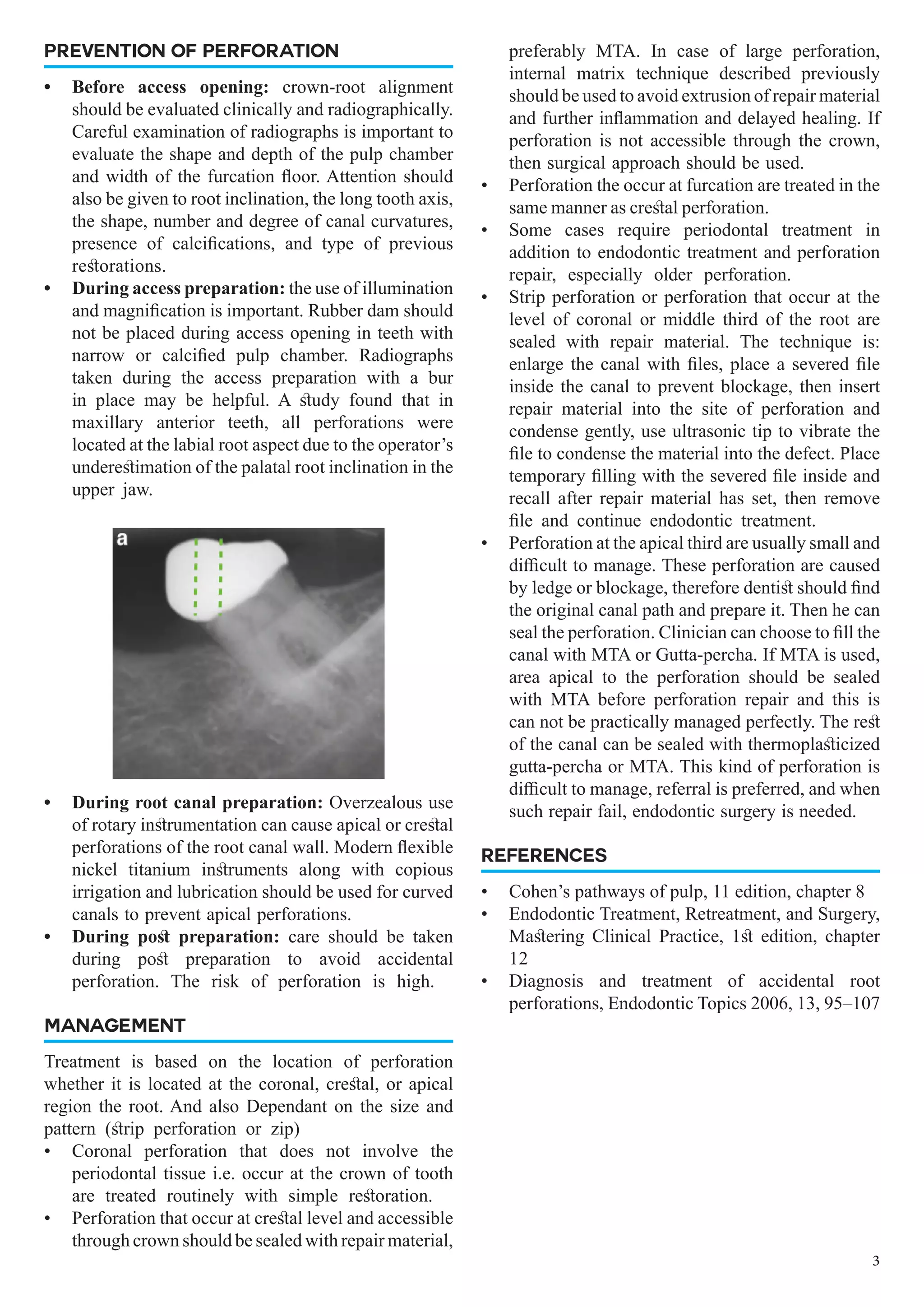
•	 Before access opening: crown-root alignment
should be evaluated clinically and radiographically.
Careful examination of radiographs is important to
evaluate the shape and depth of the pulp chamber
and width of the furcation floor. Attention should
also be given to root inclination, the long tooth axis,
the shape, number and degree of canal curvatures,
presence of calcifications, and type of previous
restorations.
•	 During access preparation: the use of illumination
and magnification is important. Rubber dam should
not be placed during access opening in teeth with
narrow or calcified pulp chamber. Radiographs
taken during the access preparation with a bur
in place may be helpful. A study found that in
maxillary anterior teeth, all perforations were
located at the labial root aspect due to the operator’s
underestimation of the palatal root inclination in the
upper jaw.
•	 During root canal preparation: Overzealous use
of rotary instrumentation can cause apical or crestal
perforations of the root canal wall. Modern flexible
nickel titanium instruments along with copious
irrigation and lubrication should be used for curved
canals to prevent apical perforations.
•	 During post preparation: care should be taken
during post preparation to avoid accidental
perforation. The risk of perforation is high.
MANAGEMENT
Treatment is based on the location of perforation
whether it is located at the coronal, crestal, or apical
region the root. And also Dependant on the size and
pattern (strip perforation or zip)
•	 Coronal perforation that does not involve the
periodontal tissue i.e. occur at the crown of tooth
are treated routinely with simple restoration.
•	 Perforation that occur at crestal level and accessible
through crown should be sealed with repair material,
preferably MTA. In case of large perforation,
internal matrix technique described previously
should be used to avoid extrusion of repair material
and further inflammation and delayed healing. If
perforation is not accessible through the crown,
then surgical approach should be used.
•	 Perforation the occur at furcation are treated in the
same manner as crestal perforation.
•	 Some cases require periodontal treatment in
addition to endodontic treatment and perforation
repair, especially older perforation.
•	 Strip perforation or perforation that occur at the
level of coronal or middle third of the root are
sealed with repair material. The technique is:
enlarge the canal with files, place a severed file
inside the canal to prevent blockage, then insert
repair material into the site of perforation and
condense gently, use ultrasonic tip to vibrate the
file to condense the material into the defect. Place
temporary filling with the severed file inside and
recall after repair material has set, then remove
file and continue endodontic treatment.
•	 Perforation at the apical third are usually small and
difficult to manage. These perforation are caused
by ledge or blockage, therefore dentist should find
the original canal path and prepare it. Then he can
seal the perforation. Clinician can choose to fill the
canal with MTA or Gutta-percha. If MTA is used,
area apical to the perforation should be sealed
with MTA before perforation repair and this is
can not be practically managed perfectly. The rest
of the canal can be sealed with thermoplasticized
gutta-percha or MTA. This kind of perforation is
difficult to manage, referral is preferred, and when
such repair fail, endodontic surgery is needed.
REFERENCES
•	 Cohen’s pathways of pulp, 11 edition, chapter 8
•	 Endodontic Treatment, Retreatment, and Surgery,
Mastering Clinical Practice, 1st edition, chapter
12
•	 Diagnosis and treatment of accidental root
perforations, Endodontic Topics 2006, 13, 95–107
3

Endodontic Root Perforation: Causes, Identification, and Management Lecture

  • 1.
    Causes Prognosis Classification Diagnosis Determining Location OfPerforation Repair Materials Prevention Of Perforation Management CAUSES • Access preparation: straight line access through the crown is essential to preserve tooth structure integrity. However, sometimes crown and root not aligned that make access opening difficult to imagine and produce. Such cases include teeth with fixed prosthesis (crown), dilacerated and rotated teeth. These teeth should be studied carefully on parallel or bitewing radiograph and depth of pulp chamber is measured to avoid overzealous preparation. • Canal identification: sometimes it’s difficult to find canal orifices due to calcified or sclerotic pulp chamber. These cases require referral to specialist endodontist with experience and equipments (endodontic microscope). Calcified pulp chambers should not be negotiated using rotary bur as this represent the perfect technique for perforation! • Canal preparation: incorrect use of large stainless steel instruments in curved canal result in perforation. Creating glide path for rotary Ni-Ti files guarantee less iatrogenic errors such as perforation or ledging. Also the overzealous use of gates glidden burs in curved portion of canals can lead to such errors. • Post space preparation: ideally 4-5 mm of gutta-percha should remain in canal after post space preparation. Inappropriate use of preparation burs and instrument to create space for posts in curved canals can lead to strip perforation. Careful study of tooth anatomy and measurement is a must. PROGNOSIS Several prognostic factors can affect the treatment outcome of perforation: • Time: is the most crucial and effective factor in prognosis of perforation. Root perforation that repaired immediately in the same appointment carry the best prognosis. If immediate treatment can not be provided, a temporary restoration is placed and patient referred to a specialist. • Size: large perforation may not response to repair as small perforation. Large perforations are more likely to occur during operative procedures, when aggressive burs are used, causing more traumatic Endodontic root perforation Osama Asadi, B.D.S, Published for Iraqi Dental Academy Blog Root perforation is an artificial communication between the root canal system and the supporting tissues of teeth and it occur in 2-12% of endodontically treated teeth. Root perforation are caused either pathological by resorption and caries, or iatrogenically during root canal treatment (zip, strip, furcation perforation) or after root canal treatment (post preparation perforation). Root perforation may complicate the success of root canal treatment if not managed correctly and immediately. LECTURE OUTLINE CHAPTER 1
  • 2.
    2 injuries to thesurrounding tissues. Furthermore, large perforations can cause the problem of an incomplete seal of the defect, thus allowing continuous bacterial irritation of the perforation area. • Location: perforation occurring close to crestal bone and epithelial attachment carry less predictable prognosis, as bacterial contamination from the oral environment is possible through gingival sulcus. Infection control at the site of perforation is the most important factor in perforation repair, and this factor can not be efficiently controlled in these kind of perforation, so the prognosis is unpredictable or questionable. Apical migration of epithelial attachment create a periodontal pocket that nourish the perforation site with inflammatory component leading to poor prognosis. In this case, both periodontal and endodontic treatment should be provided and the result is not predictable. Furcation perforation carry the same prognosis as crestal perforation. Perforations, apical to the crestal bone and epithelial attachment, are considered to have a good treatment prognosis when adequate endodontic treatment is provided. CLASSIFICATION The following is classification of root perforation based on prognostic factors which may assist the clinician to select the proper treatment: • Fresh perforation – treated immediately or shortly after occurrence under aseptic conditions, Good Prognosis • Old perforation – previously not treated with likely bacterial infection, Questionable Prognosis • Small perforation (smaller than #20 endodontic instrument) – mechanical damage to tissue is minimal with easy sealing opportunity, Good Prognosis. • Large perforation – done during post preparation, with significant tissue damage and obvious difficulty in providing an adequate seal, salivary contamination, or coronal leakage along temporary restoration, Questionable Prognosis. • Coronal perforation – coronal to the level of crestal bone and epithelial attachment with minimal damage to the supporting tissues and easy access, Good Prognosis. • Crestal perforation – at the level of the epithelial attachment into the crestal bone, Questionable Prognosis. • Apical perforation – apical to the crestal bone and the epithelial attachment, Good Prognosis. • In multi-rooted teeth where the furcation is perforated, the prognosis differs according to the factors described for single-rooted teeth DIAGNOSIS Early recognition of perforation is important to long- term prognosis. • Sudden appearance of pain and/or blood during access opening, instrumentation or post space preparation can alert the clinician to the possible occurrence of perforation. • Presence of blood on paper point, particularly in coronal or middle third can indicate a perforation. However, it should be noted that apical overinstrumentation and remnant of vital pulp can also leave blood on paper point. • A reliable method is electronic apex locator which read short of the working length. • A radiograph can be useful when taken with file inside the canal which shows that file is outside the confines of root canal space and into periodontal area. • The illumination and magnification of endodontic microscope make it ideal for locating and treating perforations above the curve line. • If perforation is old it can be detected using periodontal probe which show narrow isolated pocket to the site of perforation due to apical migration of epithelial attachment. DETERMINING LOCATION OF PERFORATION It can be measured using: • Paper point • Electronic apex locator • Digital radiography measurement tools REPAIR MATERIALS Several materials has been suggested to repair root perforation, most common repair materials are: • MTA (gold-standard) • GIC • Biodentin In large perforation, an internal matrix technique should be used to avoid extrusion of repair material into the periodontal tissue and further inflammation and delay of healing. It require placement of resorbable, biocompatible material at the base of perforation, then placement of repair material. Suggested internal matrix materials include: collagen, freeze-dried demineralized bone allograft (FDDB), hydroxyapatite, Gelfoam, or calcium sulfate.
  • 3.
    PREVENTION OF PERFORATION • Before access opening: crown-root alignment should be evaluated clinically and radiographically. Careful examination of radiographs is important to evaluate the shape and depth of the pulp chamber and width of the furcation floor. Attention should also be given to root inclination, the long tooth axis, the shape, number and degree of canal curvatures, presence of calcifications, and type of previous restorations. • During access preparation: the use of illumination and magnification is important. Rubber dam should not be placed during access opening in teeth with narrow or calcified pulp chamber. Radiographs taken during the access preparation with a bur in place may be helpful. A study found that in maxillary anterior teeth, all perforations were located at the labial root aspect due to the operator’s underestimation of the palatal root inclination in the upper jaw. • During root canal preparation: Overzealous use of rotary instrumentation can cause apical or crestal perforations of the root canal wall. Modern flexible nickel titanium instruments along with copious irrigation and lubrication should be used for curved canals to prevent apical perforations. • During post preparation: care should be taken during post preparation to avoid accidental perforation. The risk of perforation is high. MANAGEMENT Treatment is based on the location of perforation whether it is located at the coronal, crestal, or apical region the root. And also Dependant on the size and pattern (strip perforation or zip) • Coronal perforation that does not involve the periodontal tissue i.e. occur at the crown of tooth are treated routinely with simple restoration. • Perforation that occur at crestal level and accessible through crown should be sealed with repair material, preferably MTA. In case of large perforation, internal matrix technique described previously should be used to avoid extrusion of repair material and further inflammation and delayed healing. If perforation is not accessible through the crown, then surgical approach should be used. • Perforation the occur at furcation are treated in the same manner as crestal perforation. • Some cases require periodontal treatment in addition to endodontic treatment and perforation repair, especially older perforation. • Strip perforation or perforation that occur at the level of coronal or middle third of the root are sealed with repair material. The technique is: enlarge the canal with files, place a severed file inside the canal to prevent blockage, then insert repair material into the site of perforation and condense gently, use ultrasonic tip to vibrate the file to condense the material into the defect. Place temporary filling with the severed file inside and recall after repair material has set, then remove file and continue endodontic treatment. • Perforation at the apical third are usually small and difficult to manage. These perforation are caused by ledge or blockage, therefore dentist should find the original canal path and prepare it. Then he can seal the perforation. Clinician can choose to fill the canal with MTA or Gutta-percha. If MTA is used, area apical to the perforation should be sealed with MTA before perforation repair and this is can not be practically managed perfectly. The rest of the canal can be sealed with thermoplasticized gutta-percha or MTA. This kind of perforation is difficult to manage, referral is preferred, and when such repair fail, endodontic surgery is needed. REFERENCES • Cohen’s pathways of pulp, 11 edition, chapter 8 • Endodontic Treatment, Retreatment, and Surgery, Mastering Clinical Practice, 1st edition, chapter 12 • Diagnosis and treatment of accidental root perforations, Endodontic Topics 2006, 13, 95–107 3