CRACKED TOOTH SYNDROME 
SAPPORO DENTAL COLLEGE AND HOSPITAL 
DEPARTMENT OF CONSERVATIVE DENTISTRY 
AND ENDODONTICS 
Presented By: 
Dr. Mahshina Khanom (IS-25) 
Dr. Ha-Meem Fattaha (IS-26)
WHAT IS CRACKED TOOTH SYNDROME? 
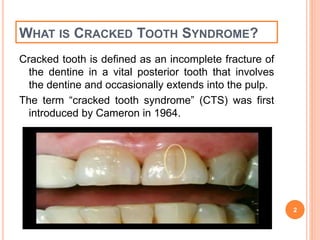
Cracked tooth is defined as an incomplete fracture of 
the dentine in a vital posterior tooth that involves 
the dentine and occasionally extends into the pulp. 
The term “cracked tooth syndrome” (CTS) was first 
introduced by Cameron in 1964. 
2
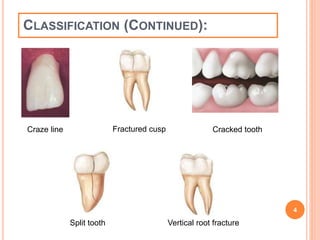
CLASSIFICATION (CONTINUED): 
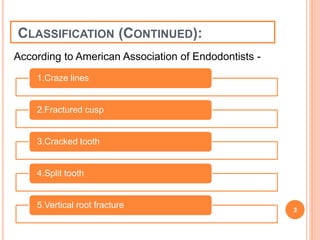
According to American Association of Endodontists - 
1.Craze lines 
2.Fractured cusp 
3.Cracked tooth 
4.Split tooth 
5.Vertical root fracture 
3
CLASSIFICATION (CONTINUED): 
Craze line Fractured cusp Cracked tooth 
Split tooth Vertical root fracture 
4
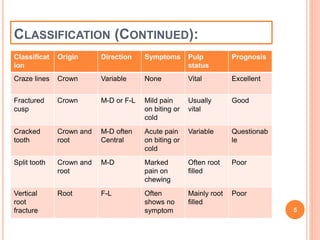
CLASSIFICATION (CONTINUED): 
Classificat 
ion 
Origin Direction Symptoms Pulp 
status 
Prognosis 
Craze lines Crown Variable None Vital Excellent 
Fractured 
cusp 
Crown M-D or F-L Mild pain 
on biting or 
cold 
Usually 
vital 
Good 
Cracked 
tooth 
Crown and 
root 
M-D often 
Central 
Acute pain 
on biting or 
cold 
Variable Questionab 
le 
Split tooth Crown and 
root 
M-D Marked 
pain on 
chewing 
Often root 
filled 
Poor 
Vertical 
root 
fracture 
Root F-L Often 
shows no 
symptom 
Mainly root 
filled 
Poor 
5
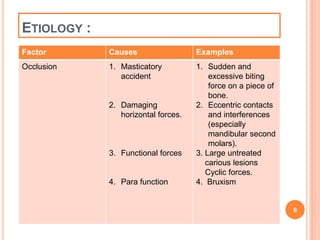
ETIOLOGY : 
Factor Causes Examples 
Occlusion 1. Masticatory 
accident 
2. Damaging 
horizontal forces. 
3. Functional forces 
4. Para function 
1. Sudden and 
excessive biting 
force on a piece of 
bone. 
2. Eccentric contacts 
and interferences 
(especially 
mandibular second 
molars). 
3. Large untreated 
carious lesions 
Cyclic forces. 
4. Bruxism 
6
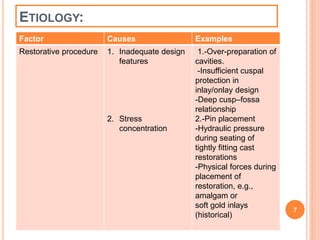
ETIOLOGY: 
Factor Causes Examples 
Restorative procedure 1. Inadequate design 
features 
2. Stress 
concentration 
1.-Over-preparation of 
cavities. 
-Insufficient cuspal 
protection in 
inlay/onlay design 
-Deep cusp–fossa 
relationship 
2.-Pin placement 
-Hydraulic pressure 
during seating of 
tightly fitting cast 
restorations 
-Physical forces during 
placement of 
restoration, e.g., 
amalgam or 
soft gold inlays 
(historical) 
7
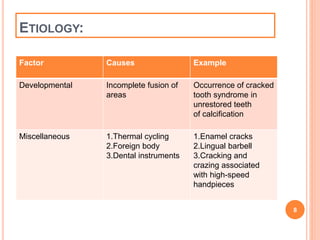
ETIOLOGY: 
Factor Causes Example 
Developmental Incomplete fusion of 
areas 
Occurrence of cracked 
tooth syndrome in 
unrestored teeth 
of calcification 
Miscellaneous 1.Thermal cycling 
2.Foreign body 
3.Dental instruments 
1.Enamel cracks 
2.Lingual barbell 
3.Cracking and 
crazing associated 
with high-speed 
handpieces 
8
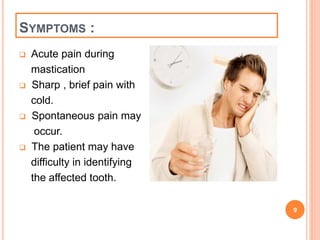
SYMPTOMS : 
 Acute pain during 
mastication 
 Sharp , brief pain with 
cold. 
 Spontaneous pain may 
occur. 
 The patient may have 
difficulty in identifying 
the affected tooth. 
9
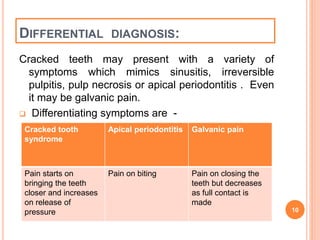
DIFFERENTIAL DIAGNOSIS: 
Cracked teeth may present with a variety of 
symptoms which mimics sinusitis, irreversible 
pulpitis, pulp necrosis or apical periodontitis . Even 
it may be galvanic pain. 
 Differentiating symptoms are - 
Cracked tooth 
syndrome 
Apical periodontitis Galvanic pain 
Pain starts on 
bringing the teeth 
closer and increases 
on release of 
pressure 
Pain on biting Pain on closing the 
teeth but decreases 
as full contact is 
made 
10
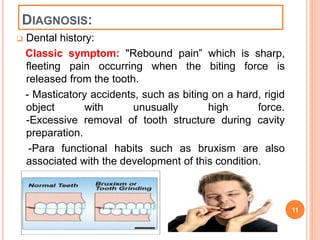
DIAGNOSIS: 
 Dental history: 
Classic symptom: "Rebound pain” which is sharp, 
fleeting pain occurring when the biting force is 
released from the tooth. 
- Masticatory accidents, such as biting on a hard, rigid 
object with unusually high force. 
-Excessive removal of tooth structure during cavity 
preparation. 
-Para functional habits such as bruxism are also 
associated with the development of this condition. 
11
Diagnosis (Continued) : 
 Signs: 
- Vitality testing usually gives a positive response. 
- Pain can be elicited when pressure into individual cusp 
by tooth slooth, rubber cup, cotton roll, wooden stick etc. 
Pain increases as the pressure is released. 
The results of these “bite tests” are conclusive in forming 
a diagnosis. 
12
Diagnosis (Continued) : 
 Visual inspection: 
Following examinations can be done to diagnose 
the syndrome - 
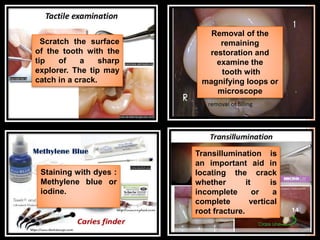
1.Tactile examination 
2.Removal of existing restoration 
3.Staining with dyes 
4.Transillumination test 
13
Scratch the surface 
of the tooth with the 
tip of a sharp 
explorer. The tip may 
catch in a crack. 
Removal of the 
remaining 
restoration and 
examine the 
tooth with 
magnifying loops or 
microscope 
Staining with dyes : 
Methylene blue or 
iodine. 
Transillumination is 
an important aid in 
locating the crack 
whether it is 
incomplete or a 
complete vertical 
root fracture. 14
TREATMENT PLANNING: 
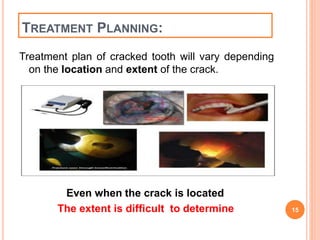
Treatment plan of cracked tooth will vary depending 
on the location and extent of the crack. 
Even when the crack is located 
The extent is difficult to determine 15
TREATMENT : 
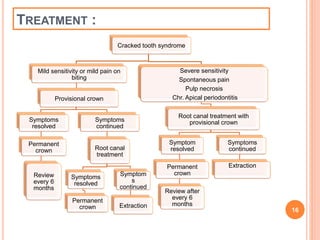
Cracked tooth syndrome 
Mild sensitivity or mild pain on 
biting 
Provisional crown 
Symptoms 
resolved 
Permanent 
crown 
Review 
every 6 
months 
Symptoms 
continued 
Root canal 
treatment 
Symptoms 
resolved 
Permanent 
crown 
Symptom 
s 
continued 
Extraction 
Severe sensitivity 
Spontaneous pain 
Pulp necrosis 
Chr. Apical periodontitis 
Root canal treatment with 
provisional crown 
Symptom 
resolved 
Permanent 
crown 
Review after 
every 6 
months 
Symptoms 
continued 
Extraction 
16
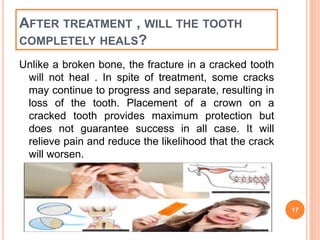
AFTER TREATMENT , WILL THE TOOTH 
COMPLETELY HEALS? 
Unlike a broken bone, the fracture in a cracked tooth 
will not heal . In spite of treatment, some cracks 
may continue to progress and separate, resulting in 
loss of the tooth. Placement of a crown on a 
cracked tooth provides maximum protection but 
does not guarantee success in all case. It will 
relieve pain and reduce the likelihood that the crack 
will worsen. 
17
PREVENTION FROM CRACKING: 
While cracked teeth are not completely preventable, 
some steps can make teeth less susceptible to 
cracks. 
A. Steps by the patient- 
-Don't chew on hard objects such as ice, unpoped 
popcorn kernels or pens. 
-Don't clench or grind teeth. 
-If you clench or grind your teeth while you sleep, 
talk to your dentist about getting a retainer or other 
mouth guard to protect your teeth. 
-Wear a mouth guard or protective mask when 
playing contact sports. 18
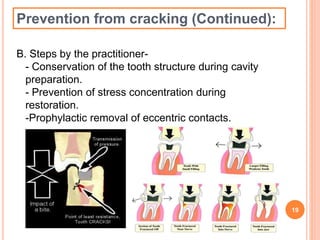
Prevention from cracking (Continued): 
B. Steps by the practitioner- 
- Conservation of the tooth structure during cavity 
preparation. 
- Prevention of stress concentration during 
restoration. 
-Prophylactic removal of eccentric contacts. 
19
SUMMERY: 
If a crack is suspected, the steps outlined and 
detailed, should be taken immediately to confirm 
the presence of a crack, determine the type and 
formulate an appropriate treatment plan. Quick 
action on the part of practitioners can improve the 
chances of saving the tooth. 
20
REFERENCES: 
 http://www.aae.org/patients/symptoms/cracked-teeth.aspx 
 http://www.aae.org/uploadedfiles/publications_and_research/e 
ndodontics_colleagues_for_excellence_newsletter/ecfesum08 
.pdf 
 https://www.google.com.bd/url?sa=t&rct=j&q=&esrc=s&source 
=web&cd=4&ved=0CDgQFjAD&url=http%3A%2F%2Fwww.re 
searchgate.net%2Fpublication%2F23488224_The_cracked_t 
ooth_conundrum_terminology_classification_diagnosis_and_ 
management%2Flinks%2F004635232fc2515ea2000000&ei=6 
aWIVNbQN8XAmAXc64HIBg&usg=AFQjCNFtPC5R1k8uZDj7 
6c7-MUurR74a2A 
 http://www.ada.org.au/app_cmslib/media/lib/0610/m29442_v1 
_632974583513097500.pdf 
21
HAVE A HEALTHY SMILE! 
THANK YOU!!! 
22

Cracked tooth syndrome

  • 1.
    CRACKED TOOTH SYNDROME SAPPORO DENTAL COLLEGE AND HOSPITAL DEPARTMENT OF CONSERVATIVE DENTISTRY AND ENDODONTICS Presented By: Dr. Mahshina Khanom (IS-25) Dr. Ha-Meem Fattaha (IS-26)
  • 2.
    WHAT IS CRACKEDTOOTH SYNDROME? Cracked tooth is defined as an incomplete fracture of the dentine in a vital posterior tooth that involves the dentine and occasionally extends into the pulp. The term “cracked tooth syndrome” (CTS) was first introduced by Cameron in 1964. 2
  • 3.
    CLASSIFICATION (CONTINUED): Accordingto American Association of Endodontists - 1.Craze lines 2.Fractured cusp 3.Cracked tooth 4.Split tooth 5.Vertical root fracture 3
  • 4.
    CLASSIFICATION (CONTINUED): Crazeline Fractured cusp Cracked tooth Split tooth Vertical root fracture 4
  • 5.
    CLASSIFICATION (CONTINUED): Classificat ion Origin Direction Symptoms Pulp status Prognosis Craze lines Crown Variable None Vital Excellent Fractured cusp Crown M-D or F-L Mild pain on biting or cold Usually vital Good Cracked tooth Crown and root M-D often Central Acute pain on biting or cold Variable Questionab le Split tooth Crown and root M-D Marked pain on chewing Often root filled Poor Vertical root fracture Root F-L Often shows no symptom Mainly root filled Poor 5
  • 6.
    ETIOLOGY : FactorCauses Examples Occlusion 1. Masticatory accident 2. Damaging horizontal forces. 3. Functional forces 4. Para function 1. Sudden and excessive biting force on a piece of bone. 2. Eccentric contacts and interferences (especially mandibular second molars). 3. Large untreated carious lesions Cyclic forces. 4. Bruxism 6
  • 7.
    ETIOLOGY: Factor CausesExamples Restorative procedure 1. Inadequate design features 2. Stress concentration 1.-Over-preparation of cavities. -Insufficient cuspal protection in inlay/onlay design -Deep cusp–fossa relationship 2.-Pin placement -Hydraulic pressure during seating of tightly fitting cast restorations -Physical forces during placement of restoration, e.g., amalgam or soft gold inlays (historical) 7
  • 8.
    ETIOLOGY: Factor CausesExample Developmental Incomplete fusion of areas Occurrence of cracked tooth syndrome in unrestored teeth of calcification Miscellaneous 1.Thermal cycling 2.Foreign body 3.Dental instruments 1.Enamel cracks 2.Lingual barbell 3.Cracking and crazing associated with high-speed handpieces 8
  • 9.
    SYMPTOMS : Acute pain during mastication  Sharp , brief pain with cold.  Spontaneous pain may occur.  The patient may have difficulty in identifying the affected tooth. 9
  • 10.
    DIFFERENTIAL DIAGNOSIS: Crackedteeth may present with a variety of symptoms which mimics sinusitis, irreversible pulpitis, pulp necrosis or apical periodontitis . Even it may be galvanic pain.  Differentiating symptoms are - Cracked tooth syndrome Apical periodontitis Galvanic pain Pain starts on bringing the teeth closer and increases on release of pressure Pain on biting Pain on closing the teeth but decreases as full contact is made 10
  • 11.
    DIAGNOSIS:  Dentalhistory: Classic symptom: "Rebound pain” which is sharp, fleeting pain occurring when the biting force is released from the tooth. - Masticatory accidents, such as biting on a hard, rigid object with unusually high force. -Excessive removal of tooth structure during cavity preparation. -Para functional habits such as bruxism are also associated with the development of this condition. 11
  • 12.
    Diagnosis (Continued) :  Signs: - Vitality testing usually gives a positive response. - Pain can be elicited when pressure into individual cusp by tooth slooth, rubber cup, cotton roll, wooden stick etc. Pain increases as the pressure is released. The results of these “bite tests” are conclusive in forming a diagnosis. 12
  • 13.
    Diagnosis (Continued) :  Visual inspection: Following examinations can be done to diagnose the syndrome - 1.Tactile examination 2.Removal of existing restoration 3.Staining with dyes 4.Transillumination test 13
  • 14.
    Scratch the surface of the tooth with the tip of a sharp explorer. The tip may catch in a crack. Removal of the remaining restoration and examine the tooth with magnifying loops or microscope Staining with dyes : Methylene blue or iodine. Transillumination is an important aid in locating the crack whether it is incomplete or a complete vertical root fracture. 14
  • 15.
    TREATMENT PLANNING: Treatmentplan of cracked tooth will vary depending on the location and extent of the crack. Even when the crack is located The extent is difficult to determine 15
  • 16.
    TREATMENT : Crackedtooth syndrome Mild sensitivity or mild pain on biting Provisional crown Symptoms resolved Permanent crown Review every 6 months Symptoms continued Root canal treatment Symptoms resolved Permanent crown Symptom s continued Extraction Severe sensitivity Spontaneous pain Pulp necrosis Chr. Apical periodontitis Root canal treatment with provisional crown Symptom resolved Permanent crown Review after every 6 months Symptoms continued Extraction 16
  • 17.
    AFTER TREATMENT ,WILL THE TOOTH COMPLETELY HEALS? Unlike a broken bone, the fracture in a cracked tooth will not heal . In spite of treatment, some cracks may continue to progress and separate, resulting in loss of the tooth. Placement of a crown on a cracked tooth provides maximum protection but does not guarantee success in all case. It will relieve pain and reduce the likelihood that the crack will worsen. 17
  • 18.
    PREVENTION FROM CRACKING: While cracked teeth are not completely preventable, some steps can make teeth less susceptible to cracks. A. Steps by the patient- -Don't chew on hard objects such as ice, unpoped popcorn kernels or pens. -Don't clench or grind teeth. -If you clench or grind your teeth while you sleep, talk to your dentist about getting a retainer or other mouth guard to protect your teeth. -Wear a mouth guard or protective mask when playing contact sports. 18
  • 19.
    Prevention from cracking(Continued): B. Steps by the practitioner- - Conservation of the tooth structure during cavity preparation. - Prevention of stress concentration during restoration. -Prophylactic removal of eccentric contacts. 19
  • 20.
    SUMMERY: If acrack is suspected, the steps outlined and detailed, should be taken immediately to confirm the presence of a crack, determine the type and formulate an appropriate treatment plan. Quick action on the part of practitioners can improve the chances of saving the tooth. 20
  • 21.
    REFERENCES:  http://www.aae.org/patients/symptoms/cracked-teeth.aspx  http://www.aae.org/uploadedfiles/publications_and_research/e ndodontics_colleagues_for_excellence_newsletter/ecfesum08 .pdf  https://www.google.com.bd/url?sa=t&rct=j&q=&esrc=s&source =web&cd=4&ved=0CDgQFjAD&url=http%3A%2F%2Fwww.re searchgate.net%2Fpublication%2F23488224_The_cracked_t ooth_conundrum_terminology_classification_diagnosis_and_ management%2Flinks%2F004635232fc2515ea2000000&ei=6 aWIVNbQN8XAmAXc64HIBg&usg=AFQjCNFtPC5R1k8uZDj7 6c7-MUurR74a2A  http://www.ada.org.au/app_cmslib/media/lib/0610/m29442_v1 _632974583513097500.pdf 21
  • 22.
    HAVE A HEALTHYSMILE! THANK YOU!!! 22