DR.OSAMA MUSHTAQ
BDS,FCPS (OMFS)
SURGICAL
ENDODONTICS
INTRODUCTION
 Surgical Endodontics is an option for
teeth with post treatment disease.
 Endodontic surgery is the management
of periradicular disease by a surgical
approach.
 this includes abscess drainage,
periapical surgery, corrective surgery,
intentional replantation, and root
removal.
Main Reasons for
Endodontic failure
• Cementu
m
lacunae
on the
root
surface
Plaque –
like
microbes
on the
apical root
surface
Dentine
derbies
inadverten
tly
extruded
periapical
during
treatment
Surgery therefore offersa better
chance to DECREASE extraradicular
infection, and this is its main benefit
Objectives and Rationale for
Surgery
Curettage:
 Effective curettage of the pathologically
effected periradicular tissue which cannot be
assesed in an orthograde approach.
This includes;
 Therapy resistant granuloma
 True cysts
 Foreign body reactions
Resection:
Surgical resection of root apex in cases where the
apical ramifications cannot be eliminated in a
nonsurgical endodontic treatment or surgical
resection in cases of poor periodontal support.
Objectives and Rationale for
Surgery
 Inspection
Inspection of periapical area to ascertain
the causes of failure, inspection of
isthmus, and trace accessory canals in
nonsurgical endodontic cases that are
clinically failing.
Objectives and Rationale for Surgery
Factors Associated WithSuccess and
Failurein Periapical Surgery
Success
 Dense orthograde fill
 Healthy periodontal status
 No dehiscence
 Adequate crown-root ratio
Radiolucent defect isolated to apical
one-third of the tooth
Tooth treated:
Maxillary incisors
Mesiobuccal root of maxillary molars
Postoperative factors:
Radiographic evidence of bone following
surgery
Resolution of pain and symptoms
Decrease in tooth mobility
Factors Associated WithSuccess and
Failurein Periapical Surgery
Failures
 Clinical or radiographic evidence of fracture
 Poor or lack of orthograde filling
 Marginal leakage of crown or post
 Poor preoperative periodontal condition
 Radiographic evidence of post perforation
 Tooth treated
 Mandibular incisor
 Postoperative factors:
 Lack of bone repair following surgery
 Lack of resolution of pain
 Fistula does not resolve or returns
Factors Associated WithSuccess and
Failurein Periapical Surgery
FAILURES
 Periapical (i.e., periradicular) surgery
includes a series of procedures performed
to eliminate symptoms. Periapical surgery
includes the
following:
1. Appropriate exposure of the root and the
apical region
2. Exploration of the root surface for
fractures or other pathologic
condition
Factors Associated WithSuccess and
Failurein Periapical Surgery
3. Curettage of the apical tissues
4. Resection of the root apex
5. Retrograde preparation with the
ultrasonic tips
6. Placement of the retrograde filling
material
7. Appropriate flap closure to permit healing
and minimize gingival
 Recession
Factors Associated WithSuccess and
Failurein Periapical Surgery
Indicationsfor PeriapicalSurgery
 Anatomic problems preventing complete debridement or
obturation
 Restorative considerations that compromise treatment
 Horizontal root fracture with apical necrosis
 Irretrievable material preventing canal treatment or
retreatment
 Procedural errors during treatment
 Large periapical lesions that do not resolve with root canal
treatment
Indications for PeriapicalSurgery
Anatomic problems preventing complete debridement
or obturation i.e. severe root curvature, calcifications,
constricted canals or other blockages.
Indications for PeriapicalSurgery
Restorative considerations that compromise
treatment e.g. Irretrievable endo posts and apical
pathosis
Indicationsfor Periapical Surgery
Horizontal root fracture with apical necrosis
Indications for PeriapicalSurgery
Irretrievable material preventing canal treatment or
retreatment i.e. Broken instruments, restorative
materials, segments of posts or other foreign objects
Indications for PeriapicalSurgery
Procedural errors during treatment i.e. Broken
instruments, ledging, gross overfills &
perforations
Indications for PeriapicalSurgery
Large periapical lesions that do not resolve with
root canal treatment
CONTRAINDICATIONS OF PERIAPICALSURGERY
 Unidentified cause of root canal treatment failure
 When conventional root canal treatment is possible
 Combined coronal treatment/ apical surgery
 When retreatment of a treatment failure is possible
 Anatomic structures e.g. adjacent nerves and vessels
are jeopardy
 Structures interfere with access and visibility
 Compromise of crown/root ratio
 Systemic complications ( e.g. bleeding disorders)
CONTRAINDICATIONS OF PERIAPICAL SURGERY
Unidentified cause of root canal treatment failure
CONTRAINDICATIONS OF PERIAPICAL SURGERY
When conventional root canal treatment is
possible
CONTRAINDICATIONS OF PERIAPICAL SURGERY
Combined coronal treatment/ apical surgery
 A situation in which both coronal treatment & apical surgery are
indicated, an approach that includes both of these as a single
procedure has no advantages.it is preferable to perform only the
conventional treatment.
 Another consideration is post treatment symptoms, the level &
incidence of pain after apical surgery is higher compared with
RCT.
 In a case, in spite of adequate instrumentation & antibiotics
,there still is purulent exudate from the tooth or a vestibular
swelling. A combined orthograde obturation with a simultaneous
apical surgery to curette the periapical region &seal the tooth can
successfully coordinated & the symptoms resolved.
CONTRAINDICATIONS OF PERIAPICAL SURGERY
When retreatment of a treatment failure is
possible
CONTRAINDICATIONS OF PERIAPICAL SURGERY
Anatomic structures e.g. adjacent nerves and
vessels are jeopardy
CONTRAINDICATIONS OF PERIAPICAL SURGERY
Structures interfere with access and visibility
CONTRAINDICATIONS OF PERIAPICAL SURGERY
Compromise of crown/root ratio
Teeth with short roots have compromised bony
support & are poor candidates for surgery, root end
resection in such cases may compromise stability
CONTRAINDICATIONS OF PERIAPICAL SURGERY
Systemic complications ( e.g. bleeding
disorders)
SURGICALPROCEDURE
 Antibiotics
 Flap Designs; a) Semilunar incision
b) Submarginal incision
c) Full mucoperiosteal incision
• Anesthesia
• Incision & reflection
• Periapical exposure
• Curettage
• Root End resection
• Root End Preparation & Restoration
• Root End filling materials
• Irrigation
• Radiographic Verification
• Flap replacement & Suturing
• Postoperative Instructions
• Suture Removal & Evaluation
SURGICALPROCEDURE
ANTIBIOTICS
Preoperative prophylactic administration
of antibiotic is indicated;
 Due to the nature of surgery & potential
spread of the infection into adjacent
spaces.
 Risk of infection of the hematoma exists
because of the amount of edema
expected after the procedure.
 Inadvertent opening of adjacent
structures such as the maxillary sinus is
expected to occur with molar surgeries.
SURGICAL PROCEDURE
DOSAGE OF
ANTIBIOTICS;
o Penicillin V 1g
o Clindamycin 600mg 1 hour
before surgery
o Use of Corticosteroids
perioperatively, may reduce
edema & speed recovery.
FLAP DESIGNS
1.SEMILUNAR INCISION
2.SUB MARGINAL INCISION
3.FULL MUCOPERIOSTEAL INCISIO
ANAESTHESIA
Incision& reflection
 Firm incision should be made through periosteum to bone.
 Incision & reflection of a full thickness flap is important to
minimize hemorrhage & to prevent tearing of the tissue.
 Raised with sharp elevator in firm contact with bone, enough
tissue is raised to allow access & visibility to apical area.
PeriapicalExposure
 Using a large
surgical round
burr until
approximately
half the root and
the lesion are
visible.
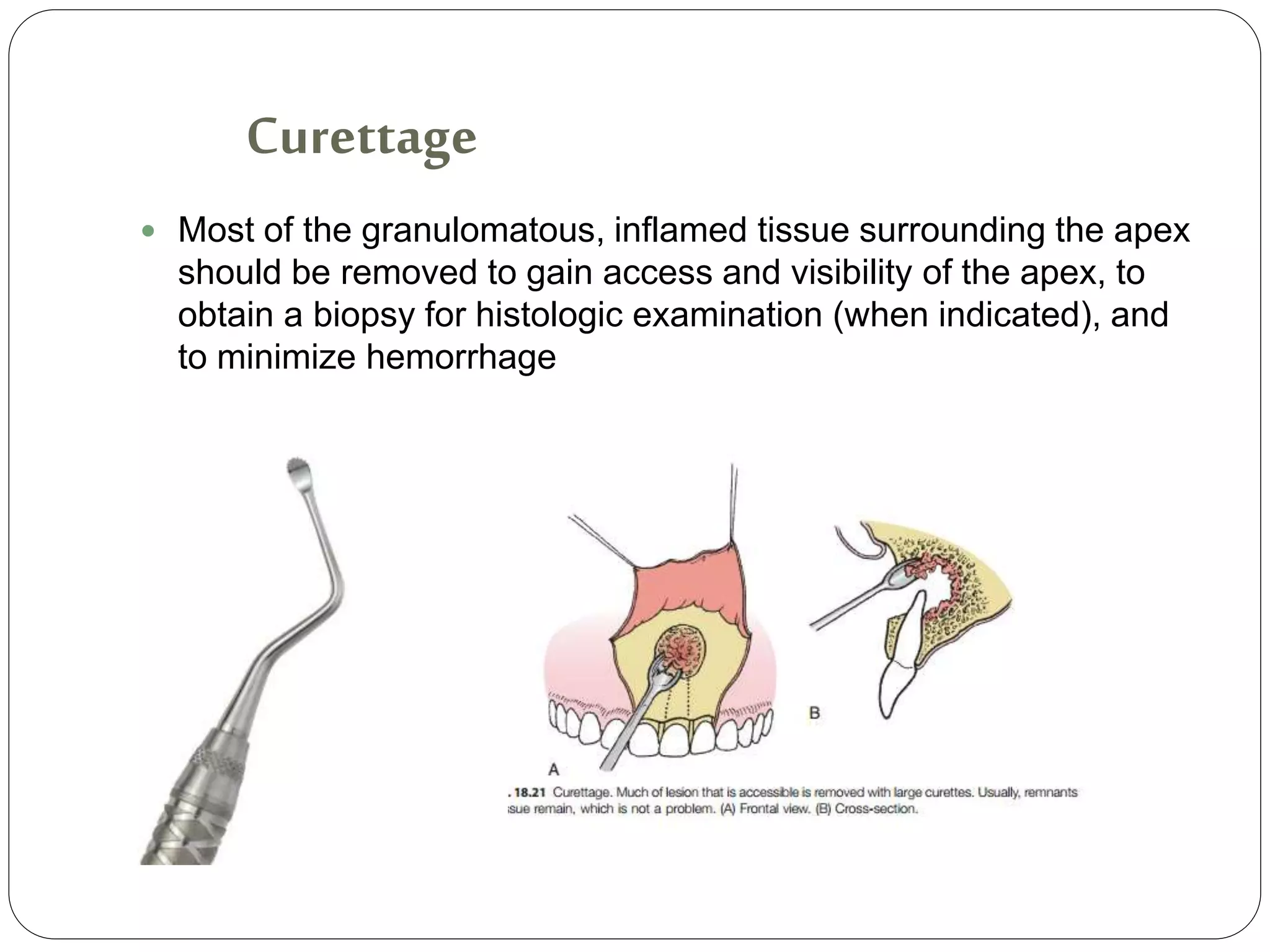
Curettage
 Most of the granulomatous, inflamed tissue surrounding the apex
should be removed to gain access and visibility of the apex, to
obtain a biopsy for histologic examination (when indicated), and
to minimize hemorrhage
Root EndResection
 A trough is created around the apex with a
tapered fissure burr to expose and isolate the root
end. The resection is done with the same tapered
fissure burr.
Root End–FillingMaterials
 Amalgam (preferably zinc free), intermediate
restorative material, and super ethoxybenzoic
acid cement have been commonly used
materials. Gutta-percha, composite resin, glass
ionomer cements.
 Mineral trioxide aggregate (MTA) has shown
favorable biologic and physical properties and
ease of handling; it has become a widely used
material.
 Irrigation
 Before MTA placement
 Radiographic Verification
 verify that the surgical objectives are satisfactory
 Flap Replacement and Suturing
 Vicryl suture , silk sutures
 Postoperative Instructions
 inform the patient of what to expect (e.g., swelling, discomfort,
 possible discoloration, and some oozing of blood)
 chlorhexidine rinse
 Analgesics
 Antibiotics
 Suture Removal and Evaluation
 Sutures ordinarily are removed in 5 to 7 days
Corrective Surgery
 Management of defects that have occurred by
a biologic response (i.e,resorption) or
iatrogenic (i.e,procedural) error.
 Defects may be anywhere
on the root, from
cervical margin to apex.
 In response to the
injury, an inflammatory
lesion may be present,
or one may develop in
the future. The
procedure involves
exposing, preparing,
and then sealing the
defect. Usually included
are removal of irritants
and rebuilding of the
root surface
Corrective Surgery
 Indications
•Procedural errors(e.g,perforations)
•Resorptive defects
 Contraindications
•Anatomic impediments
•Inaccessible defect
•Repair would create periodontal defect
Procedural Errors
 Openings through the lateral root surface created
by the operator, typically during access, canal
instrumentation, or after space preparation.
 The location of the perforation influences
success; some are virtually inaccessible
 If the defect is on the interproximal aspect, in the
furcation, or close to adjacent teeth or to the
lingual aspect, adequate repair may not be
possible or is compromised
Resorptive Perforations
 internally or externally
 resulting in a communication between the pulp
and the periodontium.
 Resorption occurs for several reasons, but most
cases include sequelae to trauma, internal
bleaching procedures, orthodontic tooth
movement, restorative procedures, or other
factors causing pulp or periradicular inflammation
Contraindications
Anatomic Considerations
 various nerve and vessel bundles
 bony structures such as the external oblique
ridge.
Location of Perforation
 clinician must be able to locate and, ideally,
readily visualize the surgical area
Accessibility
 A hand piece or an ultrasonic instrument
generally is necessary to prepare the defect.
Therefore the defect must be reachable, without
impedance by structures or by lack of visibility.
Surgical Approach
 Objective is to seal and stabilize the defect with a
restorative material.
 If a post or other material is perforating the root, it
must be reduced with burrs to within root
structure and a cavity prepared.
 The defect is then restored with one of the
materials mentioned previously.
RepairMaterial
 MTA
Favorable biologic properties.
white color blends.
• Super ethoxybenzoic acid.
Prognosis
 Repairs in the cervical third or furcation, in
particular, have the poorest prognosis.
 A defect in the middle or apical third that is
properly prepared and sealed has a very good
long-term prognosis
Rationale in Decision for Biopsy of
Periapical Lesions
 Was there evidence of pre endodontic
pulpal necrosis?
 Is the characteristic of the radiolucency “classic”?
 Will the patient return for follow-up radiographs?
If all of these criteria are met, the surgeon may
decide to not submit routinely collected
periapical tissue
Surgical Endodontics

Surgical Endodontics

  • 1.
  • 2.
    INTRODUCTION  Surgical Endodonticsis an option for teeth with post treatment disease.  Endodontic surgery is the management of periradicular disease by a surgical approach.  this includes abscess drainage, periapical surgery, corrective surgery, intentional replantation, and root removal.
  • 3.
    Main Reasons for Endodonticfailure • Cementu m lacunae on the root surface Plaque – like microbes on the apical root surface Dentine derbies inadverten tly extruded periapical during treatment
  • 4.
    Surgery therefore offersabetter chance to DECREASE extraradicular infection, and this is its main benefit
  • 5.
    Objectives and Rationalefor Surgery Curettage:  Effective curettage of the pathologically effected periradicular tissue which cannot be assesed in an orthograde approach. This includes;  Therapy resistant granuloma  True cysts  Foreign body reactions
  • 6.
    Resection: Surgical resection ofroot apex in cases where the apical ramifications cannot be eliminated in a nonsurgical endodontic treatment or surgical resection in cases of poor periodontal support. Objectives and Rationale for Surgery
  • 7.
     Inspection Inspection ofperiapical area to ascertain the causes of failure, inspection of isthmus, and trace accessory canals in nonsurgical endodontic cases that are clinically failing. Objectives and Rationale for Surgery
  • 8.
    Factors Associated WithSuccessand Failurein Periapical Surgery Success  Dense orthograde fill  Healthy periodontal status  No dehiscence  Adequate crown-root ratio Radiolucent defect isolated to apical one-third of the tooth
  • 9.
    Tooth treated: Maxillary incisors Mesiobuccalroot of maxillary molars Postoperative factors: Radiographic evidence of bone following surgery Resolution of pain and symptoms Decrease in tooth mobility Factors Associated WithSuccess and Failurein Periapical Surgery
  • 10.
    Failures  Clinical orradiographic evidence of fracture  Poor or lack of orthograde filling  Marginal leakage of crown or post  Poor preoperative periodontal condition  Radiographic evidence of post perforation  Tooth treated  Mandibular incisor  Postoperative factors:  Lack of bone repair following surgery  Lack of resolution of pain  Fistula does not resolve or returns Factors Associated WithSuccess and Failurein Periapical Surgery
  • 11.
    FAILURES  Periapical (i.e.,periradicular) surgery includes a series of procedures performed to eliminate symptoms. Periapical surgery includes the following: 1. Appropriate exposure of the root and the apical region 2. Exploration of the root surface for fractures or other pathologic condition Factors Associated WithSuccess and Failurein Periapical Surgery
  • 12.
    3. Curettage ofthe apical tissues 4. Resection of the root apex 5. Retrograde preparation with the ultrasonic tips 6. Placement of the retrograde filling material 7. Appropriate flap closure to permit healing and minimize gingival  Recession Factors Associated WithSuccess and Failurein Periapical Surgery
  • 13.
    Indicationsfor PeriapicalSurgery  Anatomicproblems preventing complete debridement or obturation  Restorative considerations that compromise treatment  Horizontal root fracture with apical necrosis  Irretrievable material preventing canal treatment or retreatment  Procedural errors during treatment  Large periapical lesions that do not resolve with root canal treatment
  • 14.
    Indications for PeriapicalSurgery Anatomicproblems preventing complete debridement or obturation i.e. severe root curvature, calcifications, constricted canals or other blockages.
  • 15.
    Indications for PeriapicalSurgery Restorativeconsiderations that compromise treatment e.g. Irretrievable endo posts and apical pathosis
  • 16.
    Indicationsfor Periapical Surgery Horizontalroot fracture with apical necrosis
  • 17.
    Indications for PeriapicalSurgery Irretrievablematerial preventing canal treatment or retreatment i.e. Broken instruments, restorative materials, segments of posts or other foreign objects
  • 18.
    Indications for PeriapicalSurgery Proceduralerrors during treatment i.e. Broken instruments, ledging, gross overfills & perforations
  • 19.
    Indications for PeriapicalSurgery Largeperiapical lesions that do not resolve with root canal treatment
  • 20.
    CONTRAINDICATIONS OF PERIAPICALSURGERY Unidentified cause of root canal treatment failure  When conventional root canal treatment is possible  Combined coronal treatment/ apical surgery  When retreatment of a treatment failure is possible  Anatomic structures e.g. adjacent nerves and vessels are jeopardy  Structures interfere with access and visibility  Compromise of crown/root ratio  Systemic complications ( e.g. bleeding disorders)
  • 21.
    CONTRAINDICATIONS OF PERIAPICALSURGERY Unidentified cause of root canal treatment failure
  • 22.
    CONTRAINDICATIONS OF PERIAPICALSURGERY When conventional root canal treatment is possible
  • 23.
    CONTRAINDICATIONS OF PERIAPICALSURGERY Combined coronal treatment/ apical surgery  A situation in which both coronal treatment & apical surgery are indicated, an approach that includes both of these as a single procedure has no advantages.it is preferable to perform only the conventional treatment.  Another consideration is post treatment symptoms, the level & incidence of pain after apical surgery is higher compared with RCT.  In a case, in spite of adequate instrumentation & antibiotics ,there still is purulent exudate from the tooth or a vestibular swelling. A combined orthograde obturation with a simultaneous apical surgery to curette the periapical region &seal the tooth can successfully coordinated & the symptoms resolved.
  • 24.
    CONTRAINDICATIONS OF PERIAPICALSURGERY When retreatment of a treatment failure is possible
  • 25.
    CONTRAINDICATIONS OF PERIAPICALSURGERY Anatomic structures e.g. adjacent nerves and vessels are jeopardy
  • 26.
    CONTRAINDICATIONS OF PERIAPICALSURGERY Structures interfere with access and visibility
  • 27.
    CONTRAINDICATIONS OF PERIAPICALSURGERY Compromise of crown/root ratio Teeth with short roots have compromised bony support & are poor candidates for surgery, root end resection in such cases may compromise stability
  • 28.
    CONTRAINDICATIONS OF PERIAPICALSURGERY Systemic complications ( e.g. bleeding disorders)
  • 29.
    SURGICALPROCEDURE  Antibiotics  FlapDesigns; a) Semilunar incision b) Submarginal incision c) Full mucoperiosteal incision • Anesthesia • Incision & reflection • Periapical exposure • Curettage • Root End resection • Root End Preparation & Restoration • Root End filling materials • Irrigation • Radiographic Verification • Flap replacement & Suturing • Postoperative Instructions • Suture Removal & Evaluation
  • 30.
    SURGICALPROCEDURE ANTIBIOTICS Preoperative prophylactic administration ofantibiotic is indicated;  Due to the nature of surgery & potential spread of the infection into adjacent spaces.  Risk of infection of the hematoma exists because of the amount of edema expected after the procedure.  Inadvertent opening of adjacent structures such as the maxillary sinus is expected to occur with molar surgeries.
  • 31.
    SURGICAL PROCEDURE DOSAGE OF ANTIBIOTICS; oPenicillin V 1g o Clindamycin 600mg 1 hour before surgery o Use of Corticosteroids perioperatively, may reduce edema & speed recovery.
  • 32.
    FLAP DESIGNS 1.SEMILUNAR INCISION 2.SUBMARGINAL INCISION 3.FULL MUCOPERIOSTEAL INCISIO
  • 33.
  • 34.
    Incision& reflection  Firmincision should be made through periosteum to bone.  Incision & reflection of a full thickness flap is important to minimize hemorrhage & to prevent tearing of the tissue.  Raised with sharp elevator in firm contact with bone, enough tissue is raised to allow access & visibility to apical area.
  • 35.
    PeriapicalExposure  Using alarge surgical round burr until approximately half the root and the lesion are visible.
  • 36.
    Curettage  Most ofthe granulomatous, inflamed tissue surrounding the apex should be removed to gain access and visibility of the apex, to obtain a biopsy for histologic examination (when indicated), and to minimize hemorrhage
  • 37.
    Root EndResection  Atrough is created around the apex with a tapered fissure burr to expose and isolate the root end. The resection is done with the same tapered fissure burr.
  • 38.
    Root End–FillingMaterials  Amalgam(preferably zinc free), intermediate restorative material, and super ethoxybenzoic acid cement have been commonly used materials. Gutta-percha, composite resin, glass ionomer cements.  Mineral trioxide aggregate (MTA) has shown favorable biologic and physical properties and ease of handling; it has become a widely used material.
  • 42.
     Irrigation  BeforeMTA placement  Radiographic Verification  verify that the surgical objectives are satisfactory  Flap Replacement and Suturing  Vicryl suture , silk sutures  Postoperative Instructions  inform the patient of what to expect (e.g., swelling, discomfort,  possible discoloration, and some oozing of blood)  chlorhexidine rinse  Analgesics  Antibiotics  Suture Removal and Evaluation  Sutures ordinarily are removed in 5 to 7 days
  • 43.
    Corrective Surgery  Managementof defects that have occurred by a biologic response (i.e,resorption) or iatrogenic (i.e,procedural) error.  Defects may be anywhere on the root, from cervical margin to apex.
  • 44.
     In responseto the injury, an inflammatory lesion may be present, or one may develop in the future. The procedure involves exposing, preparing, and then sealing the defect. Usually included are removal of irritants and rebuilding of the root surface
  • 45.
    Corrective Surgery  Indications •Proceduralerrors(e.g,perforations) •Resorptive defects  Contraindications •Anatomic impediments •Inaccessible defect •Repair would create periodontal defect
  • 46.
    Procedural Errors  Openingsthrough the lateral root surface created by the operator, typically during access, canal instrumentation, or after space preparation.
  • 47.
     The locationof the perforation influences success; some are virtually inaccessible  If the defect is on the interproximal aspect, in the furcation, or close to adjacent teeth or to the lingual aspect, adequate repair may not be possible or is compromised
  • 48.
    Resorptive Perforations  internallyor externally  resulting in a communication between the pulp and the periodontium.  Resorption occurs for several reasons, but most cases include sequelae to trauma, internal bleaching procedures, orthodontic tooth movement, restorative procedures, or other factors causing pulp or periradicular inflammation
  • 49.
    Contraindications Anatomic Considerations  variousnerve and vessel bundles  bony structures such as the external oblique ridge. Location of Perforation  clinician must be able to locate and, ideally, readily visualize the surgical area
  • 50.
    Accessibility  A handpiece or an ultrasonic instrument generally is necessary to prepare the defect. Therefore the defect must be reachable, without impedance by structures or by lack of visibility.
  • 51.
    Surgical Approach  Objectiveis to seal and stabilize the defect with a restorative material.  If a post or other material is perforating the root, it must be reduced with burrs to within root structure and a cavity prepared.  The defect is then restored with one of the materials mentioned previously.
  • 52.
    RepairMaterial  MTA Favorable biologicproperties. white color blends. • Super ethoxybenzoic acid.
  • 53.
    Prognosis  Repairs inthe cervical third or furcation, in particular, have the poorest prognosis.  A defect in the middle or apical third that is properly prepared and sealed has a very good long-term prognosis
  • 55.
    Rationale in Decisionfor Biopsy of Periapical Lesions  Was there evidence of pre endodontic pulpal necrosis?  Is the characteristic of the radiolucency “classic”?  Will the patient return for follow-up radiographs? If all of these criteria are met, the surgeon may decide to not submit routinely collected periapical tissue