Emotional Development
Dr. Akash Ardeshana
3rd MDS
Dept. of Paedodontics and
Preventive Dentistry
1
Contents
• Introduction
• Definition
• Important of Emotional Development
• Physiology of emotion
• Characteristics of commonly seen emotion in a child
• Distress or Cry
• Anger
• Fear
• Anxiety
• Phobia
• Summary
• Bibliography
2
Introduction
• Each of us is born into society with rules, expectations,
attitudes, and values.
• Our task throughout development is to come to understand
ourselves, how we feel and function, and what our society
deems desirable and appropriate.
• The process of socialization- learning socially acceptable
behavior attitude and values is greatly influence by parents and
other care providers as well as more peripheral people in
children’s lives.
3
• The emotional development of children and adolescent
represent a huge variation according to age, maturity,
intellectual development, temperament, experience , family
background, cultural background etc.
• These factors play an important role in influencing the child’s
development and underlying emotions.
4
• Concurrently, these aspects influence the child’s ability to cop
with dental treatment.
• According to their age and emotional development some
children remain calm during the treatment , while others are
vulnerable and may need more attention and time in order to
make them cooperate for dental treatment.
5
Definition
• Emotion: An effective state of consciousness in which
joy, sorrow, fear, hatred or the likes are expressed.
• Emotion: a strong feeling state, arising subjectively and
directed toward a specific object, with physiological,
somatic and behavior components.
(Dorland’s medical dictionary for health consumers)
6
• (Co T. Morgan, R. A. King, and N. M. Robinson, 1979.)
• "There is no concise definition, because an emotion is many
things at once..the way we feel when we are emotional...the
behavioral arousal ...the physiological, or bodily, basis...that
emotions are expressed by language, facial expressions, and
gestures...that...some emotions...are very much like motive
states in that they drive behavior."
7
• Emotion is a complex set of interactions among subjective and
objective factors, mediated by neural/hormonal systems, which
can (a) give rise to affective experiences such as feelings of
arousal, pleasure/displeasure; (b) generate cognitive
processes such as emotionally relevant perceptual effects,
appraisals, labeling processes; (c) activate widespread
physiological adjustments to the arousing conditions; and (d)
lead to behavior that is often, but not always, expressive, goal
directed, and adaptive.
-Kleinginna and Kleinginna (1981)
8
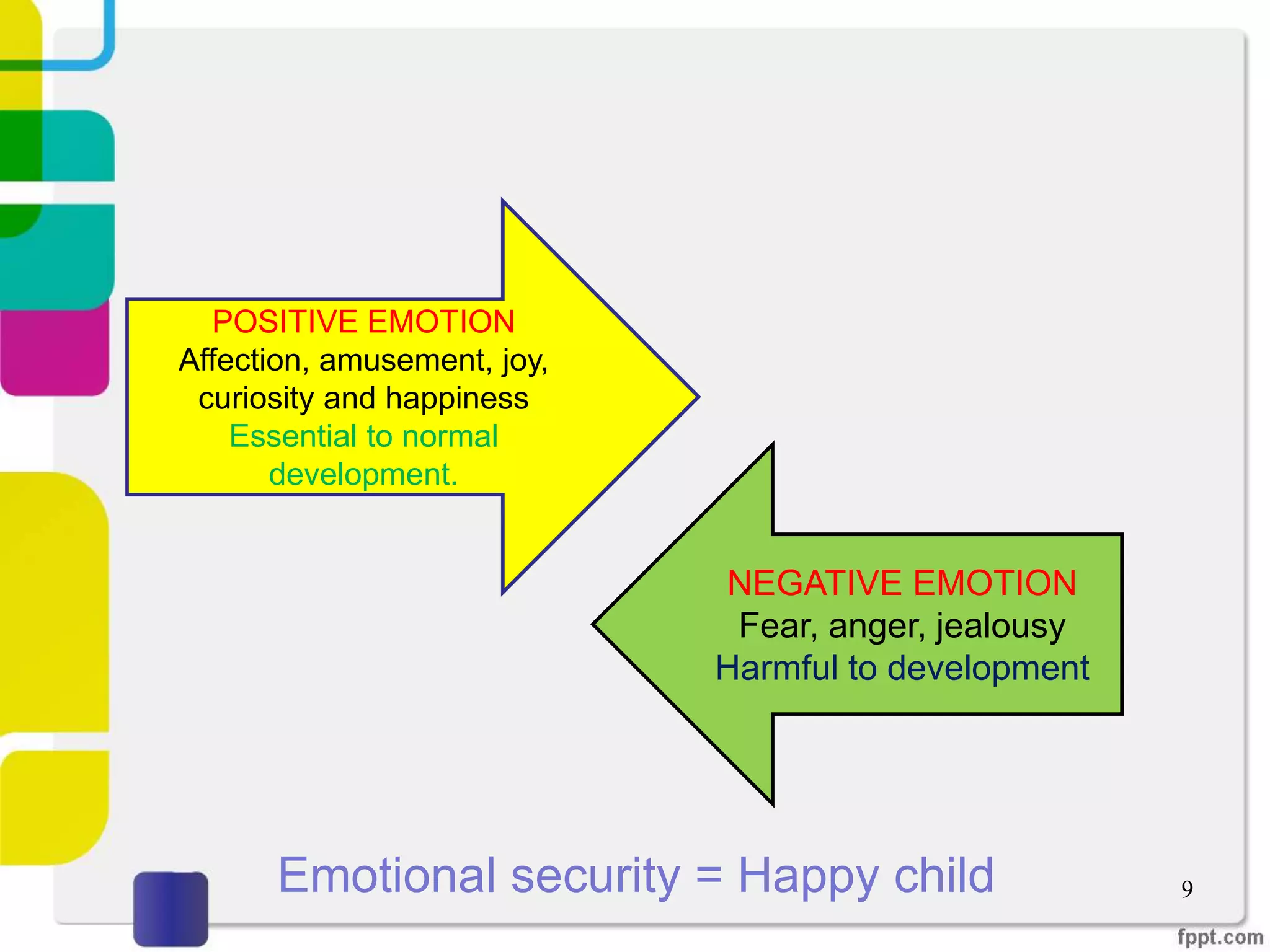
POSITIVE EMOTION
Affection, amusement, joy,
curiosity and happiness
Essential to normal
development.
NEGATIVE EMOTION
Fear, anger, jealousy
Harmful to development
Emotional security = Happy child 9
• Better understanding of the child
• To understand the problem of psychological
origin
• Deliver dental treatment service in a meaningful
manner
• Establish effective communication
• Better teaching of primary and preventive care
• Effective treatment planning and execution
• Provide a comfortable environment.
Importance of emotional development
10
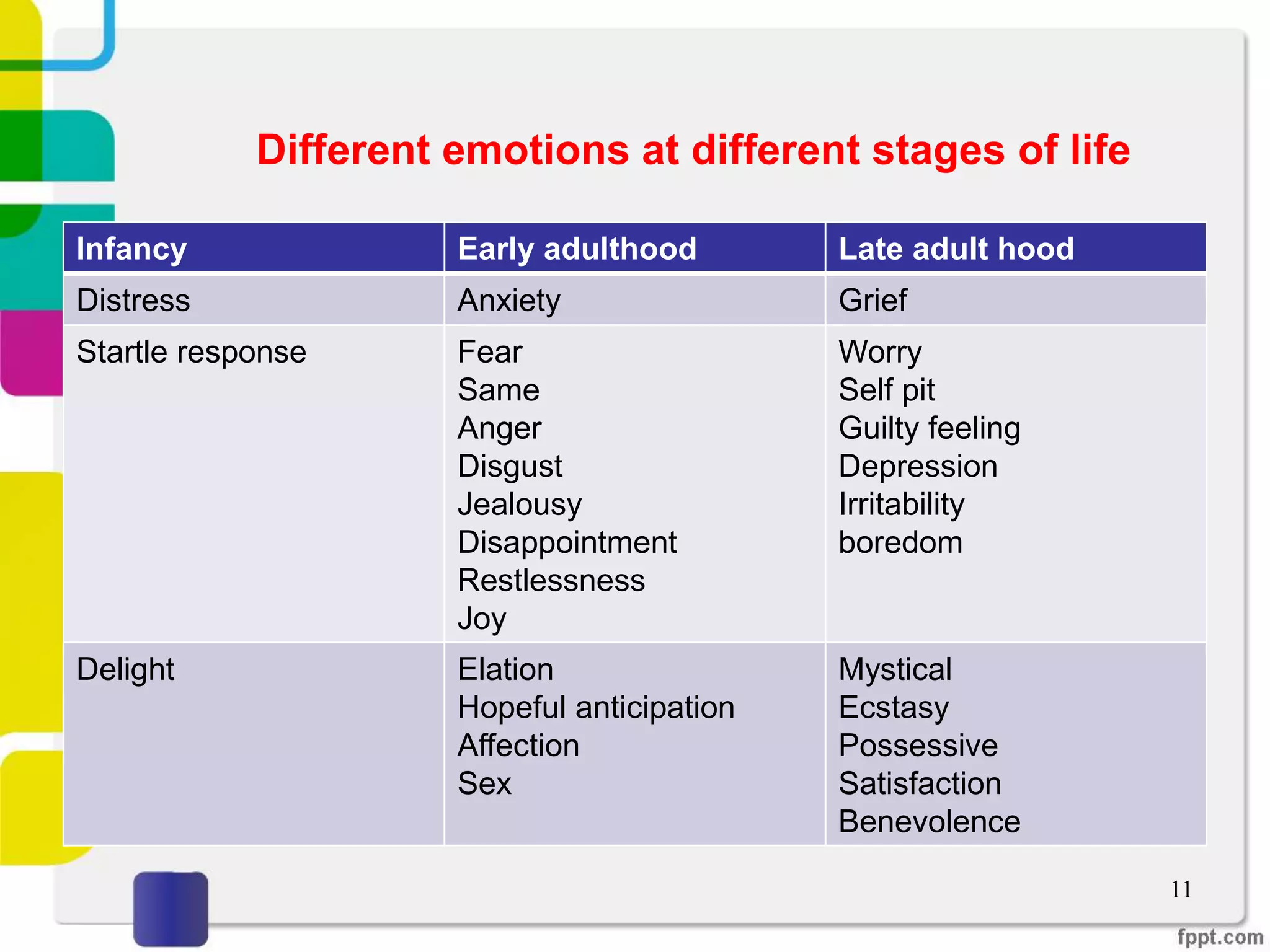
Infancy Early adulthood Late adult hood
Distress Anxiety Grief
Startle response Fear
Same
Anger
Disgust
Jealousy
Disappointment
Restlessness
Joy
Worry
Self pit
Guilty feeling
Depression
Irritability
boredom
Delight Elation
Hopeful anticipation
Affection
Sex
Mystical
Ecstasy
Possessive
Satisfaction
Benevolence
11
Different emotions at different stages of life
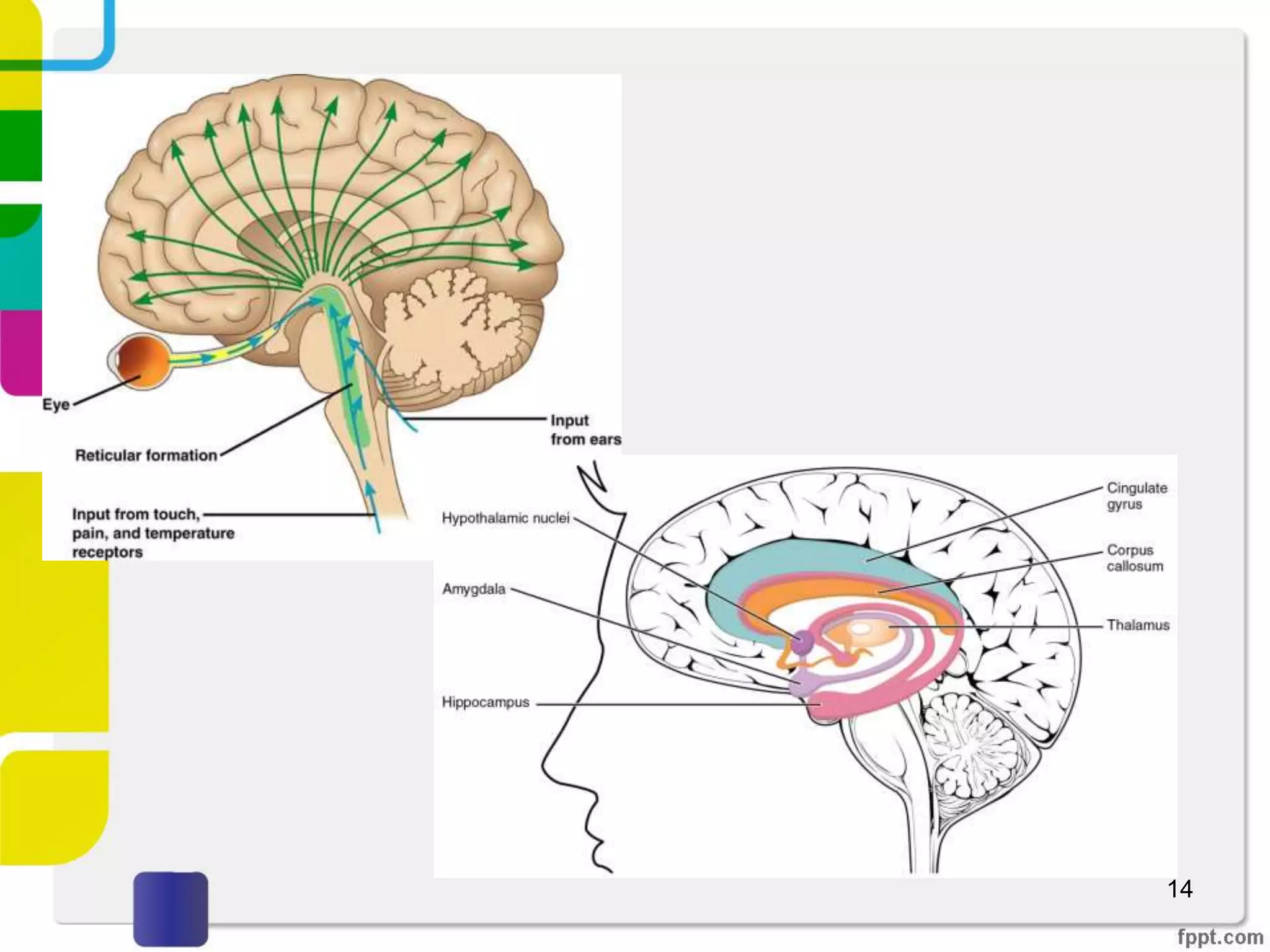
Physiology of emotion
• Development of emotion depends on maturation in the nervous
system and the endocrine system.
• Differences in emotional responsiveness between children and
adults appear to be partly due to cortical immaturity and partly
due to deference in endocrine out put.
12
13
Nervous system
CNS PNS
SOMATIC AUTONOMIC
SYMPATHETIC
PERASYMPATHETIC
14
• The sympathetic system is active during aroused states and prepares the
body for extensive action by increasing the hart rate, blood pressure, blood
glucose level and raising the level of certain hormones in the blood.
• Nerve impulses in this system which reach the inner part of the adrenal
glands, located on the top of the kidneys, trigger the secretion of
epinephrine and nor epinephrine.
• This part of the ANS that is active in may strong emotion, especially fear
and anger.
• Parasympathetic systems, tends to be active when we are calm and relaxed.
15
• At the birth cortex development is completed, frontal lobe is immature and
has little influence on the functions of the lower part of he brain resulting in
imbalanced emotion.
• Hence, emotional response of the child is quickly aroused but short liven
16
• In 2-5 years and 11 -12 years adrenal gland gain weight rapidly and
liberation of adrenaline in blood is vigorous, as a result of which a
preschooler is highly emotional and emotional outburst are prolonged too,
give rise to physiological sign of emotional disturbance.
17
• Activity of brain in certain regions, including hypothalamus and other part
of nervous system, directly influence muscles and internal organs to initiate
body changes.
• Indirect stimulating adrenal hormones to other body changes and preparing
the body for light or flight.
18
Characteristics of commonly seen
emotion in a child
• Distress or Cry
• Anger
• Fear
• Anxiety
• Phobia
19
Distress or Cry
• The most common way a child expresses fear is by crying at
the dentist’s office.
• Crying, like other emotional manifestations of human
behaviour is an expression of personality of an individual.
• Crying is liable to be the result of conflict with the developing
ego and with his newly found interests.
• After the age of one and a half child develops a variety of
fears and cries for the security of his mother’s company
. 20
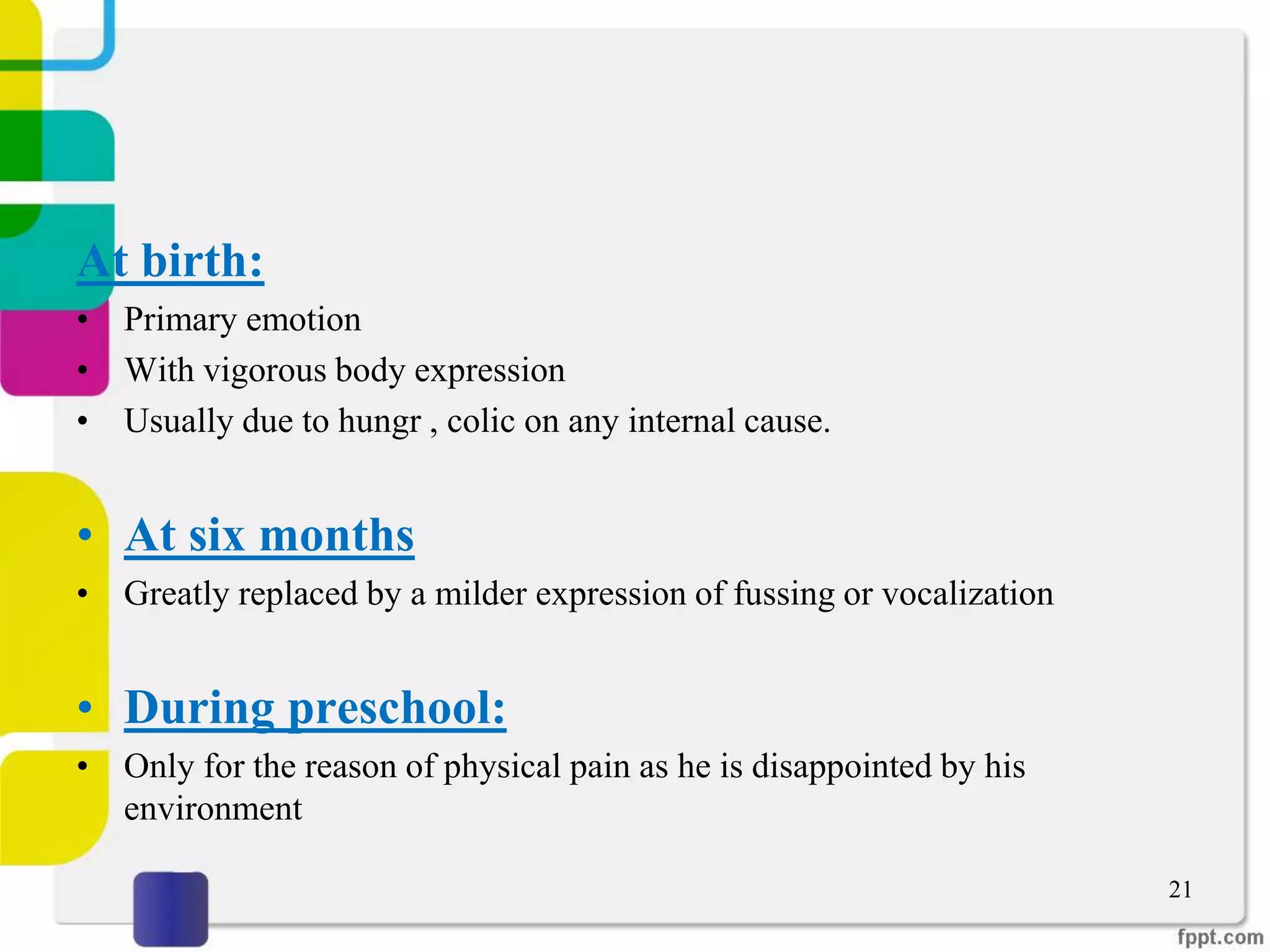
At birth:
• Primary emotion
• With vigorous body expression
• Usually due to hungr , colic on any internal cause.
• At six months
• Greatly replaced by a milder expression of fussing or vocalization
• During preschool:
• Only for the reason of physical pain as he is disappointed by his
environment
21
• During school year:
• pressure helps him to outgrow the crying habit which decrease rapidly.
• After this till 15 years crying occurs very seldom
• In young adult:
• ultimately it becomes a limited quiet crying in private only for reason of
grief or other intense emotion
22
Different type of cry seen In children
Following four type of crying are usually seen in children (Elsbach 1963)
1. Obstinate cry
2. Frightened cry
3. Hurt cry
4. Compensatory cry:
23
Obstinate cry
• The child throw a temper tantrum to through dental treatment
• It is loud, high pitched
• pause and repeated over and over again.
• Characterized as a siren like wail
• represents the child’s external response to anxiety
24
Frightened cry
• Usually accompanied by a torrent of tears.
• Convulsive breath-catching sobs
• Usually the child emitting this type of cry has been
overwhelmed by the situation.
25
Hurt cry
• May be loud and more frequent.
• Frequently accompanied by a small whimper
• Initially a child in discomfort shows a single tear filling the
corner of the eye and running down the child’s cheek with out
making any sound or resistance to the treatment procedure.
26
Compensatory cry:
• It is not a cry at all
• It is a sound that child makes to drown out the noise, for
example, a drill.
• Usually the cry sound is slow, monotone.
• It is a sort of coping mechanism to unpleasant auditory stimuli,
finding himself uncomfortable in the situation.
27
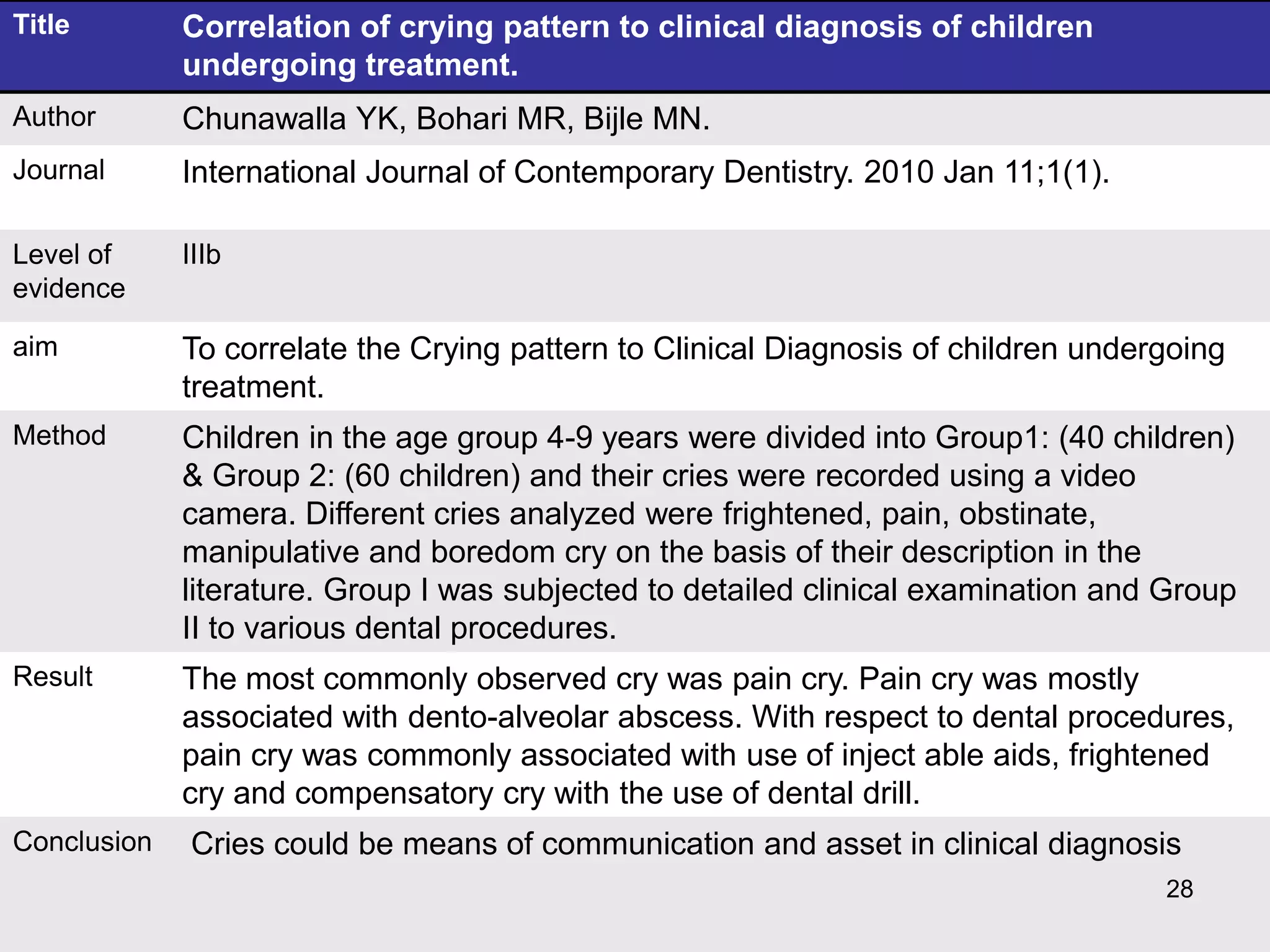
Title Correlation of crying pattern to clinical diagnosis of children
undergoing treatment.
Author Chunawalla YK, Bohari MR, Bijle MN.
Journal International Journal of Contemporary Dentistry. 2010 Jan 11;1(1).
Level of
evidence
IIIb
aim To correlate the Crying pattern to Clinical Diagnosis of children undergoing
treatment.
Method Children in the age group 4-9 years were divided into Group1: (40 children)
& Group 2: (60 children) and their cries were recorded using a video
camera. Different cries analyzed were frightened, pain, obstinate,
manipulative and boredom cry on the basis of their description in the
literature. Group I was subjected to detailed clinical examination and Group
II to various dental procedures.
Result The most commonly observed cry was pain cry. Pain cry was mostly
associated with dento-alveolar abscess. With respect to dental procedures,
pain cry was commonly associated with use of inject able aids, frightened
cry and compensatory cry with the use of dental drill.
Conclusion Cries could be means of communication and asset in clinical diagnosis
28
Anger
• Outburst of the emotion is caused by the child’s lack of skill in
handling the situation.
• Infant and young children responnd in anger in a direct and
primitive manner but as they develop, the responses become
violent and more symbolic,
29
• 15 months children express anger by throwing objects.
• Two-year olds attack other childen with an intention to hurt.
• Four year olds express their anger through begging.
• Five year olds have less expression of anger.
• Six year olds have a renewal of violent method of expression
of anger.
30
• Seven year ones display less aggressiveness, through kicking,
througwing objects is observed.
• 8-9 years olds anger is expressed through feelings. It become
directed towards a single person.
• 10 year old’s anger may become violent and may be expressed
physically.
• 12 years olds express anger verbally.
• 14 years olds may take out his anger on someone else. 31
Fear….
• The unpleasant emotioonal state consisting of psychological
and psycho-physiological responses to a real external threat or
danger including agitation, alertness, tension and mobilization
of the alarmed reaction. (Dorland Medical Dictonary)
• It is defined as a painful feeling of imending danger, evil,
trouble, etc. ( Delbridge )
• Defined as a reaction to a known danger (Rubin)
32
Fear related emotional pattern
• Shyness…..
• Characterized by shrinking from contact with who are stranger
and unfamiliar
• It is always stimulated by people never by objects, animals or
situations.
33
• In baby usual response in
shyness is crying, turning the
head.
• If able to walk- run away and
hide
• Older children- by blushing,
by stuttering, by nervous
mannerisms- a pulling at the
ears or clothing, shifting from
one foot to the other, and
bending the head to one side 34
Embarrassment:
• Fear reaction to people, not to objects or situation.
• Stimulated by uncertainty about how people will judge one and one’s
behavior.
• State of self conscious distress.
• Not present in a child less than 5 or 6 years old.
35
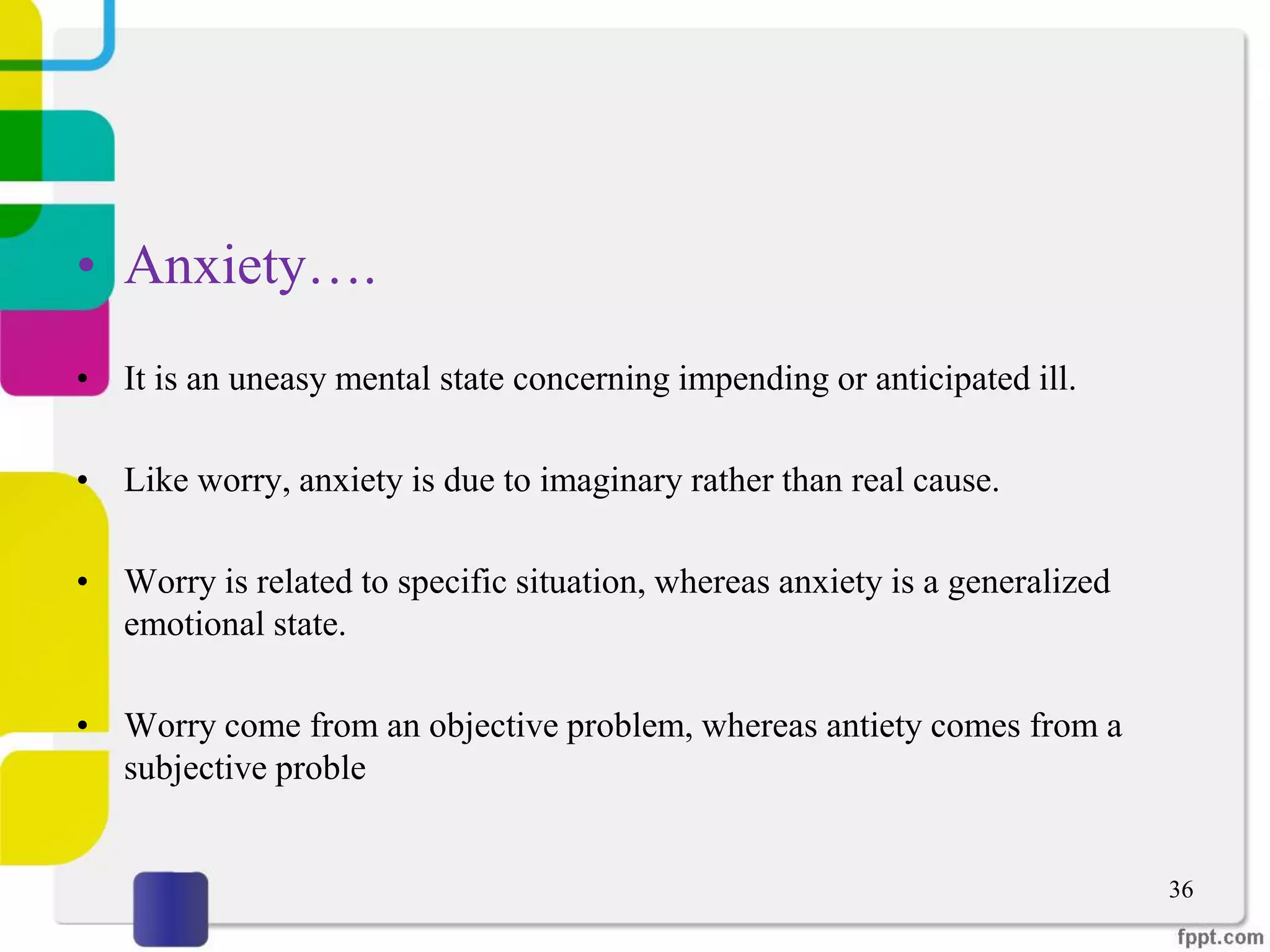
• Anxiety….
• It is an uneasy mental state concerning impending or anticipated ill.
• Like worry, anxiety is due to imaginary rather than real cause.
• Worry is related to specific situation, whereas anxiety is a generalized
emotional state.
• Worry come from an objective problem, whereas antiety comes from a
subjective proble
36
0-2 2-4 4-7 8-10 11-13
•Stranger
•Loud noises
•Loss of
support
•Strange
objects
•Being alone
•Darkness
•animals
•Environment
al threat
•imaginary
creatures
•animals
-
-Animal
-Burglar
-Personal
harm/harm
others
-Animals
-Separation
from parents
37
Different types of fears corresponding to age
Type of Fear
38
• Innate fear
• without stimuli or previous experience):
• It is thus also dependent on the vulnerability of the individual
39
Objective Fear:
• Produced by direct physical stimulation of the sense organs
and are generally not of parental origin.
• Objective fears are responses to stimuli that are felt, seen,
heard, smelled or tasted, and are of a disagreeable or
unpleasant nature.
40
Subjective fear:
• Fear based on somebody else’s
experience without actually
undergoing dental treatment himself.
• The majority of the children who visit
the dentist are anxious in particular
during first visit.
• Their anxiety level may be heightened
by stories from friends, relatives,
parents who have threatened them
using dentist’s visit as punishment for
bad behavior. 41
• Suggestive fear : acquired by imitation by observation of
other
• Imitative fears: transmitted while displayed by other (parent)
and acquired by the child without being aware of it. Displayed
emotion in parent’s face creates more impression than verbal
suggestions.
• Even a tight clenching of the child’s hand in dental office
while undergoing dental treatment creates fear in child’s mind
about dental treatment.
• Imaginative fear: as the child’s imaginative capability
develop, they become more intense with age and mental
development with certain age.
42
43
Value of fear
• Fear lowers the threshold of pain so that every pain produced
during the dental treatment becomes magnified.
• Fear has safety value when given proper direction and control.
• Since fear producing stimuli can cause actual harm to the
child, fear is protective mechanism for self protection.
44
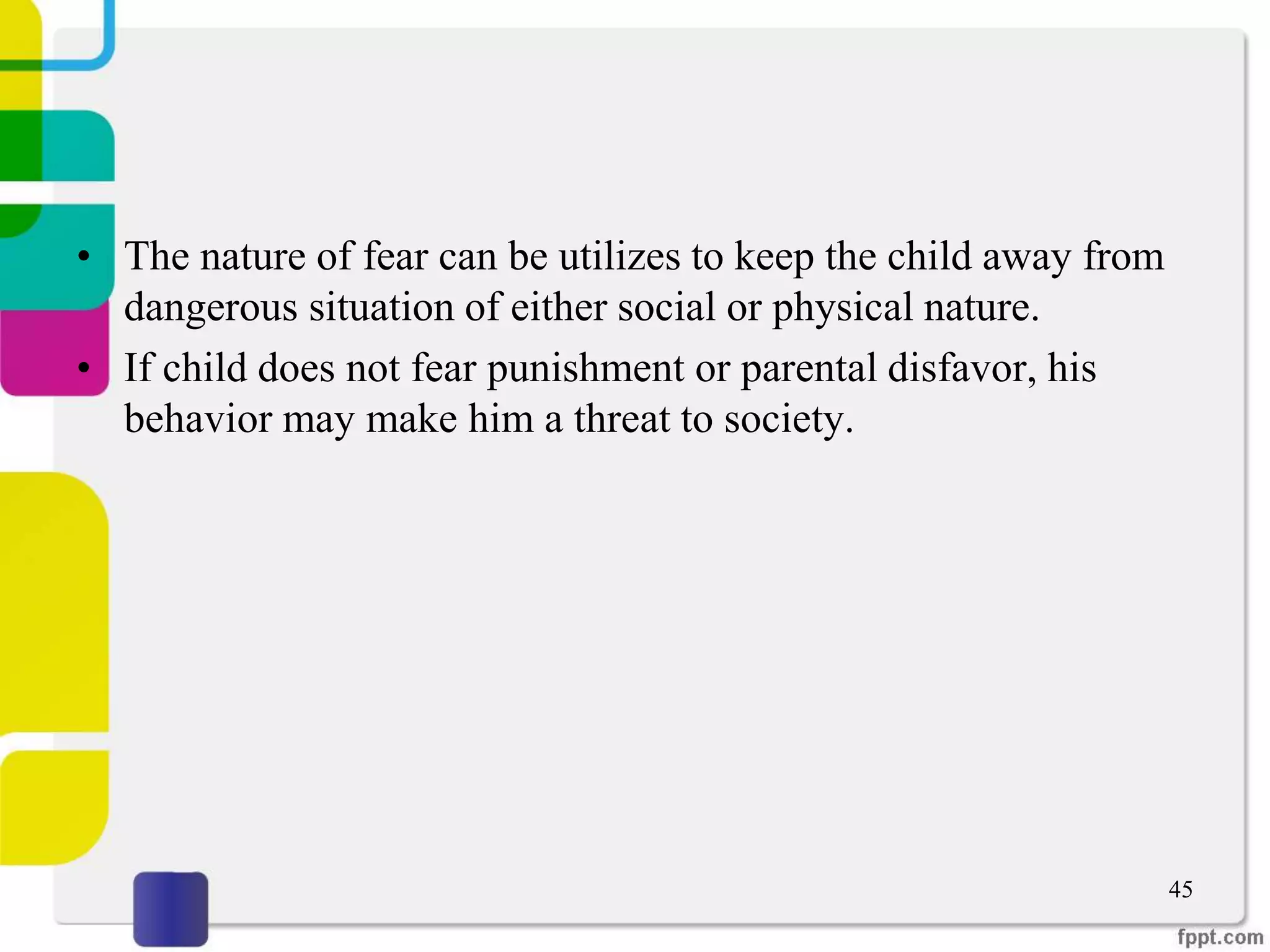
• The nature of fear can be utilizes to keep the child away from
dangerous situation of either social or physical nature.
• If child does not fear punishment or parental disfavor, his
behavior may make him a threat to society.
45
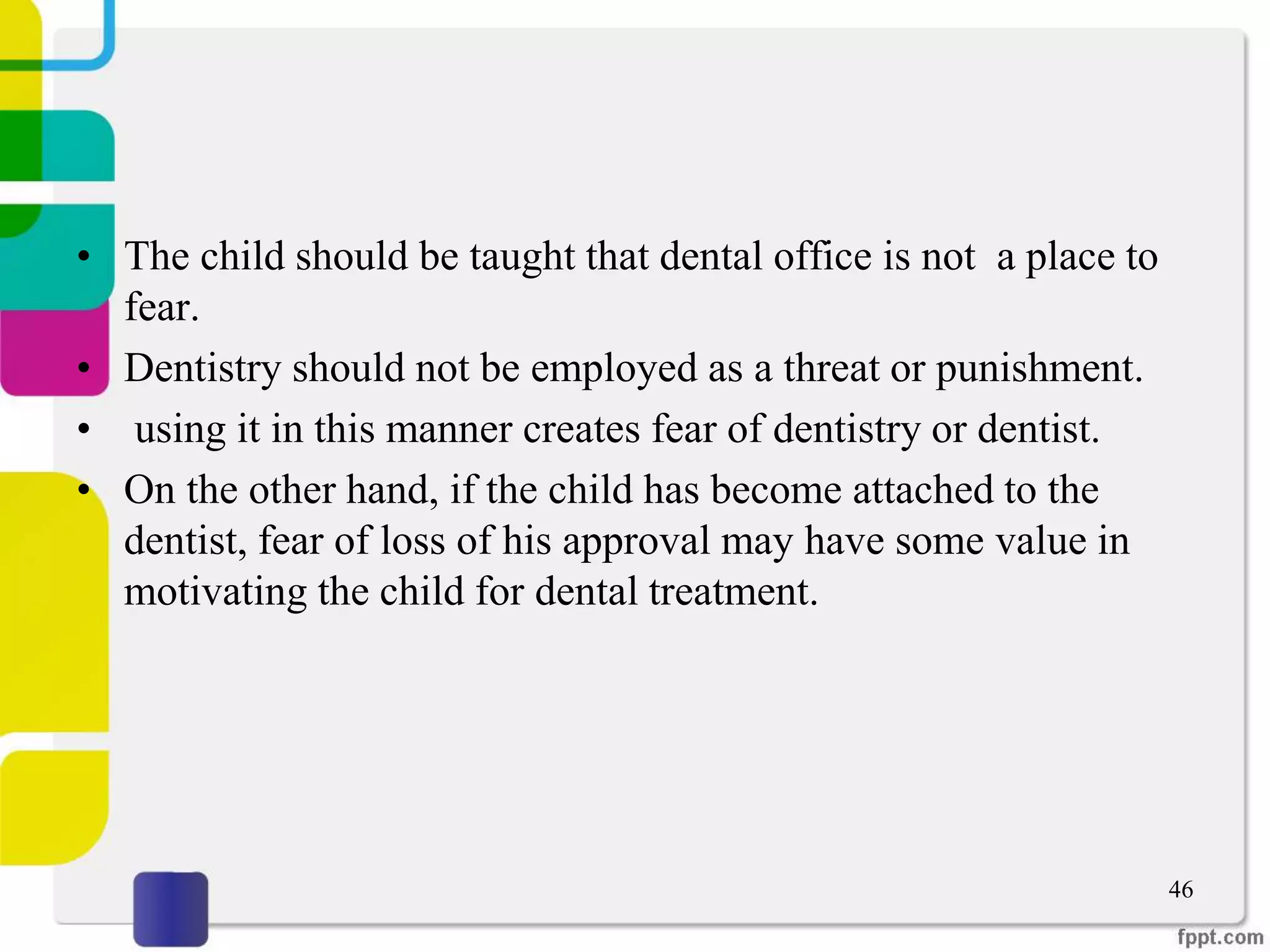
• The child should be taught that dental office is not a place to
fear.
• Dentistry should not be employed as a threat or punishment.
• using it in this manner creates fear of dentistry or dentist.
• On the other hand, if the child has become attached to the
dentist, fear of loss of his approval may have some value in
motivating the child for dental treatment.
46
Fear evoking dental situation
• Anesthetic administration locally by injection
• Extraction
• sound of drill
47
Title Child's dental fear: cause related factors and the influence of audiovisual
modeling.
Author Mungara J1, Injeti M, Joseph E, Elangovan A, Sakthivel R, Selvaraju G.
Journal J Indian Soc Pedod Prev Dent. 2013 Oct-Dec;31(4):215-20.
Level of
evidence
IIIa
aim To assess the degree of fear provoked by various stimuli in the dental office and to
evaluate the effect of audiovisual modeling on dental fear of children using CFSS-DS.
Method Ninety children were divided equally into experimental (group I) and control (group II)
groups and were assessed in two visits for their degree of fear and the effect of
audiovisual modeling, with the help of CFSS-DS.
Result The most fear-provoking stimulus for children was injection and the least was to open
the mouth and having somebody look at them. There was no statistically significant
difference in the overall mean CFSS-DS scores between the two groups during the
initial session (P > 0.05). However, in the final session, a statistically significant
difference was observed in the overall mean fear scores between the groups (P <
0.01). Significant improvement was seen in group I, while no significant change was
noted in case of group II.
Conclusion Audiovisual modeling resulted in a significant reduction of overall fear as well as
specific fear in relation to most of the items. A significant reduction of fear toward
dentists, doctors in general, injections, being looked at, the sight, sounds, and act of
the dentist drilling, and having the nurse clean their teeth was observed.
48
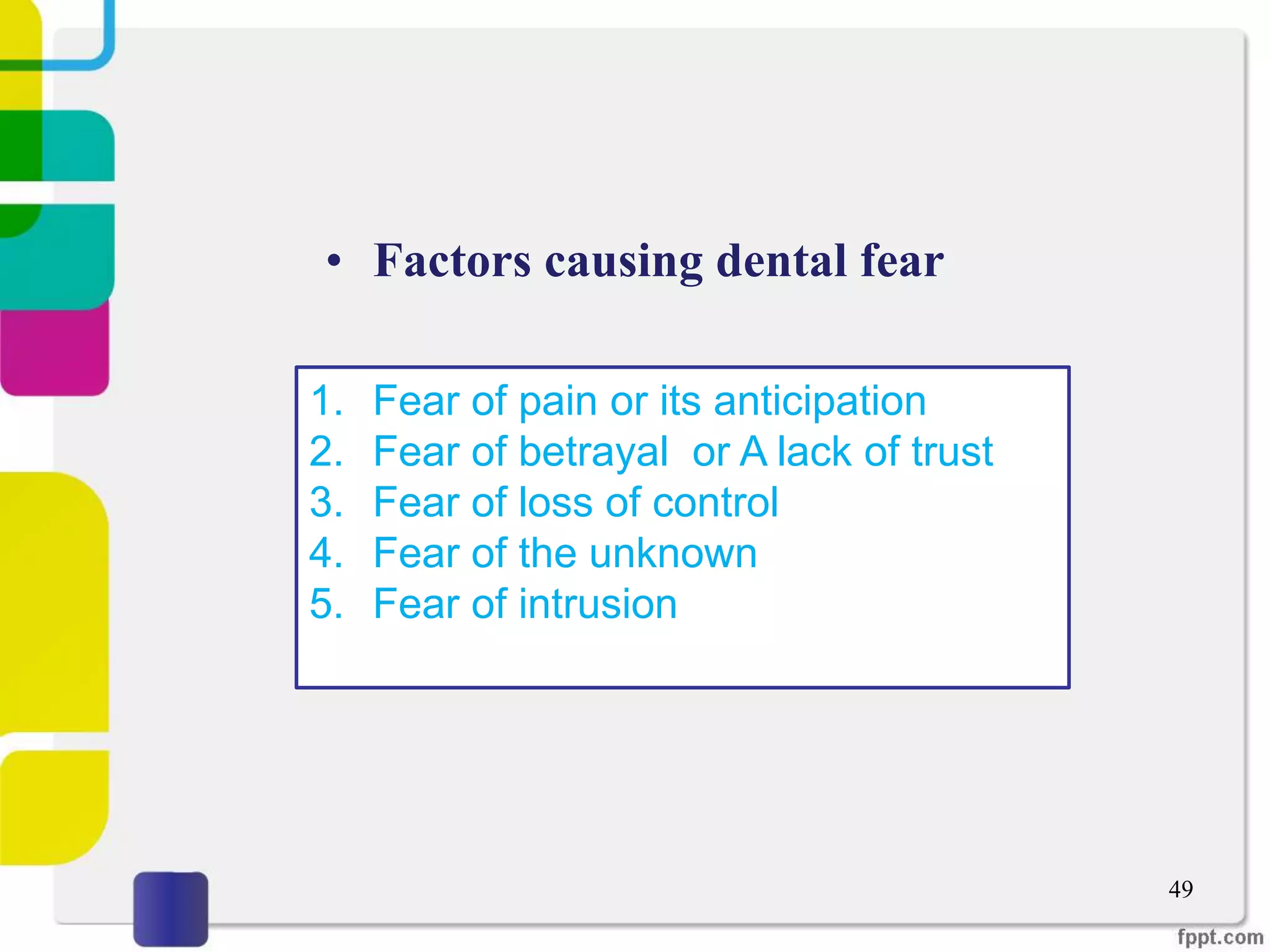
• Factors causing dental fear
49
1. Fear of pain or its anticipation
2. Fear of betrayal or A lack of trust
3. Fear of loss of control
4. Fear of the unknown
5. Fear of intrusion
Fear of pain or its anticipation:
• The link between actual or misinterpreted pain, or the anticipation of pain,
and dental fear is well established.
• We frequently see children who report that they sais that they were
experiencing pain, but the dentist ignored them and carried on.
• So, it is very important as dentist to recognize and address the pain
symptoms of the children.
50
Fear of betrayal:
• Trust may also be learned either direct from the behavior of the parents, or
peers.
• It is therefore theoretically possible that children learn to trust or distrust
dental personnel from their parents before they have any direct contact with
such person
51
• Fear of loss of control:
52
• Fear of unknown:
• In anyone’s eyes, a visit to the dentist may be classified as a potentially
threatening condition.
• Helpful comment from the mother such as, it will not hurt; even before an
examination, are going to raise the possibility in the child’s mind of being
hurt.
53
• Fear of intrusion:
• Intrusion involves impinging on the patient’s personal
space and into a bodily cavity; the mouth
• Impinging the patient’s personal space is something
that is taken for granted by professionals.
54
Features of fear
• Fear is a package of reaction that tend to occur together simultaneously or
sequentially. About 70% acquire dental fear at an early age. This emotion
may present the following main two expression.
1. Tendency to freeze, which reaches its extreme in the for of death.
2. Startle, scream, run away from the scene of danger, i.e flight.
– It turns, a shift from freeze reaction to flight.
55
Syptoms of intense fear
• Unpleasant feeling of
terror
• Pounding of the heart
• Tense muscle
• Liability to startle
• Dryness of throught and
mouth
• Sinking feeling
• Nausia feeling
• Urge to urinate
• Irritability
• Anger
• Weakness
• Sense of unreality
56
Chronic fear leads to….
• Tiredness
• Difficulty in sleeing and bad dream
• Restlessness
• Loss of apatite
• Aggression
• Avoidance of tension producing situation
57
Physiological sign of fear
• Pale sweaty skin
• Hair standing on end
• Dilatation of pupils
• Rapid breathing
• Increased heart-rate
58
• Response to fear
• Described at three level
1. Intellectual level: where the child is really to accept the
situation and face the difficulties to achieved result and
benefits ( usually seen at adolescent age)
2. Emotional level: usually the child shows the fight or flight
response, which acts as an instantaneous response. (seen in
school age)
3. Hedonic level: usually reflected as self-centeredness, thereby
accepting what is comfortable and rejecting what is not
without too much concern for the outcome or nature of the
treatment. 59
Measuring child dental fear
• Measuring child dental fear involves several
difficulties regarding technique as well as
interpretations of results. Four main types of
measures have been used:
• 1 rating of child behavior during dental visits,
• 2 psychometric scales,
• 3 physiological measures,
• 4 projective techniques
60
Commonly use fear scale
Adult and children Child specific
Kleinknecht’s
Dental Fear
Survey17
Venham Picture Scale
Gatchel’s
10-Point Fear
Scale22
Children’s Fear
Survey Schedule.
Fear of dental pain
questionnaire
Morin’s adolescent’s fear
of dental treatment
cognitive inventory
61
Children’s Fear
Survey Schedule.
• The Children’s Fear Survey Schedule, or CFSS, is designed to
assess a range of general fears in children.
• Given by Scherer and Nakamura (1968)
• It consists of 80 items on a 5-points likert scle.
• A dental subscale (CFSS-DS) has been developed by Cuthbert
and Melamed that consists of 15 items rated on a five-point
scale, ranging from 1 (not afraid) to 5 (very afraid).
62
Newton JT, Buck DJ. Anxiety and pain measures in dentistry: a guide to
their quality and application. The Journal of the American Dental
Association. 2000 Oct 31;131(10):1449-57.
• Scale scores are calculated by summing item scores; the total
score can range from 15 to 75.
• Scores above 38 indicate significant dental fear.
• The CFSS-DS has been found to discriminate between
children who do and do not display dental fear and behavioral
problems during dental treatment.
63Newton JT, Buck DJ. Anxiety and pain measures in dentistry: a guide to their
quality and application. The Journal of the American Dental Association. 2000
64
• The cognitive, physiological, behavioral ad emotional aspect
of dental fear are not measured, which under mines any clime
that the CFSS-DS is theoretically sound measure of dental
treatment.
65
Venham Picture Scale
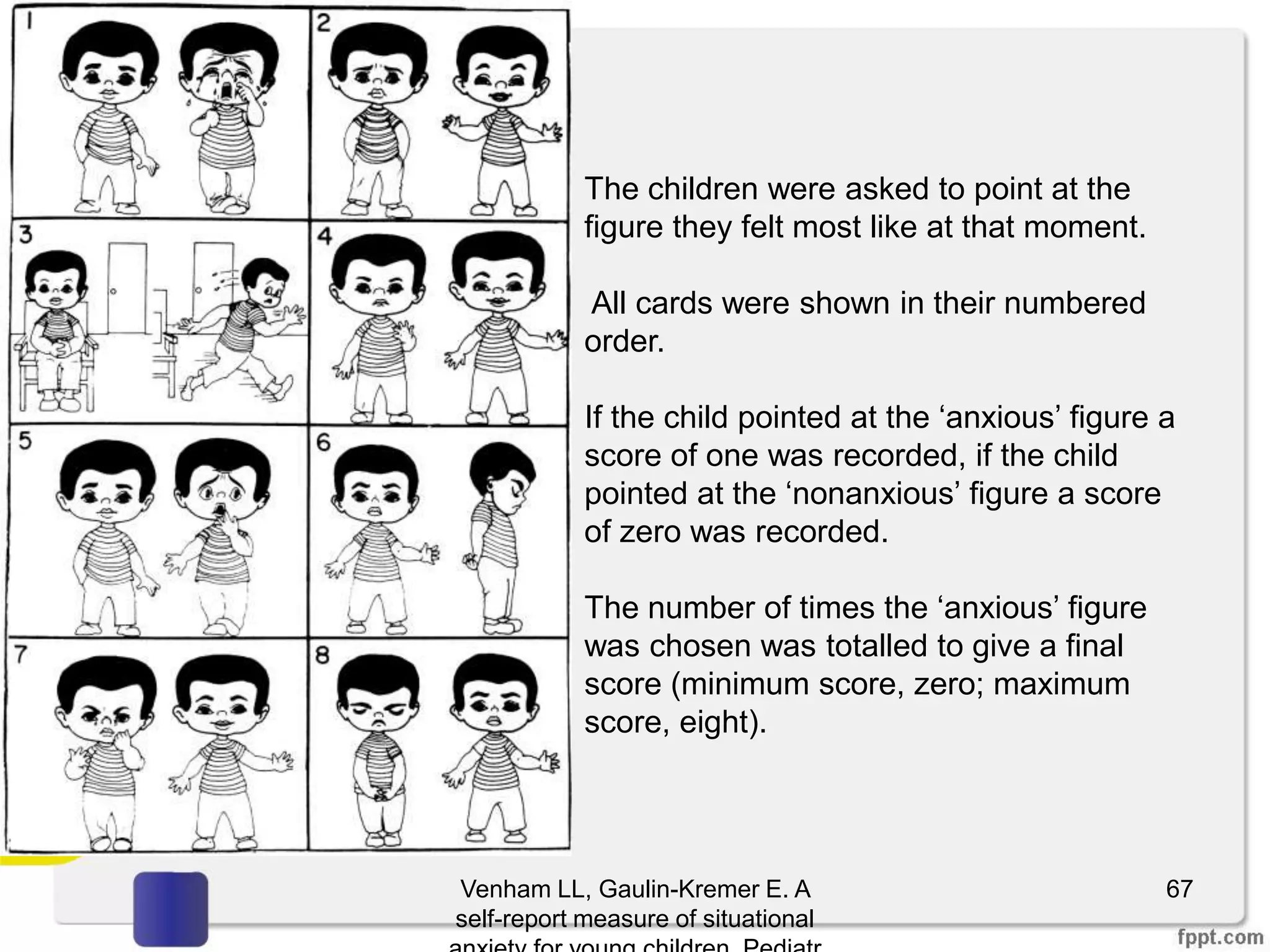
• Age group 4-11 years.
• This scale consists of a series of eight paired drawings of a
child.
• Each pair consists of a child in a non fearful pose and a fearful
pose (for example, running away).
• The respondent is asked to indicate, for each pair, which
picture more accurately reflects his or her feelings at the time.
• Scores are determined by summing the number of instances in
which the child selects the high-fear stimulus.
66
Venham LL, Gaulin-Kremer E. A self-report measure of situational
anxiety for young children. Pediatr Dent. 1979 Jun;1(2):91-6.
Venham LL, Gaulin-Kremer E. A
self-report measure of situational
67
The children were asked to point at the
figure they felt most like at that moment.
All cards were shown in their numbered
order.
If the child pointed at the ‘anxious’ figure a
score of one was recorded, if the child
pointed at the ‘nonanxious’ figure a score
of zero was recorded.
The number of times the ‘anxious’ figure
was chosen was totalled to give a final
score (minimum score, zero; maximum
score, eight).
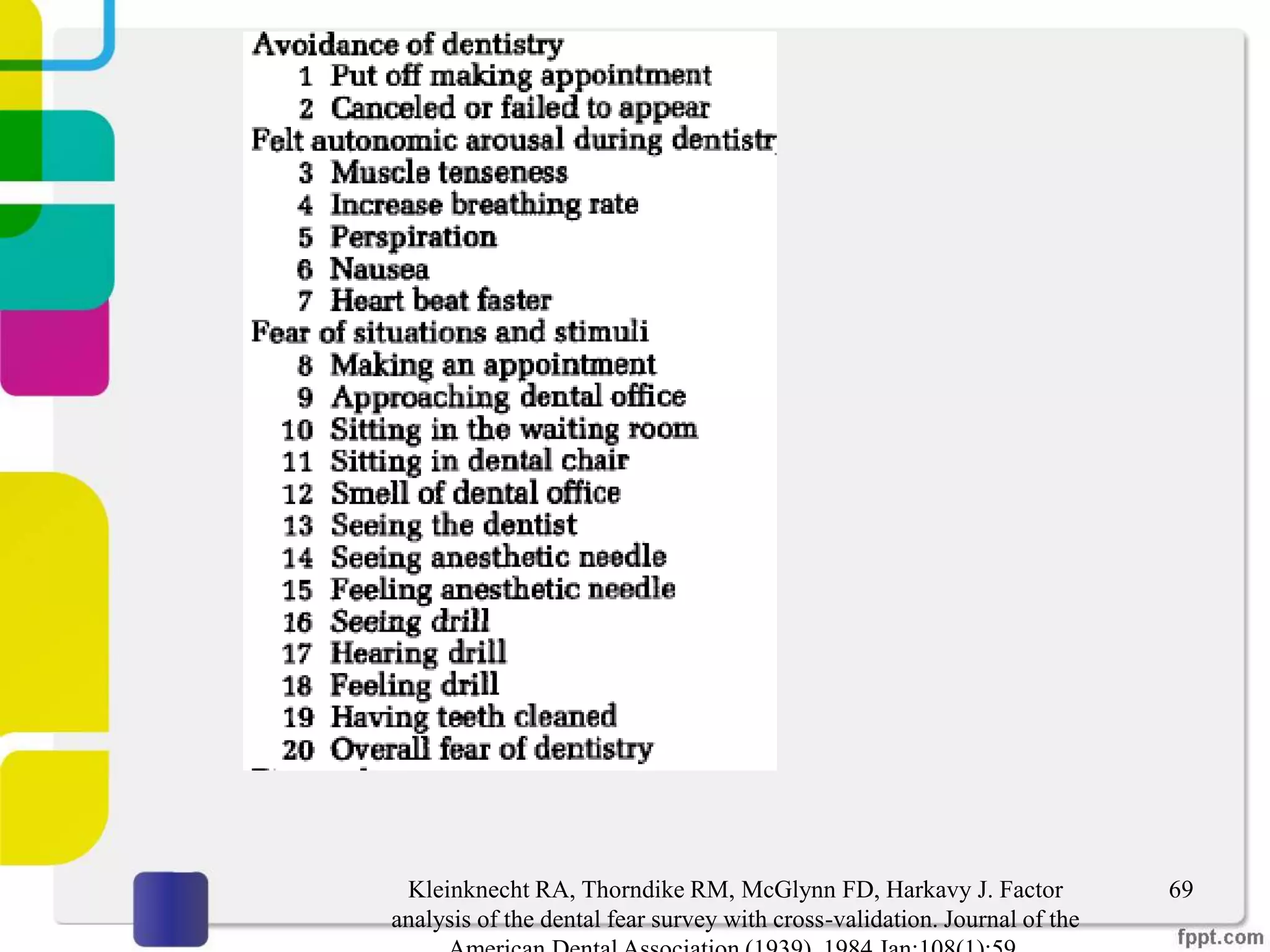
Kleinknecht’s Dental Fear
Survey.
• Age group above 12 year
• Second most commonly use
• Originally developed as 27 item scale (Kleinknecht’ et al 1978) and
subsequently reduced to 20 items.
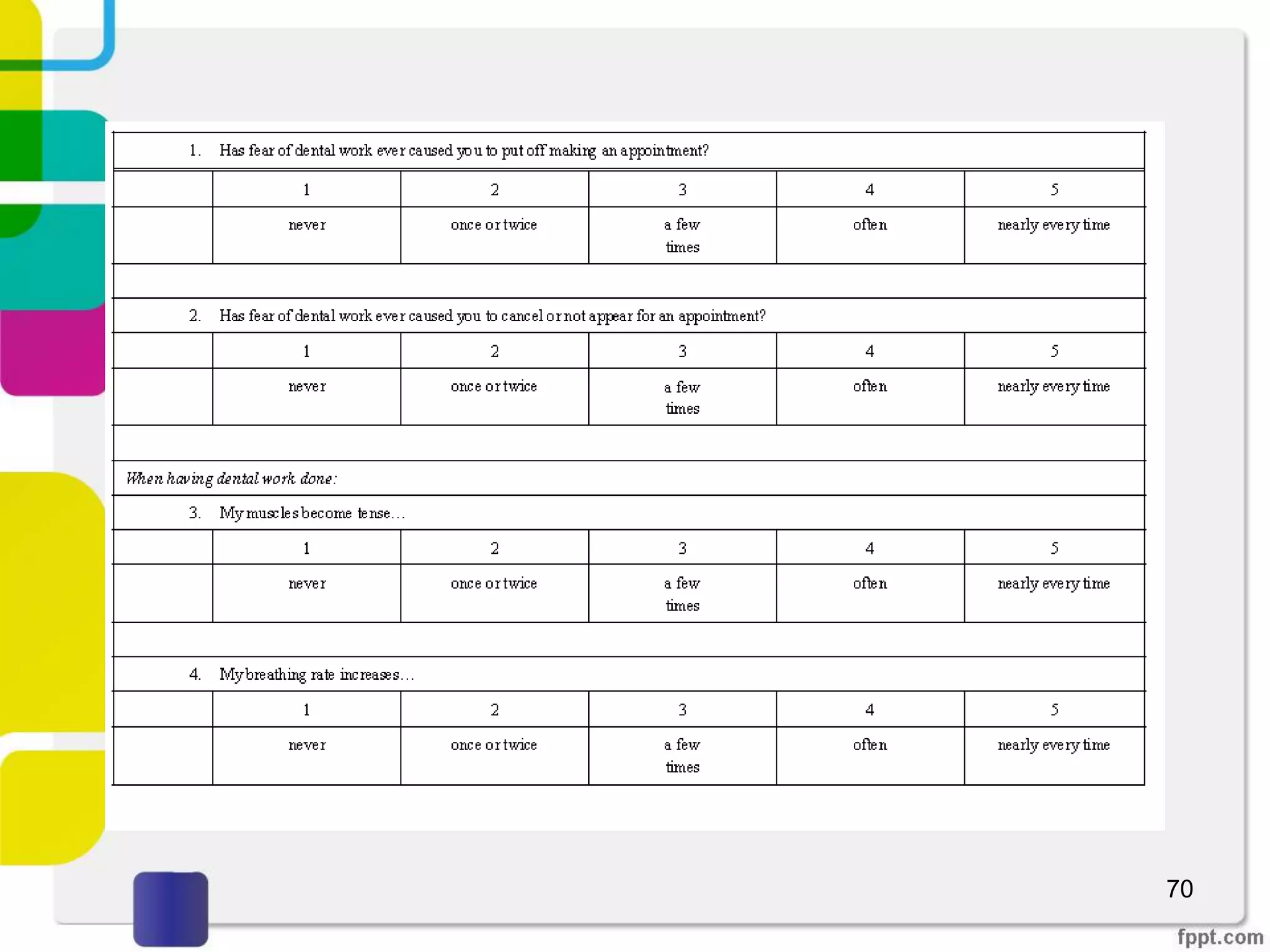
• Kleinknecht’s Dental Fear Survey asks respondents to rate their anxieties
about 27 specific situations—such as making an appointment or hearing the
dental drill—on a five-point Likert scale ranging from “none” to “great.”
• Three dimensions of the questionnaire have been derived from factor
analysis: avoidance of dental treatment, somatic symptoms of anxiety and
anxiety caused by dental stimuli.
• These factors are reliable and stable across different groups of respondents.
68Newton JT, Buck DJ. Anxiety and pain measures in dentistry: a guide to their quality
and application. The Journal of the American Dental Association. 2000 Oct
69Kleinknecht RA, Thorndike RM, McGlynn FD, Harkavy J. Factor
analysis of the dental fear survey with cross-validation. Journal of the
70
71
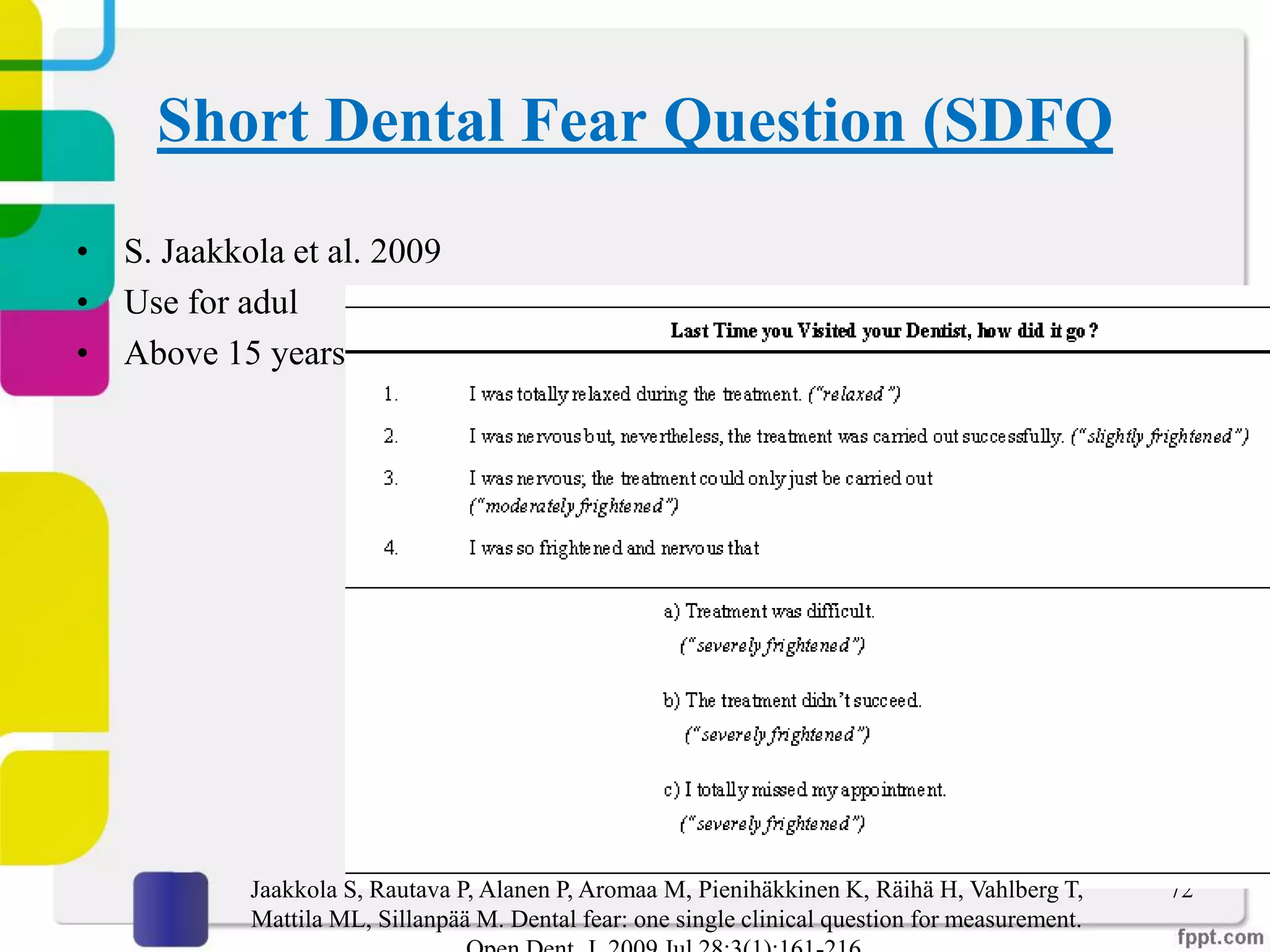
Short Dental Fear Question (SDFQ
• S. Jaakkola et al. 2009
• Use for adul
• Above 15 years
72Jaakkola S, Rautava P, Alanen P, Aromaa M, Pienihäkkinen K, Räihä H, Vahlberg T,
Mattila ML, Sillanpää M. Dental fear: one single clinical question for measurement.
• Option 4 a, b, c describes situations in which there are many great
difficulties.
• option 3: “I was nervous; the treatment could only just be carried out”,
means that the patient’s treatment takes more time than normally.
• option 2: “I was nervous; but nevertheless, the treatment was carried out
successfully”, means that the patient is a little nervous but, perhaps nobody
else is able to notice it.
• option 1:”I was totally relaxed during the treatment” is the answer of the
patient who is relaxed and confident during the treatment.
73
Gatchel’s 10-Point Fear
Scale
• For adult
• This is a single-item scale that asks respondents to rate their
dental fear on a 10- point scale.
• A score of 1 indicates no dental fear; 5, moderate fear; and 10,
extreme fear.
• A score of 8 or greater is considered to indicate a significant
degree of anxiety;
74Gatchel RJ, Ingersoll BD, Bowman L, Robertson MC, Walker C. The prevalence of
dental fear and avoidance: a recent survey study. Journal of the American Dental
Adolescents’ Fear of Dental
Treatment Cognitive Inventory
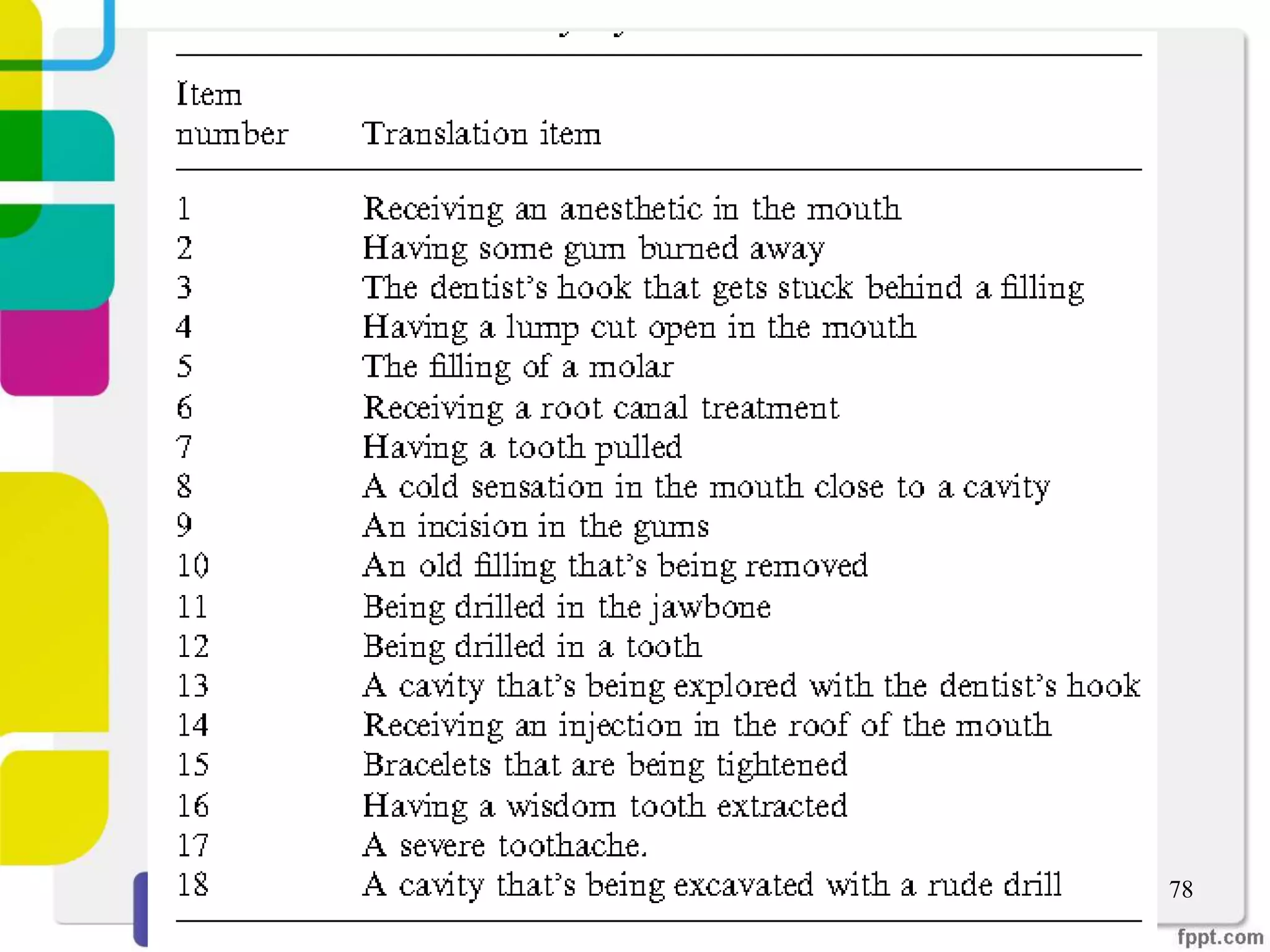
• In 1991, Gauthier et al. published the Adolescents’ Fear of Dental
Treatment Cognitive Inventory (AFDTCI), developed by Morin in 1987.
• The AFDTCI evaluates thoughts and ideas that an adolescent may
experience during dental treatment.
• The questionnaire originally consisted of 42 questions with ordinal 1- to 5-
point scales, but after assessment by 8 experts, it was reduced to 29 items.
75
• A test using adolescent subjects (n = 343) led to the removal of 6 more
items, leaving 23 items in all. The scores on the AFDTCI may range from
23 (no fear) to 115 (high fear).
• This scale measures the thoughts and ideas an adolescent may have during
dental treatment.
• It is unique among the children’s scales in that it focuses solely on the
cognitive manifestations of fear.
76
Fear of Dental Pain questionnaire
• Fear of dental pain was measured using the FDPQ .
• The original questionnaire consists of 18 items and assesses fear
• of pain associated with a variety of dental procedures.
• Each item is answered on a rating of 1 (no fear) to 5 (extreme fear),
resulting in a possible total score of 18–90.
• The FDPQ
• was developed as a dental equivalent of the Fear of Pain Questionnaire-III.
77Van Wijk AJ, McNeil DW, Ho CJ, Buchanan H, Hoogstraten J. A short English version of
the Fear of Dental Pain questionnaire. European journal of oral sciences. 2006 Jun
78
Tiwari N, Tiwari S, Thakur R, Agrawal N, Shashikiran ND, Singla S. Evaluation
of treatment related fear using a newly developed fear scale for children:“Fear
assessment picture scale” and its association with physiological response.
Contemporary clinical dentistry. 2015 Jul;6(3):327. 79
6-8 years age
The FAPS was designed by
taking a part of Klingberg’s
children dental fear picture
test (CDFP) pointing picture.
what do you feel when a
dentist checks your oral
cavity with instruments?
Fear assessment picture
scale
Behavioral treatment of fearful
children
• Communication
• Euphemisms
• The guidance cooperation model
• Time-structuring
• Distraction
• Guided imagery
• Behavior modification
• Parent in operatory
•
80
Anxiety
• The term anxiety entered the field of psychology as a
translation of the German word “Angst”, which was used by
Freud in 1936
• Anxiety is a normal part of childhood, and every child goes
through phases. A phase is temporary and usually harmless.
• But children who suffer from an anxiety disorder experience
fear, nervousness, and shyness, and they start to avoid places
and activities.
81
Anxiety
• Is an emotion similar to fear but arising without any objective
source of danger.
• Is a reaction to unknown danger.
• It is a learned process being in response to one’s environment.
• As an anxiety depends on the ability to imagine, it develops
later than fear.
82
Definition
• It is often defined as a state of unpleasant feeling combined
with an associated feeling of impending doom or danger from
within rather than from without.
• Anxiety: a state of uneasiness or tension caused by
apprehension of possible future, missfortune, dange etc.
(collins english dictonary)
• Anxiety is an emotion characterized by an unpleasant state of
inner turmoil, often accompanied by nervous behavior, such as
pacing back and forth, somatic complaints, and rumination.
83
(Seligman, M.E.P.; Walker, E.F.; Rosenhan, D.L. Abnormal psychology (4th ed.).
New York: W.W. Norton & Company)
Types of anxiety
Trait anxiety.
• It is life-long pattern of anxiety as a temperament feature.
• It is a preset level of anxiety experienced by an individual who
has tendency to be more anxious; to react less appropriately to
anxiety provoking stimuli.
• These children are generally jittery, skittish, and
hypersensitive to stimuli.
84
State anxiety:
• These are acute situational-bound episode of anxiety that do not persist
beyond the provoking situation.
• It is a fear, nervousness, discomfort, and the arousal of the autonomic
nervous system induced temporarily by situations perceived as dangerous
• Examples: A child feels anxious when confronted by a large, strange
animal. A person feels anxious to get on an airplane for the first time.
85
Free floating anxiety:
• It is condition of persistently anxious mood in which the cause
of emotion is unknown and many other thoughts or event
trigger the anxiety.
Situational anxiety:
• It is only seen in specific situations or objects.
General anxiety:
• where the individual experiences a chronic pervasive feeling
of anxiousness, whatever may be the external circumstances.
86
Subtypes of anxiety
Associated:
• This is process of classic conditioning where by previously
neutral stimuli become the cause for arousal and anxiety by
pairing them with pain or the negative experiences of others.
Appraisal:
• Here anxiety is concerned with cognition or the way we think.
• It involved reconstruction of negative experiences rather than
positive happenings that account for the arousal of anxiety.
87
Cause of anxiety
Uncertainty:
• Fear of unknown is anxiety provoking.
• In dental clinic new patient’s anxiety can be due to uncertainty
they feel about what await them after initial first appointment
check up.
88
Previous learning
• In such case anxiety is present due to their previous learning
experiences of trauma during the first visit or the learning
involved in dental anxiety may have been more indirect,
depending upon the experience of other people.
• Maternal anxiety play an important role in the child’s anxiety
level determinant.
• A mother with higher anxiety will have a child usually
showing a negative behavior as a result of his/her high level of
anxiety.
89
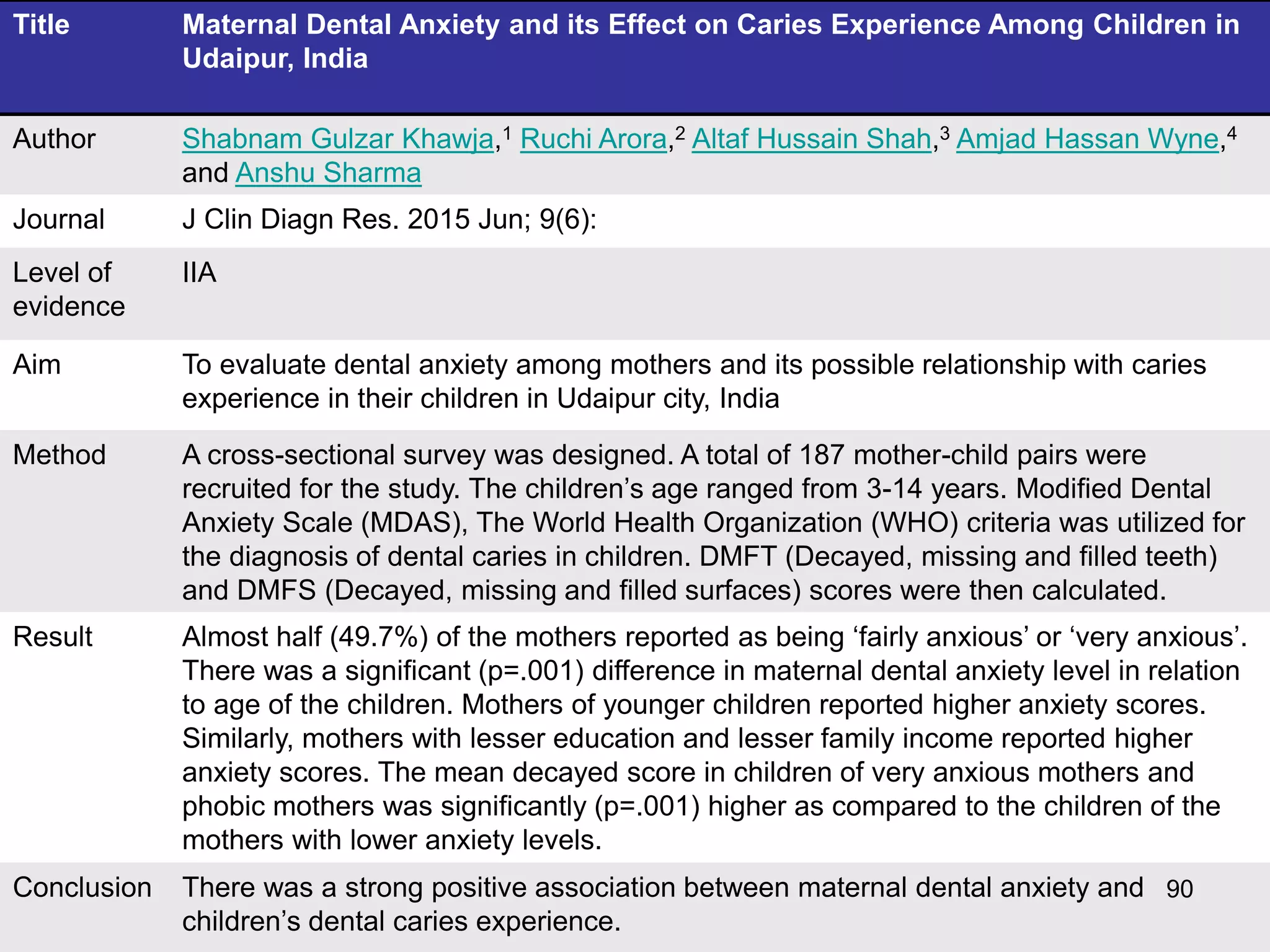
Title Maternal Dental Anxiety and its Effect on Caries Experience Among Children in
Udaipur, India
Author Shabnam Gulzar Khawja,1 Ruchi Arora,2 Altaf Hussain Shah,3 Amjad Hassan Wyne,4
and Anshu Sharma
Journal J Clin Diagn Res. 2015 Jun; 9(6):
Level of
evidence
IIA
Aim To evaluate dental anxiety among mothers and its possible relationship with caries
experience in their children in Udaipur city, India
Method A cross-sectional survey was designed. A total of 187 mother-child pairs were
recruited for the study. The children’s age ranged from 3-14 years. Modified Dental
Anxiety Scale (MDAS), The World Health Organization (WHO) criteria was utilized for
the diagnosis of dental caries in children. DMFT (Decayed, missing and filled teeth)
and DMFS (Decayed, missing and filled surfaces) scores were then calculated.
Result Almost half (49.7%) of the mothers reported as being ‘fairly anxious’ or ‘very anxious’.
There was a significant (p=.001) difference in maternal dental anxiety level in relation
to age of the children. Mothers of younger children reported higher anxiety scores.
Similarly, mothers with lesser education and lesser family income reported higher
anxiety scores. The mean decayed score in children of very anxious mothers and
phobic mothers was significantly (p=.001) higher as compared to the children of the
mothers with lower anxiety levels.
Conclusion There was a strong positive association between maternal dental anxiety and
children’s dental caries experience.
90
Biological difference:
• Some people are more predisposed to become more anxious or
to learn about anxiety responses than other due to the innate
biological mechanism.
91
Dental anxiety and its implications for
paediatric dentists
• With regard to paediatric dentistry, it is important to keep in
mind that anxious patients manifest their anxiety in different
ways. Some can respond with disruptive or interruptive
behavior.
• Others can respond by sweating and an increased heart rate,
whereas other patients do not show any external sign of
anxiety
92
• Dental anxiety, and the avoidance of situations that involve
dental treatment and care, have frequently been considered to
be the source of serious oral health problems in children and
adults.
• High levels of anxiety prevent a patient from cooperating fully
with their dentist, which can result in lost time for the
practitioner and unnecessary difficulties when carrying out the
treatment, and, most importantly, can limit the effectiveness of
the dental treatment and prevent the early detection of
pathological processes
93
Methods of assessing dental
anxiety
• Objective
• subjective
94
95
• All the physiological parameters described can be used to measure anxiety
in a patient, but they all require a monitoring team, financial expenditure,
and extra time in the dental clinic. For this reason, these types of measure
are not commonly used in dental clinics
[Klingberg et al., 1995]
96
Anxiety rating scale
97
Corah’s Dental
Anxiety Scale
• The most widely used for measurement of dental anxiety
• Developed by Norman Corah and Panterra (1969)
• DAS, is a four-item measure.
• Respondents are asked about four dentally related situations and are asked
to indicate which of four responses (of increasing severity) is closest to
their likely response to that situation.
98
Corah NL. Development of a dental anxiety scale. Journal of dental
research. 1969 Jul 1;48(4):596
99
Scoring the Dental Anxiety
Scale, Revised (DAS-R)
a = 1, b = 2, c = 3, d = 4, e = 5
Total possible = 20
Anxiety rating:
• 9 - 12 = moderate anxiety but
have specific stressors that
should be discussed and
managed
• 13 - 14 = high anxiety
• 15 - 20 = severe anxiety (or
phobia). May be manageable
with the Dental
Concerns Assessment but might
require the help of a mental
health therapist.
• First two question related to general anxiety and the second two questions
seeming to related to anticipated fear of specific situation.
• Advantages of DAS: fast , it can aid the dentist to be aware of what to
expected from patient and take measurement to help alleviate the anxiety of
the patient
• Second: it can be self administered in the waiting room in 2 minutes.
100
Modified dental anxiety scale
• Corah’s DAS has been modifiedby the addition of a fifth item that asks
about responses to administration of local anesthetic and by a change in the
response format.
• Given y Humphris et al. 1995.
Humphris GM, Morrison T, Lindsay SJ. The Modified Dental Anxiety Scale:
validation and United Kingdom norms. Community dental health. 1995
101
102
Humphris GM, Morrison T, Lindsay SJ. The Modified Dental Anxiety Scale:
validation and United Kingdom norms. Community dental health. 1995
103
MODIFIED CHILD DENTAL ANXIETY SCALE
"How do you feel about. . ."
104
How do you feel about. . ." relaxed-
not
worried.
very
slightly
worried,
fairly
worried,
worried
a lot,
very
worried
going to the dentist generally?
having your teeth looked at [examination]?
having your teeth scraped and polished [prophylaxis]?
having an injection in the gum [local anaesthedc]?
having a filling? 2
having a tooth taken our [extraction)?
being put to sleep to have treatment [general
anaesthesia]?
having a mixture of "gas and air" which will help you to
feel comfortable for treatment, but which cannot put you
to sleep [inhalation sedation]?
Humphris GM, Wong HM, Lee GT. Preliminary
validation and reliability of the modified child
dental anxiety scale. Psychological reports.
1998 Dec 1;83(3 suppl):1179-86.
105
Faces version of the Modified Child
Dental Anxiety Scale
Dental anxiety question (DAQ)
• The Dental Anxiety Question, or DAQ, is a single-item construct: “Are you
afraid of going to the dentist?”
• It has four possible responses: “no,” “a little,” “yes, quite,” “yes, very.”
• These responses are scored from 1 to 4 in the direction of increasing
anxiety.
• For some purposes, such as screening people who are likely to be highly
anxious about dental treatment, it is a useful and brief tool, although it has a
tendency to overestimate the prevalence of severe dental anxiety.
106
Spielberger’s State-Trait Anxiety
Inventory
• Spielberger (1983)
• State-Trait Anxiety Inventory, or STAI, distinguishes between anxiety as a
general aspect of personality (trait anxiety) and anxiety as a response to a
specific situation (state anxiety).
• It consists of 40 statements, 20 of which measure trait anxiety and 20 state
anxiety.
• Items are scored on four point scales, with response categories varying
according to the nature of the question.
• Although the STAI was not specifically designed for use in dentistry, it is
commonly used and has been proven to significant positive correlation with
CDAS.
Spielberger CD. Manual for the State-Trait Anxiety Inventory STAI
(form Y)(" self-evaluation questionnaire").
107
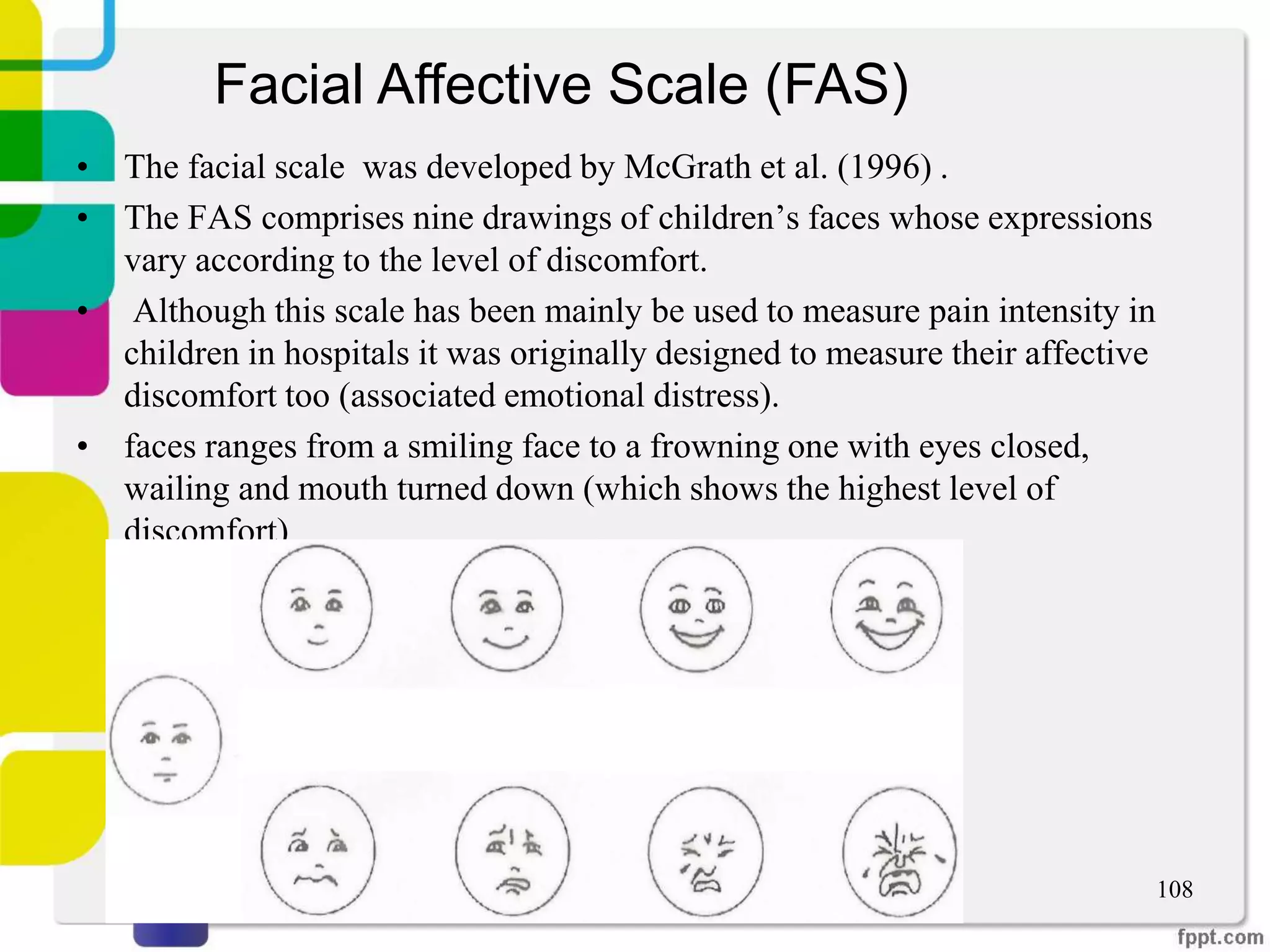
• The facial scale was developed by McGrath et al. (1996) .
• The FAS comprises nine drawings of children’s faces whose expressions
vary according to the level of discomfort.
• Although this scale has been mainly be used to measure pain intensity in
children in hospitals it was originally designed to measure their affective
discomfort too (associated emotional distress).
• faces ranges from a smiling face to a frowning one with eyes closed,
wailing and mouth turned down (which shows the highest level of
discomfort)
108
Facial Affective Scale (FAS)
Quiles JM, García GG, Chellew K, Vicens EP, Marín AR, Carrasco MP.
Identification of degrees of anxiety in children with three-and five-face facial
109
No anxiety A little anxiety Some anxiety High anxiety Very highanxiety
No anxiety Some anxiety Very high anxiety
Modified FAS using 5 and 3 faces and their
corresponding descriptors
Facial image scale
• The Facial Image Scale comprises a row of five faces ranging from very
happy to very unhappy.
• The children were asked to point at which face they felt most like at that
moment.
• The scale is scored by giving a value of one to the most positive affect face
and five to the most negative affect face.
Buchanan H, Niven N. Validation of a Facial Image Scale to assess child dental
anxiety. International Journal of Paediatric Dentistry. 2002 Jan 1;12(1):47-52.
110
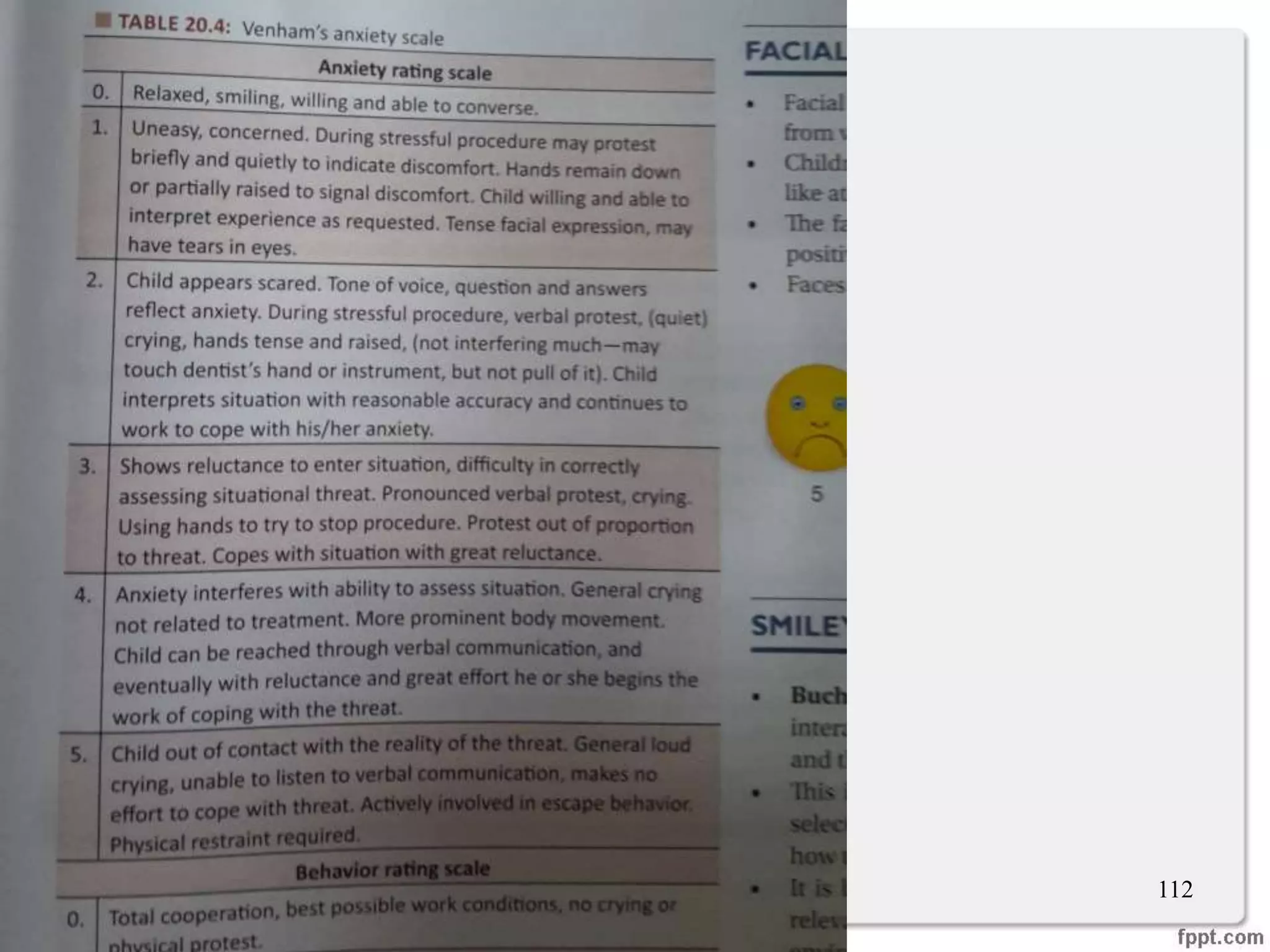
Venham Anxiety and Behavior
Rating Scales
• These two scales assess the anxiety and uncooperative behavior of children
in the dental setting.
• Both scales consist of five behaviorally defined categories ranging from 0
to 5, with higher scores indicating greater levels of anxiety or lack of
cooperation.
• This is one of the most reliable indicators of observed anxiety and has been
used predominantly in anxiety assessment protocol.
Venham L, Gaulin-Kremer E, Munster
E, Bengston-Audia D, Cohan J. Interval rating
scales for children’s dental anxiety and
uncooperative behavior. Paediatr Dent 1980;
111
112
The Smiley Faces Program
• The Smiley Faces Program (SFP) is a four item computerised trait dental
anxiety scale, using faces as a response set, to assess dental anxiety in
children.
• Using multimedia toolbook, an interactive computerised version of the
Facial Image Scale was developed; this Windows program was entitled
Smiley Faces.
Buchanan H. Development of a computerised dental anxiety scale for children:
validation and reliability. British dental journal. 2005 Sep 24;199(6):359-62. 113
• Questions:
• 1having to have dental treatment the following day;
• 2. sitting in the waiting room;
• 3. about to have a tooth drilled; and
• 4. about to have a local anaesthetic injection.
• Question 1 flashes up on the screen for five seconds: ‘If you had to go to
the dentist tomorrow to get some treatment, how would you feel?’
• The question leaves the screen and a face in a picture frame with a neutral
expression is shown.
• The child can click on the happy face for the face in the picture frame to
become happier and the unhappy face to become sadder.
• There is a choice of seven faces
114
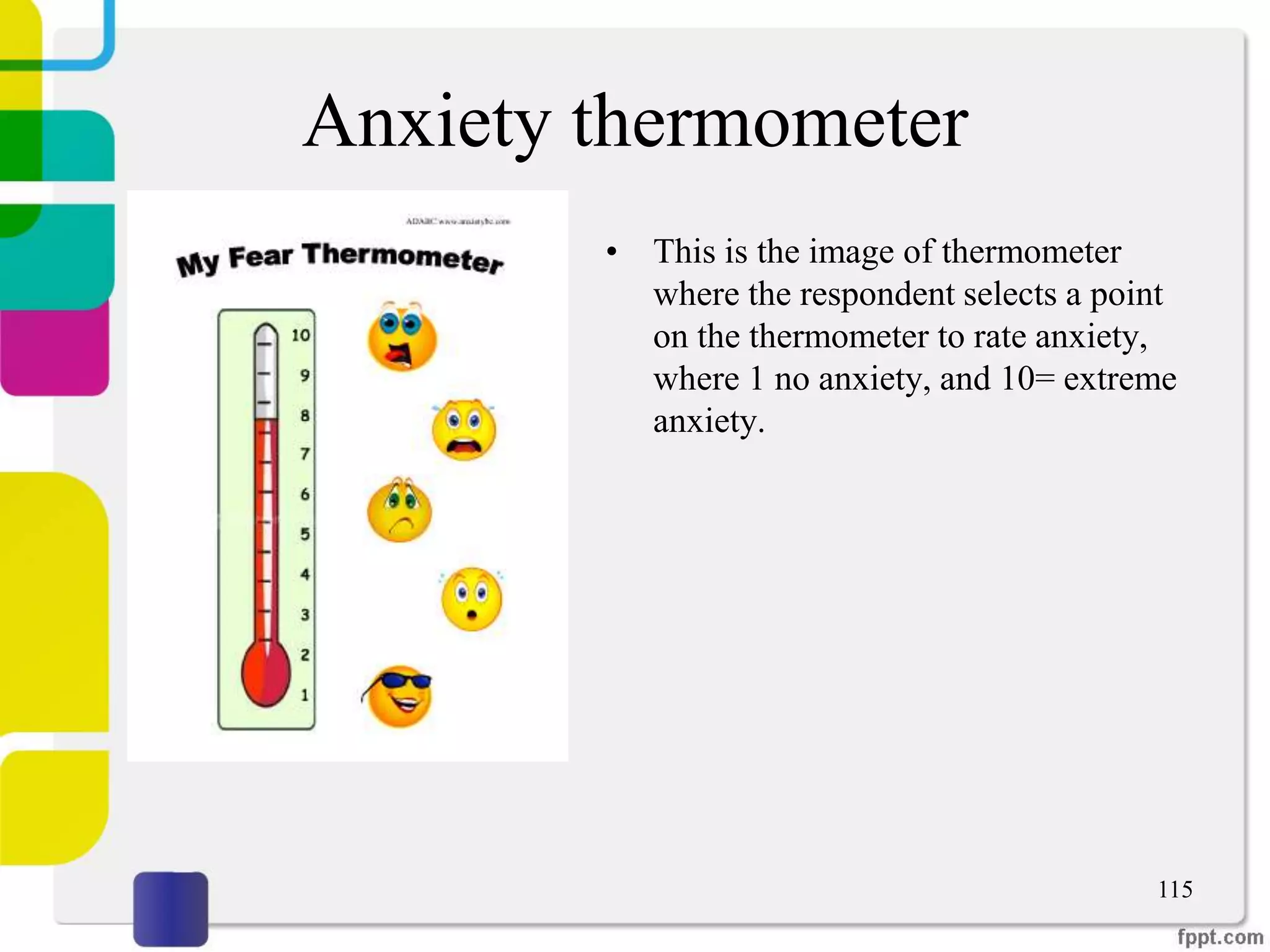
Anxiety thermometer
• This is the image of thermometer
where the respondent selects a point
on the thermometer to rate anxiety,
where 1 no anxiety, and 10= extreme
anxiety.
115
Children’s drawings as a measure
of anxiety level
Puura A, Puura K, Rorarius M, ANNILA P, Viitanen H, Baer G. Children's drawings as a
measure of anxiety level: a clinical pilot study. Pediatric Anesthesia. 2005 Mar
116
Phobia
• Is an irrigational fear resulting in the conscious avoidance of a specific
feared object, activity or situation.
• It may be defined as a persistent, excessive, unreasonable fear of a specific
object, activity or situation that results in a compelling desire to avoid the
dreaded object.
117
Characteristics of phobia
• Being out of proportion to the stimulus or situation
• Cannot be reasoned with
• Being out of voluntary control
• Persistent and inadaptable.
118
• Shelhan (1982) divided anxiety and phobia into two major
group:
• 1 endogenous
• 2. exogenous ( non –endogenous)
119
Non-endogenous
• This is a psychologically affected group which involves
situation related anticipatory anxiety symptoms such as :
• Moist palms
• Fluttery stomach
• Fine hand tremor
• Shaky inside
• Rapid hart beat
120
• These are the symptoms seen when normal individuals are
arrested or threatened.
• the main cause is in the external environment
• It is an anxiety or phobia due to a factor “to be produced from
the outside”.
• Thus, the individual can readily identify the etiological agent.
121
Endogenous:
• This anxiety is present without prior warning or the presence
of ay detectable stress situation.
• The cause is “to be produced from within”.
• This type of anxiety has a more severe cluster of symptoms
such as:
• Light headedness or dizziness
• Difficulty in breathing
• Parasthesia
• Hyper ventilation
• Chest pain
• Losing control
122
• Some of the phobias are.
• Acrophobia – height
• Agoraphobia – open space
• Arachnophobia – spider
• Anthrophobia – people
• aquaphobia – water
• Astraphobia – lightening
• Claustrophobia – closed space
• Cynophobia – dog
• Zoophobia – Animals
• Nyclophobia – darkness
• Pyrophobia - fire
• Xenophobia – stranger
123
Situational phobia:
• Is popularly interpreted as a fear of open space, but has wider
implication.
• It usually refers to a cluster of complaints.
• In addition to open or crowded places they also fear public
transport, bridges, tunnels, benign alone at home or being
away from home etc.
• Characteristics
• Dizziness, loss of bladder control or bowel control, cardiac
distress.
124
Social phobia
• It is basically phobia due to the fear of being looked at and the
concern about appearing shameful or stupid presence of other
• Main types of social phobia are public speaking, fear of eating,
fear of blushing.
125
Phobia in childhood:
• The most common phobia in childhood is the fear of animal.
• This usually comes on between the age of 2 and 4 and is gone
before the age of 10 years.
• Another common phobia is of darkness, a fear experienced b
children between the age of 4 and 6 years.
• This is most likely due to the imagination of the child as to
various creature lurking out in the dark.
126
• School phobia is an exaggerated fear of attending school and
occurs in all children peaking around 1-12 years.
• A fear of the various activities connected to school such as
new faces and challenges, fear of leaving home.
• In 12 years children of both sexes, previous aversive dental
experiences are more closely related to dental phobia than
general fear.
• At adolescent period most children outgrow their fear.
• Two phobias commonly seen are fear of blushing and fear of
being looked at.
127
Summary
128
Referances
• Tandon S. textbook of pedodontics 2nd edition, Parash publication, 20089
• Newton JT, Buck DJ. Anxiety and pain measures in dentistry: a guide to
their quality and application. The Journal of the American Dental
Association. 2000 Oct 31;131(10):1449-57.
• Venham LL, Gaulin-Kremer E. A self-report measure of situational anxiety
for young children. Pediatr Dent. 1979 Jun;1(2):91-6.
• Kleinknecht RA, Thorndike RM, McGlynn FD, Harkavy J. Factor analysis
of the dental fear survey with cross-validation. Journal of the American
Dental Association (1939). 1984 Jan;108(1):59.
129
• Jaakkola S, Rautava P, Alanen P, Aromaa M, Pienihäkkinen K, Räihä H, Vahlberg
T, Mattila ML, Sillanpää M. Dental fear: one single clinical question for
measurement. Open Dent. J. 2009 Jul 28;3(1):161-216.
• Van Wijk AJ, McNeil DW, Ho CJ, Buchanan H, Hoogstraten J. A short English
version of the Fear of Dental Pain questionnaire. European journal of oral sciences.
2006 Jun 1;114(3):204-8.
• Corah NL. Development of a dental anxiety scale. Journal of dental research. 1969
Jul 1;48(4):596
• Humphris GM, Morrison T, Lindsay SJ. The Modified Dental Anxiety Scale:
validation and United Kingdom norms. Community dental health. 1995
Sep;12(3):143-50.
• Buchanan H, Niven N. Validation of a Facial Image Scale to assess child dental
anxiety. International Journal of Paediatric Dentistry. 2002 Jan 1;12(1):47-52.
130
• Venham L, Gaulin-Kremer E, Munster E, Bengston-Audia D, Cohan J. Interval
rating scales for children’s dental anxiety an uncooperative behavior. Paediatr Dent
1980;2:195-202.
• Buchanan H. Development of a computerised dental anxiety scale for children:
validation and reliability. British dental journal. 2005 Sep 24;199(6):359-62.
• Humphris GM, Wong HM, Lee GT. Preliminary validation and reliability of the
modified child dental anxiety scale. Psychological reports. 1998 Dec 1;83(3
suppl):1179-86.
• Howard KE, Freeman R. Reliability and validity of a faces version of the Modified
Child Dental Anxiety Scale. International Journal of Paediatric Dentistry. 2007 Jul
1;17(4):281-8.
131
• Quiles JM, García GG, Chellew K, Vicens EP, Marín AR, Carrasco MP.
Identification of degrees of anxiety in children with three-and five-face
facial scales. Psicothema. 2013;25(4):446-51.
• Spielberger CD. Manual for the State-Trait Anxiety Inventory STAI (form
Y)(" self-evaluation questionnaire").
132
Thank you…..
133

Emotional development of child

  • 1.
    Emotional Development Dr. AkashArdeshana 3rd MDS Dept. of Paedodontics and Preventive Dentistry 1
  • 2.
    Contents • Introduction • Definition •Important of Emotional Development • Physiology of emotion • Characteristics of commonly seen emotion in a child • Distress or Cry • Anger • Fear • Anxiety • Phobia • Summary • Bibliography 2
  • 3.
    Introduction • Each ofus is born into society with rules, expectations, attitudes, and values. • Our task throughout development is to come to understand ourselves, how we feel and function, and what our society deems desirable and appropriate. • The process of socialization- learning socially acceptable behavior attitude and values is greatly influence by parents and other care providers as well as more peripheral people in children’s lives. 3
  • 4.
    • The emotionaldevelopment of children and adolescent represent a huge variation according to age, maturity, intellectual development, temperament, experience , family background, cultural background etc. • These factors play an important role in influencing the child’s development and underlying emotions. 4
  • 5.
    • Concurrently, theseaspects influence the child’s ability to cop with dental treatment. • According to their age and emotional development some children remain calm during the treatment , while others are vulnerable and may need more attention and time in order to make them cooperate for dental treatment. 5
  • 6.
    Definition • Emotion: Aneffective state of consciousness in which joy, sorrow, fear, hatred or the likes are expressed. • Emotion: a strong feeling state, arising subjectively and directed toward a specific object, with physiological, somatic and behavior components. (Dorland’s medical dictionary for health consumers) 6
  • 7.
    • (Co T.Morgan, R. A. King, and N. M. Robinson, 1979.) • "There is no concise definition, because an emotion is many things at once..the way we feel when we are emotional...the behavioral arousal ...the physiological, or bodily, basis...that emotions are expressed by language, facial expressions, and gestures...that...some emotions...are very much like motive states in that they drive behavior." 7
  • 8.
    • Emotion isa complex set of interactions among subjective and objective factors, mediated by neural/hormonal systems, which can (a) give rise to affective experiences such as feelings of arousal, pleasure/displeasure; (b) generate cognitive processes such as emotionally relevant perceptual effects, appraisals, labeling processes; (c) activate widespread physiological adjustments to the arousing conditions; and (d) lead to behavior that is often, but not always, expressive, goal directed, and adaptive. -Kleinginna and Kleinginna (1981) 8
  • 9.
    POSITIVE EMOTION Affection, amusement,joy, curiosity and happiness Essential to normal development. NEGATIVE EMOTION Fear, anger, jealousy Harmful to development Emotional security = Happy child 9
  • 10.
    • Better understandingof the child • To understand the problem of psychological origin • Deliver dental treatment service in a meaningful manner • Establish effective communication • Better teaching of primary and preventive care • Effective treatment planning and execution • Provide a comfortable environment. Importance of emotional development 10
  • 11.
    Infancy Early adulthoodLate adult hood Distress Anxiety Grief Startle response Fear Same Anger Disgust Jealousy Disappointment Restlessness Joy Worry Self pit Guilty feeling Depression Irritability boredom Delight Elation Hopeful anticipation Affection Sex Mystical Ecstasy Possessive Satisfaction Benevolence 11 Different emotions at different stages of life
  • 12.
    Physiology of emotion •Development of emotion depends on maturation in the nervous system and the endocrine system. • Differences in emotional responsiveness between children and adults appear to be partly due to cortical immaturity and partly due to deference in endocrine out put. 12
  • 13.
    13 Nervous system CNS PNS SOMATICAUTONOMIC SYMPATHETIC PERASYMPATHETIC
  • 14.
  • 15.
    • The sympatheticsystem is active during aroused states and prepares the body for extensive action by increasing the hart rate, blood pressure, blood glucose level and raising the level of certain hormones in the blood. • Nerve impulses in this system which reach the inner part of the adrenal glands, located on the top of the kidneys, trigger the secretion of epinephrine and nor epinephrine. • This part of the ANS that is active in may strong emotion, especially fear and anger. • Parasympathetic systems, tends to be active when we are calm and relaxed. 15
  • 16.
    • At thebirth cortex development is completed, frontal lobe is immature and has little influence on the functions of the lower part of he brain resulting in imbalanced emotion. • Hence, emotional response of the child is quickly aroused but short liven 16
  • 17.
    • In 2-5years and 11 -12 years adrenal gland gain weight rapidly and liberation of adrenaline in blood is vigorous, as a result of which a preschooler is highly emotional and emotional outburst are prolonged too, give rise to physiological sign of emotional disturbance. 17
  • 18.
    • Activity ofbrain in certain regions, including hypothalamus and other part of nervous system, directly influence muscles and internal organs to initiate body changes. • Indirect stimulating adrenal hormones to other body changes and preparing the body for light or flight. 18
  • 19.
    Characteristics of commonlyseen emotion in a child • Distress or Cry • Anger • Fear • Anxiety • Phobia 19
  • 20.
    Distress or Cry •The most common way a child expresses fear is by crying at the dentist’s office. • Crying, like other emotional manifestations of human behaviour is an expression of personality of an individual. • Crying is liable to be the result of conflict with the developing ego and with his newly found interests. • After the age of one and a half child develops a variety of fears and cries for the security of his mother’s company . 20
  • 21.
    At birth: • Primaryemotion • With vigorous body expression • Usually due to hungr , colic on any internal cause. • At six months • Greatly replaced by a milder expression of fussing or vocalization • During preschool: • Only for the reason of physical pain as he is disappointed by his environment 21
  • 22.
    • During schoolyear: • pressure helps him to outgrow the crying habit which decrease rapidly. • After this till 15 years crying occurs very seldom • In young adult: • ultimately it becomes a limited quiet crying in private only for reason of grief or other intense emotion 22
  • 23.
    Different type ofcry seen In children Following four type of crying are usually seen in children (Elsbach 1963) 1. Obstinate cry 2. Frightened cry 3. Hurt cry 4. Compensatory cry: 23
  • 24.
    Obstinate cry • Thechild throw a temper tantrum to through dental treatment • It is loud, high pitched • pause and repeated over and over again. • Characterized as a siren like wail • represents the child’s external response to anxiety 24
  • 25.
    Frightened cry • Usuallyaccompanied by a torrent of tears. • Convulsive breath-catching sobs • Usually the child emitting this type of cry has been overwhelmed by the situation. 25
  • 26.
    Hurt cry • Maybe loud and more frequent. • Frequently accompanied by a small whimper • Initially a child in discomfort shows a single tear filling the corner of the eye and running down the child’s cheek with out making any sound or resistance to the treatment procedure. 26
  • 27.
    Compensatory cry: • Itis not a cry at all • It is a sound that child makes to drown out the noise, for example, a drill. • Usually the cry sound is slow, monotone. • It is a sort of coping mechanism to unpleasant auditory stimuli, finding himself uncomfortable in the situation. 27
  • 28.
    Title Correlation ofcrying pattern to clinical diagnosis of children undergoing treatment. Author Chunawalla YK, Bohari MR, Bijle MN. Journal International Journal of Contemporary Dentistry. 2010 Jan 11;1(1). Level of evidence IIIb aim To correlate the Crying pattern to Clinical Diagnosis of children undergoing treatment. Method Children in the age group 4-9 years were divided into Group1: (40 children) & Group 2: (60 children) and their cries were recorded using a video camera. Different cries analyzed were frightened, pain, obstinate, manipulative and boredom cry on the basis of their description in the literature. Group I was subjected to detailed clinical examination and Group II to various dental procedures. Result The most commonly observed cry was pain cry. Pain cry was mostly associated with dento-alveolar abscess. With respect to dental procedures, pain cry was commonly associated with use of inject able aids, frightened cry and compensatory cry with the use of dental drill. Conclusion Cries could be means of communication and asset in clinical diagnosis 28
  • 29.
    Anger • Outburst ofthe emotion is caused by the child’s lack of skill in handling the situation. • Infant and young children responnd in anger in a direct and primitive manner but as they develop, the responses become violent and more symbolic, 29
  • 30.
    • 15 monthschildren express anger by throwing objects. • Two-year olds attack other childen with an intention to hurt. • Four year olds express their anger through begging. • Five year olds have less expression of anger. • Six year olds have a renewal of violent method of expression of anger. 30
  • 31.
    • Seven yearones display less aggressiveness, through kicking, througwing objects is observed. • 8-9 years olds anger is expressed through feelings. It become directed towards a single person. • 10 year old’s anger may become violent and may be expressed physically. • 12 years olds express anger verbally. • 14 years olds may take out his anger on someone else. 31
  • 32.
    Fear…. • The unpleasantemotioonal state consisting of psychological and psycho-physiological responses to a real external threat or danger including agitation, alertness, tension and mobilization of the alarmed reaction. (Dorland Medical Dictonary) • It is defined as a painful feeling of imending danger, evil, trouble, etc. ( Delbridge ) • Defined as a reaction to a known danger (Rubin) 32
  • 33.
    Fear related emotionalpattern • Shyness….. • Characterized by shrinking from contact with who are stranger and unfamiliar • It is always stimulated by people never by objects, animals or situations. 33
  • 34.
    • In babyusual response in shyness is crying, turning the head. • If able to walk- run away and hide • Older children- by blushing, by stuttering, by nervous mannerisms- a pulling at the ears or clothing, shifting from one foot to the other, and bending the head to one side 34
  • 35.
    Embarrassment: • Fear reactionto people, not to objects or situation. • Stimulated by uncertainty about how people will judge one and one’s behavior. • State of self conscious distress. • Not present in a child less than 5 or 6 years old. 35
  • 36.
    • Anxiety…. • Itis an uneasy mental state concerning impending or anticipated ill. • Like worry, anxiety is due to imaginary rather than real cause. • Worry is related to specific situation, whereas anxiety is a generalized emotional state. • Worry come from an objective problem, whereas antiety comes from a subjective proble 36
  • 37.
    0-2 2-4 4-78-10 11-13 •Stranger •Loud noises •Loss of support •Strange objects •Being alone •Darkness •animals •Environment al threat •imaginary creatures •animals - -Animal -Burglar -Personal harm/harm others -Animals -Separation from parents 37 Different types of fears corresponding to age
  • 38.
  • 39.
    • Innate fear •without stimuli or previous experience): • It is thus also dependent on the vulnerability of the individual 39
  • 40.
    Objective Fear: • Producedby direct physical stimulation of the sense organs and are generally not of parental origin. • Objective fears are responses to stimuli that are felt, seen, heard, smelled or tasted, and are of a disagreeable or unpleasant nature. 40
  • 41.
    Subjective fear: • Fearbased on somebody else’s experience without actually undergoing dental treatment himself. • The majority of the children who visit the dentist are anxious in particular during first visit. • Their anxiety level may be heightened by stories from friends, relatives, parents who have threatened them using dentist’s visit as punishment for bad behavior. 41
  • 42.
    • Suggestive fear: acquired by imitation by observation of other • Imitative fears: transmitted while displayed by other (parent) and acquired by the child without being aware of it. Displayed emotion in parent’s face creates more impression than verbal suggestions. • Even a tight clenching of the child’s hand in dental office while undergoing dental treatment creates fear in child’s mind about dental treatment. • Imaginative fear: as the child’s imaginative capability develop, they become more intense with age and mental development with certain age. 42
  • 43.
  • 44.
    Value of fear •Fear lowers the threshold of pain so that every pain produced during the dental treatment becomes magnified. • Fear has safety value when given proper direction and control. • Since fear producing stimuli can cause actual harm to the child, fear is protective mechanism for self protection. 44
  • 45.
    • The natureof fear can be utilizes to keep the child away from dangerous situation of either social or physical nature. • If child does not fear punishment or parental disfavor, his behavior may make him a threat to society. 45
  • 46.
    • The childshould be taught that dental office is not a place to fear. • Dentistry should not be employed as a threat or punishment. • using it in this manner creates fear of dentistry or dentist. • On the other hand, if the child has become attached to the dentist, fear of loss of his approval may have some value in motivating the child for dental treatment. 46
  • 47.
    Fear evoking dentalsituation • Anesthetic administration locally by injection • Extraction • sound of drill 47
  • 48.
    Title Child's dentalfear: cause related factors and the influence of audiovisual modeling. Author Mungara J1, Injeti M, Joseph E, Elangovan A, Sakthivel R, Selvaraju G. Journal J Indian Soc Pedod Prev Dent. 2013 Oct-Dec;31(4):215-20. Level of evidence IIIa aim To assess the degree of fear provoked by various stimuli in the dental office and to evaluate the effect of audiovisual modeling on dental fear of children using CFSS-DS. Method Ninety children were divided equally into experimental (group I) and control (group II) groups and were assessed in two visits for their degree of fear and the effect of audiovisual modeling, with the help of CFSS-DS. Result The most fear-provoking stimulus for children was injection and the least was to open the mouth and having somebody look at them. There was no statistically significant difference in the overall mean CFSS-DS scores between the two groups during the initial session (P > 0.05). However, in the final session, a statistically significant difference was observed in the overall mean fear scores between the groups (P < 0.01). Significant improvement was seen in group I, while no significant change was noted in case of group II. Conclusion Audiovisual modeling resulted in a significant reduction of overall fear as well as specific fear in relation to most of the items. A significant reduction of fear toward dentists, doctors in general, injections, being looked at, the sight, sounds, and act of the dentist drilling, and having the nurse clean their teeth was observed. 48
  • 49.
    • Factors causingdental fear 49 1. Fear of pain or its anticipation 2. Fear of betrayal or A lack of trust 3. Fear of loss of control 4. Fear of the unknown 5. Fear of intrusion
  • 50.
    Fear of painor its anticipation: • The link between actual or misinterpreted pain, or the anticipation of pain, and dental fear is well established. • We frequently see children who report that they sais that they were experiencing pain, but the dentist ignored them and carried on. • So, it is very important as dentist to recognize and address the pain symptoms of the children. 50
  • 51.
    Fear of betrayal: •Trust may also be learned either direct from the behavior of the parents, or peers. • It is therefore theoretically possible that children learn to trust or distrust dental personnel from their parents before they have any direct contact with such person 51
  • 52.
    • Fear ofloss of control: 52
  • 53.
    • Fear ofunknown: • In anyone’s eyes, a visit to the dentist may be classified as a potentially threatening condition. • Helpful comment from the mother such as, it will not hurt; even before an examination, are going to raise the possibility in the child’s mind of being hurt. 53
  • 54.
    • Fear ofintrusion: • Intrusion involves impinging on the patient’s personal space and into a bodily cavity; the mouth • Impinging the patient’s personal space is something that is taken for granted by professionals. 54
  • 55.
    Features of fear •Fear is a package of reaction that tend to occur together simultaneously or sequentially. About 70% acquire dental fear at an early age. This emotion may present the following main two expression. 1. Tendency to freeze, which reaches its extreme in the for of death. 2. Startle, scream, run away from the scene of danger, i.e flight. – It turns, a shift from freeze reaction to flight. 55
  • 56.
    Syptoms of intensefear • Unpleasant feeling of terror • Pounding of the heart • Tense muscle • Liability to startle • Dryness of throught and mouth • Sinking feeling • Nausia feeling • Urge to urinate • Irritability • Anger • Weakness • Sense of unreality 56
  • 57.
    Chronic fear leadsto…. • Tiredness • Difficulty in sleeing and bad dream • Restlessness • Loss of apatite • Aggression • Avoidance of tension producing situation 57
  • 58.
    Physiological sign offear • Pale sweaty skin • Hair standing on end • Dilatation of pupils • Rapid breathing • Increased heart-rate 58
  • 59.
    • Response tofear • Described at three level 1. Intellectual level: where the child is really to accept the situation and face the difficulties to achieved result and benefits ( usually seen at adolescent age) 2. Emotional level: usually the child shows the fight or flight response, which acts as an instantaneous response. (seen in school age) 3. Hedonic level: usually reflected as self-centeredness, thereby accepting what is comfortable and rejecting what is not without too much concern for the outcome or nature of the treatment. 59
  • 60.
    Measuring child dentalfear • Measuring child dental fear involves several difficulties regarding technique as well as interpretations of results. Four main types of measures have been used: • 1 rating of child behavior during dental visits, • 2 psychometric scales, • 3 physiological measures, • 4 projective techniques 60
  • 61.
    Commonly use fearscale Adult and children Child specific Kleinknecht’s Dental Fear Survey17 Venham Picture Scale Gatchel’s 10-Point Fear Scale22 Children’s Fear Survey Schedule. Fear of dental pain questionnaire Morin’s adolescent’s fear of dental treatment cognitive inventory 61
  • 62.
    Children’s Fear Survey Schedule. •The Children’s Fear Survey Schedule, or CFSS, is designed to assess a range of general fears in children. • Given by Scherer and Nakamura (1968) • It consists of 80 items on a 5-points likert scle. • A dental subscale (CFSS-DS) has been developed by Cuthbert and Melamed that consists of 15 items rated on a five-point scale, ranging from 1 (not afraid) to 5 (very afraid). 62 Newton JT, Buck DJ. Anxiety and pain measures in dentistry: a guide to their quality and application. The Journal of the American Dental Association. 2000 Oct 31;131(10):1449-57.
  • 63.
    • Scale scoresare calculated by summing item scores; the total score can range from 15 to 75. • Scores above 38 indicate significant dental fear. • The CFSS-DS has been found to discriminate between children who do and do not display dental fear and behavioral problems during dental treatment. 63Newton JT, Buck DJ. Anxiety and pain measures in dentistry: a guide to their quality and application. The Journal of the American Dental Association. 2000
  • 64.
  • 65.
    • The cognitive,physiological, behavioral ad emotional aspect of dental fear are not measured, which under mines any clime that the CFSS-DS is theoretically sound measure of dental treatment. 65
  • 66.
    Venham Picture Scale •Age group 4-11 years. • This scale consists of a series of eight paired drawings of a child. • Each pair consists of a child in a non fearful pose and a fearful pose (for example, running away). • The respondent is asked to indicate, for each pair, which picture more accurately reflects his or her feelings at the time. • Scores are determined by summing the number of instances in which the child selects the high-fear stimulus. 66 Venham LL, Gaulin-Kremer E. A self-report measure of situational anxiety for young children. Pediatr Dent. 1979 Jun;1(2):91-6.
  • 67.
    Venham LL, Gaulin-KremerE. A self-report measure of situational 67 The children were asked to point at the figure they felt most like at that moment. All cards were shown in their numbered order. If the child pointed at the ‘anxious’ figure a score of one was recorded, if the child pointed at the ‘nonanxious’ figure a score of zero was recorded. The number of times the ‘anxious’ figure was chosen was totalled to give a final score (minimum score, zero; maximum score, eight).
  • 68.
    Kleinknecht’s Dental Fear Survey. •Age group above 12 year • Second most commonly use • Originally developed as 27 item scale (Kleinknecht’ et al 1978) and subsequently reduced to 20 items. • Kleinknecht’s Dental Fear Survey asks respondents to rate their anxieties about 27 specific situations—such as making an appointment or hearing the dental drill—on a five-point Likert scale ranging from “none” to “great.” • Three dimensions of the questionnaire have been derived from factor analysis: avoidance of dental treatment, somatic symptoms of anxiety and anxiety caused by dental stimuli. • These factors are reliable and stable across different groups of respondents. 68Newton JT, Buck DJ. Anxiety and pain measures in dentistry: a guide to their quality and application. The Journal of the American Dental Association. 2000 Oct
  • 69.
    69Kleinknecht RA, ThorndikeRM, McGlynn FD, Harkavy J. Factor analysis of the dental fear survey with cross-validation. Journal of the
  • 70.
  • 71.
  • 72.
    Short Dental FearQuestion (SDFQ • S. Jaakkola et al. 2009 • Use for adul • Above 15 years 72Jaakkola S, Rautava P, Alanen P, Aromaa M, Pienihäkkinen K, Räihä H, Vahlberg T, Mattila ML, Sillanpää M. Dental fear: one single clinical question for measurement.
  • 73.
    • Option 4a, b, c describes situations in which there are many great difficulties. • option 3: “I was nervous; the treatment could only just be carried out”, means that the patient’s treatment takes more time than normally. • option 2: “I was nervous; but nevertheless, the treatment was carried out successfully”, means that the patient is a little nervous but, perhaps nobody else is able to notice it. • option 1:”I was totally relaxed during the treatment” is the answer of the patient who is relaxed and confident during the treatment. 73
  • 74.
    Gatchel’s 10-Point Fear Scale •For adult • This is a single-item scale that asks respondents to rate their dental fear on a 10- point scale. • A score of 1 indicates no dental fear; 5, moderate fear; and 10, extreme fear. • A score of 8 or greater is considered to indicate a significant degree of anxiety; 74Gatchel RJ, Ingersoll BD, Bowman L, Robertson MC, Walker C. The prevalence of dental fear and avoidance: a recent survey study. Journal of the American Dental
  • 75.
    Adolescents’ Fear ofDental Treatment Cognitive Inventory • In 1991, Gauthier et al. published the Adolescents’ Fear of Dental Treatment Cognitive Inventory (AFDTCI), developed by Morin in 1987. • The AFDTCI evaluates thoughts and ideas that an adolescent may experience during dental treatment. • The questionnaire originally consisted of 42 questions with ordinal 1- to 5- point scales, but after assessment by 8 experts, it was reduced to 29 items. 75
  • 76.
    • A testusing adolescent subjects (n = 343) led to the removal of 6 more items, leaving 23 items in all. The scores on the AFDTCI may range from 23 (no fear) to 115 (high fear). • This scale measures the thoughts and ideas an adolescent may have during dental treatment. • It is unique among the children’s scales in that it focuses solely on the cognitive manifestations of fear. 76
  • 77.
    Fear of DentalPain questionnaire • Fear of dental pain was measured using the FDPQ . • The original questionnaire consists of 18 items and assesses fear • of pain associated with a variety of dental procedures. • Each item is answered on a rating of 1 (no fear) to 5 (extreme fear), resulting in a possible total score of 18–90. • The FDPQ • was developed as a dental equivalent of the Fear of Pain Questionnaire-III. 77Van Wijk AJ, McNeil DW, Ho CJ, Buchanan H, Hoogstraten J. A short English version of the Fear of Dental Pain questionnaire. European journal of oral sciences. 2006 Jun
  • 78.
  • 79.
    Tiwari N, TiwariS, Thakur R, Agrawal N, Shashikiran ND, Singla S. Evaluation of treatment related fear using a newly developed fear scale for children:“Fear assessment picture scale” and its association with physiological response. Contemporary clinical dentistry. 2015 Jul;6(3):327. 79 6-8 years age The FAPS was designed by taking a part of Klingberg’s children dental fear picture test (CDFP) pointing picture. what do you feel when a dentist checks your oral cavity with instruments? Fear assessment picture scale
  • 80.
    Behavioral treatment offearful children • Communication • Euphemisms • The guidance cooperation model • Time-structuring • Distraction • Guided imagery • Behavior modification • Parent in operatory • 80
  • 81.
    Anxiety • The termanxiety entered the field of psychology as a translation of the German word “Angst”, which was used by Freud in 1936 • Anxiety is a normal part of childhood, and every child goes through phases. A phase is temporary and usually harmless. • But children who suffer from an anxiety disorder experience fear, nervousness, and shyness, and they start to avoid places and activities. 81
  • 82.
    Anxiety • Is anemotion similar to fear but arising without any objective source of danger. • Is a reaction to unknown danger. • It is a learned process being in response to one’s environment. • As an anxiety depends on the ability to imagine, it develops later than fear. 82
  • 83.
    Definition • It isoften defined as a state of unpleasant feeling combined with an associated feeling of impending doom or danger from within rather than from without. • Anxiety: a state of uneasiness or tension caused by apprehension of possible future, missfortune, dange etc. (collins english dictonary) • Anxiety is an emotion characterized by an unpleasant state of inner turmoil, often accompanied by nervous behavior, such as pacing back and forth, somatic complaints, and rumination. 83 (Seligman, M.E.P.; Walker, E.F.; Rosenhan, D.L. Abnormal psychology (4th ed.). New York: W.W. Norton & Company)
  • 84.
    Types of anxiety Traitanxiety. • It is life-long pattern of anxiety as a temperament feature. • It is a preset level of anxiety experienced by an individual who has tendency to be more anxious; to react less appropriately to anxiety provoking stimuli. • These children are generally jittery, skittish, and hypersensitive to stimuli. 84
  • 85.
    State anxiety: • Theseare acute situational-bound episode of anxiety that do not persist beyond the provoking situation. • It is a fear, nervousness, discomfort, and the arousal of the autonomic nervous system induced temporarily by situations perceived as dangerous • Examples: A child feels anxious when confronted by a large, strange animal. A person feels anxious to get on an airplane for the first time. 85
  • 86.
    Free floating anxiety: •It is condition of persistently anxious mood in which the cause of emotion is unknown and many other thoughts or event trigger the anxiety. Situational anxiety: • It is only seen in specific situations or objects. General anxiety: • where the individual experiences a chronic pervasive feeling of anxiousness, whatever may be the external circumstances. 86
  • 87.
    Subtypes of anxiety Associated: •This is process of classic conditioning where by previously neutral stimuli become the cause for arousal and anxiety by pairing them with pain or the negative experiences of others. Appraisal: • Here anxiety is concerned with cognition or the way we think. • It involved reconstruction of negative experiences rather than positive happenings that account for the arousal of anxiety. 87
  • 88.
    Cause of anxiety Uncertainty: •Fear of unknown is anxiety provoking. • In dental clinic new patient’s anxiety can be due to uncertainty they feel about what await them after initial first appointment check up. 88
  • 89.
    Previous learning • Insuch case anxiety is present due to their previous learning experiences of trauma during the first visit or the learning involved in dental anxiety may have been more indirect, depending upon the experience of other people. • Maternal anxiety play an important role in the child’s anxiety level determinant. • A mother with higher anxiety will have a child usually showing a negative behavior as a result of his/her high level of anxiety. 89
  • 90.
    Title Maternal DentalAnxiety and its Effect on Caries Experience Among Children in Udaipur, India Author Shabnam Gulzar Khawja,1 Ruchi Arora,2 Altaf Hussain Shah,3 Amjad Hassan Wyne,4 and Anshu Sharma Journal J Clin Diagn Res. 2015 Jun; 9(6): Level of evidence IIA Aim To evaluate dental anxiety among mothers and its possible relationship with caries experience in their children in Udaipur city, India Method A cross-sectional survey was designed. A total of 187 mother-child pairs were recruited for the study. The children’s age ranged from 3-14 years. Modified Dental Anxiety Scale (MDAS), The World Health Organization (WHO) criteria was utilized for the diagnosis of dental caries in children. DMFT (Decayed, missing and filled teeth) and DMFS (Decayed, missing and filled surfaces) scores were then calculated. Result Almost half (49.7%) of the mothers reported as being ‘fairly anxious’ or ‘very anxious’. There was a significant (p=.001) difference in maternal dental anxiety level in relation to age of the children. Mothers of younger children reported higher anxiety scores. Similarly, mothers with lesser education and lesser family income reported higher anxiety scores. The mean decayed score in children of very anxious mothers and phobic mothers was significantly (p=.001) higher as compared to the children of the mothers with lower anxiety levels. Conclusion There was a strong positive association between maternal dental anxiety and children’s dental caries experience. 90
  • 91.
    Biological difference: • Somepeople are more predisposed to become more anxious or to learn about anxiety responses than other due to the innate biological mechanism. 91
  • 92.
    Dental anxiety andits implications for paediatric dentists • With regard to paediatric dentistry, it is important to keep in mind that anxious patients manifest their anxiety in different ways. Some can respond with disruptive or interruptive behavior. • Others can respond by sweating and an increased heart rate, whereas other patients do not show any external sign of anxiety 92
  • 93.
    • Dental anxiety,and the avoidance of situations that involve dental treatment and care, have frequently been considered to be the source of serious oral health problems in children and adults. • High levels of anxiety prevent a patient from cooperating fully with their dentist, which can result in lost time for the practitioner and unnecessary difficulties when carrying out the treatment, and, most importantly, can limit the effectiveness of the dental treatment and prevent the early detection of pathological processes 93
  • 94.
    Methods of assessingdental anxiety • Objective • subjective 94
  • 95.
  • 96.
    • All thephysiological parameters described can be used to measure anxiety in a patient, but they all require a monitoring team, financial expenditure, and extra time in the dental clinic. For this reason, these types of measure are not commonly used in dental clinics [Klingberg et al., 1995] 96
  • 97.
  • 98.
    Corah’s Dental Anxiety Scale •The most widely used for measurement of dental anxiety • Developed by Norman Corah and Panterra (1969) • DAS, is a four-item measure. • Respondents are asked about four dentally related situations and are asked to indicate which of four responses (of increasing severity) is closest to their likely response to that situation. 98
  • 99.
    Corah NL. Developmentof a dental anxiety scale. Journal of dental research. 1969 Jul 1;48(4):596 99 Scoring the Dental Anxiety Scale, Revised (DAS-R) a = 1, b = 2, c = 3, d = 4, e = 5 Total possible = 20 Anxiety rating: • 9 - 12 = moderate anxiety but have specific stressors that should be discussed and managed • 13 - 14 = high anxiety • 15 - 20 = severe anxiety (or phobia). May be manageable with the Dental Concerns Assessment but might require the help of a mental health therapist.
  • 100.
    • First twoquestion related to general anxiety and the second two questions seeming to related to anticipated fear of specific situation. • Advantages of DAS: fast , it can aid the dentist to be aware of what to expected from patient and take measurement to help alleviate the anxiety of the patient • Second: it can be self administered in the waiting room in 2 minutes. 100
  • 101.
    Modified dental anxietyscale • Corah’s DAS has been modifiedby the addition of a fifth item that asks about responses to administration of local anesthetic and by a change in the response format. • Given y Humphris et al. 1995. Humphris GM, Morrison T, Lindsay SJ. The Modified Dental Anxiety Scale: validation and United Kingdom norms. Community dental health. 1995 101
  • 102.
  • 103.
    Humphris GM, MorrisonT, Lindsay SJ. The Modified Dental Anxiety Scale: validation and United Kingdom norms. Community dental health. 1995 103
  • 104.
    MODIFIED CHILD DENTALANXIETY SCALE "How do you feel about. . ." 104 How do you feel about. . ." relaxed- not worried. very slightly worried, fairly worried, worried a lot, very worried going to the dentist generally? having your teeth looked at [examination]? having your teeth scraped and polished [prophylaxis]? having an injection in the gum [local anaesthedc]? having a filling? 2 having a tooth taken our [extraction)? being put to sleep to have treatment [general anaesthesia]? having a mixture of "gas and air" which will help you to feel comfortable for treatment, but which cannot put you to sleep [inhalation sedation]? Humphris GM, Wong HM, Lee GT. Preliminary validation and reliability of the modified child dental anxiety scale. Psychological reports. 1998 Dec 1;83(3 suppl):1179-86.
  • 105.
    105 Faces version ofthe Modified Child Dental Anxiety Scale
  • 106.
    Dental anxiety question(DAQ) • The Dental Anxiety Question, or DAQ, is a single-item construct: “Are you afraid of going to the dentist?” • It has four possible responses: “no,” “a little,” “yes, quite,” “yes, very.” • These responses are scored from 1 to 4 in the direction of increasing anxiety. • For some purposes, such as screening people who are likely to be highly anxious about dental treatment, it is a useful and brief tool, although it has a tendency to overestimate the prevalence of severe dental anxiety. 106
  • 107.
    Spielberger’s State-Trait Anxiety Inventory •Spielberger (1983) • State-Trait Anxiety Inventory, or STAI, distinguishes between anxiety as a general aspect of personality (trait anxiety) and anxiety as a response to a specific situation (state anxiety). • It consists of 40 statements, 20 of which measure trait anxiety and 20 state anxiety. • Items are scored on four point scales, with response categories varying according to the nature of the question. • Although the STAI was not specifically designed for use in dentistry, it is commonly used and has been proven to significant positive correlation with CDAS. Spielberger CD. Manual for the State-Trait Anxiety Inventory STAI (form Y)(" self-evaluation questionnaire"). 107
  • 108.
    • The facialscale was developed by McGrath et al. (1996) . • The FAS comprises nine drawings of children’s faces whose expressions vary according to the level of discomfort. • Although this scale has been mainly be used to measure pain intensity in children in hospitals it was originally designed to measure their affective discomfort too (associated emotional distress). • faces ranges from a smiling face to a frowning one with eyes closed, wailing and mouth turned down (which shows the highest level of discomfort) 108 Facial Affective Scale (FAS)
  • 109.
    Quiles JM, GarcíaGG, Chellew K, Vicens EP, Marín AR, Carrasco MP. Identification of degrees of anxiety in children with three-and five-face facial 109 No anxiety A little anxiety Some anxiety High anxiety Very highanxiety No anxiety Some anxiety Very high anxiety Modified FAS using 5 and 3 faces and their corresponding descriptors
  • 110.
    Facial image scale •The Facial Image Scale comprises a row of five faces ranging from very happy to very unhappy. • The children were asked to point at which face they felt most like at that moment. • The scale is scored by giving a value of one to the most positive affect face and five to the most negative affect face. Buchanan H, Niven N. Validation of a Facial Image Scale to assess child dental anxiety. International Journal of Paediatric Dentistry. 2002 Jan 1;12(1):47-52. 110
  • 111.
    Venham Anxiety andBehavior Rating Scales • These two scales assess the anxiety and uncooperative behavior of children in the dental setting. • Both scales consist of five behaviorally defined categories ranging from 0 to 5, with higher scores indicating greater levels of anxiety or lack of cooperation. • This is one of the most reliable indicators of observed anxiety and has been used predominantly in anxiety assessment protocol. Venham L, Gaulin-Kremer E, Munster E, Bengston-Audia D, Cohan J. Interval rating scales for children’s dental anxiety and uncooperative behavior. Paediatr Dent 1980; 111
  • 112.
  • 113.
    The Smiley FacesProgram • The Smiley Faces Program (SFP) is a four item computerised trait dental anxiety scale, using faces as a response set, to assess dental anxiety in children. • Using multimedia toolbook, an interactive computerised version of the Facial Image Scale was developed; this Windows program was entitled Smiley Faces. Buchanan H. Development of a computerised dental anxiety scale for children: validation and reliability. British dental journal. 2005 Sep 24;199(6):359-62. 113
  • 114.
    • Questions: • 1havingto have dental treatment the following day; • 2. sitting in the waiting room; • 3. about to have a tooth drilled; and • 4. about to have a local anaesthetic injection. • Question 1 flashes up on the screen for five seconds: ‘If you had to go to the dentist tomorrow to get some treatment, how would you feel?’ • The question leaves the screen and a face in a picture frame with a neutral expression is shown. • The child can click on the happy face for the face in the picture frame to become happier and the unhappy face to become sadder. • There is a choice of seven faces 114
  • 115.
    Anxiety thermometer • Thisis the image of thermometer where the respondent selects a point on the thermometer to rate anxiety, where 1 no anxiety, and 10= extreme anxiety. 115
  • 116.
    Children’s drawings asa measure of anxiety level Puura A, Puura K, Rorarius M, ANNILA P, Viitanen H, Baer G. Children's drawings as a measure of anxiety level: a clinical pilot study. Pediatric Anesthesia. 2005 Mar 116
  • 117.
    Phobia • Is anirrigational fear resulting in the conscious avoidance of a specific feared object, activity or situation. • It may be defined as a persistent, excessive, unreasonable fear of a specific object, activity or situation that results in a compelling desire to avoid the dreaded object. 117
  • 118.
    Characteristics of phobia •Being out of proportion to the stimulus or situation • Cannot be reasoned with • Being out of voluntary control • Persistent and inadaptable. 118
  • 119.
    • Shelhan (1982)divided anxiety and phobia into two major group: • 1 endogenous • 2. exogenous ( non –endogenous) 119
  • 120.
    Non-endogenous • This isa psychologically affected group which involves situation related anticipatory anxiety symptoms such as : • Moist palms • Fluttery stomach • Fine hand tremor • Shaky inside • Rapid hart beat 120
  • 121.
    • These arethe symptoms seen when normal individuals are arrested or threatened. • the main cause is in the external environment • It is an anxiety or phobia due to a factor “to be produced from the outside”. • Thus, the individual can readily identify the etiological agent. 121
  • 122.
    Endogenous: • This anxietyis present without prior warning or the presence of ay detectable stress situation. • The cause is “to be produced from within”. • This type of anxiety has a more severe cluster of symptoms such as: • Light headedness or dizziness • Difficulty in breathing • Parasthesia • Hyper ventilation • Chest pain • Losing control 122
  • 123.
    • Some ofthe phobias are. • Acrophobia – height • Agoraphobia – open space • Arachnophobia – spider • Anthrophobia – people • aquaphobia – water • Astraphobia – lightening • Claustrophobia – closed space • Cynophobia – dog • Zoophobia – Animals • Nyclophobia – darkness • Pyrophobia - fire • Xenophobia – stranger 123
  • 124.
    Situational phobia: • Ispopularly interpreted as a fear of open space, but has wider implication. • It usually refers to a cluster of complaints. • In addition to open or crowded places they also fear public transport, bridges, tunnels, benign alone at home or being away from home etc. • Characteristics • Dizziness, loss of bladder control or bowel control, cardiac distress. 124
  • 125.
    Social phobia • Itis basically phobia due to the fear of being looked at and the concern about appearing shameful or stupid presence of other • Main types of social phobia are public speaking, fear of eating, fear of blushing. 125
  • 126.
    Phobia in childhood: •The most common phobia in childhood is the fear of animal. • This usually comes on between the age of 2 and 4 and is gone before the age of 10 years. • Another common phobia is of darkness, a fear experienced b children between the age of 4 and 6 years. • This is most likely due to the imagination of the child as to various creature lurking out in the dark. 126
  • 127.
    • School phobiais an exaggerated fear of attending school and occurs in all children peaking around 1-12 years. • A fear of the various activities connected to school such as new faces and challenges, fear of leaving home. • In 12 years children of both sexes, previous aversive dental experiences are more closely related to dental phobia than general fear. • At adolescent period most children outgrow their fear. • Two phobias commonly seen are fear of blushing and fear of being looked at. 127
  • 128.
  • 129.
    Referances • Tandon S.textbook of pedodontics 2nd edition, Parash publication, 20089 • Newton JT, Buck DJ. Anxiety and pain measures in dentistry: a guide to their quality and application. The Journal of the American Dental Association. 2000 Oct 31;131(10):1449-57. • Venham LL, Gaulin-Kremer E. A self-report measure of situational anxiety for young children. Pediatr Dent. 1979 Jun;1(2):91-6. • Kleinknecht RA, Thorndike RM, McGlynn FD, Harkavy J. Factor analysis of the dental fear survey with cross-validation. Journal of the American Dental Association (1939). 1984 Jan;108(1):59. 129
  • 130.
    • Jaakkola S,Rautava P, Alanen P, Aromaa M, Pienihäkkinen K, Räihä H, Vahlberg T, Mattila ML, Sillanpää M. Dental fear: one single clinical question for measurement. Open Dent. J. 2009 Jul 28;3(1):161-216. • Van Wijk AJ, McNeil DW, Ho CJ, Buchanan H, Hoogstraten J. A short English version of the Fear of Dental Pain questionnaire. European journal of oral sciences. 2006 Jun 1;114(3):204-8. • Corah NL. Development of a dental anxiety scale. Journal of dental research. 1969 Jul 1;48(4):596 • Humphris GM, Morrison T, Lindsay SJ. The Modified Dental Anxiety Scale: validation and United Kingdom norms. Community dental health. 1995 Sep;12(3):143-50. • Buchanan H, Niven N. Validation of a Facial Image Scale to assess child dental anxiety. International Journal of Paediatric Dentistry. 2002 Jan 1;12(1):47-52. 130
  • 131.
    • Venham L,Gaulin-Kremer E, Munster E, Bengston-Audia D, Cohan J. Interval rating scales for children’s dental anxiety an uncooperative behavior. Paediatr Dent 1980;2:195-202. • Buchanan H. Development of a computerised dental anxiety scale for children: validation and reliability. British dental journal. 2005 Sep 24;199(6):359-62. • Humphris GM, Wong HM, Lee GT. Preliminary validation and reliability of the modified child dental anxiety scale. Psychological reports. 1998 Dec 1;83(3 suppl):1179-86. • Howard KE, Freeman R. Reliability and validity of a faces version of the Modified Child Dental Anxiety Scale. International Journal of Paediatric Dentistry. 2007 Jul 1;17(4):281-8. 131
  • 132.
    • Quiles JM,García GG, Chellew K, Vicens EP, Marín AR, Carrasco MP. Identification of degrees of anxiety in children with three-and five-face facial scales. Psicothema. 2013;25(4):446-51. • Spielberger CD. Manual for the State-Trait Anxiety Inventory STAI (form Y)(" self-evaluation questionnaire"). 132
  • 133.